Archive for the ‘David Lynch Foundation’ Category

Children of the Night, movie director David Lynch expand work

June 7, 2011
LA Daily News AWARENESS

Children of the Night, movie director David Lynch expand work

Posted: 06/03/2011 09:59:06 PM PDT
Updated: 06/03/2011 10:16:19 PM PDT

David Lynch talks about the benefits of meditating. Transcendental Meditation is being used by teen victims of prostitution to ease their traumas. Academy Award-nominated director, acclaimed writer and producer David Lynch and his wife Emily; Children of the Night founder and president Dr. Lois Lee, motion picture actor Ben Foster, and world-renowned psychiatrist and author Norman Rosenthal were all on hand to talk about the benefits of meditation. (John McCoy/Staff Photographer)

Movie director David Lynch has teamed up with Children of the Night, the teen prostitute rescue organization, to raise awareness on a nationwide scale.

That means an expansion of services the nonprofit has been providing for more than three decades, and also the Transcendental Meditation instruction the David Lynch Foundation for Consciousness-Based Education and World Peace has been bringing to the Van Nuys youth shelter for the past 14 months.

“Through our experience with the David Lynch Foundation and through our discovery that Children of the Night can operate without walls, we know we can take our award-winning programs to adolescents who are forced to live in out-of-home care throughout America,” founder and president Lois Lee said Friday during a news conference at the organization’s campus.

Lynch, who became involved after his wife, Emily, began volunteering at the shelter, explained what the practice of TM – which he’s done daily for 38 years – can do for troubled psyches.

“If you’re a stressed human being – and especially a traumatically stressed human being – once you transcend and experience this deepest level, it’s like somebody took a hammer and hit the bolt at the top of a boiler filled with stress, and it starts pouring out,” said the director of such psycho-surreal classics as “Blue Velvet” and “Mulholland Dr.”

“It’s such a a relief,” continued Lynch, whose six-year-old foundation has raised millions of dollars to teach TM techniques to some 150,000 people, mostly students, worldwide. “So, the girls got happier and less stressed and saw a brighter world outside, rather than a hell world.”

The adolescents Children of the Night tries to help bring an assortment of dire baggage to the facility’s doors. Abusive homes, brutal pimps, substance addictions, the very nature of what they’ve had to do to survive. Their reservoirs of self-esteem and emotional control can understandably be all but empty.

Click here to see photo gallery.

Lee said that all current residents – about 65 – are now in the TM program, which both she and Lynch pointed out is voluntary since, as he put it, “You can never force a person to meditate if they don’t want to.”

The peaceful, focusing effect of the practice aids the kids in concentrating on the educational efforts – which includes high school proficiency and GED preparation – at the core of the nonprofit’s life-improving plan.

“I’ve done the meditation for a year,” said a 17-year-old resident who asked not to be identified. “It helps me realize the goals that I actually want to achieve.

“If I get scared or nervous or frustrated, I don’t leave right off the bat now. It’s just brought me a well of calmness that nothing else has been able to provide.”

Lee said that meditating herself had a similar effect, enabling her to clarify strategies for her long-frustrated dream of expanding Children of the Night’s programs beyond L.A.

“When we went on the first meditation retreat with David’s people, I turned off my cellphone for the first time since 1984 and I left it off for the entire weekend,” laughed Lee, an intense, micro-managing type by nature. “In the early days of TM, I stopped screaming, my anger disappeared. And about five months later, it came to me how I could put my people on the road, hit every shelter in America and – with phones and the Internet – do everything we do here out there.

“I would have never been able to make that leap in my mind without the Transcendental Meditation,” Lee said.

(l-r) Norman Rosenthal, Ben Foster, Emily and David Lynch and Lois Lee. Transcendental Meditation is being used by teen victims of prostitution to ease their traums. Academy Award-nominated director, acclaimed writer and producer David Lynch and his wife Emily; Children of the Night founder and president Dr. Lois Lee, motion picture actor Ben Foster, and world-renowned psychiatrist and author Norman Rosenthal were all on hand to talk about the benefits of meditation. (John McCoy/Staff Photographer)

###

Also see: Meditation Helps Homeless Children

Jerry Yellin on Loud Miracles with Meital Dohan: Beating PTSD through Transcendental Meditation

May 17, 2011

Click on the title to listen to the interview.

Jerry Yellin: Beating PTSD Through Transcendental Meditation

Meital Dohan talks to Jerry Yellin. They discuss how TM helped him emerge from his PTSD as well as how TM can help better the mind and body in other ways, given that Meital also practices. They discuss the effects of PTSD and how drugs are not the only answer to the hardships and trauma of War.

More about Jerry Yellin

Jerry Yellin is a World War II Veteran who suffered from PTSD after returning home from the war. For many years he suffered from depression that he could not escape, and fell deeper and deeper with no end in sight despite being surrounded by people he cared about and who cared about him. After his wife began to practice Transcendental Meditation, Jerry also tried it. Through TM, which he continues to practice, he got himself out of his depression and has lived a long and healthy life. He speaks widely about his experience and he has has teamed up with the David Lynch Foundation to create Operation Warrior Wellness to provide TM to veterans of our current wars as a way to help heal from the hardships of battle.
 
Listen to other interviews by Meital Dohan and see other articles on Jerry Yellin posted here on The Uncarved Blog.
 
Meital has moved on but her interviews are posted on SoundCloud.
 

Iconic Jazz Musician Paul Horn Performs Inside MUM’s Golden Dome in Historic Concert May 15

May 10, 2011

Iconic Jazz Musician Paul Horn Performs Inside MUM’s Golden Dome

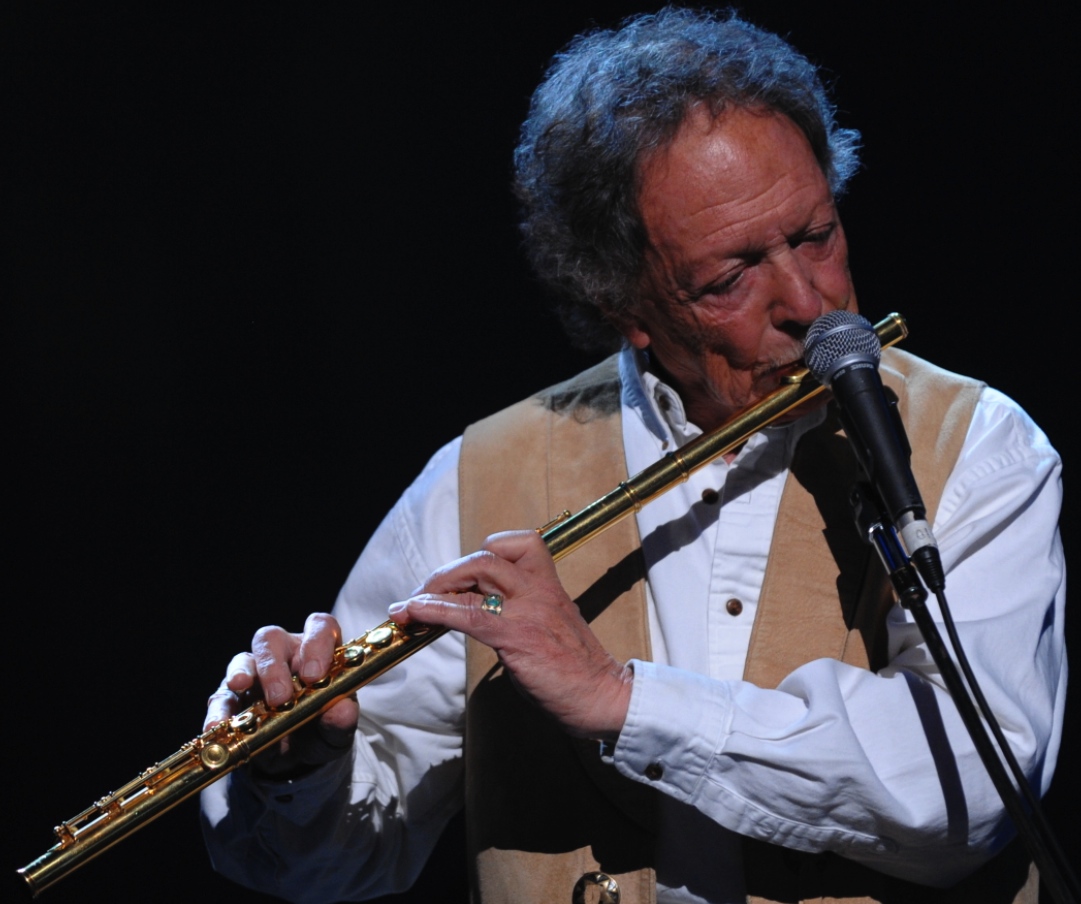
Grammy-award winning musician Paul Horn, renowned for his pioneering solo jazz performances inside timeless monuments such as the Taj Mahal and the Great Pyramid, performs in a historic concert on Sunday evening, May 15 at 7:45 pm, “Inside the Golden Dome: Paul Horn & Friends.”

Paul will be joined by his wife, celebrated Canadian singer/poet Ann Mortifee; Ed Sarath, world-class flugelhorn player; and special guest Eugene Watts, founder of the popular Canadian Brass, the world’s leading brass ensemble with over 80 CDs and DVDs. This concert is also the grand finale of the “Music & Consciousness Symposium” being held at Maharishi University of Management during the weekend of May 14 & 15. Each of these artists will deliver keynote addresses at this Symposium on the subjects of improvisation, creativity, and the relationship of music with spirituality.

Paul Horn has had an illustrious career spanning five decades, 50 albums, five Grammy nominations, and two Grammy awards. He has played both as a solo artist and with the likes of Duke Ellington, Miles Davis, Frank Sinatra, Nat King Cole, Tony Bennett, Buddy Rich, Chick Corea, Donovan, Quincy Jones, and Ravi Shankar. At the peak of his jazz career, Paul was inspired to play his flute inside the famous Taj Mahal. This improvisational performance ushered in a new era of contemplative and meditative music. “Inside the Taj Mahal” became the seminal recording of this new genre of music, and Paul became known as the “Father of New Age Music.”

One of the highlights of the concert is a rare performance inside the Golden Dome on the campus of Maharishi University of Management. The Golden Dome has been used for more than 30 years for the collective practice of the Transcendental Meditation (TM) program by several thousand practitioners. Extensive published scientific research shows the TM technique promotes a wide range of personal benefits, including reduced stress, anxiety, depression, ADHD and other learning disorders. Research also demonstrates a calming “spillover” effect on the whole of society when just a small percentage of the population practices this technique together, including decreased crime, violence and conflict throughout society.

The event is presented by the David Lynch Foundation and MUM’s new Creative Musical Arts Program.

Tickets are available in advance at the Chocolate Café, on the Square, and the MUM Bookstore.

For more details on the “Music & Consciousness Symposium,” visit: mum.edu/music/symposium.

Also see Radio Iowa interview Famed flute player visits SE Iowa, plans weekend show, and IowaPrivateColleges.org posting: Grammy Winner Paul Horn Performs at MUM. PeaceTown, USA also posted: Sacred Intersection: Paul Horn Performs Inside the Golden Dome.

Visit the TM Blog for an article posted by Keith Deboer: Paul Horn: The Music of Meditation, and a short video overview of Paul Horn’s career: Inside Paul Horn posted by annmortifee.

Video and Reports of the Symposium on Music and Consciousness

Here’s Paul’s great talk from the symposium: Improvisation: The Ultimate Art of Self-Expression — Paul Horn at MUM.
Results of MUM’s first Music and Consciousness Symposium: Why a Symposium on Music and Consciousness?
Achievement’s report on the symposium: Symposium on Music and Consciousness Honors Paul Horn

Click here to see all of the Lecture and Performance Videos from the Symposium including Q & A.

The San Francisco Examiner—Meditation program mends troubled Visitacion Valley Middle School

May 8, 2011


Meditation program mends troubled Visitacion Valley Middle School
By: Dan Schreiber
05/08/11 4:00 AM
Examiner Staff Writer

Every day before class, Visitacion Valley Middle School students pass an informal memorial known as the “R.I.P. wall,” a reminder of trouble that awaits them when the afternoon bell rings.

In 2004, two students discovered the partially decomposed body of a 19-year-old stabbing victim. Later that year, a gunman brazenly stormed into the school, threatened to kill a teacher and robbed two employees. In the 2009-10 school year, one-fifth of the students had one or both parents incarcerated.

“Everybody in this school was either related to somebody who has been shot, who did the shooting, or who saw a shooting,” said Jim Dierke, the school principal. “We had kids who couldn’t learn.”

In the spring of 2007, Dierke decided he would try a simple solution.

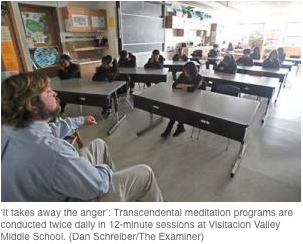
The quiet time program involves the ancient techniques of transcendental meditation, conducted twice daily in 12-minute sessions before and after class.

The first announcement comes over the school’s intercom around 8:45 a.m. — “Prepare for quiet time,” — and the teachers ring a little bell to mark the beginning of the exercise. Most students close their eyes; others cover their faces with their hands and focus on the repetition of a mantra.

“It takes away the anger,” said Charles Ollie, an eighth-grader at the school. “Your brain is like a lake holding in water, and when we meditate, the flood gates open and the water is released.”

Dierke and the school staff credit the program with reducing violence, increasing attendance and test scores and dramatically decreasing suspensions.

Other good things are happening, too, teachers said. The volleyball team made the playoffs this year for the first time in a long time, and some of the eighth-graders are making it into The City’s top high schools, such as Lowell.

Most of the annual $175,000 funding for the program is provided by the New York-based David Lynch Foundation, founded by the TV and movie director. The money is used to pay for dedicated staff to run the quiet time program.

Opponents call it “stealth religion” that violates church-state separation laws because of its association with Eastern religions, but advocates insist that the practice predates Hinduism by thousands of years.

“They come from broken homes, foster care and group home settings,” said Brian Borsos, a special education teacher. “This is a practice that helps them go back and face what they need to face. It’s a skill they take with them for the rest of their lives.”

Program is director Lynch’s brainchild
A handful of San Francisco’s troubled public schools have turned to a transcendental meditation program known as quiet time to relieve high stress in students, made possible by grants from the New York-based David Lynch Foundation.

The TV and film director launched the foundation in 2005 with support from two surviving members of the Beatles and their former meditation instructor Maharishi Mahesh Yogi. But foundation leaders say the practice has nothing to do with religion and is not a church-state separation issue.

Save some minor grumbling and initial skepticism, the San Francisco version of school meditation has not experienced nearly the opposition faced in 2006, when the foundation withdrew funding after parents at Terra Linda High School in San Rafael denouced it as a cult.

Bob Roth, the foundation’s vice president, said the programs in San Francisco have gotten better reception.

Ellie Rossiter, executive director of the nonprofit Parents for Public Schools of San Francisco, said she has heard no opposition to the program. Some of The City’s school officials have even provided testimony on the Lynch Foundation’s website.

“It’s an anchor, it’s a balance for them and I believe it opens them to learning,” Everett Middle School Principal Richard Curci said in a YouTube video.

Soothing results
The meditation program at Visitacion Valley Middle School was instituted in the spring of 2007.

45: Percent reduction in multiday suspensions for quiet-time students in program’s first year
85: Suspensions in 2005-06
10: Suspensions in 2009-10
2.5: Average GPA in fall 2006
2.9: Average GPA in fall 2010
40: Point gain in API score in testing in 2009-10

Source: Visitacion Valley Middle School

dschreiber@sfexaminer.com

Related articles: San Francisco Bay Area News: From time-out to quiet time: meditation comes to SF schools | New research shows Transcendental Meditation improves standardized academic achievementMindShiftKQED: How we will learn: Amidst Chaos, 15 Minutes of Quiet Time Helps Focus Students | and this TM Blog report with video: Breaking the “predictive power of demographics”: SF principal talks about how TM helps his students. And here’s a wonderful report from the The George Lucas Educational Foundation (GLEF): Edutopia: SF School Uses TM to Overcome Problems.

Real Life Solution: Combating PTSD with TM

March 25, 2011

March 25, 2011 posted by Veterans Today · Leave a Comment

By Dr. David Leffler

In early 2010 WWII veteran Jerry Yellin was introduced to a young man, Dory Klock, an eight-year Army veteran who had fought in Bosnia. Dory was having difficulty adjusting, keeping a job, and fighting drugs and alcohol. As a combat veteran, Jerry knew these inner struggles all too well. Dory’s wife and two daughters were suffering with him, and Dory’s mom Lin, Jerry’s friend, was beside herself. Then one day Lin called and asked Jerry if he could help her out. “Sure, Lin, anything,” he told her.

She began weeping; she couldn’t speak. Finally, she asked, “Can you help me put Dory’s medals and ribbons on his dress uniform? We want to bury him in it, Jerry. He committed suicide yesterday.” Lin brought Dory’s uniform to Jerry’s home and he put the medals and insignias in place. When Lin left, Jerry broke down. His thoughts ran wild with the suffering so many are experiencing from the life and death of our warriors who experience combat and have nothing to hold onto when they come home. Jerry was a P-51 Pilot who flew 19 missions over Japan and saw the horror of Iwo Jima – a battle involving 90,000 soldiers on a small island where 28,000 people died. He knew from his own experiences as a returning veteran who suffered from what is now called Post-Traumatic Stress Disorder (PTSD) that the problem is overwhelming our nation.

Jerry relates: “Can we expect our warriors to return from the horrors and experiences of war and integrate back into a normal routine without something deep and meaningful to hold onto? I could not. And neither can they. I also know that each and every PTSD victim needs a vehicle, a methodology that will help them help themselves. Antipsychotic and antidepressant drugs are used extensively but are extremely costly, especially for the long haul, and do not provide a cure. Many turn to alcohol and recreational drugs as a temporary escape from problems. Eighteen veterans from all our wars are said to be committing suicide daily. I know that care is dependent on complete willingness and cooperation from the patient. And that takes a long time. America does not have that time now. We are in crisis.”

This article offers a scientifically verified, time-tested solution to how we can help our military personnel, veterans and their families.

Read the rest of Real Life Solution: Combating PTSD with TM.

Also posted on OpEd News and the Purple Heart Service Foundation as Combating PTSD.

Meditation on the rise locally, nationally

March 24, 2011

The Daily Iowan: Meditation on the rise locally, nationally

BY KENDALL MCCABE | MARCH 24, 2011 7:20 AM

Click here to view an exclusive photo slideshow.

Yosra Elkhalifa felt stressed. She sat in an individual study room at the Blank Honors Center, her midterm in Theory and Practice of Argument just an hour away. But instead of cramming, she began to meditate.

She did not twist into a yogic pose but sat comfortably in a straight-backed chair with her eyes closed and her hands folded in her lap.

The University of Iowa freshman said transcendental meditation has given her a more positive outlook on life, though she has been practicing for only six weeks.

“I felt like I almost had an advantage over other people because I wasn’t panicking over the test,” she said. “I’ve been able to focus better, which is crucial, because I’m taking 17 credit hours.”

Nationally, the number of Americans meditating is increasing.

Click here to view video. (click here for free QuickTime player download)

According to a 2007 U.S. Census Bureau Survey, nearly 10 percent of the population over 18 practices some form of meditation, up from about 8 percent in 2002.

Locally, both transcendental and Buddhist meditation techniques are growing in popularity, Iowa City instructors said.

Linda Rainforth, who taught Elkhalifa transcendental meditation, conducts free introductory lectures. She said there are well more than 100 Iowa City residents who meditate, with thousands in Iowa.

Her students, who range from 6-year-olds to seniors, often meet at the Iowa City Public Library for group meditation.

Before beginning, they decide how long to meditate, then sit comfortably in their chairs with their eyes closed; the only sound is the ticking of a nearby clock.

“Take a few minutes to come out,” Rainforth whispers when the time is up, prompting students to slowly open their eyes.

College students who want to learn the art of transcendental meditation can take courses, which require a tuition payment.

The David Lynch Foundation, a nonprofit group based in Fairfield, Iowa, aims to fund scholarship programs for schools and other groups and pay for transcendental-meditation training for those wanting to learn the technique. The organization boasts many celebrities on its advisory boards, such as hip-hop pioneer Russell Simmons and actor Stephen Collins.

“We find that people are excited about transcendental meditation as they hear about the [foundation],” Rainforth said. “Many people at the top of their field are coming out and talking about transcendental meditation.”

Rainforth, who has practiced the technique for 34 years, said more than 30 UI students, staff, and faculty practice transcendental meditation regularly. One-third of the participants are new to meditation, she said, but the other two-thirds are “long-term.”

Katie Nimmer-Tsilosani, a North Liberty resident, said she runs a demanding childcare business in her home.

“[Transcendental meditation] provides me deep relaxation as well as a boost of energy that is much appreciated in my busy and fun life,” she wrote in an e-mail.

Link to rest of the article: http://www.dailyiowan.com/2011/03/24/Metro/22323.html.

This article was later mentioned in Third Age.com: Meditation On the Rise in America.

The New York Times: Look Who’s Meditating Now

March 19, 2011

Look Who’s Meditating Now

Evan Sung for The New York Times
POSTER BOY Russell Brand with David Lynch at the December Met fundraiser for Mr. Lynch’s foundation, which promotes Transcendental Meditation.

By IRINA ALEKSANDER
Published: March 18, 2011

RUSSELL BRAND, the lanky British comedian, has made a career of his outrageous antics. While a host at MTV UK, he went to work dressed up as Osama bin Laden. At the network’s annual music awards, he likened Britney Spears to a “female Christ.” And he was fired from the BBC after leaving raunchy messages on the voicemail of a 78-year-old actor, a comic bit that even his country’s then-prime minister felt compelled to denounce.

It is jarring then, to say the least, to hear Mr. Brand, 35, speaking passionately and sincerely about the emotional solace he has found in Transcendental Meditation, or TM. Yet there he was in December, onstage at the Metropolitan Museum of Art (as his new wife, the pop singer Katy Perry, waited backstage), describing how TM has helped him repair his psychic wounds.

“Transcendental Meditation has been incredibly valuable to me both in my recovery as a drug addict and in my personal life, my marriage, my professional life,” Mr. Brand said of the technique that prescribes two 15- to 20-minute sessions a day of silently repeating a one-to-three syllable mantra, so that practitioners can access a state of what is known as transcendental consciousness. “I literally had an idea drop into my brain the other day while I was meditating which I think is worth millions of dollars.”

Mr. Brand was the M.C. at a benefit for the David Lynch Foundation, an organization that offers TM at no cost to troubled students, veterans, homeless people, prisoners and others. Like many other guests in the room, Mr. Brand has been personally counseled by Mr. Lynch, the enigmatic film director, who has been a devout practitioner of TM, founded in 1958 by the spiritual leader Maharishi Mahesh Yogi, since its first wave of popularity in the late ’60s. That is when Mia Farrow, after her divorce from Frank Sinatra, joined the Beatles in the Maharishi’s ashram in Rishikesh, India; when George Lucas started meditating and was rumored to have based the Yoda character in “Star Wars” on the Maharishi (the resemblance is eerie); and when the talk show host Merv Griffin, after being introduced to the technique by his tennis buddy, the actor Clint Eastwood, invited the Maharishi to be on his show in 1975.

Since then, the celebrity endorsement, and therefore the enrollment numbers, had quieted down. That is, until the last three years when, according to the national Transcendental Meditation program, enrollment tripled.

At Trinity College in Hartford, the women’s squash league began meditating together after every practice last year. The Doe Fund, an organization that assists the homeless, has begun offering TM to its residents along with computer skills and job training. And Ray Dalio, the billionaire hedge-fund manager of Bridgewater, has long credited the success of his funds to his daily practice.

The Transcendental Meditation program attributes the spike to a series of recent studies that suggest TM can help reduce blood pressure and stress, and to the relatively recent affordability of TM. (The adult course, which had ballooned from $75 in the ’60s to $2,500 in 2007, dropped, because of the economy, to $1,500 in 2008.) No less important has been Mr. Lynch’s foundation, started in 2005, for which enlisted celebrities like Mr. Brand, interrogated often by news outlets about their diets and alternative lifestyle remedies, have been preaching about the technique.

“It’s like, imagine the ripples on top of an ocean,” Dr. Mehmet Oz, who meditates in an armchair in an enclave off his bedroom, said at Mr. Lynch’s benefit. “And I’m in a rowboat, reactively dealing with the waves and water coming into my boat. What I need to do is dive into the deeper solace, the calmness beneath the surface.”

The actress Susan Sarandon meditates once a day for 20 minutes in bed. “It helps me chill out and focus,” she said. (Ms. Sarandon said she doesn’t practice TM specifically, but was at the benefit to gather insight.)

The singer Moby, another guest, has meditated in the back of a taxicab. “Transcendental Meditation has given me a perspective on agitation,” he said. “That it’s a temporary state of mind and I don’t necessarily need to take it that seriously.” Moby said the technique helped him quit drinking more than a year ago. “I used to think that TM was for weird old hippies,” he added. “But then I heard that David Lynch was involved, and that made me curious.”

ON the afternoon before the benefit, Mr. Lynch, 65, arrived at the museum, holding hands with his wife, Emily Lynch, 32, and was escorted by a museum employee to a green room downstairs. Mr. Lynch, like a cartoon character, has maintained the same uniform for decades: a pressed white shirt under a boxy black suit and a hedge of gray hair. He scooped up a soggy egg-salad sandwich from a tray and explained what brought him to the practice.

“I was not into meditation one bit,” Mr. Lynch said, in his laconic Missoula, Mont., drawl that years of living in Los Angeles has failed to dilute. “I thought it was a fad. I thought you had to eat nuts and raisins, and I didn’t want any part of it.”

Mr. Lynch was persuaded by his sister, Martha, when he began having marital difficulties with the first of his four wives, Peggy, in the early ’70s. “I had a whole bunch of personal anger that I would take out on her,” he said. “I think I was a weak person. I wasn’t self-assured. I was not a happy camper inside. Two weeks after I started, my wife comes to me and says, ‘This anger, where did it go?’ I felt a freedom and happiness growing inside. It was like — poooft! — I felt a kind of smile from Mother Nature. The world looked better and better. It’s an ocean of unbounded love within us, so it’s real hard to get a conflict going.” (Still, a year later, the couple divorced.)

It’s easy to shrug off such utterances as hokey, New Age prattle — who can forget Jeff Goldblum’s flaky character in “Annie Hall” on the phone, complaining that he’d forgotten his mantra? — but less so when the person reciting it has dreamed up his most widely admired, vivid films on the days when he was dropping out of consciousness for at least 30 minutes a day.

“Artists like to say, ‘I like a little bit of suffering and anger,’ ” he said. “But if you had a splitting headache, diarrhea and vomiting, how much would you enjoy the work and how much work would you get done? Maybe suffering is a romantic idea to get girls, but it’s an enemy to creativity.”

A version of this article appeared in print on March 20, 2011, on page ST1 of the New York edition. It was also published Saturday, March 26, 2011, in the TheLedger.com: Transcendental Meditation: Celebrities, Recent Biological Studies Increase Interest in Discipline

David Lynch offers music for meditation

March 9, 2011

David Lynch offers music for meditation

Relaxnews
Wednesday, 9 March 2011

Acclaimed film director David Lynch (Blue Velvet, Wild at Heart, Mulholland Drive) released a 17-track charity compilation on March 8 to support his foundation, which encourages healing through meditation. The album features exclusive tracks by Tom Waits, Iggy Pop, Peter Gabriel, Moby, Ben Folds, and others.

In exchange for a pledge of $18 (€13), the David Lynch Foundation, founded in 2005, will provide all of the tracks in digital format over the course of the next six weeks. Proceeds go to the organization’s global effort to teach meditation to 1 million at-risk youth and 10,000 veterans of war with post-traumatic stress disorder.

A supporter of transcendental meditation, dubbed TM for short, Lynch believes that it is the cheapest, most effective, and medication-free way of healing people who have suffered severe stress in war and any other extreme experience.

Waits’ track is a live recording of “Briar & the Rose,” composed in 1993 for the play The Black Rider, cowritten by William S. Burroughs. On the website Pledge Music, you can hear a 90-second preview of the track alongside four more cuts from the compilation. Other artists included are Arrested Development, Au Revoir Simone, Mary Hopkin, Maroon 5, Neon Trees, Ozomatli, Heather Nova, and Slightly Stoopid.

Make a pledge and each week you will receive two or three of the comp’s featured tracks, along with videos, photos, and blog updates, “giving you an insider’s view into the artists’ lives and experiences,” states the website.

Last December, Lynch organized a Hollywood A-list fundraising event at the Metropolitan Museum of Art in New York for his foundation, which aims to train people in need the art of finding inner peace, said Lynch at the event.

In another one of Lynch’s musical endeavors, he recently released a pair of digital songs on iTunes: “Good Day Today,” with a melancholy electro-pop sound, and the more trance-like, rock-oriented “I Know.”

Inspired by working with his composer Angelo Badalamenti on Inland Empire, his last film in 2006, the director began experimenting with music, he told the Los Angeles Times. “One thing led to another, and I started making music even though I’m not a musician.”

In 2009, the director launched an artistic visual and musical project with Danger Mouse and the late Mark Linkous aka Sparklehorse called Dark Night of the Soul.

Listen to track samples, see a video of Lynch describing the project, or make a pledge: http://www.pledgemusic.com/projects/davidlynchfoundationmusic

http://davidlynch.com/

Imagine Peace: “Operation Warrior Wellness” is helping Veterans with PTSD

March 6, 2011

Visit Yoko Ono’s impressive blog, IMAGINE PEACE, and see this comprehensive post on the David Lynch Foundation’s OPERATION WARRIOR WELLNESS, Overcoming PTSD and Promoting Mental Resilience through Transcendental Meditation: Change Begins Within: “Operation Warrior Wellness” is helping Veterans with PTSD.

Jerry Yellin discusses Operation Warrior Wellness

February 21, 2011

War is an addiction; it’s a curse. We have not learned one thing since David, 5000 years ago, slung a pebble at a guy and killed a giant. All we’ve done is invent better pebbles and better slingshots, human to human. — Jerry Yellin

Listen to CBS radio broadcaster Beecher Martin interview author and decorated WW II veteran fighter pilot Jerry Yellin: Jerry Yellin discusses Operation Warrior Wellness.

Mr. Yellin, co-director of Operation Warrior Wellness, a division of the David Lynch Foundation, discusses his wartime experiences, his difficult transition suffering from PTSD, then unknown, and how TM, Transcendental Meditation transformed his life. This ½ hour radio interview was broadcast February 20, 2011, on 5 CBS radio stations in the Tampa Bay area in Florida.

Besides the tragedies of war, the tremendous stresses today’s soldiers and their families are under, and their very difficult transition to civilian life, Jerry also speaks about his goals: to not wait for the government to act but to start treating the soldiers themselves with PTSD, to help the families of war veterans, get warriors to learn TM as part of their basic training, and save government $15 billion a year.

Jerry mentions the inauguration of Operation Warrior Wellness in New York City at a press conference and evening gala event last December. Watch highlights of both events: the press conference and the second annual Change Begins Within benefit gala.

Also see WW II veteran publishes The Resilient Warrior: Healing the Hidden Wounds of War and PTSD and Transcendental Meditation mentioned in Military Times publications.