Archive for the ‘Peace’ Category

How and why Transcendental Meditation is effortless, distinguishing it from other practices

December 31, 2016

imageStudents at Maharishi University of Management practice the effortless technique of Transcendental Meditation twice a day on campus. This study involved 87 students who had been practicing TM from one month to five years. Credit: Maharishi University of Management

As the value of meditation becomes widely recognized, researchers are increasingly trying to understand the differences among approaches. A new study published in Brain and Cognition reports subjective experiences and cortical activation patterns that distinguish the Transcendental Meditation technique from other meditation practices.

It seems TM is able to easily activate the Default Mode Network (DMN), a deeper more integrated structure in the brain, when other types of meditation requiring some form of effort turn it off.

For a clearer explanation of how and why the TM technique is effortless, and can be easily learned and practiced by anyone, with immediate results, read this report: Research validates the defining hallmark of Transcendental Meditation—effortlessness.

Update: March 24, 2018: New study highlights unique state of “restful alertness” during Transcendental Meditation.

For more information on Maharishi University of Management, visit www.mum.edu, and Transcendental Meditation, www.tm.org.

An early attempt at some kind of closure with a poem on Sali’s passing and auspicious times

December 28, 2016

Celebrating the Glorious Life of Sally Monroe Peden

Sally Peden, May 26, 1947 – October 1, 2016

Sally M. Peden, May 26, 1947 – October 1, 2016

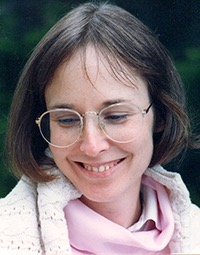
This photo of Sali was taken in the summer of 1992, about a year before we would meet. She arrived to register us for a large advanced meditation course in Washington, DC. When Sali came up to me to ask my name and check it on her list, two thoughts immediately entered my mind: Too bad I just got married (again); Too bad she’s on Mother Divine (a course for single women). Our lives would drastically change—my second marriage would end and I would eventually return to Canada, later leave to join Purusha (a course for single men) and travel the world; she would leave her way of life and end up at MUM in Fairfield, Iowa working for John Hagelin’s ISTPP and the NLP. We would meet there 10 years later in the fall of 2003, as if for the first time. A beautiful friendship would grow and transform our lives, a story worth writing one day.

Sally M. Peden, passed peacefully and gracefully on Saturday, October 1, 2016, 11:17pm, during the evening of the first day of the Nine Days of Mother Divine, the start of a new moon. Her Funeral Service and Vedic Cremation Ceremony were held on Wednesday, October 5, 2016, at the Behner Funeral Home in Fairfield, Iowa, USA.

Sali had devoted her life in personal service to Maharishi Mahesh Yogi since 1971. She traveled the world with him as a personal assistant and lived for many years at the International Capital for the Transcendental Meditation movement in Seelisberg, Switzerland working on many important projects. Sali was very humble, the sign of a great soul. She accomplished untold tasks for Maharishi, which pleased him, but never felt the need to draw attention to herself, just pure dynamic devoted service.

Many emails from around the world poured in praising Sali. I’ll reference a few here.

Sheila Chalmers had worked closely with Sali at International on several projects. In her tribute to Sali, which was read aloud, Sheila described Sali’s brilliant mind, amazingly focussed work ethic, and how much she learned from her.

Emily Levin, a close friend of Sali’s, sent this wonderful tribute to Sali, which was also read aloud. Maharishi had paired them up early on, and Emily shines a glorious light on Sali and their fun-filled friendship.

Some other people who used to work with Sali spoke at her Funeral Service. Alarik Arenander, a neuroscientist from the early days of Maharishi European Research University in Seelisberg, described an incident when they were recording an EEG of a meditating subject. Maharishi happened to enter the lab with an important guest. The scientists showed Maharishi the EEG brainwaves being printed out from the moving ink pens. Maharishi asked, “What is that?” Researchers again explained the brainwaves. After asking several times, since the researchers were not ‘getting it,’ Maharishi pulled apart the long ream of neatly folded EEG paper emphatically pointing to the long non-fluctuating line at the bottom below the EEG. The researchers had an ‘aha’ moment when they examined the breath rate signal, which indicated extended periods of no breathing. They had been looking to find a marker for transcending in meditation and there it was, right in front of them, unnoticed, until Maharishi pointed it out. Sali was meditating in the next room, and it was her clear orderly mind and refined nervous system that brought out the understanding of breath suspension during Transcendental Meditation as an indicator of transcendence! That, along with the orderliness of coherent brain functioning producing relaxed alpha waves. The rest is history!

Gerry Geer, an MUM faculty member and ISTPP director of publications, described her extraordinary personality and some of the amazing things she had accomplished early on in her career. Gerry first met Sali around 1970 when he dropped into the Cambridge TM Center to find out what it was all about. She inspired him to learn TM and to become a teacher. Decades later they would work together at the ISTPP. Read Gerry Geer’s tribute to Sali. In it he mentions a very special incident he witnessed between her and Maharishi. It speaks volumes!

Valerie Gangas, a friend and author, posted a personal reaction to that very special day celebrating Sali, and our relationship, on her blog: Life in Love with You. It was a powerful revelation for her! I am so thankful she wrote it. Also definitely worth reading!

October 1, 2017: I am updating this section a year later on the anniversary of Sali’s passing. I had asked a few of Sali’s other friends who had spoken at her Memorial service to send me what they had said or remembered about Sali.

David Orme-Johnson, TM researcher, artist, and retired MUM Professor Emeritus, wrote: “What I said about Sali was that when I arrived at Seelisberg for the first time in 1973, Sally was the number one organizer around Maharishi. Her mind was crystal clear and she radiated bliss and being.”

David’s wife Rhoda, also a founding faculty member at MIU/MUM, recalled her trip with Sali and Rindi to Jyotir Math. They were in a taxi driving up the ever-winding road. To keep from becoming ill from the constant turns, they sang Broadway tunes. Rhoda was amazed that they knew the words and music to all the songs. David recalled that Rindi was on a path to becoming a musician and singer before she found Maharishi and the TM movement. She worked closely with Sali around Maharishi, and later became one of the leaders of the Mother Divine Program.

Kate Ross sent me a description of what she had said about Sali last year. She was Kate Isen when they knew each other, starting in 1968. They shared a close friendship during those days in Cambridge, Mass, and Sali had rented a room in her house. Kate sent me a beautiful description about Sali’s accomplishments and humanity. When Sali returned from her TM Teacher Training Course (TTC) the change was even more dramatic. Kate didn’t think Sali could look even more beautiful, inside and out, but she did. It inspired her to go off to TTC. Later, when Kate joined International Staff in Seelisberg, Switzerland, there was Sali, “working as a dedicated close assistant to Maharishi. She was tremendously efficient and had powerful organizing skills, but in spite of being enormously busy with the greatest of responsibilities, she never lost the human touch to watch over people and do what was right. She was the brightest light, and an inspiration to all who knew her, and personally speaking, I feel so blessed to have been connected to her. We were and always will be spiritual sisters.” Read the rest of Kate’s inspiring speech about Sali.

A few days later, Rannie Boes sent me what she had said at Sali’s Memorial service. She recalled how they first met in Denmark, Rannie’s homeland, in 1973. “She came to Copenhagen with Maharishi’s group when we had organized a big symposium on TM.” Decades later, they worked at MUM in the same departments. Rannie recounts a sweet story of what Sali had said about their relationship during one of her visits to see her at Parkview Care Center. Read At Sali’s Memorial by Rannie Boes.

Dying, Dharma and Devotion

In the weeks leading up to Sali’s transition, I was reading two books to her. The first was an enlightened description of the nearing death experience, clearly delineated by Kathleen Dowling Singh in her reassuring book, The Grace in Dying: How We Are Transformed Spiritually as We Die. I believe this book prepared us for what was to come, to both let go and allow it to happen naturally.

Sali would soon be put back on Hospice for added care, and moved to a private room, which gave us the needed privacy for such an intimate experience. She would pass within a few days, at an auspicious time in the Vedic calendar.

The second book was The Ramayana: A New Retelling of Valmiki’s Ancient Epic–Complete and Comprehensive, written by Linda Egenes, a friend, and Kumuda Reddy. It is an inspiring story as relevant today as it has been throughout the ages, of dharma, duty, triumphing over evil; enlightened leadership; and an ideal love between an evolved man and woman. Listening to that story kept our attention focused on something spiritually elevating during her final days.

I got as far as the end of Chapter 36, where Hanuman, after finding Sita, consoles and reassures her that Rama is preparing an army to free her from her abductor, Ravana, king of the rakshasas. This comes as a great relief to Sita who was at her lowest with no hope in sight.

For the previous two days and nights, Sali’s breathing pattern consisted of short quick breaths, in and out. It was at this point in the story that her breathing began to change. It became softer, slower, and then, stopped. I waited for another, very feeble attempt, then put one hand over her heart and the other on her head. Not finding any sign of life in the body, these words came into my mind: “It’s done. The karma is over.” With a sense of relief and finality, I said: “Peace, Peace, Shanti, Shanti,” and lovingly kissed her forehead, our last goodbye. I felt a profound peacefulness deep within me, which I could not fully comprehend. The answer would come later, in a word, while meditating in India, where I wrote this poem.

UNDIFFERENTIATED
The Peace that Passeth Understanding

The final feeling
Between us was a Great Peace
Deep within the Heart

All that remained was Silence
After you took your last breath

Where was that Peace coming from
In your heart, mine, or ours
Beyond my comprehension

UNDIFFERENTIATED

As promised, I did continue reading the rest of The Ramayana to Sali, wherever she might be, that evening and the following morning, finishing it at the funeral home, after they had picked up her body and brought it there. Her memorial and cremation would take place a few days later, still within the auspicious Nine Days.

Narmada River, Brahmasthan, Atirudrabhishek

At the luncheon in Revelations following Sali’s cremation, one of our friends, Sheila Ross, suggested I take the cremains to the holy Narmada River, where some of Maharishi’s ashes had been placed. She said it was also close to the Brahmasthan, geographic center of India, where meditation courses were being held, and thousands of Maharishi Vedic Pandits were reciting Atirudrabhishek, an ancient Vedic performance to create world peace.

At the invitation of my family, I did go to India, a little over a month after Sali’s cremation, to spread her ashes from a boat at that location near the Gwari Ghat. It turned out to be during a most auspicious time—a celebration of the holy day of Kartika Poornimah, November 14, 2016, also known as Devi Dipavali, the Festival of Lights of the Gods—one of the most spiritually significant days in the Vedic calendar, during the biggest full moon in 70 years, the supermoon! Truly befitting someone of Sali’s spiritual merit.

Staying at the Brahmasthan afterwards for three weeks was healing for me. It was a powerful and blissful experience visiting the Maharishi Vedic Pandits in their large meditation hall, listening to them perform their Vedic recitations! You can sample some of them in these eCards, enhanced with audios, videos and slideshows.

To get an example of Sali’s sweetness and our special relationship, see this previous post from December 8, 2016—Capturing an authentic moment in writing—about Being with Sali on August 1, 2012, during another full moon.

I am so thankful for the support of our families, the Slusers, Kaplans, Mitchells, and Petch Peden and Robert Harper, and for many of our friends who helped handle so many details, especially Kate Ross and Jennifer Hamilton! I also appreciate acupuncturist Sarah Brooks, the staff at Parkview Care Center and Hospice Compassus for their tireless care of Sali, and sometimes me.

Recently Added

Celebrating the Glorious Life of Sally M Peden; Final entries leading up to and after Sali’s passing; and this new poem, Haiku for Her. Added, June 30, 2017, 9 months after Sali’s passing: For Us—a tanka honoring Sali and what we shared. Added Sept 1, 2017: ‘In Our Loving Eyes’ a poem by @kenchawkin remembering a special love with Sally Peden. Added October 1, 2017, A tanka remembering Sali and her gift to me on the one-year anniversary of her passing. Added October 15, 2017, Still Sali Haiku—the persistence of love over grief. Added November 12, 2017: 1st anniversary of my India trip to spread Sali’s ashes on the Narmada River, visit Bijouri campus and Maharishi Vedic Pandits at the Brahmasthan.

June 6, 2018: After rereading this, I realized how spiritually auspicious the dates were of Sali’s passing, on a new moon during the start of the Nine Days of Mother Divine, and the spreading of her ashes 45 days later in India on the holy Narmada River during a full moon, the biggest supermoon in 70 years, and on Devi Dipavali!

According to numerology, these numbers are significant: 45, 4+5 = 9, completion, fulfillment; 70, 7 is made up of two lines, the individual I am, horizontal line, upheld by the Cosmic I Am, vertical line; and 0 is wholeness. Taken together, the whole thing seemed pretty cosmic to me!

Added June 28, 2019: Poem for Sali—An Undying Love—heals the heart.

Save

Save

Enjoy some of the Zen Poetry of Ryōkan

July 3, 2016

Zen Poet RyōkanA friend loaned me a copy of Dewdrops on a Lotus Leaf, Zen Poems of Ryōkan, translated by John Stevens. A delightful little book, his poems are deceptively simple, yet go straight to the heart. A Zen master, Ryōkan was also considered one of the greatest calligraphers of all time in East Asia. Living as a hermit, he spent much of his time writing poetry, doing calligraphy, and communing with nature.

The Translator’s Introduction ends with this sage advice from the poet:

Good friends and excellent teachers—
Stick close to them!
Wealth and power are fleeting dreams
But wise words perfume the world for ages.

Ryōkan’s poems are pure, honest, direct. Here are a few beauties that caught my attention as I read them aloud to Sali.

It’s a pity, a gentleman in refined retirement
……….composing poetry:
He models his work on the classic verse of China,
And his poems are elegant, full of fine phrases.
But if you don’t write of things deep inside your own
……….heart,
What’s the use of churning out so many words?

 —————

In the stillness by the empty window
I sit in formal meditation wearing my monk’s surplice.
Navel and nose in alignment,
Ears parallel with the shoulders.
Moonlight floods the room;
The rain stops but the eaves drip and drip.
Perfect this moment—
In the vast emptiness, my understanding deepens.

—————

At night, deep in the mountains,
I sit in meditation.
The affairs of men never reach here:
Everything is quiet and empty,
All the incense has been swallowed up by the endless
……….night.
My robe has become a garment of dew.
Unable to sleep, I walk into the woods—
Suddenly, above the highest peak, the full moon
……….appears.

—————

When all thoughts
Are exhausted
I slip into the woods
And gather
A pile of shepherd’s purse.

Like the little stream
Making its way
Through the mossy crevices
I, too, quietly
Turn clear and transparent.

—————

The Lotus

First blooming in the Western Paradise,
The lotus has delighted us for ages.
Its white petals are covered with dew,
Its jade green leaves spread out over the pond,
And its pure fragrance perfumes the wind.
Cool and majestic, it rises from the murky water.
The sun sets behind the mountains
But I remain in the darkness, too captivated to leave.

—————

Bamboo

The thick bamboo grove near my hut
Keeps me nice and cool.
Shoots proliferate, blocking the path,
While old branches reach for the sky.
Years of frost give bamboo spirit;
They are most mysterious when wrapped in mist.
Bamboo is as hardy as pine and oak,
And more subtle than peach or plum blossoms.
It grows straight and tall,
Empty inside but with a sturdy root.
I love the purity and honesty of my bamboo,
And want them to thrive here always!

—————

Leave off your mad rush for gold and jewels—
I’ve got something far more precious for you:
A bright pearl that sparkles more brilliantly than the
……….sun and moon
And illuminates each and every eye.
Lose it and you’ll wallow in a sea of pain;
Find it and you’ll safely reach the other shore.
I’d freely present this treasure to anyone
But hardly anyone asks for it.

—————

Keep your heart clear and transparent
And you will never be bound.
A single disturbed thought, though,
Creates ten thousand distractions.
Let myriad things captivate you
And you’ll go further and further astray.
How painful to see people
All wrapped up in themselves.

—————

I watch people in the world
Throw away their lives lusting after things,
Never able to satisfy their desires,
Falling into deep despair
And torturing themselves.
Even if they get what they want
How long will they be able to enjoy it?
For one heavenly pleasure
They suffer ten torments of hell,
Binding themselves more firmly to the grindstone.
Such people are like monkeys
Frantically grasping for the moon in the water
And then falling into a whirlpool.
How endlessly those caught up in the floating world
……….suffer.
Despite myself, I fret over them all night
And cannot staunch my flow of tears.

—————

Even if you consume as many books
As the sands of the Ganges
It is not as good as really catching
One verse of Zen.
If you want the secret of Buddhism,
Here it is: Everything is in the Heart!

—————

Chanting old poems,
Making our own verses,
Playing with a cloth ball,
Together in the fields—
Two people, one heart.

The breeze is fresh,
The moon so bright—
Together
Let’s dance until dawn
As a farewell to my old age.

See some of Ryōkan’s quotes at goodreads. Here’s one I liked:

“In all ten directions of the universe, there is only one truth. When we see clearly, the great teachings are the same. What can ever be lost? What can be attained? If we attain something, it was there from the beginning of time. If we lose something, it is hiding somewhere near us.”
Ryokan

Here is a goodreads description of his life introducing Sky Above, Great Wind: The Life and Poetry of Zen Master Ryokan.

Enjoy another Zen master’s poetry: Wu-men shares the beauty of each season in his poem 10,000 telling us how to enjoy our best life.

— Written and compiled (citing sources) by Ken Chawkin for The Uncarved Blog.

Five great articles on #TranscendentalMeditation in The Quad-Cities Online @Dispatch_Argus

July 1, 2016

Here is a series of five stories exploring Transcendental Meditation written by Jackie Chesser and published in The Dispatch and The Rock Island Argus. Click the titles to see each one of them online with photos at QCOnline. Or click Dispatch-Argus-May 2016 articles to see a PDF of them all together, courtesy of The Dispatch/Argus.

May 14, 2016: Transcendental Meditation could improve your life

May 15, 2016: Transcendental Meditation a lifesaver for vets with PTSD

May 15, 2016: Q-C instructors are passionate about Transcendental Meditation

May 16, 2016: Transcendental Meditation pays off in the classroom

May 17, 2016: ‘It has been a godsend!’: Q-C people talk about Transcendental Meditation

Fairfield, Iowa, TM and MUM make national news

June 10, 2016

Many articles have come out in praise of Fairfield, Iowa. Two and a half years ago, Rox Laird, The Des Moines Register’s editorial columnist, published an Opinion piece, Fairfield defines community action, on the city’s civic collaboration and Maharishi University’s Sustainable Living Center. The Smithsonian named Fairfield 7th out of 20 best small towns to visit that year. BuzzFeed named Fairfield one of the coolest small towns in America. And The Iowan had published an article on how Fairfield thinks inclusively creating rural success in Iowa.

I like to think the positive outcome of this latest article on Fairfield, TM and MUM, by Kevin Hardy in The Des Moines Register and the  USA TODAY NETWORK, resulted from a phone call I received on my birthday.

In April, I went to visit my son Nathanael at his new home in the Santa Barbara Riviera. For lunch he took me to The Boathouse at Hendry’s Beach, a well-known outdoor restaurant on the beach by the ocean. While waiting for our food to arrive, an unknown number called my cellphone. It was Kevin Hardy. He told me he covered business, labor and the economy for the Des Moines Register, and was researching why some towns in Iowa were thriving while many were losing population and failing economically. Then he said something that surprised me.

According to the U.S. Census Bureau, Fairfield was Iowa’s fastest-growing city among cities of a similar size. Kevin wanted to know what role I thought Maharishi University of Management had played in the demographic and economic growth of Fairfield.

In addition to some of the longtime established businesses, I  gave him an historical overview how hundreds of meditators came from all over the US and Canada after MIU had moved to town from the mid-1970s onwards. Many would stay and relocate their businesses or start new ones. Also told him about today’s younger entrepreneurs, the new successful ventures they started, and gave him a list of people and companies to visit and interview.

Kevin Hardy and Register photographer/videographer Zach Boyden-Holmes really did their homework. They put together an impressive article that became a national success story! It is reproduced here with permission.  See the full article with 14 photos taken May 9, 2016 by Zach Boyden-Holmes/The Register. I added links for more information.

Why this Iowa town is thriving when so many aren’t
By Kevin Hardy, June 1, 2016

Click here to see a short (1:20) video of Fairfield entrepreneurs.

Fairfield out-performed all of the state’s 15 micropolitan areas in terms of population growth between 2010 and 2015.

FAIRFIELD, Ia. – Take a walk around this town’s bustling square and you’ll see an array of businesses that would rival some shopping malls.

On one corner sits a coffee shop that roasts its own beans in house. Down the block is a store specializing in sustainable children’s clothing and toys. Along another strip, there’s a women’s boutique, a Verizon store and a nutrition company.

The town’s retail center also is home to a salon, a consignment store, a furniture store and an art gallery. Just off the square is a pet spa, a natural remedy store and a photography studio. And for those looking for a bite to eat: a Thai restaurant, an Indian cafe, an Italian spot and a joint peddling pizza and steak.

In fact, local officials count only one vacancy in the storefronts that line shady Central Park. It’s just one more sign of success in this town of 9,500 in a state where most small cities and rural areas are seeing residents leave.

Since 1969, census data show Iowa’s metropolitan areas have gained nearly a half million people, while smaller cities and rural places have lost more than 171,000 residents.

But Fairfield has prospered, particularly in recent years. Between 2010 and 2015, the city saw a 4 percent population gain – a rate that rivaled the growth of some of Iowa’s much larger metro areas.

This southeast Iowa city is known as a magnet for practitioners of Transcendental Meditation at Maharishi University of Management, who flocked here since the 1970’s. Fairfield was able to capitalize on that unique niche, building a surprisingly metropolitan quality of life.

While Fairfield is home to 1,000 fewer jobs than it had 15 years ago, state figures show employers have rebounded in the last five years, adding nearly 700 jobs between 2010 and 2015. During that time, Fairfield went from 714 employers to 751, according to Iowa Workforce Development.

“We have a great quality-of-life culture and an entrepreneurial culture,” said Mayor Ed Malloy. “And we see it is allowing more young people to put down roots in this community.”

Around town, there is no shortage of small-city staples like Casey’s General Store and Pizza Ranch, though Fairfield is better known for its funky coffee houses, shops and restaurants. Locals claim the city is home to more restaurants per capita than San Francisco.

Yet the place that Oprah Winfrey dubbed “America’s most unusual town” is more than just quirky. It’s one of the few nonmetropolitan areas in Iowa posting strong population growth, according to U.S. Census figures. And around town, evidence abounds that Fairfield has done what so many small cities in the Midwest struggle to achieve: attract and retain people.

Troy with MUM Solar Array

Troy Van Beek stands in front of a solar power array his company Ideal Energy installed at the Maharishi University in Fairfield Monday, May 9, 2016. Zach Boyden-Holmes/The Register

TM’s long effect
Maharishi Mahesh Yogi introduced Transcendental Meditation, or TM, in India in the 1950’s.

But he brought his technique and “Consciousness-Based education” to Iowa in 1974, when Maharishi International University moved from Santa Barbara, Calif., to the 1 million empty square feet vacated by Parsons College in Fairfield. (The university later changed its name to Maharishi University of Management.)

While some in the community resisted the influx of meditators, locals say most of those tensions were alleviated years ago.

“As time has gone on, everybody’s meshed seamlessly,” said local designer Linda Pettit.

Pettit, who with her husband owns Finishing Touch interior design, has watched Fairfield thrive over the last 32 years from her storefront on the town square. She ticks off quality-of-life improvements such as a new pool and new recreation center.

She boasts about the many restaurants. And she tells of all the new and unusual businesses that have opened.

“We have a very vibrant community,” she said. “I think a lot of small towns don’t have the diversity that we do.”

Pettit hears about layoffs at plants in nearby Ottumwa. She knows how Iowa farmers are struggling with low commodity prices. But she said that isn’t Fairfield’s storyline.

Her business works on residential and commercial projects. But she’s noticed a slant toward more commercial projects in recent years, as new businesses pop up and old ones invest in upgrades.

“It’s a great place to have a business,” she said.

Iowa’s ‘Silicorn Valley’
Over the years, many TM practitioners and others who visited Fairfield decided to stay.

Once here, they had to find a way to make a living. Some Fairfield residents drive to Ottumwa or Iowa City for work. But many have started small businesses in Fairfield, which has been called “Silicorn Valley” for its mixture of tech startups and entrepreneurial ventures.

“People moved here and they had to figure out how to stay here,” said David Navarrete, spokesman for Sky Factory.

The 38-employee company was founded in 2002 by Bill Witherspoon, an artist who moved to Fairfield for its TM community. A serial entrepreneur, he formed Sky Factory as a means of supporting his family. It creates window and ceiling panels that recreate outdoor views like those of a blue sky or a beachfront.

Sky Factory’s biggest clients are health care providers, as research shows even a simulated view of the outdoors can boost moods for those trapped indoors.

“I think there’s definitely an entrepreneurial spirit here, and I think a lot of that comes from the university,” said Witherspoon’s son, Skye Witherspoon, now the company’s CEO.

Fairfield is also home to a surprising array of manufacturing.
Creative Edge makes intricate flooring for some of the world’s best known hotels, casinos, hospitals and universities. Bovard Studios makes and restores stained glass windows for churches across the country. And a host of businesses manufacture agricultural parts, iron castings, polyethylene piping and laundromat washers and dryers.

So many things are made in Fairfield that the Iowa Economic Development Authority will host an export conference here in the fall.

Fairfield’s biggest employers have grown in recent years, too.

Cambridge Investment Research now employs about 700 and boasts more than $70 billion in assets under its management.

Mixed signals
Like many small cities, some employers in Fairfield report trouble recruiting and hiring, especially with Iowa’s unemployment rate remaining below 4 percent.

Lori Schaefer-Wheaton, president of the 170-employee Agri-Industrial Plastics, said hiring is a struggle. She has 20 openings, a number that has held fairly constant over the last two years, she said.

Fairfield is an anomaly among small cities in Iowa, she said, but she thinks recent population growth is largely related to the university.

“That kind of population growth might show up on our census,” she said. “But I don’t think it changes the dynamics of the workforce in our town.”

Iowa State University Economist Dave Swenson said Fairfield definitely out performs many similarly sized cities. But some signals are mixed: While some measures show recent job growth, other data actually point to employment losses, he said.

“They seem to be demonstrating both demographic and economic growth that stands out,” he said. “The big question is this a short term growth or is it sustainable?”

Natives return home
Meghan Dowd came to Fairfield as a child when her parents migrated here for the TM community.

She moved away for college, then ended up working in television in California.

From there, she visited her mom in Fairfield and realized it was going through a “renaissance,” with monthly art walks, a new events center and lots of cool coffee shops and restaurants. She moved back in 2009 and started Shaktea, a maker of kombucha, a trendy fermented drink.

In Fairfield, she says she can do just about anything she could in a metro city. Plus, it’s much cheaper to buy a home or start a business. (She also started Cado, an organic avocado-based ice cream, featured with a photo in the article and video.)

Her children attend a Waldorf-inspired preschool. And after yearning for a yoga studio, she just opened her own.

“A lot of people moved here, the kids grew up here, but then the kids wanted to go out into the world and experience different things,” Dowd said. “I think that happened and some of that is kind of boomeranging back to Fairfield.”

Jesse Narducci followed a similar path. He returned home to Fairfield a few years ago after living in Colorado and California for more than a decade. He opened Jefferson County Ciderworks just outside of town. He brews hard apple cider and runs a taproom featuring hard-to-find craft brews.

Narducci said many of Iowa’s smaller towns are undesirable places to live because they lack quality places to grab a meal or a drink out. Not Fairfield.

“You don’t have to drive to Iowa City to have a good ale or a good meal,” he said. “I don’t really leave that often. … I’m trying to create my own little paradise out here.”

(more…)

Norwich University, oldest private U.S. military college, benefits from Transcendental Meditation

May 10, 2016

Five years ago the Transcendental Meditation technique was introduced at Norwich University in Vermont, the oldest private military college in the U.S. They began with 30 cadets and now there are 300 at any given time practicing TM on campus.

Dave Zobeck, the TM teacher who began the program, which was funded by the David Lynch Foundation, has a permanent, full-time position teaching TM to cadets, faculty, and administrators at Norwich. Below is a David Lynch Foundation update with a new video report from DLFTV.

TM teacher Dave Zobeck and Norwich University President Dr. Richard Schneider .png

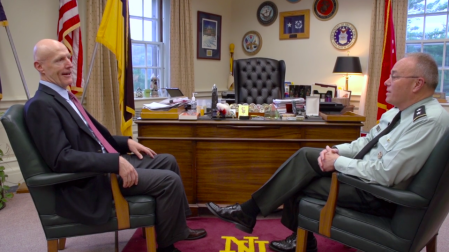
Dave Zobeck and Norwich University President Dr. Richard W. Schneider

Transcendental Meditation at Norwich University

Founded in 1819 near Montpelier, Vermont, Norwich University has educated young adults to become leaders in the community, in business and in the military. It has the distinction of being the birthplace of the Reserve Officers’ Training Corps (ROTC).

Transcendental Meditation (TM) was first introduced to Norwich in 2010 when the longtime donor and supporter Joan Andrews Prentice brought information about TM to Norwich University President Dr. Richard Schneider.

After reviewing articles and research from the David Lynch Foundation Dr. Schneider said, ”I was reluctant—skeptical—but the more I learned, the more confident I became.” After presentations from the David Lynch Foundation, he saw TM as a way to prevent stress and help with focusing and clearing the mind. He decided to be the first to learn TM saying, ”You have to lead from the front . . . ”

In collaboration with Norwich’s board of trustees, the university directors decided on a trial research project for TM. The idea of participating in the trial was presented to all incoming students and their parents in 2010. Thirty new students learned TM and thirty were in a non-meditating control group.

Group TM at Norwich U

For the TM group after learning, ”the reaction was dramatic,” says Dr. Schneider. A typical comment from a student on learning TM: ”After the first week of practicing it, you felt a difference, you felt calmer and much more aware of your surroundings, and you could focus.” Another said, ”TM is the greatest tool that I’ve had for stress-management and for keeping clarity in my life.” Since then the program has grown. Today Dr. Schneider says there are currently 300 TM participants at the University.

Major General (Ret.) Stephen Rippe, a member of the NU board of trustees, says, ”[TM practice] is part of an overall healthy lifestyle. You work out, you take care of your body, you do Transcendental Meditation, it helps you take care of your mind. The powerful part of that is that it actually, physiologically improves your brain functioning.”

Referring to their extremely full day, one young woman said that ”after I do TM, I just get it done instead of sitting around being overwhelmed by so much to do.”

improvement in psychological parameters in students.png

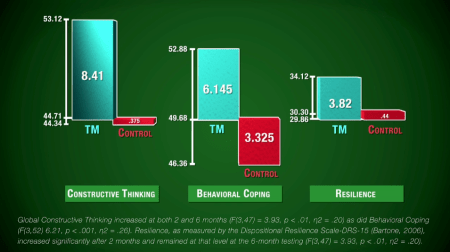
Psychology professor Dr. Carole Bandy reviewed scientific research showing overall improvement in psychological parameters in students, saying, ”constructive thinking, behavioral coping, and resilience all went up significantly.”

Staff and faculty are also practicing TM at Norwich University. As a student says, ”people here want to do what works—we see it as a tool that enables us to handle stress.” Dr. Schneider concludes, ”I think it should be made available to every college student.”

Copyright © David Lynch Foundation

Earlier Related News

The Norwich Guidon: Rooks experiment with meditation

Norwich University President Receives “Resilient Warrior Award” at National Veterans Summit in Washington, DC

Good Morning America anchor George Stphanopoulos interviews Jerry Seinfeld and Bob Roth on the importance of Transcendental Meditation for PTSD.

Read more reports about TM at Norwich University on their website.

A similar situation has occurred in medical education. See The first Transcendental Meditation elective course offered at a major US medical school.

Newly posted Oct 31, 2017: Central Saanich Police Service and Area Police Officers Benefit from #TranscendentalMeditation.

Can group meditation prevent violent crime? Surprisingly, the data suggests yes: New study

April 14, 2016

Large groups practicing the advanced Transcendental Meditation program were associated with significant reductions in U.S. homicide and urban violent crime rates during an intervention period of 2007–2010

Summary: A new study, in a series spanning decades, suggests again that a sufficiently large group practicing an advanced program of Transcendental Meditation, the TM-Sidhi program, is associated with decreased violence in the whole society. From 2007–2010 the homicide rate dropped nationally 21.2% (5.3% per year), and violent urban crime dropped 18.5% (4.6% per year) for a sample of 206 urban areas nationwide with a population over 100,000. Both reductions were relative to prior trends, 2002–2006.

EurekAlert colors 111462

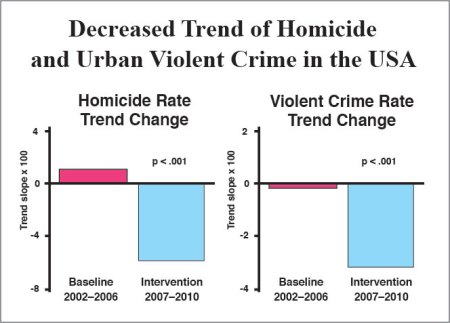
During 2007-2010 when the size of a group of advanced TM-Sidhi program participants exceeded the threshold predicted to reduce negative trends (√1%), there was a significant shift in the U.S. national homicide rate and urban violent crime. Relative to the baseline period of 2002-2006, the drop in homicide rate was 21.2% (5.3% per year) and 18.5% (4.6% per year) for violent crime.

Can group meditation prevent violent crime?

Can large group meditation lower the crime rate? The most recent in a series of studies spanning decades suggests again that a sufficiently large group practicing an advanced program of Transcendental Meditation, the TM-Sidhi program, is associated with decreased social violence.

For the period 2007–2010, when there was a sufficiently large group, statistical analysis found a significant decrease in both the national homicide rate and urban violent crime rate compared to trends during the baseline period of 2002–2006.

The total drop in the homicide rate relative to the baseline average rate was 21.2% over the four-year intervention period (5.3% per year). Analysis of monthly data showed that a rising trend of U.S. homicides during the baseline period 2002–2006 was reversed during the intervention period 2007-2010 of the study (see graph). Researchers estimate that 8,157 homicides were averted by the highly significant shift from an increasing to a decreasing trend in homicide rates.

The drop in the violent crime rate was 18.5% (4.6% per year). The study found a highly significant shift from a flat trend in 2002–2006 to a declining trend in 2007–2010 for a sample of 206 urban areas nationwide with a population over 100,000 (see graph).

Predicted in advance

Starting in July 2006, advanced meditators assembled at Maharishi University of Management in Fairfield, Iowa, to create a group large enough to have this influence on the U.S. as a whole.

Predictions were lodged with the press and other scientists that significant decreases in violent crime would occur when the group reached or exceeded the theoretically predicted threshold of the square root of 1% of the U.S. population. By January 2007 the group exceeded the required size of 1,725 participants, the square root of 1% of the U.S. population at the time, and remained above or near that level through 2010.

The study was published today in SAGE Open Apr 2016, 6 (2). This journal is a member of the Committee on Publication Ethics (COPE).

A new hypothesis in the social sciences

“I understand it’s a new hypothesis in the social sciences that meditation could have a stress-reducing and coherence-creating effect in society,” said lead author Michael Dillbeck. “But such research is increasingly suggesting that there’s a field effect of consciousness. If you get a large enough group together practicing this technique to experience the field quality of consciousness, these extended ‘field-like’ effects are expressed in society.”

The hypothesis of a field effect of consciousness implies that there is an underlying connection between individuals in much the same way that physics has uncovered greater unity beneath the diversity of matter and energy fields. The more powerfully that underlying field is enlivened, the greater the unifying influence of peace and harmony on the surface levels of life.

The hypothesis was first proposed in 1960 by Maharishi Mahesh Yogi, who introduced the Transcendental Meditation technique. This hypothesis was first confirmed by published research in the 1970s and 1980s when it was observed that those cities that had 1% of the population practicing Transcendental Meditation showed significant increases in positive trends.

The effect was found to be even greater when the advanced TM-Sidhi program was introduced, with observations suggesting that just the square root of 1% of a population could increase harmony and improve diverse measures of the quality of life in society.

Nine peer-reviewed articles, comprising 14 studies, have now been published that support this hypothesized effect.

While the earlier studies were based on groups doing their advanced meditation programs for periods of several weeks or months, this current study was for a number of years, giving researchers an opportunity to study potential long-term changes.

Rigorous statistical analysis

The study’s authors used a battery of diagnostic tests to establish the validity of the key statistical assumptions of the analysis, which utilized “broken-trend intervention analysis” of outcomes, a form of “interrupted time series analysis.”

They also found that alternative hypotheses, such as economic trends, incarceration rates, seasonal cycles, demographic changes, and policing strategies, weren’t sufficient to explain the observed reduction.

For example, violent crime rates fell significantly during the severe recession of 2007–2009 rather than rising as widely expected. According to a leading expert on crime and the economy, this was the first time since World War II in which crime rates failed to rise during a major economic downturn.

See NBC News: Jobless rate up, but crime down: What gives? (Jan 3, 2012). The New York Times published a similar report the previous year: Steady Decline in Major Crime Baffles Experts (May 23, 2011). The Washington Post first reported this news in May 25, 2010: Violent crime in U.S. on the decline.

Important implications for crime prevention

“Given that there are now multiple studies showing a highly significant relationship between a large group practicing the Transcendental Meditation and TM-Sidhi programs and decreased violence in society, this obviously has implications for crime prevention,” Dr. Dillbeck said.

The group that gathered in the period 2007–2010 has now somewhat dispersed. Dr. Dillbeck suggests that if governments were to support the establishment of groups in various countries, so that these groups could be maintained over long periods, it could have a remarkable effect in reducing hostilities and fostering coherence among nations, which could be assessed by further research. Indeed, a number of countries are already creating such groups through private organizations, and gaining increasing governmental support.

###

Societal violence and collective consciousness: Reduction of U.S. homicide and urban violent crime rates. Michael C. Dillbeck and Kenneth L. Cavanaugh, Institute of Science, Technology, and Public Policy, Maharishi University of Management. DOI: 10.1177/2158244016637891

Download a PDF of the study, and a PDF of the EurekAlert! press release. The English press release has been translated into Spanish, Portuguese, French, and German.

NB: SAGE Open is an online open access social science journal.

UPDATE (Mar 14, 2017): See latest studies published in this series: Four-year study finds large advanced Transcendental Meditation group reduces drug-related deaths nationally.

Ottumwa Courier photojournalist Rachel Leathe @courierrachel takes a tour of MUM @MaharishiU

March 19, 2016

Rachel Leathe, photojournalist for the Ottumwa Courier called to take a tour of Maharishi University. She had recently transferred to the Courier from Montana and was curious to visit the campus. Click here to see what she put together as it appeared online with 6 photographs from various campus locations. Click here to see 61 more photos at their online photo gallery. And here is a PDF of the article, which took up the back page of the Thursday, March 10, 2016 issue: A tour of MUM.

A tour of MUM

AmineKouider:RachelLeathe:The Courier

Amine Kouider, Science and Technology of Consciousness Instructor, meditates with his class before lunch on Feb. 23, 2016. This is the first class that these David Lynch Master Film students are taking and is also the first class that all students at MUM are required to take. RACHEL LEATHE/ THE COURIER

Walking around the Maharishi University of Management campus in Fairfield, you may imagine you’ve somehow been transplanted to a Buddhist temple or an Indian yoga retreat. You certainly wouldn’t expect to find yourself on a college campus in rural Iowa.

Maharishi Mahesh Yogi set up his first university on a small campus in Santa Barbara, CA in 1973. He dreamed of creating a new kind of university, one that not only offered a traditional education but also focused on what he called a “Consciousness-Based education.” One of the main features of this kind of education was Transcendental Meditation.

In 1973 Parsons College went bankrupt due to a myriad of issues including overspending, a sharp drop in enrollment, and a deep deficit. At the same time, Maharishi University was rapidly outgrowing its Santa Barbara campus and looking for a new home. In the summer of 1974, with the help of private benefactors, MUM was able to purchase the former Parsons College campus and move in.

Every new student at MUM is required to first take a class on TM. The class guides students through a seven-step learning process which explains the theory behind TM, the benefits of TM, and teaches students different techniques to help them meditate. Ken Chawkin, Publicist for MUM and TM practitioner for the last 49 years, says that “after meditation, one comes out recharged and more wide awake.” He says this is particularly beneficial to students because it makes them more receptive to what their teacher is saying.

International students make up a little over 75% percent of the MUM student body and on average represent about 85 different countries. MUM offers Bachelor’s, Master’s, and Doctorate degrees, similar to most other US colleges. However unlike most universities, nearly 70% of MUM’s students are pursuing their Master’s degrees.

Another unique aspect of MUM is that it operates on a block system. Instead of taking four or five classes at once, “which is very stressful,” Chawkin says, students “go much more deeply into that particular subject.” They attend this one class Monday through Friday, usually from 10 am to around 3 pm with a break for lunch and two daily meditations. Students are also usually expected to attend an additional Saturday morning class.

MUM campus dining services also sets MUM apart by only serving completely organic, vegetarian food. The kitchen receives a small portion of their food from the campus organic farm ran by Director of MUM Farms, Steve McLaskey, PhD. The rest of the produce they receive is from local organic farmers and from a couple outside providers. Executive Chef, Suresh Miller says that the biggest difficulty with an all organic, vegetarian menu is finding a wide variety of vegetables, “Like you can’t get asparagus in the winter time. Whereas meat you can buy all winter long, no problem.”

One Comment was posted so far by TLGreen:
Great article and gleaning of SE Iowa history. I moved to Fairfield in 2004 to attend MUM from Oregon. I was in a grad program at the [ ] and had no intention of changing schools…and then I came to visit Fairfield. I was so impressed by the level of regard to education, for students well being and for the commitment to organic food and lifestyle that my life was forever changed. I loved my experiences and studies at MUM – I was able to be that curious, motivated and engaged student that I longed to be, but struggled with the intense pressures of a traditional & unhealthy grad program.

See Rachel’s photo essay on the March Fairfield 1st Friday’s Art Walk.

Related: ABC News reports on Maharishi University in Iowa.

“Meditation Creativity Peace”—A documentary of David Lynch’s 16-country tour during 2007–2009

March 3, 2016

Between 2007-2009 the iconic American director David Lynch made a series of trips to 16 countries in Europe and the Middle East to talk about Transcendental Meditation, Creativity, and Peace.

Wherever he went David was met by hundreds of fans and honored by several film societies. He spoke with heads of state, educators, the press, and local meditators inspiring them to form peace-creating groups.

Footage from these events was taken by film students and film institutes in cities on the tour and sent to David, who, along with his editor, turned it into the film titled, “Meditation Creativity Peace.”

Interwoven throughout the documentary is an excellent interview with a French journalist at an historic art studio in Paris where David goes to create his lithographs. Besides being a talented creative artist in various visual media, David is also an excellent teacher. The way in which he illustrates and explains how TM works and what it can do for us as human beings is absolutely brilliant!

The film premiered in various cities and countries to raise funds for the David Lynch Foundation to help teach Transcendental Meditation to at-risk students everywhere. Meditating celebrities joined David at the LA premiere. See some of the coverage and interviews below. The film is now posted on the DavidLynchFoundation YouTube channel for all to see: David Lynch – Meditation, Creativity, Peace; Documentary of a 16 Country Tour [OFFICIAL].

Here are a few related posts on this subject: David Lynch addresses Israelis on Skype call after they see his film Meditation Creativity Peace | David Lynch speaks with Alan Colmes about his 16-country tour film Meditation Creativity Peace | Russell Brand and David Lynch at LA Premiere of ‘Meditation, Creativity, Peace’ Documentary | David Lynch, Russell Brand, Bob Roth Q&A after screening Meditation, Creativity, Peace documentary at Hammer Museum | Watch the trailer for a new documentary film on David Lynch titled “Meditation Creativity Peace”.

This article beautifully complements the film: David Lynch on meditation in the NewStatesman: Heaven is a place on earth. It includes the diagram and reads like a transcription of David’s brilliant explanation woven throughout the documentary film. 

This earlier article is also very interesting: Celeb Spiritual Report: One significant day in my life by David Lynch for Jane Magazine (May 2004).

See a rare look at David Lynch in this documentary made by Richard Beymer: “It’s a Beautiful World.” New film shows David Lynch retracing Maharishi’s footsteps from North to South India and the start of the TM movement.

Read inspiring excerpts from an earlier post on David Lynch’s book, Catching the Big Fish: Meditation, Consciousness, and Creativity.

David’s explanations on TM & Creativity from the Documentary

The complete brilliant explanation that David gave the French interviewer about TM was incorporated in sections into the documentary. It was filmed at Idem Printing Studio in Paris, where David works on his own art projects. Someone later edited those segments together and added a background soundtrack in this video: David Lynch explains Transcendental Meditation. Several years later, this talk was posted minus the distracting music: David Lynch gives a profound description of Transcendental Meditation.

That brilliant answer David gave a film teacher’s question at the Majestic Theater in Boston shown in the documentary, of whether TM could help her and her students, has been excerpted and posted as: David Lynch on Consciousness, Creativity and the Brain (Transcendental Meditation).

It was later brilliantly animated to David’s voice as David Lynch On How Meditation Can Change Your Life–Transcendental Meditation & Creativity.

They were all included in this Spanish website, IDEAS, by Juan Carlos Sosa Azpúrua on noviembre 1, 2019: Lynch: Meditación trascendental.

Sr. Azpúra also posted recent videos of David Lynch receiving his honorary Oscar at the Governors Awards, with introductions by Isabella Rossellini, Laura Dern and Kyle MacLachlan, and David Lynch‘s short acceptance speech.

Great interview by Paul Zollo for American Songwriter: A Q&A With Director, Songwriter David Lynch, on David’s birthday, January 20, 2020.

Excellent article on Transcendental Meditation written by Sarah Klein in Prevention Magazine

February 14, 2016

Preface: Electrical Analogies

Rosenthal_N

Norman Rosenthal

I find it fascinating that Norman Rosenthal and Jerry Seinfeld have come up with their own opposite electrical analogies to describe how Transcendental Meditation works — as both a surge protector and a battery charger!

People exposed to continual stressful trauma suffer from PTSD. Dr. Norman E. Rosenthal says Transcendental Meditation is like a surge protector against stress. First it calms the amygdala; it turns down that alarm bell where there no longer is a fire.

Jerry Seinfeld

Jerry Seinfeld

And equally important, TM acts as a buffer against future stressful reactions. The nervous system becomes more resilient to stressful stimuli; they’re no longer interpreted as such. The individuals have normalized.

Jerry Seinfeld compares TM to a phone charger for your whole body and mind. He reminds us how we charge our cellphones and then use them throughout the whole day. That’s what TM does for him. It sets him up for his day fully charged until his next TM session to recharge.

Prevention Magazine article on Transcendental Meditation

Bob Roth

Bob Roth

Rosenthal was interviewed and Seinfeld mentioned in an excellent article for Prevention Magazine by staff writer Sarah Klein. It’s nicely designed with graphics, photos and relevant links to cited studies and video clips.

Others interviewed were Bob Roth, executive director for the David Lynch Foundation, and Sandy Nidich, professor and researcher at Maharishi University of Management. Others referenced and linked to are Ellen Degeneres, Jim Carrey, and Oprah Winfrey.

Klein seems to understand her subject even though she probably has not experienced it. Her writing is clear and objective. She’s done her homework when it comes to the science, and integrates her interviewees remarks to full advantage. It’s a pleasure to read a TM article like this when someone gets it right!

Enjoy reading This Is Your Brain On Transcendental Meditation.

For information on Transcendental Meditation visit www.tm.org.

Transcendental Meditation at Prevention R3 Summit

A month before the Prevention Magazine article, Bob Roth was invited to give a talk on Transcendental Meditation at the 3rd annual Prevention R3 Summit. He spoke January 15, 2016, the opening night of the Summit, at ACL Live in The Moody Theater in Austin, Texas. Check the DavidLynchFoundation YouTube Channel for a description of his talk. Austin Art Examiner writer Nicolette Mallow was there and interviewed Bob Roth for her article on this self-transcending form of meditation that can transform people’s lives for the better.

In related news, read about The first Transcendental Meditation elective course offered at a major US medical school.

Jennie Gritz explored the use of TM in education in her article for The Atlantic: Quiet Time Brings Transcendental Meditation to Public Schools.