Archive for the ‘Peace’ Category

Jerry Yellin on Loud Miracles with Meital Dohan: Beating PTSD through Transcendental Meditation

May 17, 2011

Click on the title to listen to the interview.

Jerry Yellin: Beating PTSD Through Transcendental Meditation

Meital Dohan talks to Jerry Yellin. They discuss how TM helped him emerge from his PTSD as well as how TM can help better the mind and body in other ways, given that Meital also practices. They discuss the effects of PTSD and how drugs are not the only answer to the hardships and trauma of War.

More about Jerry Yellin

Jerry Yellin is a World War II Veteran who suffered from PTSD after returning home from the war. For many years he suffered from depression that he could not escape, and fell deeper and deeper with no end in sight despite being surrounded by people he cared about and who cared about him. After his wife began to practice Transcendental Meditation, Jerry also tried it. Through TM, which he continues to practice, he got himself out of his depression and has lived a long and healthy life. He speaks widely about his experience and he has has teamed up with the David Lynch Foundation to create Operation Warrior Wellness to provide TM to veterans of our current wars as a way to help heal from the hardships of battle.
 
Listen to other interviews by Meital Dohan and see other articles on Jerry Yellin posted here on The Uncarved Blog.
 
Meital has moved on but her interviews are posted on SoundCloud.
 

Real Life Solution: Combating PTSD with TM

March 25, 2011

March 25, 2011 posted by Veterans Today · Leave a Comment

By Dr. David Leffler

In early 2010 WWII veteran Jerry Yellin was introduced to a young man, Dory Klock, an eight-year Army veteran who had fought in Bosnia. Dory was having difficulty adjusting, keeping a job, and fighting drugs and alcohol. As a combat veteran, Jerry knew these inner struggles all too well. Dory’s wife and two daughters were suffering with him, and Dory’s mom Lin, Jerry’s friend, was beside herself. Then one day Lin called and asked Jerry if he could help her out. “Sure, Lin, anything,” he told her.

She began weeping; she couldn’t speak. Finally, she asked, “Can you help me put Dory’s medals and ribbons on his dress uniform? We want to bury him in it, Jerry. He committed suicide yesterday.” Lin brought Dory’s uniform to Jerry’s home and he put the medals and insignias in place. When Lin left, Jerry broke down. His thoughts ran wild with the suffering so many are experiencing from the life and death of our warriors who experience combat and have nothing to hold onto when they come home. Jerry was a P-51 Pilot who flew 19 missions over Japan and saw the horror of Iwo Jima – a battle involving 90,000 soldiers on a small island where 28,000 people died. He knew from his own experiences as a returning veteran who suffered from what is now called Post-Traumatic Stress Disorder (PTSD) that the problem is overwhelming our nation.

Jerry relates: “Can we expect our warriors to return from the horrors and experiences of war and integrate back into a normal routine without something deep and meaningful to hold onto? I could not. And neither can they. I also know that each and every PTSD victim needs a vehicle, a methodology that will help them help themselves. Antipsychotic and antidepressant drugs are used extensively but are extremely costly, especially for the long haul, and do not provide a cure. Many turn to alcohol and recreational drugs as a temporary escape from problems. Eighteen veterans from all our wars are said to be committing suicide daily. I know that care is dependent on complete willingness and cooperation from the patient. And that takes a long time. America does not have that time now. We are in crisis.”

This article offers a scientifically verified, time-tested solution to how we can help our military personnel, veterans and their families.

Read the rest of Real Life Solution: Combating PTSD with TM.

Also posted on OpEd News and the Purple Heart Service Foundation as Combating PTSD.

Positive News: Could the military use meditation to create peace?

March 24, 2011

Read this article published in the Spring 2011 Issue 67 of Positive News: Could the military use meditation to create peace? by David Hugues.

All his life, Einstein searched for proof of one underlying field of creation – a ‘unified field,’ more basic and many hundreds of thousands of times more powerful than the nuclear level. Today, scientists around the globe are beginning to believe that such a field indeed exists; and there’s growing evidence that a simple technique, Transcendental Meditation, may access this field and harness its power to create peace in the world. What’s more, some military authorities are quietly taking the idea seriously, and have begun applying it for themselves.

Download the PDF to read this interesting article.

The New York Times: Look Who’s Meditating Now

March 19, 2011

Look Who’s Meditating Now

Evan Sung for The New York Times
POSTER BOY Russell Brand with David Lynch at the December Met fundraiser for Mr. Lynch’s foundation, which promotes Transcendental Meditation.

By IRINA ALEKSANDER
Published: March 18, 2011

RUSSELL BRAND, the lanky British comedian, has made a career of his outrageous antics. While a host at MTV UK, he went to work dressed up as Osama bin Laden. At the network’s annual music awards, he likened Britney Spears to a “female Christ.” And he was fired from the BBC after leaving raunchy messages on the voicemail of a 78-year-old actor, a comic bit that even his country’s then-prime minister felt compelled to denounce.

It is jarring then, to say the least, to hear Mr. Brand, 35, speaking passionately and sincerely about the emotional solace he has found in Transcendental Meditation, or TM. Yet there he was in December, onstage at the Metropolitan Museum of Art (as his new wife, the pop singer Katy Perry, waited backstage), describing how TM has helped him repair his psychic wounds.

“Transcendental Meditation has been incredibly valuable to me both in my recovery as a drug addict and in my personal life, my marriage, my professional life,” Mr. Brand said of the technique that prescribes two 15- to 20-minute sessions a day of silently repeating a one-to-three syllable mantra, so that practitioners can access a state of what is known as transcendental consciousness. “I literally had an idea drop into my brain the other day while I was meditating which I think is worth millions of dollars.”

Mr. Brand was the M.C. at a benefit for the David Lynch Foundation, an organization that offers TM at no cost to troubled students, veterans, homeless people, prisoners and others. Like many other guests in the room, Mr. Brand has been personally counseled by Mr. Lynch, the enigmatic film director, who has been a devout practitioner of TM, founded in 1958 by the spiritual leader Maharishi Mahesh Yogi, since its first wave of popularity in the late ’60s. That is when Mia Farrow, after her divorce from Frank Sinatra, joined the Beatles in the Maharishi’s ashram in Rishikesh, India; when George Lucas started meditating and was rumored to have based the Yoda character in “Star Wars” on the Maharishi (the resemblance is eerie); and when the talk show host Merv Griffin, after being introduced to the technique by his tennis buddy, the actor Clint Eastwood, invited the Maharishi to be on his show in 1975.

Since then, the celebrity endorsement, and therefore the enrollment numbers, had quieted down. That is, until the last three years when, according to the national Transcendental Meditation program, enrollment tripled.

At Trinity College in Hartford, the women’s squash league began meditating together after every practice last year. The Doe Fund, an organization that assists the homeless, has begun offering TM to its residents along with computer skills and job training. And Ray Dalio, the billionaire hedge-fund manager of Bridgewater, has long credited the success of his funds to his daily practice.

The Transcendental Meditation program attributes the spike to a series of recent studies that suggest TM can help reduce blood pressure and stress, and to the relatively recent affordability of TM. (The adult course, which had ballooned from $75 in the ’60s to $2,500 in 2007, dropped, because of the economy, to $1,500 in 2008.) No less important has been Mr. Lynch’s foundation, started in 2005, for which enlisted celebrities like Mr. Brand, interrogated often by news outlets about their diets and alternative lifestyle remedies, have been preaching about the technique.

“It’s like, imagine the ripples on top of an ocean,” Dr. Mehmet Oz, who meditates in an armchair in an enclave off his bedroom, said at Mr. Lynch’s benefit. “And I’m in a rowboat, reactively dealing with the waves and water coming into my boat. What I need to do is dive into the deeper solace, the calmness beneath the surface.”

The actress Susan Sarandon meditates once a day for 20 minutes in bed. “It helps me chill out and focus,” she said. (Ms. Sarandon said she doesn’t practice TM specifically, but was at the benefit to gather insight.)

The singer Moby, another guest, has meditated in the back of a taxicab. “Transcendental Meditation has given me a perspective on agitation,” he said. “That it’s a temporary state of mind and I don’t necessarily need to take it that seriously.” Moby said the technique helped him quit drinking more than a year ago. “I used to think that TM was for weird old hippies,” he added. “But then I heard that David Lynch was involved, and that made me curious.”

ON the afternoon before the benefit, Mr. Lynch, 65, arrived at the museum, holding hands with his wife, Emily Lynch, 32, and was escorted by a museum employee to a green room downstairs. Mr. Lynch, like a cartoon character, has maintained the same uniform for decades: a pressed white shirt under a boxy black suit and a hedge of gray hair. He scooped up a soggy egg-salad sandwich from a tray and explained what brought him to the practice.

“I was not into meditation one bit,” Mr. Lynch said, in his laconic Missoula, Mont., drawl that years of living in Los Angeles has failed to dilute. “I thought it was a fad. I thought you had to eat nuts and raisins, and I didn’t want any part of it.”

Mr. Lynch was persuaded by his sister, Martha, when he began having marital difficulties with the first of his four wives, Peggy, in the early ’70s. “I had a whole bunch of personal anger that I would take out on her,” he said. “I think I was a weak person. I wasn’t self-assured. I was not a happy camper inside. Two weeks after I started, my wife comes to me and says, ‘This anger, where did it go?’ I felt a freedom and happiness growing inside. It was like — poooft! — I felt a kind of smile from Mother Nature. The world looked better and better. It’s an ocean of unbounded love within us, so it’s real hard to get a conflict going.” (Still, a year later, the couple divorced.)

It’s easy to shrug off such utterances as hokey, New Age prattle — who can forget Jeff Goldblum’s flaky character in “Annie Hall” on the phone, complaining that he’d forgotten his mantra? — but less so when the person reciting it has dreamed up his most widely admired, vivid films on the days when he was dropping out of consciousness for at least 30 minutes a day.

“Artists like to say, ‘I like a little bit of suffering and anger,’ ” he said. “But if you had a splitting headache, diarrhea and vomiting, how much would you enjoy the work and how much work would you get done? Maybe suffering is a romantic idea to get girls, but it’s an enemy to creativity.”


A version of this article appeared in print on March 20, 2011, on page ST1 of the New York edition. It was also published Saturday, March 26, 2011, in the TheLedger.com: Transcendental Meditation: Celebrities, Recent Biological Studies Increase Interest in Discipline

Imagine Peace: “Operation Warrior Wellness” is helping Veterans with PTSD

March 6, 2011

Visit Yoko Ono’s impressive blog, IMAGINE PEACE, and see this comprehensive post on the David Lynch Foundation’s OPERATION WARRIOR WELLNESS, Overcoming PTSD and Promoting Mental Resilience through Transcendental Meditation: Change Begins Within: “Operation Warrior Wellness” is helping Veterans with PTSD.

WW II veteran publishes The Resilient Warrior: Healing the Hidden Wounds of War

March 6, 2011

The Resilient Warrior: Healing the Hidden Wounds of War

On the occasion of Veterans’ Day and the first anniversary of Veterans’ Children, we are honored to feature a guest post by World War II veteran, Jerry Yellin, author of Of War and Weddings, The Blackened Canteen, The Letter, and The Resilient Warrior.  Jerry is working hard to make possible veterans having the opportunity to learn Transcendental Meditation as a means of healing from PTSD.

I was one of the 16 million people who served our country in World War Two. I was 18 when I enlisted, 19 when I graduated Luke Field in Phoenix, Arizona and three weeks into my 21st year when I landed on Iwo Jima, an eight-square mile island 650 miles from Japan. I quickly became familiar with death.

On March 7, 1945 our squadron landed on Iwo Jima on a dirt runway at the foot of Mount Suribachi. I looked out at the landscape as I taxied my Mustang to our parking area and saw huge piles of dead Japanese soldiers being pushed into mass graves, the sight and smell indelibly imprinted on my mind. It was a shocking sight for a young man just entering his 21st year to see.    Our squadron area was next to a Marine mortuary where hundreds of dead Marines were being readied for burial, a sight that continued until the remains of nearly 7000 American Marines were buried in the cemetery.

The fighting was fierce on this eight square mile Island 650 miles from Japan. Twenty one thousand Japanese soldiers lost their lives there and nearly 7000 Marines were killed.

I flew ninteen very long range missions over Japan from Iwo Jima and flew with eleven young pilots, all of them friends, who did not return home. All in all I flew with sixteen pilots who did not come back.

On one mission Al Sherren, my classmate from flying school called in “I’m hit and can’t see,” and he was gone. Robert “Pudgy” Carr also disappeared on that day. He was my tent mate.  Three of those killed were my wingmen. Danny Mathis in a mid-air collision with 26 other fighters when my wisdom teeth were pulled and I was grounded, Dick Schroeppel who was following me on a strafing run over Chichi Jima and Phil Schlamberg who disappeared from my wing in clouds on August 14, 1945 the day the war ended.

All of us knew who were fighting and why. Then it was over, one day a fighter pilot the next a civilian, no buddies, no airplane, nothing to hold on to, and no one to talk to. Life, as it was for me from 1945 to 1975 was empty. The highs I had experienced in combat became the lows of daily living. I had absolutely no connection to my parents, my sister, my relatives or my friends. I listened to some of the guys I knew talk about their experiences in combat and I knew they had never been in a battle let alone a war zone. No one that I knew who had seen their friends die could talk about it. The Army Air Corps had trained me and prepared me to fly combat missions but there was no training on how to fit into society when the war was over and I stopped flying.

I was not able to find any contentment, any reason to succeed, any connection to anyone that had meaning or value. I was depressed, unhappy and lonely even though I was surrounded by a loving wife and four sons. That feeling of disconnect, lack of emotions, restlessness, empty feeling of hopelessness lasted until 1975.

In 1975 I learned to meditate—I learned a technique called Transcendental Meditation. In just a few months life became meaningful to me and now, at 86.8 years of living, I can say that this meditation has brought me peace and contentment.

What makes the current wars in Iraq and Afghanistan so difficult for our troops? War is always difficult for those on the front lines, but these wars are being fought in the countries of our enemies, on their territory, their homeland, their cities, and there are no established front lines or objectives to capture. Every citizen can be looked at as “the enemy,” every road as a dangerous road to travel, every pile of garbage might contain an IED ready to explode.

As I write this today, in October 2010, there have been 5745 of our servicemen and women killed and 86,175 evacuated from wounds or illness, 21.7% of the approximately two million who have seen active duty.

It has been estimated that 35-40% of those who have served since 2003 are victims of Post-Traumatic Stress Disorder. Since the average age of the current military is 21, these veterans will require care for 50 or 60 years. The cost to care for our veterans as estimated by Stiglitz and Bilmes in their book The Three Trillion Dollar War will be  $5,765.00 per veteran per year; a total that could reach 717 Billion Dollars just to service the estimated 2.1 million veterans of Iraq and Afghanistan. This does not take into account additional costs to the Government for benefits to the families of the wounded and mentally ill veterans. Every veteran, either wounded or mentally ill affects everyone in his household adversely. The entire family suffers and has needs.

If I am an example of a recovered PTSD veteran, Transcendental Meditation should be offered to all veterans as an option. The cost per veteran for a lifetime of health is just one-fourth of the annual projected cost to the VA for one year of treatment. Why aren’t we pursuing this 5000 year old modality to help our young veterans and their families recover from the profound affect Iraq and Afghanistan has had on our military?

Jerry Yellin, member The Military Writers Society of America, CO-Chair Operation Warrior Wellness, a division of the David Lynch Foundation

Author: Of War and Weddings, The Blackened Canteen, The Letter, The Resilient Warrior.

1 Comments

  1. Amy Adams, November 11, 2010:

    Your story is so heart breaking. I kept reading hoping to see that you had found some reason to live, knowing you must have, to write this – and it’s meditation. It is ridiculous for us as a society not to take advantage of this very old and tested, inexpensive, idea. Thank you for sharing. Is the army listening?

Also see Jerry Yellin: Healing the Hidden Wounds of War, PTSD and Transcendental Meditation mentioned in Military Times publications, and Jerry Yellin discusses Operation Warrior Wellness.

THE WEEK: Getting the flavor of Iowa’s aura

February 23, 2011

The Chicago Tribune article, which came out a few months ago on Fairfield, TM, MUM, and The Raj, continues to be published in major papers throughout the country, and now around the world. The current issue of The Week, a very prestigious weekly magazine, included a synopsis of that story. The Week takes the best of international media and publishes it in their US, UK, and AU editions. So American, British, and Australian subscribers are now reading about us! It is also available online at their websites, but you have to be a subscriber to access it. Here is a shortened link to the article for subscribers: http://bit.ly/fYNcXL. Below is the text copied from a jpg of that page someone sent me. The column, Getting the flavor of…Iowa’s aura, is in the middle of the bottom right corner of a page in the Travel section of the Arts+Life section in this week’s issue: THE WEEK February 25, 2011.

Getting the flavor of…
lowa’s aura

Fairfield is “not just any Iowa town,” said Josh
Noel in the Chicago Tribune. Though “hemmed
in by farms” and rich in traditional Midwestern
charm, this small county seat does double
duty as a mecca for transcendental meditation,
or TM. Maharishi Mahesh Yogi, who began
the TM movement in the late 1950s, moved
his Maharishi International University from
California to Fairfield in 1974. The town got
caught up in the phenomenon, and today “a
quarter to a third of the population” practices
meditation. Twice a day, hundreds of locals,
including the mayor, meditate at precisely the
same time. Visitors are welcome, and can book
tours of various TM sites. I made an appointment
for shirodhara, a treatment that involves
“pouring a steady stream of oil on the forehead”
to balance the mind. “Life’s busy thoughts faded
as the oil rhythmically fell.” travelfairfieldiowa.com

Also see Chicago Tribune—The Iowa aura

Jerry Yellin discusses Operation Warrior Wellness

February 21, 2011

War is an addiction; it’s a curse. We have not learned one thing since David, 5000 years ago, slung a pebble at a guy and killed a giant. All we’ve done is invent better pebbles and better slingshots, human to human. — Jerry Yellin

Listen to CBS radio broadcaster Beecher Martin interview author and decorated WW II veteran fighter pilot Jerry Yellin: Jerry Yellin discusses Operation Warrior Wellness.

Mr. Yellin, co-director of Operation Warrior Wellness, a division of the David Lynch Foundation, discusses his wartime experiences, his difficult transition suffering from PTSD, then unknown, and how TM, Transcendental Meditation transformed his life. This ½ hour radio interview was broadcast February 20, 2011, on 5 CBS radio stations in the Tampa Bay area in Florida.

Besides the tragedies of war, the tremendous stresses today’s soldiers and their families are under, and their very difficult transition to civilian life, Jerry also speaks about his goals: to not wait for the government to act but to start treating the soldiers themselves with PTSD, to help the families of war veterans, get warriors to learn TM as part of their basic training, and save government $15 billion a year.

Jerry mentions the inauguration of Operation Warrior Wellness in New York City at a press conference and evening gala event last December. Watch highlights of both events: the press conference and the second annual Change Begins Within benefit gala.

Also see WW II veteran publishes The Resilient Warrior: Healing the Hidden Wounds of War and PTSD and Transcendental Meditation mentioned in Military Times publications.

PTSD and Transcendental Meditation mentioned in Military Times publications

January 22, 2011

Post-Traumatic Stress Disorder (PTSD) and the Transcendental Meditation (TM) technique were reported in all four Military Times publications in the last 30 days. The Gannett Govt Media Corp publications: Air Force Times, Marine Corps Times, Army Times, and Navy Times, published an article, December 27, 2010, page 3, in their Off Duty section, WatchList: Things You Should be Tracking titled: Transcending trauma: Group hopes to teach 10,000 vets to meditate. It discussed the David Lynch Foundation’s recent launch of Operation Warrior Wellness

Although it is a well-written and positive article, Dr. Matthew Friedman, executive director of the Department of Veterans Affairs National Center for PTSD, was quoted as saying: “There are no published randomized clinical trials testing transcendental meditation for PTSD.”

Col. (Dr.) Brian M. Rees, Army Reserve, and David Leffler, (PhD) coauthored a Letter to the Editor, published Friday, Jan 21, 2011 in the Marine Corps Times and the Navy Times on page 5 in Opening Shots. The letter, Meditation studied in ’85, informed Dr. Friedman of a random assignment study of Vietnam veterans published in the peer-reviewed Journal of Counseling and Development. The study found the Transcendental Meditation technique to be effective against PTSD. Significant reductions in emotional numbness, anxiety, startle response, depression, alcohol consumption, insomnia, and family problems, and improvements in sleep and obtaining/keeping employment, were noted, and 70% of the meditators reported they no longer required the services of the veteran’s center.

An omitted section of the original letter discussed a new pilot study by Rosenthal J, Grosswald SJ, Ross R, and Rosenthal N, titled: “Effects of Transcendental Meditation (TM) in Veterans of Operation Enduring Freedom (OEF) and Operation Iraqi Freedom (OIF) with Post Traumatic Stress Disorder (PTSD): A Pilot Study,” 2010 (in review). In this study, Iraq and Afghanistan veterans experienced a 50% drop in PTSD symptoms by the 4th week, with greater improvements by the 2nd and 3rd months. The study is summarized in Jerry Yellin and Sarina Grosswald‘s new book, The Resilient Warrior: Healing the Hidden Wounds of War (2011). Drs. Rosenthal and Grosswald also discuss this devastating problem and the promising results of their pilot study in the video: Reduction of PTSD Symptoms in Veterans with Transcendental Meditation.

Here is the original version of the Rees-Leffler letter: Meditation Effective PTSD Treatment. David Leffler, executive director of the Center for Advanced Military Science (CAMS), provides more information on TM and PTSD at: http://davidleffler.com/combat-stress-solution.html.

See this powerful personal account: Veteran Dan Burks on Overcoming the Stresses of War with Transcendental Meditation.

And these reports: Dec 14, 2010, Military.com, Celebs, Vets Promote Meditation for PTSD, Dec 15, 2010, On Patrol, Fighting PTSD with Transcendental Meditation, and Jan 5, 2011, Veterans’ Children, Making Transcendental Meditation Available to Veterans.

See Launching ‘Operation Warrior Wellness” — VIDEO HIGHLIGHTS Bringing TM to Veterans suffering from PTSD.

Also see Jerry Yellin: Healing the Hidden Wounds of War, WW II veteran publishes The Resilient Warrior: Healing the Hidden Wounds of War and Jerry Yellin discusses Operation Warrior Wellness.

Detours: Vedic City Rises Above

January 19, 2011

Vedic City Rises Above

Winter 2010 Destinations
Written by Jessica Rapp

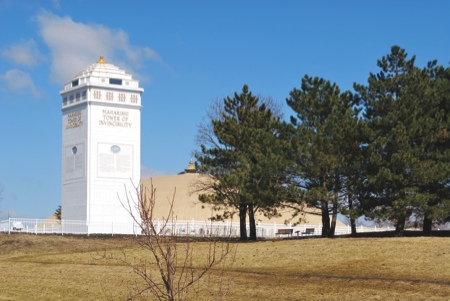
Rush hour in Vedic City, Iowa, is an understatement. Every day, just minutes before 7 a.m. and 5 p.m., its main street transforms from a desolate country road into a gently moving caravan carrying approximately 1,900 passengers intent upon achieving world peace. This common objective attracts visitors from all over the world to the heart of the Hawkeye State, many of them followers of the Transcendental Meditation (TM) movement and believers of the tranquil lifestyle. They eat organically-grown foods, live in housing built according to natural principles and make sustainability a priority in the 2,200 acres of land bordering Fairfield, Iowa, that they call home. Twice a day, they make the pilgrimage to two shimmering gold-domed complexes to cross their legs in the lotus position, close their eyes and meditate, to improve not only their own health but to better the society surrounding them.

The TM organization cites numerous studies that it says proves its method works and distinguishes the program from other common forms of meditation or yoga. Jeffrey Cohen, director of the Invincible America Assembly at accredited Maharishi University of Management (MUM), said TMers demonstrated their method in Washington, and even as far away as Lebanon. Cohen said that in Lebanon, statistics showed a “direct correlation” between the size of the groups meditating and the amount of crime and violence in the area.

“In Washington, D.C., large groups of TM meditators convened to show that [their technique] would lower the crime rate in D.C.,” Cohen said. “And in fact, statistical analysis showed that it lowered violent crime by… a very significant amount. And again, it was reviewed by experts and sociologists.”

Since the 1950s, six million people worldwide reached a consensus that the program developed by the late Maharishi Mahesh Yogi, famed guru to the Beatles, is worth following. (more…)