Archive for the ‘Articles’ Category

Transcending Stress by Norman Rosenthal, M.D. for Decision Magazine

October 1, 2012

Decision Magazine, a UK business publication, featured an article on TM in the Wellness section of the Summer 2012 issue: Transcending Stress: Transcendental Meditation offers a promising remedy for workplace stress says NORMAN E ROSENTHAL M.D. Download a PDF of Decision Summer 2012 to see the article laid out with images on pages 48-49.

Transcending Stress by Norman Rosenthal, M.D.
It’s not stress that kills us; it’s our reaction to it. – Hans Selye

It is a matter of broad consensus that stress in the workplace has reached epidemic proportions. So bad has the problem become, that stress is now a more common cause of long-term sick leave than stroke, heart attack, cancer and back problems, according to a report by the Chartered Institute of Personnel and Development. Workplace stress has been labeled “The Black Death of the 21st Century.”

Common causes of workplace stress include excessive workload, poor management style, workplace restructuring, and problems at home. As the great pioneer in stress research, Hans Selye, observed, it is not the stress itself, but how we react to it that affects its impact on our bodies and minds. During economic downturns, such as we are facing at present, ordinary workplace difficulties become more stressful because workers feel insecure about their job stability and fearful of losing their job, especially because it is often difficult to find a new one.

Stress takes a toll on both body and mind. It is a major contributor to cardiovascular disease, the number one killer in developed countries. In addition, it predisposes to anxiety and depression, both enormous mental health problems. For those who of us who are concerned about performance and productivity in the workplace, it is crucial to find remedies for toxic work stresses. Such remedies will also lead to healthier workers, with fewer days off sick, lower health care bills, and extra years of productivity. There are many available “stress management” programmes. In this piece, I make the case why a simple but powerful technique, Transcendental Meditation (TM), should rise to the top of the list.

Why Transcendental Meditation?
TM is a simple technique of meditation, taught in a standardized one-on-one way over the course of a week. The instructor gives the student a mantra, along with instructions as to how to use it. TM is simple to learn and easy to practise. Ideally, the practitioner should sit comfortably with eyes closed for two sessions of 20 minutes each per day.

As a researcher and physician, I have been impressed by the scope and extent of research data supporting the benefits of TM (over 330 peer-reviewed articles to date). Much of this research has a direct bearing on the damaging physical effects of stress. For example, controlled studies have shown multiple physical benefits of TM versus controlled treatments, such as: (1) Reduction in blood pressure that is both statistically and clinically meaningful; (2) Actual reversal of arterial narrowing in the carotid arteries which carry blood to the brain; (3) increased longevity over the course of years (a finding that has been replicated). From the point of physical wellbeing alone, TM is worth practising.

But there is more. A meta-analysis of 146 treatment groups found that TM reduced anxiety to a greater extent than other approaches. Likewise, five controlled studies in people not recruited specifically for depression showed that practising TM was followed by a reduction in depression symptoms to a greater extent than control treatments. Evidence suggests that the improved blood pressure seen with TM is mediated by decreased anxiety. In other words, TM seems to be acting as a shock absorber, decreasing the impact of stress on both mind and body.

No other “stress management technique” has anywhere close to this amount of hard data in support of its claims to reduce stress.

Beyond its effects on stress reduction, TM has also been shown in numerous studies to improve levels of self-actualization – a term used to describe the need for people to be the best they can be. This benefit may result from the direct effects of TM on the brain, which include increased brain coherence. Brain coherence means that the firing patterns in different parts of the brain correspond to one another. Higher levels of brain coherence have been associated with higher levels of performance, both in businessmen and athletes.

How do the benefits of TM play out in the workplace?
To begin, let us hear from two leading business people, who are regular meditators and have praised TM’s benefits: Ray Dalio, founder of Bridgewater, the largest hedge fund in the world; and Oprah Winfrey, media icon and CEO of Harpo Studios. Dalio has said that TM has helped him make up for lost sleep and has made his patterns of thinking “more centered and creative.” With TM, he says, “Life got better and everything became easier.” He reports dealing with challenges in a calm, clear-headed way, which allows him to put things in perspective – “like a ninja.” Winfrey was so pleased with her own personal experience with TM that she provided TM training free of charge to all members of her organization. Her observations: “You can’t imagine what has happened. People are sleeping better. People have better relationships. People interact with other people better. It’s been fantastic.”

Many other CEOs and business leaders have reported similar benefits in their organizations. How can we understand these extraordinary transformations?

How can TM help work-stress?
Let me count the ways. TM results in:
1. Increased brain coherence that is associated with increased levels of accomplishment
2. Reduced stress responses producing more clarity, less reactivity, and better decision-making. As Dalio put it, “I am centered – not hijacked by emotion”
3. Enhanced creativity, even with aging
4. Better physical health
5. Greater harmony

At every level of organization, TM promotes harmony. This applies within the mind of the meditator, between mind and body, and in groups. Once the meditator learns the practice and develops the habit, the 40 minutes spent per day is rapidly repaid in the form of improved performance and efficiency. How wonderful it is to think that this quiet twice-daily practice might turn out to be a remedy for “The Black Death of the 21st century!”

Norman E. Rosenthal, M.D is author of Transcendence: Healing and Transformation Through Transcendental Meditation (Hay House, 2012).

An updated reprint edition by Tarcher is available in North America on Amazon.

Click here for more posts on Norman Rosenthal on my blog, and also visit Norman Rosenthal’s website and blog: http://normanrosenthal.com.

For more information on Transcendental Meditation for business executives and companies please visit www.tmbusiness.org.

Norman Rosenthal spoke in Chicago on Light and Transcendence—alternative modalities to reduce stress, optimize health

September 11, 2012

Norman Rosenthal, M.D., was in Chicago September 5-7 to deliver a series of talks at various medical, educational, and public venues. His main theme was using Light and Transcendence as alternative approaches to reduce stress and optimize health. Dr. Rosenthal addressed 200 people at the University of Chicago Gleacher Center Wednesday evening, spoke on Thursday with staff and students at Stritch School of Medicine at Loyola, and talked with health care and other professionals as a guest of the Chicago Lakeshore Hospital at a Friday luncheon.

Dr. Norman E. Rosenthal is the world-renowned psychiatrist and author whose research in describing seasonal affective disorder (SAD) and pioneering the use of light therapy has helped millions of people. The New York Times best-seller, Transcendence: Healing and Transformation Through Transcendental Meditation, is out in paperback this month (September 2012), with a Foreword written by Mehmet C. Oz M.D., and a new concluding chapter, After Transcendence.

At the same time, Winter Blues: Everything You Need to Know to Beat SAD, which the New York Times called “a landmark book,” is being released in its revised and updated fourth edition. It includes a chapter, Meditation for the Winter Blues.

Stressful times affect health and happiness

Economic challenges, the feeble job market and information overload, not to mention the drought, conspire to stretch people to the breaking point. Everyone is experiencing some degree of stress and anxiety in their lives. In fact, the NIMH (National Institute of Mental Health) estimates that 40 million adults, one in seven, have some type of anxiety disorder.

Dr. Rosenthal pointed out the current epidemic of stress has resulted in cardiovascular disease as well as psychiatric disorders. It effects everyone from war veterans to the general public. “Having witnessed the mental and spiritual anguish of many hundreds of people,” he said, “I find the potential clinical power of this technique (TM) amazing.”

Transcendental Meditation—a simple effective solution

A Clinical Professor of Psychiatry at Georgetown University Medical School, Dr. Rosenthal was initially very skeptical about the effectiveness of the Transcendental Meditation technique for beating stress and anxiety. After examining the research, however, he said, “I came to scoff and remained to pray,” paraphrasing a famous line from Irish writer, playwright, and physician Oliver Goldsmith‘s poem The Deserted Village.

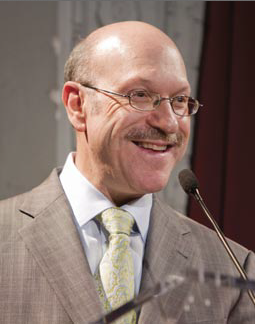
Dr. Rosenthal at University of Chicago Gleacher Center explained three different categories of meditation and how they effect the brain producing different results

The former NIMH researcher explained three different categories of meditation and how they effect the brain. He said having the right instruction in meditation can make a world of difference in the results.

Dr. Rosenthal described research examining the Transcendental Meditation program resulting in hard evidence not seen with other meditation techniques. He cited improvements in cardiovascular health, reduced drug, alcohol and tobacco use, reduced PTS symptoms in veterans, and studies showing significant reductions in health care costs and utilization resulting from twice daily TM practice.

Mr. Ulrich Sandmeyer, co-owner with his wife Ellen, of Sandmeyer’s Bookstore, an independent Chicago bookseller, brought Dr. Rosenthal’s books to every event. He does this service for speakers 3-4 times a week and has done so for 20 years.  He said that Norman Rosenthal was the most compelling speaker he has ever encountered. Coming from Mr. Sandmeyer that says a lot!

Thanks to Carla Brown, Ed.D., co-director of the Transcendental Meditation Program in the Greater Chicago Area, for organizing these events for Dr. Rosenthal and for sending us some highlights of the tour.

Click on Transcendental Meditation Visualized [Infographic] to see this new post on Dr. Rosenthal’s blog. He says, “The infographic below is brought to you as a resource and extension of the book ‘Transcendence,’ which features some of the main points about Transcendental Meditation that I highlighted in the book.”

Related posts on this topic

Dr. Norman Rosenthal gives an engaging talk to medical staff at Northern Westchester Hospital

PsychCentral reviews Norman Rosenthal’s book Transcendence: Transcendental Meditation: What Is It and How Does It Work?

Dr. Catherine Ulbricht interviews psychiatrist and author Dr. Norman Rosenthal for Natural Standard

A Transcendental Cure for Post-Traumatic Stress by David Lynch and Norman E. Rosenthal

Additional information on Norman Rosenthal, Transcendence and Winter Blues are listed below and available in his Press Kit.

(more…)

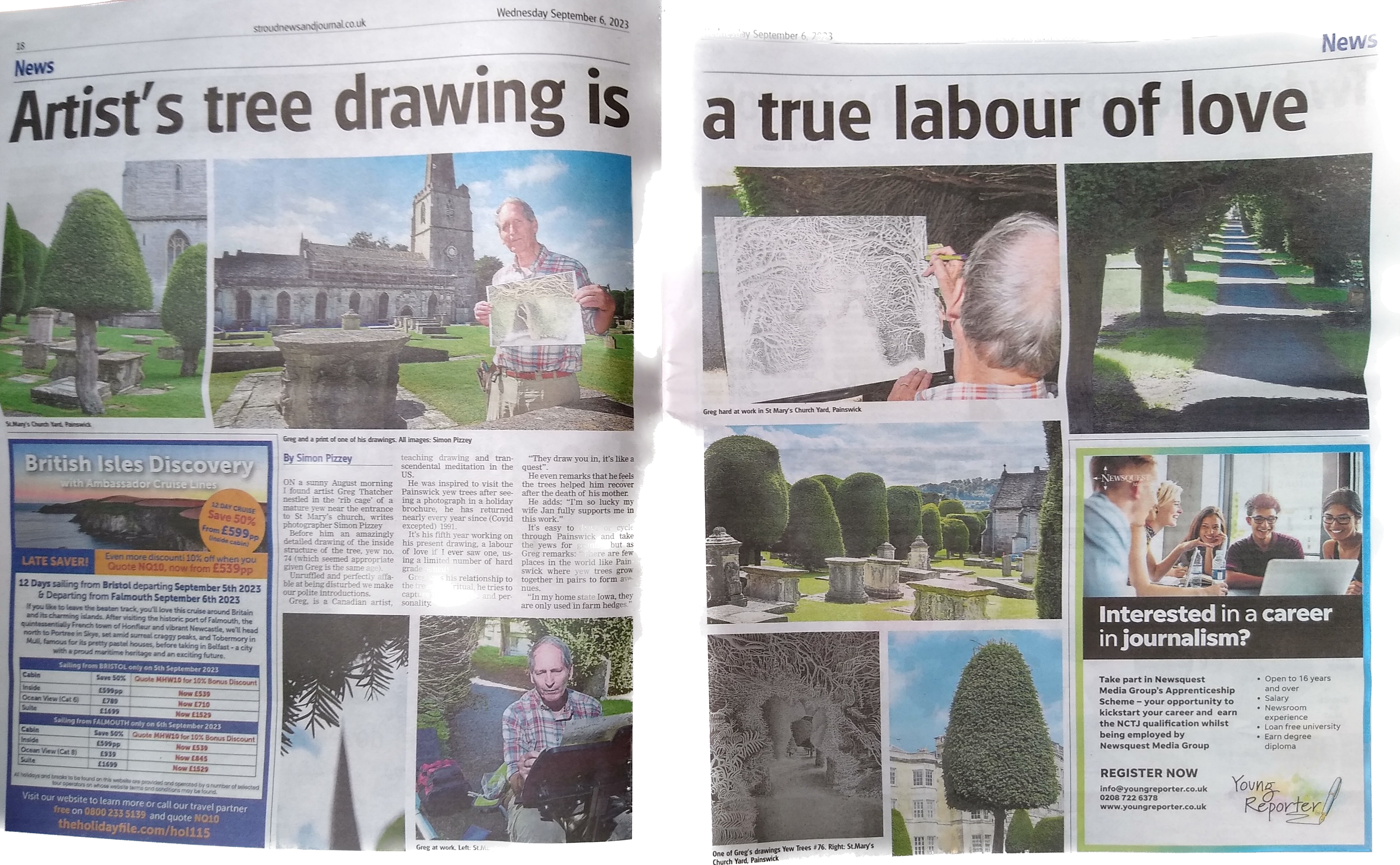
Canadian artist Greg Thatcher goes to Painswick every summer to paint its famous yew trees

August 23, 2012

Stroud News and Journal, 4:00pm Tuesday 7th August 2012 in News Canadian artist travels to Painswick every year to paint its famous yew trees by Hayley Mortimer, Reporter. Includes a galley of 5 photos.

A CANADIAN artist has travelled to Painswick to paint its famous yew trees.

Greg Thatcher, 63, who lives in Iowa, has been painting the trees at St Mary’s Church for more than 20 years and works on location from June to August every year.

The yew trees were planted in the Middle Ages and Mr Thatcher says they form the most beautiful yew tree avenues in the world.

He first saw them in a travel brochure while working in Lancashire in 1991.

At first, he worked from photographs but after visiting the churchyard he was inspired by the different shapes and intricate details.

Mr Thatcher said: “I have been drawn to them. I just keep seeing deeper and deeper levels of where I can start. It is an ongoing relationship.

“The process is very stimulating and nourishing to my creativity and imagination.

“Even after 20 years I am still finding more angles and more information to work with.

“I love Painswick and enjoy coming back each year. My trips have been pivotal to my career. It has given me access to a unique and inspiring landscape.”

Mr Thatcher spends between six and eight hours a day working on the drawings and many take more than 350 hours to complete.

He and his wife stay a mile away from the churchyard so Mr Thatcher can cycle to and from the site every day.

Mr Thatcher teaches art and art history to children aged 13 to 17 in a small school in Iowa.

He has a bachelor of fine art from the University of Victoria and a masters in painting and drawing from the University of Saskatchewan.

A series of drawings of the yew trees has been exhibited in the United States, Canada, England and France and his work hangs in corporate and private collections across the world.

For more information go to www.gregthatchergallery.com.

You can see photos of Greg, the trees, and his drawings in the online article bit.ly/Rg2k25, and in a pdf of Inspiration found under the boughs.

###

Later Additions

Canadian artist returns to Painswick.

Artist inspired by Painswick yew trees will share his skills at class.

February 25, 2020: Iowa Public Radio News: New Exhibit Explores The “Sacred” Beauty Of Yew Trees. On this edition of Talk of Iowa, host Charity Nebbe is joined by Fairfield-based artist Greg Thatcher, who has been making art inspired by yew trees for more than 30 years. Thatcher talks about his “Sacred Yew” exhibit at the Greater Des Moines Botanical Garden and his multi-decade relationship with a single grove of yew trees in a small English town. (Listen: 17 minutes)

August 20, 2023: Artist’s labour of love records Painswick’s yew trees by Simon Pizzey for Stroud News. See a layout of the article.

KTVO’s Tess Hedrick interviews Dr. Richard Beall, Head of Maharishi School, on the new school year

August 18, 2012
New additions for MSAE
Posted: 08.17.2012

Published on Aug 17, 2012 by

Maharishi School of the Age of Enlightenment staff is preparing for the first day of school / KTVO’s Tess Hedrick

FAIRFIELD, IOWA — Wednesday August 22 is when school begins for students at the Maharishi School of the Age of Enlightenment.

You’ll be seeing some new faces around the school this year.

Dr. Richard Beall, the head of Maharishi School says there are more new staff and faculty members this year than any other year in the history of the school.

“Fortunately a lot of those are young staff members, young faculty, that are graduates of our school. They’ve come back to be a part of the community. They’re doing some interesting things so we’ve got this renewal sense of infusion of new talent, new energy, new creativity that we’re really excited about,” said Dr. Beall.

Not only will there be new staff this year but also a brand new demonstration kitchen that will be the culmination of the school’s sustainability program.

“We have a 4,000 square foot greenhouse. So the children for many years have planted and grown and nurtured and ate things. Now they can do things we call seed to plate. So they’ll be taking what they’ve grown in the greenhouses and bring it back into the kitchen. And the nice thing is we’ll integrate that in, not only an elective on cooking, but also the chemistry of food preparatory, especially in our social studies — looking at culturally like that,” said Dr. Beall.

Dr. Beall said that the special thing about Maharishi School is that the staff allows their students to grow from the inside out by stopping each day to practice Transcendental Meditation.

“That pays in two ways. They get rid of stress and it also optimizes their brain so when they go to the classroom — the kids who walk to school here or they get out of their cars — they don’t go directly to the classroom, they go to a meditation, they do yoga and meditation. So I say, the student that goes into the classroom is not the same one who got out of the car right here. They’ve been able to get rid of stress and now they’re really awake and that pays all kinds of dividends during the day,” said Dr. Beall.

Maharishi University places 4 winning MBA teams in top 10 at international CAPSIM competition

August 9, 2012

M.U.M. Students Excellent In CAPSIM Competition
by Johnny Mangano
Published on Aug 9, 2012 by KTVOtv

FAIRFIELD, IA — Four MBA teams from the Maharishi University of Management placed in the top 10 of the international CAPSIM Foundation simulation.

The simulation tests MBA students acumen in areas such as sales forecasting, inventory management, operations management,  human resources, finance, and quality management.

M.U.M. competed with other schools across the continent including Villanova and Drexel even though enrollment at the school is just around 1,000 students.

The competition is spread out over a six month period and is very rigorous.

Dr. Andrew Bargerstock, Director of MBA Programs at M.U.M. led the students in this endeavor.

In the past three years, M.U.M. has placed teams in the top ten of the competition with a team actually placing first last year.

When asked whether he values that or this year with four teams placing in the top ten, Dr. Bargerstock preferred the latter because it speaks to how deep and knowledgable his MBA students are.

The simulation is scored on a Balanced Scorecard concept which measures both short and long term growth across four perspectives: financial, customer, internal business processes, and learning and growth.

The four teams were named Chester, Digby, Baldwin, and Andrews.

The Chester team placed in the 97th percentile and included Enkhbat Byambaakhuu, Laxman Bhandari, Visakha Ly, Phirada Khuon, and Nan Cao.

The Digby team was in the 95th percentile and included Seka Ellepo, Njei Akuro, Gurmu Negeri, and Eshetu Debru.

The Baldwin team finished in the 93rd percentile with team members Xiaoxu Chen, Zhou Jiang, Yue Pan, Daina Zhang, and Bo Wu.

The Andrews team placed in the 90th percentile with Eliana Freeman, Mokhlis Awad, Joseph Marquez, and Mila Zhang.

For more information on MUM’s Accounting MBA program visit: http://www.mum.edu/accounting-mba.

Also listen to the KMCD August 9 MUM Spotlight Show with Andy Bargerstock, MUM Professor and Director of MBA programs, as he discusses the significance of the CAPSIM simulation within the Accounting MBA program at MUM and how it prepares his students to compete and win against other top universities in North America.

See the MUM Blog: Four MBA Teams Place in International Competition and Dr. Andrew Bargerstock’s blog: MUM’s Four MBA CAPSIM Teams All Finish in Top 10.

Also see last year’s winning teams, one taking first place: Maharishi University MBA Students Win National Business Simulation Competition and Students Place 1st in National Business Simulation and MBA Students Win National Business Competition and this video: CAPSIM winners: MBA teams at Maharishi University of Management.

First international article on TM in Education: Meditation helps students, by Dana Micucci

August 7, 2012

International Education: Meditation helps students

By Dana Micucci

Published: Tuesday, February 15, 2005

NEW YORK — New research appears to be strengthening the case for teaching Transcendental Meditation in U.S. schools, showing it to be a means to improve the concentration of students and a way to enhance their physical and mental well-being.

Proponents say that students who meditate daily are calmer, less distracted and less stressed and less prone to violent behavior.

A study conducted at the Medical College of Georgia in Augusta, Georgia, which will be published in the April issue of the American Journal of Hypertension, found that Transcendental Meditation reduced high blood pressure in African-American teenagers. The study tracked 156 inner-city black adolescents in Augusta, Georgia, with elevated blood pressures. Those who practiced 15 minutes of Transcendental Meditation twice daily steadily lowered their daytime blood pressures over four months compared to non-meditating teens who participated in health education classes and experienced no significant change.

The technique was developed 50 years ago by the Maharishi Mahesh Yogi, and consists of silently repeating a mantra for about 20 minutes a day. It found its way into classrooms 30 years ago after Robert Keith Wallace, a medical researcher at the University of California, Los Angeles, published the first study on its positive physiological effects.

Since then, studies at universities like Harvard, Stanford and UCLA have shown that Transcendental Meditation can ease stress and enhance both physical and mental health and behavior.

Bolstered by these studies, groups of educators, parents and physicians across the United States have turned to Transcendental Meditation as a possible antidote to rising anxiety, violence and depression among students. Committees for Stress-Free Schools were established last year in New York, Washington, Los Angeles, Chicago and other cities. These committees serve as information resources about the potential benefits of meditation for students and teachers.

Transcendental Meditation is a simple mental technique that can have profound physiological effects,” says Gary Kaplan, a neurologist and clinical associate professor of neurology at New York University School of Medicine and chairman of the New York Committee for Stress-Free Schools. “It produces a state of restful alertness that provides the body with deep, rejuvenating rest and allows the mind to reach higher levels of creativity, clarity and intelligence.”

However, initial efforts to introduce the teaching of Transcendental Meditation in schools were controversial. Opponents criticized it as a religious practice and in the mid-1970s a group of citizens brought a lawsuit against several New Jersey high schools, forcing them to withdraw their programs. At the time, a New Jersey court ruled that Transcendental Meditation had religious overtones and therefore could not be offered in a public school.

“The challenge lies in educating people that although Transcendental Meditation is rooted in the Indian Vedic spiritual tradition, it is not a religious practice,” says Kaplan.

At the Fletcher-Johnson School, an elementary and junior high school in a rough Washington neighborhood, meditation has been reported to help to improve student performance and reduce fighting. George Rutherford, the principal who introduced Transcendental Meditation 10 years ago, said, “We saw immediate results.”

He added, “There was a lot of violent crime around the school. But after we trained our students in Transcendental Meditation, they were calmer. There was less fighting, and attendance increased. Students scored better on standardized tests. Transcendental Meditation helped to remove a lot of their stress.”

Now, as principal at Ideal Academy (Public Charter School) in Washington, Rutherford is training teachers in Transcendental Meditation to combat teacher burnout.

At the Nataki Talibah Schoolhouse in Detroit, an elementary and middle school, students and teachers have been practicing Transcendental Meditation twice daily for the past seven years. Carmen N’Namdi, co-founder and principal of the school, says that “given the enormous stresses of today’s world, children, like adults, need to learn how to rest and relieve tension.”

Recent research spearheaded by Rita Benn, director of education at the Center for Complementary and Alternative Medicine at the University of Michigan, found that meditating students at Nataki Talibah Schoolhouse were happier, handled stress better, had higher self-esteem and got along better with their peers than non-meditating students at another Detroit school.

In addition to improving the emotional and social development of children, meditation can also be effective in treating brain disorders such as attention deficit hyperactivity disorder, according to a study conducted in April 2004 at Chelsea School in Silver Spring, Maryland, a private school for children with learning disabilities.

“We compared students before and after they learned Transcendental Meditation,” said the principal investigator, Sarina Grosswald, president of S J Grosswald & Associates, a consulting firm in medical education in Alexandria, Virginia. “Kids who practiced Transcendental Meditation for 10 minutes twice each day for three months reported being calmer, less distracted, less stressed, and better able to control their anger and frustration.”

This New York Times article was first published earlier that day by the Paris editor of the International Herald Tribune. Click on Meditation helps some students to download a PDF of this groundbreaking article on the front page of the Tribune’s Education section.

Around that time in early 2005, the David Lynch Foundation for Consciousness-Based Education and World Peace had been established to provide Transcendental Meditation to at-risk students around the world. Today many educational institutions have successfully implemented this Quiet Time program in their schools.

The David Lynch Foundation has since gone on to provide scholarships for TM instruction for other at-risk populations: Native American Indians, the homeless, prisoners, girls and women victims of abuse, and veterans from all wars and their families suffering from post-traumatic stress.

For more information and videos on these programs, visit www.davidlynchfoundation.org.

For veterans, visit www.operationwarriorwellness.org.

For a short overview see these Excerpts From David Lynch Foundation Videos: Changing Lives With Transcendental Meditation.

Search for more DLF and OWW articles and videos posted on this blog.

Military veterans speak on need to increase resiliency: by Diane Vance, Fairfield Ledger

July 30, 2012

Military veterans speak on need to increase resiliency

Yellin, Travis: TM programs needed for veterans

By DIANE VANCE, Ledger staff writer | Jul 30, 2012

Howard Judge, left, of Fairfield, talks with Luke Jensen Saturday after the forum, Healing the Hidden Wounds of War. Jensen, a former Army Reservist from Story County, spoke about his struggles with posttraumatic stress after an Afghanistan deployment in 2009 and the help he found in practicing Transcendental Meditation. Photo by: DIANE VANCE/Ledger photo

Saturday’s forum in Fairfield about posttraumatic stress was a kick-off to promote the need to equip today’s military with more tools to increase resiliency, said Chris Busch, program director at the David Lynch Foundation.

“We need to establish resilience in our warriors, not only for combat,” Busch told the audience of about 200 people attending Healing the Hidden Wounds of War Fairfield Arts & Convention Center’s Stephen Sondheim Center for Performing Arts.

“The Veterans Administration is paying for two large studies about the effects of Transcendental Meditation on post traumatic stress disorder,” said Busch. “One of the studies is going on in Saginaw, Mich., and one in Minneapolis.”

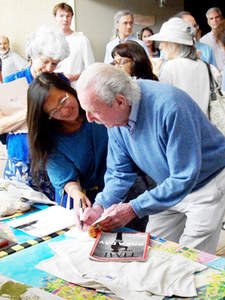
Jerry Yellin signs a copy of his book, “The Resilient Warrior,” which the Warrior Wellness program of the David Lynch Foundation had available for donations after Saturday’s forum. Refreshments were served in the lobby while a four-piece band played music at Fairfield Arts & Convention Center after the program. (Photo by: DIANE VANCE/Ledger photo)

Another TM study is under way at Norwich University in Northfield, Vt. A private university founded in 1819, Norwich is the birthplace of Reserve Officer Training Corps.

Military cadets volunteered to learn Tanscendental Meditation last school year.

Busch shared a video about the study, including feedback from the student soldiers who have practiced TM since autumn.

“At Norwich, we’ve always worried about the whole person,” said Norwich University President Richard Schneider, in the video, dressed in his two-star, major general U.S. Army uniform. “We’ve always concentrated on making very smart and very strong, great leaders; ethical leaders. I think TM will provide us another whole dimension of integrating all that and improving performance in all those areas. I haven’t found anything else that will do that.”

Cadets in the video speak about heavy class loads, being in leadership positions of responsibility and being tired; tired muscles, a tired mind and falling asleep in classes. Meditation brought noticeable change — in being more alert and muscles relaxing during meditation and experiencing a rejuvenated mind.

One student cadet said a difference he sees in his meditating platoon versus non-meditating platoons, is his “platoon is more professional, ‘more locked-on,’ they’re not joking around.

“It makes my job easier [in a leadership position] that the platoon is meditating,” he says. “Meditating definitely enhances their ability to understand what we’re essentially asking them to do. When I was a ‘rook,’ we had to have things explained three or four times before we finally got it right. Now, I can tell my rooks the first time, and maybe a second time and they’re getting it right.”

A freshman cadet said, “We’ve picked up a reputation on campus as ‘those weird people that meditate.’ I kindly point out to them the fact that we don’t fall asleep in class, we’ve got better PT [physical training] scores, we do better on tests, we have better uniforms, we don’t get yelled at as much as they do, and then they quiet down pretty quickly after that.

“I’d say the biggest benefit is the energy,” said the freshman. “In high school, I’d drink a whole thermos-full of coffee each day. I don’t have to do that anymore. It feels good not to have to rely on things like that and be able to do it myself.”

A female senior cadet said in the video she was at first a skeptic.

“Now that I’ve learned [TM], it’s great. I’ve directly seen the benefits. I’m a senior, and I’ve never earned a grade point average over 3.0,” she said. “This semester, I’ve taken 22 credits, four lab sciences and I have a 3.6. I don’t think I got that much smarter all of a sudden. The TM helps me focus so I get more out of study time.”

“ROTC commissions 70 percent of all the officers of the United States,” said Schneider, who with other administrators at Norwich learned TM a short time prior to the cadets’ learning.

“Can you imagine if by this experience at Norwich University, the birthplace of ROTC, we provide a very important tool in these young officers’ tool box they’ve never had the benefit of before; we can influence 70 percent of officers in a very short time. And we owe it to them to give them the best tools to win, and I think this is one of those tools.”

The five-minute, 13-second video is available on the David Lynch Foundation website.

Two of the main speakers Saturday were veterans Jerry Yellin and Luke Jensen.

Yellin, now a Fairfield resident, was a young World War II fighter pilot, who suffered from PTSD for 30 years before learning TM in 1975, “which genuinely saved my life,” he said.

“I’m here today to offer scholarships to any veterans, and their families, who want to learn Transcendental Meditation,” said Yellin who co-chairs the Warrior Wellness program begun in 2010, supported by the David Lynch Foundation.

He related his own story, including his wife’s support. Yellin and Helene married in August 1949.

“She never knew she married damaged goods,” said Yellin. “I know I caused her a lot of suffering. War had wounded me in places that can’t be seen.”

He also introduced Jensen, 33 years old: “No one understands combat like a combat veteran. I’m pleased to introduce my hero, Luke Jensen,” said Yellin.

Jensen, an Iowa native living in Story County, had deployed to Afghanistan in August 2009 as a member of the Army Reserves. He began experiencing severe stress, panic attacks, depression and suicidal thoughts shortly after arriving in Afghanistan.

A story in the Des Moines Register published a year ago, detailed Jensen’s struggles and life back with his wife and two young daughters when he returned home. Yellin had read that story last summer and called Jensen at work the next day and offered David Lynch scholarships to Jensen and his wife, Abi, to learn TM.

Saturday in Fairfield is the first time Jensen has told his story to a live audience. A video with the Jensens was created prior to Saturday, which told some of their story.

“Thank you Jerry for reaching out to me when I was in very dark space,” Jensen said. “Since learning TM in July 2011, I have less anxiety, my blood pressure is down, and I now know this practice has helped veterans from every generation of wars.”

Jensen recounted his story, from aspiring to work in law enforcement and fulfilling that in 2001, to daily suicidal thoughts and drinking to self-medicate in 2010 and 2011. His voice sometimes shook from nerves or emotion. He used the word “ashamed” frequently.

“TM helped my family come out of darkness, it brought me relief and gave me hope for the future,” said Jensen.

Yellin, Travis: TM programs needed for veterans

At Healing the Hidden Wounds of War forum, Jerry Yellin, told about his inspiration to ask for a division of Operation Warrior Wellness to teach Transcendental Meditation to help military veterans.

It came from a personal experience, a tragedy of another soldier’s family that had Yellin pursue a program to help veterans.

“I asked what was the cost of current treatment for veterans with post traumatic stress when I met with the deputy of the V.A. administration,” he said.

The 2006 and 2007 Veterans Affairs cost of mental health support to veterans of all wars, was $15 billion and $18 billion, said Yellin.

“We have so many young veterans who have been to Iraq and Afghanistan,” said Yellin. “They will live another 50 to 60 years … and mental health costs could be $20 billion each year?”

That provides an economic motivation to have Transcendental Meditation programs available on a large-scale basis for veterans, he said.

Fred Travis, a Maharishi University of Management professor and director of the Center for Brain, Consciousness and Cognition, also said larger-scale TM programs are needed for veterans.

“The Veterans Administration will approve TM for a veteran on a one-at-a-time basis,” he said.

“We still recommend that TM is a part of a treatment program, not the only part,” said Travis. “Work with professionals.”

Travis explained how post traumatic stress works on the brain.

“The Amygdala part of the brain tags important events to file away in your memory,” he said. “It tags each detail; it’s permenantly stuck on. Every experience is tagged with strong emotion.

“Post traumatic stress is a natural reaction to unnatural events. So once all these events are tagged with strong emotion, the person now feels they have to be completely in control. You experience hyper-vigilance and can’t rest. We also know from research that when someone is experiencing PTS, the brain’s frontal lobes turn off. The frontal lobes are the ‘CEO’ of the brain. When it’s not functioning properly, you don’t have the brain power to find a solution; you only see the problems,” said Travis.

“TM takes the mind beyond just coping,” he said. “If we could do something beforehand to increase resilience, how much better.”

— Diane Vance, Ledger staff writer

This cover story was posted with permission from The Fairfield Ledger

Other post-event coverage: Mark Newman: Courier: Iowa soldier seeks peace of mind through meditation and medication and KTVO News: How one soldier regained his life with help from WWII veteran and TM for PTSD. Pre-event coverage: WHO TV 13: WARRIOR WELLNESS: Healing Hidden Wounds | Des Moines Register: Fairfield and Ames war veterans team up to bring meditation (TM) to fellow Iowa vets with PTSD | Fairfield Ledger cover article by Diane Vance: Combat stress subject of public forum Saturday | KTVO: Veterans speak out on post-traumatic stress, offer a proven way to heal PTSD | Story County Veteran Once Suicidal Finds Relief from PTSD with Transcendental Meditation: AmesPatch article by Jessica Miller | Healing the Hidden Wounds of War: open forum for Iowa veterans and their families affected by PTSD, sponsored by Operation Warrior Wellness | TM Blog: “TM saved my life”—Suicidal Afghanistan war veteran who suffered from PTSD

Mark Newman: Courier: Iowa soldier seeks peace of mind through meditation and medication

July 30, 2012

Iowa soldier seeks peace of mind through meditation and medication

July 30, 2012

MARK NEWMAN Courier Staff Writer

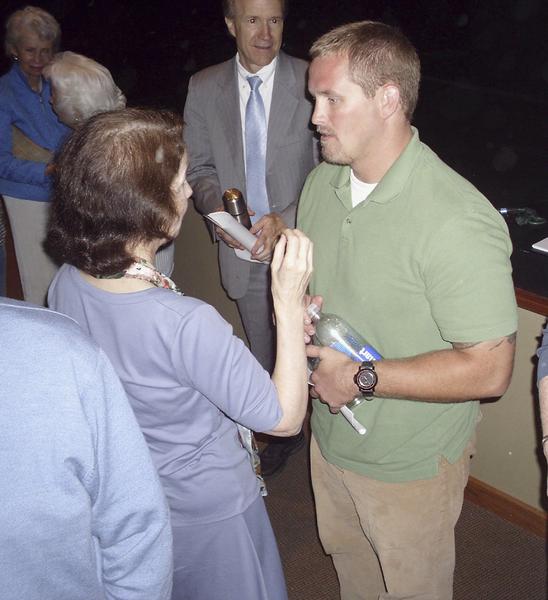
War veteran Luke Jensen from Colo, Iowa, speaks with audience members after taking part in a presentation on post traumatic stress disorder Saturday in Fairfield. A civilian police officer and SWAT team member when his Army Reserve unit was deployed, Jensen thought he was too tough to suffer PTSD. Mark Newman/The Courier

FAIRFIELD — Military police sergeants, civilian police officers and SWAT team members are all supposed to be tough. Luke Jensen was all three, so when the stress of combat began eating away at him, he felt so ashamed, he wanted to die.

Meditation helped correct that desire — and he believes it could help other soldiers and veterans.

Jensen was asked by Operation Warrior Wellness to speak about his experiences with post traumatic stress disorder (PTSD) during a presentation Saturday on PTSD, the military and the advantages of Transcendental Meditation.

“The medical [tents] in Afghanistan were for 10th Mountain Division soldiers who’d been wounded in combat,” said the Nevada, Iowa man.

How could he possibly walk into that tent and tell a medic that he was sad?

He told the Fairfield audience that his base was hit their first night there. Gunshots, explosions and outgoing fire were nearly constant. And the things he saw around him were worse than he felt he could handle.

He couldn’t sleep, he was having panic attacks and in addition to worrying about himself, the staff sergeant had his men to lead.

“I thought I was tough,” he said.

But in a combat zone, his world was out of control. When sent to investigate a report of a little Afghani girl struck by a U.S. vehicle, he found the child dead near the road.

The upset family came to claim her. Jensen contacted the Army’s Criminal Investigation Division then kept people from walking onto the death scene. He had no translator. The locals were getting angrier and more numerous, not understanding why this armed foreigner would want to keep the girl’s body from her family.

Later, someone — Jensen never found out who — ran over and killed a nearby U.S. serviceman.

His nerves couldn’t handle any more. As soon as he was able, he decided to take his sidearm and shoot himself dead. When health personnel he’d sought out heard about his attempt, he was evacuated — which made him feel as though he’d failed in his duty.

At least he could move on with his life. So why did he keep thinking the most logical step would be to take his own life — even when back in the U.S.? He still couldn’t sleep. He still had panic attacks. And he felt a deep sense of shame — especially because while on a U.S. base receiving medical care, he saw the other soldiers who had “real” injuries.

Dr. Fred Travis, a psychologist in Fairfield, said PTSD produces an injury as real as any wound. Travis is the director of the Center for Brain, Consciousness and Cognition at Maharishi University of Management.

CAT scans of patients suffering from PTSD, he said, provide evidence that the brains of sufferers are different from those without PTSD. The effect is physical.

But Jensen didn’t know his brain was short circuited. He was taking medication for depression and anxiety, back in Iowa working in law enforcement. He still wanted to die.

When his police supervisors heard he was suicidal, they began proceedings to terminate him.

“Jerry Yellin saved my life,” Jensen said.

Yellin was a World War II fighter pilot who went undiagnosed with PTSD for 30 years. Transcendental Meditation was what helped him find relaxation and peace. When he heard about the young soldier, he called him.

Yellin got support from MUM and the David Lynch Foundation in order to provide a sort of “scholarship” for Staff Sgt. Jensen and his wife to learn TM.

Jensen thought it’d be worth a try. He had recently made a suicide threat, loaded gun to his head in front of his wife and five-year-old daughter.

The trip to Fairfield was worth it, he said. He learned to find quiet in his mind, which allowed him to relax peacefully for the first time in a long time, he said.

Dr. Travis said what appears to be happening with PTSD is that in a combat zone, the mind naturally must be super vigilant. One needs to be able to see every danger, lock that sound or sight into the memory — and avoid it.

With PTSD, every similar noise or sight becomes a life-or-death situation. Memories of danger are “locked” into the brain. Worse, parts of the mind are “short circuited” so that while the “problem-seeing” part of the brain is stuck in the “on” position, the “problem-solving” part of the brain is off. Desperation develops when all you see are problems — problems with no solution.

By meditating, TM practitioners are trained to go around that damaged part of the brain, Yellin said.

Travis said CAT scans show that, too. There is more blood flow to the frontal lobes and the portion of the brain that is generally considered to be “in charge.”

In a video about their situation, Jensen’s wife said TM saved her husband’s life. Yellin wants more soldiers to have that opportunity, and is working with the David Lynch Foundation as co-chair of Operation Warrior Wellness.

Like other parts of the body, the brain responds to exercise, becoming more resilient.

“If your frontal lobes are more developed, we believe you will be better able to deal with stressful situations,” said Travis.

Presenters said practitioners of meditation are also better able to separate the quiet of inner peace from traumatic situations in the outside world. The military is starting to take notice, as is the Veterans Administration.

Chris Busch, director of programs for the David Lynch Foundation, said the VA has commissioned two large studies to see if TM really shows results.

TM is not a replacement for traditional medicine, he said. It can be, however, one of the options doctors offer mental health patients on their way to recovery.

Yellin said Saturday’s event was the start to an effort to provide scholarships every veteran who needs TM.

For more information, visit www.operationwarriorwellness.org.

Also published in Journal Express of CNHI/SE Iowa.

Other news coverage: KTVO News: How one soldier regained his life with help from WWII veteran and TM for PTSD and WHO TV 13: WARRIOR WELLNESS: Healing Hidden Wounds  |  Des Moines Register: Fairfield and Ames war veterans team up to bring meditation (TM) to fellow Iowa vets with PTSD  |  Fairfield Ledger cover article by Diane Vance: Combat stress subject of public forum Saturday  |  KTVO: Veterans speak out on post-traumatic stress, offer a proven way to heal PTSD  |  Story County Veteran Once Suicidal Finds Relief from PTSD with Transcendental Meditation: AmesPatch article by Jessica Miller  |  Healing the Hidden Wounds of War: open forum for Iowa veterans and their families affected by PTSD, sponsored by Operation Warrior Wellness | TM Blog: “TM saved my life”—Suicidal Afghanistan war veteran who suffered from PTSD

KTVO News: How one soldier regained his life with help from WWII veteran and TM for PTSD

July 29, 2012
How one soldier regained his life
by Tess Hedrick
Posted: 07.28.2012 at 8:11 PM

Published on Jul 28, 2012 by

FAIRFIELD, IOWA — It’s called Operation Warrior Wellness. It is helping war veterans of all ages with Post Traumatic Stress Disorder (PTSD) regain control of their lives through Transcendental Meditation.

“He was the comedian. He was very fun, loved his job, loved his family — very outgoing and just very involved in everything,” said Abi Jensen, wife of a war veteran.

Abi Jensen spoke about what her husband Luke was like before he was deployed to Afghanistan. However when Luke returned from war, it was a very different story.

“He was very angry, very anxious about every situation — social situations, even quiet time at home — he was just, couldn’t ever really relax. Everything caused him anger and anxiety,” said Abi.

Luke Jensen knew he needed to reach out for help when he a hit a breaking point in his life, one neither he nor his family would ever forget.

“One night I drank too much and I actually punched holes through the walls of my home. I pointed a loaded gun at my head in front of my wife and children. And that was — the next day I knew I totally crossed the line and I needed to get help now,” said Luke Jensen.

And that’s where Jerry Yellin came in. Yellin is a WWII Veteran and was suffering from PTSD until he discovered Transcendental Meditation.

Yellin happened to see a front page newspaper article on PTSD featuring Luke Jensen’s story.

“And I spoke to him — told him who I was and what I had been through and what I was doing now. And I asked him if he would come to Fairfield and learn Transcendental Meditation, when he did last August, early August and he got his life back,” said Yellin, Operation Warrior Wellness.

Luke said it’s because of Transcendental Meditation that he is still with his family today and he reiterates a particular message to those suffering from PTSD:

“If you don’t want to do it for yourself, if you’re not willing to get help for yourself, do it for your family. If you love your family, love your children — they don’t deserve to go through stress and anxiety because of, because of your experiences,” said Luke.

Related news coverage: WHO TV 13: WARRIOR WELLNESS: Healing Hidden Wounds  |  Des Moines Register: Fairfield and Ames war veterans team up to bring meditation (TM) to fellow Iowa vets with PTSD  |  Fairfield Ledger cover article by Diane Vance: Combat stress subject of public forum Saturday  |  KTVO: Veterans speak out on post-traumatic stress, offer a proven way to heal PTSD  |  Story County Veteran Once Suicidal Finds Relief from PTSD with Transcendental Meditation: AmesPatch article by Jessica Miller Healing the Hidden Wounds of War: open forum for Iowa veterans and their families affected by PTSD, sponsored by Operation  Warrior Wellness  |  TM Blog: “TM saved my life”—Suicidal Afghanistan war veteran who suffered from PTSD

WHO-TV 13 News: WARRIOR WELLNESS: Healing Hidden Wounds with Meditation for Veterans

July 27, 2012

WARRIOR WELLNESS: Healing Hidden Wounds

July 27, 2012, by for WHO-TV 13 Des Moines, Iowa

One veteran says he’s finally found a way of dealing with his Post Traumatic Stress Disorder after serving in Afghanistan. And, he wants to share his story to help other warriors heal the hidden wounds of war.

Every day used to be a struggle for Luke Jensen. He says, “I was having a lot of anxiety, depression. I was ashamed.”

Jensen served in Afghanistan in 2009. He says he fell apart after a few months of service and sent home. He says, “At the beginning of deployment, I was the guy keeping everybody cheered up and joking around. I thought I was kind of a tough guy people could lean on, and I really just started deteriorating and lost control.”

Jensen says he wasn’t himself when he came home to his wife and two girls. Last July, the Des Moines Register shared his story. World War II Fighter Pilot Jerry Yellin read the article and says, “It’s a devastating story:  At war with PTSD. The next battle for families. “

Yellin saw the article, and as a veteran, recognized his stress. He says, “What I thought was, here’s a guy who needs me. Who needs what I know.”

Yellin says he called Jensen the next day. He invited him to Fairfield to learn a practice called Transcendental Meditation. He says, “A lot of people think TM is a religion, you have to follow the guidelines, but it isn’t. It’s a technique, it’s a mental technique.”

Jensen says the technique was simple for him to learn. He finds a comfortable chair in a quiet place and closes his eyes. For twenty minutes two times a day, he repeats his personal mantra. He says, “It’s just a word that takes you in a deep state of rest and while you’re doing that, you’re getting rid of stress and giving yourself peace and relaxation.”

Jensen says his wife also learned TM. He says it’s given him his life back. He says, “It helped me relax right away. It helped me start getting better sleep, helped me with my anxiety to the point where I got off my anxiety medication completely.”

Jensen will share his story Saturday afternoon. All Iowa veterans are invited to attend with their families. Veterans will learn more about a program called Operation Warrior Wellness that offers scholarships for veterans to learn Transcendental Meditation. The seminar is Saturday, July 28 at 2 p.m. at the Fairfield Arts and Convention Center.

You can find information at www.operationwarriorwellness.org/iowa.

Veteran Meditation video published on Jul 27, 2012 by . Link to article: http://bit.ly/PJehMh.

Related news coverage: Des Moines Register: Fairfield and Ames war veterans team up to bring meditation (TM) to fellow Iowa vets with PTSD  |  Fairfield Ledger cover article by Diane Vance: Combat stress subject of public forum Saturday Veterans speak out on post-traumatic stress, offer a proven way to heal PTSD  |  Story County Veteran Once Suicidal Finds Relief from PTSD with Transcendental Meditation: AmesPatch article by Jessica Miller  |  Healing the Hidden Wounds of War: open forum for Iowa veterans and their families affected by PTSD, sponsored by Operation Warrior Wellness  |  TM Blog: “TM saved my life”—Suicidal Afghanistan war veteran who suffered from PTSD