Archive for the ‘Articles’ Category

Global Union of Scientists for Peace: Open Letter in the Wall Street Journal to the President of the United States and all World Leaders Offering a Proven Technology for Peace, Security, and a Swift Resolution of Conflict

November 5, 2023

See this related new interview with seasoned Indo-American journalist Mayank Chhaya: TM pioneer Tony Nader on achieving peace and harmony

As the world watches on in helplessness the unnerving bloodletting and destruction in Gaza in the aftermath of Hamas’s carnage in Israel, there is someone who genuinely believes that world can fundamentally alter its ways to achieve peace and harmony using Transcendental Meditation techniques. That someone is Dr. Tony Nader, an eminent neuroscientist, successor to Maharishi Mahesh Yogi, a Transcendental Meditation pioneer who is also a medical doctor trained at Harvard University and Massachusetts Institute of Technology. In the runup to an upcoming two-week event titled ‘10,000 for World Peace’ in Hyderabad, India from December 29, Dr. Nader is urging the world to at least attempt to change its violent ways. He spoke to Mayank Chhaya Reports about the event as well as broader themes.

November 15, 2023 press release: International Group of Scientists Offers Proven Solution to Global Conflict.

— Written and compiled (citing sources) by Ken Chawkin for The Uncarved Blog.

Dr. Nidich addresses Ukraine Medical Conference about the effects of Transcendental Meditation on PTSD, depression and sleep problems in veterans, military personnel and other high risk groups

November 5, 2023

November 2, 2023: Dr. Sanford Nidich was invited to present at a Ukraine Medical Conference, Current Status of Personalized Medicine: Global Issues and Prospects for Research. The title of his talk: Effects of Transcendental Meditation on PTSD, Depression and Sleep Problems in Veterans, Military Personnel and Other High Risk Groups. At 9:15 into the video, Dr. Nidich makes a PowerPoint presentation covering some of the related scientific research on Transcendental Meditation (TM). I selected Transcript, copied his talk leading up to the PowerPoint, and added a few hyperlinks. The whole video presentation is 29:25 minutes.

Thank you very much for inviting me to speak to this very prestigious conference, Current status of Personalized Medicine: Global Issues and Prospects for Research. It’s very important that we look at alternative approaches, including personalized approaches to medicine. The field is changing very rapidly, and it’s changing for the better. We’re able to help people progress with their disorders. We’re able to talk about and apply preventative medicine much more readily in a more accepted way than ever before.

Today, I wanted to address you on the effects of Transcendental Meditation on PTSD, post-traumatic stress disorder, depression and sleep problems in veterans, military personnel, and other high risk groups. We’ll be covering a lot of the research that’s been published on this very specific and effective program of Transcendental Meditation that has been taught and researched around the world for over the past 4 to 5 decades. It’s something that millions of people have been practicing in the United States and around the world, that many, many people are practicing in Ukraine.

There’s some initial research that is ongoing right now in Ukraine dealing with mental health issues in women. And there are other projects, perhaps with the military there at early stages that are being planned with Transcendental Meditation.

For transparency purposes, I started Transcendental Meditation in my first year of college at George Washington University in Washington, DC. There was hardly any research at the time that I started several decades ago. And since that time, there’s been over 700 research studies alone on Transcendental Meditation and over 400 peer reviewed independent studies on Transcendental Meditation conducted around the world.

My name is Dr. Sanford Nidich. I’m the Director of the Center for Social Emotional Health and Consciousness Research, Director of the Dr. Tony Nader Institute for Research on Consciousness and Applied Technology, and Professor and the Director of the PhD program at Maharishi International University, the Program on Physiology and Health, particularly Maharishi AyurVeda, which is a traditional system of healthcare utilized by millions of people around the world.

Central to that natural system of medicine is the practice of Transcendental Meditation, which is easy to learn, systematically taught to people everywhere in the world in the same way. And it’s really been something that has been a life-changer for many, many people, from veterans and active military to prison inmates to healthcare providers. In terms of women’s health, in terms of the mental health and academic performance of college students and high school students, and in other specific areas of medicine medicine, such as cardiovascular disease, oncology, and other medical disciplines.

It’s been a program that researchers throughout the world have been researching, including very top researchers in the United States at Columbia University Medical School, University of Michigan Medical School, Georgetown University Medical School, and on and on, Howard University in Washington, DC, Cedars-Sinai Medical Center in Los Angeles, California.

So, it’s a practice that is easy to learn. Produces a unique state of restful alertness whereby during the 20 minutes of practice, the brainwave activity becomes more coherent and orderly, leading to greater executive functioning, memory, other cognitive factors. And at the same time that it’s producing a heightened state of alertness, it’s producing very, very deep rest throughout the whole physiology.

It produces a fourth major state of consciousness beyond waking, dreaming, and deep sleep called a state of restful alertness, or a hypo-metabolic state of wakefulness. Again, where the body noticeably feels and experiences, it exudes a very deep state of rest, while at the same time, we’re still fully alert. It’s not a state of hypnosis. It’s not some program that we just practice once a day, and, you know, and when we feel better, we don’t have to practice it.

We practice it twice a day for 20 minutes. And it’s a lifetime program that we can do once we learn it. And there are people who’ve been practicing Transcendental Meditation for well over 40 years now who have learned it in the 70s and 80s. And the reason they do it is because the human potential is enormous.

Consciousness is the new frontier of medicine. And we can expand consciousness. We can develop our own consciousness, which is the basis of our own thinking and behavior. We can produce greater orderliness and balance throughout the whole physiology, throughout the whole mind and body as a result of enlivening pure consciousness at the very basis of all thought and matter.

So there’s a lot to look forward to. It’s truly a new horizon. It’s causing a new paradigm shift where consciousness is seen to be primary, giving rise to all of our thinking and behavior in a very positive, orderly society, beneficial manner.

So what I’d like to do is, is take my time now to address you and go over some of the key scientific research on Transcendental Meditation. So let me see if I can share my screen so that you can be able to see my slides. So the title of my talk is, Effects of Transcendental Meditation on PTSD, depression, and sleep problems in various high risk populations, and I’ll be covering research principally in these areas.

Go to 9:15 in the video to see the 20-minute PPT containing slides of scientific research presented by Dr. Nidich.

— Written and compiled (citing sources) by Ken Chawkin for The Uncarved Blog.
Recent study shows Transcendental Meditation reduced burnout and enhanced well-being in nurses during the Covid-19 pandemic

November 5, 2023

A new TM study and two related articles on Transcendental Meditation came out in the third week of October 2023. Online Journal of Issues in Nursing (OJIN) published a study showing TM reduced burnout and enhanced well-being in nurses during the Covid-19 pandemic. The Atlanta Journal-Constitution reported on the OJIN TM study, and KFF Health News Morning Briefing highlighted both the AJC article and OJIN study. Separately, Vogue Magazine published a very good article on TM, which also ran in the UK.

First, congratulations to Bob Roth, Kelly Malloy, and DLF on this great TM article in Vogue magazine, Transcendental Meditation Is a Superpower—And It’s as Easy as Two Syllables (and 20 Minutes)! (10/20) I liked the introduction where Corey Seymour describes how he had tried everything, was finally open to learning TM, and shared his surprise at how easy it was. A friend of Corey had learned TM from DLF CEO Bob Roth and she told him about it. Kelly Malloy taught him and Bob said that Corey “was the right guy at the right time…very smart and pure-hearted.” In his article, Corey makes understanding and appreciating TM very accessible. Impressed, I tweeted the article. The following day British Vogue (10/21) also ran the same article.

It came out the same week that KFF Health News had highlighted in their Morning Briefing this Atlanta Journal-Constitution article, Transcendental meditation can reduce nurse burnout, study says, reporting on the new TM study published in OJIN, The Impact of Transcendental Meditation: Reducing Burnout and Enhancing Well-Being in Frontline Healthcare Clinicians During the COVID-19 Pandemic

KFF Health News, a respected national newsroom that produces in-depth journalism about health issues, publishes daily summaries of health policy coverage from major news organizations. Here is what appeared at the top of their Wed Oct 18, 2023 Morning Briefing, which I also tweeted. Their second paragraph is about the AJC TM article.

Warnings That Doctors’ Mental Health Crisis Is Impacting Patients

A story in Vox highlights how resistant doctors are to receiving mental health care or medication. Also: Iowa plans to remove mental health questions from medical license paperwork. Separately, a recent study shows that transcendental meditation can help combat nurse burnout.

Atlanta Journal-Constitution: Transcendental Meditation Can Reduce Nurse Burnout, Study Says

According to a recent study published in the Online Journal of Issues in Nursing, transcendental meditation is effective at reducing burnout and enhancing the overall well-being of nurses. The study is a response to increasing levels of burnout within the healthcare industry, largely exacerbated by the pandemic. According to another recent study, by market research and consulting company PRC, 15.6% of U.S. nurses surveyed reported feeling burnout. (Boyce, 10/17)

The fact that KFF highlighted and positioned the AJC report showing TM as a solution to burnout for nurses juxtaposing it with problems doctors are having with burnout speaks volumes for TM!

As far as I know, the AJC and KFF news reports on this latest important TM study happened naturally without any official publicity efforts!

Nurse Amy Ruff, RN BSN, National Director of Transcendental Meditation for Nurses, told me that Tom and Linda were two of the TM Teachers from the Ann Arbor TM Center who were involved in teaching TM to the nurses in this study through the David Lynch Foundation’s Heal the Healers Now campaign. I asked Tom for some comments about the study and he wrote back with these experiences from the side of the teachers and two of the nurses. 

TM Teachers: It was a great experience sharing this knowledge with healthcare workers during the height of Covid and hearing of the benefit they were having. Witnessing the work load and cultural expectations demanded of these workers in a profession of giving, would turn anyone into an advocate for the improvement of healthcare worker conditions. They all expressed gratitude for the benefits of their regular TM practice and opportunity to learn TM through the DLF HtHN initiative. Here are emails from two of the nurse involved in the study.

First Nurse: Dear Margaret, Kelcey and Tom,

Thank you for the opportunity to participate in the U of M TM RN research study. It was a great honor to be selected and participation has greatly impacted my life and the lives of people around me. These past few months have been very challenging and TM helped me remain balanced, gain clarity and keep a positive attitude. I find myself being able to let go of frustrations more easily, not engage in disruptive situations such as road rage and be able to relax more easily following difficult shifts at work. I have improved relations with the people around me and have been able to improve communication skills in difficult situations. Daily TM practice has been very beneficial to my well-being and positively affected my work as a nurse on a demanding unit.

My long term goal and hope is to get more training and bring what I have learned to my patients.

From the bottom of my heart, I want to extend a sincere thank you to you and behind the scenes team members.

Sincerely,

Gerti Schrattenthaler 

Second Nurse: Good day, 

I completed the survey, sorry for the delay in my responses. Our email system just changed so I no longer had access through my phone to check email. I wanted to let you know how beneficial the TM practice has been for me. It has allowed me to fully relax and recharge. It has helped me cope during the last couple of months which have been extremely stressful with the increase in COVID patients. The practice has been extremely helpful for my mental and emotional well-being. I am so grateful for this opportunity. I hope you get the opportunity to expand the study and allow other healthcare workers to benefit from this wonderful practice. I will continue the TM practice as part of my daily routine. 

— Written and compiled (citing sources) by Ken Chawkin for The Uncarved Blog.
New Study published December 11, 2023 in Journal of Nursing Administration: New study shows Transcendental Meditation significantly reduced PTSD and anxiety in frontline nurses during COVID-19 pandemic by more than half over a 3-month period.

Charles Bukowski’s poem “The Laughing Heart” instructs us to find the light and improve our life

September 28, 2023

“The Laughing Heart” by Charles Bukowski (August 16, 1920 – March 9, 1994) seems to be another of his “death poems,” as his wife Linda referred to them in a January 21, 2011 interview. It was probably written toward the end of his life (73) when he was diagnosed with leukemia and had started Transcendental Meditation (TM).

Linda Bukowski described what TM had done for her husband. “It allowed him to open up a space within himself to say these words about himself dying. These later poems, death poems, are so acute and so awake and aware and I think that had a lot to do with how meditation allowed him to be creative in his later months and write these poems, that I still cannot read.”

The poem, cited on bukowski.net, was written and first published in Prairie Schooner circa 1993, the year before he died. He had learned Transcendental Meditation prior to that and was enjoying practicing it regularly.

Even filmmaker David Lynch, toward the end of a Dec 31, 2006 New York Times article, was quoted as saying that Bukowski liked meditating. “I heard Charles Bukowski started meditation late in his life,” Mr. Lynch said, referring to the poet laureate of Skid Row, who died in 1994. “He was an angry, angry guy, but he apparently loved meditation.”

I later added that information to an earlier post about another death poem, “a song with no end,” in Charles Bukowski sang the life victorious. He carried that same upbeat message in this poem.

The Laughing Heart
By Charles Bukowski

your life is your life
don't let it be clubbed into dank submission.
be on the watch.
there are ways out.
there is light somewhere.
it may not be much light but
it beats the darkness.
be on the watch.
the gods will offer you chances.
know them.
take them.
you can't beat death but
you can beat death in life, sometimes.
and the more often you learn to do it,
the more light there will be.
your life is your life.
know it while you have it.
you are marvelous
the gods wait to delight
in you. 

————————————

Poem written circa 1993, cited by bukowski.net in Magazines and periodicals: Prairie Schooner – 1993; and in Books: The Laughing Heart – 1996; Betting on the Muse – pg. 400 – 1996; Essential Bukowski: Poetry – pg. 209 – 2016.

I also found this video of Tom Waits reading The Laughing Heart.

Footnote: Thanks to Rhonda Thompson Gilpatrick‘s comment on September 19, 2009 pointing out an error in the fifth line of this Bukowski poem that Best American Poetry had posted. The correction was made and works better now.

Love this poem, but you’ve got one of the lines wrong (every site I look at does, though). I have the original printing of this. The line “there is a light somewhere,” should be “there is light somewhere.”

This is an important distinction between a specific light somewhere and light that is universally available somewhere—most likely within first, then without as well.

During Transcendental Meditation, breathing slows down, momentarily suspends; metabolic rate lowers twice as much as in deep sleep; deeply-rooted stresses and strains are released, dissolved, and repaired, respectively; bodily functions normalize; reaction time improves, a host of factors improve indicating a reversal of the aging process. Longtime TM meditators have a biological age of 12-15 years younger than their chronological age—one way “you can beat death in life, sometimes. and the more often you learn to do it, the more light there will be.”

For a more comprehensive picture, see this recently published article: Craig Pearson’s TM article is a cover story in India’s The Week: A Better Brain in 20 Minutes. Meditation research findings at a US university.

— Written and compiled (citing sources) by Ken Chawkin for The Uncarved Blog.

July 5, 2024: I came across a fascinating interview with Charles Bukowski’s wife posted by Read Me A Poem: Bukowski Born Into This INTERVIEWS LINDA LEE BUKOWSKI. Linda mentions when her husband Hank had learned Transcendental Meditation and had practiced it regularly twice a day during the last six months of his life. The whole interview is brilliant. The TM part starts at 6:54. I was happy to hear her speak about his appreciation for TM, but also surprised to hear her describe what she felt when she saw him meditating. It is quite profound and very moving. When he was diagnosed with leukemia, he had stopped writing. TM made a deep impact on his life. He was able to write again. And he wrote the most profound poetry of his life.

More funny Dave Coverly Speed Bump cartoons on how tied up we are with our digital devices

September 2, 2023

Here are more cartoons from Dave Coverly in Speed Bump: A 25th Anniversary Collection. The book is filled with many gems. These two remind us of how tied up we are with our digital devices.

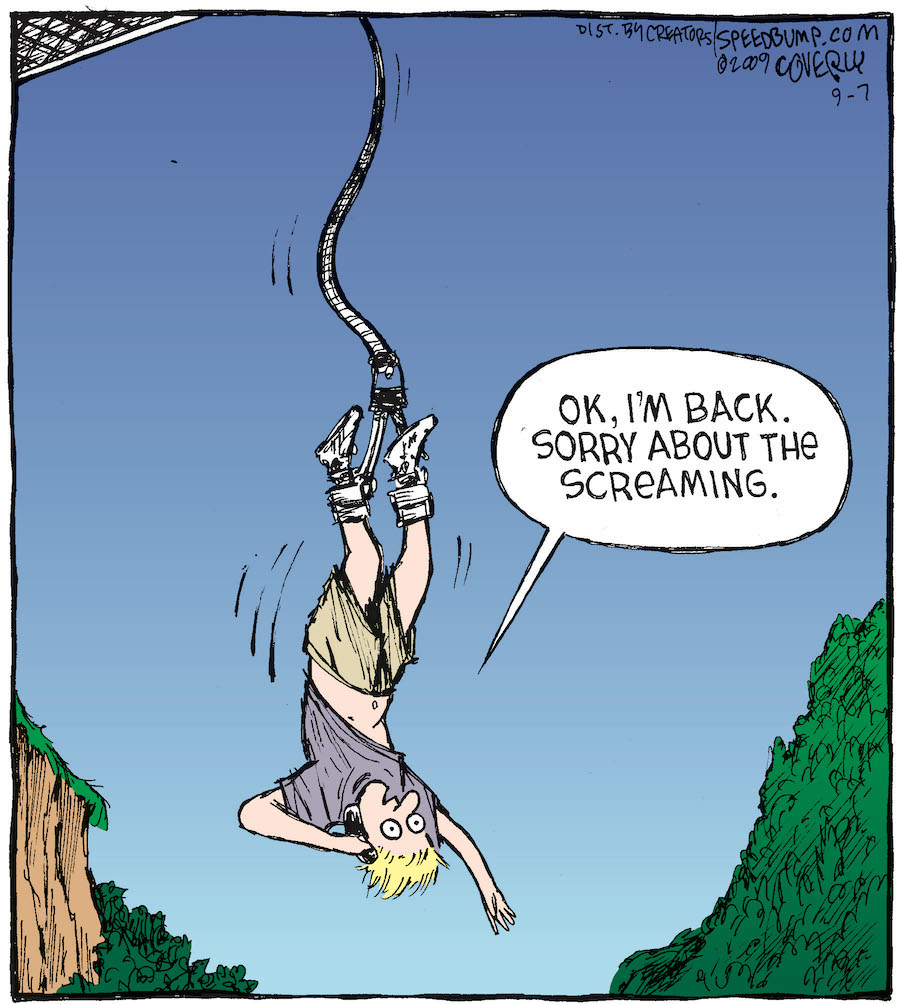
Page 22 shows a bungee jumper hanging upside down still talking on his phone. It was originally published on September 7, 2009 and is as funny today as it was back then.

Page 168 shows a man standing naked in front of his computer screen attempting to answer a verification question. It was first published on September 27, 2018. Very funny!

Dave Coverly was kind enough to send me these funny cartoons for this blog post so I could share them with you. The book’s inspiring and insightful Foreword was written by fellow cartoonist and friend Nick Galifianakis at his mother’s hospital bedside. You can read it on Amazon, along with hilarious cartoon samples from the book by using Look inside. They were so funny I had to buy a copy, which Dave inscribed at his local bookstore, Schuler Books. Amazon also lists his 11 book titles.

Visit Dave Coverly’s website, www.speedbump.com, and read his impressive bio. Follow him on Twitter and Instagram where he is known as speedbumpcomic.

Previous posts on Dave Coverly

Cartoonist Dave Coverly shows dogs begging for food from two perspectives—humans and dogs

Dave Coverly makes dogs appear smarter than humans in these cartoons @speedbumpcomic

More brilliant cartoons from Dave Coverly as he anthropomorphizes a dog and a crash test dummy

— Written and compiled by Ken Chawkin for The Uncarved Blog.

Cartoonist Dave Coverly shows dogs begging for food from two perspectives—humans and dogs

September 2, 2023

Here are two more funny Speed Bump cartoons from Dave Coverly. These deal with dogs begging for food, but from two different perspectives—that of humans and of dogs. I liked these so much, Dave sent me copies of them for posting. This first one came out March 28, 2014. The second one, July 3, 2019, which I posted a month and a half ago.

When I first saw and posted the begging cartoon below, I asked Dave how it came about. He replied: “I don’t recall an exact moment that the idea hit me, as info tends to settle somewhere in my head and doesn’t percolate until later when I’m in my studio and I turn my work brain on. But at the time this was drawn, our pup was still with us, and she was very food oriented. Easy to train thanks to this, but also could get a bit obnoxious with the begging.”

Dave went on to say it was entirely possible that his wife had said, “can I get you anything” and that he “made a mental note to convert that into a dog’s world!” And he certainly did! He turned what must’ve felt like a human’s frustrated sarcastic remark into a sincere request from a dog’s perspective. I laugh every time I see this cartoon, it’s that funny.

Visit Dave Coverly’s website, www.speedbump.com, and read his impressive bio. Follow him on Twitter and Instagram where he is known as speedbumpcomic.

Previous posts on Dave Coverly

More funny Dave Coverly Speed Bump cartoons on how tied up we are with our digital devices

Dave Coverly makes dogs appear smarter than humans in these cartoons @speedbumpcomic

More brilliant cartoons from Dave Coverly as he anthropomorphizes a dog and a crash test dummy

— Written and compiled by Ken Chawkin for The Uncarved Blog.

Dave Coverly makes dogs appear smarter than humans in these cartoons @speedbumpcomic

August 10, 2023

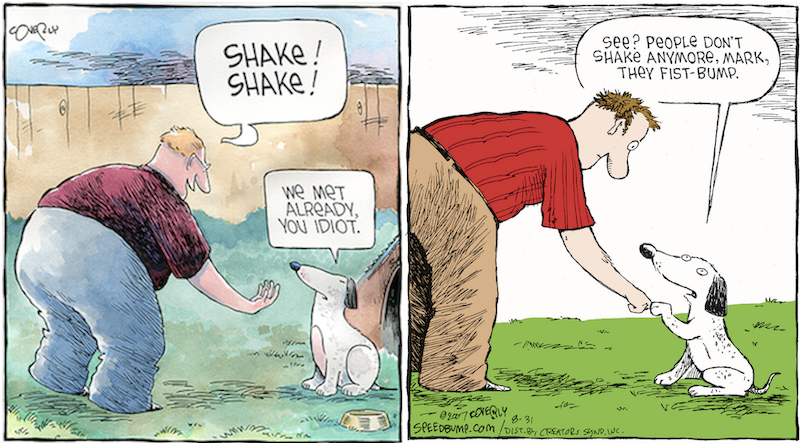
While reading Dogs Are People, Too by Dave Coverly, I noticed three funny cartoons that deal with greetings between humans and dogs. They show an evolution on the part of dogs—they’re smarter than humans! (Click on a panel to enlarge it, then on the top left arrow to come back.)

About Dave Coverly and Speed Bump

Dave Coverly is the creator of the cartoon panel “Speed Bump”, which runs internationally in hundreds of newspapers and websites. His work was named “Best in Newspaper Panels” by the National Cartoonists Society in 1995, 2003, 2014 and 2022. In 2009 the same organization gave him its highest honor, the prestigious Reuben Award, for “Outstanding Cartoonist of the Year”. See his impressive bio, which includes a photo of Dave with his dog Macy.

Amazon lists his 11 book titles where you can look inside to see some of his cartoons. Dave’s local bookstore, Schuler Books, also carries his books and is set up for him to personally inscribe copies for customers.

Visit Dave Coverly’s website, www.speedbump.com, and follow him on Twitter and Instagram where he is known as speedbumpcomic.

See More brilliant cartoons from Dave Coverly as he anthropomorphizes a dog and a crash test dummy with links to more of Dave’s cartoons as well as the work of other funny cartoonists listed at the bottom. Later added these Dave had sent me: Cartoonist Dave Coverly shows dogs begging for food from two perspectives—humans and dogs. And these: More funny Dave Coverly Speed Bump cartoons on how tied up we are with our digital devices.

— Written and compiled by Ken Chawkin for The Uncarved Blog.
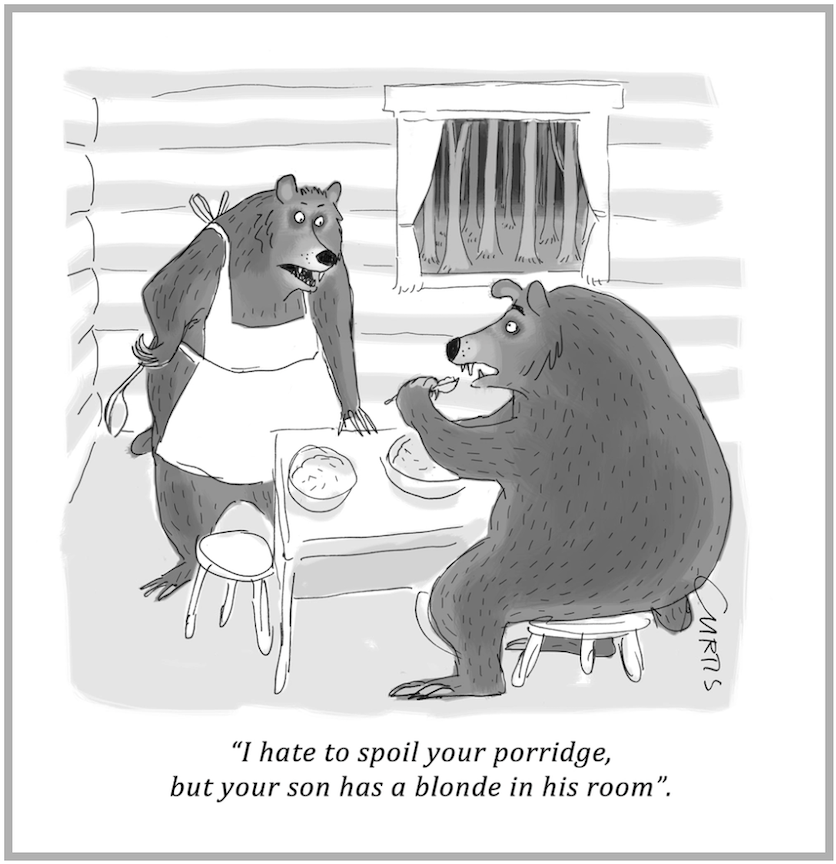
A clever twist on a classic fairytale by Kate Curtis

July 25, 2023

Enjoy this clever twist on a classic fairytale by cartoonist Kate Curtis @curtiscartoons. This is so funny because Kate took a favorite children’s bedtime story — Goldilocks and the Three Bears — and put a whole new spin on it! It seems Baby Bear is all grown up now, but still lives at home.

Did he finally get together with that naughty, now older Goldilocks!? Kate also reminds us though that Goldilocks was a home invader.

Read more About Kate in her interesting bio on her blog, Clues to Life, where she posts a cartoon daily.

Other funny cartoonists

See More brilliant cartoons from Dave Coverly as he anthropomorphizes a dog and a crash test dummy. Also see Funny cartoons make us laugh ‘cuz they’re true, which include links to them. I include Gary Larson’s cartoons are funny because they make us see the unexpected humor in things. And compiled 3 Cartoonists show us the pressure some people put on their pets and how they try to deal with it.

I updated Cartoon wisdom from Karl Stevens appears in this week’s print edition of The New Yorker, since he just appeared at Comic-Con with the multi-talented Jamie Lee Curtis and director Russell Gordon to discuss their newly published graphic novel, Mother Nature. Due to the current strike they could not talk about the film, which is in preproduction.

— Written and compiled by Ken Chawkin for The Uncarved Blog.

More brilliant cartoons from Dave Coverly as he anthropomorphizes a dog and a crash test dummy

July 13, 2023

Cartoonist Dave Coverly has a clever knack for anthropomorphizing animals with ordinary human speech. Here’s an example with a dog that just cracks me up.

He uses a similar approach blending both worlds when humanizing a crash test dummy in this New Yorker cartoon.

Here are a few more of his funny cartoons I’ve enjoyed in the past: about an old wolf that any senior can relate to; what a young wolf tells another will happen if they play nice with humans; what your dog is up to wondering when you’ll be back home; the frustrations of a wannabe author; and contemplating the central question in the Directory at the Institute of Philosophy, which complements an earlier one about the Center for Reincarnation Studies. That cartoon was so good, I used it to highlight a post about Coming Back for Love in Five Romantic Films.

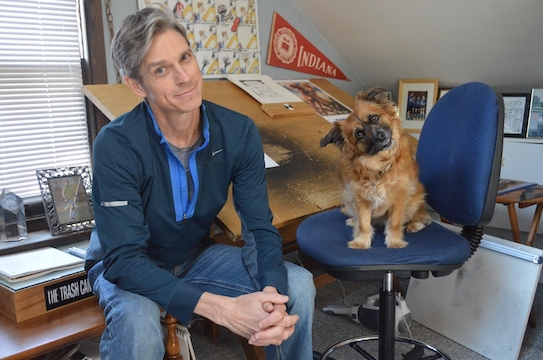
Dave Coverly, (with assistant Macy), creator of the cartoon panel “Speed Bump”, which runs internationally in hundreds of newspapers and websites.

His work was named “Best in Newspaper Panels” by the National Cartoonists Society in 1995, 2003, 2014 and 2022. In 2009 the same organization gave him its highest honor, the prestigious Reuben Award, for “Outstanding Cartoonist of the Year”. (See his impressive bio.)

Follow Dave Coverly, aka, speedbumpcomic, on Twitter and Instagram. Visit his website, www.speedbump.com. Amazon lists his 11 book titles.

I later sent Dave a tweet asking him which book the dog cartoon appears in and which one he’d recommend with this kind of human transference to animals sense of humor since I wanted to buy one. I’m adding this information in case you’re also interested in ordering one of his books for yourself or as a gift for someone.

He replied: “This one is in Dogs Are People, Too – my local bookstore is set up so I can personalize copies if you’re interested (they do that for all my books). Just let me know in the comments box how you’d like it inscribed!”

Update: I’m glad I ordered it, but that cartoon was not in the book. Dave later apologized recalling that it must’ve missed the deadline to make it into the book and offered to send me a print of it. He also sent me a digital copy of it along with copies of some of the dog cartoons I liked from the book for posting.

I asked him if it was in Speed Bump: A 25th Anniversary Collection. It was not. The Foreword was written by fellow cartoonist and friend Nick Galifianakis at his mother’s hospital bedside. You can read it on Amazon, along with cartoon samples from the book. The Foreword is so well written, the cartoons so funny, I ordered a copy from Schuler Books, where Dave will personalize it with an inscription.

Also see: Funny cartoons make us laugh ‘cuz they’re true. They include links to many others. I later added: Gary Larson’s cartoons are funny because they make us see the unexpected humor in things. Then followed up with Cartoonists show us the pressure some people put on their pets and how they try to deal with it. Just added this new one: A clever twist on a classic fairytale by Kate Curtis. And this latest one, which contains three of the ones Dave sent me: Dave Coverly makes dogs appear smarter than humans in these cartoons @speedbumpcomic. Added these Dave had sent me: Cartoonist Dave Coverly shows dogs begging for food from two perspectives—humans and dogs. Followed by these: More funny Dave Coverly Speed Bump cartoons on how tied up we are with our digital devices.

— Written and compiled by Ken Chawkin for The Uncarved Blog.

Craig Pearson’s TM article is a cover story in India’s The Week: A Better Brain in 20 Minutes. Meditation research findings at a US university.

July 9, 2023

Craig Pearson wrote a cover story on TM research at MIU for The Week’s Yoga Mid-Year Special (July 9, 2023): A BETTER BRAIN IN 20 MINUTES. Meditation research findings at a US university.

The print version is a 6-page spread: A BETTER BRAIN IN 20 MINUTES. A centre for research in America records increased intelligence and improved health in people who practice Transcendental Meditation. (Pages 86-91) Below is the online article with its own title and subtitle.

How about a better brain in 20 minutes?

Transcendental Meditation can increase intelligence and improve health

By Craig Pearson | Issue Date: July 09, 2023 | Updated: July 02, 2023 07:29 IST

A fourth-year college student named Amanda walks into the laboratory and drops her backpack on a nearby chair. She has just finished her afternoon class on human resource management. The lab director, Dr Fred Travis, greets her and motions her to take a seat in front of the window. As they exchange small talk, Travis places a red cloth cap over the top of her head. It looks something like a ski cap, except for one thing―it has 32 sensors attached to it, connected to an electroencephalograph (EEG) machine that will measure the electrical activity of Amanda’s brain at 32 different points.

He monitors Amanda’s brainwave activity for the next few minutes to establish baseline readings. Then he asks Amanda to close her eyes and continue to sit quietly for a few more minutes. All the while wavy lines are moving across the computer screen, left to right.

Then he quietly instructs her to begin her practice of Transcendental Meditation―and in less than a minute, the waves change dramatically.

It’s clear to the naked eye, without analyzing the signals, that Amanda’s brain has shifted to a significantly more integrated, coherent style of functioning. That is, the different parts of her brain are communicating much more efficiently and effectively with each other.

Outwardly, Amanda appears simply to be sitting comfortably with her eyes closed. But inside, she is experiencing a fourth major state of consciousness.

Travis directs the Center for Brain, Consciousness, and Cognition at Maharishi International University (MIU) in Fairfield, Iowa, in the United States. He is one of the world’s leading scientists in the area of brain functioning and higher human development, with special focus on how the technique of Transcendental Meditation affects brain functioning and promotes personal growth.

Founded in 1971 by Maharishi Mahesh Yogi, the noted Vedic scholar and scientist of consciousness, MIU is accredited by the Higher Learning Commission. It offers bachelor’s, master’s and doctoral degrees in a wide range of subjects, from art to computer science, from creative writing to sustainable living, from regenerative organic agriculture to Ayurveda. Three quarters of its students come from outside the US, and the student body represents more than 80 countries.

All faculty, staff and students, as well as hundreds of members of the surrounding small-town community, practise the Transcendental Meditation technique. The technique, learned from a certified TM instructor, is a simple, natural, effortless procedure practised for 20 minutes twice each day while sitting comfortably with the eyes closed. It allows the mind to settle inward into a state of quiet―to “transcend,” or go beyond, the constant stream of thoughts and perceptions that fill the mind.

MIU has been a centre for research on Transcendental Meditation since its founding. Its first president, Robert Keith Wallace, conducted the first research on the technique while a PhD student at UCLA. Within two years, he had published his research in Science, Scientific American and the American Journal of Physiology.

His findings were striking. He found that during TM practice, as the mind settles inward, the body settles down into a uniquely deep state of rest, reflected in decreased heart rate, decreased respiration rate, and increased skin resistance. Yet the mind remains entirely awake―more awake than ever, in some respects―reflected in increased EEG alpha activity in the brain.

This combination of deep rest and heightened wakefulness had never been seen before in a laboratory. Wallace described it as a “wakeful hypometabolic state”―“restful alertness,” in simpler English―and he declared it to be a fourth state of consciousness beyond the three familiar states of waking, dreaming, and sleeping.

Wallace was studying the classic state of samadhi, known in the Upanishads as turiya, “the fourth,” and termed Transcendental Consciousness by Maharishi.

This exalted state had been known and celebrated for millennia, in India and in traditions around the world. But Wallace was uncovering the constellation of changes that occur in body during this restfully alert experience―its “neurophysiological correlates.”

The TM technique does not involve focusing or concentrating the mind or attending to one’s thoughts or one’s breathing. It is not “mindfulness.” One does not try to control one’s body’s functions, as in biofeedback. The technique is effortless.

One student describes her experience during TM practice in this way: “I have the experience of transcending all activity and experiencing awareness as an unbounded unity. There is no longer any sense of ‘me’ and ‘not me,’ no longer any thought or feelings or even a body, just the Self, and that is all there is, and that is all I am.”

Yet this simple and natural experience of transcending leads to a host of physiological changes, all in the direction of rest, repair, and balance.

Wallace’s publications sparked a wave of research on the TM technique that has continued to this day. To date, research has been conducted at more than 250 universities and research institutes around the world, and studies have been published in more than 170 journals in a range of fields.

These studies have further detailed the striking physiological changes that take place during the technique. They have also looked at the long-term effects, where the findings have been equally remarkable. These include improved health, increased intelligence (IQ) and creativity, increased self-esteem and self-actualisation, and improved interpersonal relationships.

Many of these findings are notable because they had also never been seen before in modern science. For example, intelligence and creativity grow through childhood but level off in adolescence. Yet with TM practice, these values resume growing regardless of age. TM practice “unfreezes” their growth.

Wallace predicted that, given the TM technique’s ability to dissolve stress, it may affect the rate at which the body ages. Physiologists distinguish between our chronological age (our age in years) and our “biological age”―the age of the body as determined by a cluster of measures.

Wallace found that people who had been meditating more than five years were biologically 12 years younger than their chronological age. Several other studies found that TM practice can extend lifespan by 23%.

One of the most dramatic findings emerged from health insurance statistics. David Orme-Johnson, then chair of MIU’s psychology department, tracked 2,000 people over a five-year period across the US who practised the TM technique.

The data was collected by Blue Cross, the health insurer. The statistics for the meditation group were compared with those of a control group selected by the insurance company to match the TM group for age, gender, education, profession and insurance terms.

The result: The TM group went to hospital 56% less often for illness or surgery. The differences between the TM group and the control group were significant in all age groups but most conspicuous in older groups. The TM group also required 50% fewer doctors’ visits. The TM meditators had not become disenchanted with doctors―for maternity, they used health care just as much as the control group.

Starting in 1990, research on cardiovascular health became a major focus at MIU. Over the following years, the US government’s National Institutes of Health (NIH) invested more than $25 million dollars in MIU’s research on TM and cardiovascular health. With this support, MIU professor Robert Schneider and his colleagues, in partnership with universities around the US, conducted a series of studies that made headlines worldwide.

Cardiovascular diseases are the leading cause of death globally, according to the World Health Organization, accounting for 32% of all global deaths. Yet modern medicine has failed to cure or even curb this disease or even pinpoint the cause. It has only identified the risk factors.

This is why Schneider’s studies were so newsworthy. He and his teams found that TM practice shows great promise for preventing and even curing cardiovascular disease.

They focused first on hypertension, a leading risk factor for heart disease. They tested the TM programme on elderly African Americans, who have 50% more hypertension than white Americans, twice the level of cardiovascular disease, and a far higher rate of deaths from it. This is because they’re subject to higher chronic socio-environmental stress.

But when they learned the TM technique, their blood pressure dropped significantly, as much as with standard drug treatments―but with no side effects, with higher patient compliance, and at far lower cost. The meditating group also lived longer. Compared with the control group, those in the TM group were 23% less likely to die from any cause, 30% less likely to die from heart disease, and 49% less likely to die from cancer.

In these studies, the subjects made no changes in their diets or exercise habits. The effects were solely due to the regular experience of transcending using the TM technique.

Studies found that TM practice reduces other leading risk factors for heart disease, including cholesterol and free radicals, smoking and alcohol abuse, and psychological and socio-environmental stress.

Prevention is the best medicine, but for those who already have heart disease, Schneider and company also found that TM practice can actually reverse its damaging effects. TM practice unclogs arteries and reverses atherosclerosis. It reverses enlargement of the heart (left-ventricular hypertrophy). The practice even reduces the severity of congestive heart failure―and heart failure is the end result of all heart diseases. Again, subjects in these studies made no other changes in their lifestyle beyond their TM practice.

Turning their attention to another global epidemic, Schneider and company found that TM practice significantly reduces the risk of diabetes. One study found that after just 16 weeks of TM practice, patients with both heart disease and type 2 diabetes not only had lower blood pressure, but had also significantly better blood glucose and insulin levels―signifying reduced insulin resistance and more stable functioning of the autonomic nervous system.

“This research shows that the Transcendental Meditation technique helps the body tap into its inner intelligence and normalise function,” Schneider said. “These subjects simply transcended regularly, and their cardiovascular and endocrine systems regained more perfect balance.”

Travis has most recently been looking at how the integrated brain functioning characteristic of TM practice increasingly persists even outside of meditation―over time it becomes the brain’s normal style of functioning.

The computer-generated drawings (above) illustrate alpha-range EEG coherence and how it increases during TM practice―and then increasingly becomes the brain’s normal style of functioning even outside of meditation.

The lighter lines show coherence (communication) between the two linked brain areas of about 70%, the heavier lines coherence of 80% or higher (100% is perfect coherence). The more effectively the various brain areas communicate, the better the brain performs.

“These are really remarkable findings,” Travis said. “Before we started researching the Transcendental Meditation technique, we had no idea that the brain could function with this exceptional level of integration. And now we’ve learned that we can cultivate the brain to function in this way all the time.”

This is also remarkable, because the higher one’s level of brainwave coherence, the greater one’s intelligence, creativity, moral maturity, learning ability, and many other positive values, according to research studies at MIU and elsewhere.

MIU students have the option of receiving a Brain Integration Progress Report. Students have their brainwave coherence measured shortly after they enroll and then again shortly before they graduate, to see how much their brain integration has increased during their years at MIU.

“This is a remarkable contribution to education,” Travis says. “And any school, college or university can implement this same approach and give their students these same benefits, without any changes to their curriculum apart from setting aside two short periods for Transcendental Meditation practice.”

Travis is often asked whether other meditation techniques produce these same results.

“Different meditation techniques involve different mental procedures,” Travis explains, “and therefore they produce different modes of brain functioning.

For example, meditation techniques that involve focusing or concentrating the mind―known as focused attention techniques―produce beta/gamma activity in the brain, typical of any active mental processing.

A second category of techniques, called open monitoring, includes mindfulness procedures, which involve monitoring aspects of one’s experience―one’s thoughts, breathing, sensory perceptions, physical sensations―without evaluating them. These procedures induce theta activity in the brain, seen when people reflect on mental concepts.

The third category, which includes the Transcendental Meditation technique, is called automatic self-transcending. It involves procedures that transcend their own activity, enabling the mind to go beyond (transcend) the meditation process and into the experience of pure consciousness. These techniques elicit frontal alpha-1 coherence, indicating the brain’s executive control centre is functioning in an integrated manner.

“All meditation techniques are not the same,” Travis says. “Other procedures have their value. But so far only the TM technique has been shown to produce this integrated and coherent style of brain functioning along with the wide-ranging constellation of benefits that studies have found.”

Over the past 40 years the technique has been applied in a variety of practical fields, where it has been studied by MIU scientists and others.

In schools, when students and faculty learn the practice, IQ and creativity increase, students’ grades increase, graduation rates increase, and overall school climate improves.

In companies, when managers and employees learn the TM technique, stress declines, illness and absenteeism decline, cooperation increases, productivity increases, and the companies become more profitable.

In prisons, when inmates learn the technique, they sleep better, their health improves, they commit fewer infractions, and most important, they return to prison at a far lower rate than non-meditating prisoners.

Among veterans suffering from PTSD (post-traumatic stress disorder), when they start TM practice, their symptoms decrease markedly, and they reintegrate into their families and the workplace more quickly and easily.

How can such a simple technique produce such a wide constellation of benefits―for cognitive development, for health, for personality growth and interpersonal relationships?

“It’s all about the experience of transcending,” Travis said. “The experience is simple, natural, and incredibly profound. It dissolves stress and resets and rebalances the whole mind-body system. Maharishi likens it to watering the root of a tree, where a single act nourishes the tree’s countless leaves and branches. ‘Water the root to enjoy the fruit,’ he said. Consciousness is the most fundamental value of life, and now we know we can cultivate and improve our lives from that deepest level.”

Craig Pearson, PhD, has served as executive vice president and vice president of academic affairs at Maharishi International University and is currently special assistant to the president. He is the author of The Supreme Awakening: Experiences of Enlightenment Throughout Time ― And How You Can Cultivate Them. He would like to thank David and Arlene Leffler and Fred Travis. (Hyperlinks added.)

— Posted with permission from the author for The Uncarved Blog.

See this interesting related post: Bob Roth explains why and how TM is different from other types of meditation. See these previously published related studies: New study highlights unique state of “restful alertness” during Transcendental Meditation (fMRI shows increased blood flow to frontal areas of brain and decreased blood flow in pons and cerebellum), and Research validates the defining hallmark of Transcendental Meditation — effortlessness (The high activation in the default mode network, as well as the fact that the frequency of transcending is the same regardless of how long one has been practicing, together contrast Transcendental Meditation with other meditation practices). See this earlier study: Transcendental Meditation activates default mode network, the brain’s natural ground state. Feb 9, 2024: MIU News: Striking public demonstration of link between brain functioning and the Maharishi Effect (video) by Craig Pearson.