Michael Braunstein wrote a great article for The Reader’s Heartland Healing Magazine in Omaha on Jan 13, 2019. It’s a fascinating story of how he learned about Transcendental Meditation when he worked as a recording engineer in a studio where famous musicians like Paul McCartney and George Harrison showed up. But more specifically from a meditating musician some of you may remember from the early days at MIU. Enjoy reading Meditate. Your Mind Wants To.
Let’s get something straight right out of the box: You do not have to sit funny in order to meditate. All that is necessary to meditate is to learn it correctly then apply it. Since learning Transcendental Meditation in 1984, I have meditated in airports, hospital waiting rooms, sitting in the stands at soccer games, in the lobby of a busy Manhattan office building, on mountain tops and in quiet, darkened spaces wafting with incense, all with unequivocal success. Meditation doesn’t require special needs. Look, meditation is a natural state of mind that the mind craves. It’s healing. It’s transformative. And it’s easy. All you have to do is learn it correctly.
All About the Bass. You can’t start a tracking session without the bass player and the bass player was late. So I was on my knees in the studio dressing cables and doing busywork as we waited. A bass guitar case plopped on the floor right in front of me. I looked up. I stammered, “You must be the… bass… player.” The hesitations came because the “bass player” was Paul McCartney.
It was back in my LA days as a recording engineer. During the next 14-plus hours of cutting a track, McCartney’s demeanor impressed me. Accustomed to over-amped and often crazy rock ‘n’ rollers in those days, I will never forget his gentle presence and the restrained command he offered the session. The details of the recording session are unimportant but the impression he made on me as a person remained powerful. A few months later, working on a different record with George Harrison, I observed the same sense of centered-ness and clarity.
Another musician I worked with had a similar demeanor in the studio. Readers wouldn’t recognize his name but he, Harrison and McCartney share a common link. This third musician had an even deeper effect on my life. He was the ultimate catalyst that made me decide I wanted to learn how to meditate.
My Two Cents. Ron Altbach was executive producer of a major live concert album and television broadcast I engineered. It starred the Beach Boys, America, Ringo, Hank Williams, Jr., Julio Iglesias, Three Dog Night and a host of others. It was a complex project and required a lot of technical expertise both on the day of recording and in post-production. Some of the problem-solving techniques of the day included me standing around in the control room with my techie assistants mulling solutions. As we geniuses would banter about which way to proceed, on more than one occasion, from the back of the room came a quiet and unassuming comment, usually along the lines of, “What if you…? Would that work?” The speaker was Ron. And each time he was right.
After two or three of his successful suggestions, I said to him, “Ron, you’re not an engineer or tech. How are you coming up with these solutions? Where’s that coming from? You seem to see things in a clear overview.” His answer was simple: “I think because I meditate, I’m able to assess situations more clearly.”
We talked about the meditation he learned, Transcendental Meditation, and it stuck with me. Three months later I learned TM at the Beverly Hills TM Center on 3rd Street. It took four sessions over 5 days and was easy. It wasn’t free or even cheap to learn. But it may go down as the most valuable thing I ever spent money on. Extrapolated over the 34 years since, it’s worked out to about two cents a day. And it’s becoming a better deal everyday.
On May 7, 2018, Dr. Travis gave a presentation at the Gordon Institute of Business Science at Pretoria University in Johannesburg, South Africa:Achieving Career Excellence through Mind/Brain Development. This forum explores the essential role that mind/brain development plays in enhanced performance.
Research indicates that the level of mind-brain development underlies excellence in all fields of life. Higher brain integration is associated with higher emotional stability, more openness to experience, greater creativity, and greater problem-solving ability. Research shows that world-class professional athletes, top-level managers, and professional musicians have higher levels of brain integration.* This forum explores the different factors that influence brain integration and performance.
Dr. Fred Travis earned his Ph.D. in 1988 from Maharishi University of Management and after a 2-year postdoctoral position returned to Maharishi University of Management to direct research in the Center from Brain, Consciousness, and Cognition. He has authored over 80 papers that investigate the relation between natural human development and lifestyle choices on brain functioning and personal and professional success. He has lectured extensively in North and South America, Europe, and Asia.
The GIBS Business School published two videos of his talk on their YouTube channel May 14, 2018: Dr Fred Travis – Mind-Brain Development for Excellence (4:15). Dr. Fred Travis, Director of the Center for Brain, Consciousness and Cognition at the Maharishi University of Management, says studies have found that that a certain level of mind-brain development underlies excellence in all fields of life.
Seated up front is a subject with EEG leads taped to his head and EEG signatures projected onto the screen behind him. A meditation demonstration must have been done, but that footage is not included in these videos, just a screensaver of it for the second video.
Towards the end of the first video Dr. Travis mentions the Transcendental Meditation technique as a practical tool to help you develop excellence in whatever field you’re in. That theme is more developed in this second video:Dr Fred Travis – Meditation Develops Brain Coherence (5:35). MUM/CBCC Director Dr. Travis believes that meditation develops greater coherence across the brain and aligns the flow of information.
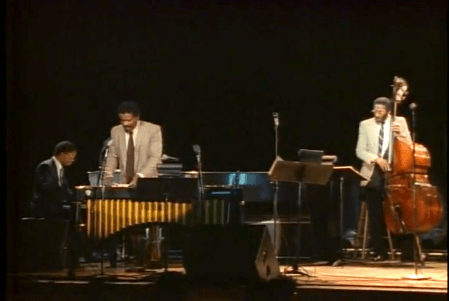
The first time I heard jazz vibraphonist Bobby Hutcherson play was with pianist Herbie Hancock and bassist Ron Carter performing Bouquet. It was on a Netflix DVD, One Night With Blue Note: The Historic All-Star Reunion Concert, recorded live for Blue Note’s 50th anniversary at New York’s Town Hall on February 22, 1985. When the historic Blue Note record label was revived in 1985, this all-star concert was held bringing together their legendary roster of musicians, a who’s who of jazz.
The concert was great! It opens with Herbie Hancock performing his popular tune Canteloupe Island featuring Freddie Hubbard on trumpet, Joe Henderson on sax, Ron Carter on bass, and Tony Williams on drums. But I bought the DVD primarily for Bobby’s beautiful ballad Bouquet.
Now, years later, I searched the internet and found the concert, as well as just the performance of Bobby Hutcherson’s Bouquet with Ron Carter and Herbie Hancock. The YouTube video includes the short introduction from the DVD. This excerpt on Dailymotion doesn’t, but the quality is better. The audience was so moved they applauded before the piece was actually finished, but the musicians quietly played on to the end.
You can hear Bouquet on Hutcherson’s album Happenings in the Remastered 2006/Rudy Van Gelder Edition. This slightly mellower version includes Herbie Hancock on piano, Bob Cranshaw on bass, and the smooth brush work of Joe Chambers on drums. It’s about a minute longer than the concert version and has a rich clear tone.
The three hours of brilliant performances were distilled down to the two-hour DVD, One Night With Blue Note All-Star Reunion Concert. You can see it here, or in this larger format. It’s also available in better quality on Dailymotion divided into two one-hour sections: Part 1 and Part 2.
I later found the 2-hour video on YouTube: One Night With Blue Note (1985) – Considered one of the greatest nights in Jazz history, this film documents the reunion of 30 jazz greats from the Blue Note label filmed at Town Hall in New York City on February 22nd, 1985. Click here for the Highlighted comment of the Tracklist and Musicians.
The good rain knows its season,
When spring arrives, it brings life.
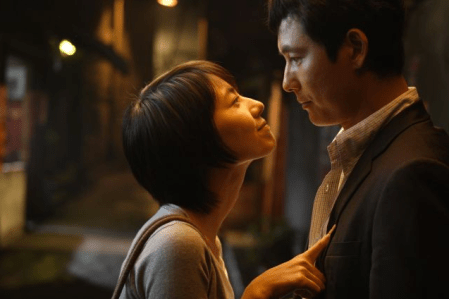
I appreciate believable romantic movies. For some reason this one deeply moved me. I’ve watched A Good Rain Knows (when to come) (2009) several times. Also titled, Season of Good Rain, the film’s theme was inspired by a poem from Du Fu (Tu Fu). Love, like the right season, can come around again and potentially renew one’s life.
HUR Jin-ho directs this Korean-Chinese co-production. The love story stars South Korean actor Jung Woo-sung (Dong-ha) and Chinese actress Gao Yuanyuan (Mei).
Synopsis: Timely like the spring rain, so has he come back into my life… Dong-ha is a thirty-something Korean man on a business trip to Chengdu, China where his company is carrying out construction projects to rebuild the city after the earthquake of 2008. There, totally by chance, he meets an old friend from his school days in the U.S.. Mei (May) is originally from Chengdu, the capital city of Sichuan Province. She returned home after graduation and now works as a tour guide. Dong-ha and Mei were perhaps more than friends and had feelings for each other back then, but they parted ways before they had a chance to define or declare them. Now that their paths have crossed again, they find the old feelings remained, and new ones are forming that may resemble love.
The good rain knows its season,
When spring arrives, it brings life.
It follows the wind secretly into the night,
And moistens all things softly, without sound.
On the country road, the clouds are all black,
On a riverboat, a single fire bright.
At dawn one sees this place now red and wet,
The flowers are heavy in the brocade city.
The brocade city is Chengdu, in south-west China, where the story takes place. The park where Mei works contains a statue of Du Fu and a replica of the hut that he lived in, along with the kind of flowering trees he had planted. Dong-ha was also a poet, but got caught up in his work instead. He is later seen reading a poem by Du Fu titled, A Spring View.
Though a country be sundered, hills and rivers endure;
And spring comes green again to trees and grasses
Where petals have been shed like tears
And lonely birds have sung their grief.
…After the war-fires of three months,
One message from home is worth a ton of gold.
…I stroke my white hair. It has grown too thin
To hold the hairpins any more.
The subject matter about the destruction of war from the past resonates with the physical and emotional losses in the city after a recent earthquake. Mei’s life was also affected, as we find out later in the film.
Maybe sometime
It could be here again.
Trying to find out.
We don’t know yet.
Maybe it’s something
To make us come around.
The rain will be something
To let me calm down.
There is silence
Flowing around me
In the air
When you approach.
Maybe it’s something
To make you turn around
The raining is something
Just holding me now.
(Musical bridge)
I know that you wonder
Where we stay around.
Maybe I found you
Always here in my mind.
It’s falling around me
I’m feeling like lost in time.
I’m waiting behind you.
Just don’t let me down.
You’re running away now.
You’re sinking in flowing time.
The raining reminds me of your smile.
Don’t bring me down.
This love song, sensitively and beautifully performed, captures the uncertainty of their situation after meeting again years later by chance. The attraction between them is still there, but it never had a chance to develop into a serious relationship. Will it now? The song plays at the end of the film and as the credits roll.
Two different endings?
For some reason the ending seems slightly different in this version, which has better picture and sound quality on YouTube. At the last moment of the film, we see Dong-ha pacing back and forth, hoping that Mei will come out of the park entrance, but she doesn’t appear. It leaves the viewer hoping and waiting, with him. Did he return after much soul-searching ready to commit to her? Was she ready to commit to him? Will he wait in vain?
I found a similar version, with English subtitles, and at that last scene, as he turns away, we see someone pushing a yellow bicycle with a basket out of the park entrance, but can’t quite make out if it’s Mei as it cuts to black and the credits roll. Maybe they did that to keep us in suspense. You get the feeling they will see each other, but we’re left to wonder what will happen next.
The reason why I think it’s Mei is because he had mailed a bicycle to her as a gift. She had sold the first one he had given her when they were students, since she didn’t ride a bike. When they meet again, and it comes up in conversation, he gets upset. Now, at the end of the film, her co-workers assemble the new yellow bike with basket. We see her awkwardly riding it at first, then with more confidence, and finally smiling with the wind blowing in her hair. Fade to black, then wait for who I think might be her.
I had posted a link to that moment, but the video was taken down. I found another one with that footage at the end of the film where Dong-ha is pacing back and forth hoping to see Mei who doesn’t know he’s there. He turns away from looking at the entrance, where the other version ends. In this version we see a woman walk out of the park entrance pushing a yellow bike with a basket. At that moment we see him “turn around” again looking towards the entrance. We get a glimpse of their potential reunion, just as the picture fades to black. It’s only 4 seconds, but it gives viewers hope. The movement matches the words of the song, as their hearts have “come around” to each other. Click this link to see it from 1:37:16 to 1:37:20, before it fades to black and the credits roll.
For some reason it was left out in the other version. Maybe they decided to make it purposefully ambiguous to keep viewers guessing? Or it might have something to do with which version was shown in which country — Korea, China, Taiwan, Japan, or elsewhere. If you watch the film with both endings, post a comment; I’d like to know your take on it. Assuming those links will still be active. I keep checking and replacing the old non-functional links with newer ones. Here are two of the same video (1:41:16) posted as A Season of Good Rain… and A Good Rain Knows 2009 XviD AC3 MZone.
Updated: Possible explanation
I later discovered an American film critic living in South Korea who had reviewed the film and emailed to ask him about the film’s ending. When I pointed out the different endings he was surprised, and said “that was a very good eye catch on your part.”
He didn’t remember which version he had seen and wouldn’t have noticed or guessed that it was Mei with her bicycle. But he did give this surprising answer. “If I were to hazard a guess I would say the version without the woman and the bicycle is the original version and the one with the woman and the bicycle was added in for international release (or at least, the release in whichever market CHC operates in) for the sake of implying a happier ending. This is a fairly common practice with exported South Korean films from this time period.”
I noticed that some videos get blocked by YouTube for copyright purposes, so by the time you read this review, you may not be able to access the other version with the different ending. But I update them whenever possible, replacing older links with newer ones.
Later added: The symbolic role of the two books in this film
In the opening scene, Dong-ha is seen reading ‘The Alchemist’ by Paulo Coelho, which is “about the essential wisdom of listening to our hearts, learning to read the omens strewn along life’s path, and, above all, following our dreams.” I found that 1993 English version he was reading on Amazon.
We see him putting a postcard in the book, which has a photo of the bamboo gardens (1:02) dedicated to the Chinese poet Du Fu, a place he will soon visit, where fate will intervene.
When at the bookstore of the park dedicated to the great poet, Dong-ha sees a statue of Du Fu and symbolically puts his hand over the poet’s hand (4:45-5:02), until he is interrupted by the business associate who had picked him up at the airport. The man walks off and Dong-ha is left behind. He searches for him and gets lost in the park.
As he is silently walking alone among the bamboo groves (7:50), we hear and see a wind stirring the leaves above him, an omen of what is about to transpire. That’s when he hears a muffled voice of one of the tour guides. As it sounds clearer, he seeks out the voice only to discover an old friend from his college days back in America. Mei continues to give her tour until she sees Dong-ha looking at her. Surprised, she walks over to him and they say, ‘Hi’.
Later on in the film, Dong-ha is at the airport with Mei saying their goodbyes. As he is about to leave Chengdu for his flight back to South Korea, he invites Mei for a coffee. She had given him some gifts, one of which was a book of Du Fu’s poetry, ‘Good rain on a Spring Night’. As he flips through the pages (51:24) he tells her he was thinking of getting it when he was in the gift shop at the Du Fu park (6:09). This was shortly before they would met by chance. She tells him he should think of writing again. He says if he does she will be the first to see it.
Both books are signs of what is deep inside Dong-ha—a buried desire to follow his heart—his love of poetry and writing, which he had put aside for a more practical job. The themes also signify the love they still seem to hold for each other buried in their hearts, unable to be expressed due to life’s experiences, yet hoping for renewal, like a good rain in spring.
I don’t know who this harpist is or the name of the piece he is playing, but it is beautiful! Other examples of beautiful music across genres I love are listed here:
Bob Roth and Katy Perry present TM’s benefits for children at Unite to Cure during the Fourth International Vatican Conference
Enjoy this video published by The Cura Foundation at their Unite to Cure event during the Fourth International Vatican Conference on Saturday, April 28, 2018: Impacting Children’s Health Through Meditation Globally. This presentation was delivered by Bob Roth, CEO of the David Lynch Foundation, and Katy Perry, well-known American singer and songwriter.
Bob explained how easy it is to practice Transcendental Meditation (TM) and showed a 4-minute video about the David Lynch Foundation’s Quiet Time program offered in schools around the world that showed how effective it is in reducing stress in students, and improving their health and academic outcomes. He then introduced a special guest—Katy Perry.
Katy shared how TM has helped to naturally ease her anxiety. She also expressed her concern for young people who are glued to their phones for hours at a time posting on their social media platforms to be liked. She said they don’t even know how to just be themselves.
Katy also admitted to being connected to her phone, always ‘on call’. “I want to disconnect to connect back with myself.” And she does this with TM, which for her, “has been such an incredible tool.” It provides her with a more powerful rest than napping. She says it’s “key to finding your authentic self, finding that stillness, recharging,” which gives her the added mental, physical, and immune strength “to take on this big technological world.” After meditation, she adds, “it brings some of the best, most creative ideas to me.”
I enjoyed the banter between them. Watch this fun and informative video.
Have you ever heard of Eva Cassidy, or heard her sing? Eva Marie Cassidy (February 2, 1963 – November 2, 1996) was an unpretentious humble girl from small town Bowie, Maryland. She worked hard with her mother in their nursery growing flowers and plants. But Eva also sang. She had the voice of an angel, and delivered songs with purity, passion, and power. She accompanied herself on guitar, and also sang with a band. She would immerse herself in the words, she “connected to the lyric” and lived the songs. Her voice communicated directly to the hearts of her listeners. Rarely was there a dry eye in the place.
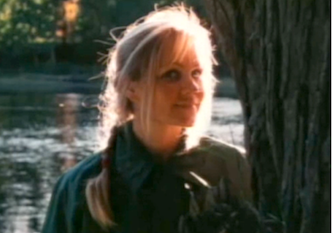
In the film Eva Cassidy: Timeless Voice, Carrie Grant, a British vocal coach who worked with top recording artists in the UK and US, was amazed when she heard Eva’s voice. After listening to Over The Rainbow, she said, “I cannot imagine what Eva Cassidy was thinking of when she chose to make it sound the way it does. But it’s just genius!” She describes how she redefines the song in unexpected ways, “yet for some reason it just works.”
She also explained the effect that Eva’s voice had on listeners. “She sounds like she’s singing just to you. And that is what makes it so intimate. And that becomes even more profound once you know she’s no longer alive. Because it’s haunting. And it’s personal.”
Eva sang the songs that she liked, regardless of genres, which is why record companies would not sign her during the days of manufactured music. They couldn’t slot her into a specific category. She sang blues, jazz, gospel, folk, old standards, and more. At first she was extremely shy, didn’t care for stage presence or how she dressed. With the help of local musicians she performed at Blues Alley, a local jazz spot in Georgetown, Maryland. One of her shows was later recorded. She sold two locally produced CDs out of the trunk of her car. You can listen to Live At Blues Alley on Spotify.
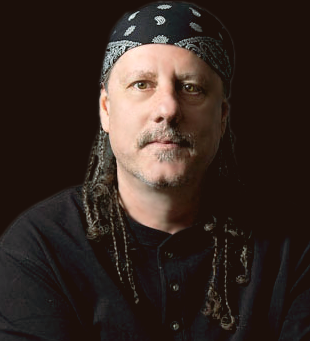
We might wonder how her singing was recorded in the first place when no company would sign her. One comment on Ain’t No Sunshine explained that the world owes Chris Biondo a debt of gratitude. Chris worked as a bassist, guitarist, keyboardist, recording engineer, and producer. He owned a studio in the 80s and 90s, and Eva would come in for session work. He recognized her ability, and said he “would just roll tape and stay out of her way.” At one point they were romantically involved. Chris “was the one who recognized her transcendent, ageless genius.”
In 1986 Chris began recording the then-unknown singer Eva Cassidy. For the next ten years he worked with Eva to develop her as a recording artist, producing most of her recordings available today. In the years since Eva’s death in 1996, her recordings have sold more than 10 million copies and achieved international renown, including three albums that reached number one in the UK charts. Chris has received numerous Gold and Platinum records in the U.S. and internationally for his work with Eva.
Bill Straw of Blix Street Records signed her up and continues to release and reissue her music, like the 20th anniversary of the new 32 track/2CD Nightbird album, The Best Of Eva Cassidy, Simply Eva, and eight other collections listed there that you can sample.
Sting himself was blown away when he heard her rendition of his song. He put a copy of her Songbird CD into record producer David Foster’s hands who quoted him saying, “‘If you want to hear the greatest version of my song ever’—he didn’t say it in an egotistical way—he said, ‘listen to Fields Of Gold with this girl, it’ll change your life.’ And her voice is life-changing, she’s that spiritual.” I love that song and remember hearing it on an airplane’s music channel during a flight. It was astounding! I had to find out who this singer was.
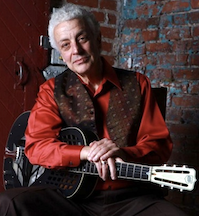
Another singer-songwriter who was overwhelmed by Eva Cassidy singing one of his songs was award-winning acoustic bluesman Doug MacLeod. During an interview he was asked: “Your songs have been recorded by many artists, so which are your favorite interpretations?” He said he had a couple of favorites, and that Eva Cassidy’s version of Nightbird was one of them. He told the story of how he first heard Eva sing when his wife put on her CD in the car. He said it moved him so much, “I pulled over to the side of the road and I was weeping.” When people ask him to play Nightbird, he tells them that “if they want to hear THE version, she is the one to listen to.” Read the whole interesting story in the highlighted comment Harvey Bobb posted to Eva Cassidy – Nightbird.
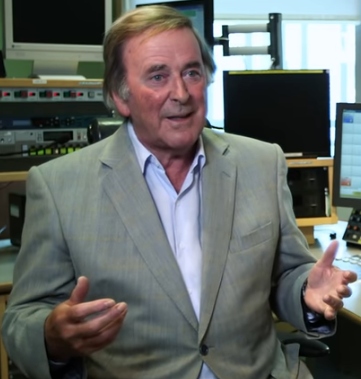
A relatively unknown singer in America at the time, somehow her music made its way across the Atlantic. From the first time Sir Terry Wogan, a BBC radio broadcaster, listened to Eva sing, he knew “she was an outstanding talent.” He said, “It was pure sound. A bell-like voice. She had this perfect pitch.” He couldn’t wait to play it on the radio. His was the most listened to program in the country at the time. It created a huge response from many of their seven million listeners wanting to know who she was. Unfortunately they found out that she had died two years earlier of cancer at the young age of 33.
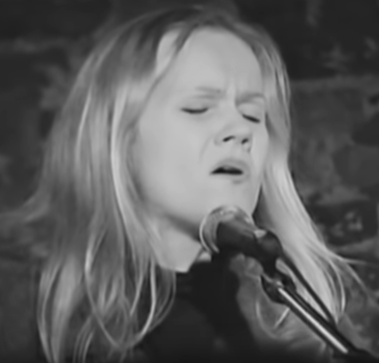
When Mark Hagon, a Top of the Pops BBC (TOTP2) producer at the time, agreed to play that homemade video of Eva Cassidy singing Over The Rainbow, people kept calling in for weeks wanting to know her name. The listening public created a demand for her music. It was a groundswell! Sales of her CDs went from a hundred thousand to over a million in the UK. “Radio broke it. Television exploded it.”
Cropped screensaver taken from the video of Eva Cassidy singing Over The Rainbow at Blues Alley, Georgetown, DC, January 3, 1996.
At one point five of her CDs became top sellers at the same time, a feat usually held by the Beatles and Rolling Stones. She was then discovered back home in the USA. ABC Nightline in Washington, DC researched and produced The Eva Cassidy Story (18:40). It was shown in many countries around the world and within a week of it airing her CDs went to the top of the local charts.
In Timeless Voice, Terry Wogan concluded, “You’d have to say about Eva Cassidy that her talent was pretty timeless. The voice has a quality of timelessness about it. Anytime you would hear it, whether it was thirty years ago, or thirty years from now, it’ll still be worth listening to, and still strike a responsive chord in most people’s hearts.”
Mick Fleetwood of Fleetwood Mac who knew Eva said, “She was brilliant. She had the magic. And I call it, It. She had It!”
Eva Cassidy: 25 years ago, a little known singer, Eva Cassidy, and her producer scraped together enough money to record a gig and self-produce an album. This is the story of one night – 3rd January 1996 – at a jazz club in Georgetown, Washington D.C., a set of recordings that almost never happened, and the extraordinary success that followed told by her band members who played with her that night. No one could have imagined that the audio and video recordings from that night would prove to be the foundation of her unparalleled posthumous worldwide success.
True to the end, Leonard Cohen‘s work charted the arc of his career, between life and death (Sept 21, 1934 – Nov 7, 2016). His search for redemption also influenced his fans. Cohen’s evolving understanding of life, beautifully expressed through his music, shone a light through the cracks of a broken humanity in a dark suffering world. He never claimed to have found all the answers, but seemed to have reached a kind of inner peace toward the end of his life, between himself and his God.
There is a repeated stanza in one of his songs, Anthem, that conveys the redeeming acceptance of light illuminating the darkness, compassion and love overcoming bigotry and hatred: “Ring the bells that still can ring/ Forget your perfect offering/ There is a crack in everything/ That’s how the light gets in.”
There may be a crack in everything, but how does the light get in—from without, or is it released from within? I’ve often thought about the profundity of those lines, and there have been many interpretations of what he may be implying. See mine below.* I think he sang about finding that divinity within and among our broken humanity. I wrote this tanka in honor of Leonard Cohen.
Leonard Cohen’s music lit up a dark world A tanka in honor of the poet by Ken Chawkin
Leonard Cohen said There’s a crack in everything How the light gets in
It came through him and lit up a broken humanity
Of course there is a kind of irony here when he says, “Forget your perfect offerings,” since he labored for months, sometimes years, on getting the lyrics to his songs perfect. At some point, though, he must’ve given up, admitted his imperfection, and sent them out into the world. As Leonardo da Vinci once said: Art is never finished, only abandoned. Other famous artists and writers have said and done the same thing.
Artistic Genius—Two Creative Approaches
There is a story about Leonard Cohen and Bob Dylan. They happened to be in Paris at the same time and decided to meet at a certain café. During their conversation, Dylan, one of the first to sing Cohen’s song “Hallelujah” in his concerts, asked Cohen how long it took him to write it. Cohen was embarrassed to tell him the truth so he lied and said 2 years. Then Leonard asked Bob how long it took him to write “I And I“, and he replied 15 minutes. I think he said he wrote it in the back of a cab. Cohen later told this story to an interviewer and confessed that it took him more like 5 years to write that song. He never could complete it, even after 30 verses! Their styles reflect thedifferent philosophical approaches of ‘first thought, best thought’ versus ‘revise, revise, revise’.
You can read the fascinating history of that song in Alan Light’s book, The Holy or the Broken: Leonard Cohen, Jeff Buckley, and the Unlikely Ascent of “Hallelujah”. Malcolm Gladwell, in Season 1, Episode 7 of his Revisionist History podcast, discusses the history of “Hallelujah”with Alan Light. That segment starts at 21:35 and explains how this obscure song was first covered by only a few artists 15 years after Cohen had recorded it. The theme is about two kinds of artists—those who seem to create spontaneously, and others who labor for a very long time—the differences between Mozart and Beethoven, or Picasso and Cezanne. It first aired July 28, 2016. Later added on YouTube March 8, 2023 starting at 18:13. Also listen to BBC – SOUNDS – Soul Music – Series 20 – Hallelujah. First broadcast on BBC Radio 4 in April 14, 2015. (27:50)
During Leonard Cohen’s final public appearance at the Canadian consulate in Los Angeles on October 13, 2016, the day Bob Dylan was awarded the Nobel Prize in Literature, he was asked what he thought about that and said: “To me, it’s like pinning a medal on Mount Everest for being the highest mountain.”
Hallelujah: Leonard Cohen, a Journey, a Song
I later read the Guardian article (6-29-2022) that this book served as the basis for the new documentary Hallelujah: Leonard Cohen, A Journey, A Song. Directed and produced by Dayna Goldfine and Dan Geller, the film takes both a micro and macro view of the song and Cohen, along with their respective and deeply intertwined places in culture. See ‘More than a song’: the enduring power of Leonard Cohen’s Hallelujah. In a new documentary, fans and experts explore the legacy of a song originally shunned before becoming a timeless classic.
I saw this documentary at the FilmScene in Iowa City (Saturday, August 6, 2022). It was very well put together. The ending moved me to tears. Netflix later offered it: Hallelujah: Leonard Cohen, A Journey, A Song. From there it would later move to Hulu and Disney+. You can rent it on Amazon and other platforms.
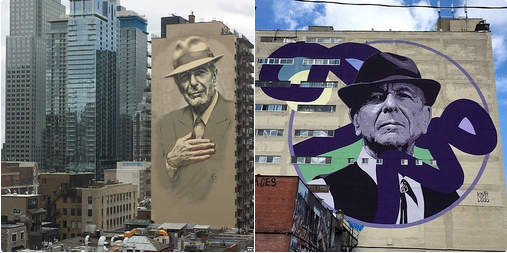
Murals mark 1-year anniversary of Leonard Cohen’s death
Montreal murals made by Gene Pendon (l) and Kevin Ledo (r)
November 7, 2017 is the 1-year anniversary of Leonard Cohen’s death. To personally commemorate this date, Sylvie Simmons tweeted a picture of herself standing in front of a large mural of Leonard Cohen painted by Kevin Ledo on the side of a 9-storey Montreal building close to where Leonard kept a home. It was the center piece for the fifth Mural International Public Art Festival in June. CBC Arts interviewed Kevin Ledo while he was working on it: Montreal Remembers Leonard Cohen With This Massive Mural. The Montreal Gazette’s Bill Brownstein had written an article about the making of it. He also mentions another mural, a tribute to Leonard Cohen made by artist Gene Pendon, which was painted on the side of a 20-storey downtown building, as part of Montreal’s 375th billion dollar birthday bash. The Globe and Mail described them in detail: Leonard Cohen and a tale of two Montreal murals. ET Canada reported on the official inauguration today, a year after Cohen’s passing. Josée Cloutier posted photos of both murals in one tweet, shown above.
The M.A.C.’s Exhibition on Leonard Cohen: A Crack in Everything
The Guardian published Leonard Cohen: A Crack in Everything – Montreal’s tribute to its favourite son. The new exhibition was conceived as part of the city’s 375th anniversary celebrations – but has morphed into a thorough investigation of all things Cohen. On 9 November, the Musée d’art contemporain de Montréal (AKA the Mac) will open the doors to Leonard Cohen : une brèche en toute chose/A Crack in Everything, a tribute to the artist, poet and musician, filled with multi-disciplinary works inspired by Cohen’s songs of life. This special exhibition at the Montreal Museum of Contemporary Art will conclude 9 April 2018.
The show takes its title from Cohen’s song Anthem, which contains the famous line “There is a crack in everything, that’s how the light gets in.” The song also inspired artist Kara Blake’s piece for the show, an immersive installation called The Offerings. “The song apparently took Cohen 10 years to craft and is just one example of his many artistic offerings that get inside the beautifully flawed nature of being human,” says Blake. “I wanted my piece to present visitors with a sampling of the creativity, wit and insight Cohen has gifted us with.”
Julia Holter contributed a cover of Cohen’s Take This Waltz, which will play on rotation in the Listening Room. “I enjoyed getting into the feeling of this passionate, seductive, demented waltz,” says Holter, who incorporated field recordings she made during a visit to the Greek island of Hydra, where Cohen had a home. “Being there was incredible,” she says.
For Holter, being invited to contribute to the show is the perfect way for her to give back to an artist she was introduced to as a child and who inspired her love of poetry. “What was special about Leonard Cohen’s work was its calm mystery. I think that can be an inspiration to the world right now,” she says. “The world needs this subtle beauty right now.”
And of course, who could ever forget Suzanne, Leonard’s mysterious poetic song that started it all, thanks to Judy Collins who wanted to cover it right after she heard Leonard sing it to her. It launched his career as a singer-songwriter. The song was inspired by Suzanne Verdal, the then estranged wife of his friend, sculptor Armand Vaillancourt. Read Suzanne’s 1998 BBC Radio 4 interview.
I enjoyed reading Sylvie’s wonderful biography, I’m Your Man: The Life of Leonard Cohen. It will be published next year in a new French edition with an added afterword that will be included in a revised English edition by McClelland & Stewart.
The afterword is Cohen’s response to the question about what was the driving force that propelled his output. Simmons calls it Traveling Light, and quotes Cohen’s answer in this interview for The Senior Times: Biographer Sylvie Simmons pays tribute to Montreal’s favourite son.
Leonard Cohen was very active towards the end of his life. Due to his declining health he tried to bring as many projects to completion as possible. One of them was his last album, You Want It Darker, produced by his son Adam Cohen. A new poetry book, The Flame, will be released next year.
The Flame: Poems Notebooks Lyrics Drawings
On Oct 1, 2018 CBC q host Tom Power interviewed Adam Cohen on the legacy of his father Leonard Cohen. It’s been almost two years since the passing of Leonard Cohen, but we’re about to hear from the legendary singer and poet again. The Flame is a posthumous collection of his final writing that features never before published poems that Leonard Cohen wrote in the final few years of his life. The day before it’s release, Adam Cohen returns to q to talk about mourning his father’s life and and celebrating his legacy on the morning of the book’s release.
*My reply to Quora question about the crack and the light
I agree with a number of interpretations posted here, quoting William Blake, the Kabbalah, and other esoteric sources, to explain what Leonard Cohen may be referring to in that line. They all make good sense to me. I also think that the light, of clarity, understanding, call it what you will, comes from within, not without. Metaphorically we may imagine light coming into a dark broken place from outside. But it can also light up the darkness from inside, if one knows how to turn on the switch. Another interpretation then, is no matter how broken, incomplete we are, with the proper approach, meditation technique, one can transcend, go beyond our limitations and just Be, experience that unbroken inner light of pure consciousness. With repeated exposures to one’s inner divine nature, the outer vessel, our body, can begin to heal, mend the broken cracks, and become whole. One way to experience this inner and outer development is with the regular practice of Transcendental Meditation.
New information on this topic later found and added
I recently discovered a quote by Rumi, which led me to believe this is where Leonard may have received the idea of the light entering the crack. Rumi wrote: “The wound is the place where the Light enters you.”
In the documentary, Andrea Bocelli – The Power of Silence, the interviewer quotes Rumi to Andrea. Here, ‘wound’ replaces ‘crack’, and he changes ‘you’ to ‘the heart’, but the idea is the same. It seems more intimate. “The wound is the place where the Light enters the heart.” They discuss the notion of the value of suffering and he asks him, “When did the light enter your heart? When did that light strike Andrea?”
Andrea gives him an unexpected, beautiful, religious answer. “So the vision of Rumi the philosopher that you quoted is very interesting and I agree with what he says. In my case I didn’t think it was a wound, not such a painful wound that opened up and allowed the light to enter. No, I think the light entered my heart thanks to the grace of God.”
He asks him, “Are you happy?” and Bocelli replies, “I am happy, yes, but more importantly, I am serene. To me happiness is a transitory condition and it can sometimes be a bit dangerous; whereas being serene is a state of mind that can be consolidated and it can stay with us forever.”
In 1991 media mogul Moses Znaimer inducted Leonard Cohen into the Canadian Music Hall of Fame at The JUNO Awards in Vancouver. Leonard gave a brilliant and humorous acceptance speech.
k.d. lang agreed to pay tribute to the legendary singer-songwriter with a rendition of his beloved song, “Hallelujah.” She had never performed the song for Cohen and “was excruciatingly nervous” knowing he would be in the audience. She received a standing ovation, and as the credits began to roll, she ran down the stage steps towards Leonard to offer him her reverence and appreciation. He rose to meet her and they warmly, respectfully embraced. Cohen’s partner, singer Anjani Thomas, looked at Cohen and said, “Well, I think we can lay that song to rest now! It’s really been done to its ultimate blissful state of perfection.” He agreed. A few years later, in a CBC interview, Cohen recalled that performance and said, “that really touched me.” He was asked about the history of that song, and said, “the only person who seemed to recognize the song was Dylan.” During her world tour in 2008, lang gave a beautiful performance of the song backed by the BBC Concert Orchestra in a concert filmed at St. Luke’s Church in London. And two years later, lang sang Leonard Cohen’s “Hallelujah” at the Vancouver 2010 Olympics Opening Ceremony. It was spectacular!
Leonard Cohen on Q TV (CBC exclusive). To celebrate Q’s 2nd anniversary — poet, novelist, songwriter, legend…a special exclusive feature interview with Leonard Cohen… recorded at his home in Montreal. Posted Apr 15, 2009.
Listen to CBC Radio’s As It Happens interview Marianne’s close friend, filmmaker Jan Christian Mollestad, the week she died: So long, Marianne. Leonard Cohen’s final letter to his muse. At Marianne’s request, Jan had conveyed a message to Leonard that she was dying. He wrote back to her, the subject of the interview. There is also a link to Leonard Cohen’s Facebook page with Jan’s reply to Leonard, saying his letter to Marianne gave her deep peace of mind, and described her peaceful passing to him.
Jan Christian Mollestad was one of the executive producers on the film. He had posted a video celebrating Marianne’s 80th birthday that previous year on Hydra, including Adam Cohen singing “So long, Marianne” in Oslo, and Marianne and Judy Collins enjoying singing “Famous Blue Raincoat” together.
Listen to the beautiful soundtrack by Nick Laird-Clowes: Marianne & Leonard: Words of Love (Original Score) https://lnk.to/WordsOfLove. Where you can watch the movie.
Leonard and Marianne: A portrait of Leonard Cohen and Marianne Ihlen, the woman who inspired Cohen’s song ‘So Long, Marianne’. Based on Kari Hesthamar’s NRK award-winning documentary ‘So Long, Marianne’. Falling Tree Productions made this 27:33 minute piece. Produced by Alan Hall, it was first broadcast August 2, 2008 on BBC Radio 4. Leonard Cohen’s muse when he turned from poetry to song-writing was a beautiful Norwegian woman immortalised in the song So Long, Marianne—this is their story. Listen to in on SoundCloud. It won Best Feature Bronze Award at the Sony Radio Academy Awards (2009).
November 22, 2019 brings the release of the first posthumous Leonard Cohen album, Thanks For the Dance. For the nine-track LP, Cohen’s son, Adam, took leftover sketches and poems from his father’s 2016 LP, You Want it Darker, and fleshed them out with the assistance of Beck, Damien Rice, The National’s Bryce Dessner, and others. Following last month’s teaser track, “The Goal”, “Happens to the Heart” has now been released as the album’s first official single.
July 7, 2022, Directors Dan Geller and Dayna Goldfine, and head of the Cohen estate/Executive Producer Robert Kory discuss HALLELUJAH: Leonard Cohen, A Journey, A Song at the Rock & Roll Hall of Fame. This was the first RRHF screening and discussion since the covid pandemic had shut them down for a year. See the 42-minute video.
Speaking of The Coming of Wisdom in Time, as William Butler Yeats put it, Leonard Cohen came to a similar realization when he said: “The older I get, the surer I am that I’m not running the show.”
I later found this video posted on YouTube by AirGigs on Jan 18, 2022: 10 Pearls Of Wisdom From Leonard Cohen. In this episode we look at his thoughts on success, writing, talent and much more.
Apr 9, 2024, Contra Costa JCC presented, Leonard Cohen: Untold Stories. Award-winning writer, playwright, journalist, and author of seven books, Michael Posner, joined the Under One Tent audience online on Tuesday, April 9, 2024. He introduced the third volume of his book, “Leonard Cohen: Untold Stories,” a must-read for fans of Leonard Cohen.
I discovered jazz in high school and soon became aware of Bill Evans. An accomplished musician educated in classical music, he chose to become a jazz pianist instead, and took elements of those influences to create his own unique style.
As a young man, Evans went on to compose and perform modal music with Miles Davis. Miles praised Bill’s contribution in the groundbreaking Kind of Blue LP released in the summer of 1959 by Columbia Records, often considered the best-selling jazz album of all time. Evans later left Davis to play solo, and form his own jazz trios. Bill Evans became one of the true jazz legends of our time.*
In this intimate 1970 interview and concert at the rural home of Finnish host Ilkka Kuusisto, a very wealthy and very highly regarded classical musician, with jazz musicians in the family, Evans was asked if his group practiced. He explained that “the trio has never rehearsed. … All the things that we play have grown out of performance.” They shared “a natural development through common desire to make it more musical all the time as much as we can.” It was “freedom with responsibility…to the total performance.”
In his solo work, Bill Evans’s Peace Piece is musical onomatopoeia. The calming repetitive left hand chords juxtaposed with the right hand animated notes evoke fluttering doves of peace calling to each other. Pure genius! It reminds me of the French impressionistic sounds of Erik Satie, Claude Debussy, and Ravel, but this is distinctly his own music.
“Peace Piece” was an unrehearsed modal composition he recorded December 15, 1958 for his Everybody Digs Bill Evans LP released in early 1959 on the Riverside label (Riverside RLP 1129). It’s been hailed as one of the most beautiful and evocative solo piano improvisations ever recorded. I totally agree. One of the most beautiful jazz recordings I’ve ever heard. A peaceful masterpiece. A masterpiece of peace!
In this 1966 documentary, Bill Evans talks with his composer brother Harry about the creative process and self-teaching. Evans spoke of a Universal Mind. “I believe that all people are in possession of what might be called a universal musical mind. Any true music speaks with this universal mind, to the universal mind in all people. The understanding that results will vary only in so far as people have or have not been conditioned to the various styles of music in which the universal mind speaks. …”
Click SHOW MORE under that video to read the rest of the transcription. Evans also analyzes the melody and harmonics of Star Eyes, and performs other pieces, in between musical discussions with his brother.
Bill Evans (August 16, 1929–September 15, 1980) was one of the most famous jazz pianists of the twentieth century. Along with McCoy Tyner and Oscar Peterson, he was the force behind the biggest evolution in jazz since Art Tatum and Bud Powell.
Evans won seven Grammys during his career, the first for Conversations With Myself (1963), [which I had bought back then] although not for his most celebrated work, Sunday At The Village Vanguard (1961) with bassist Scott LaFaro and drummer Paul Motian.
His use of impressionistic harmony, his inventive interpretation of traditional jazz repertoire, and his syncopated and polyrhythmic melodic lines influenced a generation of pianists, including Herbie Hancock, Denny Zeitlin, Chick Corea, and Keith Jarrett, and his work continues to inspire younger pianists such as Fred Hersch, Bill Charlap, and Lyle Mays, as well as other musicians such as guitarist John McLaughlin.
In 1994, Bill Evans was posthumously awarded a “Lifetime Achievement Award” by the National Academy of Recording Arts and Sciences (NARAS) “for altering the course of jazz piano with his lyrical, impressionistic solo and trio recordings, characterised by the understated intensity, distinctive chord voicings, and unique harmonic sensibility that opened up the vocabulary of modern jazz.”
Taken from the notes to the video: Bill Evans was often asked to perform “Peace Piece” in later years after the 1959 recording, but he usually resisted, claiming that it had been the inspiration of the moment, and not something that could be recreated, he considered it as a one-time thing. Only on this occasion in 1978 he performed “Peace Piece” with the Bill Evans Dance Company in Seattle. This Peace Piece, extracted from the video, recorded in 1978, is probably the only recorded performance after “Everybody Digs Bill Evans” from 1959. Peace Piece is a “practiced improvisation” and you can hear how Bill adapts his playing to the choreography of the dancers compared to his 1959 solo performance.
Emanuil Ivanov covers Bill Evans Peace Piece 2022
Emanuil Ivanov performed Bill Evans – Peace Piece beautifully at Bulgaria Hall, Sofia on October 3, 2022 as a Prayer for Peace. It is the closest to the original. Ivanov’s playing is very refined and delicate, capturing the peaceful feeling perfectly.
September 24, 2025, Daniel Anastasio posted on Instagram how Bill Evans came to write Peace Piece. He said he came into the studio to record Leonard Bernstein’s Some Other Time from his musical On The Town. But he never got past the opening bars because they turned into this: and he starts playing Bill’s improvisation. He gives a commentary about playing in the moment and not trying to be perfect. I posted a comment on his reference to the left hand playing like a non-wavering mantra while the right hand improvises, suggesting another metaphor, like a metronome, explaining the proper use of a mantra in meditation. Another reminded him that the right hand evolves a melody based on bird calls! True genius. I agreed and said: Exactly! That’s why I call this Peace Piece musical onomatopoeia.
— Written and compiled (citing sources) by Ken Chawkin for The Uncarved Blog.
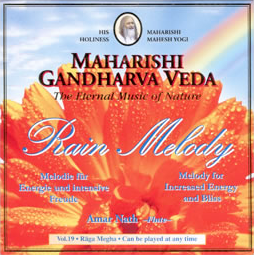
Feeling too hot? Experiencing a drought? Listen to this beautiful Maharishi Gandharva Veda musical performance of Raga Megha, also known as the famous Rain Raga. It creates a soothing cooling influence on listeners and in Nature. It can be played at any time for increased energy and bliss. This Rain Melody reduces tensions in the atmosphere and is traditionally played during the hot summer season to bring rain and relief from heat. We can use some of that, which is why I’m posting it for us to play!
Musicians are Amar Nath on bansuri (bamboo flute), Somnath Mukergee on tabla (percussion), and Sukhamar Chandra on tambura (drone). This 45-minute CD, is available at MIU Press. Listen to this raga on repeat from your own device. Also posted on SoundCloud. Video by Frank Lotz.
TM.org posted this article, Maharishi Gandharva Veda Rain Melody, Restoring Greater Balance in Nature, which explains its purpose and soft power. Embedded are two videos—the 45-minute video, and one on a continuous loop. They were made available to help bring relief to those areas affected by the recent severe droughts and related fires. Play the Maharishi Gandharva Veda Rain Raga to help enliven the evolutionary power of nature and create a wave of harmony in your area.


 In the film
  We might wonder how her singing was recorded in the first place when no company would sign her. One comment on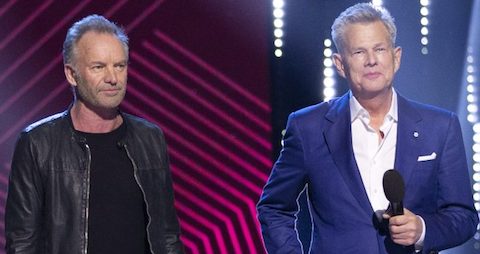
 In Timeless Voice, Terry Wogan concluded, “You’d have to say about Eva Cassidy that her talent was pretty timeless. The voice has a quality of timelessness about it. Anytime you would hear it, whether it was thirty years ago, or thirty years from now, it’ll still be worth listening to, and still strike a responsive chord in most people’s hearts.”
 Feeling too hot? Experiencing a drought? Listen to this beautiful Maharishi Gandharva Veda musical performance of Raga Megha, also known as the famous Rain Raga. It creates a soothing cooling influence on listeners and in Nature. It can be played at any time for increased energy and bliss. This
  The Uncarved Blog