Archive for the ‘Health’ Category

The David @LynchFoundation @TMmeditation Program Brings Relief to Traumatized Moms Who Lost a Child to City Violence

August 28, 2014

Here is a great article by Erin Meyer, and inspiring interview with DNAinfo Chicago Radio News Director that aired August 22, 2014: Moms Traumatized by City Violence Join David Lynch Meditation Program.

Erin answers Jon’s questions based on what grieving mothers who had lost a child to city violence, and have now started meditating, are telling her. This is the first time they’ve been able to experience any kind of inner peace for 20 minutes twice a day. For these program participants, TM is bringing relief to their stress-filled days and nights.

HUMBOLDT PARK — Eyes closed in meditation, a small group of grieving women sat in a circle on the second floor of a Humboldt Boys & Girls Club one recent Sunday afternoon.

The lights were dimmed. Except for the hum of the air conditioner and the far away sound of basketballs hitting the gym floor below, the room was awash in a deep silence.

The quiet, say the mothers — most of whom have lost children to Chicago violence — was coming from within, a rediscovered inner peace thought to have died with their children.

“For all these years, I’ve been fighting with my brain. I took medication to forget, but you can never forget,” said 49-year-old Beti Guevara, who was just a girl when her brother was slain 38 years ago.

Erin Meyer says the mothers struggle to find peaceful moments after the death of a child:

With Transcendental Meditation, “I can think clearly, I’m calmer, and I can finally sleep,” he said.

Guevara and her friends are learning the trademarked relaxation method, called TM for short, at the invitation of the David Lynch Foundation for Consciousness-Based Education and World Peace.

Lynch, an innovator of cinema best known as the director of the TV series “Twin Peaks” and films including “Mulholland Drive” and “Lost Highway,” views TM as a tonic for victims of trauma and a vehicle to world peace.

The New York-based foundation that bears his name teaches TM on American Indian reservations, in prisons and schools, to homeless people, to former soldiers suffering post-traumatic stress disorder and to victims of war in Africa, according to the organization’s website.

Recently, the David Lynch Foundation added to that list Chicago mothers living in the wake of a child’s murder.

Among those participating are: An-Janette Albert, mother of 16-year-old Derrion Albert, whose 2009 beating death outside Fenger High School shocked the nation; Myrna Roman, who lost her first-born in an unprovoked 2010 drive-by in Humboldt Park; and Maria Pike, the mother of an aspiring chef, Ricky Pike, who was gunned down in Logan Square in 2012.

The group met multiple times over the course of a week with a husband-wife TM instruction team, adopted their mantras and started meditating twice a day for 10 to 20 minutes at a time. Four days into the practice, most of the new students said they have found a surprising measure of peace.

Transcendental Meditation is not an ancient technique, but a method developed by the Indian guru Maharishi Mahesh Yogi in the 1950s. It became wider known when it was adopted by members of The Beatles.

On Sunday, at the Union League Boys & Girls Club, meditation teacher Chris Busch described TM as a nonreligious exercise with myriad mind and body benefits ranging from stress reduction to reduced cholesterol and improved cardiovascular health.

“It’s a simple thing,” Busch said. “Even children 10 years old, they can do it,” he said, describing improvements that some schools in San Francisco have seen through the implementation of a TM program for students.

Lynch told the New York Times earlier this year that he began TM in 1973.

“The Beatles were over with Maharishi in India and lots of people were getting hip to Transcendental Meditation and different kinds of meditation, and I thought it was real baloney,” Lynch said. “I thought I would become a raisin-and-nut eater, and I just wanted to work.”

Then, he heard the phrase, “True happiness is not out there, true happiness lies within.”

“And this phrase had a ring of truth to it,” Lynch said.

He described TM, which usually costs about $1,000 to learn through TM teachers, as “a key that opens the door.”

After spending time with Maharishi Mahesh Yogi, he decided to set up a foundation in 2005 to spread the meditation approach, according to the Times.

“Things like traumatic stress and anxiety and tension and sorrow and depression and hate and bitter, selfish anger and fear start to lift away,” Lynch said. He launched a Women’s Initiative in 2012.

The Chicago mothers, just beginning to see the potential meditation has to bring order to their lives, stumbled into TM.

Maria Pike was telling friends on a recent trip to Washington D.C. about the daily challenges she encounters just trying to live a normal life in the wake of her son’s murder. The friends turned out to be TM practitioners, Pike said.

They made some phone calls, which led to more phone calls. Eventually, supporters of the David Lynch Foundation offered to pay for Pike and her friends to take the TM training.

“I feel like it was meant to be,” Pike said.

Published with permission from the author. See the complete article with photos here.

See executive director Bob Roth speak at Google Zeitgeist 2014 about the work of the David Lynch Foundation offering Transcendental Meditation to at-risk populations, as well as Wall Street executives.


Iowa Public Radio reports on how far we’ve come treating PTSD in Veterans, from lobotomies to TM

March 27, 2014

Iowa Public Radio news correspondent Rick Fredericksen reports on Veterans: Lobotomies to Meditation

Listen to today’s (March 27, 2014) Iowa Public Radio report on how Iowa Veterans have been historically treated for what is now known as PTSD — from lobotomies, to drugs and therapy, to finally a more benign approach, that of meditation, specifically Transcendental Meditation.

Iowa Public Radio correspondent Rick Fredericksen produced an impressive historical report on the subject. Early attempts to deal with this misunderstood medical problem were crude and frightening. Introducing TM as a viable option shows you how far we’ve come in dealing more humanely with Veterans suffering from PTSD!

It aired twice this morning with a third broadcast on All Things Considered this afternoon at 4:50pm CST. You can listen to the 7:30 minute report online http://bit.ly/QjMY00, where you can also see a 3-photo slideshow, and link to the Wall Street Journal investigation.

Dan Gannon, IDVA, meditates in IPR studio

Marine veteran Daniel Gannon meditates in the IPR studios.

Interviews with meditating Iowa veterans include Luke Jensen, Afghanistan veteran; Vietnam veteran Daniel Gannon, Iowa Dept of Veterans Affairs; and Jerry Yellin, WWII veteran, and national TM advocate for veterans.

Rick Fredericksen did a fantastic job! What a testament to TM, and boost for MUM, gearing up to welcome veterans as students!

This story is also reported on the TM Blog: PTSD Treatments: From Lobotomies to Meditation.

PTSD Treatments: From Lobotomies to Meditation

Related news items:

Matt Kelley of Radio Iowa interviews Jerry Yellin about an Iowa Veterans Summit solution to PTSD

Military Leaders to Promote Meditation at Iowa Summit to Help Reduce Veteran Suicide Epidemic

See video highlights of the Iowa Veterans Summit – PTSD and Transcendental Meditation

AFP report: War veterans say Transcendental Meditation could help with PTSD


Capetown’s Shafiq Morton interviews David Leffler on a solution to the violence in Kiev

February 20, 2014

The VoicThe Voice of the Capee of the Cape’s after five Drivetime Show has a national and international flavor focusing on issues making news where the biggest story of the day or week is analyzed. South African host Shafiq Morton interviewed American Dr. David Leffler this week, Wednesday, Feb. 19, 2014, on a unique solution to the growing violence in Kiev.

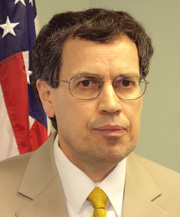
Dr-David-LefflerDavid R. Leffler, Ph.D. is the Executive Director of the Center for Advanced Military Science (CAMS) at the Institute of Science, Technology and Public Policy, in Fairfield, Iowa, USA. He spoke on IDT, Invincible Defense Technology, as a viable solution to the rising crisis. Dr. Leffler explained how increasing stress levels erupt into opposing factions, violence and war, and how group practice of Transcendental Meditation and its advanced procedures can defuse such collective stress and prevent war, softening the atmosphere for people and groups to more harmoniously discuss solutions to their problems without resorting to violence.

Listen to the 20-minute interview on 91.3 FM http://iono.fm/e/74837.

I was so impressed by Morton’s questions and responses to Leffler’s informative answers, I posted this comment:

When Marconi said we could communicate through the airwaves they thought he was crazy. He was just using a technology that was able to take advantage of the electromagnetic field that was already there. Invincible Defense Technology similarly uses an advanced procedure to allow our minds to collectively enliven the all-powerful, all-nourishing Unified Field, the source of all the force and matter fields, the home of all the laws of nature, for the good of society, and the world, depending on the size of the group. Thank you for exposing your listeners to this hopeful and intelligent out-of-the-box proven approach to creating world peace!

The editorial piece referred to in the interview was co-authored by Dr. Leffler and Dr. Mykola Didukh, National Director for TM in Ukraine. Titled, “Proven Strategy to Prevent Turmoil in Ukraine,” how Invincible Defense Technology could be implemented to solve the crisis, the Op-Ed was published earlier this month in a number of locations: NEPAL: Review Nepal; WORLD SERVICE: The Common Ills; UNITED STATES & CANADA: Times of Earth; INDONESIA: Sigma News; and UKRAINE: Evening Lugansk, which was also published in Russian and Ukrainian.

(more…)

Second study to show Transcendental Meditation reduces PTSD in African Refugees—in just 10 days

February 10, 2014

Transcendental Meditation significantly reduces PTSD in African refugees within 10 days

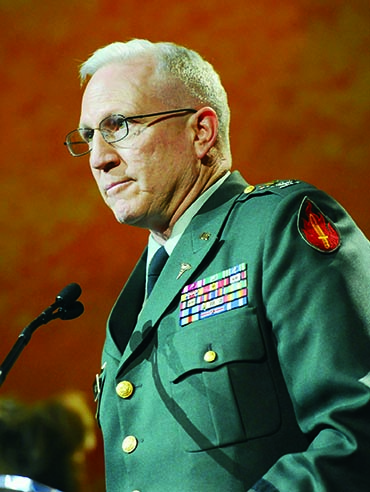
This is lead author Col. Brian Rees, MD, MPH, US Army Reserve Medical Corps

This is lead author Col. Brian Rees, MD, MPH, US Army Reserve Medical Corps

African civilians in war-torn countries have experienced the threat of violence or death, and many have witnessed the abuse, torture, rape and even murder of loved ones. Many Congolese living in Ugandan refugee camps are suffering from severe posttraumatic stress disorder (PTSD).

New research shows that Congolese war refugees who learned the Transcendental Meditation® technique showed a significant reduction in posttraumatic stress disorder in just 10 days, according to a study published today in the February 2014 issue of the Journal of Traumatic Stress (Volume 27, Issue 1, pages 1–119).

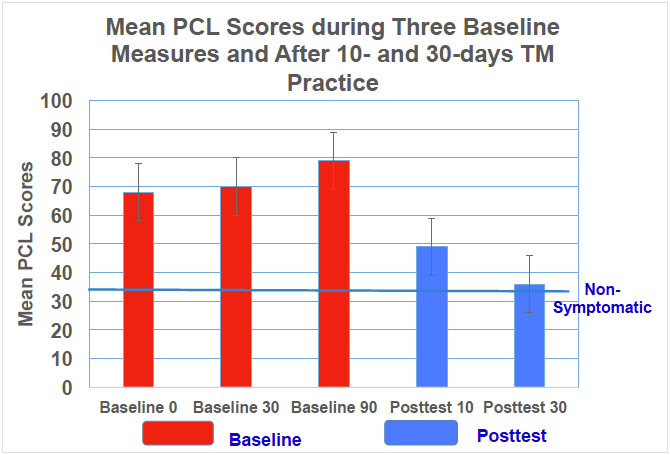
In the study, “Significant Reductions in Posttraumatic Stress Symptoms in Congolese Refugees within 10 days Transcendental Meditation Practice,” 11 subjects were tested after 10-days and 30-days TM practice. After just 10-days PTSD symptoms dropped almost 30 points.

“An earlier study found a similar result after 30 days where 90% of TM subjects dropped to a non-symptomatic level. But we were surprised to see such a significant reduction with this group after just 10 days,” said study author Brian Rees, MD, MPH.

The subjects were assessed using the Posttraumatic Stress Disorder Checklist for Civilians, (PCL-C), which rates the severity of PTSD on a scale from 17 to 85. A score below 35 means the symptoms of PTSD have abated.

Eleven Congolese refugees who had been tested three times over a 90-day period on the PCL-C, which rates the level of PTSD on a scale from 17 to 85, began with an average score of 77.9. They learned Transcendental Meditation within 8 days of the third test and after 10 days their average score dropped to 48, which was highly clinically significant. They were retested 30 days later measuring an average score of 35.3. With scores below 35 considered non-symptomatic, they were practically symptom free.

Eleven Congolese refugees who had been tested three times over a 90-day period on the PCL-C, which rates the level of PTSD on a scale from 17 to 85, began with an average score of 77.9. They learned Transcendental Meditation within 8 days of the third test and after 10 days their average score dropped to 48, which was highly clinically significant. They were retested 30 days later measuring an average score of 35.3. With scores below 35 considered non-symptomatic, they were practically symptom free.

The subjects in the study initially tested with an average score of 77.9. After just 10 days of practicing the Transcendental Meditation technique, their PTSD test scores dropped to an average of 48, which was highly significant clinically.

Thirty days later the subjects were tested again with their PTSD scores falling to an average of 35.3 — meaning that they were nearly without symptoms of PTSD.

“What makes this study interesting is when we tested them in the 90 days before they began the TM technique, their PTSD scores kept going up,” said coauthor Fred Travis, director of the Center for Brain, Consciousness, and Cognition at Maharishi University of Management. “During that period their scores were rising, from 68.5 at the beginning to 77.9 after 90 days. But once they started the Transcendental Meditation technique, their PTSD scores plummeted.”

According to the researchers, during this particular meditation technique one experiences a deep state of restful alertness. Repeated experience of this state for 20 minutes twice a day cultures the nervous system to maintain settled mental and physical functioning the rest of the day. This helps to minimize disturbing thoughts, sleep difficulties, and other adverse PTSD symptoms.

In this video, Dr. Travis explains the neurophysiology of trauma and how TM relieves it. He says, “Something very profound is happening. Because experience changes the brain, and trauma locks in a specific brain functioning (the over stimulated amygdala), you’re stuck in a specific way of thinking and feeling, (vigilance, fear and mistrust) and appreciating the world.” He further explains how the experience of transcending, with Transcendental Meditation, calms the amygdala, relieves PTS symptoms and frees the individual “to see more possibilities.”

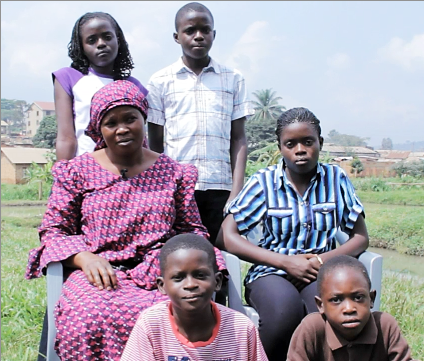
Congolese refugee Esperance Ndozi and her 5 children

Congolese refugee Esperance Ndozi and her 5 children

Esperance Ndozi was one of the Congolese refugees traumatized by the civil war. The 35-year old mother of 5 was part of the group of refugees that learned TM. Before learning the effortless technique, Esperance couldn’t find relief from a flood of dark disturbing memories. She could hardly sleep. After a week of meditating 20-minutes twice a day she describes increasing relaxation and relief from PTSD symptoms. “Your mind, your body relaxes. You feel you are out of the outside world. You are just in your peaceful world. No negativity. It doesn’t come near me now.” Like other refugees in the study the calm and peace grew to last throughout the day. Watch the video.

A previous study of Congolese refugees, which involved 42 subjects found that the Transcendental Meditation group had an average Checklist score of below 35 after 30 days, a non-symptomatic level, while the average score of the control group actually worsened over the same period.

“This is now the fourth study to show an improvement in PTSD,” said Dr. Rees, a colonel in the US Army Reserve Medical Corps. “The Transcendental Meditation technique is increasingly being seen as a viable treatment by the US military.”*

###

Study co-author Dr Fred Travis is a professor of neurophysiology at Maharishi University of Management, an accredited university to the PhD level, where Transcendental Meditation is incorporated into its curriculum and practiced by faculty and students. This provides a way for students, including veterans, to reduce the effects of past stress and trauma, and make learning easier and more enjoyable. www.mum.edu

This study was funded in part by the David Lynch Foundation. www.davidlynchfoundation.org/africa

The Journal of Traumatic Stress is published on behalf of International Society for Traumatic Stress Studies.

Source: EurekAlert!

*Two earlier studies have shown the Transcendental Meditation (TM®) technique to effectively lower post-traumatic stress in veterans of Vietnam and Iraq/Afghanistan wars.

See first refugee study: New study shows Transcendental Meditation significantly reduces PTS in African refugees

New study out on Transcendental Meditation shows reduced teacher stress and burnout

February 3, 2014

Transcendental Meditation Reduces Teacher Stress and Burnout, New Research Shows

Effect of Transcendental Meditation on Employee Stress, Depression, and Burnout: A Randomized Controlled Study

This graph shows the average level of change in total burnout, as measured by the Maslach Burnout Inventory, in the Transcendental Meditation group compared to controls. The graph displays a marked reduction in burnout symptoms in the TM group, with the control group showing a small increase in burnout over the duration of the study.

This graph shows the average level of change in total burnout, as measured by the Maslach Burnout Inventory, in the Transcendental Meditation group compared to controls. The graph displays a marked reduction in burnout symptoms in the TM group, with the control group showing a small increase in burnout over the duration of the study.

A new study published in The Permanente Journal (Vol. 18, No.1) on health showed the introduction of the Transcendental Meditation® technique substantially decreased teacher stress and burnout.

Research indicates that stress and burnout are pervasive problems among employees, with teachers being especially vulnerable to feeling frequent stress from their jobs. Burnout, a syndrome of emotional exhaustion, depersonalization, and job dissatisfaction, has been found to contribute to lower teacher classroom performance and higher absenteeism and job turnover rates.

This current study sought to determine whether practice of the Transcendental Meditation (TM) program results in lower psychological distress and decreased burnout in teachers and support staff at the Bennington School in Vermont, a special in-residence school for students with behavioral problems.

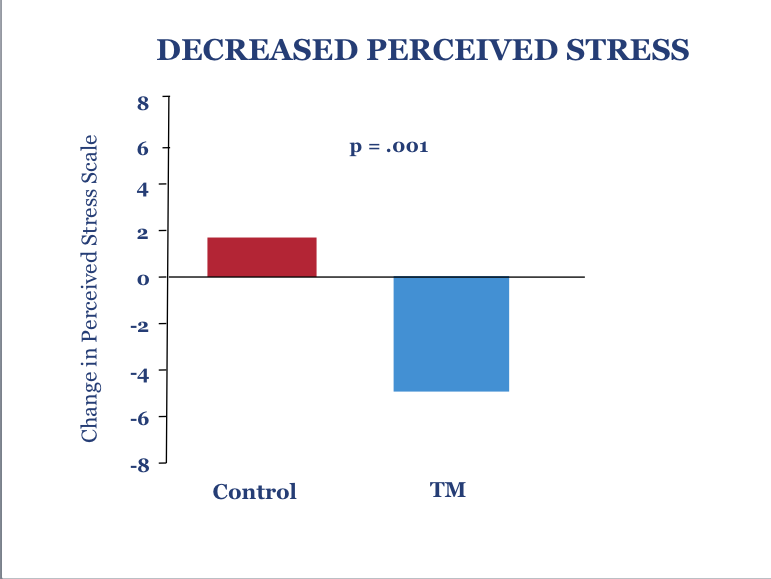
This graph shows the average level of change in perceived stress, as measured by the Perceived Stress Scale, in the Transcendental Meditation group compared to controls. The graph displays a marked reduction in perceived stress in the TM group, with the control group showing a small increase in stress over the duration of the study.

This graph shows the average level of change in perceived stress, as measured by the Perceived Stress Scale, in the Transcendental Meditation group compared to controls. The graph displays a marked reduction in perceived stress in the TM group, with the control group showing a small increase in stress over the duration of the study.

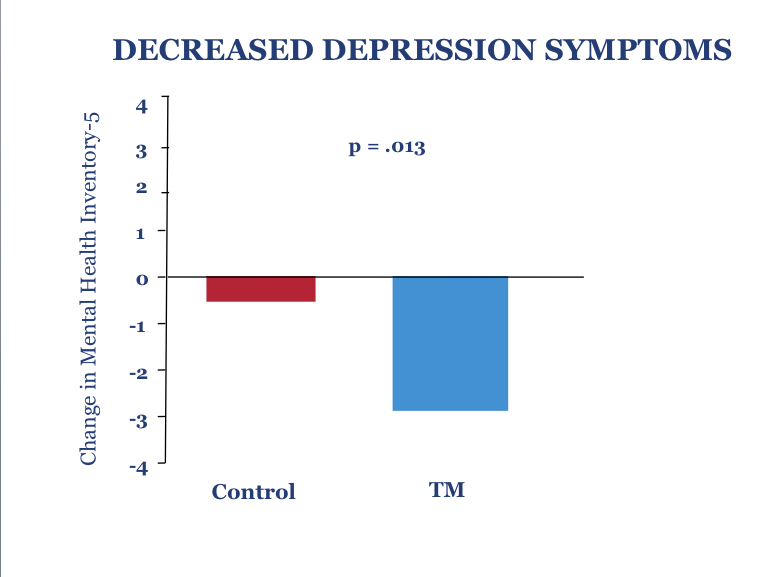
According to Dr. Charles Elder, MD, MPH, lead author of the study and a Senior Physician in the Department of Internal Medicine at Kaiser Permanente Northwest, “The results of this randomized controlled trial are very striking and demonstrate the utility of introducing a stress reduction program for teachers and other public and private employees. The four-month study found significant and clinically important decreases in perceived stress, emotional exhaustion associated with teacher burnout, and depressive symptoms in those practicing the TM program compared to a wait-list control group.”

“Burnout and other psychological distress factors have been linked to negative health behaviors, obesity, and hypertension, all of which are major contributors to cardiovascular disease,” emphasized Dr. Sanford Nidich, EdD, study principal investigator and Professor of Education at Maharishi University of Management. “Prior medical research has found that practice of the TM program is effective in reducing both risk factors for heart disease and cardiovascular events. Taken as a whole, this present study and prior research provide evidence for the value of the TM program for enhancing mental and physical health and well-being, explained Dr. Nidich.”

This graph shows the average level of change in decreased depression symptoms, as measured by the Mental Health Inventory-5, in the Transcendental Meditation group compared to controls. The graph displays a marked reduction in depression symptoms in the TM group, with the control group showing a small decrease in depression over the duration of the study.

This graph shows the average level of change in decreased depression symptoms, as measured by the Mental Health Inventory-5, in the Transcendental Meditation group compared to controls. The graph displays a marked reduction in depression symptoms in the TM group, with the control group showing a small decrease in depression over the duration of the study.

The study included 40 teachers and support staff measured at baseline and then randomly assigned to either immediate start of the TM program or delayed start (wait-list control group). Compliance with practice of the TM technique throughout the four-month intervention period was high; 100% of the participants assigned to the TM group meditated at least once a day. Of those, 56% meditated regularly at home twice a day.

This is the first study to investigate the effects of Transcendental Meditation on teacher burnout. Recent published studies have shown a positive impact of this program on student graduation rates, academic achievement, and psychological distress. Transcendental Meditation has seen widespread implementation in secondary schools across the country within the context of school-wide Quiet Time programs.

The study was funded by the Nine East Network and David Lynch Foundation.

About the Transcendental Meditation technique

The TM technique is a simple, natural, effortless procedure practiced 20 minutes twice each day while sitting comfortably with the eyes closed. Extensive peer-reviewed research studies have found that TM reduces psychological distress, including anxiety and depression, and promotes overall mental and physical health.

The TM technique is available in the USA through Maharishi Foundation USA, a federally recognized non-profit educational organization. Through partnerships with other non-profit organizations and foundations, full TM scholarships have been given to more than 250,000 at-risk children, school teachers, veterans suffering from PTSD, homeless people, and others. Visit http://www.tm.org for more information.

About Maharishi University of Management

Maharishi University of Management is an accredited university offering bachelor’s, master’s, and doctoral degrees in the arts, sciences, humanities, and business, where Transcendental Meditation is also practiced by both professors and students. Visit http://www.mum.edu for more information.

Source: EurekAlert!

Australian TV show objectively reports on TM

January 30, 2014

Transcendental Meditation on ABC’s Catalyst Sydney, Australia

Published over a year ago, this report on Transcendental Meditation, by the ABC’s Catalyst in Sydney, Australia, takes an objective look at the uniqueness of the practice, and its personal and health benefits. One skeptical physician says most people would sooner pop a pill to lower their blood pressure than waste time meditating. But, based on the scientific research, the American Heart Association now recommends that physicians may safely prescribe only TM for those patients who want to lower their blood pressure naturally, instead of taking long-term costly medications with potentially harmful side effects.

Dr. Robert Schneider’s tour in Australia and New Zealand educating physicians on the value of TM for heart health

Dr. Robert Schneider, MD, FACC, a leading medical researcher on the application of Transcendental Meditation for heart health, toured Australia and New Zealand in the fall of 2013. He presented the breakthrough scientific research findings of TM’s ability to reduce heart attack, stroke and early death by about 50%.

Dr. Schneider also mentioned the AHA statement, based on meta-analyses of data on different relaxation and meditation techniques, that physicians could only recommend TM to their patients wanting to naturally lower their HBP. You can see a video clip from a presentation made at Macquarie University Hospital in Sydney, Australia.

While making presentations in New Zealand, Dr. Schneider appeared on NZTV’s Breakfast ONE News program explaining how TM improves heart health, and the response from the medical community. You see that lively interaction here.

Related: @MaharishiU’s Dr. Robert Schneider presents @TMmeditation research to @uiowa Hospitals and Clinics medical staff | George Stephanopoulos interviews Jerry Seinfeld & Bob Roth on the importance of Transcendental Meditation for PTSD | Transcendental Meditation May Help Fight Heart Disease—article on Chef Marcus Samuelsson’s blog | Effects of TM Practice on Trait Anxiety: A Meta-Analysis of Randomized Controlled Trials.

Health India’s Editorial Team says Transcendental Meditation (TM) is taking the world by storm

January 14, 2014

Health India

Transcendental Meditation — a meditation technique that is taking the world by storm

Editorial Team January 14, 2014 at 5:24 pm

Meditation, a simple yet deep-rooted technique that helps you think better, control your emotions with finesse and even makes you a better person. First practiced in India, meditation is a method carried down through the ages. It was first mentioned in the Vedas and is well-known in India as a doorway to nirvana. But now the Americans have woken up to its benefits.

According to study carried out by Fred Travis, director of the centre for brain, consciousness, and cognition at Maharishi University of Management in the US, physiological measures and first-person descriptions of transcendental experiences and higher states have only been investigated during practice of the Transcendental Meditation (TM) technique.

After analysing descriptions of transcendental consciousness from 52 people practicing TM, Travis found that they experienced ‘a state where thinking, feeling, and individual intention were missing, but self-awareness remained’. A systematic analysis of their experiences revealed three themes – absence of time, space and body sense.

‘This research focuses on the larger purpose of meditation practices – to develop higher states of consciousness,’ explained Travis. With regular meditation, experiences of transcendental consciousness begin to co-exist with sleeping, dreaming and even while one is awake.

This state is called cosmic consciousness in the Vedic tradition, said the paper published in the journal Annals of the New York Academy of Sciences. Whereas people practicing TM describe themselves in relation to concrete cognitive and behavioural processes, those experiencing cosmic consciousness describe themselves in terms of a continuum of inner self-awareness that underlies their thoughts, feelings and actions, added the paper.

‘The practical benefit of higher states is that you become more anchored to your inner self, and, therefore, less likely to be overwhelmed by the vicissitudes of daily life,’ said Travis. TM is an effortless technique for automatic self-transcending, different from the other categories of meditation – focused attention or open monitoring.

It allows the mind to settle inward beyond thought to experience the source of thought – pure awareness or transcendental consciousness. This is the most silent and peaceful level of consciousness – one’s innermost self, said the study.

Wondering what it is? Here is all you need to know about the TM technique

Transcendental Meditation?

Also called the TM technique, Transcendental Meditation is a simple practice one does for 20 minutes twice in a day. All you need to do is sit comfortably and close your eyes. This meditation technique is not a religion, philosophy or lifestyle, it is simply a way to reach self-development.

This technique allows your mind to settle and gives you a chance to experience pure awareness, also known as transcendental consciousness. It allows you to experience the most silent and peaceful level of consciousness – your innermost self. It also allows your brain to attain deep rest helping you be more efficient and betters your cognitive functions.

Where did this technique originate?

About 50 years ago, Maharishi Mahesh Yogi introduced Transcendental Meditation to the world. Maharishi Mahesh Yogi is considered the representative of Vedic tradition in our day and age. This form of meditation helped in restoring knowledge and helps people experience a higher state of consciousness. The most important aspect of this technique is that it is still practiced with the same technique and principles as it was when the Vedas were first written, giving it maximum effectiveness.

How do I learn?

The TM technique has local teachers who will guide you through the process. It consists of seven steps after which one can practice the TM technique on their own.

Benefits of the TM technique

The TM technique is known to calm your mind, directly affecting the stress that your brain experiences on a daily basis. According to the experts, practicing the TM technique regularly helps in developing total brain control, thereby making you more equipped to deal with every day stress. It indirectly reduces the production on hormones that are commonly produced when one is stressed and thereby stops the damage that is normally produced.

Apart from all this, a calm mind and body is the best way to protect your body from cardiovascular stress. The TM technique also has great benefits for students, it helps improve their memory, IQ and helps them fight stress.

With inputs from: IANS

Reference: Transcendental Meditation

Related: Transcendental experiences during meditation practice – paper published in @AcademyAnnals.

Health India also posts: Practice Transcendental Meditation to lower BP, heart and mortality risks.

See more news coverage: Transcendental Meditation and lifestyle changes both stimulate genes that reduce blood pressure and extend lifespan.

Transcendental experiences during meditation practice – paper published in @AcademyAnnals

January 13, 2014

Overview of research on individuals experiencing higher states of consciousness published in Annals of the New York Academy of Sciences

Today, millions of Americans say they practice some form of yoga and/or meditation. It’s become a health fad. Yet the goal of these practices seems unknown or elusive to many practitioners — transcendence.

Dr. Travis, PhD, Director, Center for Brain, Consciousness, and Cognition, Maharishi University of Management

Fred Travis, PhD, is the Director of the Center for Brain, Consciousness, and Cognition at Maharishi University of Management

An article: Transcendental experiences during meditation practice, by Fred Travis, PhD, Director of the Center for Brain, Consciousness, and Cognition at Maharishi University of Management, provides an overview of research on individuals experiencing higher states of consciousness. It is published today in Annals of the New York Academy of Sciences: January 2014, Volume 1307, Advances in Meditation Research: Neuroscience and Clinical Applications, pages 1-8.

The paper is based on a presentation Dr. Travis was invited to give at “Advances in Meditation Research” (AMR), a meeting of the nation’s top meditation researchers, which took place a year ago  at the New York Academy of Sciences New York City.

In his paper Dr. Travis explains that different meditations have different effects, and that meditation can lead to nondual or transcendental experiences, a sense of self-awareness without content.

However, after a search of the scientific literature he reported that physiological measures and first-person descriptions of transcendental experiences and higher states have only been investigated during practice of the Transcendental Meditation® (TM) technique.

TM is an effortless technique for automatic self-transcending, different from the other categories of meditation — focused attention or open monitoring. It allows the mind to settle inward beyond thought to experience the source of thought — pure awareness or Transcendental Consciousness. This is the most silent and peaceful level of consciousness — one’s innermost Self.

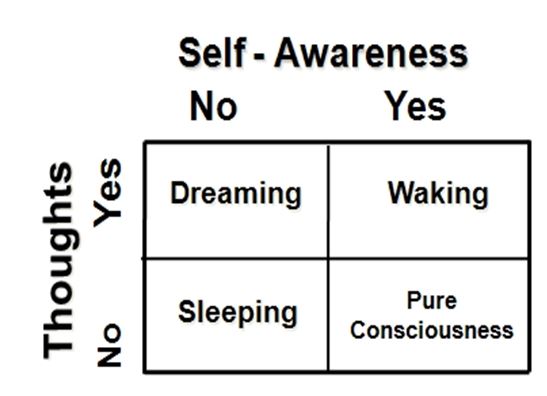
This figure, a 2 X 2 table, compares subjective and objective experiences during waking, sleeping, dreaming, and pure consciousness. As seen in this table, waking state contains a sense of self and mental content, thoughts and perceptions. In contrast, during pure consciousness, there is only Self-awareness, without any sense of time, space, and body awareness.

This figure, a 2 X 2 table, compares subjective and objective experiences during waking, sleeping, dreaming, and pure consciousness. As seen in this table, waking state contains a sense of self and mental content — thoughts and perceptions. In contrast, during pure consciousness (Transcendental Consciousness), there is only Self-awareness, without any sense of time, space, and body awareness.

Dr. Travis discusses a study of descriptions of Transcendental Consciousness from 52 subjects practicing the Transcendental Meditation technique and found that they experienced “a state where thinking, feeling, and individual intention were missing, but Self-awareness remained.” A systematic analysis of their experiences revealed three themes: absence of time, space, and body sense.

Specific physiological changes are associated with this subjective experience of Transcendental Consciousness. These include changes in breath rate, skin conductance, and EEG patterns.

Dr. Travis further explains that with regular meditation, experiences of Transcendental Consciousness begin to co-exist with sleeping, dreaming, and even while one is awake. This state is called Cosmic Consciousness, in the Vedic tradition. The paper presents first-person accounts followed by an overview of the physiological patterns associated with Cosmic Consciousness.

Whereas control subjects describe themselves in relation to concrete cognitive and behavioral processes, those experiencing Cosmic Consciousness describe themselves in terms of a continuum of inner self-awareness that underlies their thoughts, feelings, and actions.

In addition, the Cosmic Consciousness subjects showed the EEG patterns seen during Transcendental Consciousness along with the EEG patterns when they were asleep, and during waking tasks. This leads to higher scores on the Brain Integration Scale developed by Dr. Travis.

Dr. Travis suggests that such higher states of consciousness can be seen as normal developments beyond the classic stages described by Piaget. One simply needs a technique to experience transcendence and thereby facilitate the development of these states. The practical benefit of higher states, he says, is that you become more anchored to your inner Self, and therefore less likely to be overwhelmed by the vicissitudes of daily life.

“This research focuses on the larger purpose of meditation practices — to develop higher states of consciousness,” explained Dr. Travis. “This paper is the outgrowth of meetings at Esalen and the Institute for Noetic Sciences to chart the future of meditation research.”

Source: EurekAlert!

The Annals of the New York Academy of Sciences is the oldest continuously published scientific serial in the United States and among the most cited of multidisciplinary scientific serials worldwide. Established in 1823, the Annals is the premier publication of the Academy, offering volumes of review articles in special topical areas and proceedings of conferences sponsored by the Academy as well as other scientific organizations. You can find out more about them here: http://www.nyas.org/whatwedo/publications/annals.aspx.

Read the Foreword to Advances in Meditation Research: Neuroscience and Clinical Applications, by editor Sonia Sequeira.

Related: Health India’s Editorial Team says Transcendental Meditation (TM) is taking the world by storm

Medical News Today: Overview of research on individuals experiencing higher states of consciousness during transcendental meditation.

A PDF of the study is now available at ResearchGate.

Transcendental Meditation @TMmeditation article in @THR on @DAVID_LYNCH

January 11, 2014

Here is an excellent article about Transcendental Meditation published in the latest issue of The Hollywood Reporter, part of a Health series on how stress effects celebrities and what they do to relieve it. This one is on David Lynch. Click on the title to see the original article with photos.

How David Lynch and His Hollywood Friends Are Bringing Back Transcendental Meditation

One of film’s darkest directors, with help from Jerry Seinfeld and Hugh Jackman, is shining a light by bringing meditation to everyone from PTSD sufferers to inner-city kids.

January 10, 2014 | by Seth Abramovitch

Call it the ultimate comeback. Transcendental meditation — which involves speaking a silent mantra to oneself for 20 minutes, twice daily — is an ancient practice that is now attracting some of Hollywood’s biggest names, who insist that its stress-relief benefits are nothing short of miraculous: Among its most powerful practitioners are Jerry Seinfeld, Hugh Jackman and Russell Brand — who all have become supporters of David Lynch and his plans to bring meditation to people in dire need of stress relief. A directing genius whose dark dreamscapes are littered with severed ears and plastic-wrapped homecoming queens, Lynch, 67, has morphed into one of the world’s most enthusiastic if unlikely TM cheerleaders.

Lynch first encountered TM in 1974, as he searched for ways to combat mounting anger and depression relating to his epic struggle to get his first feature, the mind-bending Eraserhead, to the big screen. “I had a weakness inside,” says Lynch from his Hollywood Hills studio, a splash of sunlight illuminating his famous white pompadour. “That kind of thing, in this business, you’re a sitting duck. You could get slaughtered.” It was then that he decided to try his hand at TM, an ancient practice revived by the late Maharishi Mahesh Yogi, an expat from India who rocketed to stardom during the 1960s as The Beatles‘ spiritual adviser. Lynch feared TM might dull his artistic edge, but he says the opposite happened — it helped him to access untapped fonts of creativity. He even goes so far as to credit the practice with potentially having saved his life: “I was even thinking at the time, ‘If I didn’t have this meditation, I might have seen that a way out was suicide.’ ”

The Twin Peaks mastermind hasn’t missed a single day of meditation in the 40 years since. In 2005, that devotion led him to found The David Lynch Foundation for Consciousness-Based Education and World Peace, a nonprofit that brings TM to inner-city students, veterans with post-traumatic stress disorder and victims of domestic violence. The foundation has taught the fundamentals to more than 500,000 at-risk candidates, and Lynch says the effects have been astonishing: “Before too long, they’re saying, ‘Thank you very much. I got my life back again.’ ” In celebration of Lynch’s birthday on Jan. 20, DLF Live, the foundation’s live-performance arm, is mounting a benefit at the El Rey Theatre, where Ringo Starr is set to receive the Lifetime of Peace & Love Award. Ben Harper and Ben Folds are slated to perform. And on Feb. 27, Dixie Chicks will headline a night at the Beverly Wilshire Hotel honoring record producer (and longtime TM practitioner) Rick Rubin. For the admittedly shy director, Hollywood’s ongoing love affair with TM offers a highly effective method of spreading the gospel. “Life gets better and better and better,” says Lynch of his 40-year journey. “That’s the long and the short of it.”

This Pret-a-Reporter story first appeared in the Jan. 17 issue of The Hollywood Reporter magazine.

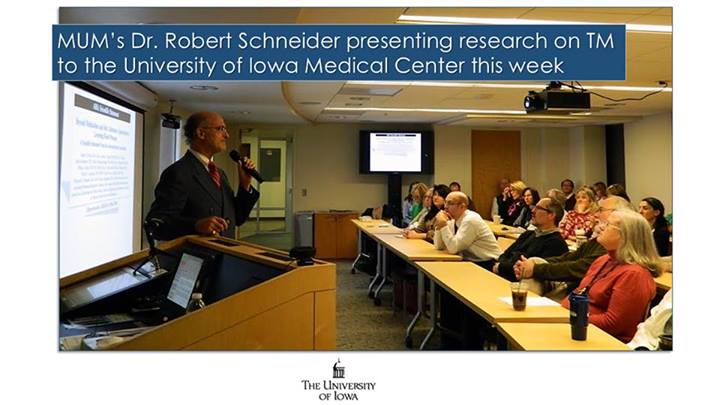
@MaharishiU’s Dr. Robert Schneider presents @TMmeditation research to @uiowa Hospitals and Clinics medical staff

January 9, 2014

Doctor touts health benefits of Transcendental Meditation
Written by Sara Agnew, Iowa City Press-Citizen
Jan. 7, 2014 8:55 PM

Dr. Francois Abboud, left, talks with Dr. Robert H. Schneider, who spoke with medical staff at University of Iowa Hospitals and Clinics Tuesday about how the practice of Transcendental Meditation can reduce the risk of heart disease and lower blood pressure. / Sara Agnew / Iowa City Press-Citizen

Dr. Francois Abboud, left, talks with Dr. Robert H. Schneider, who spoke with medical staff at University of Iowa Hospitals and Clinics Tuesday about how the practice of Transcendental Meditation can reduce the risk of heart disease and lower blood pressure. / Sara Agnew / Iowa City Press-Citizen

If you want to reduce your risk of cardiovascular disease and lower your blood pressure without taking medication, Dr. Robert H. Schneider has a suggestion: Transcendental Meditation.

Schneider says he has been involved in studies that show this type of meditation can reduce the rate of death from cardiovascular disease by 30 percent and from cancer by 40 percent.

The key is you need to know the “techniques” of Transcendental Meditation to experience the benefits — sitting with your eyes closed for 10 minutes won’t cut it.

That’s the message Schneider shared with about 40 hospital personnel Tuesday during an hourlong presentation called MIND-BODY-HEART: Evidence for Meditation in Hypertension and Cardiovascular Disease at University of Iowa Hospitals and Clinics. It was his first visit with staff and doctors at UIHC.

“It was breakthrough,” he said of his visit.

Schneider is director of the Institute for Natural Medicine and Prevention and dean of medical programs at Maharishi University of Management in Fairfield. As a physician and scientist, Schneider has spent the past 30 years researching evidence-based natural approaches for treating heart disease, high blood pressure, stress and other cardiovascular factors. Over the past 20 years, he has received more than $20 million in research grants from the National Institutes of Health for his natural approaches to treating heart disease.

Much of his work centers on the benefits of Transcendental Meditation.

Schneider said TM is an effortless technique for “automatic self-transcending.” It allows your mind to settle inward beyond thought to experience the source of thought — pure awareness. This is the most silent and peaceful level of consciousness and what many who practice TM call your innermost self.

“It takes a technique that you learn in an eight-hour course,” Schneider said. “Once you have the technique, it happens quite easily.”

Schneider said humans have an “inborn ability” to practice this type of meditation.

“But we have lost this simple and natural technique,” he said.

Schneider said much of his research about the correlation between mind and body were affirmed last June when the American Heart Association announced that Transcendental Meditation is the only meditation practice that has shown to lower blood pressure. In addition, AHA reported lower blood pressure through TM is associated with substantially reduced rates of death, heart attack and stroke.

Ultimately, Schneider said the AHA recommended that TM be recommended for consideration as an alternative treatment for individuals with blood pressure greater than 120/80 mm Hg.

Schneider said he learned about TM 40 years ago as a college student.

“I was always interested in how we can tap into the body’s own cell repair and healing abilities,” he said. “I thought I’d try it and see if it works.”

He read the research and gave TM a try.

“I found I could study better and learn better and had more energy,” Schneider said.

Later, when he was a fellow in hypertension at the University of Michigan Medical School, Schneider took an interest in the connection between the brain and heart.

“I thought maybe we could use the brain to lower blood pressure,” he said.

Schneider believes his years of research on managing the mind-body connection is paying off as organizations such as the AHA begin recognizing the benefits of TM.

During his presentation at UIHC, Schneider highlighted a 2012 study that showed blacks with heart disease who practiced TM regularly were 48 percent less likely to have a heart attack, stroke or die from all causes compared with blacks who attended a health education class over more than five years.

Those practicing TM also “lowered their blood pressure and reported less stress and anger,” Schneider said.

Schneider is interested in researching how TM can be used to help military veterans recover from post-traumatic stress disorder.

Dr. Francois Abboud, the namesake of UI’s Cardiovascular Research Center, asked, “How will I know if I am meditating correctly?”

Linda Rainforth, a certified TM teacher from Iowa City, said people who are practicing TM reach a “deep, deep level of silence and stillness” in which they experience an “expansion of the mind.”

One listener wondered whether men or women followed through most consistently in practicing TM during research studies.

“Men and women both get results,” Schneider said. “But in some of our studies, there was slightly more compliance with the women.”

If you go

Learn more about Transcendental Meditation by attending one of the following presentations by certified teachers in TM. All presentations will be at the Iowa City Public Library, meeting room E.
• 7:30 to 8:30 p.m. Thursday.
• 3 to 5 p.m. Saturday.
• 6:30 p.m. Jan. 16.
TM sessions also can be by appointment by calling Iowa City Transcendental Meditation Program at 936-1986, 641-472-0827 or 641-919-7282. For more information, go to www.tm.org.

MUM's Dr. Robert Schneider presenting research at UIMC

Dr. Robert Schneider was also interviewed by Steve Smith on KMCD’s MUM Spotlight Show about the American Heart Association’s recommendation of Transcendental Meditation to lower high blood pressure. He also reported on his visit to UI’s Medical Center. Steve asked some great questions. It was a lively discussion. Listen here: http://fairfieldiowaradio.com/audio/spotlight%201-9.mp3. (20:45)

See Dr. Schneider on New Zealand Television’s Breakfast ONE News describing the value of TM for heart health. http://tvnz.co.nz/breakfast-news/meditating-your-heart-video-5602306