Posts Tagged ‘Transcendental Meditation’

The Independent: Transcendental Meditation: Were the hippies right all along?

July 10, 2011


Transcendental Meditation: Were the hippies right all along?

For years, it has been ridiculed as a 1960s embarrassment. Now Transcendental Meditation is back in a big way. So were those hippies on to something all along?

By Laura Tennant
Sunday, 10 July 2011

Remember M-People’s 1995 Top 10 hit instructing you to “search for the hero inside yourself”? A decade-and-a-half on, it seems that things have changed – these days, it’s not so much a hero as a guru that many of us are hoping to internalise. For strange as it may sound, among those of us who seek to surf the zeitgeist, the most fashionable thinker of 2011 may turn out to be Maharishi Mahesh Yogi, the founder of the Transcendental Meditation movement – and the fact that he passed to a better place in 2008 doesn’t appear to have discouraged us one bit.

TM, as its followers call it, is rapidly moving from kooky margin to respectable mainstream thanks largely to a burgeoning body of scientific research which indicates that regular meditators can expect to enjoy striking reductions in heart attack, stroke and early mortality (as much as 47 per cent, according to one study). And the apparent benefits don’t stop there: according k to a pilot study just published in the US journal Military Medicine, veterans of the Iraq and Afghanistan wars showed a 50 per cent reduction in their symptoms of post-traumatic stress disorder after eight weeks of TM.

Meanwhile, educational establishments which introduce a “quiet time programme” – as did Visitacion Valley Middle School in San Francisco – report drops in fights and suspensions, increased attendance and improvements in exam results. In this country, the Maharishi School in Ormskirk, Lancashire, gets glowing reports from Ofsted and achieves exceptional academic results.

An estimated four million people now practise TM globally – 20 minutes twice daily, as per the Maharishi’s prescription – many of them over the course of many decades, and there are some famous, and rather surprising, names on the list. Clint Eastwood, for example, has been doing it for 40 years, a fact he vouchsafed via video link at a fund-raising dinner for the David Lynch Foundation, an organisation set up by the film-maker to teach TM to school children, soldiers suffering post-traumatic stress, the homeless and convicted prisoners. Other celebrity adherents include Paul McCartney, Russell Brand, Martin Scorsese, Ringo Starr, Mary Tyler Moore, Laura Dern and Moby.

TM reaches far into the rational and sceptical world, too; the American philosopher Daniel Dennett does it, as does Dr Jonathan Rowson, head of the Social Brain project at the Royal Society for the Encouragement of Arts, Manufactures and Commerce (RSA) and a chess grandmaster (more from them later). Now a psychiatrist with 30 years’ clinical experience, Dr Norman Rosenthal has written a book, Transcendence: Healing and Transformation through Transcendental Meditation, which gathers all the available evidence for TM and urges healthcare professionals to offer it to patients suffering from mental illnesses ranging from mild depression to bipolar disorder.

While the research on the health benefits of TM is fascinating, there’s another, more compelling, reason why meditation is in the air just now. Done consistently, it seems to offer some sort of corrective to modernity, a respite from anxiety and the ability to really, truly relax, without chemical assistance; a break from our constant, restless and often doomed aspirations to be thinner, richer and more popular on Facebook; the welcome discovery that happiness is to be found not in retail therapy, but within.

Those spiritual cravings explain why Rosenthal’s book is now riding high at number 14 on America’s Publishers Weekly non-fiction list. And according to TM UK’s official representative, David Hughes, there’s a similar surge of interest on this side of the Atlantic; figures are vague, but he reports that “there’s definitely an ongoing increase month by month” to the estimated 200,000 people who have learnt TM in the UK since 1960.

I first began to ponder the notion of meditation while writing a piece on solitude. While aloneness might not be a state that comes naturally to most humans, without it, mental-health experts believe, it is impossible to be creative or even really to know oneself. It was the sheerest coincidence that on the day I contacted TM’s UK website they were preparing for Dr Rosenthal’s press conference.

Click on this link to read the rest of the article: http://t.co/795LCEz.

According to David Hughes, TM is a not-for-profit, charitable and educational foundation which, once it has paid its teachers and covered its costs, ploughs its revenue back into outreach programmes in the developing world. It is certainly not shy about proselytising; but if its impact on public health is as great as Dr Rosenthal believes, one could argue it has a moral responsibility to spread its message. As for me, I’m seriously considering introducing my children to a stress- and anxiety-busting daily ritual that seems to do no harm and may well do a great deal of good.

For more information on the movement, visit t-m.org.uk

©independent.co.uk

A nicely edited version of this article was posted Tues Jul 12, 2011 in the Times of Oman: In search of a quiet time.

ABC News: Study finds meditation helps soldiers overcome trauma, PTSD

June 28, 2011

Study finds meditation helps soldiers overcome trauma, PTSD

Short video link: http://bcove.me/dug2ceme

By Cynne’ Simpson WJLA – ABC 7

June 28, 2011 – 06:45 pm

More than 20 percent of soldiers returning from Iraq and Afghanistan suffer from post-traumatic stress disorder, according to the Department of Defense.

New research suggests one way to combat the symptoms is through meditation.

David George was sleeping in his cot during his deployment to Iraq when a car bomb exploded 25 yards away.

“I turn the lights on, and see a white cloud billowing into the room,” the 27-year-old recalls. “All the windows were blown out.”

Since then, he’s struggled with PTSD, is often anxious, angry and depressed. At one point, back at home in Maryland, he stopped himself from buying a pistol.

“I never bought a pistol because I was pretty sure I was going to shoot myself,” George said.

His mother noticed a change in her son’s behavior, too. “When he came back, he was not the boy I raised,” Julia Elena George said.

Medications and therapy didn’t help. George started drinking heavily.

Then he joined a study for veterans with PTSD using transcendental meditation, a mind-based practice involving repeating a mantra to focus one’s thoughts.

“It made me feel, and that’s the biggest sense I lost,” George said. “From that moment, I knew it was something I’d do for the rest of my life.”

The study’s findings are published in this month’s Military Medicine journal. The study found participants saw their symptoms reduced by half within two months of participating in the meditation.

Dr. Norman Rosenthal says transcendental meditation settles down the nervous system.

“People become calmer, less reactive, less jumpy,” he said. “I think the time is right for us to seriously consider this as a viable treatment.”

George meditates twice a day and says he finally feels like himself again.

“There’s something else than pills or therapies or substance abuse – there’s yourself that you can always count on,” he said.

George is working with operation warrior wellness and the David Lynch foundation to reach their goal to help 30,000 veterans through transcendental meditation in the next three years.

Short URL: http://wj.la/kKqDh3

Huffington Post: Transcendental Meditation: Topping The Bestseller List Since 1975

June 21, 2011
Philip Goldberg
Interfaith Minister, author of ‘American Veda:
How Indian Spirituality Changed the West’

Transcendental Meditation: Topping The Bestseller List Since 1975

Posted: 06/21/11 08:10 AM ET

When I saw a book about Transcendental Meditation (TM), written by a scientist, had landed on the New York Times bestseller list, my reaction was to quote the great Yogi of Berra: “It’s déjà vu all over again.”

In 1975, “TM: Discovering Inner Energy and Overcoming Stress” was propelled onto the list when its lead author, psychiatrist Harold Bloomfield, appeared on Merv Griffin’s syndicated TV talk show (the Oprah of its day) with TM founder Maharishi Mahesh Yogi. The book remained a bestseller for six months, and then had a solid run on the paperback list. During that period, Merv devoted a second show to Maharishi, and TM centers could barely keep up with the demand. By the end of 1976, over a million Americans had learned to meditate.

This was the culmination of a remarkable eight-year run that began when the Beatles famously learned the TM and sojourned at Maharishi’s ashram in India. Between that watershed moment and the two Merv programs, meditation moved from the counterculture to the mainstream, from weird to respectable, from youthful mind expansion to middle-age stress remedy. Now, the celebrity meditators were not rock stars but Clint Eastwood and Mary Tyler Moore, and you could not get more mainstream than the nation’s big screen hero and its TV sweetheart.

The route from esoteric mystical discipline to respectable relaxation technique was paved by science. It started in the late ’60s when a young meditator named Robert Keith Wallace was persuaded by his guru, Maharishi, to study the physiology of TM. The research became his Ph.D. dissertation, and then a Science magazine article in 1970. Wallace’s follow-up study, conducted with Harvard cardiologist Herbert Benson, was published in 1971 in The American Journal of Physiology and Scientific American. The data sparked an avalanche of research. By 1975, a substantial body of evidence had demonstrated the efficacy of meditation on various measures of physical and mental health.

Now comes another psychiatrist, Norman E. Rosenthal, with “Transcendence: Healing and Transformation through Transcendental Meditation.” Once again, celebrity endorsements add pizzazz, in this case Mehmet Oz, David Lynch, Martin Scorcese and Russell Simmons, with cameo appearances by the gray eminences, Ringo Starr and Paul McCartney. And once again science confers credibility. Whereas Bloomfield was fresh out of his Yale residency when Merv Griffin showcased his book, Rosenthal has 30 years of distinguished clinical research and more than 200 scholarly articles under his belt. And by now TM has been the subject of over 300 peer-reviewed articles. The book describes the most recent findings, many of them involving common maladies such as ADHD, PTSD and hypertension, but not limited to medical conditions.

That meditation is good for you is no longer an eye-opening news flash. But the new book’s bestsellerdom suggests that a new generation wants to hear the message. In this era of soaring anxiety, depression and health costs, perhaps the only people who don’t think that’s a good thing are the makers of pharmaceuticals.

As someone who has chronicled the transmission of Eastern spirituality to the West, I hope that this time around we can avoid some of the pitfalls of the past. As the title of Rosenthal’s book “Transcendence,” suggests, meditation is not just a medical intervention. The deeper purpose has always been the development of higher consciousness, as described in the Vedic tradition from which practices like TM derive. But when yogic methods become medicalized and their benefits quantified, they tend to get disconnected from their spiritual roots — a loss for all of us.

Another consequence of the popularization of meditation was the rise of imitation practices. Health experts, self-help mavens and entrepreneurs did everything they could to de-Hinduize and de-Indianize the practice. Recently, we’ve seen a similar tendency as practices derived from Buddhism were secularized as “mindfulness.” The advantage of this adaptation, of course, is that it makes such practices far more accessible. The downside is that something vital can be lost in translation, thereby diminishing their effectiveness. Modernizing the language is one thing, but tinkering with the ingredients of a meditation practice is not unlike changing a medical formula or a food recipe.

Finally, in the past, all forms of meditation were lumped together as if their differences were inconsequential. People who should have known better assumed that the initial TM data could be applied to just about anything that resembled meditation. That techniques practiced differently would produce identical outcomes defies logic, yet the premise was accepted on faith and promoted by both healthcare professionals and New Age promoters. Recent findings have corrected that mistake to a large extent, and current researchers are sorting out which practices produce which results under which circumstances.

The scientific investigation of ancient spiritual practices might be one of the most important advances of the modern era. But we have to proceed with care and discernment, assimilating the methods without obscuring or dishonoring their roots. If we get careless, we can dilute them, corrupt them and otherwise fail to harness their full potential. It’s happened to some extent already, and it’s happening as we speak in the trendy world of yoga studios, where complex and profound teachings are being reduced to fitness exercises. Rudyard Kipling’s assertion that “East is East and West is West and never the twain shall meet” turned out to be mistaken, to our everlasting benefit. But we have to make sure that East does not become West.

Link to article, comments, and this blogger’s books: http://www.huffingtonpost.com/philip-goldberg/transcendental-meditation_b_880098.html.

Here is the first TM bestseller, now out again: Transcendental Meditation: The Essential Teachings of Maharishi Mahesh Yogi. The classic text revised and updated by Jack Forem (Oct 8, 2012).

Listen to Philip Goldberg on KRUU FM: Cheryl Fusco Johnson interviews Philip Goldberg, author of American Veda: How Indian Spirituality Changed the West on October 12, 2012, and Dennis Raimondi interviews Philip Goldberg on Speaking Freely about his latest book American Veda on Nov 22, 2010.

The Power of The Collective, by John Hagelin

June 15, 2011

SHIFT: AT THE FRONTIERS OF CONSCIOUSNESS
IONS: JUNE–AUGUST 2007 #15
THE MYSTIQUE OF INTENTION

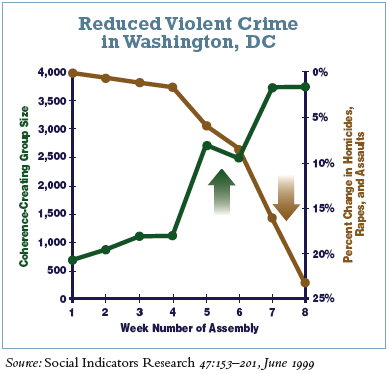
A remarkable series of scientifically credible studies has shown a link between group meditation and lowered incidents of violence and crime. And why not? argues Hagelin: If meditation is good for the individual, it should also be good for the collective. From June 7 to July 31, 1993, up to 4000 participants of Maharishi Mahesh Yogi’s Transcendental Meditation and TM-Sidhi Programs gathered together in Washington, DC, to form a Group for a Government Global Demonstration Project. Under the direction of Dr. John Hagelin, violent crime in Washington, DC was significantly reduced as predicted during the time of this World Peace Assembly. The study presenting these findings was published in Social Indicators Research. What follows is a report of that study presented in the context of a talk Dr. Hagelin gave in a Holland videocast to the Noetic Sciences (IONS) regional conference on February 18, 2007, in Tucson, Arizona, titled: “A New Science of Peace: The Effects of Group Meditation on Crime, Terrorism, and International Conflict.” The editor of Shift magazine excerpted, abridged, and edited that talk into this article, The Power of the Collective, for their June-August 2007 issue on The Mystique of Intention. You can download a PDF of the complete article Shift-The Power of the Collective.

THE POWER OF THE COLLECTIVE
John Hagelin

We’re living in an epidemic of stress. Doctors report an alarming rise of stroke, hypertension, and heart disease—now called metabolic syndrome—all of which are diseases of stress. As a result, we would expect to see stressed behavior in society, and it turns out there is plenty of it: crime, domestic violence, terrorism, and war.

Since meditation provides an effective, scientifically proven way to dissolve individual stress, and if society is composed of individuals, then it seems like common sense to use meditation to similarly defuse societal stress. A reduction in crime and stress-related behavior would then be expected to follow.

Nobody would have ever guessed—I wouldn’t have guessed—the extraordinary degree to which you can reduce social violence through meditation, because it doesn’t take everyone meditating to generate profound effects. A relatively small number of people meditating together has a powerful spillover effect, reducing stress throughout a surrounding area in a measurable way. That’s the phenomenon I want to focus on. That’s where the really interesting physics and metaphysics can be found.

REAL-WORLD EFFECTS

A study I conducted in the summer of 1993 in Washington, DC, shows rising crime levels over a period of six months, which take place every year as the temperature gets hotter between the winter and the summer. People stay out later, they are more aggravated and agitated, they get into more fights, and the crime rate goes up. This is an absolutely known annual trend. From June through July of that summer, we brought to the area a large number of practicing meditators and trained quite a few others. When the group reached a particular size—2,500 (ultimately reaching 4,000)—which was about halfway through the period, there was a distinct and highly statistically significant drop in crime compared to expected rates based on previous data, weather conditions, and a variety of other factors.

We collaborated with the local police department, the FBI, and 24 leading, independent criminologists and social scientists from major institutions, including the University of Maryland, the University of Texas, and Temple University, who used highly sophisticated research tools to control for variables such as weather. Everyone ended up agreeing on the language, the analysis, and the results, and those results were quite astonishing. We predicted a 20 percent drop in crime, and we achieved a 25 percent drop. Just before the study, the Washington, DC, chief of police went on television and said something like, “It’s gonna take a foot of snow in June to reduce crime by 20 percent.” But he allowed his department to participate in the experiment by collecting and analyzing the data. In the end, the police department signed on as one of the authors of a published paper (see Social Indicators Research 47:153–201, June 1999).

In this case it was only a few thousand people in a city of about a million and a half. So a relatively small group was influencing a much larger group. This is what is so fascinating. And it has implications for more than just crime. In my opinion the most immediate implications today in the world are stopping ethnic wars, the conflict in the Middle East, and so on. And in fact a similar experiment was done during the peak of the Israel-Lebanon war in the 1980s. We found that on days when the numbers of meditators were largest (and also on the subsequent day), levels of conflict were markedly reduced—by about 80 percent overall. This turned out to be a statistically significant effect and also a surprising one, because there were only about 600 to 800 people meditating in the midst of this entire conflict and the highly stressed surrounding population.

The results were published in Yale University’s Journal of Conflict Resolution (32:776–812, December 1988), which also published a letter urging other universities, collaborators, and groups to repeat this study. The editors felt that the implications of this were so far reaching, so fundamentally important, that it must be repeated to test the likelihood that the results were a statistical fluke. And that’s exactly what happened over the next two and a quarter years. During this 821-day period, seven subsequent experiments were performed to examine the effects of group meditation on the Israel-Lebanon war. These groups gathered in Israel, in Lebanon itself in the actual conflicted neighborhoods, and at locations throughout the Middle East, Europe, and other parts of the world.

In each case, when the size of the group reached the threshold that was predicted (based on previous research) to have an effect, there was a marked and statistically significant reduction of violence. We have also found in other studies that in the geographic vicinity of such a meditating group, people experienced physiological changes—increased EEG coherence, reduced plasma cortisol, increased blood levels of serotonin, biochemical changes, and neurophysiological changes—as if they were meditating.

When you put all these studies together, the likelihood that the reductions of violence were simply coincidental—a statistical fluke—was less than one part in 10 million million million (1019). An overwhelming number of papers documenting more than sixty different experiments of group meditation’s effect on conflict have been published in peer-reviewed scientific journals that have the most stringent standards for research. I believe it is the most rigorously established and thoroughly tested phenomenon in the history of the social sciences.

“I think the claim can be plausibly made that the potential impact of this research exceeds that of any other ongoing social or psychological research program. It has survived a broader array of statistical tests than most research in the field of conflict resolution. This work and the theory that informs it deserve the most serious consideration by academics and policy makers alike.”

—David Edwards, PhD
Professor of Government
University of Texas at Austin

The rest of this compelling article continues below with the subheading STRINGS AND SPACE-TIME. If you don’t see it here, scroll below and click on Read the rest of this entry at the bottom of this post to continue reading.

You’ll also come across a subsection added after the article titled, TM and Intention. It was part of a conversation between the editor of Shift magazine and the team at the Maharishi University of Management.

* * * *

Around the same time, as a companion piece, Byron Belitsos interviewed John Hagelin for the IONS online Intention Downloads. It is truly spectacular. To elaborate and elucidate on the subject, Byron asked some great questions on the differences between meditation and intention. Dr. Hagelin’s brilliant replies really took this current Intention debate to a deeper more comprehensive level of understanding, equating intention with thought, distinguishing between thinking and consciousness, and how one can enhance one’s intentions multifold from a deeper level of consciousness. You can listen to the 23:12 minute interview published June 26, 2007 by clicking Download as mp3. Click on View Transcript under the description to read it. Here is their introduction to that interview:

Intention Downloads Interview: John Hagelin
Visionary: John Hagelin, PhD

In this interview, quantum physicist and former Presidential candidate John Hagelin explains the difference between intention and consciousness, which opens the door on a fascinating discussion of how spending time in deep meditation in the “nuclear” level of thought can multiply the efficacy of intentions. Residing in object-free consciousness connects us to a field of pure, unlimited, creative potential, which in turn ripples out through the quantum field, affecting our lives and even large systems in positive ways. He cites studies he has been involved in showing that a critical mass of meditators has correlated with significantly lowered crime rates. He also predicted similar effects on complex systems from hurricanes to stock markets, with positive results so far. Scientific study of such effects is gaining steam and his ambitious Invincible America Assembly project plans to take this work to the next level, training a critical mass of meditators to positively affect the rates of violence for the entire planet.

JOHN HAGELIN, PhD, is a quantum physicist, educator, public policy expert, and one of the world’s foremost proponents of peace. He is director of the Institute of Science, Technology, and Public Policy, and international director of the Global Union of Scientists for Peace. For more information, go to http://hagelin.org.

Research Links: www.permanentpeace.org and www.invincibility.org.

Also posted on www.MeditationAsheville.org

* * * *

See: Group Meditations Reduce Crime, As Predicted
And Explanation to Steady Decline in Major Crime

(more…)

Meditation Promoted For Troops With PTSD

June 9, 2011

Alternative treatment promoted for soldiers suffering from PTSD

Washington (CNN) — Celebrities and a medical researcher want to convince the Defense Department this week that meditation could help the increasing number of military personnel suffering from post-traumatic stress.

Star-studded events in New York and Washington are bringing together people experienced in transcendental meditation with soldiers suffering from post-traumatic stress disorder, or PTSD.

Designer Donna Karan hosted a reception in Manhattan on Tuesday evening, and movie director David Lynch (“Blue Velvet,” “Mulholland Drive”) and CNN anchor and correspondent Candy Crowley will headline a Washington event Wednesday to kick off a campaign the sponsors hope will teach 10,000 veterans how to meditate.

A Georgetown Medical School clinical professor, Dr. Norman Rosenthal, said he has the facts, figures and testimonials to show that meditation can be a low-cost, low-risk alternative to strong narcotics often prescribed by government doctors.

The Pentagon and the Department of Veterans Affairs “are big institutions,” Rosenthal said in a telephone interview. “Our hope is someone will raise an eyebrow and say, “Well, well.”

He includes case studies in his new book, “Transcendence-healing and Transformation through Transcendental Meditation.”

In one case, he quotes a Marine gunner on a Humvee who saw heavy fighting in Iraq. The Marine wrote that PTSD symptoms disrupted his sleep and derailed his family life upon his return to the United States, but “TM (transcendental meditation) has helped with organizing, prioritizing and just being calmer overall. I just feel better.”

Rosenthal says a simple seven-step process has quick results. “What do we have to lose? It is so cheap, and it is safe,” he told CNN.

The military, meanwhile, is facing a number of challenges over the use of powerful drugs prescribed for a variety of stress-related ailments, with increased risk of sometimes deadly, accidental overdoses. The Army’s assistant surgeon general, Brig. Gen. Richard Thomas, told CNN recently that he thinks there has been over-reliance on prescription drugs.

“It reflects how we are in society. We do have a tendency to rely on prescription meds,” he said.

And the Pentagon, according to Thomas, is receptive to nondrug treatments.

“Whether it be acupuncture or biofeedback or yoga therapy, there is a host of other things we can provide to patients to take care of them right, other than narcotics,” Thomas said at the Pentagon. “Narcotics may still have a role, but it doesn’t have as big a role and there are alternatives, and that’s the key.”

Rosenthal said he and his fellow researchers, who published their findings in the journal Military Medicine, found that meditation can help an individual control emotions and thoughts and deal with common PTSD complaints of anxiety, depression, sleeplessness and anger.

He compares his latest efforts to win government support to his early uphill battle researching and publicizing his findings after he first diagnosed seasonal affective disorder, or SAD.

His research on military PTSD and meditation has a pilot study of five veterans. He brushes aside any suggestions that this is too small a sample.

“When you get a powerful intervention, you see a signal,” Rosenthal said. “And how do you get interest without a pilot study?”

His book says of 1.64 million U.S. military personnel sent to the Iraq and Afghanistan war zones between 2001 and 2008, one in seven met criteria for PTSD.

“Half of these veterans had never sought any kind of help for their symptoms, probably because of the stigma of being labeled with a psychiatric disorder,” Rosenthal wrote. “Of those who sought help, half received inadequate treatment.”

Link to article: http://edition.cnn.com/2011/US/06/08/ptsd.meditation

This story was picked up in over 50 major US media outlets as: Meditation Promoted For Troops With PTSD.

See ABC NEWS/Health: Meditation Heals Military Vets With PTSD

See: Donna Karan and David Lynch collaborate to launch “Operation Warrior Wellness-NYC”

See EurekAlert press release on Dr. Norman Rosenthal’s pilot study: TM Reduces Veterans PTSD Symptoms by 50%

And other entries on Operation Warrior Wellness here.

TM Reduces Veterans PTSD Symptoms by 50%

June 1, 2011

Veterans Show a 50% Reduction in PTSD Symptoms
After 8 Weeks of Transcendental Meditation

WASHINGTON | Wed, June 1, 2011, 9:00am EDT

Veterans of the Iraq/Afghanistan wars showed a 50 percent reduction in their symptoms of post-traumatic stress disorder (PTSD) after just eight weeks of practicing the stress-reducing Transcendental Meditation technique, according to a pilot study published in the June 2011 issue of Military Medicine (Volume 176, Number 6).

The study evaluated five veterans, ages 25- to 40-years-old, who had served in Iraq, Afghanistan or both from 10 months to two years involving moderate or heavy moderate combat.

The study found that Transcendental Meditation produced significant reductions in stress and depression, and marked improvements in relationships and overall quality of life. Furthermore, the authors reported that the technique was easy to perform and was well accepted by the veterans.

The Clinician Administered PTSD Scale (CAPS) was the primary measure for assessing the effectiveness of TM practice on PTSD symptoms. CAPS is considered by the Department of Veterans Affairs as the “gold standard” for PTSD assessment and diagnosis for both military Veteran and civilian trauma survivors.

The paper’s senior researcher, Norman Rosenthal, M.D., is clinical professor of psychiatry at Georgetown University Medical School and director of research at Capital Clinical Research Associates in Rockville, Maryland. Dr. Rosenthal was the first to describe seasonal affective disorder (SAD) and pioneered the use of light therapy as a treatment.

“Even though the number of veterans in this study was small, the results were very impressive,” Rosenthal said. “These young men were in extreme distress as a direct result of trauma suffered during combat, and the simple and effortless Transcendental Meditation technique literally transformed their lives.”

The findings were similar to those from a randomized controlled study of Vietnam veterans conducted by researchers at the University of Colorado School of Medicine. In that study, published in the Journal of Counseling and Development in 1985, after three months of twice-daily TM practice, the veterans had fewer symptoms than those receiving   conventional psychotherapy of the day.  In fact, most of the TM-treated subjects required no further treatment.

“Even though the combat experiences of OEF/OIF veterans and Vietnam veterans are quite different, the fact that our study corroborates the results of the previous study tells us that this technique has the potential to be an effective tool against PTSD and combat stress, regardless of combat situation,” explained Sarina Grosswald, EdD, co-researcher on the study.

Rosenthal hypothesizes that Transcendental Meditation helps people with PTSD because regular practice produces long-term changes in sympathetic nervous system activity, as evidenced by decreased blood pressure, and lower reactivity to stress. “Transcendental Meditation quiets down the nervous system, and slows down the ‘fight-or-flight’ response,” he said.  People with PTSD show overactive fight-or-flight responses, making them excellent candidates for Transcendental Meditation.

Rosenthal points out that there is an urgent need to find effective and cost-effective treatments for veterans with combat-related PTSD. “The condition is common, affecting an estimated one in seven deployed soldiers and Marines, most of whom do not get adequate treatment.  So far, only one treatment—simulation exposure to battleground scenes—has been deemed effective, but it requires specialized software and hardware, trained personnel and is labor intensive.

“Based on our study and previous findings, I believe Transcendental Meditation certainly warrants further study for combat-related PTSD,” says Rosenthal.

Rosenthal is the author of a new book, “Transcendence: Healing and Transformation through Transcendental Meditation,” which will be released by Tarcher Penguin on June 2, 2011. For those wanting to interview Dr. Rosenthal, contact his publicist, Dean Draznin Communications, Inc., 641-472-2257, dean@drazninpr.com.

Results of the new “PTSD and Meditation” study will be announced at special presentations: Tuesday evening, June 7, in New York City, and Wednesday evening, June 8, in Washington, DC.

Watch: Reduction of PTSD Symptoms in Veterans with Transcendental Meditation.

FACT SHEET

Post-Traumatic Stress Disorder (PTSD)

  • A new report paints a stark picture of the toll on the U.S. military of almost a decade of war: higher stress and lower morale. The report, released Thursday, May 19, 2011, at the Pentagon, relied on questions to soldiers and Marines in Afghanistan in July and August of last year and compared responses with similar surveys in 2005 and 2009. The report noted “significant decline in reports of individual morale” as well as “acute stress rates significantly higher” than in earlier years. Source: CNN: New Pentagon study finds psychological toll from years of fighting.
  • VA’s suicide hotline receives 10,000 calls per month from active and retired servicemen. There are 950 suicide attempts per month by veterans receiving care from the VA. 18 veterans commit suicide each day, 5 of them are under the care of the VA. Source: Army Times: 18 veterans commit suicide each day.
  • The Rand Corporation’s study “Invisible Wounds of War” revealed a disturbing truth about the health of our military as recently as 2008:  Over 300,000 returning veterans from Iraq and Afghanistan suffer from PTSD or major depression.  According to the Rand report, these “invisible wounds” take a high toll—impacting veterans’ quality of life, hindering their performance at work, straining their families, and placing them at greater risk for violent and self-destructive behaviors. The economic cost of these disorders is equally great—reaching as high as $6 billion over 2 years. Yet, despite the heavy toll of PTSD and depression, only half of affected veterans seek care, and only a third of those who do, receive adequate treatment. Thus, over 80% of affected veterans remain without needed help.

The Transcendental Meditation Technique

  • The Transcendental Meditation technique is an effortless technique practiced 10-20 minutes twice a day sitting comfortably with the eyes closed.
  • TM is not a religion or philosophy and involves no new beliefs or change in lifestyle.
  • Over 350 peer-reviewed research studies on the TM technique confirm a range of benefits for mind, body and behavior.
  • Several studies have compared the effects of different meditation practices and found that Transcendental Meditation provides deeper relaxation and is more effective at reducing anxiety, depression and hypertension than other forms of meditation and relaxation. In addition, no other meditation practice shows the widespread coherence throughout all areas of the brain that is seen with Transcendental Meditation.
  • The Transcendental Meditation technique is taught in the United States by a non-profit, educational organization.

Source: EurekAlert! Veterans show a 50 percent reduction in PTSD symptoms after 8 weeks of Transcendental Meditation.
The Huffington Post: Top Research Psychiatrist Promotes Meditation for Healing and Transformation.
Fox News.com: Could Transcendental Meditation Help Veterans Suffering From Post-Traumatic Stress Disorder?
The Epoch Times by Ginger Chan: Post-Traumatic Stress Disorder Reduced by Meditation.
Insidermedicine: Transcendental Meditation May Help Veterans with PTSD (Video)
ABC News/Health: ABC News: Meditation Heals Military Vets With PTSD
Medical News Today: Veteran PTSD Symptoms Significantly Reduced After 8 Weeks Of Transcendental Meditation
Click here for more articles and news videos on TM and PTSD posted on The Uncarved Blog.

Jerry Yellin on Loud Miracles with Meital Dohan: Beating PTSD through Transcendental Meditation

May 17, 2011

Click on the title to listen to the interview.

Jerry Yellin: Beating PTSD Through Transcendental Meditation

Meital Dohan talks to Jerry Yellin. They discuss how TM helped him emerge from his PTSD as well as how TM can help better the mind and body in other ways, given that Meital also practices. They discuss the effects of PTSD and how drugs are not the only answer to the hardships and trauma of War.

More about Jerry Yellin

Jerry Yellin is a World War II Veteran who suffered from PTSD after returning home from the war. For many years he suffered from depression that he could not escape, and fell deeper and deeper with no end in sight despite being surrounded by people he cared about and who cared about him. After his wife began to practice Transcendental Meditation, Jerry also tried it. Through TM, which he continues to practice, he got himself out of his depression and has lived a long and healthy life. He speaks widely about his experience and he has has teamed up with the David Lynch Foundation to create Operation Warrior Wellness to provide TM to veterans of our current wars as a way to help heal from the hardships of battle.
 
Listen to other interviews by Meital Dohan and see other articles on Jerry Yellin posted here on The Uncarved Blog.
 
Meital has moved on but her interviews are posted on SoundCloud.
 

The San Francisco Examiner—Meditation program mends troubled Visitacion Valley Middle School

May 8, 2011


Meditation program mends troubled Visitacion Valley Middle School
By: Dan Schreiber
05/08/11 4:00 AM
Examiner Staff Writer

Every day before class, Visitacion Valley Middle School students pass an informal memorial known as the “R.I.P. wall,” a reminder of trouble that awaits them when the afternoon bell rings.

In 2004, two students discovered the partially decomposed body of a 19-year-old stabbing victim. Later that year, a gunman brazenly stormed into the school, threatened to kill a teacher and robbed two employees. In the 2009-10 school year, one-fifth of the students had one or both parents incarcerated.

“Everybody in this school was either related to somebody who has been shot, who did the shooting, or who saw a shooting,” said Jim Dierke, the school principal. “We had kids who couldn’t learn.”

In the spring of 2007, Dierke decided he would try a simple solution.

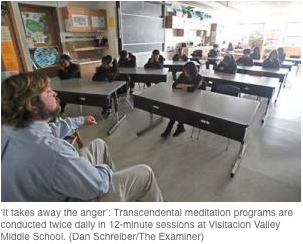
The quiet time program involves the ancient techniques of transcendental meditation, conducted twice daily in 12-minute sessions before and after class.

The first announcement comes over the school’s intercom around 8:45 a.m. — “Prepare for quiet time,” — and the teachers ring a little bell to mark the beginning of the exercise. Most students close their eyes; others cover their faces with their hands and focus on the repetition of a mantra.

“It takes away the anger,” said Charles Ollie, an eighth-grader at the school. “Your brain is like a lake holding in water, and when we meditate, the flood gates open and the water is released.”

Dierke and the school staff credit the program with reducing violence, increasing attendance and test scores and dramatically decreasing suspensions.

Other good things are happening, too, teachers said. The volleyball team made the playoffs this year for the first time in a long time, and some of the eighth-graders are making it into The City’s top high schools, such as Lowell.

Most of the annual $175,000 funding for the program is provided by the New York-based David Lynch Foundation, founded by the TV and movie director. The money is used to pay for dedicated staff to run the quiet time program.

Opponents call it “stealth religion” that violates church-state separation laws because of its association with Eastern religions, but advocates insist that the practice predates Hinduism by thousands of years.

“They come from broken homes, foster care and group home settings,” said Brian Borsos, a special education teacher. “This is a practice that helps them go back and face what they need to face. It’s a skill they take with them for the rest of their lives.”

Program is director Lynch’s brainchild
A handful of San Francisco’s troubled public schools have turned to a transcendental meditation program known as quiet time to relieve high stress in students, made possible by grants from the New York-based David Lynch Foundation.

The TV and film director launched the foundation in 2005 with support from two surviving members of the Beatles and their former meditation instructor Maharishi Mahesh Yogi. But foundation leaders say the practice has nothing to do with religion and is not a church-state separation issue.

Save some minor grumbling and initial skepticism, the San Francisco version of school meditation has not experienced nearly the opposition faced in 2006, when the foundation withdrew funding after parents at Terra Linda High School in San Rafael denouced it as a cult.

Bob Roth, the foundation’s vice president, said the programs in San Francisco have gotten better reception.

Ellie Rossiter, executive director of the nonprofit Parents for Public Schools of San Francisco, said she has heard no opposition to the program. Some of The City’s school officials have even provided testimony on the Lynch Foundation’s website.

“It’s an anchor, it’s a balance for them and I believe it opens them to learning,” Everett Middle School Principal Richard Curci said in a YouTube video.

Soothing results
The meditation program at Visitacion Valley Middle School was instituted in the spring of 2007.

45: Percent reduction in multiday suspensions for quiet-time students in program’s first year
85: Suspensions in 2005-06
10: Suspensions in 2009-10
2.5: Average GPA in fall 2006
2.9: Average GPA in fall 2010
40: Point gain in API score in testing in 2009-10

Source: Visitacion Valley Middle School

dschreiber@sfexaminer.com

Related articles: San Francisco Bay Area News: From time-out to quiet time: meditation comes to SF schools | New research shows Transcendental Meditation improves standardized academic achievementMindShiftKQED: How we will learn: Amidst Chaos, 15 Minutes of Quiet Time Helps Focus Students | and this TM Blog report with video: Breaking the “predictive power of demographics”: SF principal talks about how TM helps his students. And here’s a wonderful report from the The George Lucas Educational Foundation (GLEF): Edutopia: SF School Uses TM to Overcome Problems.

Students find their centers at Maharishi

May 6, 2011


The  Spring 2011 issue of DUH Magazine, Drake University Honors Magazine, in Des Moines, Iowa, describes the unique features of living and learning at Maharishi University of Management, in Fairfield, Iowa, including conversations with teachers, administrators, and students. In the editor’s letter, The spark behind this year’s magazine, Editor-in-Chief Jessica Kinkade comments on the theme for their Spring issue, and how the feature article written by Josie Berg-Hammond exemplifies that theme. Here’s an excerpt:

We chose spark … because we wanted to write stories that would get people thinking—that would spark ideas and curiosity. So this magazine is intended as a catalyst—something to inspire you to have new conversations. … And what sparks conversation and change more than differences? And being open to those differences and letting things inspire us?

Our biggest feature story, written about Maharishi University of Management in Fairfield, Iowa, is perhaps the most genuine example of what it means to be open to this spark of inspiration. l can’t remember how I first heard about the Maharishi, but I was shocked to find out the whole school practices Transcendental Meditation every day. No one in Des Moines seemed to know about it, and I got in my head that it must not be a real school. It couldn’t be. But writer Josie Berg-Hammond was determined to get the real story and see what it was all about. She came back from her visit smiling from ear to ear.

Before l’d even read her story, she was so excited about it. She met so many new people and they were all so friendly. They told her about their schedules, how they eat organic foods, meditate every morning, are in bed by 10 p.m. and only take one class at a time. It all sounds so different from Drake, but the people, the core of the Maharishi community, are still just people … just like us. Their university experience has been a little different from ours, but they sparked thoughts in Josie, and that comes through in her story. The differences between two university communities sparked new relationships and conversations, and what is life about if not those new adventures?

This article was featured in their EVOLUTIONS section of the magazine.

Students find their center at Maharishi

Most high school students look forward to college as a time of new experiences: new friends, new classes, new parties. One thing most students don’t think about: meditation. For students at Maharishi University of Management (MUM) in Fairfield, Iowa, however, that’s at the top of the list.

The four-year, accredited university was founded by Maharishi Mahesh Yogi. The school, originally called Maharishi International University, took over the campus of a recently closed university in 1974 and opened its doors to hoards of students eager to learn through Consciousness-Based education. Now, the school has 1,233 full-time students, both undergraduate and graduate. While the school has many non-traditional students going back for second degrees or graduate school, there are many more students who arrive fresh out of high school.

Four years ago, when he was a high school senior, Brian Faulkner, 22, had a tough decision to make. He could go to a school where he could continue playing soccer or go to MUM where he could continue practicing Transcendental Meditation (TM).

“Now I feel like, thank God I came here,” Faulkner says.

Faulkner has been practicing TM since he was about 4, and it was important to him to continue the practice through college. Even though he had been in the habit for a while, Faulkner said his friends were surprised when he decided to go to MUM.

“The vast majority of my friends never knew I did TM,” Faulkner says. “Some thought I was in a cult; others just said, ‘OK, if you’re happy.’”

“It’s not a cult,” says first year student, Supriya Vidic, 26.

Vidic started school at Maharishi after six years of military service. She says she was ready to reach an inner peace she felt she was missing while she served in the military.

“It’s a total 180 from where I came from,” Vidic says. “With the military, I traveled outwards. Here I travel inwards.”

[TRANSCENDENTAL MEDITATION]
Many students find MUM because they’re looking for something different. Students want to focus on themselves just as much as on their schoolwork. For most, the regular practice of TM is crucial to their educational journey.

First year students are enrolled in an introductory course when they first begin at MUM. This gender-separated experience helps ease students into the MUM way of life. One of the most important things students learn in the class is how to practice TM.

TM is not something that someone can begin on his or her own. While anyone can learn, the practice must be taught. In its most basic form, TM is the practice of closing the eyes, sitting still and settling the mind. Students and professors alike believe TM allows the mind to transcend to a point of pure awareness, allowing the mind to rest deeply and the brain to function with more coherence.

Fred Travis, an MUM professor, says it takes about four days to learn TM and about six months to stabilize it.

“We can ask every student who comes here to learn TM because they can do it. It’s not unattainable,“ Travis says. “Once you get the idea of how the mind transcends, you can do it on your own.”

Students meditate for 20 minutes in the morning and 20 minutes in the afternoon or evening. Travis said this rests the brain and is crucial to Consciousness-Based education.

“You settle down to pure wakefulness,” Travis says.

[CONSCIOUSNESS-BASED EDUCATION]
A healthy vegetarian diet, low homework load and TM are all a part of MUM’s system of Consciousness-Based education. Classes at MUM are set on a block system. This means that students go to one class five days a week from 10 a.m. to 3 p.m. Students are completely immersed in one course for a month and then take a three-day weekend and start up another month-long course.

Professor Travis has spent his career crusading for Consciousness-Based education. He suggests that a switch to this type of learning creates a less stressful, more fruitful academic experience for both professor and student.

“Consciousness-Based education says that the student is the core,” Travis says.

The method encourages less homework, more class time on one subject, sleep, exercise and a healthy diet. Students are encouraged to be in bed by 10 p.m. and are never assigned more than an hour and a half of homework each night, leaving them time to hang out with friends or join extra-curricular groups.

Travis believes that this type of lifestyle is much better than the classic education model. Most students at other universities take about five classes a semester and spend varied amounts of time on homework—all-nighters fueled by energy drinks—for different classes, which often leads to a sporadic schedule. Travis doesn’t think that’s right.

“You don’t sleep, you don’t get good food and then you go out and party,” Travis says. “The brain has no time to relax.”

Travis also finds the class structure of traditional universities lacking. Instead of a lecture class with a final exam at the end, he believes students should be interacting with each other and the professor in order to retain information.

“Final exams are structured forgetting,” Travis says. “With active learning, the professor stops talking and lets the students talk.

[THE FOOD]
Just like any other college campus, MUM has a cafeteria where many of the students eat three meals a day. But MUM’s cafeteria is 100 percent vegetarian with mostly local food and vegan options. And in a world of pre-prepared meals, the MUM cafeteria relies on fresh ingredients every day, often newly harvested from its own garden.

Though most people would find the food at MUM to be a huge step up from the classic cafeteria fare, it’s not always easy to get accustomed to it. According to Ila Zeeb, the director of the first year experience at MUM, students don’t always like the food right away. “For some students, this food is a huge change from home,” Zeeb says.

While many students do enroll as vegetarians, others are confronted with a completely different diet.

Graham Torpey, 24, who graduated from Syracuse University and is now a graduate student at MUM, is thrilled with the meal offerings.

“Man, my health was bad when I was at Syracuse,” Torpey says. “This place is a treasure trove for me. Now, I have a great meal every day.”

The students are also knowledgeable about what food is offered in the cafeteria. Brooke Hadfield, 28, a second-year student from Australia, says it’s important to her to know about her food.

“The honey is the only thing here today that I can think of that isn’t organic,” Hadfield says. “I mean, where else do you get organic food for every meal?”

[SOCIAL LIFE]
Once their bellies are full of organic quinoa and locally grown vegetables, many students head back to their dorm rooms for the evening. Of the 1,233 full-time students at MUM, 544 live on campus. At MUM, students have a single room to themselves, which the university cites as a way to ensure that students have their own quiet, private space.

The dormitories don’t discriminate based on age or gender. That means at MUM, where there is an abundance of nontraditional students, a 20-year-old could have a 60-year-old student for a neighbor. Students don’t seem to mind, though, embracing the opportunity to live in harmony with any age.

“I, personally, like the variety and diversity of ages and culture in the dorms,” Hadfield says. “There’s inherent peace in this environment. It’s easy to live amongst other ages.”

When students aren’t doing their hour and a half of homework in their dorm rooms, Hadfield assures that they’re partying just like any other college student. “The social life here is so much fun,” Hadfield said. “I’m more social here than I am anywhere else.”

Although Des Moines may be the “big city” of Iowa, MUM’s home city, Fairfield, has a pretty bumpin’ social scene. Faulkner described the downtown area as “an oasis of creativity.” In a town of about 9,500, Fairfield has more restaurants per capita than San Francisco and a booming art and music scene. Along with its resident university, Fairfield provides young adults with unique social experiences.

Students and professors at MUM are the first to admit their school is different from most. Transcendental Meditation and Consciousness-Based education are crucial to their academic and personal life. Students are joined together not just by school pride, but also by a deeper journey of self-exploration.

“MUM is a place to grow,” Hadfield said. “A place to expand our potential to function in the most healthy way; the most conscious way.”

To see how the article actually looked, click on this title, Students find their center at Maharishi, to download a pdf of it. This article originally appeared in Drake University Honors Magazine, Spring 2011. The staged photos taken by photographer Sarah Andrews and used with this article actually have nothing to do with our students. That was one of the editor’s decisions for the colorful layout. 

Final note: As part of her final school project, Josie creating a website linking Iowa farmers to Des Moines chefs who are serving their food. So if you’re planning on eating locally in Des Moines, check out the Capital Palate.

See this article by Grandview University journalism students: Maharishi University featured in ALT magazine.

Drake University Honors Magazine’s main feature: Students find their center at Maharishi University

May 5, 2011

This post was moved to: Students find their centers at Maharishi.

I’ve removed the old post and replaced it with this newer one. You can access it here: Students find their centers at Maharishi. Now you don’t have to download the pdf of the article to read it, unless you want to see how it was laid out, and I’ve edited down the editor’s letter to the relevant section. It’s an excellent article, and a great example of an intelligent, open-minded student from a different university who was curious enough to want to find out what MUM was all about. She shares what she learned from visiting with students, faculty and administrators at MUM in this wonderful article.

Enjoy and share this with anyone who may be curious to find out more about Consciousness-Based education at Maharishi University of Management, especially potential students. They can always come to one of our Visitors Weekends and experience for themselves what it’s like to be at MUM.

Thank you.

Ken