The surgeon general said that America is swimming in an ocean of stress. If this is true, our children are drowning in it. ~ Robert Roth, Vice President of the David Lynch Foundation
A teacher of a Montgomery County high school describes the 7:30 AM morning: kids with hoods pulled over their eyes, practically sleepwalking. At their desks, students are slumped over, exhausted – sleep deprived.
 A school counselor describes a student whose deep anxiety constricts her ability to understand a basic math concept, and another student whose pressure to succeed is so intense that anxiety escalates into insomnia, depression, and feelings of suicide.
In most schools in our country, the student himself, and his instrument of learning – his physiology – are being ignored. We are experiencing – possibly promoting – epidemics of sleep deprivation and stress in our schools, and in the general public. Not only do we not pay attention to students’ physical health, we do the opposite: impose physical and mental strain – sometimes to the breaking point – often with serious, long-term results for both physical and emotional health.
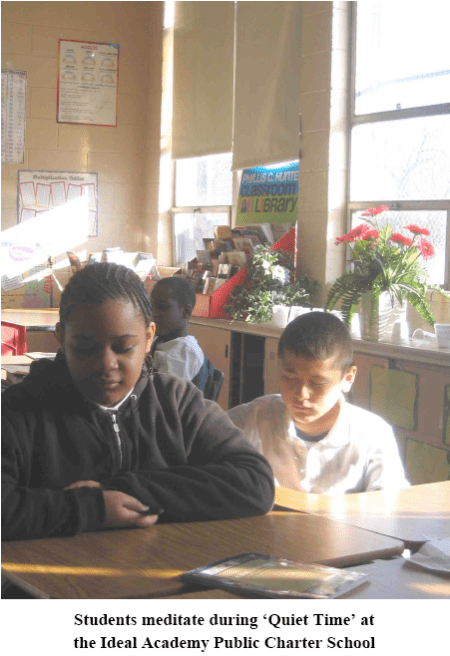
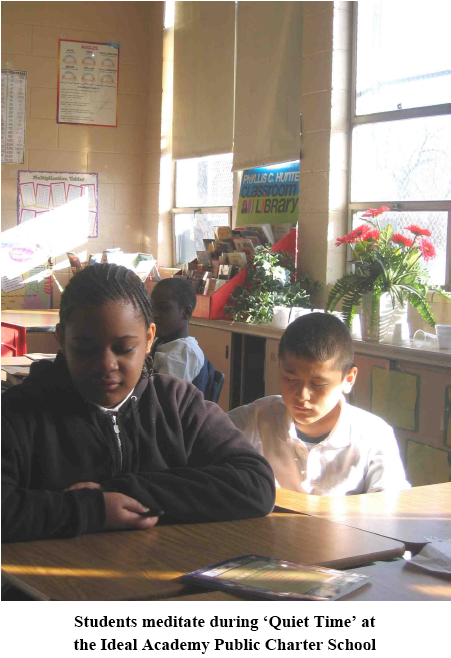
In this article, we look at some recommendations and programs addressing this problem. We begin with refreshing our understanding of the goal of ideal education. Next we look at sleep deprivation, stress, anxiety, and related problems of ADHD and depression, and the impact on student health and learning. Next, advice by professionals who work in this field of stress and adolescence will be presented. Finally, we look at promising examples where recommendations are successfully implemented: a school in D.C., the Ideal Academy Public Charter School, experiencing remarkable results by incorporating “Quiet Time” into the daily routine; and breakthrough research on ADHD and “Quiet Time” from several middle schools.
WHAT DOES EDUCATION REALLY MEAN?
All that lies before us and all that lies behind us are tiny matters compared to what lies within us. ~ Emerson.
Education comes from the Latin root ‘educere’, meaning to ‘draw out from within’ or to ‘lead forth’. ‘Education’ means something other than filling up the mind with information. Socrates said, “Education is the kindling of a flame, not the filling of a vessel.” It involves cultivating the
student’s inner genius, innate intelligence, creativity, consciousness.
Quite clearly the two great things for which we aim are the improvement of intelligence and the deepening and the extension of the feeling of friendliness and love. ~ Aldous Huxley
A student truly being educated is not merely learning information. He is cultivating the quality of his awareness: becoming more awake, clear, creative. He is developing his character: virtues of friendliness, helpfulness, compassion. And cultivating a love of learning and sense of vitality: feeling interested, enthusiastic, capable, confident.
The qualities we often find in great people – flexibility, curiosity, energy, receptivity to new ideas, and lovingness – are first found in children and then maintained through adulthood. ~ Dr. Melanie Brown, Attaining Personal Greatness: One Book for Life
But what are we doing to cultivate these qualities in our students? It seems clear that we often forget the meaning and goal of education.
Click on the above title for a Google docs quick view of the entire article, including photos, and/or download the PDF of Taking Care Of The Student – The Forgotten Element In Education, originally printed in the Winter 2009 issue of Pathways Magazine, Washington, DC.
 The Uncarved Blog