Posts Tagged ‘meditation’

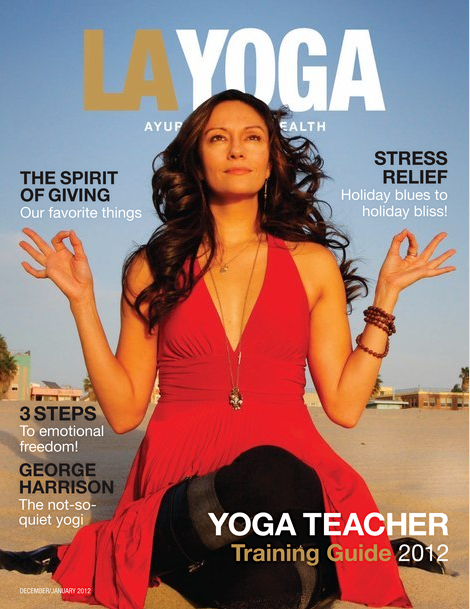
George Harrison: The not-so-quiet Beatle, article by Philip Goldberg in LA YOGA Magazine

December 14, 2011

George Harrison: The not-so-quiet Beatle,

by Philip Goldberg, author of American Veda,

published in LA YOGA Magazine.

Download a PDF of this article

found on pages 28+29 of the LAYOGA

December/January 2012 issue.

Listen to this Oct 12, 2012 KRUU FM interview with Philip Goldberg and Cheryl Fusco Johnson on Writers’ Voices http://www.kruufm.com/node/14325/node/14325.

David Lynch donates $1 million in grants through his foundation to teach veterans to meditate

December 2, 2011

The Washington Post: Entertainment

David Lynch donates $1 million in grants through his foundation to teach veterans to meditate

By Associated Press: Friday, December 2, 8:17 AM

LOS ANGELES — David Lynch wants soldiers and veterans to experience the stress-reducing benefits of Transcendental Meditation.Lynch’s namesake foundation is giving $1 million in grants to teach the meditation technique to active-duty military personnel and veterans and their families suffering from post-traumatic stress.

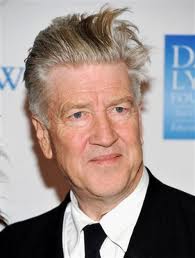
(Evan Agostini, file/Associated Press) – FILE – In this Dec. 13, 2010 file photo, director David Lynch attends the 2nd annual “Change Begins Within” benefit celebration, hosted by the David Lynch Foundation at the Metropolitan Museum of Art in New York. Lynch wants soldiers and veterans to experience the stress-reducing benefits of Transcendental Meditation. Lynch’s namesake foundation is giving $1 million in grants to teach the meditation technique to active-duty military personnel and veterans and their families suffering from post-traumatic stress.

The filmmaker said Friday that the grants are from the Operation Warrior Wellness division of his foundation, which funds meditation instruction for various populations, including inner-city students and jail inmates. Recipients of Operation Warrior Wellness grants include Iraq and Afghanistan Veterans of America, the Wounded Warrior Project and UCLA’s Operation Mend. Lynch’s credits include TV’s “Twin Peaks” and the films “Mulholland Drive,” ‘’Blue Velvet” and “Wild At Heart.”
———
———

See the Replay of David Lynch Foundation Launch of Operation Warrior Wellness Los Angeles. Watch the Third Annual David Lynch Foundation Benefit Gala.

The Early Show looks at Martin Scorsese’s ‘George Harrison: Living in The Material World’

October 11, 2011

“Our true nature is consciousness and bliss.” George Harrison

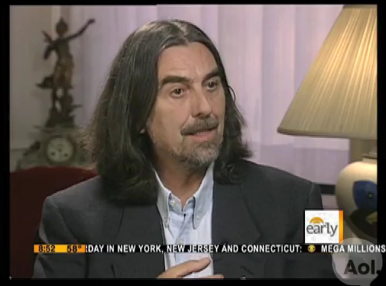
‘The Early Show’ Takes a Look at Martin Scorsese’s ‘George Harrison: Living in The Material World’ 10/05/11. Click here to see the TV Replay.

Also see The Daily: Marty’s Mantra For Meditators and Martin Scorsese’s film, George Harrison: Living in the Material World, premiers at the Sondheim Center for the Performing Arts in Fairfield, Iowa.

Oprah says she and her staff meditate, enjoy a Quiet Time twice a day—Facebook Live interview

September 17, 2011

Oprah and Facebook COO Sheryl Sandberg enjoy a lively discussion.

This was news to me. Did you know that Oprah was interviewed on Facebook Live? Live Interview with Oprah Winfrey – Sept 8, 2011. Since I’m not on Facebook I didn’t go there to look for it. So I did a Bing search and found it posted on talkbytes.com. Oprah sat down with Facebook COO Sheryl Sandberg for an enjoyable talk. Besides Sandberg, members of the Facebook crowd also got to ask Oprah questions, along with online participants.

Oprah is quite the talker. She is a great communicator and teacher. She sincerely wants to bring more consciousness into the lives of her viewers, and shares some revealing valuable lessons she’s learned over the years. Around 9:15 minutes into this enjoyable 1 hour interview, Oprah tells Sheryl that she and her OWN company offices in Chicago and LA have now incorporated meditation, a Quiet Time, twice a day into their schedule. Hopefully, we’ll hear more about this in a future show.

There were so many wise things Oprah said about her life, the evolving philosophy of her program, from entertaining and shocking her viewers, to helping them empower themselves. She feels her mission is to help people become the best they can be. Here is a partial transcript from the section on meditation. Sheryl asks Oprah what was it in her that helped her become who she is today.

Oprah: I think that the same thing that is in me is in everybody else, and when you close your eyes sometimes and you get really still…like one of the things that we are doing at my companies now is everybody is learning to meditate. And everybody gets all thrown by the word, meditation. So I said to them the other day: Let’s not call it meditation, let’s just call it Quiet Time, because…

Sheryl: Like my kids. They get Quiet Time.

Oprah: Yes, yes. Because when you teach your children meditation, you don’t say, we’re going to me-di-tate. You say, let’s have some Quiet Time. So twice a day now, at OWN, in Chicago and Los Angeles, we take Quiet Time…where you…literally…

So I have…having grown up in rural Mississippi, alone with my grandmother, I had a lot of quiet time. I had a lot of time to touch the stillness inside me. And the truth is, that’s where God lives. God lives in the space of stillness. Whatever you chose to call God, or not call God. It doesn’t matter whether you chose to call it or not, that stillness is always there, that awareness space.

…where you live, where the capital You resides, is not in the thoughts, but in the awareness, in that space. So I have lived in that space, of awareness for myself for a very long time. I can’t even remember…

You know, all of us has that space were you’re willing to get still, because the world will try to tell you everything about yourself, and…we have so many voices, in our heads and on our Facebook pages telling us everything. But, to know, really, what to do and how to be guided in your life, you have to go to that still space where the bigger You, the greater You, resides. And I have it, and so does everybody else who’s listening to us right now.

Sheryl: Get ready Facebook, we’re going to be meditating. (Sheryl gives the peace sign).

Oprah (laughs): Ya…ha ha ha

Sheryl: Twice a day.

Oprah: It changes the energy of everybody in your company. I mean, for years I’ve wanted to do it. And I knew that, because I didn’t start out that way. And I started out my school doing it too in South Africa.

Have a moment where you can go into that space, so that you’re not just talking and operating outta the top of your head, and you’re not just moving in your action-external self, but that you’re bringing a deeper sense of who you really are.

For a review of the show with quotes, here’s an article about it in The Huffington Post: Oprah At Facebook: Incredible (VIDEO). The video is posted there, as it also is on talkbytes.com: Oprah Forces Her Employees to Meditate, which is unfair since Oprah doesn’t force her employees to participate in such programs, she just provides it to them as a Quiet Time option, a time to chill out—something we can all benefit from in this fast-paced crazy world. You can lead a horse to water, but you can’t make him drink.

This first show is now posted on Facebook: http://livestre.am/11yid.

It’s a great interview. Enjoy!

Also see Reports of Oprah’s visit to Fairfield, Iowa in the news Oct 19+20, 2011: Fairfield Ledger: Oprah visits Maharishi School, Fairfield | KTVO: Oprah and her jet land in southeast Iowa | Oprah Winfrey Meditated in Fairfield Iowa Tonight with Other Transcendental Meditation Meditators: Oprah Jets into Fairfield and MeditatesInspiring Developments | Mount Everest | Emporium. And Oprah meditates with ladies in MUM Golden Dome, which includes links to an interview with Dr. Oz, reported in examiner.com: Oprah Discusses Her Life After the Practice of Transcendental Meditation. And a recent post on the TM Blog Oprah Winfrey talks TM with Dr. Mehmet Oz. For more, see: Some Reports on Dr. Oz’s Interview with Oprah about TM and her Next Chapter. And this latest news: Oprah writes in O Mag about her visit to TM Town and meditating with ladies in their Golden Dome.

PsychCentral reviews Norman Rosenthal’s book Transcendence: Transcendental Meditation: What Is It and How Does It Work?

September 16, 2011

Transcendental Meditation: What Is It and How Does It Work?

By Therese Borchard

Transcendental Meditation: What Is It and How Does It Work?Being that my job is to feature and review books on psychology, spirituality, and especially the intersection between the two, I receive my share of books on meditation. And as a person who has been trying to meditate for two years, but who just can’t seem to get the hang of it, I always open the cover a tad sinister, looking for a magic bullet.

The book Transcendence: Healing and Transformation Through Transcendental Meditation was on my decline stack until I read the short bio on Norman Rosenthal, M.D. and became intrigued. He’s a clinical professor of psychiatry at Georgetown Medical School. He conducted research at the National Institute of Mental Health. And he was the one who first described and diagnosed seasonal affective disorder (SAD). Ironically, I knew of him through my good friend Michelle, who had been one of the case studies for him on SAD.

So, with those credentials I opened the book and began to read stories that inspired me and gave me hope that one day I might be a meditator too.

Rosenthal won my trust in that he clearly states in the introduction that Transcendental Meditation is not a stand-alone treatment for emotional disorders, especially when effective treatments are available and work (if not full proof). He writes, “The fact is that no single treatment works every time for any given set of symptoms. We often have to try several different medications or treatment approaches before we find the right mix. I am suggesting that TM should be part of that mix, especially when conventional approaches prove unsatisfactory.” Rosenthal would in no way advise a person to go off his meds and try this type of meditation. However, he believes that practicing it can be the difference between a life of coping and a life of living.

Before reading Rosenthal’s book, I was unaware of the ways different kinds of meditations activate neurons in distinct regions of the brain. For example, Mindful Meditation increases the activity of neurons not only in certain emotional areas of the brain, but also in frontal regions, which are responsible for decision making and other functions. In Transcendental Meditation, there is a more global effect. Characteristic brain wave patterns are seen in many different parts of the brain, so the meditator has a better chance of experiencing the effects of meditation long past the meditation session.

What, exactly, is this Transcendental Meditation? Rosenthal writes:

Transcendental Meditation is always taught one-on-one, at least initially, by a teacher who is a longtime meditator trained not only to instruct new students and provide follow-up, but also to customize the approach for each student. Initial instruction has seven steps: two lectures and a personal interview with a certified teacher, then four teaching sessions on four consecutive days. Each session lasts about ninety minutes. Ideally, the fledgling meditator then follows up with the teacher, perhaps weekly for the first month and monthly thereafter. These thirty-minute “checking” sessions give students a chance to ask questions and make sure their technique is still on track, so they will derive the maximum benefit.

Basically, TM is a nonreligious practice that involves sitting comfortably for twenty minutes twice a day, while using a silent mantra, or nonverbal sound, to attain a profound state of aware relaxation. And just like yoga or martial arts, says Rosenthal, in order to learn it correctly, you need ongoing guidance with a teacher.

A profound gift of TM is that regular practice increases brain wave coherence, meaning that the frequencies of brain waves in different parts of the brain work together as a result of TM. In seasoned meditators, brain wave coherence can be found throughout the day, not only during meditation. Electroencephalograms (EEG) indicate that TM calms the brain while organizing the prefrontal brain regions so that meditators can improve their focus, decision-making, and job performance.

Especially enlightening to me were Rosenthal’s chapters on how TM can help treat acute anxiety, major depression, and bipolar disorder. This psychiatrist and some of his colleagues obtained a grant to study TM in a group of bipolar patients. In the study, eleven people received immediate TM training, while fourteen people were placed on a wait list. Both groups continued with their previous medical treatments. A few from the TM group reported a drop in manic symptoms, however, depressive symptoms were especially relieved, as stated in the patient reports but also upon inspecting the results of TM by Rosenthal and his team. Explains Rosenthal:

Several patients reported increased calmness, improved focus, and improved ability to stay organized and set priorities–no surprise, given TM’s known effects on the prefrontal cortex. TM helped bipolar patients improve their executive function, just as it did for people with anxiety disorders and ADHD… All in all … our study study suggests that TM might be very helpful for bipolar patients. In fact, all the clinicians who worked on the study are now referring certain of their bipolar patients, particularly those with residual depression, for TM training–along with their other treatments.

Check out Rosenthal’s book, Transcendence, for more information on the science and benefits of Transcendental Meditation.

Therese J. Borchard is Associate Editor at Psych Central, where she regularly contributes to World of Psychology. She also writes the daily blog, Beyond Blue, on

Beliefnet.com. Therese is the author of Beyond Blue: Surviving Depression & Anxiety and Making the Most of Bad Genes and The Pocket Therapist. Subscribe to her RSS feed on Psych Central or Beliefnet. Visit her website or follow her on Twitter @thereseborchard.

APA Reference
Borchard, T. (2011). Transcendental Meditation: What Is It and How Does It Work?. Psych Central. Retrieved on September 14, 2011, from http://psychcentral.com/lib/2011/transcendental-meditation-what-is-it-and-how-does-it-work/

Scientifically Reviewed
Last reviewed: By John M. Grohol, Psy.D. on 13 Jul 2011
Published on PsychCentral.com. All rights reserved.

————–
Also listen to an excellent interview with Norman Rosenthal and Jenny Crwys-Williams on South Africa’s 702 Talk Radio. Click to download Podcast. It’s mentioned in this post: Meditation for Health, Happiness and Spirituality.

The Power of The Collective, by John Hagelin

June 15, 2011

SHIFT: AT THE FRONTIERS OF CONSCIOUSNESS
IONS: JUNE–AUGUST 2007 #15
THE MYSTIQUE OF INTENTION

A remarkable series of scientifically credible studies has shown a link between group meditation and lowered incidents of violence and crime. And why not? argues Hagelin: If meditation is good for the individual, it should also be good for the collective. From June 7 to July 31, 1993, up to 4000 participants of Maharishi Mahesh Yogi’s Transcendental Meditation and TM-Sidhi Programs gathered together in Washington, DC, to form a Group for a Government Global Demonstration Project. Under the direction of Dr. John Hagelin, violent crime in Washington, DC was significantly reduced as predicted during the time of this World Peace Assembly. The study presenting these findings was published in Social Indicators Research. What follows is a report of that study presented in the context of a talk Dr. Hagelin gave in a Holland videocast to the Noetic Sciences (IONS) regional conference on February 18, 2007, in Tucson, Arizona, titled: “A New Science of Peace: The Effects of Group Meditation on Crime, Terrorism, and International Conflict.” The editor of Shift magazine excerpted, abridged, and edited that talk into this article, The Power of the Collective, for their June-August 2007 issue on The Mystique of Intention. You can download a PDF of the complete article Shift-The Power of the Collective.

THE POWER OF THE COLLECTIVE
John Hagelin

We’re living in an epidemic of stress. Doctors report an alarming rise of stroke, hypertension, and heart disease—now called metabolic syndrome—all of which are diseases of stress. As a result, we would expect to see stressed behavior in society, and it turns out there is plenty of it: crime, domestic violence, terrorism, and war.

Since meditation provides an effective, scientifically proven way to dissolve individual stress, and if society is composed of individuals, then it seems like common sense to use meditation to similarly defuse societal stress. A reduction in crime and stress-related behavior would then be expected to follow.

Nobody would have ever guessed—I wouldn’t have guessed—the extraordinary degree to which you can reduce social violence through meditation, because it doesn’t take everyone meditating to generate profound effects. A relatively small number of people meditating together has a powerful spillover effect, reducing stress throughout a surrounding area in a measurable way. That’s the phenomenon I want to focus on. That’s where the really interesting physics and metaphysics can be found.

REAL-WORLD EFFECTS

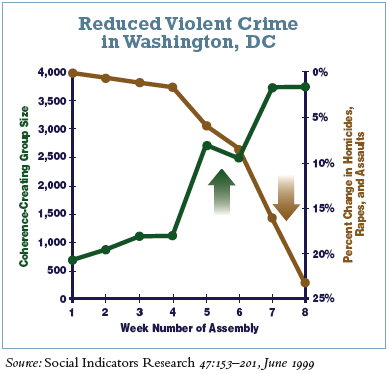
A study I conducted in the summer of 1993 in Washington, DC, shows rising crime levels over a period of six months, which take place every year as the temperature gets hotter between the winter and the summer. People stay out later, they are more aggravated and agitated, they get into more fights, and the crime rate goes up. This is an absolutely known annual trend. From June through July of that summer, we brought to the area a large number of practicing meditators and trained quite a few others. When the group reached a particular size—2,500 (ultimately reaching 4,000)—which was about halfway through the period, there was a distinct and highly statistically significant drop in crime compared to expected rates based on previous data, weather conditions, and a variety of other factors.
We collaborated with the local police department, the FBI, and 24 leading, independent criminologists and social scientists from major institutions, including the University of Maryland, the University of Texas, and Temple University, who used highly sophisticated research tools to control for variables such as weather. Everyone ended up agreeing on the language, the analysis, and the results, and those results were quite astonishing. We predicted a 20 percent drop in crime, and we achieved a 25 percent drop. Just before the study, the Washington, DC, chief of police went on television and said something like, “It’s gonna take a foot of snow in June to reduce crime by 20 percent.” But he allowed his department to participate in the experiment by collecting and analyzing the data. In the end, the police department signed on as one of the authors of a published paper (see Social Indicators Research 47:153–201, June 1999).

In this case it was only a few thousand people in a city of about a million and a half. So a relatively small group was influencing a much larger group. This is what is so fascinating. And it has implications for more than just crime. In my opinion the most immediate implications today in the world are stopping ethnic wars, the conflict in the Middle East, and so on. And in fact a similar experiment was done during the peak of the Israel-Lebanon war in the 1980s. We found that on days when the numbers of meditators were largest (and also on the subsequent day), levels of conflict were markedly reduced—by about 80 percent overall. This turned out to be a statistically significant effect and also a surprising one, because there were only about 600 to 800 people meditating in the midst of this entire conflict and the highly stressed surrounding population.

The results were published in Yale University’s Journal of Conflict Resolution (32:776–812, December 1988), which also published a letter urging other universities, collaborators, and groups to repeat this study. The editors felt that the implications of this were so far reaching, so fundamentally important, that it must be repeated to test the likelihood that the results were a statistical fluke. And that’s exactly what happened over the next two and a quarter years. During this 821-day period, seven subsequent experiments were performed to examine the effects of group meditation on the Israel-Lebanon war. These groups gathered in Israel, in Lebanon itself in the actual conflicted neighborhoods, and at locations throughout the Middle East, Europe, and other parts of the world.

In each case, when the size of the group reached the threshold that was predicted (based on previous research) to have an effect, there was a marked and statistically significant reduction of violence. We have also found in other studies that in the geographic vicinity of such a meditating group, people experienced physiological changes—increased EEG coherence, reduced plasma cortisol, increased blood levels of serotonin, biochemical changes, and neurophysiological changes—as if they were meditating.

When you put all these studies together, the likelihood that the reductions of violence were simply coincidental—a statistical fluke—was less than one part in 10 million million million (1019). An overwhelming number of papers documenting more than sixty different experiments of group meditation’s effect on conflict have been published in peer-reviewed scientific journals that have the most stringent standards for research. I believe it is the most rigorously established and thoroughly tested phenomenon in the history of the social sciences.

“I think the claim can be plausibly made that the potential impact of this research exceeds that of any other ongoing social or psychological research program. It has survived a broader array of statistical tests than most research in the field of conflict resolution. This work and the theory that informs it deserve the most serious consideration by academics and policy makers alike.”

—David Edwards, PhD
Professor of Government
University of Texas at Austin

The rest of this compelling article continues below with the subheading STRINGS AND SPACE-TIME. If you don’t see it here, scroll below and click on Read the rest of this entry at the bottom of this post to continue reading.

You’ll also come across a subsection added after the article titled, TM and Intention. It was part of a conversation between the editor of Shift magazine and the team at the Maharishi University of Management.

* * * *

Around the same time, as a companion piece, Byron Belitsos interviewed John Hagelin for the IONS online Intention Downloads. It is truly spectacular. To elaborate and elucidate on the subject, Byron asked some great questions on the differences between meditation and intention. Dr. Hagelin’s brilliant replies really took this current Intention debate to a deeper more comprehensive level of understanding, equating intention with thought, distinguishing between thinking and consciousness, and how one can enhance one’s intentions multifold from a deeper level of consciousness. You can listen to the 23:12 minute interview published June 26, 2007 by clicking Download as mp3. Click on View Transcript under the description to read it. Here is their introduction to that interview:

Intention Downloads Interview: John Hagelin
Visionary: John Hagelin, PhD

In this interview, quantum physicist and former Presidential candidate John Hagelin explains the difference between intention and consciousness, which opens the door on a fascinating discussion of how spending time in deep meditation in the “nuclear” level of thought can multiply the efficacy of intentions. Residing in object-free consciousness connects us to a field of pure, unlimited, creative potential, which in turn ripples out through the quantum field, affecting our lives and even large systems in positive ways. He cites studies he has been involved in showing that a critical mass of meditators has correlated with significantly lowered crime rates. He also predicted similar effects on complex systems from hurricanes to stock markets, with positive results so far. Scientific study of such effects is gaining steam and his ambitious Invincible America Assembly project plans to take this work to the next level, training a critical mass of meditators to positively affect the rates of violence for the entire planet.

JOHN HAGELIN, PhD, is a quantum physicist, educator, public policy expert, and one of the world’s foremost proponents of peace. He is director of the Institute of Science, Technology, and Public Policy, and international director of the Global Union of Scientists for Peace. For more information, go to http://hagelin.org.

Research Links: www.permanentpeace.org and www.invincibility.org.

Also posted on www.MeditationAsheville.org

* * * *

See: Group Meditations Reduce Crime, As Predicted
And Explanation to Steady Decline in Major Crime

(more…)
Brain Researchers Demonstrate How Students Can Overcome Stress And Function Like Top Achievers

February 1, 2011

Prominent Brain Researchers Demonstrate
How Students Can Overcome Stress Crisis
And Function Like Top Achievers

Free Public Lecture: February 8, 2011, 5 p.m.
Location: Harper Memorial, #103, 1116 E. 59th Street, Chicago, IL 60637
Sponsored by: Students Transcendental Meditation Association, University of Chicago
Contact: Dr. Carla Brown: 773–324–8695, chicago@tm.org

How can today’s students overcome the debilitating effects of heavy stress – made even more difficult by the economy – in order to perform at their best?  It is indeed possible, and two prominent brain researchers will demonstrate how and share their compelling research findings on Tuesday, February 8, during a free public lecture at the University of Chicago. Check below for a listing of other lectures at different locations throughout the week.

Dr. William Stixrud, Ph.D., a prominent clinical neuropsychologist from Silver Spring, M.D., and Dr. Fred Travis, a neuroscientist and Director of the Center for Brain, Consciousness and Cognition at Maharishi University of Management in Fairfield, IA, will discuss how meditation can affect functional integration of the brain and enable changes that result in dramatic reductions in stress hormones and cardiovascular disease.

Both doctors agree that students can use these same meditation techniques to help them reduce and overcome stress and pressure, perform better, and engender increased well being and contentment.

Last week the New York Times covered a survey of 200,000 college freshmen that found that their emotional health was at the lowest level surveyed in 25 years. Dr. William Stixrud, who specializes in work with children and adolescents, responded,

“It is possible for students to ‘have it all’—to experience high achievement in a competitive world and still have happiness and peace of mind.”

Dr. Stixrud’s 2008 research found that middle school students with ADHD who practiced the Transcendental Meditation technique twice a day in school experienced over 50% reduction in stress and anxiety, and improvements in ADHD symptoms.

During the lecture on February 8, Dr. Travis will also present a live demonstration of changed brain activity as a result of the Transcendental Meditation® technique and will discuss differences in TM from other mental techniques.

In 2009 Dr. Travis collaborated with the American University Department of Psychology in Washington, D.C. in the first random assignment study of effects of meditation practice on brain and physiological functioning in college students International Journal of Psychophysiology, 2009. Dr. Travis and colleagues randomly assigned American University students to practice the Transcendental Meditation technique. Measured during the height of exam pressures, these students exhibited functional brain integration resembling that of gold medal athletes.

Non-meditating controls in this experiment were overwhelmed and displayed significantly less brain integration, which is brain functioning that was more fragmented and disorganized. Students reported being more anxious and irritable, reflecting the detrimental effects of college life on the students.

According to a study published in the American Journal of Hypertension, December 2009, the Transcendental Meditation technique was shown to be an effective method of reducing blood pressure, anxiety, depression, and anger among at-risk college students.

“The problem is stress,” says Dr. Stixrud, who has studied and lectured frequently on the effects of stress on the brain, particularly the developing brain. Dr. Stixrud added,

“The effects of stress are not pretty. Not only does stress interfere with functions such as attention, memory, organization, and integration, but prolonged stress actually kills brain cells and shrinks the brain’s main memory structures. In fact, the top stress researchers in the world report that lifelong stress level is the best predictor of risk for Alzheimer’s disease and other forms of dementia. In light of this research, I am increasingly struck by how counterproductive it is for students to learn in highly stressful contexts, since stress not only interferes with their learning and retention in the short run but also burns out their brains in the long run.”

FREE PUBLIC LECTURE SERIES:

Diamond Bank, Conference Room, 1800 W. North Avenue, Chicago, IL — Tuesday, February 8th, 11:30 am

University of Chicago, Harper Memorial, #103, 1116 E. 59th Street, Hyde Park, Chicago, IL — Tuesday, February 8th, 5 pm, sponsored by: Students Transcendental Meditation Association

Joliet Junior College, 1215 Houbolt Road, Rm. D 2001, Joliet, Il — Wednesday, February 9th, 1:15 pm. For information, call Pat Tinken 815 280 6660

Oak Park Public Library, Veterans Room (2nd Floor), 834 Lake St., Oak Park, IL — Saturday, February 12th, 2 pm

LINKS:

New York Times: Record Level of Stress Found in College Freshmen
College freshmen at 25-year low in emotional health, study says
Dr. Travis: Live demonstration: What happens when you meditate?

Dr. Travis: Transcending & Brain Research
Dr. Travis: What’s missing from education?
Also see: David Lynch Foundation: School Projects

‘Vedanta and yoga perfect match for certain American values’

January 31, 2011

‘Vedanta and yoga perfect match for certain American values’
2011-01-09 10:10:00

Chicago, Jan 9 (IANS) There has always been a pervasive but undocumented feeling that Indian philosophy, as manifest in Vedanta on the intellectual plain and yoga on the physical plain, has very significantly influenced the West in general and America in particular. That feeling now finds a meticulously constructed scholastic endorsement in the form of an important new book.

Author Philip Goldberg’s ‘American Veda – From Emerson to the Beatles to Yoga and Meditation, How Indian Spirituality Changed the West‘ (Harmony Books, 398 pages, $26) offers a comprehensive account of the inroads made by Indian philosophy since the early 19th century.

‘The combination of Vedanta and Yoga was a perfect match for certain American values: freedom of choice and religion, individuality, scientific rationality, and pragmatism.  They appealed especially to well-educated Americans who were discontent with ordinary religion and unsatisfied by secularism, giving them a way to be authentically spiritual without compromising their sense of reason, their consciences or their personal inclinations,’ Goldberg told IANS in an interview.

He said Indian teachers who came to the US were conscious of the openness of American society and they adapted the teachings accordingly.

Explaining the mainstreaming of Indian philosophy in the US, Goldberg said, ‘I think the remarkable growth of the ‘spiritual but not religious’ cohort of Americans would have been unthinkable without access to the practices derived from Hinduism and Buddhism.  In addition, the philosophy was presented so rationally that its premises could be regarded as hypotheses, and the practices were so uniform and so widely applicable that they lent themselves to scientific experimentation.’

The book begins with a claim that is deliberately designed to be an attention grabber. ‘In February 1968 the Beatles went to India for an extended stay with their new guru, Maharishi Mahesh Yogi. It may have been the most momentous spiritual retreat since Jesus spent those 40 days in the wilderness. The media frenzy over the Fab Four made known to the sleek, sophisticated West that meek, mysterious India had something of value. Our understanding and practice of spirituality would never be the same,’ Goldberg writes.

He points out that translated Hindu texts were very much a part of the libraries of John Adams, the second president of the United States and one of its most respected statesmen and political theorists, and Ralph Waldo Emerson, an eminent poet and essayist who led the transcendentalist movement in the mid-19th century. From there those ideas permeated to author and philosopher Henry David Thoreau and poet Walt Whitman among others.

In recounting Thoreau’s perspective about the Bhagavad Gita, Goldberg refers to a much quoted passage from the book Walden. Thoreau writes, ‘In the morning I bathe my intellect in the stupendous and cosmogonal philosophy of the Bhagavad Gita, since whose composition years of the gods have elapsed, and in comparison with which our modern world and its literature seems puny and trivial.’

The book has two distinct trends in support of the author’s primary contention about how Indian spirituality changed the West. One trend is at the operational level where words such as mantra, guru, karma and pundits have so seamlessly become part of the mainstream lexicon. The other trend is much deeper in terms of internalising the core values of Indian philosophy.  Asked if the people in the US are conscious of this, Goldberg said, ‘Some are conscious of it, and therefore grateful to the Indian legacy.  Others are not: it’s seeped into the American consciousness in subtle but profound ways.’

Goldberg also talks about the ‘Vedization of America’. On whether it can be attributed to the general secularisation/pluralisation significantly caused by the rise of agnostic information technologies, he said, ‘If you mean, could the trends I describe be attributed to the growth of pluralism and other social forces, independent of the Indian influence, it is very hard to say. Certainly, the combination of factors made for a perfect storm. I tend to think that the experiential practices of meditation and yoga, and the intellectual framework of Vedanta, accelerated, deepened and broadened what might have been an inevitable but amorphous evolution.’

On whether he apprehends any organized backlash or pushback against Indian philosophy, he said ‘Not a big one, but some of it is inevitable. There has always been a backlash from both mainstream religion – conservative Christians in particular – and the anti-religious left. Vivekananda faced up to it in 1893, and all the important gurus were confronted by it. Right now, there’s an anti-yoga campaign by some Christian preachers.  I’d be very pleased if my book becomes a lightning rod for such a controversy. Bring ’em on!’

On a movement in support of a ‘Christian yoga’ that may be gaining some ground Goldberg said, ‘That’s a more complicated issue than is often realised. The question, ‘Is yoga a form of Hinduism’ depends entirely on how one defines both yoga and Hinduism.  That there are people teaching Christian Yoga and Jewish Yoga strikes me as a backhanded compliment to one of the great glories of the Vedic tradition: its universality and adaptability. That having been said, the idea that yoga is ‘a Hindu tool,’ i.e., a form of stealth conversion, strikes me as a projection by Christians of their own messianic drive to convert the ‘heathen’. That conversion is not in the Hindu repertoire – and that the gurus and swamis and yoga masters are content to have their students become better Christians – is hard for many to comprehend.’

(Mayank Chhaya is a US-based writer and commentator. He can be contacted at m@mayankchhaya.net)

Huffington Post named American Veda one of the top ten religion books of 2010.

Listen to this KRUU FM interview with Cheryl Fusco Johnson on Writers’ Voices, Oct 12, 2012 http://www.kruufm.com/node/14325/node/14325.

UK: Meditation school to transfer to state sector

January 29, 2011

Education

Meditation school to transfer to state sector

By Richard Garner, Education Editor

Saturday, 29 January 2011

Britain is set to get its first state school dedicated to the values of transcendental meditation. A private school run by followers of the Maharishi Mahesh Yogi will transfer to the state sector in September.

The Maharishi School in Ormskirk, Lancashire, has been given the green light to be part of the first tranche of Education Secretary Michael Gove’s “free” schools.

Mr Gove announced yesterday that 35 “free school” applications had received the go-ahead. In all, 249 applications have been received by the Department for Education to join the scheme. Under the “free schools” policy, parents, teachers and charities can open schools – funded by the taxpayer.

Pupils at the Maharishi School – for four-to-16-year-olds – have three 10-minute every day. The school has smaller-than-average classes and just 80 pupils. It says meditation calms pupils, making it easier to learn, and claims it could double its numbers with state support. Head Derek Cassells said: “All scientific research shows transcendental meditation brings more balance to the brain… It helps with behaviour and improved relationships with other people.”

His school’s philosophy is that of the Maharishi, pictured, whose movement gained prominence in the 1960’s when The Beatles became converts.

Mr Gove said ministers hoped every new state school would be an academy or “free” school. He spoke ahead of a conference on “free” schools today when he will be accompanied by leaders of the Charter school movement in the United States – which is advising ministers on the “free” schools’ policy.

Charter schools do not recognise teacher unions, but Mr Gove said it would be up to individual school heads to decide if they do. US education experts said it was essential schools could “terminate” weak teachers.

Joel Klein, former chancellor of the New York City Department of Education, said that there must be “reasonable processes in place for terminating non-performing and under-performing teachers.”

Veteran Dan Burks on Overcoming the Stresses of War with Transcendental Meditation

January 18, 2011

Veteran Dan Burks on Overcoming the Stresses of War with TM

DavidLynchFoundation | December 12, 2010

Transcription: “December 18th 1967 – Newsweek, five days after my birthday. This is a story called ‘The Days Work.’ And this is my unit, we went out and got ambushed, and this is me doing my job. We were attacked at this place called Buddha. That fight went on for two weeks. The first night I killed 14 people. There were 25 hundred of them, 250 of us. The next morning in front of my fighting position there were 18 of our men dead. So this is very, very, very distressing, and it creates huge amounts of distress in your system.”

“Later in the magazine there’s this… this is an article Maharishi Mahesh Yogi and a couple guys in my platoon, one of them got the magazine and came running over and said ‘Burks, you gotta read this!’ So I did. And I said, ‘I’m going to do that….’ Because it talks about stress release, about becoming a whole person.”

“The next part of the story is about getting home. And that’s a whole big deal, because things changed. All of a sudden you’re in a different culture. They don’t understand you. They have no idea. They don’t understand that you’re always still in the rubber plantation in the jungle. You’re always on an adrenalin high. You’re looking to protect your buddies, you’re looking to protect yourself and you’re looking to kill the enemy.”

Help us heal our Veterans – http://www.davidlynchfoundation.org

See two other videos: AFP: Meditation soothes war veterans and 50% reduction in PTSD symptoms within 4 weeks of Veterans practicing Transcendental Meditation.

See AFP’s How Clint Eastwood keeps his cool, Meditation May Ease PTSD for Vets, and watch highlights of the David Lynch Foundation‘s Operation Warrior Wellness press conference and the second annual Change Begins Within benefit gala.