Posts Tagged ‘creativity’

New York poet laureate Marie Howe reads “Annunciation” to Krista Tippett On Being

September 22, 2013

New York poet laureate Marie Howe speaks with Krista Tippett about her poetry on the NPR show, On Being. Closing the interview, The Poetry of Ordinary Time, recorded In The Room, April 2013, Howe reads a poem in the voice of Mary, mother of Jesus, describing the Annunciation, which, her friend and mentor, Stanley Kunitz, said no one had ever gotten right. She wrote several versions, tore them up, and then this final one came through her.

Marie Howe said it had nothing to do with her. It just came through her, a reminder that the best poetry comes through us when we get out of the way. When we are emptied of our small self, “by being no one,” transcend our senses and turn within and are open to the higher Self, then that great creative force of Love within us creates, and the miracle of life, of poetry, happens. You can hear “Annunciation” by Marie Howe on SoundCloud. 

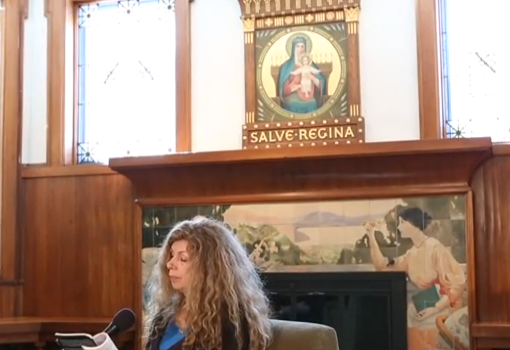
Thought this screen save from the video is most appropriate with the poster of Mother Mary holding the infant Jesus!

Marie Howe reads her poem Annunciation to Krista Tippett for On Being

Marie Howe reads her poem “Annunciation” to Krista Tippett for On Being

Annunciation

Even if I don’t see it again—nor ever feel it
I know it is—and that if once it hailed me
it ever does—

And so it is myself I want to turn in that direction
not as towards a place, but it was a tilting
within myself,

as one turns a mirror to flash the light to where
it isn’t—I was blinded like that—and swam
in what shone at me

only able to endure it by being no one and so
specifically myself I thought I’d die
from being loved like that.

This amazingly beautiful and profound poem can be found at 1:36:02 at the end of the interview, but she starts talking about it at 1:34:45. There are six audio clips of Howe reading her poems posted on SoundCloud recorded on March 16, 2003, at the College of Saint Benedict in Saint Joseph Minnesota.

On Being later recorded: Marie Howe — The Power of Words to Save Us.

Also see An Evening with New York State Poet Laureate Marie Howe.

This relates: David Whyte describes the mysterious way a poem starts inside you with the lightest touch. Whyte also uses a biblical reference, comparing poetic revelation to Lazarus walking to the light.

Enjoy reading: The Millions Interviews Marie Howe—Words Can Sustain and Save Us, published January 11, 2018, where Marie describes what the writing and reading of poetry has done for her, and what it can do for the rest of us. This Q&A particularly reinforces the point Marie Howe made to Krista Tippett when writing “Annunciation.”

TM: Do you think of writing as a spiritual act at its core?

MH: I do, because it involves a wonderful contradiction, which is, in order for it to happen, you have to be there, and you have to disappear. Both. You know, nothing feels as good as that. Being there and disappearing—being possessed by something else. Something happening through you, but you’re attending it. There are few other things in the world like that, but writing is pretty much a relief from the self—and yet the self has to be utterly there.

I know exactly what she means. I had a similar experience when “I wrote” ODE TO THE ARTIST: Sketching Lotus Pads at Round Prairie Park.

William Stafford in his poem, Rx Creative Writing: Identity, also writes about being open to “that bone light,” which “belongs inside of things.” And “You know so sure there burns a central vividness.” He reiterates this idea of being a recipient, a receptacle, and an attendant, a reporter: “It tells you; all you do is tell about it.”

In her poem, Mindful, Mary Oliver delights in the world around her, which leaves her “like a needle in the haystack of light. It was what I was born for — to look, to listen, to lose myself inside this soft world — to instruct myself over and over in joy, and acclamation.”

Oliver codifies this message in 3 short, powerful sentences in the 4th stanza of Sometimes, where she gives us “Instructions for living a life: Pay attention. Be astonished. Tell about it.”

Both poems are included in this post: Attentive to and delighting in her surroundings, Mary Oliver lived a life writing astonishing poetry.

Later added this article/interview by Kim Rosen for Spirituality&Health, Feb 16, 2014: Marie Howe: Holding the Silence. The acclaimed poet reflects on prayer, desperation, and letting go of what can’t be said. (PDF)

Newly added, Nov 2, 2022: What the Living Do—Marie Howe’s ‘letter’ to her brother—an elegy to loss and how she lives with it.

— Written and compiled (citing sources) by Ken Chawkin for The Uncarved Blog.

David Lynch speaks with Alan Colmes about his 16-country tour film Meditation Creativity Peace

August 8, 2013

banner-colmesLegendary Filmmaker David Lynch

Award-winning filmmaker David Lynch speaks with Alan Colmes about his 16-country tour, teaching millions of struggling people how to achieve peace through Transcendental Meditation. Click on the title to go to the website and listen to this dynamic and inspiring interview: [Video] Alan’s FASCINATING interview with legendary filmmaker David Lynch! and here: David Lynch On The Value Of Transcendental Meditation.

Watch the trailer for a new documentary film on David Lynch titled “Meditation Creativity Peace” | Russell Brand and David Lynch at LA Premiere of ‘Meditation, Creativity, Peace’ Documentary | Russell Brand and David Lynch at LA Premiere of ‘Meditation, Creativity, Peace’ Documentary | Enlightenment, The TM Magazine: Meditation Creativity Peace: How the David Lynch Foundation Brings Change from Within.

Visit the new website, Meditation Creativity Peace, for a list of upcoming and previous screenings: http://meditationcreativitypeace.com.

You may also enjoy this earlier article David Lynch wrote for Jane Magazine’s celeb issue: Celeb Spiritual Report: One significant day in my life by David Lynch for Jane Magazine (May 2004).

Celeb Spiritual Report: One significant day in my life by David Lynch for Jane Magazine (May 2004)

August 3, 2013

Here is an article I helped facilitate for David Lynch when we first started working with him, a year before the idea for the David Lynch Foundation was created under the dynamic leadership of Bob Roth, executive director for the Foundation. Up to this point David had kept his Transcendental Meditation practice private. When he made the decision to go public and help the TM movement he turned out to be a most unique and brilliant spokesman.

One event was a project to create world peace. We sent out our press release to the media and set up a NY press conference David would attend. Jauretsi Saizarbitoria, the entertainment editor for Jane magazine at the time, emailed back saying she was interested in David’s meditating and suggested he write an article for their special celeb issue on the topic: One significant day in my life. We mentioned it to him and he sent us an article of the day he learned that our human physiology, our body, was made of consciousness, which we forwarded to them. Knowing he was a painter, they also wanted to know what consciousness looked like to David. He sent a jpeg of an image he had created and they included it, giving him a whole page and titling it a Celeb Spiritual Report, with that announcement on the bottom right side of the magazine cover. It was published in their May, 2004 celeb issue. Jane was a popular woman’s magazine, published from 1997-2007. David posted the report on his website with other earlier David Lynch articles and interviews.

Here is David’s love of Maharishi’s Vedic knowledge explained in such a simple conversational tone that’s truly David Lynch. He’s actually a brilliant writer and speaker! They put the text on the bottom right of this photo. Here it is with the text underneath.

Jane – May, 2004
One significant day in my life

By David Lynch

This is a picture that director David Lynch (above) painted to show what consciousness looks like.

This is a picture that director David Lynch (above) painted to show what consciousness looks like.

A significant event occurred in my life the day I learned that our human physiology, our body, is made of consciousness.

Consciousness???

“What???” I asked out loud in wonder.

I learned that our human physiology is so magnificent and complex, and so exquisite in its design and makeup, as to be wondrous beyond imagination. We are spun out of unbounded, infinite, eternal consciousness.

I learned that underlying all matter is a vast, unbounded, infinite and eternal field of consciousness called the Unified Field. I found out that modern science started taking this field seriously about 25 years ago and that all matter is unified at this level in a state of perfect symmetry, or balance. The entire universe emerges from this field in a process called “spontaneous sequential symmetry breaking.”

Are you still with me?

I also learned that there is another science called Vedic Science. This Vedic Science is ancient, and it has always talked of the Unified Field.

Interesting!

Veda, I learned, means “total knowledge.” The home of total knowledge is the Unified Field. It is also the home of all the laws of nature. The branches of Veda, 40 in total, make up the language of the Unified Field, the impulses of this eternal field.

I realized this Unified Field is quite an interesting place. It is not manifest and is full, meaning it is no thing, yet all things in potential. It manifests and permeates all things: the whole universe, everything, while still remaining full and not manifest.

Amazing!

Is this mind-boggling or what?

Now comes the hippest part. I have learned that any human being can “experience” the Unified Field.

Really?

Or: So what?

Why in the world would we care to experience the Unified Field?

First, another question.

Have you ever heard that most of us human beings use only 5 percent of our brain, our mind? Have you ever wondered what in the heck the other 95 percent is all about?

This is the beautiful part coming up.

The “experience” of the Unified Field actually unfolds “enlightenment”—higher states of consciousness culminating in Unity Consciousness, the highest state of consciousness. These higher states use that 95 percent of the brain. That is what the 95 percent is there for—to give us permanent, all-time enlightenment.

Now, what is enlightenment? If you were a lightbulb, let’s say, your “glow” might light up your whole house and surrounding yard. In enlightenment, your “glow” would be unbounded, infinite and eternal. That would be some glow!

Enlightenment is fulfillment. Supreme fulfillment. Unbounded, infinite, eternal bliss, consciousness, intelligence, creativity, harmony, dynamic peace.

Enlightenment, I have learned, is our “full potential.” It is the birthright of every human being to enjoy enlightenment.

Is this good news? I think it is such good news.

In Vedic Science, the Unified Field is called “Atma.” Translated, that is “Self”—the Self of us all.

The Unified Field is not something foreign, or even something far away. It is right within each of us at the base of our mind, the source of thought. A great sage from the Himalayas, Maharishi Mahesh Yogi, brought a beautiful gift to our world in the form of Transcendental Meditation. Transcendental Meditation is an easy and effortless, yet supremely profound, technique that allows any human to dive within and experience that unbounded ocean of pure bliss, pure consciousness. the Unified Field, our Self.

It may be interesting for you to know that millions of people are practicing Transcendental Meditation all around the world. People from all religions, and all walks of life. Over 600 studies have been done in universities and research institutes validating the profound benefits of Maharishi’s Transcendental Meditation Program.

Having this kind of knowledge and technologies of consciousness available to us in this age is, in my mind, a significant event. Yet the “experience” of that Unified Field is the most significant event, because it unfolds what we truly are—totality.

David’s movies include Eraserhead, Dune, Blue Velvet and Mulholland Drive. He is looking forward to Creating World Peace Day, to be held mid-September at the Maharishi University of Management in Fairfield, Iowa (www.mum.edu).

Copyright 2004 Fairchild Publications, Inc.

(more…)

Inspiring excerpts – David Lynch: Catching the Big Fish – Meditation, Consciousness, and Creativity

July 28, 2013

Inspiring excerpts from a book by David Lynch: Catching the Big Fish – Meditation, Consciousness, and Creativity

Ideas are like fish. If you want to catch little fish, you can stay in the shallow water. But if you want to catch the big fish, you’ve got to go deeper. Down deep, the fish are more powerful and more pure. They’re huge and abstract. And they’re beautiful. Everything, anything that is a thing, comes up from the deepest level. Modern physics calls that level the Unified Field. The more your consciousness – your awareness – is expanded, the deeper you go toward this source, and the bigger fish you can catch.

Catching the Big Fish: Meditation, Consciousness, and Creativity
–David Lynch

David Lynch (b. 1946) – director, visual artist, musician and, most significantly, long-term Transcendental Meditation practitioner – is best known for his surrealist films, having developed his own unique cinematic style, characterized by dream imagery and meticulous sound design. In the course of his career, he has received numerous nominations and awards, including the illustrious Palme d’Or at the Cannes Film Festival and a Golden Lion award for lifetime achievement at the Venice Film Festival.

His most popular and critically-acclaimed film projects include Eraserhead, The Elephant Man, Wild at Heart, Twin Peaks, Blue Velvet, Mulholland Drive and INLAND EMPIRE. He has also embraced the internet as a medium, producing several web-based shows, such as the animation, Dumbland, and the surrealist sitcom, Rabbits.

He has also produced a brilliant literary offering, Catching the Big Fish: Meditation, Consciousness, and Creativity. Written in short chapters on themes as diverse as painting, filmmaking, meditation, consciousness, the texture of a dead body and other such profound matters, it is an absolute treat for any aspiring artist who is also keen to dive deep for the so-called bigger fish and is looking for a truly authentic and honest interpretation of life.

Desire
Desire for an idea is like bait. When you’re fishing, you have to have patience. You bait your hook, and you wait. The desire is the bait that pulls those fish in – those ideas.

The beautiful thing is that when you catch one fish that you love, even if it’s a little fish – a fragment of an idea – that fish will draw in another fish, and they’ll hook onto it. Then you’re on your way. Soon there are more and more and more fragments, and the whole thing emerges. But it starts with desire.

Consciousness
Through meditation one realizes the unbounded. That which is unbounded is happy. There is no happiness in the small.
Upanishads

Little fish swim on the surface, but the big ones swim down below. If you can expand the container you’re fishing in – your consciousness – you can catch bigger fish.

Here’s how it works: Inside every human being is an ocean of pure, vibrant consciousness. When you ‘transcend’ in Transcendental Meditation, you dive down into that ocean of pure consciousness. You splash into it. And it’s bliss. You can vibrate with this bliss. Experiencing pure consciousness enlivens it, expands it. It starts to unfold and grow.

Intuition
Know That by knowing which everything is known.
Upanishads

Life is filled with abstractions, and the only way we make heads or tails of it is through intuition. Intuition is seeing the solution – seeing it, knowing it. It’s emotion and intellect going together. That’s essential for the filmmaker.

How do you get something to feel right? Everybody’s got the same tools: the camera and the tapes and the world and the actors. But in putting those parts together, there are differences. That’s where intuition enters.

Personally, I think intuition can be sharpened and expanded through meditation, diving into the Self. There’s an ocean of consciousness inside each of us, and it’s an ocean of solutions. When you dive into that ocean, that consciousness, you enliven it.

You don’t dive for specific solutions; you dive to enlighten that ocean of consciousness. Then your intuition grows and you have a way of solving those problems – knowing when it’s not right and knowing a way to make it feel correct for you. That capacity grows and things go much more smoothly.

Identity
The thing about meditation is: You become more and more you.

Sound
Sometimes you hear a piece of music, and it marries to a scene in the script. When I’m shooting, I will often play that piece of music in the headphones whilst listening to the dialogue. Hearing the music is just a verification that things are going the right way – for instance, the right pace or lighting. It’s just another tool to ensure that you’re following that original idea and being true to it.

Ask The Idea
The form which embodies that wish appeared in consciousnesses – that is to be held within consciousness.
Upanishads

The idea is the whole thing. If you stay true to the idea, it tells you everything you need to know, really. You just keep working to make it look like that idea looked, feel like it felt, sound like it sounded, and be the way it was. And it’s weird, because when you veer off, you sort of know it. You know when you’re doing something that is not correct because it feels incorrect. It says, ‘No, no; this isn’t like the idea said it.’ And when you’re getting into it the correct way, it feels correct. It’s an intuition: You feel-think your way through.

You start one place, and as you go, it gets more and more finely tuned. But all along it’s the idea talking. At some point, it feels correct to you. And you hope that it feels somewhat correct to others.

Suffering
It’s good for the artist to understand conflict and stress. Those things can give you ideas. But I guarantee you, if you have enough stress, you won’t be able to create. And if you have enough conflict, it will get in the way of your creativity. You can understand conflict, but you don’t have to live in it.

In stories, in the worlds that we can go into, there’s suffering, confusion, darkness, tension and anger. There are murders; there’s all kinds of stuff. But the filmmaker doesn’t have to be suffering to show suffering. You can show it, show the human condition, show conflicts and contrasts, but you don’t have to go through that yourself. You are the orchestrator of it, but you’re not in it. Let your characters do the suffering.

It’s common sense: The more the artist is suffering, the less creative he is going to be. It’s less likely that he is going to enjoy his work and less likely that he will be able to do really good work.

Light of the Self
He who sees everything as nothing but the Self,
and the Self in everything he sees,
such a seer withdraws from nothing.
For the enlightened, all that exists is nothing but the Self,
so how could any suffering or delusion continue
for those who know Oneness?
Upanishads

Negativity is like darkness. So what is darkness? You look at darkness, and you see that it’s nothing: It’s the absence of something. You turn on the light, and darkness goes.

But sunlight, for instance, doesn’t get rid of negativity. It gets rid of darkness but not negativity. So what light can you turn on that removes negativity the way sunlight removes darkness? It’s the light of pure consciousness, the Self – the light of unity.

Don’t fight the darkness. Don’t even worry about the darkness. Turn on the light and the darkness goes. Turn up that light of pure consciousness: Negativity goes.

The Box and the Key
I don’t have a clue what those are.

Fire
Sitting in front of a fire is mesmerizing. It’s magical. I feel the same way about electricity. And smoke. And flickering lights.

Advice 
The Truth upholds the fragrant Earth and makes the living
water wet. Truth makes fire burn and the air move,
Makes the sun shine and all life grow. A hidden truth
supports everything. Find it and win.
Ramayana

Stay true to yourself. Let your voice ring out, and don’t let anybody fiddle with it. Never turn down a good idea, but never take a bad idea. And meditate. It’s very important to experience the Self, that pure consciousness. It’s really helped me. I think it would help any filmmaker. So start diving within, enlivening that bliss consciousness. Grow in happiness and intuition. Experience the joy of doing. And you’ll glow in this peaceful way. Your friends will be very, very happy with you. Everyone will want to sit next to you. And people will give you money!

Thanks to StillnessSpeaks.com for compiling this list.

See Fishing For Fallen Light: A Tanka inspired by David Lynch and Pablo Neruda with links to videos of David talking about these ideas.

Documentary film on David Lynch titled “Meditation Creativity Peace”

Since the book, David Lynch made a 16-country tour around the world when he spoke to government leaders, film students, and the press. It was made into a documentary film and premiered in NY. Watch the trailer for a new documentary film on David Lynch titled “Meditation Creativity Peace”.

This was later followed by a premier in Los Angeles: Russell Brand and David Lynch at LA Premiere of ‘Meditation, Creativity, Peace’ Documentary. Also see David Lynch, Russell Brand, Bob Roth Q&A after screening Meditation, Creativity, Peace documentary at Hammer Museum. Links to videos and articles are available at the bottom of each post.

The film continues to be shown in major cities around the world. Check your local TM center and the David Lynch Foundation for more information.

The documentary film was made available online, March 3, 2016. You can watch it here on The Uncarved Blog.

Fishing For Fallen Light: A Tanka inspired by David Lynch and Pablo Neruda

July 28, 2013

I thought of David Lynch and his book, Catching the Big Fish, when I read a particular poem by Pablo Neruda in The Sea and the Bells. Both deal with the search for illumination; finding and clarifying a creative idea.

In this video David answers a question about his creative process, describing where ideas come from and how they coalesce into a finished product: David Lynch: ‘Ideas Are Like Fish.’ He says ideas are like fish and the deeper you go the more powerful, abstract and beautiful they are. Your desire for an idea is like a bait on a hook. When you catch one, others get attracted to it. Lynch sometimes gets a part of an idea and others come along. He writes them down. He advises that you have to stay true to the initial idea as it begins to form, even in ways you may not have anticipated, until it all comes together and you get it right. He describes how a script for a film can come about in this way.

The last line-stanza in Neruda’s poem uses the same idea, described here as sitting on the rim of a well of darkness fishing for fallen light.

Talk about transcending and patiently waiting to catch the big fish, an idea that will illuminate the mind and inform a work of art!

Here is that poem by Pablo Neruda in The Sea and the Bells (pp. 82/83):

Si cada día
dentro de cada noche,
hay un pozo
donde la claridad está encerrada.

Hay que sentarse a la orilla
del pozo de la sombra
y pescar luz caída
con paciencia.

If each day falls
inside each night,
there exists a well
where clarity is imprisoned.

We need to sit on the rim
of the well of darkness
and fish for fallen light
with patience.

Here is my tanka inspired by David Lynch and Pablo Neruda:

Fishing For Fallen Light

Catching the big fish
will illuminate the mind
and inform the work

Look within to find the light
ideas are swimming there

More information on David Lynch and his book:

This audio book review provides a clear synopsis of David’s book and the ideas expressed in it. See Inspiring excerpts – David Lynch: Catching the Big Fish – Meditation, Consciousness, and Creativity, which lists quotes by topic posted on StillnessSpeaks.com. You can listen to Catching the Big Fish (FULL AUDIOBOOK) on YouTube. Excerpts by topic can be found on YouTube, for example, the notion of suffering to create.

David Lynch says meditation has allowed him to remove stress and access deeper more beautiful ideas he falls in love with and translates into film, painting, sculpture or music. In this talk filmmaker David Lynch describes his experience of the creative process in the light of his practice of Transcendental Meditation at the Majestic Theater in Boston. He says, “It’s a great thing for the filmmaker.”

See Inspiring excerpts – David Lynch: Catching the Big Fish – Meditation, Consciousness, and Creativity.

Article on the multi-talented Lanny Shuler: artist, consultant, surfboard designer, and TM instructor

June 9, 2013

What’s going on in that purple building?

You might have noticed Shuler Surfboards before – it’s located in a purple building south of Seaside at milepost 24 on U.S. Highway 101.

Lanny Shuler, owner of Shuler Surfboards, rides the waves of creativity in business and in life

Thursday, June 6, 2013 8:00 am

Article and photos by DWIGHT CASWELL for COAST WEEKEND: ARTS & ENTERTAINMENT: COASTAL LIFE.

I can’t tell you how many times I’ve driven by that purple building just south of Seaside. The sign by the side of U.S. Highway 101 says “Shuler,” and the windows are lined with surfboards. I always wonder, “A surfboard factory in Seaside?”

My curiosity finally got the best of me, and I stopped by. What I found surprised me. Yes, there are surfboards being made here – custom-made, state-of-the-art boards – but there’s a lot more going on. There’s an artist, a materials consultant to Corning and Dow, a creativity consultant to Nike, a Transcendental Meditation (TM) instructor.

From the outside, the building doesn’t seem large enough to house all those people, and it couldn’t if not for the fact that all those people are one: Lanny Shuler, who has been doing all those things on the North Coast since relocating here in 1983.

Shuler grew up in West Long Beach and Huntington Beach, Calif., where he learned to surf at the age of 7 and built his first surfboard 10 years later. “We were water kids,” he says of his childhood friends, “so surfing was a natural thing to pursue, and I was never attracted to organized sports. It was easier to just go surfing, to have fun even if I wasn’t with friends.” Surfing was, at the time, an outsider sport. “This was before the Beach Boys,” he says, “and before ‘Gidget,’” the first surfing movie, made in 1959. “That was the beginning of cultural awareness of surfing,” he continues, “but I was never interested in surfing culture.”

As a young man in 1972, Shuler moved to Astoria to help his father, Don, build a commercial fishing boat, eventually moving back to southern California to make and lose a fortune in real estate. He studied art and architecture in school and began to practice TM, a mantra-based meditation technique that is practiced twice daily for 15 to 20 minutes. Through TM, Shuler found an inner peace and wakefulness, and he left formal education to study under TM founder Maharishi Mahesh Yogi, eventually becoming a certified TM teacher.

In 1983, having discovered that “a simpler life was more to my liking,” he returned to Oregon, just in time to catch the wave of windsurfing tourism in the Columbia Gorge. In addition to his surfboard business in Seaside, Shuler opened Shuler Sailboards in the Gorge and discovered that building both sailboards and surfboards gave him a more diverse outlet for innovation and creativity, as he constantly modified and reinvented his cutting edge board designs.

Shuler’s innovations with resins, fiberglass and foam led to consultancy work with Dow Chemical and Owens Corning. Word of Shuler’s creativity also got around to Nike’s product development team, called the “Innovation Kitchen,” prompting their visit to the purple building for inspiration on long-term maintenance of creativity. Shuler credits TM for his daily charge of inspiration and enthusiasm in new ideas, and his capacity to incorporate them into his career. Since that first meeting he has been invited to the Nike Campus to bolster employee creativity through lectures and TM lessons.

Shuler stresses that “It is a challenge for everyone to have many dimensions and diversities to integrate into one’s life, many demands into one combined fulfilling experience.”

The latest aspect of Shuler’s diversity is his return to art. “My art interests have often fallen aside to other priorities,” says Shuler. “Regardless, whenever I applied artwork on my surfboards, people would take notice.”

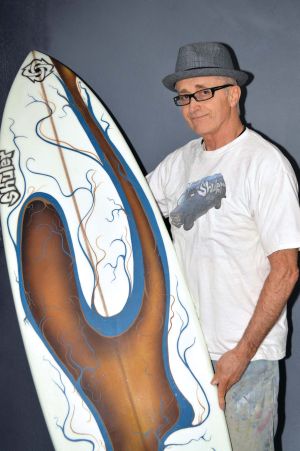
Lanny Shuler with a sample of his surfboard art.As an art student Shuler was uninspired painting on flat surfaces, but his enthusiasm returned when he began painting the sculptural form of his surfboards. “I found inseparability between my color interests and the three dimensionality of the surfboards I was painting on. Without my intending it, my art had become more challenging and engaging.”

Shuler’s “relationship with the aesthetic of the three dimensional form” also resulted in his art becoming more abstract. “It’s much less calculated and more intuitive, and there is a more intimate relationship with the creative silence of my daily meditation, with inner restful alertness and more abstract consciousness.”

Shuler is now working on a gallery show of paintings on what he calls “nonfunctional painted sculptures that can’t be surfed on.” He explains, “My surfboards have always been painted sculptures, but because they were functional, their value was mostly perceived in the terms of sporting equipment rather than higher valued art. That’s changing now.”

Which is not to say that he is abandoning functional surfboards. In fact, he is introducing an entirely new type of board designed to allow novices and experienced surfers alike to more easily develop their surfing skills and have more fun surfing in a variety of conditions.

The new boards and Shuler’s art will soon make an appearance on a redesigned website, www.shulersurfboards.com, and stay tuned for the next dimension of Lanny Shuler’s multifaceted life.

© 2013 Coast Weekend.

David Lynch, Russell Brand, Bob Roth Q&A after screening Meditation, Creativity, Peace documentary at Hammer Museum

May 24, 2013

David Lynch: Meditation, Creativity, Peace Q&A

Filmmaker David Lynch, comedian Russell Brand, and David Lynch Foundation Executive Director Bob Roth answer questions about Transcendental Meditation following a screening of the documentary Meditation, Creativity, Peace. (Run Time: 41 minutes, April 2, 2103.)

Published on May 2, 2013 by hammermuseum

See related videos: Russell Brand and David Lynch at LA Premiere of ‘Meditation, Creativity, Peace’ Documentary and Watch the trailer for a new documentary film on David Lynch titled “Meditation Creativity Peace”

Enlightenment, The TM Magazine, also reported on the event: Meditation Creativity Peace: How the David Lynch Foundation Brings Change from Within.

David Lynch speaks with Alan Colmes about his 16-country tour film Meditation Creativity Peace.

Visit the new website, Meditation Creativity Peace, for a list of upcoming and previous screenings: http://meditationcreativitypeace.com.

Happy Birthday Katy Perry! Thank you for supporting the David Lynch Foundation

October 24, 2012

The David Lynch Foundation Wishes Happy Birthday to Katy Perry

For her birthday, Katy Perry tweets fans to support Transcendental Meditation for school kids and veterans https://twitter.com/katyperry

Katy Perry says that Transcendental Meditation changed her life and, for her October 25 birthday, she is asking her fans to donate to the David Lynch Foundation, a US-based charity that provides meditation instruction at no charge to inner-city school kids and veterans suffering from the traumatic stress of combat.

In a tweet to her 27 million twitter followers, Perry writes:

“Transcendental Meditation changed my life. For my birthday I would love to pay it forward. In lieu of gifts, donate to www.davidlynchfoundation.org/katyperry.”

Perry joins a growing number of A-list celebs who practice Transcendental Meditation, or “TM”as it is called, including Oprah Winfrey, Ellen DeGeneres, Dr. Mehmet Oz, Russell Simmons, Jerry Seinfeld, Paul McCartney, Ringo Starr, Martin Scorsese, Clint Eastwood, Cheryl Crow, Moby, Ben Harper, and Laura Dern.

On the David Lynch Foundation donation webpage, Perry writes about her support for TM:

“I have been meditating for two years now, and it’s the best thing I have ever done to help bring more creativity, positive energy and peace to my life. When I’m tired, stressed, anxious or depressed, I meditate, and it clears my mind, and makes me feel relaxed and happier. I have shared the meditation experience with my friends, and recommend it to everyone I know.

“I support the David Lynch Foundation because it brings Transcendental Meditation to millions of adults and children all over the world who suffer from post-traumatic stress, such as veterans, inner-city school kids, and women and girls who are victims of violence.

“Please help me celebrate my birthday by making a donation to DLF. Your donation is not only special to me, but to all of the people whose lives you will help through the lifelong gift of meditation.”

Last year, Perry urged her fans to “pay it forward” with donations to the ASPCA to care for abused animals.

For more information, please contact heather@davidlynchfoundation.org.

About The DLF

Find out how Transcendental Meditation is being used to help at-risk students, veterans, and abused women and girls overcome stress. Watch

Celebrity websites have reported the news. See Look to the Stars: The World of Celebrity Giving: Katy Perry Urges Fans To Support Meditation Charity For Her Birthday. All the celebrities listed there are TM-ers who support the David Lynch Foundation. Examiner: Katy Perry birthday wish: 28 million fans support the David Lynch Foundation. MTV: act: Sweet Tweet: Katy Perry Asks for Charitable Donations For Her Birthday

Watch the trailer for a new documentary film on David Lynch titled “Meditation Creativity Peace”

February 9, 2012

“Meditation Creativity Peace”

“Meditation Creativity Peace” is David Lynch Foundation Television’s compelling new documentary film featuring exclusive, candid footage from David Lynch’s 16-country tour around the world when he spoke to government leaders, film students, and the press during 2007 and 2008. David’s unique, free-styling demeanor grabs your attention from the very beginning of the film. David has also selected deeply insightful quotes from great thinkers and revered texts throughout history, which reveal how the practice of meditation, developing creativity, and enjoying true inner peace are the birthright of everyone. As David says in the documentary, “Transcendental Meditation is for human beings—it doesn’t matter where you live.” Watch the trailer for this new documentary film here: Meditation Creativity Peace.*

About the David Lynch Foundation

The David Lynch Foundation, a 501(c)(3) organization, was established in 2005 to fund the implementation of scientifically proven stress-reducing modalities including Transcendental Meditation, for at-risk populations such as underserved inner-city students; veterans with PTSD and their families; American Indians suffering from diabetes, cardiovascular disease, and high suicide rates; homeless men participating in reentry programs striving to overcome addictions; and incarcerated juveniles and adults. The Foundation also funds university and medical school research to assess the effects of the program on academic performance, ADHD and other learning disorders, anxiety, depression, substance abuse, cardiovascular disease, post-traumatic stress disorder, and diabetes.

Related Websites and Posts

David Lynch Foundation http://www.davidlynchfoundation.org
Operation Warrior Wellness http://www.operationwarriorwellness.org
David Lynch Foundation Music http://davidlynchfoundationmusic.org
David Lynch Foundation Television http://dlf.tv
Transcendental Meditation http://www.tm.org
Click here for DLF Featured Past Events

Announcements and Reviews: Julie Eagleton: Meditation Creativity Peace: A Documentary of David Lynch’s 16 Country Tour | BlackBook: David Lynch’s Transcendental Meditation Documentary Gets a New York Premiere | New York Times: David Lynch Double Bill | Gothamist: David Lynchian Events Happening All Over NYC This Weekend | Yelp: An Evening with the Work of David Lynch, from Transcendental Meditation to Eraserhead

Related articles: HUFFPOST: David Lynch: Why I Meditate | Meditation for Students: Results of the David Lynch Foundation’s Quiet Time/TM Program in San Francisco Schools | Replay of David Lynch Foundation Launch of Operation Warrior Wellness Los Angeles | Third Annual David Lynch Foundation Benefit Gala | David Lynch gives $1M to teach vets meditation | David Lynch donates $1 million in grants through his foundation to teach veterans to meditateRussell Brand Does Stand-Up for Transcendental Meditation | What do Stephen Collins, Ellen DeGeneres, Russell Brand, Russell Simmons, David Lynch and Oprah have in common?

New related posts: Russell Brand and David Lynch at LA Premiere of ‘Meditation, Creativity, Peace’ Documentary, and David Lynch, Russell Brand, Bob Roth Q&A after screening Meditation, Creativity, Peace documentary at Hammer Museum. Enlightenment, The TM Magazine, reported on the LA Premiere: Meditation Creativity Peace: How the David Lynch Foundation Brings Change from Within. David Lynch speaks with Alan Colmes about his 16-country tour film Meditation Creativity Peace.

*Visit the new website, Meditation Creativity Peace, for a list of upcoming and previous screenings. You can also ask your local TM Center if they have a copy and plan to show it. http://meditationcreativitypeace.com

You can now see the film “Meditation Creativity Peace”—A documentary of David Lynch’s 16-country tour during 2007–2009.

William Stafford—You and Art

September 10, 2009

You and Art

Your exact errors make a music
that nobody hears.
Your straying feet find the great dance,
walking alone.
And you live on a world where stumbling
always leads home.

Year after year fits over your face—
when there was youth, your talent
was youth;
later, you find your way by touch
where moss redeems the stone;

and you discover where music begins
before it makes any sound,
far in the mountains where canyons go
still as the always-falling, ever-new flakes of snow.

—William Stafford

Also see William Stafford—A Course in Creative Writing

Listen to You and Art performed by Daniel Sperry from his CD: William Stafford: Cutting Loose ~ A Tribute To William Stafford.

I later included the last stanza of this Stafford poem in response to The Poetry Society’s tweet of the last half of Wallace Stevens’s poem, The Snow Man, which they liked. The imagery is similar, and the GIF they used of snow falling also fits perfectly with both poems.

My poem, Poetry—The Art of the Voice, communicates that silent music from nature to poet to audience, where it “begins before it makes any sound” as Stafford wrote at the end of You and Art.

And my poem, Telling the Story of Silence by Ken Chawkin, allows that silence to tell its own story, the “Nothing that is not there and the nothing that is” as Stevens wrote in The Snow Man.

Later found and added: Henry Lyman interviewed William Stafford for NPR’s series, Poems to a Listener, later posted on YouTube. Stafford reads several poems, including You and Art.

I found this quote by James Joyce (Ulysses): “A man of genius makes no mistakes. His errors are volitional and are the portals of discovery.” It seems to reiterate this notion that mistakes lead to discovering something new and unexpected, i.e., thinking out of the box.