Some articles on David Lynch, Jan 20, 2011, David’s 65th birthday

January 20, 2011

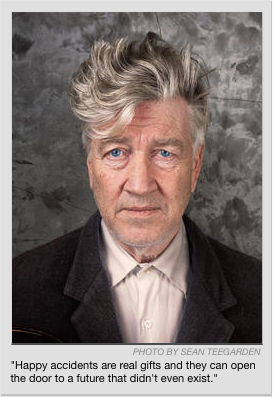
David Lynch, (Non-)Musician: The L.A. Weekly Interview

By Gustavo Turner Thursday, Jan 20 2011

[Music Ed.’s Note: On January 31st, David Lynch will release an expanded edition of his recent single “Good Day Today”/”I Know” on the Sunday Best label. The collection features remixes by several prominent electronic artists and special packaging by renowned UK designer Vaughan Oliver (of 4AD fame).
Check out also our selected David Lynch discography (including instructions for the perfectly Asymmetrical David Lynch mixtape) and our exclusive interview with Vaughan Oliver about the “Good Day Today”/”I Know” single.]

Here’s David Lynch‘s recipe for success, taken from his inspiring little manual Catching the Big Fish: “Try to get a job that gives you some time; get your sleep and a little bit of food; and work as much as you can. There’s so much enjoyment in doing what you love.”

This philosophy, plus a healthy helping of Transcendental Meditation, of which he remains a vocal advocate, allowed Lynch to become an intriguing visual artist, with works in painting, collage, cartooning, photography and art-film. Later, this approach helped him make the mysterious jump into Hollywood filmmaking, where he remains one of the few working heirs to the great surrealist auteurs of cinema.

And it’s a philosophy that Lynch is now applying with renewed focus to yet another art form: music. Anyone familiar with his film work has long figured out that Lynch is a genuine sound freak: Witness the uncanny industrial soundscapes of Eraserhead, the unforgettable aural stampede that elevates The Elephant Man, his 180-degree redefinition of Bobby Vinton and Roy Orbison in Blue Velvet, the groundbreaking romanticism of the Twin Peaks score, the jagged, deranged edges of Lost Highway and, especially, his covert beatnik musical Wild at Heart. It wouldn’t be much of a stretch to say he possesses the keenest ears among all major living Hollywood directors.

Lynch soon will be relaunching his website, davidlynch.com, as a way to broadcast the result of a series of musical collaborations (or “combos,” as he likes to call them) with other artists, under the supervision of his personal engineer and main partner in sound, Dean Hurley, at the filmmaker’s prolevel home studio, Asymmetrical Studio.

Hurley says the website “will feature unreleased singles, experiments and instrumentals created through the years,” including the legendary Thought Gang project, a full album of noir avant-jazz recorded alongside the Twin Peaks: Fire Walk With Me soundtrack by Lynch and longtime associate Angelo Badalamenti.

We met Lynch for a conversation about his music at his luminous homebase/art studio in the Hollywood Hills. (The italics below are an attempt to convey Lynch’s distinctive manner of speaking, an infectious way to share his enthusiasm. In Lynch’s world, some things are not just great, they’re “really, really, really great.”)

DAVID LYNCH: I’m not a musician, but I play music. So it’s a strange thing.

Click on this link to read the complete interview, page 1, January 20, 2011, published in the LA Weekly News on David’s 65th birthday http://bit.ly/dVOWWA.

Also see flavorwire: 65 Things You Didn’t Know About David Lynch | Moviefone: Lunch Break: Happy Birthday, David Lynch! | Houston Press Blog: The Best of David Lynch on the Web. And two days later from Vanity Fair’s James Wolcott’s Trance and Transcendence.

Detours: Vedic City Rises Above

January 19, 2011

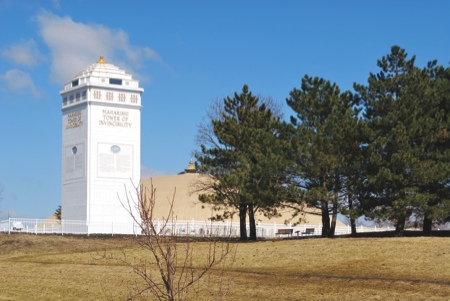
Vedic City Rises Above

Winter 2010 Destinations
Written by Jessica Rapp

Rush hour in Vedic City, Iowa, is an understatement. Every day, just minutes before 7 a.m. and 5 p.m., its main street transforms from a desolate country road into a gently moving caravan carrying approximately 1,900 passengers intent upon achieving world peace. This common objective attracts visitors from all over the world to the heart of the Hawkeye State, many of them followers of the Transcendental Meditation (TM) movement and believers of the tranquil lifestyle. They eat organically-grown foods, live in housing built according to natural principles and make sustainability a priority in the 2,200 acres of land bordering Fairfield, Iowa, that they call home. Twice a day, they make the pilgrimage to two shimmering gold-domed complexes to cross their legs in the lotus position, close their eyes and meditate, to improve not only their own health but to better the society surrounding them.

The TM organization cites numerous studies that it says proves its method works and distinguishes the program from other common forms of meditation or yoga. Jeffrey Cohen, director of the Invincible America Assembly at accredited Maharishi University of Management (MUM), said TMers demonstrated their method in Washington, and even as far away as Lebanon. Cohen said that in Lebanon, statistics showed a “direct correlation” between the size of the groups meditating and the amount of crime and violence in the area.

“In Washington, D.C., large groups of TM meditators convened to show that [their technique] would lower the crime rate in D.C.,” Cohen said. “And in fact, statistical analysis showed that it lowered violent crime by… a very significant amount. And again, it was reviewed by experts and sociologists.”

Since the 1950s, six million people worldwide reached a consensus that the program developed by the late Maharishi Mahesh Yogi, famed guru to the Beatles, is worth following. Read the rest of this entry »

Veteran Dan Burks on Overcoming the Stresses of War with Transcendental Meditation

January 18, 2011

Veteran Dan Burks on Overcoming the Stresses of War with TM

DavidLynchFoundation | December 12, 2010

Transcription: “December 18th 1967 – Newsweek, five days after my birthday. This is a story called ‘The Days Work.’ And this is my unit, we went out and got ambushed, and this is me doing my job. We were attacked at this place called Buddha. That fight went on for two weeks. The first night I killed 14 people. There were 25 hundred of them, 250 of us. The next morning in front of my fighting position there were 18 of our men dead. So this is very, very, very distressing, and it creates huge amounts of distress in your system.”

“Later in the magazine there’s this… this is an article Maharishi Mahesh Yogi and a couple guys in my platoon, one of them got the magazine and came running over and said ‘Burks, you gotta read this!’ So I did. And I said, ‘I’m going to do that….’ Because it talks about stress release, about becoming a whole person.”

“The next part of the story is about getting home. And that’s a whole big deal, because things changed. All of a sudden you’re in a different culture. They don’t understand you. They have no idea. They don’t understand that you’re always still in the rubber plantation in the jungle. You’re always on an adrenalin high. You’re looking to protect your buddies, you’re looking to protect yourself and you’re looking to kill the enemy.”

Help us heal our Veterans – http://www.davidlynchfoundation.org

See two other videos: AFP: Meditation soothes war veterans and 50% reduction in PTSD symptoms within 4 weeks of Veterans practicing Transcendental Meditation.

See AFP’s How Clint Eastwood keeps his cool, Meditation May Ease PTSD for Vets, and watch highlights of the David Lynch Foundation‘s Operation Warrior Wellness press conference and the second annual Change Begins Within benefit gala.

Israeli Actress and Author Meital Dohan Interviews TM exponent Bob Roth

January 18, 2011

Talking Miracles with Israeli Actress and Author Meital Dohan
By Meital Dohan | Tuesday, January 18, 2011 12:25 PM ET

The very sexy and very spiritual actress and philanthropist talks with Bob Roth, executive director of The David Lynch Foundation.

Hello y’all…. I was honored to be asked to do a radio show called Loud Miracles on WOMEN’S RADIO and a blog by Tonic, and I decided to talk with you guys about Miracles — not like hoki poki abra cadabra style, but more about Miracles which make this life worth living.

I launched the first episode of my radio show with a very special guest named Bob Roth, someone whom I consider to be a miracle worker for his 40 years of contribution to the world of meditation.

Bob serves as the executive director to the David Lynch Foundation, started by the great filmmaker David Lynch who has a mission to provide scholarships for underprivileged and at risk kids all over the world to learn Transcendental Meditation. Bob also serves as the executive director of the nonprofit Transcendental Meditation Organization. You can read more about Bob’s work involvement by clicking on the links below.

I met Bob at a charity event a few months ago and he immediately began talking to me about Transcendental Meditation. He was very passionate about TM and I was very curious because I had tried so many things to improve my well being before. In other words, how to stay alive without jumping off a bridge or going to an asylum.

I was initially very skeptical about trying something new because I feel that are so many people out there promising to change your life. However, I did end up taking Bob’s advice and trying TM. I loved it and it has been part of my life, twice a day for 15 minutes, ever since. And of course, since my show is about miracles, I asked Bob to share his thoughts on miracles, which were very unique and inspiring.

Me: So I have the pleasure to have you as the first guest on the show. And the show is about miracles. And I wanted to hear if you believe in miracles at all.

Bob: First of all, I’d like to begin by reading this great quote from the great Catholic saint, Saint Augustine. And he said about miracles: “Miracles are not contrary to nature but only contrary to what we know about nature.” And my feeling is that there is no such thing as a miracle. There are just deeper realities and deeper manifestations of the ultimate reality. And what we perceive to be a miracle is actually just an expression of an infinite network and fabric of Divine Life or nature’s existence. But the same intelligence that can create, not just all the infinite life forms on this earth, but think of all the planets and galaxies and infinite numbers. So that intelligence can do lots of things that we don’t understand. So I don’t know that the word “miracle” means something that is unreal. I think there are just very real things that are very profound that sometimes pop up and let us see them.

I wanted to give Bob enough time to describe the magic of Transcendental Meditation. Bob describes it in the best way when he compares our minds to the ocean.

Bob: If you take an ocean, you will see that there are waves on the surface and then there are 20-foot high waves and then a mile in depth of the ocean. The waves on the surface are a tiny little thing compared to the mile long depth of the ocean. And the active thinking mind, all the millions of things we have to do, are just the surface of the mind. But the mind is profoundly deep and silent in its depth. TM is a simple technique that allows the attention of the mind to turn inward. So we are not just stuck on the surface of the wavy mind. And the mind naturally begins to effortlessly settle down to experience quieter levels of thought. And then there are times when we experience the deepest level of the mind, the source of thought, when we transcend even the finest thought and we experience our big Self. The land of pure miracle.

Me: I am fascinated by [TM] and the effects of it. I was so taken by this technique that now we are talking about bringing more awareness to it and bringing it to people that serve in the Israeli Army. For me, your role is definitely to bring magic and miracles to other people’s lives.

Bob: Let’s say all of us are 100-watt bulbs. But stress and fatigue and tension and strain and doubt and disappointment and rejection, all of the stresses are like dust and dirt on the light bulb. And we don’t glow. It’s there. It’s inside of us. TM doesn’t create anything that isn’t already there. It just washes off that dirt and dust and we can shine the way we want to shine.

Me: What is the source of the technique?

Bob: TM has its origins in the oldest continuous tradition of meditation known. It predates Buddhism, Hinduism… It predates all the ‘isms’. It’s just a science of consciousness. It has been handed down from teacher to student, from teacher to student, throughout time. And the most recent custodian that everyone knows about at this time is Maharishi Mahesh Yogi who brought TM to the world about 50 years ago. And I was very fortunate to spend some time with him. He taught me to become a teacher of TM.

I loved the way Bob’s explanations were so beautifully simple.

Listen to my first show to hear the complete, wonderful message from Bob Roth who was taught TM by the master himself, Maharishi Mahesh Yogi.

 Listen to other interviews by Meital Dohan posted on The Uncarved Blog.
 

* Are you a miracle worker? Perhaps you know someone who is a miracle worker. Meital would love to hear your story. She would like to interview some more miracle workers for her show! She invites you to post suggestions or stories on her Facebook Page: http://www.facebook.com/MeitalDohan
* To learn more about TM, visit their website at www.DavidLynchFoundation.org
* To learn more about Meital Dohan, visit her website at www.meitaldohan.com

Meital has moved on but her interviews are posted on SoundCloud.

Added July 16, 2019: Meital Dohan on Transcendental Meditation.

The prime mover of life – The Times of India

January 18, 2011

The prime mover of life

Lane Wagger, Jan 19, 2011, 12.00am IST

Maharishi Mahesh Yogi’s unique and enduring contribution to humankind was his deep understanding of—and mechanics of experiencing—pure consciousness, the vacuum state of consciousness, the most powerful state of the mind.

The ground state or vacuum state, is an inexhaustible field of creativity, energy, orderliness and intelligence: literally a field of all possibilities. Everything in the universe—animate and inanimate—emerges from this quantum mechanical level. It is the total potential of Natural Law. All of the innumerable laws of nature—the impulses of nature’s intelligence—responsible for governing all diverse tendencies in the universe, are found here. This same field of Nature’s unlimited potential can be located within each individual at the source of thought, the most settled state of one’s awareness. Acting from this level of pure consciousness, one inherits the infinite organising power of Natural Law, making all things easy of attainment.

Imagine a wave on the sea. Even a very big wave has limitations; it is only this high and that wide. Now imagine that wave settling down, flattening out, until it merges with the sea. Its value then assumes the unlimited, infinitely more powerful status of the sea. The wave, which was bound before, has gained boundlessness.

The mind is capable of the same settling down, or transcending process. During Maharishi’s Transcendental Meditation (TM), the waves of thought ‘retire’ to the source of thought. The word “transcend” means to go beyond; “meditation” refers to thinking. During TM the mind experiences progressively less excited states of thought until one transcends thought completely, to arrive at its source. The agitated, limited value of thought gains the unlimited status of Being, the silent depth of the ocean of consciousness.

Transcending thought is as effortless as thinking. If a man can run, naturally he can walk and stand still. The active mind already contains the ability to be silently alert. No effort is required. It only needs a technique.

The mind is like a body of water: choppy on the surface, silent and stable at its depth. When we experience only the ‘noisy’, surface level of thinking, difficulties abound. All problems result from, or are magnified by, an agitated state of mind. If we could anchor the surface mind to its vacuum state—if we could enliven the stability inherent at the depth of consciousness—we would be insulated from “the winds of change”.

In the Bhagavad Gita (2.48) Krishna says: ‘Yogasthah kuru karmani’: Established in yoga or pure consciousness, perform actions. Here the mind is most powerful, most effective. ‘Yogah karmasu kaushalam’ (2.50): Yoga is skill in action. From this level we “do less and accomplish more”. The growth of inner silence is the basis of spiritual unfolding and material success.

Consciousness is the prime mover of life. Everything we do depends on the quality of our consciousness. If your mind is sleepy, agitated, or negative, then everything you perceive. Speak or do reflects that incoherence. But if your consciousness is orderly, fresh and alert, the world appears much different. Knowledge is different in different states of consciousness. When you wear red tinted glasses, everything appears red and when you wear green tinted glasses, everything appears green. The Vedas say that knowledge is structured in consciousness. The world is, as we are. If you are anchored to the silent, blissful state of consciousness, everything you do becomes joyful. Maharishi summarises simply, “Handle that one thing—consciousness—by which everything else is handled.”

50% reduction in PTSD symptoms within 4 weeks of Veterans practicing Transcendental Meditation

January 18, 2011

Reduction of PTSD Symptoms in Veterans with Transcendental Meditation

DavidLynchFoundation http://www.davidlynchfoundation.org/

Norman Rosenthal, M.D. (Clinical Professor of Psychiatry, Georgetown University Medical School): Over half a million of our veterans from Iraq and Afghanistan are suffering from Post Traumatic Stress Disorder. These are people who have been exposed to violence on the battlefield serving for our country. And, as one of my patients said, it can happen once in your life but a hundred times in your mind. The echos linger on.

Sarina Grosswald, Ed.D. (Cognitive Learning Specialist): With traumatic stress it’s really some enormous stress that’s more than the body can process, and it leaves a big impression on your brain. The estimates are that at least 30% of returning veterans are experiencing PTSD and really the estimates are that it’s probably much greater than that. I think that maybe as many as 50% who are experiencing these symptoms aren’t actually even seeking help.

Dr. Rosenthal: They get bombarded on a daily basis by memories and flashbacks and it’s a shocking statistic that 18 veterans every day commit suicide.

Dr. Grosswald: We’ve lost more to suicide than actually have been lost in combat. That’s the first time ever.

Dr. Rosenthal: One thing that we who are interested in Transcendental Meditation are seeking is could TM be one of the answers or one of the ways in which we can treat PTSD?

Dr. Grosswald: We put together a pilot study with returning veterans from the OEF-OIF war, which is the Iraq/Afghanistan war, and what we saw was for these young men there was, within 4 weeks, a 50% reduction in the PTSD symptoms. That’s pretty dramatic, I don’t think there’s anything that shows that level of response that quickly.

Dr. Rosenthal: Because of TM’s ability to settle down the nervous system, to quiet it down, to slow down the fight-or-flight response, I believe it is a very promising direction for us to explore. I think it’s definitely something we should be trying and testing and studying.

See AFP: Meditation soothes war veterans

Writing—a poem on the writing process

January 18, 2011

Writing

Writing is a series of letting go’s
of our preconceived notions of how it goes
and allowing a deeper part of you to tell you what it knows;
when the writing’s good, it shows.

Because, ultimately, when we do,
that recognition of what’s true,
comes from the deepest part of you.

So let the writing speak to itself,
and let the writer listen, for

writing is listening on paper.

© Ken Chawkin

Also see Storytelling—a poem on the storytelling process and Sometimes Poetry Happens: a poem about the mystery of creativity.

Read the rest of this entry »

Ode to the Artist: a magical day looking at lotus pads

January 16, 2011

ODE TO THE ARTIST
Sketching Lotus Pads at Round Prairie Park

Black lines briefly sketched on paper
capture our appearance but not our essence.

Your attention interests us,
although others have never before.
Your watchful eyes tell us
we are apart of you.

Can you feel our thoughts?
Can you think our feelings?
We do yours
and we thank you for committing us to memory.

For long after we’ve gone
and transmuted ourselves back into nature
our likeness will remind you that we were.
And your response will touch our hearts.

© Ken Chawkin

Read the rest of this entry »

Sometimes Poetry Happens: a poem about the mystery of creativity

January 16, 2011

Sometimes Poetry Happens
(Sequel to ODE TO THE ARTIST)

Some poets can write
from reflected experience
referring back to what was written.

Others need to be there,
in full view of their subject,
opening up to what’s being given.

Sometimes poetry happens between the two.

It’s then you don’t really write the poem.
It writes you!
You just put it down on paper.

When you see it there,
You’ve captured it.
Or, rather, it’s captured you.

What really happened between the two?

To explore that space
between you and me
is to discover who we are.

For deep within,
at the source of the gap
lie the togetherness of the three—

the seer, the seen, and the poetry … in between.

© Ken Chawkin

Read the rest of this entry »

CRYSTAL MORNING

January 16, 2011

CRYSTAL MORNING

Winter crystal morning bright
after raining night.

Dark tree branches frozen tight
in shiny shells of ice.

A strange and wondrous sight.
Transparent bones of light!

© Ken Chawkin

For more poems about trees see Being in Nature—a gift from a tree, with links to others.