Jerry Yellin on Loud Miracles with Meital Dohan: Beating PTSD through Transcendental Meditation

May 17, 2011

Click on the title to listen to the interview.

Jerry Yellin: Beating PTSD Through Transcendental Meditation

Meital Dohan talks to Jerry Yellin. They discuss how TM helped him emerge from his PTSD as well as how TM can help better the mind and body in other ways, given that Meital also practices. They discuss the effects of PTSD and how drugs are not the only answer to the hardships and trauma of War.

More about Jerry Yellin

Jerry Yellin is a World War II Veteran who suffered from PTSD after returning home from the war. For many years he suffered from depression that he could not escape, and fell deeper and deeper with no end in sight despite being surrounded by people he cared about and who cared about him. After his wife began to practice Transcendental Meditation, Jerry also tried it. Through TM, which he continues to practice, he got himself out of his depression and has lived a long and healthy life. He speaks widely about his experience and he has has teamed up with the David Lynch Foundation to create Operation Warrior Wellness to provide TM to veterans of our current wars as a way to help heal from the hardships of battle.
 
Listen to other interviews by Meital Dohan and see other articles on Jerry Yellin posted here on The Uncarved Blog.
 
Meital has moved on but her interviews are posted on SoundCloud.
 

For a New Beginning by John O’Donohue

May 16, 2011

For a New Beginning

In out-of-the-way places of the heart,
Where your thoughts never think to wander,
This beginning has been quietly forming,
Waiting until you were ready to emerge.

For a long time it has watched your desire,
Feeling the emptiness growing inside you,
Noticing how you willed yourself on,
Still unable to leave what you had outgrown.

It watched you play with the seduction of safety
And the gray promises that sameness whispered,
Heard the waves of turmoil rise and relent,
Wondered would you always live like this.

Then the delight, when your courage kindled,
And out you stepped onto new ground,
Your eyes young again with energy and dream,
A path of plenitude opening before you.

Though your destination is not yet clear
You can trust the promise of this opening;
Unfurl yourself into the grace of beginning
That is at one with your life’s desire.

Awaken your spirit to adventure;
Hold nothing back, learn to find ease in risk;
Soon you will be home in a new rhythm,
For your soul senses the world that awaits you.

© John O’Donohue

(To Bless the Space Between Us)
A Book of Blessings

Also see: The Inner History of a Day by John O’Donohue
and What To Remember When Waking by David Whyte.

Listen to Krista Tippett interview John O’Donohue On Being:
The Inner Landscape of Beauty.

Later added: John O’Donohue’s 4 short lines say it all for poets and A Blessing of Solitude by John O’Donohue complements Derek Walcott’s Love after Love.

 — Written and compiled (citing sources) by Ken Chawkin for The Uncarved Blog.

Iconic Jazz Musician Paul Horn Performs Inside MUM’s Golden Dome in Historic Concert May 15

May 10, 2011

Iconic Jazz Musician Paul Horn Performs Inside MUM’s Golden Dome

Grammy-award winning musician Paul Horn, renowned for his pioneering solo jazz performances inside timeless monuments such as the Taj Mahal and the Great Pyramid, performs in a historic concert on Sunday evening, May 15 at 7:45 pm, “Inside the Golden Dome: Paul Horn & Friends.”

Paul will be joined by his wife, celebrated Canadian singer/poet Ann Mortifee; Ed Sarath, world-class flugelhorn player; and special guest Eugene Watts, founder of the popular Canadian Brass, the world’s leading brass ensemble with over 80 CDs and DVDs. This concert is also the grand finale of the “Music & Consciousness Symposium” being held at Maharishi University of Management during the weekend of May 14 & 15. Each of these artists will deliver keynote addresses at this Symposium on the subjects of improvisation, creativity, and the relationship of music with spirituality.

Paul Horn has had an illustrious career spanning five decades, 50 albums, five Grammy nominations, and two Grammy awards. He has played both as a solo artist and with the likes of Duke Ellington, Miles Davis, Frank Sinatra, Nat King Cole, Tony Bennett, Buddy Rich, Chick Corea, Donovan, Quincy Jones, and Ravi Shankar. At the peak of his jazz career, Paul was inspired to play his flute inside the famous Taj Mahal. This improvisational performance ushered in a new era of contemplative and meditative music. “Inside the Taj Mahal” became the seminal recording of this new genre of music, and Paul became known as the “Father of New Age Music.”

One of the highlights of the concert is a rare performance inside the Golden Dome on the campus of Maharishi University of Management. The Golden Dome has been used for more than 30 years for the collective practice of the Transcendental Meditation (TM) program by several thousand practitioners. Extensive published scientific research shows the TM technique promotes a wide range of personal benefits, including reduced stress, anxiety, depression, ADHD and other learning disorders. Research also demonstrates a calming “spillover” effect on the whole of society when just a small percentage of the population practices this technique together, including decreased crime, violence and conflict throughout society.

The event is presented by the David Lynch Foundation and MUM’s new Creative Musical Arts Program.

Tickets are available in advance at the Chocolate Café, on the Square, and the MUM Bookstore.

For more details on the “Music & Consciousness Symposium,” visit: mum.edu/music/symposium.

Also see Radio Iowa interview Famed flute player visits SE Iowa, plans weekend show, and IowaPrivateColleges.org posting: Grammy Winner Paul Horn Performs at MUM. PeaceTown, USA also posted: Sacred Intersection: Paul Horn Performs Inside the Golden Dome.

Visit the TM Blog for an article posted by Keith Deboer: Paul Horn: The Music of Meditation, and a short video overview of Paul Horn’s career: Inside Paul Horn posted by annmortifee.

Video and Reports of the Symposium on Music and Consciousness

Here’s Paul’s great talk from the symposium: Improvisation: The Ultimate Art of Self-Expression — Paul Horn at MUM.
Results of MUM’s first Music and Consciousness Symposium: Why a Symposium on Music and Consciousness?
Achievement’s report on the symposium: Symposium on Music and Consciousness Honors Paul Horn

Click here to see all of the Lecture and Performance Videos from the Symposium including Q & A.

The San Francisco Examiner—Meditation program mends troubled Visitacion Valley Middle School

May 8, 2011


Meditation program mends troubled Visitacion Valley Middle School
By: Dan Schreiber
05/08/11 4:00 AM
Examiner Staff Writer

Every day before class, Visitacion Valley Middle School students pass an informal memorial known as the “R.I.P. wall,” a reminder of trouble that awaits them when the afternoon bell rings.

In 2004, two students discovered the partially decomposed body of a 19-year-old stabbing victim. Later that year, a gunman brazenly stormed into the school, threatened to kill a teacher and robbed two employees. In the 2009-10 school year, one-fifth of the students had one or both parents incarcerated.

“Everybody in this school was either related to somebody who has been shot, who did the shooting, or who saw a shooting,” said Jim Dierke, the school principal. “We had kids who couldn’t learn.”

In the spring of 2007, Dierke decided he would try a simple solution.

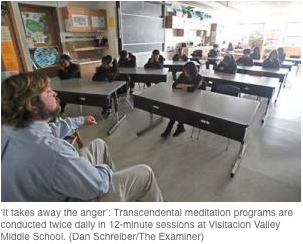
The quiet time program involves the ancient techniques of transcendental meditation, conducted twice daily in 12-minute sessions before and after class.

The first announcement comes over the school’s intercom around 8:45 a.m. — “Prepare for quiet time,” — and the teachers ring a little bell to mark the beginning of the exercise. Most students close their eyes; others cover their faces with their hands and focus on the repetition of a mantra.

“It takes away the anger,” said Charles Ollie, an eighth-grader at the school. “Your brain is like a lake holding in water, and when we meditate, the flood gates open and the water is released.”

Dierke and the school staff credit the program with reducing violence, increasing attendance and test scores and dramatically decreasing suspensions.

Other good things are happening, too, teachers said. The volleyball team made the playoffs this year for the first time in a long time, and some of the eighth-graders are making it into The City’s top high schools, such as Lowell.

Most of the annual $175,000 funding for the program is provided by the New York-based David Lynch Foundation, founded by the TV and movie director. The money is used to pay for dedicated staff to run the quiet time program.

Opponents call it “stealth religion” that violates church-state separation laws because of its association with Eastern religions, but advocates insist that the practice predates Hinduism by thousands of years.

“They come from broken homes, foster care and group home settings,” said Brian Borsos, a special education teacher. “This is a practice that helps them go back and face what they need to face. It’s a skill they take with them for the rest of their lives.”

Program is director Lynch’s brainchild
A handful of San Francisco’s troubled public schools have turned to a transcendental meditation program known as quiet time to relieve high stress in students, made possible by grants from the New York-based David Lynch Foundation.

The TV and film director launched the foundation in 2005 with support from two surviving members of the Beatles and their former meditation instructor Maharishi Mahesh Yogi. But foundation leaders say the practice has nothing to do with religion and is not a church-state separation issue.

Save some minor grumbling and initial skepticism, the San Francisco version of school meditation has not experienced nearly the opposition faced in 2006, when the foundation withdrew funding after parents at Terra Linda High School in San Rafael denouced it as a cult.

Bob Roth, the foundation’s vice president, said the programs in San Francisco have gotten better reception.

Ellie Rossiter, executive director of the nonprofit Parents for Public Schools of San Francisco, said she has heard no opposition to the program. Some of The City’s school officials have even provided testimony on the Lynch Foundation’s website.

“It’s an anchor, it’s a balance for them and I believe it opens them to learning,” Everett Middle School Principal Richard Curci said in a YouTube video.

Soothing results
The meditation program at Visitacion Valley Middle School was instituted in the spring of 2007.

45: Percent reduction in multiday suspensions for quiet-time students in program’s first year
85: Suspensions in 2005-06
10: Suspensions in 2009-10
2.5: Average GPA in fall 2006
2.9: Average GPA in fall 2010
40: Point gain in API score in testing in 2009-10

Source: Visitacion Valley Middle School

dschreiber@sfexaminer.com

Related articles: San Francisco Bay Area News: From time-out to quiet time: meditation comes to SF schools | New research shows Transcendental Meditation improves standardized academic achievementMindShiftKQED: How we will learn: Amidst Chaos, 15 Minutes of Quiet Time Helps Focus Students | and this TM Blog report with video: Breaking the “predictive power of demographics”: SF principal talks about how TM helps his students. And here’s a wonderful report from the The George Lucas Educational Foundation (GLEF): Edutopia: SF School Uses TM to Overcome Problems.

Students find their centers at Maharishi

May 6, 2011


The  Spring 2011 issue of DUH Magazine, Drake University Honors Magazine, in Des Moines, Iowa, describes the unique features of living and learning at Maharishi University of Management, in Fairfield, Iowa, including conversations with teachers, administrators, and students. In the editor’s letter, The spark behind this year’s magazine, Editor-in-Chief Jessica Kinkade comments on the theme for their Spring issue, and how the feature article written by Josie Berg-Hammond exemplifies that theme. Here’s an excerpt:

We chose spark … because we wanted to write stories that would get people thinking—that would spark ideas and curiosity. So this magazine is intended as a catalyst—something to inspire you to have new conversations. … And what sparks conversation and change more than differences? And being open to those differences and letting things inspire us?

Our biggest feature story, written about Maharishi University of Management in Fairfield, Iowa, is perhaps the most genuine example of what it means to be open to this spark of inspiration. l can’t remember how I first heard about the Maharishi, but I was shocked to find out the whole school practices Transcendental Meditation every day. No one in Des Moines seemed to know about it, and I got in my head that it must not be a real school. It couldn’t be. But writer Josie Berg-Hammond was determined to get the real story and see what it was all about. She came back from her visit smiling from ear to ear.

Before l’d even read her story, she was so excited about it. She met so many new people and they were all so friendly. They told her about their schedules, how they eat organic foods, meditate every morning, are in bed by 10 p.m. and only take one class at a time. It all sounds so different from Drake, but the people, the core of the Maharishi community, are still just people … just like us. Their university experience has been a little different from ours, but they sparked thoughts in Josie, and that comes through in her story. The differences between two university communities sparked new relationships and conversations, and what is life about if not those new adventures?

This article was featured in their EVOLUTIONS section of the magazine.

Students find their center at Maharishi

Most high school students look forward to college as a time of new experiences: new friends, new classes, new parties. One thing most students don’t think about: meditation. For students at Maharishi University of Management (MUM) in Fairfield, Iowa, however, that’s at the top of the list.

The four-year, accredited university was founded by Maharishi Mahesh Yogi. The school, originally called Maharishi International University, took over the campus of a recently closed university in 1974 and opened its doors to hoards of students eager to learn through Consciousness-Based education. Now, the school has 1,233 full-time students, both undergraduate and graduate. While the school has many non-traditional students going back for second degrees or graduate school, there are many more students who arrive fresh out of high school.

Four years ago, when he was a high school senior, Brian Faulkner, 22, had a tough decision to make. He could go to a school where he could continue playing soccer or go to MUM where he could continue practicing Transcendental Meditation (TM).

“Now I feel like, thank God I came here,” Faulkner says.

Faulkner has been practicing TM since he was about 4, and it was important to him to continue the practice through college. Even though he had been in the habit for a while, Faulkner said his friends were surprised when he decided to go to MUM.

“The vast majority of my friends never knew I did TM,” Faulkner says. “Some thought I was in a cult; others just said, ‘OK, if you’re happy.’”

“It’s not a cult,” says first year student, Supriya Vidic, 26.

Vidic started school at Maharishi after six years of military service. She says she was ready to reach an inner peace she felt she was missing while she served in the military.

“It’s a total 180 from where I came from,” Vidic says. “With the military, I traveled outwards. Here I travel inwards.”

[TRANSCENDENTAL MEDITATION]
Many students find MUM because they’re looking for something different. Students want to focus on themselves just as much as on their schoolwork. For most, the regular practice of TM is crucial to their educational journey.

First year students are enrolled in an introductory course when they first begin at MUM. This gender-separated experience helps ease students into the MUM way of life. One of the most important things students learn in the class is how to practice TM.

TM is not something that someone can begin on his or her own. While anyone can learn, the practice must be taught. In its most basic form, TM is the practice of closing the eyes, sitting still and settling the mind. Students and professors alike believe TM allows the mind to transcend to a point of pure awareness, allowing the mind to rest deeply and the brain to function with more coherence.

Fred Travis, an MUM professor, says it takes about four days to learn TM and about six months to stabilize it.

“We can ask every student who comes here to learn TM because they can do it. It’s not unattainable,“ Travis says. “Once you get the idea of how the mind transcends, you can do it on your own.”

Students meditate for 20 minutes in the morning and 20 minutes in the afternoon or evening. Travis said this rests the brain and is crucial to Consciousness-Based education.

“You settle down to pure wakefulness,” Travis says.

[CONSCIOUSNESS-BASED EDUCATION]
A healthy vegetarian diet, low homework load and TM are all a part of MUM’s system of Consciousness-Based education. Classes at MUM are set on a block system. This means that students go to one class five days a week from 10 a.m. to 3 p.m. Students are completely immersed in one course for a month and then take a three-day weekend and start up another month-long course.

Professor Travis has spent his career crusading for Consciousness-Based education. He suggests that a switch to this type of learning creates a less stressful, more fruitful academic experience for both professor and student.

“Consciousness-Based education says that the student is the core,” Travis says.

The method encourages less homework, more class time on one subject, sleep, exercise and a healthy diet. Students are encouraged to be in bed by 10 p.m. and are never assigned more than an hour and a half of homework each night, leaving them time to hang out with friends or join extra-curricular groups.

Travis believes that this type of lifestyle is much better than the classic education model. Most students at other universities take about five classes a semester and spend varied amounts of time on homework—all-nighters fueled by energy drinks—for different classes, which often leads to a sporadic schedule. Travis doesn’t think that’s right.

“You don’t sleep, you don’t get good food and then you go out and party,” Travis says. “The brain has no time to relax.”

Travis also finds the class structure of traditional universities lacking. Instead of a lecture class with a final exam at the end, he believes students should be interacting with each other and the professor in order to retain information.

“Final exams are structured forgetting,” Travis says. “With active learning, the professor stops talking and lets the students talk.

[THE FOOD]
Just like any other college campus, MUM has a cafeteria where many of the students eat three meals a day. But MUM’s cafeteria is 100 percent vegetarian with mostly local food and vegan options. And in a world of pre-prepared meals, the MUM cafeteria relies on fresh ingredients every day, often newly harvested from its own garden.

Though most people would find the food at MUM to be a huge step up from the classic cafeteria fare, it’s not always easy to get accustomed to it. According to Ila Zeeb, the director of the first year experience at MUM, students don’t always like the food right away. “For some students, this food is a huge change from home,” Zeeb says.

While many students do enroll as vegetarians, others are confronted with a completely different diet.

Graham Torpey, 24, who graduated from Syracuse University and is now a graduate student at MUM, is thrilled with the meal offerings.

“Man, my health was bad when I was at Syracuse,” Torpey says. “This place is a treasure trove for me. Now, I have a great meal every day.”

The students are also knowledgeable about what food is offered in the cafeteria. Brooke Hadfield, 28, a second-year student from Australia, says it’s important to her to know about her food.

“The honey is the only thing here today that I can think of that isn’t organic,” Hadfield says. “I mean, where else do you get organic food for every meal?”

[SOCIAL LIFE]
Once their bellies are full of organic quinoa and locally grown vegetables, many students head back to their dorm rooms for the evening. Of the 1,233 full-time students at MUM, 544 live on campus. At MUM, students have a single room to themselves, which the university cites as a way to ensure that students have their own quiet, private space.

The dormitories don’t discriminate based on age or gender. That means at MUM, where there is an abundance of nontraditional students, a 20-year-old could have a 60-year-old student for a neighbor. Students don’t seem to mind, though, embracing the opportunity to live in harmony with any age.

“I, personally, like the variety and diversity of ages and culture in the dorms,” Hadfield says. “There’s inherent peace in this environment. It’s easy to live amongst other ages.”

When students aren’t doing their hour and a half of homework in their dorm rooms, Hadfield assures that they’re partying just like any other college student. “The social life here is so much fun,” Hadfield said. “I’m more social here than I am anywhere else.”

Although Des Moines may be the “big city” of Iowa, MUM’s home city, Fairfield, has a pretty bumpin’ social scene. Faulkner described the downtown area as “an oasis of creativity.” In a town of about 9,500, Fairfield has more restaurants per capita than San Francisco and a booming art and music scene. Along with its resident university, Fairfield provides young adults with unique social experiences.

Students and professors at MUM are the first to admit their school is different from most. Transcendental Meditation and Consciousness-Based education are crucial to their academic and personal life. Students are joined together not just by school pride, but also by a deeper journey of self-exploration.

“MUM is a place to grow,” Hadfield said. “A place to expand our potential to function in the most healthy way; the most conscious way.”

To see how the article actually looked, click on this title, Students find their center at Maharishi, to download a pdf of it. This article originally appeared in Drake University Honors Magazine, Spring 2011. The staged photos taken by photographer Sarah Andrews and used with this article actually have nothing to do with our students. That was one of the editor’s decisions for the colorful layout. 

Final note: As part of her final school project, Josie creating a website linking Iowa farmers to Des Moines chefs who are serving their food. So if you’re planning on eating locally in Des Moines, check out the Capital Palate.

See this article by Grandview University journalism students: Maharishi University featured in ALT magazine.

Drake University Honors Magazine’s main feature: Students find their center at Maharishi University

May 5, 2011

This post was moved to: Students find their centers at Maharishi.

I’ve removed the old post and replaced it with this newer one. You can access it here: Students find their centers at Maharishi. Now you don’t have to download the pdf of the article to read it, unless you want to see how it was laid out, and I’ve edited down the editor’s letter to the relevant section. It’s an excellent article, and a great example of an intelligent, open-minded student from a different university who was curious enough to want to find out what MUM was all about. She shares what she learned from visiting with students, faculty and administrators at MUM in this wonderful article.

Enjoy and share this with anyone who may be curious to find out more about Consciousness-Based education at Maharishi University of Management, especially potential students. They can always come to one of our Visitors Weekends and experience for themselves what it’s like to be at MUM.

Thank you.

Ken

What do world-class athletes, top-level managers, musicians, and TM meditators have in common?

May 5, 2011

Musicians’ Brains Highly Developed

ScienceDaily (May 5, 2011) — New research shows that musicians’ brains are highly developed in a way that makes the musicians alert, interested in learning, disposed to see the whole picture, calm, and playful. The same traits have previously been found among world-class athletes, top-level managers, and individuals who practice transcendental meditation.

The new study was conducted by Fred Travis, Maharishi University of Management in the US, Harald Harung, Oslo University College in Norway, and Yvonne Lagrosen, University West in Sweden. They relate to high mind brain development, and it appears that this represents a basic potential to become really, really good at something.

The researchers measure mind brain development in several ways. EEGs reveal special patterns in the electrical activity of the brain in people with high mind brain development. They have well‑coordinated frontal lobes. Our frontal lobes are what we use for higher brain functions, such as planning and logical thinking. Another characteristic is that activity at a certain frequency, so‑called alpha waves, dominates. Alpha waves occur when the brain puts together details into wholes. Yet another EEG measure shows that individuals with high mind brain development use their brain resources economically. They are alert and ready for action when it is functional to be so, but they are relaxed and adopt a wait‑and‑see attitude when that is functional.

Two questionnaires are also used to measure mind brain development. One has to do with moral reasoning. Those with high mind brain development score higher here. The other questionnaire targets what are called peak experiences. These are described as a higher level of consciousness. You have an intense feeling of happiness and harmony and of transcending limitations. Individuals with high mind brain development have many peak experiences.

Fred Travis emphasizes that everything we do changes our brain. Transcendental meditation and making music are activities people should devote themselves to if they wish to change their mind in the right direction. But you can make good progress by following common health recommendations: get enough sleep, work out physically, eat healthily, and don’t do drugs. How you think also plays a role.

“If you are a very envious, angry, mean person and that’s the way you think about people that’s what’s going to be strengthened in your brain. But if you are very expanded and open and supportive of others, there will be different connections,” says Fred Travis.


Story Source:

The above story is reprinted (with editorial adaptations by ScienceDaily staff) from materials provided by Expertanswer (Expertsvar in Swedish), via AlphaGalileo.


Journal Reference:

  1. Frederick Travis, Harald S. Harung, Yvonne Lagrosen. Moral development, executive functioning, peak experiences and brain patterns in professional and amateur classical musicians: Interpreted in light of a Unified Theory of Performance. Consciousness and Cognition, 2011; DOI: 10.1016/j.concog.2011.03.020

—————————

Also see Freakonomics article from 05/18/2011: Do Musicians Have Better Brains?

Meital Dohan, host of Loud Miracles, interviews Stephen Hopson, author of Obstacle Illusions

April 12, 2011

Deaf, Living Life, and Surprising Everyone

Meital Dohan talks to Stephen Hopson, a former Wall Street stockbroker who’s deaf handicap pushed him to work harder than the rest. They discuss his school life growing up, along with how he got the job on Wall Street plus how his work drive and passion made him a highly recognized broker. They talk about why he gave that all up to be a motivational speaker and how miracles played a role in his life. This episode features music from Geela’s Album, The Veil of Life. The interview is now posted on SoundCloud.

Listen to other interviews by Meital Dohan on The Uncarved Blog.

Meital has moved on but her interviews are posted on SoundCloud.

More about Stephen Hopson
Stephen has been profoundly deaf since birth but that hasn’t stopped him! His mother taught him to speak at home and sent him to public school. When he was five, Stephen told his parents he would become a pilot and was dismissed as being foolish, but as an adult made aviation history by becoming the world’s first deaf instrument-rated pilot in 2006.

Stephen is a former Wall Street stockbroker where he won numerous sales awards and recognition in the coveted Executive Club three years in a row. In less than 4 years, he increased personal sales 1,700%. While in this position, he built and managed multi-million dollar investment portfolios for wealthy clients.

Stephen is a man of intense passion who is known as a risk-taker with a capital R. In 1996, he stunned his family, friends and colleagues by giving up a lucrative six-figure Wall Street career to follow his divine calling of becoming an inspirational speaker and author. At that time, he had not spoken to a live audience since graduating from college 15 years earlier nor did he have any writing credentials.

You can find out more about about Stephen Hopson at his website: http://sjhopson.com. To learn more about his book, visit the landing page for Obstacle Illusions: http://www.obstacleillusionsbook.com. For other articles and interviews on Stephen posted on this blog, click here.

Indonesian Mystery Poem honoring Nyi Roro Kidul

April 12, 2011

Indonesian Mystery Poem
Honoring Nyi Roro Kidul
Queen of the Southern Seas

He hides within the rock
of three dimensions
and cannot be found
in this world

When night comes
she rises like a moon
to shine her light
upon the mountain

The sea dances
rising and falling
like a lover
in her arms

What pull does she have
on his life
as she looks for a partner
to dance with

The moon bows
before the rising sun
and he is left
breathless

© Ken Chawkin
June 2000
Jakarta, Indonesia

Read the rest of this entry »

Sitting with Sally: 5-haiku poem

April 11, 2011

Sitting with Sally
(5-haiku poem)

Sitting with Sally
After moments of madness
Then freedom from fear

Sitting quietly
Our hearts and minds are settled
The soul is nourished

Stillness saturates
Every tissue with comfort
Our world is at peace

It feels like being
In a deep meditation
Too silent to speak

Fulfilling moments
Just resting here together
And we are thankful

© Ken Chawkin
April 9-13+16+18, 2011
Fairfield, Iowa

Also see An Unwanted Guest and Two Love Tanka.

I wrote an earlier poem, Rage Against the Disease, but never posted it.

Read the rest of this entry »