May you recognize in your life, the presence, power and light of your soul.
May you realize that you are never alone,
That your soul in its brightness and belonging
connects you intimately with the rhythm of the universe.
May you have respect for your own individuality and difference.
May you realize that the shape of your soul is unique,
that you have a special destiny here,
That behind the facade of your life
there is something beautiful, good, and eternal happening.
May you learn to see yourself with the same delight, pride,
and expectation with which God sees you in every moment.
Rumi and Octavio Paz on Discovering a more Cosmic Perspective
Rumi
I am so small I can barely be seen.
How can this great love be inside me?
Look at your eyes. They are small, but they see enormous things.
(The Essential Rumi by Coleman Barks)
~
Octavio Paz
Brotherhood
Homage to Claudius Ptolemy
I am a man: little do I last
and the night is enormous.
But I look up:
the stars write.
Unknowing I understand:
I too am written,
and at this very moment
someone spells me out.
(Collected Poems by Octavio Paz, translated with Eliot Weinberger)
An even more cosmic understanding our relationship to the universe comes from the Vedic Literature — “Yatha pinde tatha brahmande, yatha brahmande tatha pinde” — “As is the individual, so is the universe, as is the universe, so is the individual” or “As is the atom, so is the Universe” or “As is the human body, so is the Cosmic Body” or “As is the Microcosm, so is the Macrocosm”, or succinctly as “As Above, So Below.” See my poem As Above So Below.
Another expression is “Anor aniyan mahato mahiyan“ — “Smaller than the smallest is larger than the largest” i.e., our essential nature, our Self, is beyond measure, infinite, unbounded, transcendental.
Who made the world? Who made the swan, and the black bear? Who made the grasshopper? This grasshopper, I mean– the one who has flung herself out of the grass, the one who is eating sugar out of my hand, who is moving her jaws back and forth instead of up and down, who is gazing around with her enormous and complicated eyes. Now she lifts her pale forearms and thoroughly washes her face. Now she snaps her wings open, and floats away.
I don’t know exactly what a prayer is. I do know how to pay attention, how to fall down into the grass, how to kneel down in the grass, how to be idle and blessed, how to stroll through the fields, which is what I have been doing all day. Tell me, what else should I have done? Doesn’t everything die at last, and too soon? Tell me, what is it you plan to do with your one wild and precious life?
Just received this beautiful poem, Love after Love, written by Derek Walcott. To me it’s about coming back to yourself, discovering and loving your self. It can be a sweet, quiet awakening, when you recognize it, open your heart to it, to who you are.
I remember when it happened to me, living alone in a room I was renting in a house in North Vancouver. I finally let go of all the distracting reasons to search for happiness outside myself, in wanting to love another person or be loved by them, or some thing to do I thought would make me happy. I just stopped and discovered the loving stranger who was there, and accepted myself instead, as if for the first time. Took more than half my life for it to finally happen, but was quietly surprised and pleased when it did. Derek Walcott describes this process of self-recognition and acceptance so well, so powerfully.
Love after Love
The time will come
when, with elation
you will greet yourself arriving
at your own door, in your own mirror
and each will smile at the other’s welcome,
and say, sit here. Eat.
You will love again the stranger who was your self.
Give wine. Give bread. Give back your heart
to itself, to the stranger who has loved you
all your life, whom you ignored
for another, who knows you by heart.
Take down the love letters from the bookshelf,
the photographs, the desperate notes,
peel your own image from the mirror.
Sit. Feast on your life.
After a little research I discovered Derek Walcott to be an amazing man, an artist, poet, professor and playwright. Acknowledged as the greatest living poet in the English language, he won the Nobel prize for Literature in 1992. He taught at Boston University for 20 years. Turns out he also taught in Canada. In 2009, Walcott began a three-year distinguished scholar-in-residence position at the University of Alberta. In 2010, he became Professor of Poetry at the University of Essex.
Born in Saint Lucia, Derek Walcott was influenced by his mixed racial and cultural heritage. He married a Trinidadian, raised a family there, and built the Trinidad Theatre Workshop. For someone who was in search of his own identity, both as a person and an artist, this poem represents a coming back to one’s essential self. It resonates deeply with the thousands who have read it. It was first published in Sea Grapes, and later in Derek Walcott, Collected Poems, 1948-1984, and The Poetry of Derek Walcott 1948-2013.
Listen to this excellent July 13, 2014 BBC Radio 4 interview where Nobel Laureate poet Derek Walcott talks about his life and work at home on St Lucia: Derek Walcott: A Fortunate Traveller (28 mins).
Here is an excerpt of Derek Walcott reciting his poem, Love After Love, in a new documentary film about him, POETRY IS AN ISLAND, by Ida Does.
Withdrawing into silence, being blessed by “a kind of fleeting grace”
I was surprised to see these comments from Derek Walcott in the Paris Review, Issue 101, Winter 1986: Derek Walcott, The Art of Poetry, No. 37. Since Walcott seems to equate poetry and prayer in this discussion, interviewer Edward Hirsch asks him how he writes. He describes it as withdrawing into a world of silence, and creating from there, as if in a trance, being blessed by “a kind of fleeting grace” if something happens.
“But I do know that if one thinks a poem is coming on—in spite of the noise of the typewriter, or the traffic outside the window, or whatever—you do make a retreat, a withdrawal into some kind of silence that cuts out everything around you. … I’m not a monk, but if something does happen I say thanks because I feel that it is really a piece of luck, a kind of fleeting grace that has happened to one. Between the beginning and the ending and the actual composition that goes on, there is a kind of trance that you hope to enter where every aspect of your intellect is functioning simultaneously for the progress of the composition. But there is no way you can induce that trance.”
Other videos will be added next week: Dr. Craig Pearson’s introduction, as well as Dr. Bevan Morris’s impressive introduction to Jim Carrey. In it he told a story about Judd Apatow, who, early in his career as a young standup comic, was opening for Jim Carrey. After seeing Jim perform and the response from the audience, Judd decided to quit comedy. He said “Jim Carrey is funniest man on earth. This is something we can all agree on. We can debate forever number two but Jim will always be the king.” Until that video is available, I share this story so you’ll more fully appreciate the humor in the Valedictorian’s opening remarks.
About six months later, November 13, 2014, Jim Carrey was on The Ellen Degeneres Show promoting his film Dumb and Dumber To. One of the things Ellen asked him about was the Commencement speech he had given and what it was like for him. Jim spoke glowingly about MUM and the students, and that he had learned TM. They actually showed a clip of it. Here is the 1:40 minute segment, which starts at 6:36 of the 8:20 interview. After the show over a half-million people visited the MUM YouTube Channel. To date over 60 million people worldwide have seen Jim’s inspiring talk. I later found a transcript of it.
“I learned many great lessons from my father, not the least of which, was that you can fail at what you don’t want, so you might as well take a chance on doing what you love.”
This was one of many profoundly wise things Jim Carrey told the graduating class of 2014 at Maharishi University of Management in Fairfield, Iowa on Saturday. He was referencing his father’s choice in life, who could have been a great comedian, but chose instead to play it safe and become an accountant, thinking it would be a secure profession. But after several years he lost his job and the family had to do what they could to survive. In Jim’s case that meant leaving school to work at something he didn’t like to help support the family. But he also realized his father’s humor and love made people laugh, feel happy and forget about their cares. He soon realized he wanted to do that too and decided to become a comedian to make people forget their concerns. And he certainly succeeded beyond his wildest dreams!
Gazette writer, Diana Nollen, attended the MUM Graduation and heard Jim Carrey deliver his amazingly funny and deeply insightful Commencement speech. Earlier, during his introductory remarks, President Bevan Morris mentioned Judd Apatow’s story of opening for Jim Carrey in his early days, and after seeing Jim perform, decided to quit standup comedy. He said Jim is the number one funniest person on the planet.
So when Donna Marie Jones, the class valedictorian, was walking up to the podium we all wondered how she could follow such an act! Diana opens her piece quoting Donna’s opening remark, and then comments:
“Wow! What an honor to have Jim Carrey as my opening act!”
It was the best opening line to a valedictory speech, following the best commencement address ever.
Both were delivered Saturday at Maharishi University of Management, where about 1,000 people filled every chair and space in the Golden Dome to see 285 students from 54 countries receive bachelor’s, master’s or doctoral degrees — and to hear what the veteran Hollywood funnyman would have to say.
Everyone, including Carrey, laughed at valedictorian Donna Marie Jones’ opening line. The mathematics major had the unenviable task of following Carrey at the microphone.
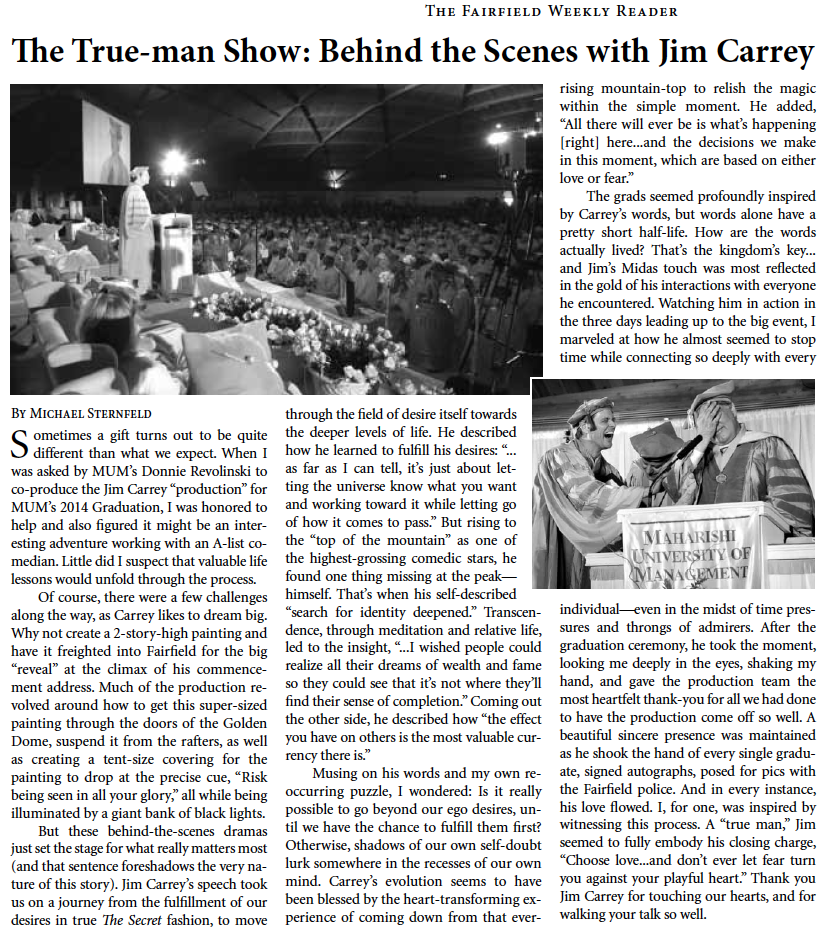
Sunday’s Hawk Eye cover story on Jim Carrey delivering the commencement address at Maharishi University in Fairfield was written by Bob Saar. He captured the joyful mood of Carrey’s wit and wisdom as he delivered a funny yet deeply powerful message of insight and encouragement to the graduates. Dr. Carrey (he received a doctorate in Fine Arts) touched the hearts and minds of the over 1000 people there in the dome with his understanding, humility and humor. Brilliant! To read this article, just click on it once, and then again after it opens larger. Other articles are available below as well. Other Iowa media that reported on the MUM 2014 Graduation with Jim Carrey are: The Des Moines Register, Jim Carrey mixes laughs with advice at Iowa college graduation; The Gazette/KCRG, Jim Carrey wise beyond his wise guy ways, which is another excellent article, but with a slideshow and voice-over; The Fairfield Ledger: Carrey infuses graduation speech with humor; The Iowa Source article with photos and quotes: Jim Carrey Gives Heartfelt, Laugh-Filled Commencement Speech; and The Fairfield Weekly Reader for a personal glimpse from Michael Sternfeld of what it was like to see Jim Carrey work with the MUM and DLF crew to get his presentation in place: The True-man Show: Behind the Scenes with Jim Carrey.
Michael Sternfeld later had a longer version of this article published as a cover story in Australia’s largest holistic magazine, Living Now, on pages 12+13, with a mention by the editor in the middle of page 3: http://bit.ly/1rmUTXE.
ITN Factual, a production company based in London, UK, was commissioned by A&E, Arts and Entertainment channels, to do a film biography on Maharishi Mahesh Yogi. Producer/Director Fiona Procter came to Fairfield, Iowa in October 2007 and the show was aired on the History International Channel on Nov 28, 2007. Interviews included Drs. Bevan Morris and John Hagelin, David Lynch, Donovan, Mike Love, Teresa Olson, Jerry Jarvis, Alan Waite, Deepak…
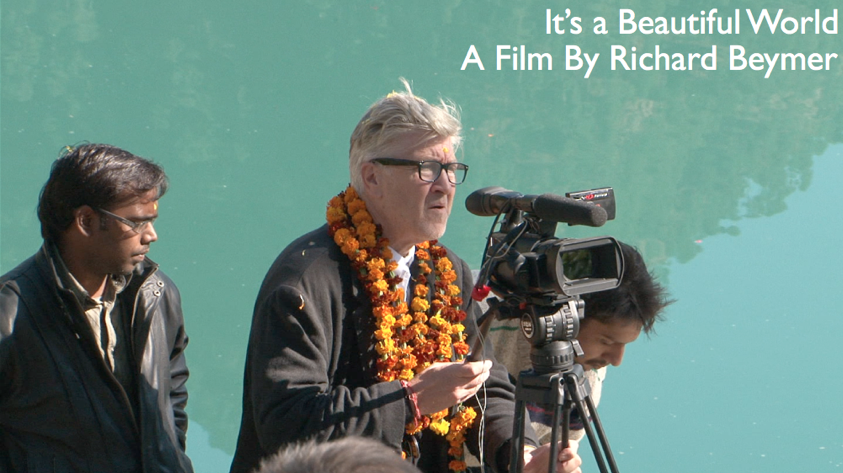
It’s a Beautiful World, is a film made by Richard Beymer as he accompanied David Lynch with Bob Roth and a film crew to India. David went from northern India to the south retracing his master Maharishi Mahesh Yogi’s footsteps for a documentary film he was going to make. Richard records the early stages of the making of that film on Maharishi.
David first visits Jyotir Math where Maharishi served his teacher Guru Dev for 13 years. After his passing, Maharishi went into silence for 2 years in a small cave-like room in a house in Uttar Kashi, the Valley of the Saints. David takes us right into that cave! A persistent thought brought Maharishi out to travel to a famous temple in Rameshwaram. From there he continued on to the great Temple to Mother Divine in Kanyakumari located at the southern-most tip of India where the 3 oceans meet. Along his return journey northwards a man from the Trivandrum Public Library asked Maharishi to speak. The film takes us to those sites and into that library where Maharishi gave his first series of 7 lectures. People had asked to learn what he was teaching, and that was the start of the TM movement. What had taken Maharishi two years, David covered in 10 inspiring eventful-packed days.
About a year or so before David made his trek to India, he also had the opportunity to visit with Maharishi in Vlodrop, Holland at his International Headquarters. A special interview was arranged and David was able to ask Maharishi some questions. It had been recorded, possibly for David to use in his documentary. I mentioned that interview to Richard and he checked with David for permission to use some of it. David directed Richard to use specific segments of an answer Maharishi gave him to a particular question. The film ends with it, coming full circle, of Maharishi explaining why he came out of the Silence of the Himalayas to bring his message to the world. He told David he thought what he had to offer would be useful to humanity. He said that the nature of life is bliss, and the nature of the individual is cosmic. And all those years of teaching TM had borne that out, later verified by hundreds of scientific research studies on the range of benefits in people’s lives, and the development of higher states of consciousness.
This film is also a rare glimpse into David’s personal life. Throughout the journey David reveals snippets of his film career. It’s an intimate look at David Lynch the man, the director in action, the devoted meditator, and his inspiration to share the gift of Transcendental Meditation with the world through his Foundation. Watch this skillfully edited trailer, then visit the website to order the film to stream or download.
Thanks to John Burns for sending me this truly wonderful birthday poem! With reference to I turned 70 today!
The Truly Great by Stephen Spender
I think continually of those who were truly great.
Who, from the womb, remembered the soul’s history
Through corridors of light, where the hours are suns,
Endless and singing. Whose lovely ambition
Was that their lips, still touched with fire,
Should tell of the Spirit, clothed from head to foot in song.
And who hoarded from the Spring branches
The desires falling across their bodies like blossoms.
What is precious, is never to forget
The essential delight of the blood drawn from ageless springs
Breaking through rocks in worlds before our earth.
Never to deny its pleasure in the morning simple light
Nor its grave evening demand for love.
Never to allow gradually the traffic to smother
With noise and fog, the flowering of the spirit.
Near the snow, near the sun, in the highest fields,
See how these names are fêted by the waving grass
And by the streamers of white cloud
And whispers of wind in the listening sky.
The names of those who in their lives fought for life,
Who wore at their hearts the fire’s centre.
Born of the sun, they travelled a short while toward the sun
And left the vivid air signed with their honour.
Hafiz’s poem, translated by Daniel Ladinsky, of leaving something behind in the world to inspire others, is exemplified in the singer-songwriting musical skills of the late Jesse Winchester. Read Hafiz’s poem, Leave something in the marketplace, then listen and be moved when Jesse sings this love song, Sham-A-Ling-Dong-Ding.
Leave something in the marketplace
Sometimes it can happen to these cheeks when a poem visits my mind for the first time and begins to look around.
They can wonder why rain is falling on them, and causing my nose to run too.
O boy, what a mess love makes of me. But there is nothing else right now I would rather
be doing . . . than reaping something from a field in another dimension
and leaving it in the marketplace for any who might happen by.
Leave something in the marketplace for us before you leave this world.
Singer-songwriter Jesse Winchester (May 17, 1944 – April 11, 2014) left many beautiful songs for us in the marketplace (IMDb). Jesse appeared on Week 2 of Elvis Costello’s TV show, Spectacle. Elvis Costello, Ron Sexsmith, Sheryl Crow, and Neko Case joined Jesse Winchester to perform “Payday“. Jesse also a sang about the sweet shyness of young love. Listen to the poetic melodic musings of Sham-A-Ling-Dong-Dingas it wets your cheeks and lifts your mouth into a wistful smile.
I first met Jesse in Montreal at a friend’s place during the summer of ’67. He had been drafted to fight in the Vietnam War, which he did not support, and came to Canada instead. He stayed and made a name for himself as a fine singer-songwriter.
Robbie Robertson of The Band produced Jesse’s first album. But he couldn’t return to the states to tour until after all “draft dodgers” were pardoned by President Carter. I remember him singing The Brand New Tennesse Waltz and Yankee Lady, which ended up on his self-titled debut album. I also liked Say What (Talk Memphis), which became a hit. Mississippi You’re On My Mind (Learn to Love It) is another beautiful, vividly-written song.
Many top recording artists would go on to perform Jesse’s songs, and he became known as a first-rate songwriter. Even Bob Dylan was famously quoted as saying of Mr. Winchester: “You can’t talk about the best songwriters and not include him. If you know me well, you know I think Jesse IS the very best.” Lyle Lovett also spoke highly of him. In 2007, a special musical tribute was given to singer-songwriter Jesse Winchester, when he was honored with The ASCAP Foundation Life in Music Award.
You can’t talk about the best songwriters and not include him. If you know me well, you know I think Jesse IS the very best. — Bob Dylan
Decades later, I went to one of Jesse’s concerts on his tour through Iowa. He was surprised to find me here. It was sweet to see him again, now free to play in the states and accept the recognition for his great talent.
Remembering Jesse Winchester
Here is some news coverage of Jesse’s recent passing, reviewing his life and career, in The Commercial Appeal, USA Today, Rolling Stone, The New York Times, and C-Ville Weekly. From all his fans, and friends who knew him, I’m sure they would agree with Hafiz that Jesse Winchester did leave a lot of good music in the marketplace, and love in their hearts. You did well, Jesse. We thank you!
Jesse Winchester Radio Special: Listen to a special 2007 radio interview and music special with Jesse Winchester recorded by Donna Green-Townsend for WUFT-FM before Jesse’s scheduled performance at the Butterfly Festival in Gainesville, FL. In this program Jesse talked about his early years in Mississippi and Memphis, the inspiration for many of his songs and what he thinks about the music industry today. He also talks about the number of artists who have recorded many of his songs including The Everly Brothers, Waylon Jennings, Wynonna Judd, Bonnie Raitt, Emmylou Harris, Reba McEntire, and Elvis Costello to name a few. RIP Jesse.
Roots Music Canada uploaded a Jesse Winchester interview on April 13, 2010 with RMC’s editor-in-chief David Newland, from Hugh’s Room, Toronto, a venue Jesse launched about a decade ago, and one for which he has the highest regard.
September 2, 2014: Rolling Stone: Hear the Late Jesse Winchester’s Chilling Dissertation on Dying — Song Premiere. “Every Day I Get the Blues” appears on the final album by Winchester, who died April 11th. A Reasonable Amount of Trouble, is a gentle collection of playful songs about love, memory and gratitude that amounts to one of the most moving, triumphant albums of Winchester’s 45-year career.
Previous inductees include: Elvis Presley, Jerry Lee Lewis, Johnny Cash, Otis Redding, B.B. King, Isaac Hayes, Al Green, Howlin’ Wolf, Sam Phillips, Bobby ‘Blue’ Bland, Albert King, Rufus Thomas, Willie Mitchell, Carla Thomas, Booker T & The MGs, The Staple Singers, and the ‘Father of The Blues’ W.C. Handy.



 The Uncarved Blog