Grief persists after the loss of a close friend, but so does love. In time, grief recedes and love predominates. Here is a haiku for my sweetheart: Still Sali. I see that ‘still’ has both meanings: continuing and stillness.
During difficult times, and Sali’s final days, we were helped by the kind staff from Hospice Compassus. After Sali passed, they continued to offer me support with their bereavement program throughout the year. On the one-year anniversary of her death they sent me a letter and a brochure, Journey Through Grief: Looking back at your first year. They encourage “Grief journaling and all forms of writing as an important and helpful tool for healing.” They offered helping prompts to those grieving to get started with these two Reflective Questions.
As you look back at the past twelve months:
1. When thinking about the life of the person that you’ve lost to death, what — of themselves — have they given you to help you move through the rest of your life?
2. During your walk through grief, what have you learned about yourself that will assist you in moving forward?
I had been writing in a journal all along, and posted some entries and many poems. After reading these questions I was moved to write a haiku, then extended it to this tanka. I will give more thought to these questions and write something later, but wanted to post this tonight to mark the one-year anniversary of Sali’s passing.
Tanka for Sali A remembrance of you and your gift to me
What you did for me
Was draw Love out of my heart
And into our lives
It completely transformed me
To become a better man
This entry, 9 months after her passing, reviews our relationship and what it meant: For Us—a tanka honoring Sali and what we shared. I also updated the entry Celebrating the Glorious Life of Sally Monroe Peden, which contains newer descriptions about Sali by friends who spoke at her Memorial Service. There are many beautiful tributes there, and now, halfway down, you’ll see today’s date, October 1, 2017, with new entries from David and Rhoda Orme-Johnson, Kate Ross, and later Rannie Boes.
True to the end, Leonard Cohen‘s work charted the arc of his career, between life and death (Sept 21, 1934 – Nov 7, 2016). His search for redemption also influenced his fans. Cohen’s evolving understanding of life, beautifully expressed through his music, shone a light through the cracks of a broken humanity in a dark suffering world. He never claimed to have found all the answers, but seemed to have reached a kind of inner peace toward the end of his life, between himself and his God.
There is a repeated stanza in one of his songs, Anthem, that conveys the redeeming acceptance of light illuminating the darkness, compassion and love overcoming bigotry and hatred: “Ring the bells that still can ring/ Forget your perfect offering/ There is a crack in everything/ That’s how the light gets in.”
There may be a crack in everything, but how does the light get in—from without, or is it released from within? I’ve often thought about the profundity of those lines, and there have been many interpretations of what he may be implying. See mine below.* I think he sang about finding that divinity within and among our broken humanity. I wrote this tanka in honor of Leonard Cohen.
Leonard Cohen’s music lit up a dark world A tanka in honor of the poet by Ken Chawkin
Leonard Cohen said There’s a crack in everything How the light gets in
It came through him and lit up a broken humanity
Of course there is a kind of irony here when he says, “Forget your perfect offerings,” since he labored for months, sometimes years, on getting the lyrics to his songs perfect. At some point, though, he must’ve given up, admitted his imperfection, and sent them out into the world. As Leonardo da Vinci once said: Art is never finished, only abandoned. Other famous artists and writers have said and done the same thing.
Artistic Genius—Two Creative Approaches
There is a story about Leonard Cohen and Bob Dylan. They happened to be in Paris at the same time and decided to meet at a certain café. During their conversation, Dylan, one of the first to sing Cohen’s song “Hallelujah” in his concerts, asked Cohen how long it took him to write it. Cohen was embarrassed to tell him the truth so he lied and said 2 years. Then Leonard asked Bob how long it took him to write “I And I“, and he replied 15 minutes. I think he said he wrote it in the back of a cab. Cohen later told this story to an interviewer and confessed that it took him more like 5 years to write that song. He never could complete it, even after 30 verses! Their styles reflect thedifferent philosophical approaches of ‘first thought, best thought’ versus ‘revise, revise, revise’.
You can read the fascinating history of that song in Alan Light’s book, The Holy or the Broken: Leonard Cohen, Jeff Buckley, and the Unlikely Ascent of “Hallelujah”. Malcolm Gladwell, in Season 1, Episode 7 of his Revisionist History podcast, discusses the history of “Hallelujah”with Alan Light. That segment starts at 21:35 and explains how this obscure song was first covered by only a few artists 15 years after Cohen had recorded it. The theme is about two kinds of artists—those who seem to create spontaneously, and others who labor for a very long time—the differences between Mozart and Beethoven, or Picasso and Cezanne. It first aired July 28, 2016. Later added on YouTube March 8, 2023 starting at 18:13. Also listen to BBC – SOUNDS – Soul Music – Series 20 – Hallelujah. First broadcast on BBC Radio 4 in April 14, 2015. (27:50)
During Leonard Cohen’s final public appearance at the Canadian consulate in Los Angeles on October 13, 2016, the day Bob Dylan was awarded the Nobel Prize in Literature, he was asked what he thought about that and said: “To me, it’s like pinning a medal on Mount Everest for being the highest mountain.”
Hallelujah: Leonard Cohen, a Journey, a Song
I later read the Guardian article (6-29-2022) that this book served as the basis for the new documentary Hallelujah: Leonard Cohen, A Journey, A Song. Directed and produced by Dayna Goldfine and Dan Geller, the film takes both a micro and macro view of the song and Cohen, along with their respective and deeply intertwined places in culture. See ‘More than a song’: the enduring power of Leonard Cohen’s Hallelujah. In a new documentary, fans and experts explore the legacy of a song originally shunned before becoming a timeless classic.
I saw this documentary at the FilmScene in Iowa City (Saturday, August 6, 2022). It was very well put together. The ending moved me to tears. Netflix later offered it: Hallelujah: Leonard Cohen, A Journey, A Song. From there it would later move to Hulu and Disney+. You can rent it on Amazon and other platforms.
Murals mark 1-year anniversary of Leonard Cohen’s death
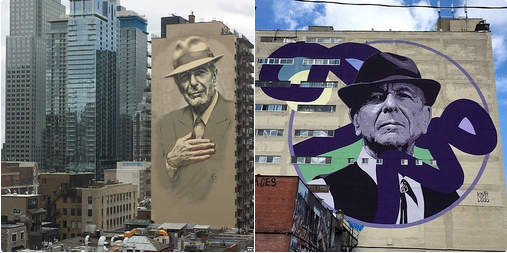
Montreal murals made by Gene Pendon (l) and Kevin Ledo (r)
November 7, 2017 is the 1-year anniversary of Leonard Cohen’s death. To personally commemorate this date, Sylvie Simmons tweeted a picture of herself standing in front of a large mural of Leonard Cohen painted by Kevin Ledo on the side of a 9-storey Montreal building close to where Leonard kept a home. It was the center piece for the fifth Mural International Public Art Festival in June. CBC Arts interviewed Kevin Ledo while he was working on it: Montreal Remembers Leonard Cohen With This Massive Mural. The Montreal Gazette’s Bill Brownstein had written an article about the making of it. He also mentions another mural, a tribute to Leonard Cohen made by artist Gene Pendon, which was painted on the side of a 20-storey downtown building, as part of Montreal’s 375th billion dollar birthday bash. The Globe and Mail described them in detail: Leonard Cohen and a tale of two Montreal murals. ET Canada reported on the official inauguration today, a year after Cohen’s passing. Josée Cloutier posted photos of both murals in one tweet, shown above.
The M.A.C.’s Exhibition on Leonard Cohen: A Crack in Everything
The Guardian published Leonard Cohen: A Crack in Everything – Montreal’s tribute to its favourite son. The new exhibition was conceived as part of the city’s 375th anniversary celebrations – but has morphed into a thorough investigation of all things Cohen. On 9 November, the Musée d’art contemporain de Montréal (AKA the Mac) will open the doors to Leonard Cohen : une brèche en toute chose/A Crack in Everything, a tribute to the artist, poet and musician, filled with multi-disciplinary works inspired by Cohen’s songs of life. This special exhibition at the Montreal Museum of Contemporary Art will conclude 9 April 2018.
The show takes its title from Cohen’s song Anthem, which contains the famous line “There is a crack in everything, that’s how the light gets in.” The song also inspired artist Kara Blake’s piece for the show, an immersive installation called The Offerings. “The song apparently took Cohen 10 years to craft and is just one example of his many artistic offerings that get inside the beautifully flawed nature of being human,” says Blake. “I wanted my piece to present visitors with a sampling of the creativity, wit and insight Cohen has gifted us with.”
Julia Holter contributed a cover of Cohen’s Take This Waltz, which will play on rotation in the Listening Room. “I enjoyed getting into the feeling of this passionate, seductive, demented waltz,” says Holter, who incorporated field recordings she made during a visit to the Greek island of Hydra, where Cohen had a home. “Being there was incredible,” she says.
For Holter, being invited to contribute to the show is the perfect way for her to give back to an artist she was introduced to as a child and who inspired her love of poetry. “What was special about Leonard Cohen’s work was its calm mystery. I think that can be an inspiration to the world right now,” she says. “The world needs this subtle beauty right now.”
And of course, who could ever forget Suzanne, Leonard’s mysterious poetic song that started it all, thanks to Judy Collins who wanted to cover it right after she heard Leonard sing it to her. It launched his career as a singer-songwriter. The song was inspired by Suzanne Verdal, the then estranged wife of his friend, sculptor Armand Vaillancourt. Read Suzanne’s 1998 BBC Radio 4 interview.
I enjoyed reading Sylvie’s wonderful biography, I’m Your Man: The Life of Leonard Cohen. It will be published next year in a new French edition with an added afterword that will be included in a revised English edition by McClelland & Stewart.
The afterword is Cohen’s response to the question about what was the driving force that propelled his output. Simmons calls it Traveling Light, and quotes Cohen’s answer in this interview for The Senior Times: Biographer Sylvie Simmons pays tribute to Montreal’s favourite son.
Leonard Cohen was very active towards the end of his life. Due to his declining health he tried to bring as many projects to completion as possible. One of them was his last album, You Want It Darker, produced by his son Adam Cohen. A new poetry book, The Flame, will be released next year.
The Flame: Poems Notebooks Lyrics Drawings
On Oct 1, 2018 CBC q host Tom Power interviewed Adam Cohen on the legacy of his father Leonard Cohen. It’s been almost two years since the passing of Leonard Cohen, but we’re about to hear from the legendary singer and poet again. The Flame is a posthumous collection of his final writing that features never before published poems that Leonard Cohen wrote in the final few years of his life. The day before it’s release, Adam Cohen returns to q to talk about mourning his father’s life and and celebrating his legacy on the morning of the book’s release.
*My reply to Quora question about the crack and the light
I agree with a number of interpretations posted here, quoting William Blake, the Kabbalah, and other esoteric sources, to explain what Leonard Cohen may be referring to in that line. They all make good sense to me. I also think that the light, of clarity, understanding, call it what you will, comes from within, not without. Metaphorically we may imagine light coming into a dark broken place from outside. But it can also light up the darkness from inside, if one knows how to turn on the switch. Another interpretation then, is no matter how broken, incomplete we are, with the proper approach, meditation technique, one can transcend, go beyond our limitations and just Be, experience that unbroken inner light of pure consciousness. With repeated exposures to one’s inner divine nature, the outer vessel, our body, can begin to heal, mend the broken cracks, and become whole. One way to experience this inner and outer development is with the regular practice of Transcendental Meditation.
New information on this topic later found and added
I recently discovered a quote by Rumi, which led me to believe this is where Leonard may have received the idea of the light entering the crack. Rumi wrote: “The wound is the place where the Light enters you.”
In the documentary, Andrea Bocelli – The Power of Silence, the interviewer quotes Rumi to Andrea. Here, ‘wound’ replaces ‘crack’, and he changes ‘you’ to ‘the heart’, but the idea is the same. It seems more intimate. “The wound is the place where the Light enters the heart.” They discuss the notion of the value of suffering and he asks him, “When did the light enter your heart? When did that light strike Andrea?”
Andrea gives him an unexpected, beautiful, religious answer. “So the vision of Rumi the philosopher that you quoted is very interesting and I agree with what he says. In my case I didn’t think it was a wound, not such a painful wound that opened up and allowed the light to enter. No, I think the light entered my heart thanks to the grace of God.”
He asks him, “Are you happy?” and Bocelli replies, “I am happy, yes, but more importantly, I am serene. To me happiness is a transitory condition and it can sometimes be a bit dangerous; whereas being serene is a state of mind that can be consolidated and it can stay with us forever.”
In 1991 media mogul Moses Znaimer inducted Leonard Cohen into the Canadian Music Hall of Fame at The JUNO Awards in Vancouver. Leonard gave a brilliant and humorous acceptance speech.
k.d. lang agreed to pay tribute to the legendary singer-songwriter with a rendition of his beloved song, “Hallelujah.” She had never performed the song for Cohen and “was excruciatingly nervous” knowing he would be in the audience. She received a standing ovation, and as the credits began to roll, she ran down the stage steps towards Leonard to offer him her reverence and appreciation. He rose to meet her and they warmly, respectfully embraced. Cohen’s partner, singer Anjani Thomas, looked at Cohen and said, “Well, I think we can lay that song to rest now! It’s really been done to its ultimate blissful state of perfection.” He agreed. A few years later, in a CBC interview, Cohen recalled that performance and said, “that really touched me.” He was asked about the history of that song, and said, “the only person who seemed to recognize the song was Dylan.” During her world tour in 2008, lang gave a beautiful performance of the song backed by the BBC Concert Orchestra in a concert filmed at St. Luke’s Church in London. And two years later, lang sang Leonard Cohen’s “Hallelujah” at the Vancouver 2010 Olympics Opening Ceremony. It was spectacular!
Leonard Cohen on Q TV (CBC exclusive). To celebrate Q’s 2nd anniversary — poet, novelist, songwriter, legend…a special exclusive feature interview with Leonard Cohen… recorded at his home in Montreal. Posted Apr 15, 2009.
Listen to CBC Radio’s As It Happens interview Marianne’s close friend, filmmaker Jan Christian Mollestad, the week she died: So long, Marianne. Leonard Cohen’s final letter to his muse. At Marianne’s request, Jan had conveyed a message to Leonard that she was dying. He wrote back to her, the subject of the interview. There is also a link to Leonard Cohen’s Facebook page with Jan’s reply to Leonard, saying his letter to Marianne gave her deep peace of mind, and described her peaceful passing to him.
Jan Christian Mollestad was one of the executive producers on the film. He had posted a video celebrating Marianne’s 80th birthday that previous year on Hydra, including Adam Cohen singing “So long, Marianne” in Oslo, and Marianne and Judy Collins enjoying singing “Famous Blue Raincoat” together.
Listen to the beautiful soundtrack by Nick Laird-Clowes: Marianne & Leonard: Words of Love (Original Score) https://lnk.to/WordsOfLove. Where you can watch the movie.
Leonard and Marianne: A portrait of Leonard Cohen and Marianne Ihlen, the woman who inspired Cohen’s song ‘So Long, Marianne’. Based on Kari Hesthamar’s NRK award-winning documentary ‘So Long, Marianne’. Falling Tree Productions made this 27:33 minute piece. Produced by Alan Hall, it was first broadcast August 2, 2008 on BBC Radio 4. Leonard Cohen’s muse when he turned from poetry to song-writing was a beautiful Norwegian woman immortalised in the song So Long, Marianne—this is their story. Listen to in on SoundCloud. It won Best Feature Bronze Award at the Sony Radio Academy Awards (2009).
November 22, 2019 brings the release of the first posthumous Leonard Cohen album, Thanks For the Dance. For the nine-track LP, Cohen’s son, Adam, took leftover sketches and poems from his father’s 2016 LP, You Want it Darker, and fleshed them out with the assistance of Beck, Damien Rice, The National’s Bryce Dessner, and others. Following last month’s teaser track, “The Goal”, “Happens to the Heart” has now been released as the album’s first official single.
July 7, 2022, Directors Dan Geller and Dayna Goldfine, and head of the Cohen estate/Executive Producer Robert Kory discuss HALLELUJAH: Leonard Cohen, A Journey, A Song at the Rock & Roll Hall of Fame. This was the first RRHF screening and discussion since the covid pandemic had shut them down for a year. See the 42-minute video.
Speaking of The Coming of Wisdom in Time, as William Butler Yeats put it, Leonard Cohen came to a similar realization when he said: “The older I get, the surer I am that I’m not running the show.”
I later found this video posted on YouTube by AirGigs on Jan 18, 2022: 10 Pearls Of Wisdom From Leonard Cohen. In this episode we look at his thoughts on success, writing, talent and much more.
Apr 9, 2024, Contra Costa JCC presented, Leonard Cohen: Untold Stories. Award-winning writer, playwright, journalist, and author of seven books, Michael Posner, joined the Under One Tent audience online on Tuesday, April 9, 2024. He introduced the third volume of his book, “Leonard Cohen: Untold Stories,” a must-read for fans of Leonard Cohen.
I discovered jazz in high school and soon became aware of Bill Evans. An accomplished musician educated in classical music, he chose to become a jazz pianist instead, and took elements of those influences to create his own unique style.
As a young man, Evans went on to compose and perform modal music with Miles Davis. Miles praised Bill’s contribution in the groundbreaking Kind of Blue LP released in the summer of 1959 by Columbia Records, often considered the best-selling jazz album of all time. Evans later left Davis to play solo, and form his own jazz trios. Bill Evans became one of the true jazz legends of our time.*
In this intimate 1970 interview and concert at the rural home of Finnish host Ilkka Kuusisto, a very wealthy and very highly regarded classical musician, with jazz musicians in the family, Evans was asked if his group practiced. He explained that “the trio has never rehearsed. … All the things that we play have grown out of performance.” They shared “a natural development through common desire to make it more musical all the time as much as we can.” It was “freedom with responsibility…to the total performance.”
In his solo work, Bill Evans’s Peace Piece is musical onomatopoeia. The calming repetitive left hand chords juxtaposed with the right hand animated notes evoke fluttering doves of peace calling to each other. Pure genius! It reminds me of the French impressionistic sounds of Erik Satie, Claude Debussy, and Ravel, but this is distinctly his own music.
“Peace Piece” was an unrehearsed modal composition he recorded December 15, 1958 for his Everybody Digs Bill Evans LP released in early 1959 on the Riverside label (Riverside RLP 1129). It’s been hailed as one of the most beautiful and evocative solo piano improvisations ever recorded. I totally agree. One of the most beautiful jazz recordings I’ve ever heard. A peaceful masterpiece. A masterpiece of peace!
In this 1966 documentary, Bill Evans talks with his composer brother Harry about the creative process and self-teaching. Evans spoke of a Universal Mind. “I believe that all people are in possession of what might be called a universal musical mind. Any true music speaks with this universal mind, to the universal mind in all people. The understanding that results will vary only in so far as people have or have not been conditioned to the various styles of music in which the universal mind speaks. …”
Click SHOW MORE under that video to read the rest of the transcription. Evans also analyzes the melody and harmonics of Star Eyes, and performs other pieces, in between musical discussions with his brother.
Bill Evans (August 16, 1929–September 15, 1980) was one of the most famous jazz pianists of the twentieth century. Along with McCoy Tyner and Oscar Peterson, he was the force behind the biggest evolution in jazz since Art Tatum and Bud Powell.
Evans won seven Grammys during his career, the first for Conversations With Myself (1963), [which I had bought back then] although not for his most celebrated work, Sunday At The Village Vanguard (1961) with bassist Scott LaFaro and drummer Paul Motian.
His use of impressionistic harmony, his inventive interpretation of traditional jazz repertoire, and his syncopated and polyrhythmic melodic lines influenced a generation of pianists, including Herbie Hancock, Denny Zeitlin, Chick Corea, and Keith Jarrett, and his work continues to inspire younger pianists such as Fred Hersch, Bill Charlap, and Lyle Mays, as well as other musicians such as guitarist John McLaughlin.
In 1994, Bill Evans was posthumously awarded a “Lifetime Achievement Award” by the National Academy of Recording Arts and Sciences (NARAS) “for altering the course of jazz piano with his lyrical, impressionistic solo and trio recordings, characterised by the understated intensity, distinctive chord voicings, and unique harmonic sensibility that opened up the vocabulary of modern jazz.”
Taken from the notes to the video: Bill Evans was often asked to perform “Peace Piece” in later years after the 1959 recording, but he usually resisted, claiming that it had been the inspiration of the moment, and not something that could be recreated, he considered it as a one-time thing. Only on this occasion in 1978 he performed “Peace Piece” with the Bill Evans Dance Company in Seattle. This Peace Piece, extracted from the video, recorded in 1978, is probably the only recorded performance after “Everybody Digs Bill Evans” from 1959. Peace Piece is a “practiced improvisation” and you can hear how Bill adapts his playing to the choreography of the dancers compared to his 1959 solo performance.
Emanuil Ivanov covers Bill Evans Peace Piece 2022
Emanuil Ivanov performed Bill Evans – Peace Piece beautifully at Bulgaria Hall, Sofia on October 3, 2022 as a Prayer for Peace. It is the closest to the original. Ivanov’s playing is very refined and delicate, capturing the peaceful feeling perfectly.
September 24, 2025, Daniel Anastasio posted on Instagram how Bill Evans came to write Peace Piece. He said he came into the studio to record Leonard Bernstein’s Some Other Time from his musical On The Town. But he never got past the opening bars because they turned into this: and he starts playing Bill’s improvisation. He gives a commentary about playing in the moment and not trying to be perfect. I posted a comment on his reference to the left hand playing like a non-wavering mantra while the right hand improvises, suggesting another metaphor, like a metronome, explaining the proper use of a mantra in meditation. Another reminded him that the right hand evolves a melody based on bird calls! True genius. I agreed and said: Exactly! That’s why I call this Peace Piece musical onomatopoeia.
— Written and compiled (citing sources) by Ken Chawkin for The Uncarved Blog.
Written eleven months after she had passed, I would later record this and two earlier love poems for Sali (COMMITTED and This Quiet Love) for a 2019 Valentine’s Day program on KHOE, MIU’s campus radio station. Click here to read and listen to them.
On August 6, 2025 Bob Roth, CEO of the David Lynch Foundation, completed the morning Zoom world group meditation at 30:40 with this introduction: “This is a beautiful poem by Kenny Chawkin called, In Our Loving Eyes, about the late love of his life.” He then read the poem, twice, and quietly concluded, “Beautiful….” It was emotional for both of us, as he later confirmed in a phone call two minutes after I had emailed to thank him. Sali’s loving memory still lives deep within our hearts.
— Written and compiled (citing sources) by Ken Chawkin for The Uncarved Blog.
Good poetry begins with
the lightest touch,
a breeze arriving from nowhere,
a whispered healing arrival,
a word in your ear,
a settling into things,
then, like a hand in the dark,
it arrests the whole body,
steeling you for revelation.
In the silence that follows
a great line,
you can feel Lazarus,
deep inside
even the laziest, most deathly afraid
part of you,
lift up his hands
and walk toward the light.
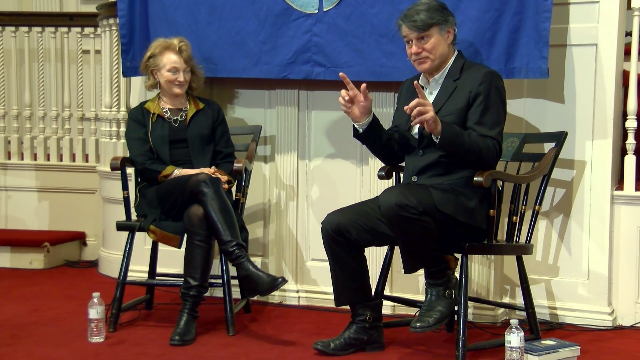
In a similar vein, before New York poet laureate Marie Howe read “Annunciation” to Krista Tippett On Being, she described how, after tearing up several versions, she gave up, and then, it just came through her. This revelatory description of mystical conception, in Mary’s words, parallels that of poetic creation, in Marie’s words.
My first published poem, ODE TO THE ARTIST: Sketching Lotus Pads at Round Prairie Park, was a similar experience. After several attempts at writing a poem about the lotus pads in front of us, I got out of my self and wondered about their perspective. Much to my surprise the poem quickly wrote itself. Other parts of poems would present themselves while Being in Nature, which I would later complete.
This process of getting out of the way and allowing poetry to innocently come through you was expressed by my son after his class was assigned to write a poem for homework. He felt strongly that you couldn’t will a poem into existence; it had to be inspired. He was barely eleven years old when he wrote INSPIRATION, a poem by Nathanael Chawkin.
When I was going through a difficult time with Sali’s illness getting worse, Carol Palma and her husband Greg came to visit us. Carol later sent me a lovely little poem as a gift to help me cope. Previously written for a friend, it was profound and went deep! In a way, what was expressed in the poem would prepare me for the inevitable. And to understand that it was not the end. It was all about letting go, in more ways than one. And the repeated end-rhyme gently reinforced the point.
I’m in a place where there is no night
We experience each other with divine sight
I wear a robe of shimmering light
With golden threads that hug me tight
I cling to you with all my might
Tethered to earth like string to kite
You let me go and I take flight
I always wanted to share this perfect poem with friends. I bumped into Carol at the Dome Market last night and she approved my posting it.
Norman and I get into my car parked across the street from Thai Deli where we just had lunch. It’s hot so we wait for the AC to kick in and cool down. He points out the beautiful petunias on the sidewalk in front of us. They’re purple, planted in pots, and placed on both sides of a doorway. Playing with the ‘p’ sound, I come up with a line that has seven syllables in it. I’m reminded of The Red Wheelbarrow by William Carlos Williams and think of a similar opening. Noticing the backdrop, I finish the last line of the haiku. Coincidentally, I later discover it has the same word ‘white’ in it. I return the next day to take this photo to go with it.
Potted Purple Petunias Poem Haiku in Homage to William Carlos Williams
there’s something about
potted purple petunias
by a white brick wall
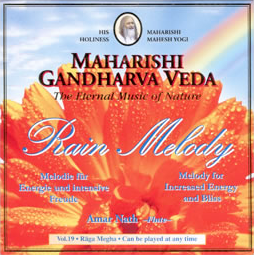
Feeling too hot? Experiencing a drought? Listen to this beautiful Maharishi Gandharva Veda musical performance of Raga Megha, also known as the famous Rain Raga. It creates a soothing cooling influence on listeners and in Nature. It can be played at any time for increased energy and bliss. This Rain Melody reduces tensions in the atmosphere and is traditionally played during the hot summer season to bring rain and relief from heat. We can use some of that, which is why I’m posting it for us to play!
Musicians are Amar Nath on bansuri (bamboo flute), Somnath Mukergee on tabla (percussion), and Sukhamar Chandra on tambura (drone). This 45-minute CD, is available at MIU Press. Listen to this raga on repeat from your own device. Also posted on SoundCloud. Video by Frank Lotz.
TM.org posted this article, Maharishi Gandharva Veda Rain Melody, Restoring Greater Balance in Nature, which explains its purpose and soft power. Embedded are two videos—the 45-minute video, and one on a continuous loop. They were made available to help bring relief to those areas affected by the recent severe droughts and related fires. Play the Maharishi Gandharva Veda Rain Raga to help enliven the evolutionary power of nature and create a wave of harmony in your area.
On July 26, 2017, I took Norman Zierold to the Bonaparte Retreat Restaurant in Bonaparte, Iowa to celebrate his 90th birthday. It’s located about 29 miles south of Fairfield in the historic Villages of Van Buren. He told me he enjoyed eating at this restaurant from time to time as it reminded him of his earlier years growing up in the Amana Colonies. I was also curious to see it so we went.
Housed in the historic 1879 old Meek Grist Mill building, Ben and Rose Hendricks had opened the restaurant in 1970. Before the Industrial Revolution, farmers from miles around used to haul their grains there to be milled into flour. The Gazette published an article with 19 wonderful photos (Feb 15, 2015): Iowa All Over: Time stands still in Bonaparte.
The restaurant serves traditional Iowa food, and the staff are very personable. Word got around that Norman was celebrating his 90th, and they came over, one by one, to wish him a happy birthday.
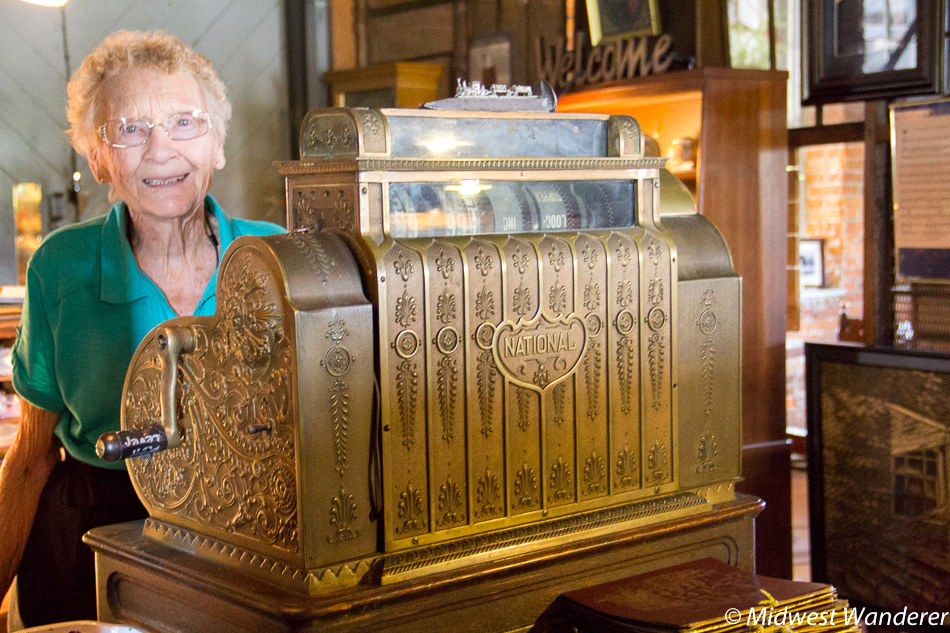
One of them was Marie Hainline, a friendly 94-year old woman with the most wonderful smile and twinkle in her eyes. She used to run her own nursing home, which was a challenge. She retired and has been working as a waitress at the restaurant for over 30 years. She’s happy and looks healthy. Marie raised 4 children, has 11 grandchildren, many great grandchildren, and 2 one-year old great-great-grandchildren—twins!
After paying our bill, Marie showed me an article about her published almost 7 years ago in the Hancock County Journal-Pilot in Carthage, IL. I found it on the internet and wanted to share it with you. It’s a delightful description of Marie and her impressive work ethic. She is an inspiration!
Recently my sisters and I took a road trip. Although we talk pretty much every day, we seldom get to spend much time actually hanging out together. As we started the day, we decided our destination would be the villages of Van Buren County in Iowa.

 Feeling too hot? Experiencing a drought? Listen to this beautiful Maharishi Gandharva Veda musical performance of Raga Megha, also known as the famous Rain Raga. It creates a soothing cooling influence on listeners and in Nature. It can be played at any time for increased energy and bliss. This
 The Uncarved Blog