Enjoy this profound blog post by Deborah J. Brasket: Like Flowers Falling Everywhere: A Poem. Click on the title to see an accompanying painting by Odilon Redon. This beautiful little poem, aptly titled “Morning Prayer,” is soft and mysterious, filled with an intimate silence that just might leave you feeling sanctified.
“Morning Prayer” Deborah J. Brasket
Everywhere I look I see you, I see us. This fragile hand, this blue pen, this yellow pad.
These fingers gently folded, Embracing the eagerness of your movements across the page.
This tender paper accepting All we write. These words that rise up and lay down, so simple.
You are what I feel. This beating heart, this circling breath, this wide sphere of silence that enfolds us. Your soft sigh.
The day waits. It pours out of us whole and clear, unending. How kind you are. Kindness like flowers falling everywhere.
* * * * *
I asked a writer-artist friend who she thought is speaking in the poem, and to whom. She nailed it with this reply: “It sounds like the poet is speaking to herself about her writing life, and the love she feels for it.”
This reminds me of what B. Nina Holzer wrote in her lovely book, “A Walk Between Heaven and Earth,” A Personal Journal on Writing and the Creative Process. This edited journal entry is on the back cover:
Talking to paper is talking to the divine. Paper is infinitely patient. Each time you scratch on it, you trace part of yourself, and thus part of the world, and thus part of the grammar of the universe. It is a huge language, but each of us tracks his or her particular understanding of it.
Louise Glück was awarded The Nobel Prize in Literature 2020 “for her unmistakable poetic voice that with austere beauty makes individual existence universal.” She served as Chancellor for the Academy of American Poets and was the Library of Congress’s twelfth poet laureate consultant in poetry. Click on her name to read her biography filled with many publications and awards.
In The Red Poppy, Glück shows us the glory of the heart, but from a different perspective. She does not use the word, love, but the opening and closing to it is powerfully implied.
The Red Poppy
Louise Glück

The great thing
is not having
a mind. Feelings:
oh, I have those; they
govern me. I have
a lord in heaven
called the sun, and open
for him, showing him
the fire of my own heart, fire
like his presence.
What could such glory be
if not a heart? Oh my brothers and sisters,
were you like me once, long ago,
before you were human? Did you
permit yourselves
to open once, who would never
open again? Because in truth
I am speaking now
the way you do. I speak
because I am shattered.
Glück’s conclusion to this beautiful poem, “I speak because I am shattered,” may be due to a deep loss of connection with the Divine, her “lord in heaven called the sun,” where she permitted herself “to open once, who would never open again,” brokenhearted, “speaking now the way you do.” From the flower’s perspective, it is like a death. In another flower poem, The Wild Iris, death is not the end: “whatever returns from oblivion returns to find a voice.” See her read that poem on YouTube. Both poems were from a May 11, 2016 Lannan Foundation Literary Event.
This loss is reiterated in her quote from a human perspective: We look at the world once, in childhood. The rest is memory. As humans, there may yet be a chance for illumination and grace. Rumi wrote: “The wound is the place where the Light enters you.” Leonard Cohen sang in his song, Anthem: “There is a crack in everything/ That’s how the light gets in.”
It seems to take a generation for scientific truths to be accepted as facts. Even in today’s political arena, science and its findings are either accepted or rejected depending on vested interests. Each group holds on to its version of the truth and is threatened by opposing views. Same thing occurs in the scientific realm.
What is it that turns the tables from non-truth to truth, from fiction to fact, from illusion to reality? Time, and the evolutionary growth of knowledge and understanding, which becomes the conventional wisdom.
This phenomenon is known as a paradigm shift, a concept identified by the American physicist and philosopher Thomas Kuhn. It is a fundamental change in the basic concepts and experimental practices of a scientific discipline. Even though Kuhn restricted the use of the term to the natural sciences, the concept of a paradigm shift has also been used in numerous non-scientific contexts to describe a profound change in a fundamental model or perception of events. (Wikipedia)
Throughout the ages, now famous scientists and philosophers experienced this kind of repression during their lifetime. Since their findings could potentially shake up the status quo, challenge current authority, like the church, they were threatened, and their work was not allowed to see the light of day. Here are a few wise quotes about this unfortunate situation in the history of human thought.
All truths are easy to understand once they are discovered; the point is to discover them. — Galileo Galilei (1564–1642)
All truth passes through three stages. First, it is ridiculed. Second, it is violently opposed. Third, it is accepted as being self-evident. — Arthur Schopenhauer (1788-1860)
A scientific truth does not triumph by convincing its opponents and making them see the light, but rather because its opponents eventually die and a new generation grows up that is familiar with it. — Max Planck (1858-1947)
Two versions of understanding and living life by Søren Kierkegaard (1813-1855)
It is perfectly true, as philosophers say, that life must be understood backwards. But they forget the other proposition, that it must be lived forwards.
Life can only be understood backwards; but it must be lived forwards. Life is not a problem to be solved, but a reality to be experienced.
I later found and added this very appropriate quote from one of the greatest minds of the twentieth century, Albert Einstein (1879-1955).
Great spirits have always encountered violent opposition from mediocre minds. The mediocre mind is incapable of understanding the man who refuses to bow blindly to conventional prejudices and chooses instead to express his opinions courageously and honestly.
Understanding the physical universe with consciousness
When it comes to the unseen yet measurable influence of large group meditation on stressful societies, the same resistance shows up with many scientists not accepting this phenomenon, even when demonstrated by a growing series of scientific studies.
This all depends on their worldview, whether they see consciousness as the epiphenomenon of physiology, or the other way around, with consciousness being primary. Same with the natural extension of the different ways we can influence our surroundings.
In his comprehensive review of a new book, An Antidote to Stress: Evaluating the Evidence, by authors Barry Spivack and Patricia Saunders, David Orme-Johnson, Ph.D., concludes his comments with a description of how knowledge progresses, challenging the current worldview, in this case, The Maharishi Effect, and its ability to reduce negative trends in society. He writes:
The Maharishi Effect is not everyone’s cup of tea, and this is how it should be. Science advances through a dialectic between conservative forces that try to hold on to the prevailing worldview, and evolutionary forces that try to expand knowledge to a more comprehensive framework that encompasses more of reality into a consistent picture, in this case integrating our understanding of the physical universe with consciousness.
Wendell Erdman Berry (born August 5, 1934) is an American novelist, poet, essayist, environmental activist, cultural critic, and farmer. He has published more than 50 books. Berry is an elected member of the Fellowship of Southern Writers, a recipient of The National Humanities Medal, and the Jefferson Lecturer for 2012. He lives in Port Royal, Kentucky. Listen to him read this poem at the On Being website.
The Peace of Wild Things
When despair for the world grows in me and I wake in the night at the least sound in fear of what my life and my children’s lives may be, I go and lie down where the wood drake rests in his beauty on the water, and the great heron feeds. I come into the peace of wild things who do not tax their lives with forethought of grief. I come into the presence of still water. And I feel above me the day-blind stars waiting with their light. For a time I rest in the grace of the world, and am free.
After considerable persuasion in 2013, Bill Moyers, with The Schumann Media Center, which he heads, produced a portrait of Wendell Berry: Poet & Prophet. During the interview (20:30), Moyers asked Berry to read his famous poem, The Peace of Wild Things.
Moyers then asks Berry to elaborate on what he means by the grace of the world. He says he meant it in a religious sense, that “the world is maintained every day by the force that created it.” To him the whole thing is holy. At 22:16 he says: “There are no sacred and unsacred places. They’re only sacred and desecrated places.” He mentions that the corporate blowing up of a mountain and the strip mining for coal that’s taking place is a desecration of the land. He alluded to and expressed that same sentiment in How to Be a Poet when he wrote: There are no unsacred places; / there are only sacred places / and desecrated places.
Sometimes, certain questions about life grip us, but we have no answers for them. In time, with more of life’s experiences, understanding may grow, and some questions will eventually get answered, resolved.
On the other hand, some of those questions may no longer seem relevant, and will be replaced by other more practical pressing problems.
In Letters to a Young Poet, I remember the now famous wise advice Rainer Maria Rilke gave a young man who wrote to him looking for answers to life’s unanswerable questions.
I recently came across a similar notion in a quote by Carl Gustav Jung. What they both said makes sense, each from their own perspective.
Read what Rilke and Jung had to say about this idea and let us know if you agree or disagree. Leave your comments below.
“Be patient toward all that is unsolved in your heart and try to love the questions themselves, like locked rooms and like books that are now written in a very foreign tongue. Do not now seek the answers, which cannot be given you because you would not be able to live them. And the point is, to live everything. Live the questions now. Perhaps you will then gradually, without noticing it, live along some distant day into the answer.”
― Rainer Maria Rilke (December 4, 1875 – December 29, 1926)
“The greatest and most important problems of life are all in a certain sense insoluble…. They can never be solved, but only outgrown…. This ‘outgrowing’, as I formerly called it, on further experience was seen to consist in a new level of consciousness. Some higher or wider interest arose on the person’s horizon, and through this widening of view, the insoluble problem lost its urgency. It was not solved logically in its own terms, but faded out when confronted with a new and stronger life-tendency.”
I remember this incident as if it was yesterday, even though it happened around 50 years ago. I had purchased a ticket to see a well-known rock group perform that evening at Place Des Arts, Montreal’s newest and most beautiful arts center at the time.
I had learned Transcendental Meditation a few years earlier and was conscientious about getting both 20-minute meditations in every day. The morning one was easy, but fitting in the evening session could sometimes be a bit of a challenge depending on where I was.
There was a long intermission between performances, when people could go to restrooms or get refreshments on the mezzanine. As audience members around me got up to leave, I decided to stay and do my evening meditation. I closed my eyes and meditated undisturbed. I could hear the buzz of people socializing on the other side of the closed doors to the concert hall, but it didn’t bother me.
After I finished, I went out to see what was happening. People were milling about and talking. There were several oval-shaped bars located on the floor with a few servers behind them. Some people had formed separate lines on all sides leading up to them to purchase drinks or snacks. I joined one of the lines closest to me. I felt calm, relaxed and refreshed, and was in no hurry.
We were moving slowly. Some people spoke casually among themselves. The lady in front of me was antsy. She kept looking at the barman at the front of our line serving customers, wanting him to hurry up and get to her. Frustrated, she blurted out, “He’s everywhere but in front of him.”
“He’s everywhere but in front of him.”
I looked and noticed the barman taking an order from the person in front of him. He then ran to serve a drink to someone further down the bar. Next, he gave change to a customer who had just paid for their drink from another side. He was all over the place.
After seeing how busy he was, I rearranged her words from a different perspective and said, “But everywhere is in front of him!”
“But everywhere is in front of him!”
She anxiously looked again, and this time noticed that he was trying his best to quickly serve as many people as possible. My observational joke had broken the tension. She laughed and said, “That’s a good one.”
I was just as surprised as her at what had spontaneously come out of my mouth. I smiled and said, “You like it? It’s yours.”
Visibly relaxed, she smiled and thanked me. Good thing I had done my TM! Just goes to show you the effect we can have on each other for good.
When I saw this wise cartoon by Karl Stevens on his Twitter and Instagram feeds I had to share it. I posted comments on both and Karl replied. Turns out there’s a TM connection. See our conversation below.
I was so taken with this cartoon, I had to share a comment on Twitter and on Karl’s Instagram: “Love this! So funny and so true!!”
Surprisingly, Karl replied to both! Here’s a compilation: “Thanks, Ken! By the way, (You know) I’ve been doing TM for the past 7 years. Completely changed my life for the better! Thanks for all your work.”
I’ve been doing TM for the past 7 years. Completely changed my life for the better!
I had a suspicion this may have been the case when I saw a page from Karl’s forthcoming book, Penny, A Graphic Memoir. Published by Chronicle Books, this colorful graphic novel features the philosophical and existential musings of a cat named Penny.
The original publication date of April 13 was pushed back to April 20, then May 4 because of the shipping crisis, but you can still preorder the book in Karl’s profile @karlstevens from booksellers around the world.
In this frame on his Instagram, Penny says: “No, true transcendence comes from within. There is an oasis of happiness inside of me waiting to be unlocked. I just need to find the right key.” The second frame shows the cover of this new book, his fourth.
I had asked Karl if I could post his cartoons and he replied: “You can absolutely use that Penny comic for your blog. I’ve been meaning to be more vocal regarding my TM practice. Use the links for the Penny graphic novel in my profile, and my IG and Twitter handle,” which I’ve done.
I looked up Karl Stevens’ books on Amazon, and Time Out Boston wrote on the back of his book, Failure, “Karl Stevens may be the closest thing to a Charles Bukowski equivalent working in comic art. Except Stevens is way classier….” I mentioned it to Karl and told him that Charles Bukowski had learned TM later in his life. Karl was excited to learn about this. He said when he was working on Failure, “I was struggling with alcoholism which I think was where the comparison lies. I stopped drinking a couple months before beginning to learn TM. Obviously the practice was crucial to helping me focus on living a cleaner life.”
I stopped drinking a couple months before beginning to learn TM. Obviously the practice was crucial to helping me focus on living a cleaner life.
Karl Stevens is a Boston-based comic strip artist. He’s written four graphic novels, and his comics have appeared regularly in the New Yorker, Village Voice, and Boston Phoenix. His comic strips appeared in the Boston Phoenix between 2005 and 2012. His work has been well received all around, and The Lodger was a Los Angeles Times Book Prize finalist.
UPDATE: After reading this blog post my niece found a cartoonist profile on Karl and sent it to me. He mentions his TM practice further down under Misc. It was posted May 22, 2019 on A Case For Pencils. The blog, created/edited/run by Jane Mattimoe, is a peek inside the pencil bags and minds of New Yorker cartoonists, where they talk about their art supplies and drawing process.
Cartoonists sit and concentrate on drawing for long periods of time. In that profile, Karl describes the benefits of exercise and TM. He says:
It’s important to take breaks during the day, especially exercise. At the risk of sounding like David Lynch, I would also recommend learning Transcendental Meditation. I’ve been doing it for five years, and have never felt more creative. Slacking off twice a day for 20 minutes each really does help your mind and body recharge.
Karl also recommended The Winner, published May 23, 2018. He did it after he started TM. He said, “It’s on the lighter side, basically a love letter to my wife Alex.” I took a Look inside at the book preview on Amazon and it’s beautiful! Some of the panels are like miniature paintings. I can see why this book garnered rave reviews.
When I asked Karl what or who inspired him and his wife to learn TM he said that a friend of his had started six months before they did. He also said, “it was because of David Lynch. Well, Howard Stern too. We were/are regular listeners and would hear about the benefits from him too.” I sent him a link to a conversation Howard Stern and Jerry Seinfeld had about their TM practice.
Speaking of slacking off twice a day for 20 minutes to meditate, Jim Carrey, in his 2014 Commencement address at MUM/MIU mentions a similar thing at this point in his talk. Very funny!
July 17, 2023: WBUR’s Radio Boston aired: Local artist teams up with Jamie Lee Curtis in new horror comic about climate change. Host Tiziana Dearing spoke with actress Jamie Lee Curtis, co-writer and film director Russell Goldman, comic book artist Karl Stevens, and Joel Christian Gill, inaugural chair of Boston University’s MFA program in visual narrative.
Jamie said she had this idea since she was 19 and it’s finally being realized with Russell. They came up with a script, and then reached out to Karl, who put in hundreds of hours of work giving it a shape and a direction. They worked on this graphic novel, Mother Nature, for 2 years. It comes out Aug 8, 2023. The movie is in pre-production.
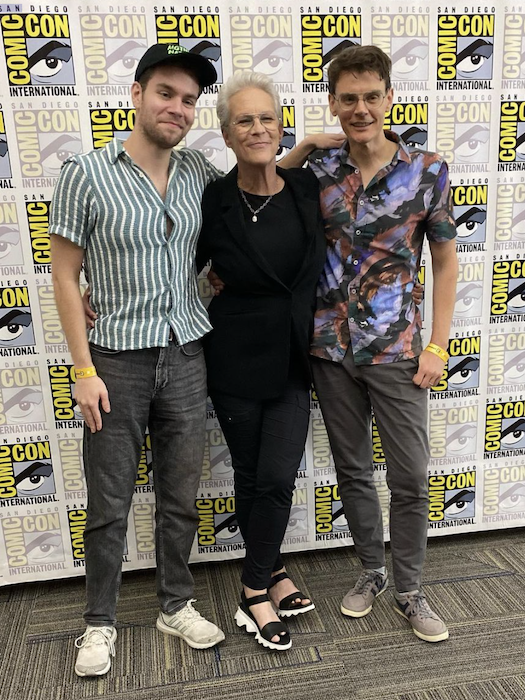
Karl tweeted 4 images: Pics from San Diego Comic-Con International where @jamieleecurtis@russell_golds and I debuted our graphic novel MOTHER NATURE. It was a surreal and incredible experience. BIG thanks to @ComicsTitan for organizing it, and ALL their hard work. ❤️ ❤️
The video in the 4th panel shows Karl flipping through the pages of their newly minted graphic novel. Jamie Lee stops to ask him who that is focussing in on Cynthia, the main villain, then says, tongue-in-cheek, that “she looks a lot like someone we know.” Karl later posted it separately on his Instagram. Interestingly, one of the panels shows a character that looks like Karl. I asked him about it, but so far he hasn’t responded.
At 1:08:25 Karl discusses his morning routine, which consists of him and his wife Alex both doing Transcendental Meditation for 20 minutes, running for 5 miles, then getting ready for their day. They’ve been doing TM for 10 years now. Jim and Karl talk about the value of running for physical and mental health, especially for cartoonists who sit in a chair drawing for hours.
At 1:14:18 Karl advocates for TM and how it helps him improve his focus, increase his energy, and enhance his awareness of everything. TM rests his brain deeply and sometimes ideas come up for his work. He even sleeps better. When asked how he learned TM, Karl mentioned that he and a friend used to listen to Howard Stern who talked about it on his show, and knowing that David Lynch promoted TM as well. His friend learned first and encouraged Karl and Alex to learn, which they did. That TM section ends at 1:16:26.
August 4, 2023: LiveSigning: Jamie Lee Curtis’s Book Signing & Interview | Mother Nature. Jamie Lee Curtis, Russell Goldman, and Karl Stevens discuss the creation and evolution of their graphic novel, Mother Nature, as they sign copies, interview each other, and answer fan questions.
You can get a Hardcover Edition of “Mother Nature” with Jamie Lee Curtis, Russell Goldman, and Karl Stevens’s Personal Autograph Inside Book and a Certificate of Authenticity from Premiere Collectibles.
September 23, 2023: On my way back from visiting family in Europe, then seeing Angelina Jordan at her Portsmouth, NH concert, I met Karl Stevens for lunch in Boston’s Chinatown. He took me back to his apartment where I met his cat Penny. Karl’s wife Alex arrived home later. Here is a photo of the three of them.
Karl generously gave me a signed copy of MOTHER NATURE. He then surprised me with the original print of the two dandelions he had sent to The New Yorker seen at the top of this post! He showed me the February 1, 2021 issue it was published in. I later discovered his was the 5th of 12 cartoons for that month. My commenting on it had started up our correspondence and subsequent friendship.
Karl happened to mention that David Sedaris will be promoting PENNY again on his upcoming new book tour.
A while back, Karl had offered to donate some of his original prints to an upcoming DLF fundraising event, so I connected him with one of the organizers. When I asked him what had happened to them he said that Jamie Lee Curtis, or her husband Christopher Guest, had made a generous donation for them. A fan of Karl’s work, Jamie was happy to receive the prints and support the work of the David Lynch Foundation.
In his Introduction to a 2008 cartoon collection by The New York Times bestselling artist Harry Bliss, Death by Laughter, Christopher Guest mentions his love of cartoons. “My wife and I have been collecting originals for more than twenty years. We have a gallery of the Greats, and among them is the work of Harry Bliss.” Several of Karl’s cartoons are included in that special collection, so he’s in good company!
I recently saw some of Karl’s New Yorker cartoons in the Condé Nast Store. I cracked up when I saw the one from the classic film Casablanca, where Humphrey Bogart’s character Rick Blaine looks forlorn sitting at the bar with a drink in his hand saying, “Alexa, play ‘As Time Goes By.’” It’s so funny, so good, blending an iconic film character from the 40’s with today’s technology! Clever! And done with superb artistry!
Speaking of Jamie Lee Curtis, Karl said she bought this Bogart cartoon independent of the DLF contribution. “It’s how I got to know her, and she was just being nice by donating to the foundation.” You never know how one thing will eventually lead to another unexpected opportunity—an invitation to collaborate on a graphic novel with a famous Hollywood actor and author. Who also happened to be an all-round great person.
Life does NOT happen to you, it happens FOR you. Many things in life are outside of our control, but the way we respond to events can shape our reality. Viewing challenges as opportunities, not misfortunes, will help you lead a productive, successful life. We all know Jim Carrey for his comedy, but he is now spreading joy through his inspiring words.
Mark wrote on his Patreon page: “My goal with After Skool is to enhance the most empowering ideas with my art. I animate the ideas that have impacted my life in a beneficial way, and hopefully by sharing them, they have helped you in some way.” Visit his website to see more of his amazing work: kRAMgallery.
ASHEVILLE, N.C. (WLOS) — Medical experts say health care workers are experiencing higher rates of burnout, exhaustion and even PTSD as they continue to fight the COVID-19 pandemic.
One group is trying to change that.
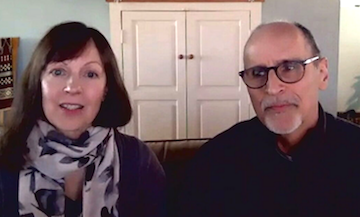
Tom and Jeanne Ball, directors at the Asheville TM Center, joined the national Heal The Healers Now project to offer free Transcendental Meditation training for health care workers who are experiencing higher rates of burnout, exhaustion and even PTSD as they continue to fight the COVID-19 pandemic. (Photo credit: WLOS staff)
Tom and Jeanne Ball, directors at the Asheville TM Center, have joined the national Heal The Healers Now project to offer free Transcendental Meditation training for health care workers. This is happening at a time when those involved in the project said health care workers need it the most.
“We found before the pandemic a year ago, found that half of physicians anyway were reporting significant levels of burnout,” said Dr. Stuart Rothenberg, medical director of the Center for Health and Wellness. “Now, we have 75 to 80% reporting significant burnout,” said Stuart Rothenberg, MD, Medical Director of the Center for Health and Wellness.
Tom Ball said health care workers need a way to do destress.
“Our health care workers that are so overly stressed and overly taxed right now,” Tom Ball said.
He said the Transcendental Meditation technique is a way for them to find peace during the chaos.
“Practice 15, 20 minutes a day, just sit comfortably with your eyes closed,” Tom Ball said.
Jeanne Ball said she’s teaching a nurse right now.
“She’s told me that she’s been able to take a break at the hospital and just sit down and do this,” Jeanne Ball said.
Michael Stephens, an Asheville area doctor, agreed with the technique’s effectiveness. He learned the technique before the pandemic.
“Working in a COVID environment is very suffocating. Wearing protective gear all the time and having to wear masks and gowns and gloves and shields is very suffocating, both physically hard to breath and emotionally,” Stephens said. “The Transcendental Meditation just really gives respite.”
Rothenberg said a national survey found that since the pandemic 76% of health care workers feel emotionally exhausted and 50% said they cry frequently at work, with 67% of nurses saying they cry frequently at work.
“We don’t really see the light at the end of tunnel for our health care workers,” he said. “It’s just an opportunity, twice a day, to get out of that cycle.”
The Balls said the free course they are offering is held over four days with 1.5 hours each day.
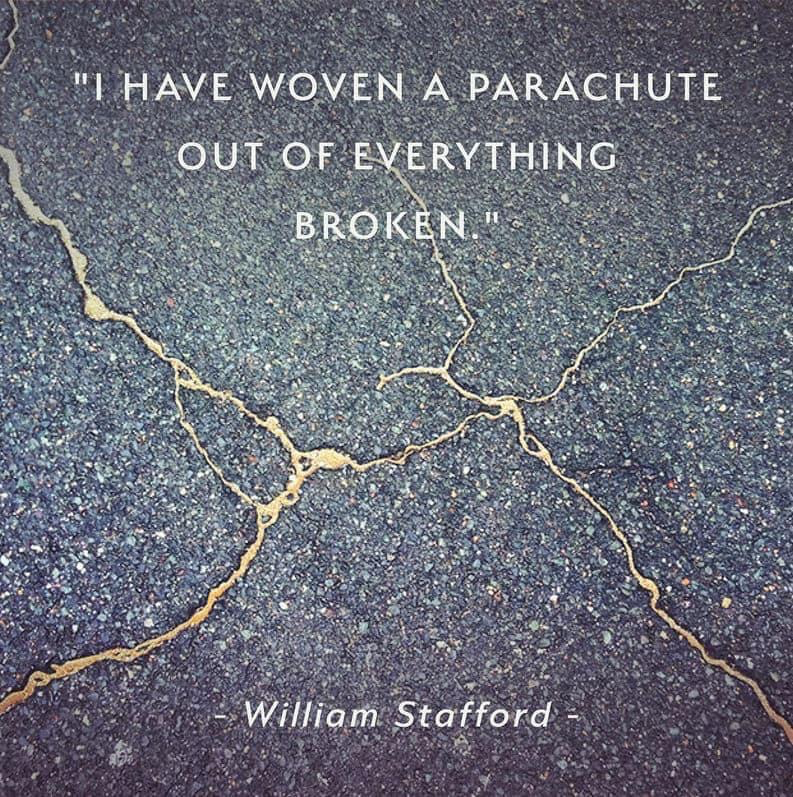
My son sent me a link to a quote by William Stafford that Michael Meade had posted on his Instagram. I couldn’t find the source.
Update: Leslie Marlowe sent me more of the quote. I did a search and discovered the poem in The Way It Is, and then online. I include this information in my reply below. It was part of the third stanza of a 24-line 4-stanza poem, Any Time, first published in Allegiances (1970).
“I have woven a parachute out of everything broken.” — William Stafford
The Japanese art of kintsugi
The quote and background image remind me of kintsugi or kintsukuroi, the Japanese art of repairing broken pieces of pottery using lacquermixed with powdered gold, silver, orplatinum. As a philosophy, it treats breakage and repair as part of the history of an object, rather than something to disguise. The piece becomes stronger and more beautiful than the original because of its unique imperfections.
To me, this serves as a metaphor for overcoming life’s challenges, scars and all, which build character. When I first saw a piece of repaired broken Japanese pottery using this method, it inspired a poem using one of the forms of Japanese poetry—kintsugi tanka.
A poet of peace
William Stafford responded creatively and with integrity to the challenges life sent his way. He remained true to his voice as a conscientious objector, poet of peace, and the innovative way he taught writing.
For it is important that awake people be awake, or a breaking line may discourage them back to sleep; the signals we give—yes or no, or maybe— should be clear: the darkness around us is deep.
“I give you the end of a golden string, Only wind it into a ball, It will lead you in at Heaven’s gate Built in Jerusalem’s wall.”
As any persistent writer will tell you, when they finally “get it right,” there’s a feeling of euphoria, the metaphorical equivalent of entering “Heaven’s gate.”
Stafford was awake to that revelatory moment when each thread of thought presented itself to him. They would lead to unexpected associations and realizations. In the last poem he wrote the day he died, he said: You can’t tell when strange things with meaning will happen.
Speaking of weaving together a parachute from everything broken, this most popular poem by Stafford, and my favorite, talks about holding onto an unseen thread that’s woven throughout all of life’s experiences.
There’s a thread you follow. It goes among things that change. But it doesn’t change. People wonder about what you are pursuing. You have to explain about the thread. But it is hard for others to see. While you hold it you can’t get lost. Tragedies happen; people get hurt or die; and you suffer and get old. Nothing you do can stop time’s unfolding. You don’t ever let go of the thread.
Coincidentally, I came across a quote from the Vedic literature that takes this idea of an uncommon thread and extends it to a cosmic thread.
He who knows the fine-drawn thread of which the creatures that we see are spun, who knows the thread of that same thread—he also knows Brahman, the Ultimate. (Atharva Veda Samhita 10.8.37)