This Saturday, January 24, 2015, PublicVine will host a private screening of Sundance award-winning director/producer Greg Reitman’s latest film, ROOTED in PEACE. The event will be held at the I-Heart Radio Lounge located in the heart of Sundance on Main Street in Park City, Utah. The film will be presented using PublicVine’s innovative social media platform. There will be a live question and answer after the screening with filmmaker Greg Reitman, PublicVine CEO Nam Mokwunye, and writer/producer Scott Zarakin, followed by an after party for all in attendance.
Greg Reitman says one of the most important issues for filmmakers wanting to get their films out into the marketplace is being able “to reach the widest available audience while retaining as much financial control as possible.” He feels PublicVine’s platform will provide “a perfect balance for releasing our new film, ROOTED in PEACE.” And when it comes to reaching consumers for digital transactions on a world-wide level Reitman adds, “PublicVine’s platform is going to be a game-changer for filmmakers.”
PublicVine CEO Nam Mokwunye points out that Reitman’s screening of ROOTED in PEACE “from his channel on PublicVine could be a first in film history.” He says it will only “give us a glimpse of what is possible with PublicVine and what opportunities lie ahead.”
Read the press release to find out more details about this innovative social video marketplace and how it can benefit filmmakers.
About ROOTED in PEACE
ROOTED in PEACE challenges viewers to examine their values as Americans and human beings. Today we are at war within ourselves, with our environment, and with the world. Director and award-winning filmmaker Greg Reitman invites viewers on a film journey to take notice of the world we live in, proactively seek ways to find personal and ecological peace, and stop the cycle of violence.
The film relies not only on memoir, but also interviews with such luminaries and activists as Deepak Chopra, music legends Donovan, Mike Love, and Pete Seeger, film director David Lynch, Noble Peace Laureate Mairead Maguire, media mogul Ted Turner, Archbishop Desmond Tutu, green architect William McDonough, physician and best-selling author Mark Hyman, neuroscientists Dan Siegel and Fred Travis, sustainability and nutritional experts, and many more.
Reitman learns from all of them, and heeds Maharishi Mahesh Yogi’s words, that if the forest is to be green, every tree must be green; if there’s going to be Peace on earth, then everybody needs to experience that quality of Peace within themselves. And so in asking viewers to do the same, Reitman poses the basic question: How do we want to live?
Reitman’s journey is an example of transformation — how one person can learn to make the necessary changes to enjoy a better life — and in so doing inspire others to want to improve their own lives, and society as a whole.
About Greg Reitman
Greg Reitman is the founder of Blue Water Entertainment, Inc., an independent production company focusing on environmentally conscious entertainment. Widely regarded as Hollywood’s “Green Producer,” Greg produced the 2008 SUNDANCE Audience Award-winning feature documentary “FUEL.” He wrote, produced, and directed the feature documentary “HOLLYWOOD’S MAGICAL ISLAND-CATALINA” (PBS) and returns back on the festival circuit with his latest revolutionary feature documentary film, “ROOTED in PEACE.” He’s currently in development on the motion picture film: “The Roni Levi Story.”
Classical guitarist Sharon Isbin has been a trailblazer for both female musicians, and the guitar’s place in the world of classical music. A winner of two Grammys, she is the director of guitar programs at the Juilliard School and at the Aspen Music Festival. Liz Robbins interviewed Ms. Isbin for The New York Times and wrote this fascinating article on the world’s greatest classical guitarist: Sharon Isbin: Seeking Out Serenity. The Jan 2, 2015 Sunday Routine featured photos, other aspects of her life, and a short video of Sharon playing guitar. The article was well-written and richly put together. This part took me by surprise:
I have done Transcendental Meditation since I was 17 years old. I do 20 minutes in the morning and 20 minutes in the afternoon. I really believe it has helped make me the person that I am. Because it is an extraordinary way to release stress and allow it to dissolve, so that you can focus on what you want to focus on, and have your energy towards very positive things.
Sharon Isbin: Cosmic Performer
An earlier insightful article written by Linda Egenes for Enlightenment, The Transcendental Meditation Magazine (Issue 7) sheds more light on this topic: An Interview with Sharon Isbin: The Monet of Classical Guitar. Knowing that Sharon had been practicing TM since she was 17 years old, Linda asked how it had benefited her life, especially performing in front of live audiences. Her amazing reply reveals an enlightened performer.
As a musician, TM enhances my mental stamina, memory, concentration, and ability to learn. It puts me in touch with my innermost creative core and enables its expression through music. Most importantly, it facilitates instant access to a state of “cosmic immersion,” that feeling of being in the flow, or in “the zone.”
When I perform onstage, I enter a state of being very similar to the one I enter daily when practicing TM. It’s a sense of communion with the energy of the universe, the audience, the composer, and the music—without ego or interference. It’s a feeling of unity between me and the listeners, a sense of “oneness” in which we are all experiencing the beauty of the music together. That sensation is one of the reasons live performances can be so powerful—everyone is focused and transported, and the experience is unique and in the moment, never to be replicated.
Guitar Passions: Sharon Isbin & Friends
Linda also asked Sharon questions about her musical influences and her work as a performer, teacher and collaborator, in particular about her new CD at the time, (August 30, 2011) Guitar Passions: Sharon Isbin & Friends. This promotional video shares music and interviews with Sharon and Steve Vai; in studio with Nancy Wilson (Heart) and Stanley Jordan; previews with Steve Morse, Paul Winter, Rosa Passos, Romero Lubambo, and Thiago de Mello.
Documentary Film: Sharon Isbin: Troubadour
Sharon Isbin is also featured in a new documentary film that came out towards the end of last year, and is still being aired on public television: Sharon Isbin: Troubadour. The one-hour documentary produced by Susan Dangel (2014), includes guests Martina Navratilova, Michelle Obama, Joan Baez, Steve Vai, Stanley Jordan, Garrison Keillor, David Hyde Pierce, Janis Ian, Lesley Gore, Mark O’Connor, Tan Dun, John Corigliano, Christopher Rouse, Joan Tower, Leonard Slatkin, Thiago de Mello, Paul Winter, and more, with Isbin’s performances showcased from international concert stages to the GRAMMYs and White House.
American Public Television presents the national broadcast on nearly 200 public television stations in the US Nov 2014 – March 2015. Video Artists International will release it on DVD/Blu-ray with added performances. See http://www.sharonisbintroubadour.com for screenings, broadcast, and release information.
Sharon Isbin on The Leonard Lopate Show
Today, Wed, January 7, 2015, WNYC’s Leonard Lopate interviewed Sharon Isbin about the program: A New Documentary On The Acclaimed Classical Guitarist, Sharon Isbin (16:33). Leonard asks Sharon about her Transcendental Meditation practice at the 10:50 mark. She answers at 11:08–12:20. Leonard mentions Julliard School inviting Sharon to head up a guitar department in their Music division and asks if Transcendental Meditation is part of the program. At the request of the David Lynch Foundation, Sharon did invite teachers to introduce the TM technique to Julliard faculty, staff, and students, offering to make it available for free. Listen to the interview here: http://www.wnyc.org/story/sharon-isbin.
I recently enjoyed watching Words and Pictures, a 2013 film about a male English teacher and a female art instructor who form a rivalry that ends up galvanizing students in a competition to decide the most effective way to communicate, using words or pictures. This battle between mind and heart, ideas and feelings, is also about self-discovery, expressing one’s creativity, and the blocks that get in the way. Cleverly written by Gerald Di Pego, a one-time English teacher, and faithfully directed by Fred Schepisi, it stars Clive Owen, Juliette Binoche, and Bruce Davison. Visit their website for more info: http://wordsandpicturesthemovie.com.
I especially liked the quotes about writing and art, the word vs. the image. A poem by Mary Oliver was supposed to be featured in the film. They never said which one but kept waiting for permission to use it. By the time the answer came in, no, it was too late, and they had to come up with a replacement. The pressure was on screenwriter Gerald Di Pego. Being a poet himself, and seeing how this was his screenplay, the muse inspired him, and he wrote this very vivid and appropriate poem, just in time. Juliette Binoche liked it, which came as a relief to him and the director. I found it online and wanted to share it with you. The poem plays a central role, but you’ll have to see the film to find out who wrote it and how it’s used.
WHO ARE YOU?
I am a small poem
On a page with room
For another.
Share with me
This white field,
Wide as an acre
Of snow, clear
But for these tiny
Markings like the
Steps of a bird.
Come. Now.
This is the trough
Of the wave, the
Seconds after
Lightning, thin
Slice of silence
As music ends,
The freeze before
The melting. Hurry.
Lie down beside me.
Make angels. Make devils.
Make who you are.
As you can see, the poem invites you to create and become who you are, from that gap, the transitional point of possibility, and to share in the experience with another. Here’s a poem I wrote after a special painting class that seems relevant: ArtWords—poem about a creative awakening.
Interestingly, the Special Features part of the DVD revealed that Juliette Binoche, an artist in her own right, offered to do all of the paintings herself, which thrilled both writer and director. Because her character is dealing with physical challenges due to her medical condition, she had to paint in different styles, from portraiture to more abstract. Binoche enjoyed the added challenge and it possibly influenced her own future work.
When it comes to romantic movies, here are some of my favorite films where love transcends time.
Canadian Connection: These shoes are made for walking
The featurette also confirmed for me where they had made the film. The story is set in a New England prep school, but was actually shot at St. George’s School, an independent boarding and day university-preparatory school for boys in Vancouver, British Columbia, Canada, a.k.a., Hollywood North.
I recognized the location, and it reminded me of a story I had heard on a local CBC radio talk show during my stay there. The guest was an English teacher who taught at St. George’s School. One of the topics being discussed was meeting famous people. Listeners called in to share their stories and the teacher related an unusual event that had recently happened to him.
He had gone shopping at a well-known store for comfortable walking shoes. He settled on a particular pair and the sales clerk told him it was a popular item. She said someone famous had been in that morning and purchased a similar pair. She left to find out the name of the celebrity, but got sidetracked with another customer, so he left.
He put on his new shoes and, as was his routine every day after lunch, he went for a walk in the woods next to the school property. While walking along the path, eyes downcast, he saw a pair of shoes just like his, coming his way. Looking up he saw someone he never would have expected to see, especially in the forest. He pointed at him in surprise trying to say his name, but it came out as gibberish. The person mimicked him sputtering his name. It was Robin Williams! I think he was in town at that time filming Jumanji.
They had a wonderful walk and talk together. Robin had asked him what he did for a living and where he worked, which was something he could identify with having played an English teacher at an elite boys prep school in Dead Poets Society. When they reached the edge of the forest, there was Robin’s stretch limousine parked on the street waiting for him. He invited the teacher into the car saying they would drop him off at the school.
Now this man was not the most popular teacher at the school. When they pulled up, he got out of the limo, and all heads turned to look at him. Then Robin lowered the darkly tinted window, stuck his head out, and thanked the teacher for a wonderful time. All the kids’ jaws dropped! And from that day on he was the coolest person at school. Thank you, Robin! God Bless you, wherever you are.
I later found this August 5, 2024 Vanity Fair article by Tomris Laffly: “He’s Absolutely Extraordinary”: Remembering Robin Williams. On the 10-year anniversary of Robin Williams’s untimely passing, we asked more than 20 of his costars, collaborators, and friends—including Billy Crystal, Matt Damon, Ben Stiller, Al Pacino, Sally Field, Jeff Bridges, and Julianne Moore—for their favorite memories of this kind, playful, and uniquely intelligent artist.
— Written and compiled (citing sources) by Ken Chawkin for The Uncarved Blog.
Prudence Farrow Bruns, PhD, is the daughter of actress Maureen O’Sullivan and award-winning writer/director, John Farrow. She has been practicing the Transcendental Meditation technique for 48 years, and has been a teacher of the TM program for 46 years.
It all started so simply. It was 1966, and 18-year-old Prudence Farrow was sitting on a bluff overlooking the Pacific Ocean at her brother’s home in Los Angeles. She was reading a book on meditation when she heard a voice say, “If you’re interested in meditation, I know just the meditation for you.”
The voice was that of Peter Wallace, a friend of her brother. Peter had spent six months traveling through India, where he met Maharishi Mahesh Yogi and began the Transcendental Meditation technique. He told her how simple and effortless the technique was, and yet how profound the experience and benefits could be.
“It was the simplicity of the practice that struck me most,” Prudence said. “I’d been trying different methods of meditation for some time, but they had all been complicated and difficult. When Peter described a simple, natural practice of diving deep within, I knew he was truly onto something.”
So Prudence learned the TM technique at UCLA. After experiencing the positive effects of TM for herself, Prudence wanted more. She wanted to meet Maharishi and to study with him. “At that time Maharishi had courses in India,” says Prudence. “He brought people there, and they studied for three or four months with him. You meditated for long periods under his guidance.”
On January 23, 1968, three days after her 20th birthday, Prudence traveled with Maharishi from New York to Rishikesh, India to attend her TM teacher training course. And that’s when the “Dear Prudence” story really began.
The Beatles Make the Scene
One month after Prudence arrived in Rishikesh, The Beatles showed up to study with Maharishi. While they all spent some time there, John Lennon and George Harrison stayed the longest.
“The Beatles were all very nice, humble, modest, kind, and down-to-earth people,” Prudence remembers. “I was closest to John and George, since they were my ‘course buddies’ during our studies with Maharishi. We were supposed to look out for each other during the course.”
Prudence (left) sat next to Ringo in course photo.
Prudence soon became known for her tendency to keep to herself in her room, focused on her meditation practice. “I was deeply immersed in my studies and meditation, locked away in my quarters. John, as my course buddy, was concerned and wanted to bring me out of my room to enjoy the experience more.”
John and George would come over to her room and play their guitars, encouraging her to come out and sing with them. It was this experience that became the inspiration for their song “Dear Prudence” in which John sings, “Dear Prudence, won’t you come out to play?”
Before he left Rishikesh, George mentioned to Prudence that they had written a song about her, but she had no idea what it was. She didn’t hear the song until it came out on their 1968 album The Beatles, commonly known as the “White Album.”
Prudence’s dedication to her meditation practice did pay off. After four months, she graduated from the course and became one of the first and youngest teachers of the Transcendental Meditation technique at that time.
But that was just the beginning of the “Dear Prudence” story.
Prudence Comes out to Play
Once she completed her teacher training course in India, Prudence definitely did come out to play. Over the past 46 years, she’s instructed thousands of people in the TM technique throughout the United States and Canada. She married TM teacher Al Bruns in 1969, and they have three children and four grandchildren.
She’s produced Hollywood feature films and a play in Manhattan. She was an assistant to the curator of the “Theatre Collection” of the Museum of the City of New York. She has been a magazine writer. She’s written two books.
Prudence earned a BA, an MA, and a PhD from the University of California at Berkeley. She received her doctoral degree in 2007, with a major in South Asian Studies and Sanskrit. She has made presentations to conferences at numerous universities, including Harvard, the University of Texas at Austin, and the University of Hawaii. She’s taught courses at UC Berkeley and Rutgers University.
TM and Yoga
Prudence continues to teach the TM program in Florida. In fact, she’s the most successful teacher in the U.S. at setting up Affiliate Programs in yoga studios. Maybe that’s not so surprising, considering that she’s a lifelong yoga practitioner, and she opened a yoga institute in Boston back in 1967.
Prudence attended India’s Kumbh Mela last year.
Maharishi Foundation created the Affiliate Program to bring TM to yoga studios and fitness centers. When a studio becomes an Affiliate, their members can learn TM at a reduced course fee, and the studio receives a share of the income. Everyone benefits—the new TM student, the yoga studio, and the local TM teachers.
Today most people think of yoga as a series of physical postures. But Maharishi has explained that in the Yoga Sutras, Patanjali identifies eight limbs of yoga, and the eighth limb is Samadhi or transcendental consciousness. Maharishi said that with the practice of TM, Samadhi is actually the easiest limb of yoga to achieve, since no effort is required. We simply tap into the natural tendency of the mind to go within, to transcend, and that transcendence nourishes and supports all the other limbs.
“I do think that Transcendental Meditation is—of the meditations that are available to us—the most direct, and the simplest,” says Prudence. “When you meditate, when you transcend, it allows your heart and mind to balance. And when they’re balanced, that’s when you are really healthy. You are happy. You’re happy mentally, happy emotionally, and happy spiritually. Those three are all components of what make a human being, so that connection to transcendence is absolutely necessary for health.”
Creating a Better World
Fortunately for us all, Prudence did come out to play.
“The years of meditating have enriched my life so much,” Prudence says. “And that’s why at this point in my life, I’m giving back. We need a better world. We need people to be more conscious, to be more evolved. And expanding the mind, like TM does, is absolutely vital to bring about stronger people. If you can strengthen people inside, you’ve changed the world.”
So even today, 48 years later, the “Dear Prudence” story continues.
[In July 2018, this article was updated and published in Enjoy TM News.]
Years later, The Beatles released many versions of their songs on the 50th Anniversary of The White Album, now out on Spotify, which include The Esher Tapes. There are 3 versions of Dear Prudence there: the Esher version of John Lennon singing on guitar; one of just vocal, guitar, and drums; and the 2018 mix.
Another beautiful song that John Lennon wrote about his experience with Transcendental Meditation was, Across the Universe. Spotify included John Lennon on guitar singing Across The Universe–Take 6.
NEW: Enjoy TM News posted this more recent discussion. Mario Orsatti, the host of TM Talks and Senior Teacher of the Center for Health and Wellness, a division of the David Lynch Foundation, interviewed Dr. Bruns on June 14, 2020. This popular episode was rebroadcast on September 4, 2022. Watch the interview with Dr. Prudence Farrow Bruns (55:17)
Our current obsession with social media and mobile devices seems to have improved our connectivity with each other, but it is also changing it for the worse. Here are two innovative creative videos that remind us how social media can destroy, not build, relationships.
Lee Ross’s creatively produced vignette brilliantly demonstrates the breakdown in human interaction; while Prince Ea intelligently raps about the problem, ironically pointing out what we’re missing. They both beg the question: Are we really living life, communicating and developing meaningful relationships?
I continue find and add relevant cartoons and videos, as well as some possible solutions to this modern problem.
1. From a comedic perspective 4gLove by LEE ROSS is a funny but sadly true depiction of cellphone addiction destroying relationships. This 5-minute film is available on Vimeo and YouTube.
2. We are so consumed by our phones and social networks, we sometimes forget how to live. Prince Ea says the obvious in this video: Why I Refuse to Let Technology Control Me: You need not delete your social networks or destroy your cell phones, the message is simple, be balanced, be mindful, be present, be here. 🙂 If you like his message you can download the digital audio Can We Auto-Correct Humanity?
See the brilliant depiction of the grip of modern technology over our brains by British cartoonist and animator Steve Cutts in these cartoons: OWNED, and this unusual selfie: SENT FROM MY IBRAIN.
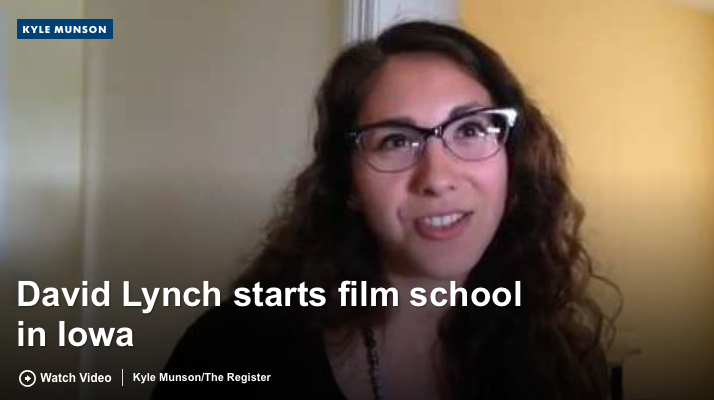
On Thursday, October 9, 2014, I hosted The Register’s Iowa journalist Kyle Munson and photographer Mary Willie. Kyle had contacted me during the week because of David Lynch’s announcement to produce 9 new episodes of Twin Peaks for Showtime. This seemed to be the tipping point to finally visit our Masters Program in Film in David Lynch’s name. For information on the David Lynch MA in Film at MUM, visit http://filmschool.mum.edu.
The title may appear to be a bit confusing since the David Lynch MA in Film is part of Maharishi University of Management, based in Fairfield, Iowa. But the graduate film department classrooms and offices are located in Headley Hall in neighboring Maharishi Vedic City.
As a result they’ve now retitled the article to read: Munson: David Lynch and the ‘Twin Peaks’ of Iowa. The article starts out referencing one of the most famous lines from David Lynch’s iconic TV series, Twin Peaks.
Fairfield, Ia. – It’s easier to find a “damn fine cup of coffee” here than in other Iowa towns two or three times the size.
At least a few top-notch coffee shops surround the town square — not to mention a vast array of vegetarian and organic cuisine far beyond the staple pork tenderloin or rural fixture of “Taco Tuesday.”
It’s all part of the familiar plotline about how Fairfield, pop. 9,447, has evolved in the last 40 years into a surprising cosmopolitan oasis on the prairie thanks to the global influx of followers of the late Maharishi Mahesh Yogi. They practice Transcendental Meditation (TM) — at least 20 minutes twice a day — as a means to promote peace and unlock their creativity. They have trekked here since the Maharishi University of Management (MUM) was founded on the former Parsons College campus as a center of “consciousness-based education.”
Kyle interviews Joanna Plafsky, the one who created the program; John Raatz, the new executive director who also brought Jim Carrey to give this year’s commencement address; as well as some of the students who came from far and wide for the graduate film program, including the international scholarship winner, Agnes Baginska, whose film was selected by David Lynch himself. Agnes posted a scan of the full article on her website and her Facebook Timeline Photos. Read the rest of the article here. Click on these titles to see the video and photos.
The David Lynch MA in Film at the Maharishi University of Management in Fairfield and Vedic City began a year ago. The second year of the “Twin Peaks” filmmaker-focused curriculum is underway. Kyle Munson/The Register
Fairfield Iowa is the home of David Lynch’s MA film program which encourages creativity cultivated by consciousness at Maharishi University of Management Thursday, Oct. 9, 2014. Mary Willie/The Register
I already put some of the photos up on my Pinterest account, which go on Twitter. Also posted the links to the photos and the video on Google+ and Twitter. Even though I officially retired, I could not pass up this PR OP! 🙂
Just received this beautiful poem, Love after Love, written by Derek Walcott. To me it’s about coming back to yourself, discovering and loving your self. It can be a sweet, quiet awakening, when you recognize it, open your heart to it, to who you are.
I remember when it happened to me, living alone in a room I was renting in a house in North Vancouver. I finally let go of all the distracting reasons to search for happiness outside myself, in wanting to love another person or be loved by them, or some thing to do I thought would make me happy. I just stopped and discovered the loving stranger who was there, and accepted myself instead, as if for the first time. Took more than half my life for it to finally happen, but was quietly surprised and pleased when it did. Derek Walcott describes this process of self-recognition and acceptance so well, so powerfully.
Love after Love
The time will come
when, with elation
you will greet yourself arriving
at your own door, in your own mirror
and each will smile at the other’s welcome,
and say, sit here. Eat.
You will love again the stranger who was your self.
Give wine. Give bread. Give back your heart
to itself, to the stranger who has loved you
all your life, whom you ignored
for another, who knows you by heart.
Take down the love letters from the bookshelf,
the photographs, the desperate notes,
peel your own image from the mirror.
Sit. Feast on your life.
After a little research I discovered Derek Walcott to be an amazing man, an artist, poet, professor and playwright. Acknowledged as the greatest living poet in the English language, he won the Nobel prize for Literature in 1992. He taught at Boston University for 20 years. Turns out he also taught in Canada. In 2009, Walcott began a three-year distinguished scholar-in-residence position at the University of Alberta. In 2010, he became Professor of Poetry at the University of Essex.
Born in Saint Lucia, Derek Walcott was influenced by his mixed racial and cultural heritage. He married a Trinidadian, raised a family there, and built the Trinidad Theatre Workshop. For someone who was in search of his own identity, both as a person and an artist, this poem represents a coming back to one’s essential self. It resonates deeply with the thousands who have read it. It was first published in Sea Grapes, and later in Derek Walcott, Collected Poems, 1948-1984, and The Poetry of Derek Walcott 1948-2013.
Listen to this excellent July 13, 2014 BBC Radio 4 interview where Nobel Laureate poet Derek Walcott talks about his life and work at home on St Lucia: Derek Walcott: A Fortunate Traveller (28 mins).
Here is an excerpt of Derek Walcott reciting his poem, Love After Love, in a new documentary film about him, POETRY IS AN ISLAND, by Ida Does.
Withdrawing into silence, being blessed by “a kind of fleeting grace”
I was surprised to see these comments from Derek Walcott in the Paris Review, Issue 101, Winter 1986: Derek Walcott, The Art of Poetry, No. 37. Since Walcott seems to equate poetry and prayer in this discussion, interviewer Edward Hirsch asks him how he writes. He describes it as withdrawing into a world of silence, and creating from there, as if in a trance, being blessed by “a kind of fleeting grace” if something happens.
“But I do know that if one thinks a poem is coming on—in spite of the noise of the typewriter, or the traffic outside the window, or whatever—you do make a retreat, a withdrawal into some kind of silence that cuts out everything around you. … I’m not a monk, but if something does happen I say thanks because I feel that it is really a piece of luck, a kind of fleeting grace that has happened to one. Between the beginning and the ending and the actual composition that goes on, there is a kind of trance that you hope to enter where every aspect of your intellect is functioning simultaneously for the progress of the composition. But there is no way you can induce that trance.”
Other videos will be added next week: Dr. Craig Pearson’s introduction, as well as Dr. Bevan Morris’s impressive introduction to Jim Carrey. In it he told a story about Judd Apatow, who, early in his career as a young standup comic, was opening for Jim Carrey. After seeing Jim perform and the response from the audience, Judd decided to quit comedy. He said “Jim Carrey is funniest man on earth. This is something we can all agree on. We can debate forever number two but Jim will always be the king.” Until that video is available, I share this story so you’ll more fully appreciate the humor in the Valedictorian’s opening remarks.
About six months later, November 13, 2014, Jim Carrey was on The Ellen Degeneres Show promoting his film Dumb and Dumber To. One of the things Ellen asked him about was the Commencement speech he had given and what it was like for him. Jim spoke glowingly about MUM and the students, and that he had learned TM. They actually showed a clip of it. Here is the 1:40 minute segment, which starts at 6:36 of the 8:20 interview. After the show over a half-million people visited the MUM YouTube Channel. To date over 60 million people worldwide have seen Jim’s inspiring talk. I later found a transcript of it.
ITN Factual, a production company based in London, UK, was commissioned by A&E, Arts and Entertainment channels, to do a film biography on Maharishi Mahesh Yogi. Producer/Director Fiona Procter came to Fairfield, Iowa in October 2007 and the show was aired on the History International Channel on Nov 28, 2007. Interviews included Drs. Bevan Morris and John Hagelin, David Lynch, Donovan, Mike Love, Teresa Olson, Jerry Jarvis, Alan Waite, Deepak…
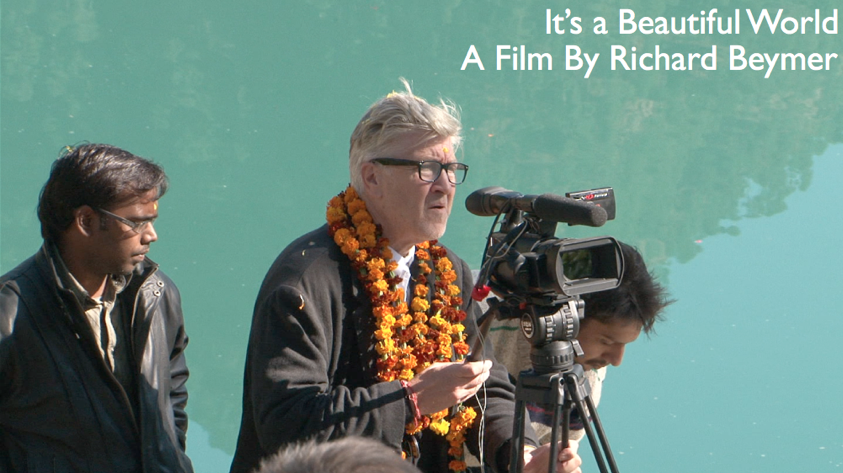
It’s a Beautiful World, is a film made by Richard Beymer as he accompanied David Lynch with Bob Roth and a film crew to India. David went from northern India to the south retracing his master Maharishi Mahesh Yogi’s footsteps for a documentary film he was going to make. Richard records the early stages of the making of that film on Maharishi.
David first visits Jyotir Math where Maharishi served his teacher Guru Dev for 13 years. After his passing, Maharishi went into silence for 2 years in a small cave-like room in a house in Uttar Kashi, the Valley of the Saints. David takes us right into that cave! A persistent thought brought Maharishi out to travel to a famous temple in Rameshwaram. From there he continued on to the great Temple to Mother Divine in Kanyakumari located at the southern-most tip of India where the 3 oceans meet. Along his return journey northwards a man from the Trivandrum Public Library asked Maharishi to speak. The film takes us to those sites and into that library where Maharishi gave his first series of 7 lectures. People had asked to learn what he was teaching, and that was the start of the TM movement. What had taken Maharishi two years, David covered in 10 inspiring eventful-packed days.
About a year or so before David made his trek to India, he also had the opportunity to visit with Maharishi in Vlodrop, Holland at his International Headquarters. A special interview was arranged and David was able to ask Maharishi some questions. It had been recorded, possibly for David to use in his documentary. I mentioned that interview to Richard and he checked with David for permission to use some of it. David directed Richard to use specific segments of an answer Maharishi gave him to a particular question. The film ends with it, coming full circle, of Maharishi explaining why he came out of the Silence of the Himalayas to bring his message to the world. He told David he thought what he had to offer would be useful to humanity. He said that the nature of life is bliss, and the nature of the individual is cosmic. And all those years of teaching TM had borne that out, later verified by hundreds of scientific research studies on the range of benefits in people’s lives, and the development of higher states of consciousness.
This film is also a rare glimpse into David’s personal life. Throughout the journey David reveals snippets of his film career. It’s an intimate look at David Lynch the man, the director in action, the devoted meditator, and his inspiration to share the gift of Transcendental Meditation with the world through his Foundation. Watch this skillfully edited trailer, then visit the website to order the film to stream or download.
 This Saturday, January 24, 2015, PublicVine will host a private screening of Sundance award-winning director/producer Greg Reitman’s latest film, ROOTED in PEACE. The event will be held at the I-Heart Radio Lounge located in the heart of Sundance on Main Street in Park City, Utah. The film will be presented using PublicVine’s innovative social media platform. There will be a live question and answer after the screening with filmmaker Greg Reitman, PublicVine CEO Nam Mokwunye, and writer/producer Scott Zarakin, followed by an after party for all in attendance.
 ROOTED in PEACE challenges viewers to examine their values as Americans and human beings. Today we are at war within ourselves, with our environment, and with the world. Director and award-winning filmmaker Greg Reitman invites viewers on a film journey to take notice of the world we live in, proactively seek ways to find personal and ecological peace, and stop the cycle of violence.






 The Uncarved Blog