Archive for the ‘Articles’ Category

SIERRA: AMERICA’S COOLEST SCHOOLS: Maharishi University of Management

August 22, 2011

The Nonconformist Class | AMERICA’S COOLEST SCHOOLS

Going green may finally be “normal,” but some schools with eco-agendas remain miles from mainstream

By Tim McDonnell

Maharishi University of Management

Courtesy of Shane Ernest

The Beatles’ onetime spiritual adviser, the late Maharishi Mahesh Yogi (sometimes called the “giggling guru”), founded Maharishi University of Management, in Fairfield, Iowa, as a place for “consciousness-based education.” The school’s buildings face east and have a central nucleus, and rooms are aligned with the sun’s movement according to the strictures of an ancient Indian architectural style. The first U.S. university to offer a four-year degree in sustainable living, MUM balances modern clean technology and 5,000-year-old Vedic philosophy based on Sanskrit texts.

The dining hall serves food that’s entirely vegetarian and organic. To graduate, each student is required to have maintained a plot on the campus’s farm. Above, students celebrate the completion of their permaculture class with a feast made of ingredients harvested from their gardens.

Attending to the earth is hardwired into the school’s signature (and trademarked!) practice, Transcendental Meditation. From it, says Robbie Gongwer, the program developer for MUM’s Sustainable Living Center, “students get this subjective experience of an interconnectedness to life.”

Maharishi University MBA Students Win National Business Simulation Competition

August 19, 2011

Maharishi University of Management MBA Students Place First in National Business Simulation Competition

Also see: Students Place 1st in National Business Simulation and MBA Students Win National Business Competition and this video: CAPSIM winners: MBA teams at Maharishi University of Management

L-R: Peng Wang (China), Ganesh Baniya (Nepal), Abdul Sheikh (Pakistan), Chittaranjan Sahu (India)

Competing against 137 other MBA teams from universities nationwide, a team of four MBA students from Maharishi University of Management recently placed first in a business simulation competition.

Taking place over a six-month period, the simulation had students guide a fictitious company through eight rounds of decision-making, with each round representing a year of business activity.

According to professor Andy Bargerstock, who teaches the simulation in his course titled “U.S. and International Accounting Practices,” the students had to analyze and assess a variety of reports about the industry, competitors, and its own past performance results.

For their simulated company to perform well, the students must decide on research and development strategies, marketing tactics, sales and production forecasts, financing requirements, human resource management tactics, and total quality management initiatives.

The simulation, created by the CAPSIM Foundation, evaluates students on the growth of their company, based on financial results, customer perspectives, internal business development, and learning and growth initiatives.

“Strong analytical skills and informed intuition are valuable for simulation decision-making,” Dr. Bargerstock said. “When our MBA students perform so well against some of the best business schools in the U.S., it validates the quality of their decision-making skills and builds confidence that they can compete in the international business environment.”

The four-member winning MUM team consisted of students from around the world: Nepal, Pakistan, India, and China. In addition, a second team from MUM finished among the top 20%, comprising students from Iran, Cameroon, and Barbados.

Universities who participate regularly in this simulation include Harvard, Cornell, UC-Berkeley, Northwestern, Vanderbilt, the University of North Carolina, Pittsburgh, Boston College, the University of Iowa, and Iowa State, among others.

The game scenario took place in the sensor products industry and began with the premise that the Securities Exchange Commission had broken a monopoly into smaller companies. Each team assumed the role of a company and began with an equal market share and financial resources.

Bargerstock said that the winning team attributed their success to a combination of good decisions about product pricing, building customer awareness, product innovation, automation of production facilities, controlled expansion of capacity, cost control, training and development of personnel, and sound financing strategies.

The simulation creator, Capsim Management Simulations, Inc. of Northfield, Illinois, is the largest business game provider in the U.S.

Also listen to the Sept 8 KMCD MUM Spotlight Show as MUM Professor Andy Bargerstock and MBA student Ganesh Baniya discuss the Accounting MBA program at MUM and their team’s recent win, placing first in the nation, in a national business simulation competition created by the CAPSIM Foundation.

For more information on MUM’s Accounting MBA program visit: http://www.mum.edu/accountingmba

Also see Iowa and Nepal Rotary Clubs Provide Well for City in Nepal, and Maharishi University’s Rao and Bargerstock published in Management Accounting Quarterly.

David Lynch Foundation Television to premiere David S. Ware: A World of Sound

August 18, 2011

“It’s like you’re trying to cognize a world of sound.” — David S. Ware

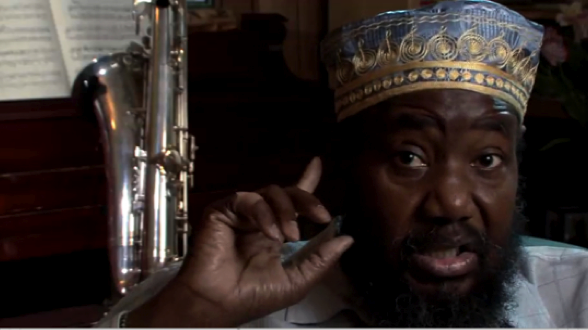
David S. Ware cognizes and manifests a world of sound. On August 30th 2011, David S. Ware: A World of Sound will premiere on David Lynch Foundation Television. The film profiles one of the most original minds in jazz history – saxophonist/composer/bandleader David S. Ware. In 2010, BBC reviewer Daniel Spicer wrote, “Ware’s playing is astonishing, pushing the limits of brain, fingers and equipment, ideas rushing out in a stream of furious, liquid invention, with an almost superhuman precision.”

“You learn to listen to music with sort of a third ear.” — David S. Ware

David counts Sonny Rollins as an early mentor, from whom he learned circular breathing in 1966 while still a teenager. By the 1980’s, David’s concerns as a saxophonist had shifted away from the rush and fury of extended improvisations, and into the area of concentrated thematic development. He formed the David S. Ware Quartet in 1989 to put these ideas into practice, and they became known as the reigning advanced jazz super-group of the 90’s and into the new millennium. Since that Quartet’s disbanding in 2007, Ware has found expression in a number of different forms; including solo performances and a new quartet entitled Planetary Unknown.

A World of Sound is the latest film by DLF.TV’s Amine Kouider, who has previously profiled several other innovative artists, including installation and performance artist S.B. Woods and Malek Salah, a pioneer of the modern art scene in Algeria.

At Amine and David’s first meeting, David said bluntly, “Good luck trying to finish this film.” The luck turned out to be much needed, as A World of Sound ended up taking over two years to finish. But, when finally completed, film director and DLF.TV founder David Lynch offered high praise, telling Amine, “How cool is cool? … I love this guy, David S. Ware … and I love this film you’ve made for him, Amine … Really good to have documented this great man and his music and his spirit.”

The film (13:36) premieres August 30, 2011 on http://DLF.TV. Also see exclusive bonus footage (8:01) of David S. Ware playing at home.

For more info on David S. Ware, visit http://www.davidsware.com and http://www.aumfidelity.com.

News Coverage: Chicago Reader: Bleader: Saxophonist David S. Ware, sound and vision | JazzTimes: David S. Ware Documentary to Air Aug. 30: Saxophonist’s relationship with Transcendental Meditation will be explored | Ottawa Citizen: Jazzblog: David Lynch on David S. Ware | Listen to Mike Ragogna’s 2.0 interview (43:48) 20110828 – David S. Ware  on solar-powered KRUU-LP 100.1 FM. It was transcribed, edited, and posted in Mike Ragogna’s blog on The Huffington Post: A World Of Sound: Chatting & Improvising With David S. Ware | Also available on Allie Is Wired | TM Blog: David S. Ware: A jazz musician with “a world of sound”

Interesting interview in All About Jazz: David S. Ware: Planetary Musician

See Beautiful film on Algerian artist Malek Salah by Amine Koudier.

DETAILS: critical eye: Meditation Nation

August 14, 2011

Meditation Nation

Power brokers no longer motivate or medicate—they meditate. How Transcendental Meditation returned as the new status symbol.

Photograph by Adam Voorhes
September 2011 Issue

A funny thing happened on the way to enlightenment. The quest got stripped of yogic posturing, Buddhist trappings, and even the last vestige of spirituality and turned into a search for the kind of clarity that might help us all in our worldly pursuits. Which is why movers and shakers are again embracing that seventies mainstay Transcendental Meditation. You’re likely to hear it spoken of reverentially in interviews: Russell Brand, whose wildman behavior was cartoonish in its intensity, credits TM with helping him to conquer his heroin, sex, and alcohol addictions. “After meditation,” he has said, “I felt this beautiful serenity and selfless connection.” And where celebrities venture (the latest wave of TM-ers includes the likes of Hugh Jackman and Naomi Watts), many of us are likely to follow. The rolls of practitioners have tripled in the past three years, according to the Transcendental Meditation Program, the practice’s national organization.

“The game-changer, I think, is David Lynch and his foundation,” says Dr. Norman E. Rosenthal, the Georgetown University psychiatry professor who wrote the recent best seller Transcendence: Healing and Transformation Through Transcendental Meditation. Lynch, the surrealist director of Twin Peaks, Blue Velvet, and Mulholland Dr., had been quietly practicing TM since, yes, the seventies, but about six years ago he came out of the closet, launching a foundation to promote the practice and later publishing a manifesto, Catching the Big Fish: Meditation, Consciousness, and Creativity.

It’s a process perfectly matched to our self-interested times—”no pain, but a lot of gain,” according to Rosenthal. Bob Roth, an executive director of the David Lynch Foundation, who taught TM to Brand and Moby, explains that when the mind has been calmed with the help of a mantra, a Sanskrit word given to each TM grad, it will effortlessly sink below the level of thought to “pure consciousness.” Practically speaking, sit in a chair, close your eyes, and silently repeat the mantra for 20 minutes. Once you get the hang of it, Lynch says, you cut the elevator cables of your normal-thinking mind to descend to a place that feels different. You may experience a connection with the universe or a mental light show, what Rosenthal calls “four-star graphic effects.” At the very least, you should be blissfully relaxed, which is the foundation of the health benefits that have been measured in the medical research amassed, much of it funded by the government. The deep tranquillity TM promotes quiets the body’s “fight or flight” stress response, lowering blood pressure and anxiety and combating depression.

Maharishi Mahesh Yogi, the so-called giggling guru, who hosted the Beatles and Mia Farrow, among others, was the innovator who stripped Hindu meditation practice of its religious baggage and repackaged it as a systematic, stress-reducing, creativity-building technique. Lynch, a disciple, is responsible for adding a fresh civic-mindedness to the game. His foundation aims to bring TM free of charge to those most in need of its calming effects—at-risk kids, prison inmates, veterans suffering from post-traumatic stress. That, of course, means fund-raising benefits, which means reeling in rich folk and entertainers (many introduced to TM by Lynch and Roth), all of which attracts media coverage and an increased brand awareness among those in the general public who might be willing to shell out $1,500 for the basic course.

“It was straight out of The Great Gatsby,” Rosenthal says of the poolside benefit party thrown this past June at the Malibu home of Juicy Couture cofounder Pam Levy and her TV-director husband, Jefery Levy. One imagines the vibes spreading to their neighbor Ryan Kavanaugh, CEO of Relativity Media, the freshly minted Converse-wearing, 36-year-old movie mogul who practices TM twice a day. Kavanaugh, who started out as a stockbroker, has leveraged his connections by allying with the New York hedge fund Elliot Associates, among other investors, giving his company the billions required to dominate Hollywood film production. But his secret weapon is his risk-assessment algorithm, a high-tech quantitative analysis of the big picture that he says allows him to make money even on box-office dogs.

As the New York hard-chargers who flock to the TM courses Roth teaches at the Center for Leadership Performance soon learn, this kind of success is not coincidental. According to published research, TM enhances neural activity in the part of the brain that houses the decision-making “executive center.” “The businesspeople say they’re more focused during the day,” Roth says. As do the other Gotham heavy hitters who’ve evangelized for TM and the Lynch Foundation, from Jerry Seinfeld and Heather Graham to Ben Foster and Howard Stern. Leave it to Mr. Katy Perry himself, speaking at a gala fund-raiser at the Metropolitan Museum of Art this past winter, to get at the essence of TM’s guilt-free marriage of creativity and commerce: “I literally had an idea drop into my brain the other day while I was meditating which I think is worth millions of dollars.”

Also on Details.com
Celebrity Om-Meter: The Top 10 Moments in Meditation History
Retreat, Relax, Recharge: Inside the World’s Best Spas
How to Avoid the Office Strain
Guy-Friendly Alternatives to Yoga

Prop Styling by Robin Finlay

Inspiring results from the TM-Quiet Time Program in the San Francisco Unified School District

August 12, 2011

Click on these links and you’ll be inspired as I was by the amazing results of the TM-Quiet Time Program in some San Francisco schools:

Schools Students and teachers speak about their experiences with TM-Quiet Time Program in San Francisco schools. http://t.co/D0QJtvf

Laurent Valosek, director of the Center for Wellness and Educational Achievement, discusses the implementation and results of the TM-Quiet Time Program in the San Francisco Unified School District. http://t.co/dAfYdTw

James Dierke, Principal of Visitacion Valley Middle School in San Francisco, presents research findings on the TM-Quiet Time Program. http://t.co/m4INjFT

David Lynch, founder of the David Lynch Foundation, gives an inspiring address to educators about experiences with the Transcendental Meditation program. (Q & A with Bob Roth). http://t.co/6IZOggu

See the complete presentation of Meditation for Students: Results of the David Lynch Foundation’s Quiet Time/TM Program in San Francisco Schools

Dr. Catherine Ulbricht interviews psychiatrist and author Dr. Norman Rosenthal for Natural Standard

August 9, 2011

Q & A with Dr. Norman Rosenthal

Dr. Catherine Ulbricht, Founder and CEO of Natural Standard, interviews world-renowned psychiatrist and author Dr. Norman Rosenthal. Dr. Rosenthal’s research has pioneered the use of light therapy for seasonal affected disorder (SAD). His latest book Transcendence: Healing and Transformation Through Transcendental Meditation discusses the value of this technique for healing and transformation.

Complimentary access to the webinar is available August 1-31, 2011 (Requires Windows Media Player). The interview is 49:20 minutes long. The transcript is also available as a PDF file.

Norman Rosenthal, MD, mentions this on his blog: Interview with Dr. Catherine Ulbricht on Transcendental Meditation (TM) and Addiction.

Bob Roth Speaks at Maharishi School Graduation

August 6, 2011

Bob Roth, Vice President of the David Lynch Foundation, addresses students, parents, faculty and staff at the Maharishi School of Age of Enlightenment graduation on June 12, 2011 in Fairfield, Iowa. In his Commencement Address, Bobby shares a list of 10 ideas, or guidelines to live by to become a great person: 1) Meditate, 2) Be true to yourself. Think for yourself, 3) Energy is everything (fatigue is your enemy), 4) Live with conviction. Be persistent, 5) Be powerful. Be gentle (“It’s polite to apologize”), 6) Thank your teachers (Wisdom is priceless), 7) Love your parents (No one loves you more), 8) Truth triumphs, 9) You are the Master of your own destiny (Don’t complain), 10) Be happy. Enjoy your life! Bobby concludes his very inspiring talk, filled with wonderful stories, by reading a beautiful passage from the Talmud, given to him by Jane Pitt, who asked him to share it with the graduates. (Bobby is my hero!)

TM improves brain function in ADHD students

July 26, 2011

New study shows Transcendental Meditation improves brain functioning in ADHD students

A non-drug approach to enhance students’ ability to learn

A random-assignment controlled study published today in Mind & Brain, The Journal of Psychiatry (Vol 2, No 1, pp. 73–81) found improved brain functioning and decreased symptoms of attention-deficit/hyperactivity disorder, ADHD, in students practicing the Transcendental Meditation® (TM) technique. The paper, ADHD, Brain Functioning, and Transcendental Meditation Practice, is the second published study demonstrating TM’s ability to help students with attention-related difficulties.
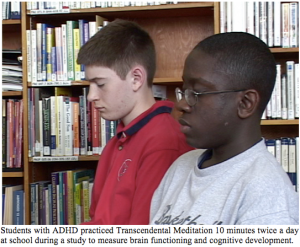
The first exploratory study, published in Current Issues in Education, followed a group of middle school students diagnosed with ADHD who meditated twice a day in school. After 3 months, researchers found over 50% reductions in stress, anxiety, and ADHD symptoms. During the study, a video was made of some students discussing what it felt like to have ADHD, and how those experiences changed after 3 months of regular TM practice.

In this second study, lead author, neuroscientist Fred Travis, PhD, director of the Center for Brain, Consciousness and Cognition, joined principal investigator Sarina J. Grosswald, EdD, a George Washington University-trained cognitive learning specialist, and co-researcher William Stixrud, PhD, a prominent Silver Spring, Maryland, clinical neuropsychologist, to investigate the effects of Transcendental Meditation practice on task performance and brain functioning in 18 ADHD students, ages 11-14 years.

The study was conducted over a period of 6 months in an independent school for children with language-based learning disabilities in Washington, DC. The study showed improved brain functioning, increased brain processing, and improved language-based skills among ADHD students practicing the Transcendental Meditation technique.

A local TV news station reported on the study in-progress during the first 3 months.

What was Measured

Students were pretested, randomly assigned to TM or delayed-start comparison groups, and post-tested at 3- and 6-months. Delayed-start students learned TM after the 3-month post-test.

EEG measurements of brain functioning were taken while students were performing a demanding computer-based visual-motor task. Successful performance on the task requires attention, focus, memory, and impulse control.

In addition, students were administered a verbal fluency test. This test measured higher-order executive functions, including initiation, simultaneous processing, and systematic retrieval of knowledge. Performance on this task depends on several fundamental cognitive components, including vocabulary knowledge, spelling, and attention.

Theta/Beta Power Ratios and ADHD

Using EEG measurements, the relationship of theta brain waves to beta brain waves can be diagnostic of ADHD. Dr. Joel Lubar of the University of Tennessee has demonstrated that the theta/beta ratio can very accurately identify students with ADHD from those without it.

While theta EEG around 4-5 Hz is commonly associated with daydreaming, drowsiness, and unfocused mental states, theta EEG around 6-8 Hz is seen when one focuses on inner mental tasks, such as memory processing, identifying, and associating.

“In normal individuals, theta activity in the brain during tasks suggests that the brain is blocking out irrelevant information so the person can focus on the task,” said Dr. Travis. “But, in individuals with ADHD, the theta activity is even higher, suggesting that the brain is also blocking out relevant information.”

“And when beta activity, which is associated with focus, is lower than normal,” Travis added, “it affects the ability to concentrate on task for extended periods of time.”

“Prior research shows ADHD children have slower brain development and a reduced ability to cope with stress,” said Dr. Stixrud. “Virtually everyone finds it difficult to pay attention, organize themselves and get things done when they’re under stress,” he explained. “Stress interferes with the ability to learn—it shuts down the brain. Functions such as attention, memory, organization, and integration are compromised.”

Why the TM Technique

“We chose the TM technique for this study because studies show that it increases brain function. We wanted to know if it would have a similar effect in the case of ADHD, and if it did, would that also improve the symptoms of ADHD,” said Dr. Grosswald.

Dr. Stixrud added, “Because stress significantly compromises attention and all of the key executive functions such as inhibition, working memory, organization, and mental flexibility, it made sense that a technique that can reduce a child’s level of stress should also improve his or her cognitive functioning.”

The Transcendental Meditation technique is an effortless, easy-to-learn practice, unique among categories of meditation. “TM does not require concentration, controlling the mind or disciplined focus—challenges for anyone with ADHD,” Grosswald added.

There is substantial research showing the effectiveness of the TM technique for reducing stress and anxiety, and improving cognitive functioning among the general population. “What’s significant about these new findings,” Grosswald said, “is that among children who have difficulty with focus and attention, we see the same results. The fact that these children are able to do TM, and do it easily, shows us that this technique may be particularly well-suited for children with ADHD.”

Transcendental Meditation produces an experience of restful alertness, which is associated with higher metabolic activity in the frontal and parietal parts of the brain, indicating alertness, along with decreased metabolic activity in the thalamus, which is involved in regulating arousal, and hyperactivity.

With regular practice, this restfully alert brain state, characteristic of the TM technique, becomes more present outside of meditation, allowing ADHD students to attend to tasks. “In a sense,” Dr. Travis said, “the repeated experience of the Transcendental Meditation technique trains the brain to function in a style opposite to that of ADHD.”

Improved Brain Functioning

During the practice of the Transcendental Meditation technique, coherence is found across different EEG frequencies. After meditation, the brain utilizes this increased functioning ability to support the performance of a task in an integrated manner.

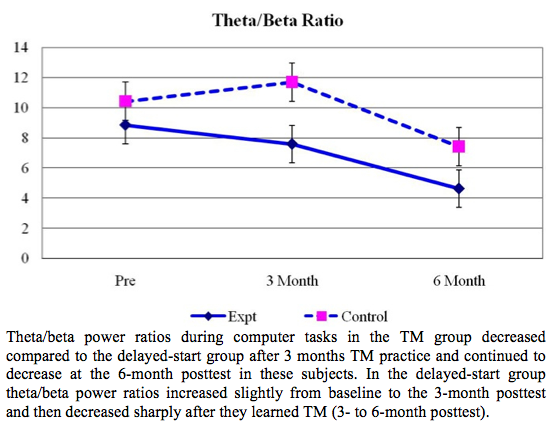
Three months of TM practice resulted in significant decreases in theta/beta ratios and increased verbal fluency.  This translates into improved executive function and more efficient cognitive processing.

During the first 3 months of the study, the theta/beta ratios of the control group (delayed start) actually increased. After learning, and practicing TM for 3 months, this group experienced dramatic decreases in theta/beta ratios and increased verbal fluency as well.

Student and Parent Surveys

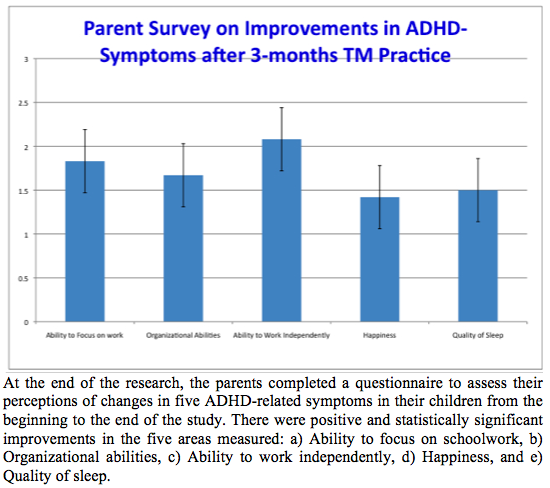
Students reported that the TM technique was enjoyable and easy to do. They felt calmer, less stressed, and better able to concentrate on their schoolwork. They also said they were happier since they started TM. This correlated with reports from the parents.

At the end of the research, the parents completed a questionnaire to assess their perceptions of changes in five ADHD-related symptoms in their children from the beginning to the end of the study. There were positive and statistically significant improvements in the five areas measured: a) Ability to focus on schoolwork, b) Organizational abilities, c) Ability to work independently, d) Happiness, and e) Quality of sleep.

Promising Results

The combined results were significant. There was a 48% reduction in the theta/beta power ratios and a 30% increase in brain coherence after the 6-month period. Studies have shown that pharmaceuticals decrease theta/beta power ratios by 3%, and neurofeedback by 25%.

“These are very encouraging findings,” said Dr. Stixrud. “Significant improvement in the theta/beta ratio without medication and without having to use any expensive equipment is a big deal, as is significant improvement in student happiness and student academic functioning reported by the parents.”

“While stimulant medication is very beneficial for some of my clients with ADHD,” Stixrud added, “the number of children who receive great benefit from medicine with minimal side-effects is relatively small. The fact that TM appears to improve attention and executive functions, and significantly reduces stress with no negative side-effects, is clearly very promising.” Stixrud said he hoped these findings would lead to more research on the use of TM with children and adolescents.

In conclusion, these findings warrant additional research to assess the impact of Transcendental Meditation practice as a non-drug treatment for ADHD, and to track meditating students’ improved academic achievements.

The study was funded by a grant from the David Lynch Foundation.

###

FACT SHEET

Attention-Deficit/Hyperactivity Disorder (ADHD)

  • Attention-deficit/hyperactivity disorder (ADHD)—characterized by inattentiveness, impulsivity, and hyperactivity—is diagnosed in almost 10% of children ages 4-17 years, representing 5.4 million children.
  • The Center for Disease Control and Prevention reported among children with current ADHD, 66.3% were taking medication for the disorder. In total, 4.8% of all children ages 4-17 years (2.7 million) were taking medication for ADHD. The majority of them stay on it into adulthood.
  • The rate of prescriptions for Attention-Deficit/Hyperactivity Disorder in the U.S. has increased by a factor of five since 1991—with production of ADHD medicines up 2,000 percent in 9 years.
  • The commonly used drugs for ADHD are stimulants (amphetamines). These drugs can cause persistent and negative side-effects, including sleep disturbances, reduced appetite, weight loss, suppressed growth, and mood disorders. The side-effects are frequently treated with additional medications to manage insomnia or mood swings. Almost none of the medications prescribed for insomnia or mood disturbances are approved by the Food and Drug Administration (FDA) for use with children.
  • The long-term health effects of ADHD medications are not fully known, but evidence suggests risks of cardiac disorders and sudden death, liver damage and psychiatric events. It has also been found that children on long-term medication have significantly higher rates of delinquency, substance use, and stunted physical growth.
  • A new study, Study raises questions about long-term effects of ADHD medication, the first of its kind, released February 17, 2010 by the Government of Western Australia’s Department of Health, found that “long-term use of drugs such as Ritalin and dexamphetamine may not improve a child’s social and emotional well-being or academic performance.” The chair of the Ministerial Implementation Committee for Attention Deficit Hyperactivity Disorder in Western Australia said in the Department’s press release, “We found that stimulant medication did not significantly improve a child’s level of depression, self perception or social functioning and they were more likely to be performing below their age level at school by a factor of 10.5 times.”

The Transcendental Meditation Technique

  • The Transcendental Meditation technique is an effortless technique practiced 10-20 minutes twice a day sitting comfortably with the eyes closed.
  • TM is not a religion or philosophy and involves no new beliefs or change in lifestyle.
  • Over 350 peer-reviewed research studies on the TM technique confirm a range of benefits for mind, body and behavior.
  • Several studies have compared the effects of different meditation practices and found that Transcendental Meditation provides deeper relaxation and is more effective at reducing anxiety, depression and hypertension than other forms of meditation and relaxation. In addition, no other meditation practice shows the widespread coherence throughout all areas of the brain that is seen with Transcendental Meditation.
  • The Transcendental Meditation technique is taught in the United States by a non-profit, educational organization.

Source: EurekAlert!

Some Media Coverage: PhysOrg.com: New study shows Transcendental Meditation improves brain functioning in ADHD Students, PsychCentral.com: Transcendental Meditation Lessens Kids’ ADHD Symptoms, eMaxHealth: Transcendental Meditation Improves ADHD Symptoms, Academic SkillsADHD/ADD Natural Remedy Report: New study shows Transcendental Meditation improves brain functioning in ADHD students, GGN-Education News: New study shows Transcendental Meditation improves brain functioning in ADHD students, Part 2, Part 3, Part 4, Part 5; The Times of India: Transcendental meditation for the brain, Health24: Meditation boosts brain functioning, RedOrbit: New Study Shows Transcendental Meditation Improves Brain Functioning In ADHD Students, The Behavioral Medicine Report: Transcendental Meditation Improves Brain Functioning In Students With ADHD, Science News Line medicine, Science Codex, Transcendental Meditation Blog: New study finds TM boosts brain functioning and helps students with ADHD, GoodTherapy.org: Children with ADHD May Benefit from Transcendental Meditation, and many others.

Could The Key To Health And Happiness Be Restoring A ‘Lost’ State Of Consciousness?

July 18, 2011

The Key To Health And Happiness:
A ‘Lost’ State of Consciousness?

VIDEO by Fred Travis: “The Transcending Brain”

Here are a few excerpts from an enlightening article posted: 7/15/11 on Huffington Post/AOL Healthy Living by , writer for the David Lynch Foundation and 25-year teacher of Transcendental Meditation:

“Life happens within the realm of three, ever-changing phases: waking, dreaming and sleep. Yet most of us intuit that there’s more to human consciousness than what we ordinarily experience.

Scientists have long known that each of the three major states of consciousness has its own distinct style of physiology and brain activity.

Could there be a fourth major state of consciousness that likewise has its own physiological signature and brain pattern, a state that’s been overlooked or forgotten?

What if the loss of this state were the cause for much of what ails us — personally and collectively?

“Sages throughout history, from Laozi to Emerson, have sung the praises of this exalted “lost” state…

READ THE ARTICLE /WATCH THE VIDEO
ON HUFFINGTON POST (CLICK HERE)

You are invited to comment and share this article with friends! You can also “fan” Jeanne by clicking next to her photo above the Huffington Post article and sign up for emails as new articles appear. Jeanne and her husband Tom Ball teach the TM Program in Asheville, NC. www.MeditationAsheville.org.  You can follow them on Twitter: www.Twitter.com/MeditationAVL and Facebook: www.Facebook.com/MeditationAsheville. This excellent article is also posted on their website as: An Undiscovered State of Consciousness?

A Transcendental Cure for Post-Traumatic Stress by David Lynch and Norman E. Rosenthal

July 13, 2011
THE WALL STREET JOURNAL OPINION JULY 13, 2011
A Transcendental Cure for Post-Traumatic Stress
One study of soldiers showed a 50% reduction in symptoms after eight weeks of meditation.

By DAVID LYNCH and NORMAN E. ROSENTHAL

War wounds come in many forms. Some are obvious, such as scars, gashes and amputations. Others, the psychological ones, are less visible but equally devastating. The numbers in this second group are staggering: The military’s latest mental health survey of combat troops in Afghanistan found that 20%—one in five—suffer from post-traumatic stress disorder.

People with combat-related PTSD often suffer from periods of emotional numbness and depression that may coexist or alternate with intense anxiety and delusional thinking. Their days may be afflicted by flashbacks to traumatic situations. Their nights are often disrupted by sleeplessness and nightmares, from which they awake drenched in sweat as though back on the battlefield.

Yet most veterans with PTSD do not receive adequate treatment for various reasons, including fear of stigma, a dearth of effective treatments, and insufficient government resources. Gen. Peter Chiarelli, vice chief of staff of the U.S. Army, recently acknowledged that, “The therapies used for treatment of brain injuries lag behind the advanced medical science employed for treating mechanical injuries.”

Clearly, there is a need for new, creative approaches: Transcendental Meditation, better known as TM, is a promising candidate. An ancient Vedic technique developed in India, TM was brought to the West in the late 1950s by Maharishi Mahesh Yogi. It involves sitting comfortably with eyes closed for 20 minutes twice a day while thinking a mantra. It does not require adherence to any religious belief system or ritual practices. Yet to date there are over 340 peer-reviewed papers describing the beneficial effects of TM on the mind and body.

lynch

The David Lynch Foundation recently hosted an event to help raise funds to teach TM to our wounded warriors returning home from Iraq and Afghanistan. We heard from veterans of three wars: Jerry Yellin, a fighter pilot in World War II who flew 19 missions over Japan; Dan Burks, who served in Vietnam; and David George, a veteran of Operation Iraqi Freedom. Despite differences in age and wartime experiences, these men had two things in common: All suffered terribly from PTSD, and all experienced tremendous relief from TM. Life became once again peaceful and even joyful for them.

What was clear from these men’s stories was how great a toll their symptoms took on their families, as well as on themselves. In a poignant video, Mr. George’s mother described the transformation of her son from a courteous young man into a hard-drinking, depressed and deeply disturbed veteran, who she feared would take his own life or someone else’s.

All that changed when Mr. George began to meditate on a regular basis. According to Ms. George, TM saved her son’s life.

In a study of Vietnam vets conducted by James S. Brooks and Thomas Scarano and published in the Journal of Counseling and Development in November 1985, TM outperformed the conventional psychotherapy of the day. More recently, a pilot study of five Iraq and Afghanistan veterans published in the June 2011 issue of Military Medicine showed a 50% reduction in PTSD symptoms after just eight weeks of practicing TM.

There is a scientific basis for the observed benefits of TM for combat-related PTSD. In several studies, TM has been shown to buffer fight-or-flight responses, which are thought to be overactive in people with PTSD, as evidenced by their hypervigilance, anxiety and exaggerated startle responses.

In addition, TM has been found to reduce blood pressure and decrease the risk of heart attacks and strokes—other conditions in which an overactive fight-or-flight response may play a role. In a similar manner, TM may modulate nervous system responses, thereby allowing affected veterans to relax and leave behind the traumas of war.

Regardless of how TM helps, the mounting evidence leads to one conclusion: If a simple, low-cost technique like TM can substantially alleviate the suffering of even some of the thousands of veterans afflicted with PTSD, how can we afford not to give it a try?

Mr. Lynch is a filmmaker and the founder of the David Lynch Foundation. Dr. Rosenthal is a clinical professor of psychiatry at Georgetown University Medical School and the author of “Transcendence: Healing and Transformation Through Transcendental Meditation” (Tarcher-Penguin, 2011).

Photo credit: Associated Press
Link to article: http://on.wsj.com/rg8tYC

WSJ: LETTERS: VA Meditating on Good Therapies, July 22, 2011

In “A Transcendental Cure for Post-Traumatic Stress” (op-ed, July 13) David Lynch and Norman E. Rosenthal pose a challenge for the federal agency entrusted with caring for our nation’s 23 million veterans: “If a simple, low-cost technique like TM can substantially alleviate the suffering of even some of the thousands of veterans afflicted with PTSD, how can we afford not to give it a try?” In fact, Transcendental Meditation has received substantial attention at the Department of Veterans Affairs, the Department of Defense and the National Institutes of Health. Indeed, meditation and other forms of complementary and alternative medicine are already used at VA to help veterans suffering from PTSD. We have embarked on a series of clinical investigations to evaluate all forms of meditation, TM among them, in order to determine whether this promising technique can produce results consistently for our patients, and which kind of meditation, from among several practiced widely today, would be most helpful to them. VA is beginning demonstration projects across the country in different care settings. We are looking for a simple, natural, culturally neutral and repeatable technique that can augment existing PTSD treatments. These studies require us to be open to new techniques for prevention and treatment, as well as structured in our approach to determining their value and efficacy. The studies already conducted, and those currently underway, are listed at http://tinyurl.com/3gx74o3.

The promising personal experiences mentioned in the article and the dedicated efforts of our VA, DoD and NIH team offer us all hope for finding more effective treatments for PTSD. We can’t afford not to.

W. Scott Gould

Deputy Secretary

DVA

Robert A. Petzel, M.D.

Under Secretary for Health

DVA

Washington