Asher Fergusson, a business startup expert with bizHUMM, is featured among Maharishi University of Management’s successful alumni profiles. Hailing from Sydney, Australia, Asher quickly rose to become a leader, who, at 29, graduated Valedictorian from MUM in 2008 with a degree in Maharishi Vedic Science.
Upon completing his undergraduate degree, Asher became the Chief Executive Officer (CEO) of Galaxy Ninja, his own startup Internet marketing business, which he successfully ran for 6 years before selling it in 2014. During his tenure as CEO of Galaxy Ninja, Asher earned his second degree from MUM — an MBA in Sustainable Business.
Asher says he appreciates the clarity of mind he’s received from his regular practice of the Transcendental Meditation technique, which was part of the Consciousness-Based Education curriculum at MUM. “It gives me the mental space to find solutions to what otherwise might have been an insurmountable hurdle. The idea for a solution just magically comes out of no-where and this often saves me countless hours of time. It really does make me ‘lucky’ in all kinds of situations, it’s great!”
As an Internet marketer, he specializes in fields such as Search Engine Optimization, viral content creation and Facebook Advertising. He has helped countless small businesses successfully compete with billion dollar companies.
Asher is now the Chief Marketing Officer for a new startup based in Fairfield called bizHUMM. This website is a free resource that teaches people the steps to starting a business and also how to grow existing businesses. “At bizHUMM I’m applying all the knowledge I gained during my MBA at MUM and from running my first startup, Galaxy Ninja. It’s so fulfilling to apply my degree and help businesses all over the world start and grow. We often get emails of praise from far off places like Gambia, Malaysia and of course locally in the US,” Asher said.
Click here to read the rest of this fascinating MUM alumni profile with photos of Asher surfing, his worldwide travels and recent marriage to 2006 alumna Lyric Benson.
Asher is also helping his wife, Lyric Benson Fergusson, a talented singer-songwriter/poet, launch her first book of poetry. They currently live in Maui, Hawaii.
Bob Roth, executive director of the David Lynch Foundation, appeared on this week’s Fox 5 WNYW Good Day New York morning newscast* with Rosanna Scotto and Greg Kelly to talk about Transcendental Meditation. Rosanna’s friends were telling her about it, and she was interested in learning. So she invited the in-demand TM teacher to the show.
Bob explained how easy and effortless it is to learn and practice TM, and how different it is from other more difficult approaches. He also described some of the many scientific published research studies showing improvements in health, education, and rehabilitation.
He emphasized TM wasn’t just for the needy or wealthy segments of society. Everyone could benefit from it. People from every walk of life were practicing it — military personnel, Wall Street brokers, educators, physicians, housewives, students, anyone dealing with today’s stressful challenges. More than just relaxation, he said TM gives you more energy, focus and drive to get things done.
Rosanna asked about the work of the Foundation and the upcoming concert. Bob described the various DLF projects helping different at-risk sectors of society, and announced the November 4th Change Begins Within Benefit Concert at Carnegie Hall.
Proceeds from the event will benefit the David Lynch Foundation’s Meditate New York initiative to provide Transcendental Meditation instruction at no cost to 10,000 at-risk New Yorkers, including underserved youth, veterans with post-traumatic stress, and women and children who are victims of domestic violence.
*This morning news show originally aired on Tuesday, Oct. 13th, 2015. You can watch the 10-minute interview in a larger format from the Fox 5 archive HERE and at the TM Blog.
Rosanna Scotto attended the DLF benefit concert and talked with Greg Kelly about it on Good Day New York.
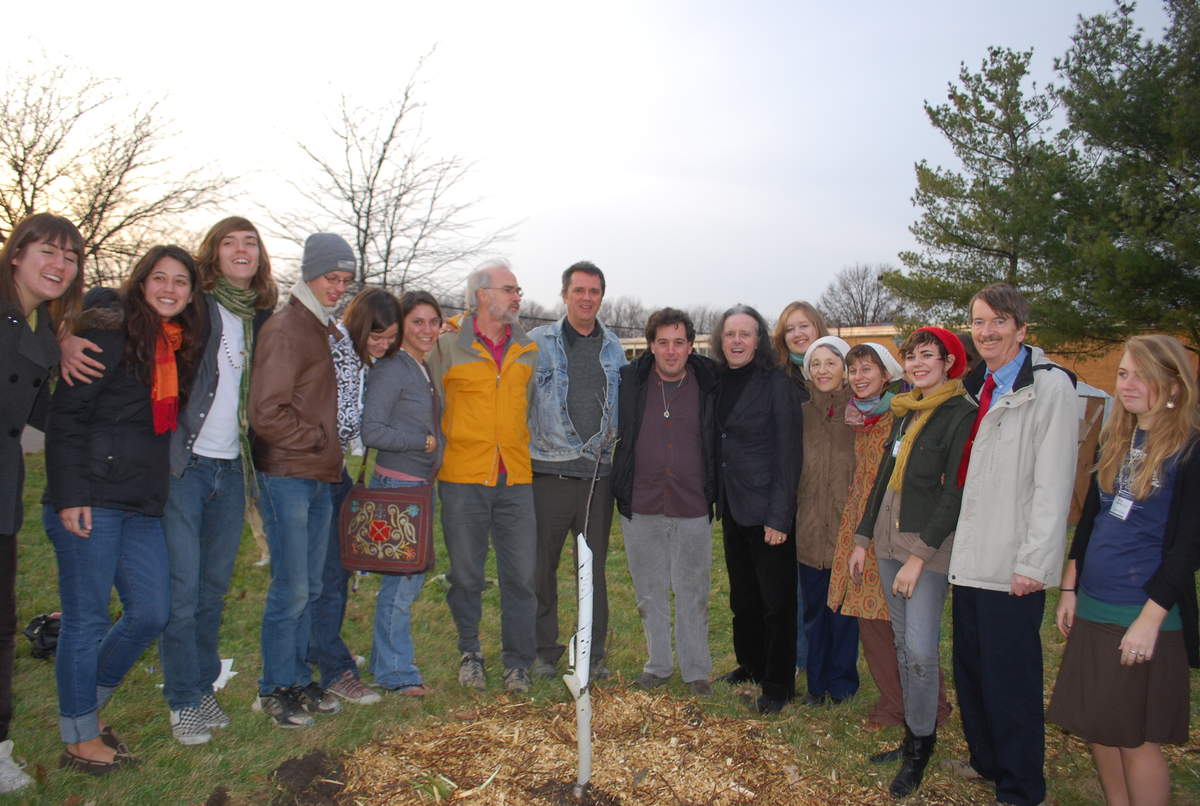
During his visit to Fairfield, film producer Greg Reitman planted a tree with MUM students outside the university’s library. Reitman is the man in the center with the necklace. The man to the right is the singer Donovan, whom Reitman interviewed for his film “Rooted in Peace,” which will be shown at 7 p.m. Sunday at the Stephen Sondheim Center for the Performing Arts. Photo by: Nicole Hester-Williams/Ledger
A documentary that was filmed partially in Fairfield will make its Iowa debut at 7 p.m. Sunday at the Steven Sondheim Center for the Performing Arts.
The film, “Rooted in Peace,” is a product of Greg Reitman, founder of Blue Water Entertainment, Inc. In a press release, Reitman said the film challenges viewers to examine their values as Americans and human beings.
“Today we are at war within ourselves, with our environment, and with the world,” reads the press release. “Director and award-winning filmmaker Greg Reitman invites viewers on a film journey to take notice of the world we live in, proactively seek ways to find personal and ecological peace, and stop the cycle of violence.”
Reitman interviewed numerous celebrities for the film such as author Deepak Chopra, film director David Lynch, musicians Donovan, Mike Love and Pete Seeger, media mogul Ted Turner, Archbishop Desmond Tutu and more.
He also interviewed Fred Travis, professor of Maharishi Vedic Science at Maharishi University of Management.
The press release states that Reitman learned kernels of wisdom from all those he interviewed.
“Reitman’s journey is an example of transformation — how one person can learn to make the necessary changes to enjoy a better life — and in so doing inspire others to want to improve their own lives, and society as a whole,” reads the press release.
Reitman said he became interested in documentaries while studying abroad in Florence, Italy, where he took a class on Italian cinema. He would go on to produce the 2008 SUNDANCE Audience Award-winning feature documentary “FUEL.”
After that, he started thinking about doing a film about all the violence in the world. An experience at JFK Airport in New York City opened his eyes to a whole new world.
“I almost got arrested for not giving up a bottle of water,” he said. “I was seeing racial profiling going on. It made me start thinking about our rights, and about what fear can do. It mirrored a world that I had lived in at age 19, when I was living in Israel during the first Gulf War.”
Reitman got in touch with Ken Chawkin, who was then the public relations officer at MUM. Chawkin encouraged him to visit Fairfield, and mentioned that the Beach Boys were going to be in town for a concert. Reitman’s wife is from Iowa, so the two decided to attend the concert.
Reitman came back a second time with Donovan for the David Lynch Film Weekend. During his second trip to Fairfield, he interviewed Donovan, David Lynch and Bob Roth.
After the film, Reitman will hold a question-and-answer session with the audience.
One of the common questions Reitman has received in his other Q and As is, “Why did the film take so long to make?” The film took five years in all, which Reitman said is not too far out of the ordinary for documentaries.
“The reason it took me so long was that I had to find peace first,” he said. “When I talked to Ken, he said, ‘Greg, you’re not going to understand peace until you come to Fairfield.’”
Reitman said he greatly enjoyed his time in Fairfield. It reminded him of another small town he filmed in, Carbondale, Colorado, with a population of just over 6,000.
Part of the film is autobiographical, where Reitman shares his person story of living in Israel and visiting Hiroshima, Japan. That said, he feels it’s more an inspirational film than a dry, descriptive documentary.
“It’s one man’s quest to seek inner peace and coming upon the roadblocks that lead him to enlightenment,” he said. “It’s about him having to unlock each of those pearls of wisdom, to understand the concept of a healthy heart and a healthy body. Then you can understand what a healthy world looks like.”
This three-column cover story with large photo carries over to a page 7 three-column section with two photos, one of Greg Reitman with Donovan playing guitar, the other of Mike Love singing on stage from the Beach Boys concert. This article is republished here with permission from The Fairfield Ledger. Click FF Ledger Documentary 7-31-2015 to see a PDF of the whole 2-page article with photos.
I enjoyed watching Be You, an impressive little film documenting the life-transforming power of Transcendental Meditation in one of the schools of the APC, a UK educational alternative for socially-challenged students in need of individual support.
The West Sussex Alternative Provision College is one of four hundred pupil referral units in the United Kingdom, which caters specifically for pupils who are not currently in mainstream education for various reasons. This school offers young people with emotional and behavioral issues a new chance to succeed.
Be You is a start-up, grass-roots, not-for-profit organization founded by Ricky Reemer and Kitty de la Beche. It sets out to transform the lives and prospects of young people who struggle to fulfill their potential within the school system by teaching them valuable life skills and techniques.
The Be You project opened the way for the introduction of Transcendental Meditation to the teachers and pupils in this specialized Unit. With the support of the Be You, the pupils were encouraged to continue their daily practice of TM over a full school year.
More screenings are coming up this summer for Hollywood director Greg Reitman’s documentary feature film.
Martha’s Vineyard Film Society
This month, Martha’s Vineyard Film Societywill present ROOTED in PEACE on Wednesday, July 15, 2015, at 7:30pm. There will be a special post-screening Q&A with director Greg Reitman.
In early August the film will premiere in Fairfield, Iowa. Read how this Hollywood filmmaker came to Fairfield for a Beach Boys concert, returned for a David Lynch Weekend at MUM, learned TM and more, in the July issue of the Iowa Source in their All About FAIRFIELD section: Getting Rooted In Peace: Green Producer Greg Reitman Brings New Documentary to Sondheim for Iowa Premiere. Here is a PDFof the print version.
Included in the film are interviews from those visits with filmmaker David Lynch; musicians Donovan and Mike Love; Bob Roth, executive director of the David Lynch Foundation; and Fred Travis, director of Maharishi University’s Center for Brain, Consciousness, and Cognition; as well as historical footage of Maharishi Mahesh Yogi, founder of the Transcendental Meditation®technique, and Maharishi University of Management.
Blue Water Entertainment and the David Lynch Foundation are presenting the Iowa premiere of this inspirational documentary feature film, Sunday, August 2nd at 7pm in the Sondheim Center for the Performing Arts. There will be a Q&A following the showing with Sundance award-winning Director Greg Reitman and Executive Producer Joanna Plafsky. Joanna is an established international film producer and distributor, and member of the DLF Board of Directors.
Visit the Fairfield Arts and Convention Center websiteto find out more about Greg and his film, including production stills and the movie trailer, and if you’ll be in town at that time, to purchase tickets. Here is a PDF of the ROOTED in PEACE poster for Fairfield with affordable ticket prices.
The Fairfield Weekly Reader will publish an article on the event July 23rd.
I received an email this morning from a member of the TMhomeTeam, an international Transcendental Meditation news website. I’ve admired their wonderful work over the years representing TM internationally, especially their interesting interviews with famous, and not so famous people who have benefited from this unique meditation practice.
They wrote to say the article they had been putting together about me was now up. As a publicist who is always concerned with properly promoting other people and their work, this was a complete turnaround for me. I very much enjoyed sharing stories with Liisa of how I started TM, my work as a publicist, and the wonders of the creative process writing poetry. So when I read her article I was very moved; she did an excellent job representing me!
The article is currently featured on their home page and under the People section. I invite you to visit their website and enjoy reading it. They also did a lovely job laying it out with personal photos and two of my poems.
I am thrilled to share this milestone with you! Click on the title of the article to take you there.
In 1967, Ken Chawkin walked into the local TM centre without any intention of learning Transcendental Meditation. He simply wanted to buy a copy of The Science of BeingandArt of Living written by Maharishi Mahesh Yogi.
US President Barack and Mrs. Obama with Japan PM Yukio and Mrs. Hatoyama Sept. 23, 2009 (Closeup of Official White House Photo by Lawrence Jackson)
Dr. Yukio Hatoyama, prime minister of Japan in 2009–2010, will deliver the commencement address on May 23 and will be awarded an honorary degree of Doctor of Laws.
“It is an enormous honor to have a former prime minister of Japan speak at our graduation ceremony,” said MUM President Dr. Bevan Morris in making the announcement.
A record number of 391 students, representing 61 different countries, will be graduating at the 2015 commencement ceremony at Maharishi University of Management.
Dr. Hatoyama holds an undergraduate degree in engineering from the University of Tokyo and a PhD in industrial engineering from Stanford. He was a professor of engineering at Tokyo Institute of Technology and at Senshu University.
He was instrumental in forming two political parties in Japan and was credited by Time magazine with helping Japan take steps toward a multi-party system after decades of single-party government under the Liberal Democratic Party. He became president of the Democratic Party of Japan in 2009 and led the party to an electoral victory.
President Morris met Dr. Hatoyama in Tokyo
MUM President Morris met Dr. Hatoyama in Tokyo when he visited Japan in November 2013 and found him to be a “man of remarkable warmth and sweetness, and fascinated by Consciousness-Based education and by Maharishi University of Management.”
Dr. Hatoyama practices the Transcendental Meditation technique, having been instructed by MUM alumnus Shizuo Suzuki, who leads the Transcendental Meditation organization in Japan. Dr. Hatoyama will be accompanied by his wife Miyuki, whom he met when he was at Stanford and who also practices the Transcendental Meditation technique.
The Hatoyamas plan to spend time in the community while they’re here to learn more about MUM, Maharishi School, Maharishi Vedic City, and Fairfield.
Member of a distinguished Japanese family
Dr. Hatoyama is a member of a distinguished Japanese family that has a long history of government service. His great-grandfather was the speaker of the House of Representatives in Japan’s legislature in the late 19th century. His grandfather was prime minister of Japan in the 1950s and helped secure membership in the United Nations for Japan. His father was Japan’s foreign minister. His younger brother served as Minister of Internal Affairs and Communications.
His family also has a long history in higher education. His great-grandfather, after stepping down from government service, became president of Waseda University, and his great grandmother co-founded Kyoritsu Women’s University.
His political career began in 1986, when he was elected to the House of Representatives. He was elected prime minister in 2009, and despite his relatively short time in office, he has a long list of achievements, including greater spending on education and student scholarships and free support services for people with disabilities. Under his leadership, Japanese relations with China became more cordial.
The graduating students
The graduating students include 96 undergraduates and 252 graduate students. Also receiving degrees will be 43 students at Maharishi Invincibility Institute in South Africa who have been enrolled in MUM’s BA in business and MBA programs via distance education.
A total of 158 will be receiving an MS in computer science — the largest academic department at the university. Twenty students will be receiving degrees in the David Lynch MA in Film. Three students will be receiving PhDs, two in management and one in Maharishi Vedic Science. Among undergraduate students, 20 will be receiving degrees in media and communications, and 18 in sustainable living. For more details, see 2015 Graduate Statistics. For those living in or visiting Fairfield, Iowa, Commencement will begin at 1:00 pm CT in the Men’s Golden Dome.
Maharishi University of Management (MUM) in Fairfield, IA is a private, accredited university featuring Consciousness-Based℠ education, designed to develop the student’s total potential. The curriculum offers bachelor’s, master’s, and doctoral degrees in the arts, sciences, humanities, and business, but also integrates self-development programs. All students, faculty, and staff practice the Transcendental Meditation® technique, which develops integrated brain functioning, promotes wellness, and enhances learning ability and academic performance. Other innovations include taking one course for 3-1/2 weeks with a three-day break between each course, and organic vegetarian meals. Visitors Weekends are held throughout the year. For more information, call the Admissions Office at 800-369-6480 or visit www.mum.edu.
Transcendental meditation (TM) has been having a renaissance in recent years: Celebrities, businesspeople, and regular folk are practicing it in record numbers. Last week, the David Lynch Foundation, the major non-profit champion of TM, hosted an event in New York City at which public figures like Arianna Huffington, Robin Roberts, and Cynthia McFadden discussed the transforming role of TM in their lives. They made compelling arguments for what the practice had done for them, as previously harried and stressed-to-the-max businesspeople – they may still be stressed, but at least they’re able to balance it with a sense of calm. But the Foundation has a larger goal: To bring TM to schoolchildren, domestic abuse survivors, veterans, and prison inmates to help give them tools to process their trauma and reclaim the capacity to live fulfilling lives. And that’s not a bad goal to have.
The TM movement itself has had some bumps in its past. Developed in the 1950s by Maharishi Mahesh Yogi, it rose to popularity after The Beatles “discovered” and helped propagate it – by the late 70s, 4% of Americans were practicing TM, according to a Gallup poll. Then things started to get shaky – and TM began to be associated with some cultishness. But in the last decade or so, the practice has gained back the respect and indeed acclaim, as people – some very famous ones – began to flock to it for its simple and straightforward method to find inner peace.
The business-meets-meditation stories are everywhere these days. Huffington told the endearing but jarring story of when she’d awoken in a pool of her own blood in her office, having passed out from exhaustion; it was then, she said, that she realized that money and power were only two legs of a three-legged stool – self-care, including meditation, being the other critical leg. And the list of companies that encourage their employees to meditate – by teaching it to them and by providing meditation time and space – is growing. Google, Target, Nike, Aetna, and Goldman Sachs have integrated meditation into their cultures.
But the more pressing focus of the David Lynch Foundation is to give psychological support in the form of TM, at low or no cost, to those who need it most: Veterans, schoolchildren, prison inmates, and women and children who have survived domestic abuse. To be sure, TM isn’t the only meditative practice that’s been used to help these groups of people. Yoga, mindfulness, and other forms of meditation are other increasingly common tools in the “service” arena. But, says Bob Roth, CEO of the David Lynch Foundation, there’s something quite simple and powerful about TM which makes it particularly well-suited to touch people who have been through emotional turmoil, or worse. Perhaps its greatest benefit is that it’s relatively quick to learn and easy to master. No waiting weeks or months of practice before you see results: TM cuts right to the chase, taking only days – or for some, minutes – before one feels reprieve from their painful and overwhelming thoughts.
“With TM, you’re given a mantra – a word with no meaning – and taught how to use it,” says Roth. “The active thinking mind settles down to a state of inner calm without any effort. It’s not clearing your mind, as in focused awareness meditation, and not gently observing thoughts as in open monitoring (which is vipassana, or mindfulness). I can put it even more succinctly: TM uses sounds or mantra that has no meaning as a vehicle to experience a quieter, less agitated thought process.”
With the two classical forms of meditation – focused awareness (samatha) and open monitoring/mindfulness (vipassana) there’s generally more practice involved. With focused awareness, the practitioner uses a mantra or other object of concentration to bring a wandering mind back, again and again. With open monitoring/mindfulness, people observe their thoughts with curiosity and some detachment, so that they eventually lose their charge. Though the former is typically learned before the latter, they ultimately work in tandem and complement one another in practice.
To describe TM’s psychological effects, Roth often uses an ocean analogy: An agitated mind, he says, is like 30-foot surges at the surface of the ocean. Focused awareness tries to stop the waves at the top, he says, while open monitoring tries to observe them until they go away. TM, on the other hand, says Roth, has its practitioners plunge deep below the waves, to a quieter depth that’s perfectly still, and blissful. Roth adds that unlike the two classic forms of meditation, “the third form of meditation, TM, is self-transcending. It’s not concentration, and it’s not simply observing thought. TM creates a specific type of alpha brain waves, which is indicative of a unique state of ‘restful alertness.’”
The practice does seem to be helping a great number of people. Roth says the Foundation has helped bring meditation to half a million school children all over the world, and hopes to bring it to three million adults and children in the next five years. It’s also taught TM to 2,000 veterans and as many female victims of domestic abuse through Family Justice Centers across the country, where it’s offered free of charge. The Foundation has also just begun to teach the perpetrators of that abuse, Roth says. The Foundation can barely keep up with all the requests it has from school systems, family centers, and prisons to teach TM.
“There is no medicine, no wonder drug you can take to prevent trauma and toxic stress. And there is no pill you can take to treat or cure it,” says Roth, “Ambien and Xanax, while perhaps helpful to some, are often abused or mere Band-Aid solutions.” There is some relatively strong evidence that TM can affect the stress response, and much of the scientific support for TM comes from its effects on the cardiovascular system, and blood pressure reduction. “The problem of stress is not going away, it’s getting worse and worse,” says Roth. “TM can be an effective tool. It helps you navigate increasingly stressful times. I’m a skeptical person. There’s nothing to believe in. There’s no buy-in. It just works.”
This Saturday, January 24, 2015, PublicVine will host a private screening of Sundance award-winning director/producer Greg Reitman’s latest film, ROOTED in PEACE. The event will be held at the I-Heart Radio Lounge located in the heart of Sundance on Main Street in Park City, Utah. The film will be presented using PublicVine’s innovative social media platform. There will be a live question and answer after the screening with filmmaker Greg Reitman, PublicVine CEO Nam Mokwunye, and writer/producer Scott Zarakin, followed by an after party for all in attendance.
Greg Reitman says one of the most important issues for filmmakers wanting to get their films out into the marketplace is being able “to reach the widest available audience while retaining as much financial control as possible.” He feels PublicVine’s platform will provide “a perfect balance for releasing our new film, ROOTED in PEACE.” And when it comes to reaching consumers for digital transactions on a world-wide level Reitman adds, “PublicVine’s platform is going to be a game-changer for filmmakers.”
PublicVine CEO Nam Mokwunye points out that Reitman’s screening of ROOTED in PEACE “from his channel on PublicVine could be a first in film history.” He says it will only “give us a glimpse of what is possible with PublicVine and what opportunities lie ahead.”
Read the press release to find out more details about this innovative social video marketplace and how it can benefit filmmakers.
About ROOTED in PEACE
ROOTED in PEACE challenges viewers to examine their values as Americans and human beings. Today we are at war within ourselves, with our environment, and with the world. Director and award-winning filmmaker Greg Reitman invites viewers on a film journey to take notice of the world we live in, proactively seek ways to find personal and ecological peace, and stop the cycle of violence.
The film relies not only on memoir, but also interviews with such luminaries and activists as Deepak Chopra, music legends Donovan, Mike Love, and Pete Seeger, film director David Lynch, Noble Peace Laureate Mairead Maguire, media mogul Ted Turner, Archbishop Desmond Tutu, green architect William McDonough, physician and best-selling author Mark Hyman, neuroscientists Dan Siegel and Fred Travis, sustainability and nutritional experts, and many more.
Reitman learns from all of them, and heeds Maharishi Mahesh Yogi’s words, that if the forest is to be green, every tree must be green; if there’s going to be Peace on earth, then everybody needs to experience that quality of Peace within themselves. And so in asking viewers to do the same, Reitman poses the basic question: How do we want to live?
Reitman’s journey is an example of transformation — how one person can learn to make the necessary changes to enjoy a better life — and in so doing inspire others to want to improve their own lives, and society as a whole.
About Greg Reitman
Greg Reitman is the founder of Blue Water Entertainment, Inc., an independent production company focusing on environmentally conscious entertainment. Widely regarded as Hollywood’s “Green Producer,” Greg produced the 2008 SUNDANCE Audience Award-winning feature documentary “FUEL.” He wrote, produced, and directed the feature documentary “HOLLYWOOD’S MAGICAL ISLAND-CATALINA” (PBS) and returns back on the festival circuit with his latest revolutionary feature documentary film, “ROOTED in PEACE.” He’s currently in development on the motion picture film: “The Roni Levi Story.”
This Quiet Time article appeared in the Waterloo-Cedar Falls Courier. It is published here with permission from the columnist, Scott Cawelti, a retired professor of English at the University of Northern Iowa, freelance writer and musician. Contact him at cawelti@forbin.net. Click here to see Scott Cawelti BIO. Photo by Doug Hines.
Nothing succeeds like success, as they say, and I’m here to report two genuine successes. One is small, the other large, a possible game-changer.
The small success involves my own daily meditation practice. It began over 30 years ago and continues to this day.
As a young assistant professor teaching anywhere from 90 to 250 students in three classes, struggling with writing conference papers, grading piles of student essays, meeting with students, attending multiple faculty committees, facing constant pressure to do more and do better, I was stressed. I mean, stressed out, exhausted, short-tempered and chronically anxious. I was staying afloat, but barely.
In those days, Cedar Falls had a Transcendental Meditation Center down on Third and Main streets, and a couple of friends each recommended I try TM.
Scott Cawelti
I did, and it worked. Within a few days of twice-daily meditation, I began feeling relaxed, then peaceful, then downright blissed out. Well, not quite, but close.
And it continued. No one was more surprised than I.
Over the years I’ve attended meditation workshops, modified my practice slightly, and still continue meditating twenty minutes, twice a day. It has made all the difference in my stress level, and I’m still alive, well and pushing 72.
I’m convinced regular brain-quieting has given me more, and better, years. That’s what meditation does, by the way: quiets our always-buzzing brains.
I recommend some form of meditation for anyone who feels overwhelmed with pushes and pulls beyond their control. If it worked for me, it will work for you.
Beyond my own small life, there’s a much larger meditation success story that recently made national news.
At Visitacion Valley Middle School in San Francisco, they began a program in 2007 of twice-daily “quiet time” breaks for the entire school. This particular school sits in a rough, even violent, neighborhood. Attendance, academic scores and teacher and student retention were dismal.
Teachers and students alike hated the chaos of school days. In other words, the school made no progress toward anything but failure.
Now, after over seven years, they can judge Quiet Time’s success. It’s been dramatic, schoolwide and heartening. This is how David Kirp, a professor of public policy at Berkeley, describes the results:
“In the first year of Quiet Time, the number of suspensions fell by 45 percent. Within four years, the suspension rate was among the lowest in the city. Daily attendance rates climbed to 98 percent, well above the citywide average. Grade point averages improved markedly. About 20 percent of graduates are admitted to Lowell High School – before Quiet Time, getting any students into this elite high school was a rarity. Remarkably, in the annual California Healthy Kids Survey, these middle school youngsters recorded the highest happiness levels in San Francisco.”
Amazing but true. Kirp continues:
“On the California Achievement Test, twice as many students in Quiet Time schools have become proficient in English, compared with students in similar schools where the program doesn’t exist, and the gap is even bigger in math. Teachers report they’re less emotionally exhausted and more resilient.”
Incidentally, students are not forced to practice TM. They can simply close their eyes, daydream, nap — as long as they’re quiet during those two 15-minute periods.
Parents must give permission if they want their child to learn the meditation technique.
I can hear objections: wasting valuable school time, returning to hippie-dom, imposing a religious practice in a state school. All of these seem to be satisfactorily answered, since the program’s success with the parents’ permission for seven years speaks for itself.
Best of all, Quiet Time costs virtually nothing, and it affects whole schools so positively (based on real data) it’s at least worth a look.
My own small success story offers unqualified support.
Much more power to them.
# # #
Quiet Time at Visitacion Valley Middle School
Principal James Dierke first implemented the Quiet Time Program at Visitacion Valley Middle School in San Francisco. As a result of his school’s dramatic turnaround he was selected NASSP National Middle School Principal of the Year in 2008. Principal Dierke wrote an article about it (a Quiet Transformation) for Leadership, a publication of the Association of California School Administrators. He concluded, “I retire with the lowest blood pressure I have had in 10 years and a great optimism about our ability to realize this vision for education.”
NBC Nightly News reports on the Quiet Time Program
NEW VIDEO: With the successful transformation of Visitacion Valley Middle School several schools in the San Francisco Unified School District also incorporated the meditation-based Quiet Time Program with amazing results. Cynthia McFadden visited both Visitacion Valley Middle School and Burton High School and filed a report on December 30, 2014 for NBC Nightly News: San Francisco Schools Transformed by the Power of Meditation. Visit the David Lynch Foundation for more on the Quiet Time program in schools.
Edutopia reported on Quiet Time at Visitacion Valley Middle School