Archive for the ‘Education’ Category

The San Francisco Examiner—Meditation program mends troubled Visitacion Valley Middle School

May 8, 2011


Meditation program mends troubled Visitacion Valley Middle School
By: Dan Schreiber
05/08/11 4:00 AM
Examiner Staff Writer

Every day before class, Visitacion Valley Middle School students pass an informal memorial known as the “R.I.P. wall,” a reminder of trouble that awaits them when the afternoon bell rings.

In 2004, two students discovered the partially decomposed body of a 19-year-old stabbing victim. Later that year, a gunman brazenly stormed into the school, threatened to kill a teacher and robbed two employees. In the 2009-10 school year, one-fifth of the students had one or both parents incarcerated.

“Everybody in this school was either related to somebody who has been shot, who did the shooting, or who saw a shooting,” said Jim Dierke, the school principal. “We had kids who couldn’t learn.”

In the spring of 2007, Dierke decided he would try a simple solution.

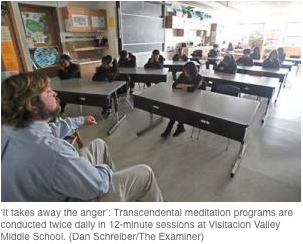
The quiet time program involves the ancient techniques of transcendental meditation, conducted twice daily in 12-minute sessions before and after class.

The first announcement comes over the school’s intercom around 8:45 a.m. — “Prepare for quiet time,” — and the teachers ring a little bell to mark the beginning of the exercise. Most students close their eyes; others cover their faces with their hands and focus on the repetition of a mantra.

“It takes away the anger,” said Charles Ollie, an eighth-grader at the school. “Your brain is like a lake holding in water, and when we meditate, the flood gates open and the water is released.”

Dierke and the school staff credit the program with reducing violence, increasing attendance and test scores and dramatically decreasing suspensions.

Other good things are happening, too, teachers said. The volleyball team made the playoffs this year for the first time in a long time, and some of the eighth-graders are making it into The City’s top high schools, such as Lowell.

Most of the annual $175,000 funding for the program is provided by the New York-based David Lynch Foundation, founded by the TV and movie director. The money is used to pay for dedicated staff to run the quiet time program.

Opponents call it “stealth religion” that violates church-state separation laws because of its association with Eastern religions, but advocates insist that the practice predates Hinduism by thousands of years.

“They come from broken homes, foster care and group home settings,” said Brian Borsos, a special education teacher. “This is a practice that helps them go back and face what they need to face. It’s a skill they take with them for the rest of their lives.”

Program is director Lynch’s brainchild
A handful of San Francisco’s troubled public schools have turned to a transcendental meditation program known as quiet time to relieve high stress in students, made possible by grants from the New York-based David Lynch Foundation.

The TV and film director launched the foundation in 2005 with support from two surviving members of the Beatles and their former meditation instructor Maharishi Mahesh Yogi. But foundation leaders say the practice has nothing to do with religion and is not a church-state separation issue.

Save some minor grumbling and initial skepticism, the San Francisco version of school meditation has not experienced nearly the opposition faced in 2006, when the foundation withdrew funding after parents at Terra Linda High School in San Rafael denouced it as a cult.

Bob Roth, the foundation’s vice president, said the programs in San Francisco have gotten better reception.

Ellie Rossiter, executive director of the nonprofit Parents for Public Schools of San Francisco, said she has heard no opposition to the program. Some of The City’s school officials have even provided testimony on the Lynch Foundation’s website.

“It’s an anchor, it’s a balance for them and I believe it opens them to learning,” Everett Middle School Principal Richard Curci said in a YouTube video.

Soothing results
The meditation program at Visitacion Valley Middle School was instituted in the spring of 2007.

45: Percent reduction in multiday suspensions for quiet-time students in program’s first year
85: Suspensions in 2005-06
10: Suspensions in 2009-10
2.5: Average GPA in fall 2006
2.9: Average GPA in fall 2010
40: Point gain in API score in testing in 2009-10

Source: Visitacion Valley Middle School

dschreiber@sfexaminer.com

Related articles: San Francisco Bay Area News: From time-out to quiet time: meditation comes to SF schools | New research shows Transcendental Meditation improves standardized academic achievementMindShiftKQED: How we will learn: Amidst Chaos, 15 Minutes of Quiet Time Helps Focus Students | and this TM Blog report with video: Breaking the “predictive power of demographics”: SF principal talks about how TM helps his students. And here’s a wonderful report from the The George Lucas Educational Foundation (GLEF): Edutopia: SF School Uses TM to Overcome Problems.

Students find their centers at Maharishi

May 6, 2011


The  Spring 2011 issue of DUH Magazine, Drake University Honors Magazine, in Des Moines, Iowa, describes the unique features of living and learning at Maharishi University of Management, in Fairfield, Iowa, including conversations with teachers, administrators, and students. In the editor’s letter, The spark behind this year’s magazine, Editor-in-Chief Jessica Kinkade comments on the theme for their Spring issue, and how the feature article written by Josie Berg-Hammond exemplifies that theme. Here’s an excerpt:

We chose spark … because we wanted to write stories that would get people thinking—that would spark ideas and curiosity. So this magazine is intended as a catalyst—something to inspire you to have new conversations. … And what sparks conversation and change more than differences? And being open to those differences and letting things inspire us?

Our biggest feature story, written about Maharishi University of Management in Fairfield, Iowa, is perhaps the most genuine example of what it means to be open to this spark of inspiration. l can’t remember how I first heard about the Maharishi, but I was shocked to find out the whole school practices Transcendental Meditation every day. No one in Des Moines seemed to know about it, and I got in my head that it must not be a real school. It couldn’t be. But writer Josie Berg-Hammond was determined to get the real story and see what it was all about. She came back from her visit smiling from ear to ear.

Before l’d even read her story, she was so excited about it. She met so many new people and they were all so friendly. They told her about their schedules, how they eat organic foods, meditate every morning, are in bed by 10 p.m. and only take one class at a time. It all sounds so different from Drake, but the people, the core of the Maharishi community, are still just people … just like us. Their university experience has been a little different from ours, but they sparked thoughts in Josie, and that comes through in her story. The differences between two university communities sparked new relationships and conversations, and what is life about if not those new adventures?

This article was featured in their EVOLUTIONS section of the magazine.

Students find their center at Maharishi

Most high school students look forward to college as a time of new experiences: new friends, new classes, new parties. One thing most students don’t think about: meditation. For students at Maharishi University of Management (MUM) in Fairfield, Iowa, however, that’s at the top of the list.

The four-year, accredited university was founded by Maharishi Mahesh Yogi. The school, originally called Maharishi International University, took over the campus of a recently closed university in 1974 and opened its doors to hoards of students eager to learn through Consciousness-Based education. Now, the school has 1,233 full-time students, both undergraduate and graduate. While the school has many non-traditional students going back for second degrees or graduate school, there are many more students who arrive fresh out of high school.

Four years ago, when he was a high school senior, Brian Faulkner, 22, had a tough decision to make. He could go to a school where he could continue playing soccer or go to MUM where he could continue practicing Transcendental Meditation (TM).

“Now I feel like, thank God I came here,” Faulkner says.

Faulkner has been practicing TM since he was about 4, and it was important to him to continue the practice through college. Even though he had been in the habit for a while, Faulkner said his friends were surprised when he decided to go to MUM.

“The vast majority of my friends never knew I did TM,” Faulkner says. “Some thought I was in a cult; others just said, ‘OK, if you’re happy.’”

“It’s not a cult,” says first year student, Supriya Vidic, 26.

Vidic started school at Maharishi after six years of military service. She says she was ready to reach an inner peace she felt she was missing while she served in the military.

“It’s a total 180 from where I came from,” Vidic says. “With the military, I traveled outwards. Here I travel inwards.”

[TRANSCENDENTAL MEDITATION]
Many students find MUM because they’re looking for something different. Students want to focus on themselves just as much as on their schoolwork. For most, the regular practice of TM is crucial to their educational journey.

First year students are enrolled in an introductory course when they first begin at MUM. This gender-separated experience helps ease students into the MUM way of life. One of the most important things students learn in the class is how to practice TM.

TM is not something that someone can begin on his or her own. While anyone can learn, the practice must be taught. In its most basic form, TM is the practice of closing the eyes, sitting still and settling the mind. Students and professors alike believe TM allows the mind to transcend to a point of pure awareness, allowing the mind to rest deeply and the brain to function with more coherence.

Fred Travis, an MUM professor, says it takes about four days to learn TM and about six months to stabilize it.

“We can ask every student who comes here to learn TM because they can do it. It’s not unattainable,“ Travis says. “Once you get the idea of how the mind transcends, you can do it on your own.”

Students meditate for 20 minutes in the morning and 20 minutes in the afternoon or evening. Travis said this rests the brain and is crucial to Consciousness-Based education.

“You settle down to pure wakefulness,” Travis says.

[CONSCIOUSNESS-BASED EDUCATION]
A healthy vegetarian diet, low homework load and TM are all a part of MUM’s system of Consciousness-Based education. Classes at MUM are set on a block system. This means that students go to one class five days a week from 10 a.m. to 3 p.m. Students are completely immersed in one course for a month and then take a three-day weekend and start up another month-long course.

Professor Travis has spent his career crusading for Consciousness-Based education. He suggests that a switch to this type of learning creates a less stressful, more fruitful academic experience for both professor and student.

“Consciousness-Based education says that the student is the core,” Travis says.

The method encourages less homework, more class time on one subject, sleep, exercise and a healthy diet. Students are encouraged to be in bed by 10 p.m. and are never assigned more than an hour and a half of homework each night, leaving them time to hang out with friends or join extra-curricular groups.

Travis believes that this type of lifestyle is much better than the classic education model. Most students at other universities take about five classes a semester and spend varied amounts of time on homework—all-nighters fueled by energy drinks—for different classes, which often leads to a sporadic schedule. Travis doesn’t think that’s right.

“You don’t sleep, you don’t get good food and then you go out and party,” Travis says. “The brain has no time to relax.”

Travis also finds the class structure of traditional universities lacking. Instead of a lecture class with a final exam at the end, he believes students should be interacting with each other and the professor in order to retain information.

“Final exams are structured forgetting,” Travis says. “With active learning, the professor stops talking and lets the students talk.

[THE FOOD]
Just like any other college campus, MUM has a cafeteria where many of the students eat three meals a day. But MUM’s cafeteria is 100 percent vegetarian with mostly local food and vegan options. And in a world of pre-prepared meals, the MUM cafeteria relies on fresh ingredients every day, often newly harvested from its own garden.

Though most people would find the food at MUM to be a huge step up from the classic cafeteria fare, it’s not always easy to get accustomed to it. According to Ila Zeeb, the director of the first year experience at MUM, students don’t always like the food right away. “For some students, this food is a huge change from home,” Zeeb says.

While many students do enroll as vegetarians, others are confronted with a completely different diet.

Graham Torpey, 24, who graduated from Syracuse University and is now a graduate student at MUM, is thrilled with the meal offerings.

“Man, my health was bad when I was at Syracuse,” Torpey says. “This place is a treasure trove for me. Now, I have a great meal every day.”

The students are also knowledgeable about what food is offered in the cafeteria. Brooke Hadfield, 28, a second-year student from Australia, says it’s important to her to know about her food.

“The honey is the only thing here today that I can think of that isn’t organic,” Hadfield says. “I mean, where else do you get organic food for every meal?”

[SOCIAL LIFE]
Once their bellies are full of organic quinoa and locally grown vegetables, many students head back to their dorm rooms for the evening. Of the 1,233 full-time students at MUM, 544 live on campus. At MUM, students have a single room to themselves, which the university cites as a way to ensure that students have their own quiet, private space.

The dormitories don’t discriminate based on age or gender. That means at MUM, where there is an abundance of nontraditional students, a 20-year-old could have a 60-year-old student for a neighbor. Students don’t seem to mind, though, embracing the opportunity to live in harmony with any age.

“I, personally, like the variety and diversity of ages and culture in the dorms,” Hadfield says. “There’s inherent peace in this environment. It’s easy to live amongst other ages.”

When students aren’t doing their hour and a half of homework in their dorm rooms, Hadfield assures that they’re partying just like any other college student. “The social life here is so much fun,” Hadfield said. “I’m more social here than I am anywhere else.”

Although Des Moines may be the “big city” of Iowa, MUM’s home city, Fairfield, has a pretty bumpin’ social scene. Faulkner described the downtown area as “an oasis of creativity.” In a town of about 9,500, Fairfield has more restaurants per capita than San Francisco and a booming art and music scene. Along with its resident university, Fairfield provides young adults with unique social experiences.

Students and professors at MUM are the first to admit their school is different from most. Transcendental Meditation and Consciousness-Based education are crucial to their academic and personal life. Students are joined together not just by school pride, but also by a deeper journey of self-exploration.

“MUM is a place to grow,” Hadfield said. “A place to expand our potential to function in the most healthy way; the most conscious way.”

To see how the article actually looked, click on this title, Students find their center at Maharishi, to download a pdf of it. This article originally appeared in Drake University Honors Magazine, Spring 2011. The staged photos taken by photographer Sarah Andrews and used with this article actually have nothing to do with our students. That was one of the editor’s decisions for the colorful layout. 

Final note: As part of her final school project, Josie creating a website linking Iowa farmers to Des Moines chefs who are serving their food. So if you’re planning on eating locally in Des Moines, check out the Capital Palate.

See this article by Grandview University journalism students: Maharishi University featured in ALT magazine.

Drake University Honors Magazine’s main feature: Students find their center at Maharishi University

May 5, 2011

This post was moved to: Students find their centers at Maharishi.

I’ve removed the old post and replaced it with this newer one. You can access it here: Students find their centers at Maharishi. Now you don’t have to download the pdf of the article to read it, unless you want to see how it was laid out, and I’ve edited down the editor’s letter to the relevant section. It’s an excellent article, and a great example of an intelligent, open-minded student from a different university who was curious enough to want to find out what MUM was all about. She shares what she learned from visiting with students, faculty and administrators at MUM in this wonderful article.

Enjoy and share this with anyone who may be curious to find out more about Consciousness-Based education at Maharishi University of Management, especially potential students. They can always come to one of our Visitors Weekends and experience for themselves what it’s like to be at MUM.

Thank you.

Ken

Meditation improves maths and English

April 2, 2011

Meditation improves maths and English

Created: Monday, March 28, 2011

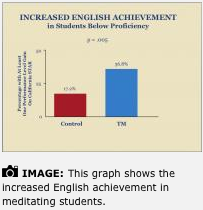
The Transcendental Meditation technique may be an effective approach to improve maths and English academic achievement in low-performing students, according to a new study published in the journal Education.

The study was conducted at a California public middle school with 189 students who were below proficiency level in English and maths. Change in academic achievement was evaluated using the California Standards Tests (CST).

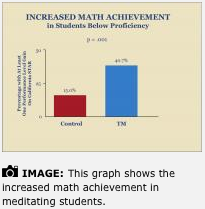
Students who practised the Transcendental Meditation programme showed significant increases in maths and English scale scores and performance level scores over a one-year period. 41% of the meditating students showed a gain of at least one performance level in maths compared to 15% of the non-meditating controls.

Among the students with the lowest levels of academic performance, “below basic” and “far below basic,” the meditating students showed a significant improvement in overall academic achievement compared to the control group, which showed a slight gain.

“This initial research, showing the benefits of the Quiet Time/Transcendental Meditation programme on academic achievement, holds promise for public education,” said Sanford Nidich, EdD, lead author and professor of education at Maharishi University of Management. “The findings suggest that there is an easy-to-implement, value-added educational programme which can help low-performing minority students begin to close the achievement gap,” said Nidich.

Results highly relevant to South Africa

“This study has huge relevance to South Africa,” said Dr Taddy Blecher, director of Consciousness Based Education in South Africa. “The school featured in the study was situated in a poor and often violent neighbourhood, and the students participating in the study were from underprivileged socio-economic backgrounds, with low and sometimes very low levels of proficiency in basic educational skills. These are the same kind of challenges that confront educators in South Africa. At present, standard tests of basic skills (especially maths) at Grade 6 level place South African children near the bottom of the international table.

“Where we have implemented Transcendental Meditation in South African schools,” Blecher continued, “results have been excellent. When 9,000 school-children learned TM in a Gauteng township their pass rates increased by 25%, while the pass rates of 12,000 children in other schools in the area fell by 1%.  South African schools implementing TM have also experienced a marked improvement in student motivation and discipline, as well as teacher morale.”

Faculty of the California school, surveyed as part of the project, reported the Quiet Time/Transcendental Meditation programme to be a valuable addition to the school. They reported the students to be calmer, happier, and less hyperactive, with an increased ability to focus on school-work. In terms of the school environment, faculty reported less student fights, less abusive language, and an overall more relaxed and calm atmosphere since implementation of the programme.

health24 is South Africa’s largest health website.

Also see New research shows Transcendental Meditation improves standardized academic achievement

Meditation on the rise locally, nationally

March 24, 2011

The Daily Iowan: Meditation on the rise locally, nationally

BY KENDALL MCCABE | MARCH 24, 2011 7:20 AM

Click here to view an exclusive photo slideshow.

Yosra Elkhalifa felt stressed. She sat in an individual study room at the Blank Honors Center, her midterm in Theory and Practice of Argument just an hour away. But instead of cramming, she began to meditate.

She did not twist into a yogic pose but sat comfortably in a straight-backed chair with her eyes closed and her hands folded in her lap.

The University of Iowa freshman said transcendental meditation has given her a more positive outlook on life, though she has been practicing for only six weeks.

“I felt like I almost had an advantage over other people because I wasn’t panicking over the test,” she said. “I’ve been able to focus better, which is crucial, because I’m taking 17 credit hours.”

Nationally, the number of Americans meditating is increasing.

Click here to view video. (click here for free QuickTime player download)

According to a 2007 U.S. Census Bureau Survey, nearly 10 percent of the population over 18 practices some form of meditation, up from about 8 percent in 2002.

Locally, both transcendental and Buddhist meditation techniques are growing in popularity, Iowa City instructors said.

Linda Rainforth, who taught Elkhalifa transcendental meditation, conducts free introductory lectures. She said there are well more than 100 Iowa City residents who meditate, with thousands in Iowa.

Her students, who range from 6-year-olds to seniors, often meet at the Iowa City Public Library for group meditation.

Before beginning, they decide how long to meditate, then sit comfortably in their chairs with their eyes closed; the only sound is the ticking of a nearby clock.

“Take a few minutes to come out,” Rainforth whispers when the time is up, prompting students to slowly open their eyes.

College students who want to learn the art of transcendental meditation can take courses, which require a tuition payment.

The David Lynch Foundation, a nonprofit group based in Fairfield, Iowa, aims to fund scholarship programs for schools and other groups and pay for transcendental-meditation training for those wanting to learn the technique. The organization boasts many celebrities on its advisory boards, such as hip-hop pioneer Russell Simmons and actor Stephen Collins.

“We find that people are excited about transcendental meditation as they hear about the [foundation],” Rainforth said. “Many people at the top of their field are coming out and talking about transcendental meditation.”

Rainforth, who has practiced the technique for 34 years, said more than 30 UI students, staff, and faculty practice transcendental meditation regularly. One-third of the participants are new to meditation, she said, but the other two-thirds are “long-term.”

Katie Nimmer-Tsilosani, a North Liberty resident, said she runs a demanding childcare business in her home.

“[Transcendental meditation] provides me deep relaxation as well as a boost of energy that is much appreciated in my busy and fun life,” she wrote in an e-mail.

Link to rest of the article: http://www.dailyiowan.com/2011/03/24/Metro/22323.html.

This article was later mentioned in Third Age.com: Meditation On the Rise in America.

New research shows Transcendental Meditation improves standardized academic achievement

March 21, 2011

New research shows TM improves standardized academic achievement
A study with at-risk urban middle school students

The Transcendental Meditation® technique may be an effective approach to improve math and English academic achievement in low-performing students, according to a new study published in the journal Education.

The study was conducted at a California public middle school with 189 students who were below proficiency level in English and math. Change in academic achievement was evaluated using the California Standards Tests (CST).

“The results of the study provide support to a recent trend in education focusing on student mind/body development for academic achievement,” said Dr. Ronald Zigler, study co-author and associate professor at Penn State, Abington. “We need more programs of this kind implemented into our nation’s public schools, with further evaluation efforts.”

Students who practiced the Transcendental Meditation program showed significant increases in math and English scale scores and performance level scores over a one-year period. Forty-one percent of the meditating students showed a gain of at least one performance level in math compared to 15.0% of the non-meditating controls.

Among the students with the lowest levels of academic performance, “below basic” and “far below basic,” the meditating students showed a significant improvement in overall academic achievement compared to controls, which showed a slight gain.

“This initial research, showing the benefits of the Quiet Time/Transcendental Meditation program on academic achievement, holds promise for public education” said Sanford Nidich, EdD, lead author and professor of education at Maharishi University of Management. “The findings suggest that there is an easy-to-implement, value-added educational program which can help low-performing minority students begin to close the achievement gap,” said Dr. Nidich.

The middle school level is of particular concern to educators because of low academic performance nationally. Sixty-six percent of eighth-grade students are below proficiency level in math and 68% are below proficiency level in reading, based on 2009 National Assessment of Educational Progress data.

Faculty surveyed as part of the project reported the Quiet Time/Transcendental Meditation program to be a valuable addition to the school. They reported the students to be calmer, happier, and less hyperactive, with an increased ability to focus on schoolwork. In terms of the school environment, faculty reported less student fights, less abusive language, and an overall more relaxed and calm atmosphere since implementation of the program.

The study was supported by the David Lynch Foundation.

Study Facts

• This study evaluated change in academic achievement in public middle school students practicing the Transcendental Meditation program compared to non-meditating controls. A total of 189 students (125 meditating and 64 non-meditating students), who were below proficiency level at baseline in English and math, were evaluated for change in academic achievement, using the California Standards Tests (CST).

• Ninety-seven percent were racial and ethnic minority students.

• The Transcendental Meditation program was practiced in class twice a day as part of the school’s Quiet Time program for three months prior to posttesting.

• The Transcendental Meditation program was taught in the context of a school-wide Quiet Time program in which students voluntarily chose the Quiet Time program in which they wanted to participate.

• The Transcendental Meditation technique is a simple, natural, effortless technique that allows the mind to settle down and experience a silent yet awake state of awareness, a state of “restful alertness.” Practice of this stress reduction program does not involve any change in beliefs, values, religion, or lifestyle.

• Compared to eyes-closed rest, research has found that Transcendental Meditation practice is characterized by decreased activation or arousal of the autonomic nervous system, as reflected in decreased breath rate and lower sympathetic nervous system activity. The Transcendental Meditation program has been shown to increase electroencephalographic (EEG) brain integration and coherence, especially in the frontal area of the brain, responsible for higher-order processing.

• Other published research on high school and college students has shown reduced psychological distress, improved positive coping ability, decreased blood pressure, reduced cardiovascular reactivity to stressful stimuli, reduced absenteeism, and decreased school suspensions.

• Results of the current study indicated improvement for meditating students compared to controls on English scale scores (p = .002) and math scale scores (p < .001). A greater percentage of meditating students improved at least one performance level in math and English compared to controls (p values < .01).

• A matched-control subgroup of 50 students in each group yielded similar results.

Facts on Academic Achievement

• According to the National Assessment of Educational Progress (NAEP), 68% of eight grade students nationally are below proficiency level in reading and 66% are below proficiency in math, based on 2009 data.

• Nearly 1.3 million students did not graduate from high school in 2010.

• For further facts please see the National Assessment of Educational Progress: http://nces.ed.gov/nationsreportcard/subjectareas.asp
Also see Alliance for Excellence in Education website http://www.all4ed.org/files/UnitedStates.pdf

###

Posted today, March 21, 2011: New research shows Transcendental Meditation improves standardized academic achievement. Source: EurekAlert!

Also reported in South Africa by health24:Meditation improves maths and English

Also see: San Francisco Bay Area News: From time-out to quiet time: meditation comes to SF schools

This new article: The San Francisco Examiner—Meditation program mends troubled Visitacion Valley Middle School

TM Blog reports (with video): “Meditation mends troubled school in San Francisco” – SF Examiner, and Struggling students find TM improves academic achievement: New research.

MUM BLOG Reports: Transcendental Meditation: Improving academic performance.

See Related Research: Transcendental Meditation Effective Antidote to Record Stress Levels in School Students.

The New York Times: Look Who’s Meditating Now

March 19, 2011

Look Who’s Meditating Now

Evan Sung for The New York Times
POSTER BOY Russell Brand with David Lynch at the December Met fundraiser for Mr. Lynch’s foundation, which promotes Transcendental Meditation.

By IRINA ALEKSANDER
Published: March 18, 2011

RUSSELL BRAND, the lanky British comedian, has made a career of his outrageous antics. While a host at MTV UK, he went to work dressed up as Osama bin Laden. At the network’s annual music awards, he likened Britney Spears to a “female Christ.” And he was fired from the BBC after leaving raunchy messages on the voicemail of a 78-year-old actor, a comic bit that even his country’s then-prime minister felt compelled to denounce.

It is jarring then, to say the least, to hear Mr. Brand, 35, speaking passionately and sincerely about the emotional solace he has found in Transcendental Meditation, or TM. Yet there he was in December, onstage at the Metropolitan Museum of Art (as his new wife, the pop singer Katy Perry, waited backstage), describing how TM has helped him repair his psychic wounds.

“Transcendental Meditation has been incredibly valuable to me both in my recovery as a drug addict and in my personal life, my marriage, my professional life,” Mr. Brand said of the technique that prescribes two 15- to 20-minute sessions a day of silently repeating a one-to-three syllable mantra, so that practitioners can access a state of what is known as transcendental consciousness. “I literally had an idea drop into my brain the other day while I was meditating which I think is worth millions of dollars.”

Mr. Brand was the M.C. at a benefit for the David Lynch Foundation, an organization that offers TM at no cost to troubled students, veterans, homeless people, prisoners and others. Like many other guests in the room, Mr. Brand has been personally counseled by Mr. Lynch, the enigmatic film director, who has been a devout practitioner of TM, founded in 1958 by the spiritual leader Maharishi Mahesh Yogi, since its first wave of popularity in the late ’60s. That is when Mia Farrow, after her divorce from Frank Sinatra, joined the Beatles in the Maharishi’s ashram in Rishikesh, India; when George Lucas started meditating and was rumored to have based the Yoda character in “Star Wars” on the Maharishi (the resemblance is eerie); and when the talk show host Merv Griffin, after being introduced to the technique by his tennis buddy, the actor Clint Eastwood, invited the Maharishi to be on his show in 1975.

Since then, the celebrity endorsement, and therefore the enrollment numbers, had quieted down. That is, until the last three years when, according to the national Transcendental Meditation program, enrollment tripled.

At Trinity College in Hartford, the women’s squash league began meditating together after every practice last year. The Doe Fund, an organization that assists the homeless, has begun offering TM to its residents along with computer skills and job training. And Ray Dalio, the billionaire hedge-fund manager of Bridgewater, has long credited the success of his funds to his daily practice.

The Transcendental Meditation program attributes the spike to a series of recent studies that suggest TM can help reduce blood pressure and stress, and to the relatively recent affordability of TM. (The adult course, which had ballooned from $75 in the ’60s to $2,500 in 2007, dropped, because of the economy, to $1,500 in 2008.) No less important has been Mr. Lynch’s foundation, started in 2005, for which enlisted celebrities like Mr. Brand, interrogated often by news outlets about their diets and alternative lifestyle remedies, have been preaching about the technique.

“It’s like, imagine the ripples on top of an ocean,” Dr. Mehmet Oz, who meditates in an armchair in an enclave off his bedroom, said at Mr. Lynch’s benefit. “And I’m in a rowboat, reactively dealing with the waves and water coming into my boat. What I need to do is dive into the deeper solace, the calmness beneath the surface.”

The actress Susan Sarandon meditates once a day for 20 minutes in bed. “It helps me chill out and focus,” she said. (Ms. Sarandon said she doesn’t practice TM specifically, but was at the benefit to gather insight.)

The singer Moby, another guest, has meditated in the back of a taxicab. “Transcendental Meditation has given me a perspective on agitation,” he said. “That it’s a temporary state of mind and I don’t necessarily need to take it that seriously.” Moby said the technique helped him quit drinking more than a year ago. “I used to think that TM was for weird old hippies,” he added. “But then I heard that David Lynch was involved, and that made me curious.”

ON the afternoon before the benefit, Mr. Lynch, 65, arrived at the museum, holding hands with his wife, Emily Lynch, 32, and was escorted by a museum employee to a green room downstairs. Mr. Lynch, like a cartoon character, has maintained the same uniform for decades: a pressed white shirt under a boxy black suit and a hedge of gray hair. He scooped up a soggy egg-salad sandwich from a tray and explained what brought him to the practice.

“I was not into meditation one bit,” Mr. Lynch said, in his laconic Missoula, Mont., drawl that years of living in Los Angeles has failed to dilute. “I thought it was a fad. I thought you had to eat nuts and raisins, and I didn’t want any part of it.”

Mr. Lynch was persuaded by his sister, Martha, when he began having marital difficulties with the first of his four wives, Peggy, in the early ’70s. “I had a whole bunch of personal anger that I would take out on her,” he said. “I think I was a weak person. I wasn’t self-assured. I was not a happy camper inside. Two weeks after I started, my wife comes to me and says, ‘This anger, where did it go?’ I felt a freedom and happiness growing inside. It was like — poooft! — I felt a kind of smile from Mother Nature. The world looked better and better. It’s an ocean of unbounded love within us, so it’s real hard to get a conflict going.” (Still, a year later, the couple divorced.)

It’s easy to shrug off such utterances as hokey, New Age prattle — who can forget Jeff Goldblum’s flaky character in “Annie Hall” on the phone, complaining that he’d forgotten his mantra? — but less so when the person reciting it has dreamed up his most widely admired, vivid films on the days when he was dropping out of consciousness for at least 30 minutes a day.

“Artists like to say, ‘I like a little bit of suffering and anger,’ ” he said. “But if you had a splitting headache, diarrhea and vomiting, how much would you enjoy the work and how much work would you get done? Maybe suffering is a romantic idea to get girls, but it’s an enemy to creativity.”

A version of this article appeared in print on March 20, 2011, on page ST1 of the New York edition. It was also published Saturday, March 26, 2011, in the TheLedger.com: Transcendental Meditation: Celebrities, Recent Biological Studies Increase Interest in Discipline

Report on the Victoria School for Ideal Education

March 10, 2011

Victoria School for Ideal Education

Hilary Hillman, a Community News Specialist for The Daily, files a report on the Victoria School for Ideal Education. Have a look inside this Canadian  independent elementary school in Victoria, BC where children practice Transcendental Meditation twice a day. The younger children perform a simple walking meditation version of the technique, which does not involve any special breathing or centering techniques as mentioned in this report. Children over 10 years of age practice TM sitting comfortably with eyes closed. In these seemingly more progressive times, the introduction of yoga and/or meditation, especially the  Transcendental Meditation technique, is becoming part of an ongoing healthy trend in education.

Also see this wonderful video on the Victoria School for Ideal Education posted in this Message from Monique.

THE WEEK: Getting the flavor of Iowa’s aura

February 23, 2011

The Chicago Tribune article, which came out a few months ago on Fairfield, TM, MUM, and The Raj, continues to be published in major papers throughout the country, and now around the world. The current issue of The Week, a very prestigious weekly magazine, included a synopsis of that story. The Week takes the best of international media and publishes it in their US, UK, and AU editions. So American, British, and Australian subscribers are now reading about us! It is also available online at their websites, but you have to be a subscriber to access it. Here is a shortened link to the article for subscribers: http://bit.ly/fYNcXL. Below is the text copied from a jpg of that page someone sent me. The column, Getting the flavor of…Iowa’s aura, is in the middle of the bottom right corner of a page in the Travel section of the Arts+Life section in this week’s issue: THE WEEK February 25, 2011.

Getting the flavor of…
lowa’s aura

Fairfield is “not just any Iowa town,” said Josh
Noel in the Chicago Tribune. Though “hemmed
in by farms” and rich in traditional Midwestern
charm, this small county seat does double
duty as a mecca for transcendental meditation,
or TM. Maharishi Mahesh Yogi, who began
the TM movement in the late 1950s, moved
his Maharishi International University from
California to Fairfield in 1974. The town got
caught up in the phenomenon, and today “a
quarter to a third of the population” practices
meditation. Twice a day, hundreds of locals,
including the mayor, meditate at precisely the
same time. Visitors are welcome, and can book
tours of various TM sites. I made an appointment
for shirodhara, a treatment that involves
“pouring a steady stream of oil on the forehead”
to balance the mind. “Life’s busy thoughts faded
as the oil rhythmically fell.” travelfairfieldiowa.com

Also see Chicago Tribune—The Iowa aura

Pathways Magazine: Taking Care Of The Student – The Forgotten Element In Education

February 18, 2011

Taking Care Of The Student – The Forgotten Element In Education

The surgeon general said that America is swimming in an ocean of stress. If this is true, our children are drowning in it. ~ Robert Roth, Vice President of the David Lynch Foundation

A teacher of a Montgomery County high school describes the 7:30 AM morning: kids with hoods pulled over their eyes, practically sleepwalking. At their desks, students are slumped over, exhausted – sleep deprived.

A school counselor describes a student whose deep anxiety constricts her ability to understand a basic math concept, and another student whose pressure to succeed is so intense that anxiety escalates into insomnia, depression, and feelings of suicide.

In most schools in our country, the student himself, and his instrument of learning – his physiology – are being ignored. We are experiencing – possibly promoting – epidemics of sleep deprivation and stress in our schools, and in the general public. Not only do we not pay attention to students’ physical health, we do the opposite: impose physical and mental strain – sometimes to the breaking point – often with serious, long-term results for both physical and emotional health.

In this article, we look at some recommendations and programs addressing this problem. We begin with refreshing our understanding of the goal of ideal education. Next we look at sleep deprivation, stress, anxiety, and related problems of ADHD and depression, and the impact on student health and learning. Next, advice by professionals who work in this field of stress and adolescence will be presented. Finally, we look at promising examples where recommendations are successfully implemented: a school in D.C., the Ideal Academy Public Charter School, experiencing remarkable results by incorporating “Quiet Time” into the daily routine; and breakthrough research on ADHD and “Quiet Time” from several middle schools.

WHAT DOES EDUCATION REALLY MEAN?

All that lies before us and all that lies behind us are tiny matters compared to what lies within us. ~ Emerson.

Education comes from the Latin root ‘educere’, meaning to ‘draw out from within’ or to ‘lead forth’. ‘Education’ means something other than filling up the mind with information. Socrates said, “Education is the kindling of a flame, not the filling of a vessel.” It involves cultivating the
student’s inner genius, innate intelligence, creativity, consciousness.

Quite clearly the two great things for which we aim are the improvement of intelligence and the deepening and the extension of the feeling of friendliness and love. ~ Aldous Huxley

A student truly being educated is not merely learning information. He is cultivating the quality of his awareness: becoming more awake, clear, creative. He is developing his character: virtues of friendliness, helpfulness, compassion. And cultivating a love of learning and sense of vitality: feeling interested, enthusiastic, capable, confident.

The qualities we often find in great people – flexibility, curiosity, energy, receptivity to new ideas, and lovingness – are first found in children and then maintained through adulthood. ~ Dr. Melanie Brown, Attaining Personal Greatness: One Book for Life

But what are we doing to cultivate these qualities in our students? It seems clear that we often forget the meaning and goal of education.

Click on the above title for a Google docs quick view of the entire article, including photos, and/or download the PDF of Taking Care Of The Student – The Forgotten Element In Education, originally printed in the Winter 2009 issue of Pathways Magazine, Washington, DC.