It’s funny how events that happened thirty, even forty years ago, can come back to life in your mind. Sometimes all it takes is one thing to trigger old memories. Here is an example of that one thing, one quote, one memory, that led to another, and another, which then turned into this two-part blog post on learning about and facilitating the writing process in myself and in others.
Part One
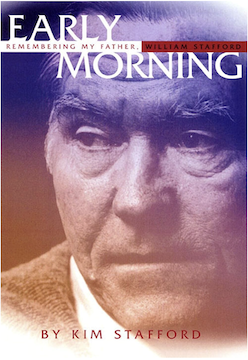
I usually sit in a mini recliner chair next to my library when I meditate. The top shelf is filled with books on poetry and writing. After a recent morning session, I pulled out a favorite—Early Morning: Remembering My Father, William Stafford by Kim Stafford. In it were a few of the thin plastic liners we used to peel off to seal and mail back DVDs in those Netflix red envelopes. They made perfect little bookmarks to highlight certain poems or quotes on writing I liked. I recognized some that ended up in blog posts on this well-known seminal poet and non-conventional writing instructor.
What a writer is
One sentence that stood out for me is on page 160 in the chapter, Priest of the Imagination, the same title of an essay William Stafford had written on his unique way of facilitating writing in students. The quote was featured on the back cover of You Must Revise Your Life highlighting his earlier compilation on the subject, Writing the Australian Crawl: Views on the Writer’s Vocation, which opens the chapter, A Way of Writing, on page 17. It epitomized Stafford’s approach to writing.
A writer is not so much someone who has something to say as he is someone who has found a process that will bring about new things he would not have thought of if he had not started to say them.
The paragraph continues: That is, he does not draw on a reservoir; instead, he engages in an activity that brings to him a whole succession of unforeseen stories, poems, essays, plays, laws, philosophies, religions, or—but wait!
A writer is not so much someone who has something to say as he is someone who has found a process that will bring about new things he would not have thought of if he had not started to say them. — William Stafford
Committing to the process
That act of submitting and committing to the process, and what unforeseen things might follow from it, reminds me of a famous quote from William H. Murray, author of The Scottish Himalayan Expedition.
Until one is committed, there is hesitancy, the chance to draw back. Concerning all acts of initiative (and creation), there is one elementary truth, the ignorance of which kills countless ideas and splendid plans: that the moment one definitely commits oneself, then Providence moves too. All sorts of things occur to help one that would never otherwise have occurred. A whole stream of events issues from the decision, raising in one’s favor all manner of unforeseen incidents and meetings and material assistance, which no man could have dreamed would have come his way. Whatever you can do, or dream you can do, begin it. Boldness has genius, power, and magic in it. Begin it now.
I found another bookmark between pages 164 & 165, and wondered what part I thought was worth quoting. I hadn’t yet, but this first of two sentences stood out to me, and is worth posting here now.
Once you decide to write in your own voice, for your own purposes, in your own way—then the act of writing is your teacher. Other writers, perhaps some in the role of “teacher,” become companions in our common search for uncommon things.
Once you decide to write in your own voice, for your own purposes, in your own way—then the act of writing is your teacher. — Kim Stafford
Kim Stafford discussed his father’s approach—asking students questions “to get at the heart, the origin, the authentic source of the student’s life in writing. … It wasn’t about texts for improvement, but about the pure beginning.”
He previously mentions a 1950s handout his father gave students, “Assumptions About Literature Classes”. He sought freedom for the private writer, but with the benefit of company. The course description lets students know there would be no pressure to write and they would not be graded. As for “Difficulty, etc.: Kim quoted the description:
The course is easy, no hazards. Minimum involvement can be very light. At an extreme of involvement, the course could become a career.
I had to laugh at the sincere understated irony of that last statement.
The practice of the writer
Kim goes on to say: “The last point is the core of my father’s teaching: start the utterly authentic life right now. We are not practicing to be writers; we are entering into the practice of the writer, revising our very lives, yielding in each moment to the vocation that demands our deepest allegiance.”
For Kim’s father, the classroom was a collaborative place where young writers could help each other with their writing by giving feedback. Further down the page he elaborates: “The class was a village honoring each student’s native discoveries, and learning occurred as a process of mutual discovery in which the teacher’s principal concern was to avoid the occupational hazard of hoarding authority.”
Part Two
Introducing students to writing
During my time as a graduate student in Education at MIU in the mid-80’s, one of the courses we took was teaching writing to students. I had also volunteered to become a writing facilitator outside of class. I took the training and read books about learning and teaching the writing process by Donald Murray (Learning by Teaching), Donald Graves (Writing: Teachers & Children at Work), Lucy Calkins (Lessons from a Child), and, over the years, writers like Natalie Goldberg (Writing Down the Bones), Ann Lamott (bird by bird), and Burghild Nina Holzer (A Walk Between Heaven and Earth: A Personal Journal on Writing and the Creative Process), to name a few. I helped students with their writing, and did some of my own.
Recalling the quotes in Part One triggered memories of when I worked at a Sylvan Learning Center in North Vancouver, BC after I had returned to Canada in the mid-90’s. The center offered individualized tutoring with a school-aligned curriculum in Math, Reading, Writing, and Science. When it came to helping students after school with writing, instead of working with the curriculum, which included lessons on grammar, the administrator I reported to—an upbeat American woman who was familiar with the newer student-centered process approach to writing—thankfully gave me free rein due to my training and the success I was starting to have with some of the more stressed students. They were very nervous about having to write anything. So, I first set them at ease by asking them questions about their personal interests. I wanted to know what they were passionate about, what was meaningful to them.
A girl and her horse
One young girl talked about her horse, how she liked to groom and ride him. I encouraged her to write that down and to tell me more about the horse, to describe him. What color was he? Before she knew it, she had written something worthwhile. I asked her to read it aloud. When done, she smiled; it wasn’t as difficult as she had imagined it to be. She felt good about herself as a writer. This was a good beginning.
Hollywood North connection
I later remembered her mentioning that her uncle, a cameraman for The X-Files, met and fell in love with the show’s costar, Gillian Anderson, who played FBI Special Agent Dana Scully. She was like an auntie to her. One day, her uncle and Anderson walked into a North Vancouver jewelry store to pick out an engagement ring. Someone later verified it and the news was told to a local columnist. The story went viral.
Not long after I had arrived in Vancouver, a friend had taken me for a meal at The Naan, Vancouver’s well-known vegetarian restaurant. It was so popular, people would line up outside to get in. I soon realized that I was standing behind David Duchovny, aka FBI Special Agent Fox Mulder! He was there with an older lady friend for lunch. When we were seated, our table was along the same wall close to theirs. A few pretty young women walked up to David to tell him how great last week’s show was.
Which reminds me of another story I heard on the local radio station while I was there. It involved a very famous Hollywood actor who was in town making what would become a popular movie. Scroll down to the second part of this blog post to read the story and discover who it was. But I digress.
What, me worry?
I don’t remember working much with this student, but he is worth mentioning. This boy showed up wearing a T-shirt with Alfred E. Newman on the front, Mad magazine’s mascot. The crazy thing was, he looked exactly like him, with the same red wavy hair, freckled cheeks, silly grin, and protruding ears. Instead of being made fun of, he took advantage of the similarity, which made him popular. Smart move.
A boy and his bagpipes
But I do remember this one boy who was so nervous about having to write, his hands were shaking. He said he couldn’t write and really didn’t want to. With some gentle prodding I found out that he played the Scottish bagpipes. He was so good, he had been asked to play with the local college marching band on weekends! I checked with my advisor first and then asked him if he would bring his bagpipes to the next class. He did, and before the sessions started, he played for all of us. He was very good. The sound of the pipes filled the room with traditional Scottish music. Everyone was impressed and applauded. Flush with excitement and appreciation, he sat down and agreed to write about the bagpipes, a natural topic for him. When he realized he could do it, his fear began to lift; he felt more self-assured, happier.
The mystery writer
Another boy wanted to write a detective story. He was excited and highly motivated. I asked him to tell me about it. He shared some ideas, and I told him to go for it. At some point, he wanted to know how to show characters speaking to each other. I asked him if he knew what quotation marks were and how to use them. He did not. So I suggested he bring that large grammar book to the table. We looked it up and reviewed it together. He began to write dialogue. He was pleased with himself. He was learning through his own writing. This was his project and he continued with it from class to class until he felt it was finished.
A mother’s feedback
Some time later, a day was arranged for parents to meet with administrators and teachers to review their children’s progress. The mystery writer’s mother showed up and told us that her son’s grades had improved, not only in English, but also in History. (Learning how to express oneself in the written and spoken word are skills needed in most disciplines.) She added that he was more confident in class. And, he was happier at home. His public school teachers had noticed these changes in him and mentioned them to her during their parent-teacher meeting. She was very appreciative. Great feedback for a writing tutor!
The pianist
An older Asian girl was there to improve her English skills for college entrance. I asked her about her hobbies. She played classical piano. I asked her who her favorite composers were and which pieces she liked to play. She had a lot to say about that and started writing. In another session, she shared an unusual event that her grandfather had told her about when he was a young man traveling throughout China. I suggested it might make for an interesting story and asked questions for more details, which she willingly wrote down. In both cases, when questions about vocabulary or grammar came up, we resolved them together. She reworked her drafts. They turned out to be excellent pieces of writing. Even the other teachers were impressed with her growing language fluency and skill as a writer.
Taking care of the writer
In each case, I asked questions to draw out more information, to provide more details. When they said something interesting, I suggested they write it down, and then continue. Like this, they lost their fear of writing, because they were free to share what they were passionate about, to tell their own story. Once they had an initial draft on paper, I had them read it out loud to the rest of us at the table. Some liked it. Some had questions for further clarification. As listeners and readers, they instinctively knew what to do. They revised and improved their written drafts—something they were motivated to do. They were finding their own voice as a writer with something to say that was unique to them. Surprised, they ended up with a piece of writing they felt good about.
They were finding their own voice as a writer with something to say that was unique to them. — Ken Chawkin
Satisfied, it confirmed for me what the leading researcher and teacher of writing in school, Donald Graves, had said about the profession: “If you take care of the writer, the writing will take care of itself.”
If you take care of the writer, the writing will take care of itself. — Donald Graves
Other posts worth seeing on this topic are: The perils of praise or blame for young writers. New ways to help students find their own voice and Writers on Writing–What Writing Means To Writers. One of the first poems I wrote was Writing—a poem on the writing process, inspired by reading and applying what Donald Murray and William Stafford had said about it.
Also see William Stafford prescribed creative writing to find your own voice and reveal your inner light, which includes that famous first quote in this post. See other quotes from Early Morning: Remembering My Father, William Stafford mentioned in William Stafford’s last poem now seemed prophetic—an unintended literary epitaph. Kim Stafford used key phrases from some of the lines in his father’s most profound and popular poem, The Way It Is, as main chapter headings for Early Morning. See more posts/poems about/by William Stafford listed on pages one and two of The Uncarved Blog.
Discovering William Stafford
William Stafford was a poet, a lifelong pacifist, and National Book Award winner. He was a conscientious objector during World War II, and taught at Lewis & Clark College for decades. He was also a Consultant in Poetry to the Library of Congress, now called, Poet Laureate Consultant in Poetry. He later served as Oregon’s Poet Laureate for many years.
William Stafford rose very early every morning while it was still dark out, made himself a cup of coffee, reclined on the couch, and wrote in his journal before anyone one was awake. He cultured this habit while working in public service camps for COs during WWII and continued the practice throughout his life. He wrote at least one poem a day, along with letters to friends, submissions, and other correspondence.
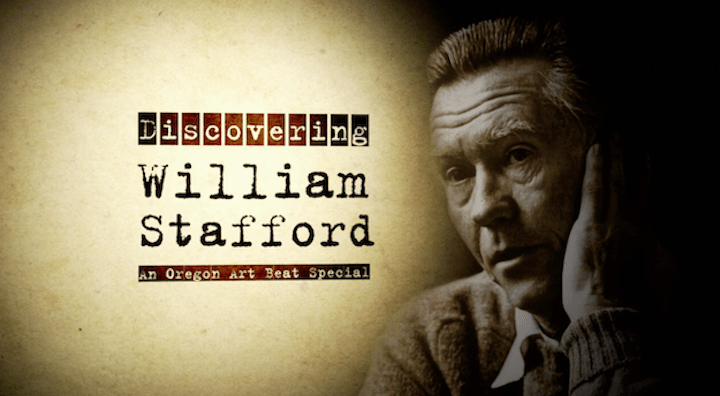
Towards the end of putting this post together, I came across a program celebrating the 100th anniversary of his birth. In this OPB Oregon Art Beat Special, Discovering William Stafford, (Season 15, Episode 8), Oregon’s beloved poet laureate describes how he captures and expresses life in words. “I have an appetite for finding that perfect fit of language with the experience of life as you’re having it right now. Every now and then you can break off a piece of that and call it a poem.” How did he do this? He lowered his standards and kept going—what he told his students to do when they said they couldn’t write a poem a day.
Also available on Iowa PBS, Discovering William Stafford is a wonderful short biography featuring many voices, some well-known, like Garrison Keillor, who, in the promo, says something surprising, yet so true: “The basis, I think, for loving Stafford, is that you read him and you feel that you and he are friends.” He opens the program reading Once in the 40’s. Throughout the show, writers and artists take turns reading Stafford poems. One that introduced me to him and got me hooked, is When I Met My Muse. The show ends with Stafford’s son Kim and daughter Barbara, and the others, alternately reciting lines from The Way It Is—a most appropriate way to remember and honor this much-loved, unassuming, compassionate, creative soul.
You can also watch it using the PBS viral player in full screen mode: https://player.pbs.org/viralplayer/3010539588/.
A final thought
If you made it this far, I’ll leave you with this final thought I had as I’ve been rereading, remembering, adding, and rewriting what I wrote. I am reminded of the difference a good teacher can make in a student’s life. My grade six teacher did for me. Maybe there was one who did for you. Teachers who enter the profession generally aspire to make a difference in their students’ lives. I remember reading a book about it that you may also enjoy: An Apple for My Teacher: Twelve Writers Tell about Teachers Who Made All the Difference. Bye for now. Keep writing and rewriting. 😉
— Written and compiled (citing sources) by Ken Chawkin for The Uncarved Blog.


 The Uncarved Blog