Posts Tagged ‘Transcendental Meditation’

Record of the Day: BMI named Donovan a BMI Icon

October 8, 2009

Record of the Day

BMI Award winners
2009-10-07

American music rights organization Broadcast Music, Inc. (BMI) lauded the UK and Europe’s premier songwriters, composers and music publishers tonight during its annual BMI London Awards. The ceremony was hosted by BMI President & CEO Del Bryant; BMI Senior Vice President, Writer/Publisher Relations Phil Graham; and Executive Director, Writer/Publisher Relations, Europe & Asia Brandon Bakshi. Staged in London’s Dorchester Hotel, Park Lane, the event honored the past year’s most-performed songs on U.S. radio and television. BMI is a United States-based performing right organization that collects and distributes monies for the public performance of music on outlets including radio, television, the Internet and the top-grossing tours in the U.S. British citizens honored at the event are members of the UK performing right society PRS for Music (PRS) and are represented in the US by BMI.
In addition to saluting numerous UK songwriters, composers and music publishers alongside music creators from Europe, India and other international markets, BMI named Donovan a BMI Icon. The Icon designation is given to BMI songwriters who have bestowed “a unique and indelible influence on generations of music makers.” Donovan joins an elite list of past honorees that includes multi-genre nobility Bryan Ferry, Peter Gabriel, Ray Davies, Van Morrison, the Bee Gees, Isaac Hayes, Dolly Parton, James Brown, Willie Nelson, Paul Simon, Steve Winwood and more.
Donovan transformed popular music in the 1960s, earning 12 consecutive Top 40 hits, including “Mellow Yellow,” “Sunshine Superman,” “Wear Your Love Like Heaven,” “There Is a Mountain,” “Lalena,” “Epistle to Dippy,” “Atlantis,” “Hurdy Gurdy Man,” and “Jennifer Juniper,” all of which he wrote alone. His compositions have also resurfaced in hit films and television series, as well as various advertising campaigns. In 1965, “Catch the Wind” earned an Ivor Novello Award for best contemporary folk song, marking the first time the honor was bestowed on an artist’s debut single. Donovan received an Honorary Doctor of Letters from the University of Hertfordshire in 2003, and in 2009, he became Officer of the Order of Arts and Letters from the Minister of Culture, France, and garnered the American Visionary Art Museum Baltimore’s prestigious Grand Visionary Award. A man not only of unfathomable talent but of rare conviction as well, he is a well-known proponent and student of Transcendental Meditation and leads the musical wing of the David Lynch Foundation for Consciousness-Based Education and World Peace. Hard at work on a new album entitled Ritual Groove, Donovan plans to tour continuously through 2010.

Read about the other BMI Award winners in the complete article here: http://bit.ly/uK5DQ

Donovan to be Named Icon at BMI London Awards

October 4, 2009

Donovan to be Named Icon at BMI London Awards

Donovan.BMI.IconLONDON: Donovan will be named a BMI Icon at the U.S. performing right organization’s annual London Awards, slated for Tuesday, October 6 at London’s Dorchester Hotel, Park Lane. The invitation-only gala will recognize the U.K. and European songwriters and publishers of the past year’s most-played BMI songs on American radio and television. Broadcast Music Inc. (BMI) is a United States-based performing right organization that collects and distributes monies for the public performance of music on outlets including radio, television, the Internet and the top-grossing tours in the U.S.

The Icon designation is given to BMI songwriters who have bestowed “a unique and indelible influence on generations of music makers.” Donovan joins an elite list of past honorees that includes multi-genre nobility Bryan Ferry, Peter Gabriel, Ray Davies, Van Morrison, the Bee Gees, Isaac Hayes, Dolly Parton, James Brown, Willie Nelson, Hall & Oates, Paul Simon, Crosby, Stills & Nash, Steve Winwood and more.

Donovan is a master of poignant simplicity. Capable of evoking passionate idealism and freewheeling emotion in a single word or chord, he transformed popular music in the 1960s and went on to build a legendary career. Already a folk hero in the early 60s thanks to hits including “Catch the Wind” and “Colours,” Donovan proceeded to generate considerable radio success for the rest of the decade with 11 consecutive Top 40 hits, including “Mellow Yellow,” “Sunshine Superman,” “Wear Your Love Like Heaven,” “There Is a Mountain,” “Lalena,” “Epistle to Dippy,” “Atlantis,” “Hurdy Gurdy Man,” and “Jennifer Juniper,” all of which he wrote alone. While “Jennifer Juniper” has generated more than 1 million performances, “Mellow Yellow” has earned more than 2 million and ““Sunshine Superman” has garnered almost 3 million performances. His compositions have also resurfaced in hit films and television series including Goodfellas, Election, Dumb and Dumber, Rushmore, The Simpsons, Nip/Tuck, Ugly Betty, Clueless, Boys on the Side, Murphy Brown, My Name is Earl and Dancing with the Stars.

Donovan was profoundly influential on the Beatles, becoming one of an elite handful of artists who collaborated on songs with the band. In 1965, “Catch the Wind” earned an Ivor Novello Award for best contemporary folk song, marking the first time the honor was bestowed on an artist’s debut single. Donovan received an Honorary Doctor of Letters from University of Hertfordshire in 2003, and in 2009, he became Officer of the Order of Arts and Letters from the French Republic and garnered the American Visionary Art Museum Baltimore’s prestigious Grand Visionary Award.

A man not only of unfathomable talent but of rare conviction as well, he is a well-known proponent and student of Transcendental Meditation and leads the musical wing of the David Lynch Foundation for Consciousness-Based Education and World Peace. In the past three years, Donovan has traveled with David Lynch throughout the United States, the UK, and Brazil, performing his hit songs and speaking on the benefits of meditation.

The David Lynch Foundation has now provided scholarships for more than 100,000 at-risk youth worldwide to learn to meditate. http://www.davidlynchfoundation.org

Hard at work on a new album entitled Ritual Groove, Donovan plans to tour continuously through 2010.

While BMI collects royalties for him in the United States, Donovan is a member of British performing right society PRS for Music.

Hosted by BMI President & CEO Del Bryant; BMI Senior Vice President, Writer/Publisher Relations Phil Graham; and Executive Director, Writer/Publisher Relations, Europe & Asia Brandon Bakshi, the BMI London Awards will also present the Robert S. Musel Award to the writer and publisher of the most performed song of the year. BMI will also bestow “Million-Air” certificates on writers and publishers whose songs have achieved more than three million U.S. radio and television performances — the equivalent of more than 17 years of continuous airplay.

Broadcast Music, Inc.® (BMI) is an American performing right organization that represents more than 375,000 songwriters, composers and music publishers in all genres of music and more than 6.5 million works. BMI reported $901 million for its 2008 fiscal year in performing right collections. BMI has represented the most popular and beloved music from around the world for 70 years. The U.S. corporation collects license fees from businesses that use music, which it then distributes as royalties to the musical creators and copyright owners it represents.

###

Contacts:

USA – Hanna Pantle, BMI

310-289-6328; hpantle@bmi.com

UK – Kate Etteridge, LD Communications

44-(0)20-7439-7222; kate.etteridge@ldcommunications.co.uk

Photo credit: Stuart Steele

Q & A with Mike Love

October 1, 2009

Arkansas Times

Q&A with Mike Love

Lindsey Millar
Updated: 10/1/2009

Print E-mail del.icio.us Digg this

Mike Love
MIKE LOVE

In advance of the Beach Boys’ performance with the Arkansas Symphony Orchestra on Sunday, I spoke by phone to original member Mike Love, 68, about the benefits of transcendental meditation, being cast as a bad guy in the Beach Boys’ story and “acid alliteration.”

You still practice transcendental meditation?

Yes, I do. I did it this morning. I do it, as it’s meant to be, twice a day, morning and evening. It’s been a huge help in my life in terms of combating stress, but also giving me that deeper rest. Transcendental meditation can lower your metabolism to the level of rest twice as deep as deep sleep. I learned from Maharishi in Paris in December of 1967, and I’ve been doing it ever since.

So many of your greatest songs were about teen-age life and high school concerns. Does it get harder to sing those songs the farther removed you get from those days?

I have a young daughter. She came home from school three or four years ago and said, “Hey Dad, my fourth grade class’ favorite songs is ‘Wouldn’t It Be Nice.’” For children, pre-teens, teens and young adults, “Wouldn’t It Be Nice” is relevant to their lives at the place where they are. For me and for people who started out as fans of the Beach Boys in the ’60s, it’s going to be nostalgic. The fact that we’re appreciated by multiple generations is a blessing.

The Beach Boys have their own little slice of Americana. My mom and Brian, Dennis and Carl Wilson’s father were sister and brother. Whenever we got together for a birthday party or Thanksgiving or Christmas, it was always music. We had a grand piano, an organ and a harp in my living room, and we’d have these family get-togethers with aunts and uncles and cousins. The Beach Boys becoming a career started out as a love of singing and making harmonies together.

Do you feel like you’ve been cast as the bad guy in the Beach Boys story?

In some places. I think it’s the result of my not getting credit for a lot of the songs I wrote with Brian. I co-wrote “California Girls” and “Help Me Rhonda” and “I Get Around,” but I was never credited. Brian was under a conservatorship, an attorney, who would not allow him to right those wrongs. Yet wanted to. I know he wanted to because he told me so, but he wasn’t in charge of his business affairs because of the issues he’s had, emotionally and mentally, over the years. I wasn’t thrilled about being cheated or not credited, but as far as my relationship with Brian, how he felt about things and that he always wanted to rectify things and subsequently things have been, for the most part, rectified.

What about the idea that you hampered the creative evolution of the band?

That’s another fabrication. We all worked on the “Pet Sounds” album as diligently as we could as humans. Brian was the producer and he did the great orchestrations, but we all worked on the vocals extremely hard. Brian and I both went to Capitol Records and presented them with the record. Any talk of me not being in favor of “Pet Sounds” is garbage. So there’s misinformation like that that has its own life on websites that’s not true. If something’s true, I’ll own up to it. For instance, we wrote “Good Vibrations” together, and it went to number one. The follow-up to that was “Heroes and Villains” and that was done with another co-writer.

Van Dyke Parks.

Right. And it went to number 48 or something. I asked Van Dyke, what does “over and over the crow cries uncover the cornfield” mean, or “have you seen the Grand Coulee working on the railroad?” I coined the term “acid alliteration.” That’s what I called it. It’s absolutely true that I have an issue with doing lyrics that are so obscure and oblique that they can’t be relatable to by most people. I mean they can be appreciated, and I do appreciate the art form itself. But I like art that relates to people to the point where a song has a chance to go to number one. So I am guilty of liking songs that are artistic as well as popular.

So all of the court battles have been resolved and you and Brian and Al are in a good place?

Yeah, there’s no outstanding legal fracases going on, which is a good thing because there’s been some dialogue between Brian and I getting together and seeing what we could come up with, and there’s a 50th anniversary of the Beach Boys coming up in a couple of years, and it would make a lot of sense to do something together.

http://bit.ly/3qmn2t

KTVO 3: M.U.M. Gets $1 Million Research Grant

September 26, 2009

MUM gets $1 million research grant

Friday, September 25, 2009 at 6:37 p.m.

FAIRFIELD, IOWA — University Receives $1 Million NIH Grant for Mind-Body Medicine Research

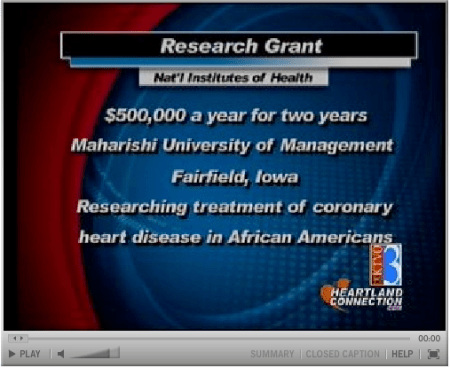
The National Institutes of Health recently awarded a grant of $500,000 per year for two years for research on the Transcendental Meditation® technique in the treatment of coronary heart disease in African Americans.

The research is a collaboration between Maharishi University of Management Research Institute’s Center for Natural Medicine and Prevention and Columbia University Medical School in New York.

The funding comes from the American Recovery and Investment Act, via the NIH-National Heart, Lung and Blood Institute.

About 21,000 applications were submitted to NIH for these specific funds, with just 3% receiving grants.

“This recent achievement continues to place MUM Research Institute and its research on the Transcendental Meditation technique and Maharishi Vedic MedicineSM programs in an elite category in academic medicine,” said project director Robert Schneider, M.D., F.A.C.C., and dean of the Maharishi College of Perfect Health.

The research will compare the effectiveness of cardiac rehabilitation with and without the Transcendental Meditation program, especially after a heart attack. The study will utilize positron emission tomography (PET) to image and quantify changes in heart disease in the patients.

The Center for Natural Medicine and Prevention team includes Sanford Nidich, EdD, Carolyn King, PhD, Maxwell Rainforth, PhD, John Salerno, PhD, Marilyn Ungaro, Laura Alcorn, and Linda Heaton.

See video: http://bit.ly/13D7d4

KTVO Medical News

Hollywood Today reports on American Indian Conference

September 20, 2009


American Indian Conference to Focus on Health, Sustainability

September 20, 2009

Stocel+drum

STOLCEL of the WSANEC First Nation performs traditional recitation at international conference in Holland

Leaders of Native Indian tribes from around the US and Canada will gather on the campus of Maharishi University of Management in Fairfield, Iowa, for an international conference September 25-27 entitled “Building Healthy, Sustainable American Indian Communities.”

Conference speakers include Joe A. Garcia, president of the National Congress of American Indians; Robert Cook, president of the National Indian Education Association; Lucille Echohawk, strategic advisor for the Casey Family Programs; and Kevin Skenandore, acting director of the Bureau of Indian Education.

Conference hosts and participants include the Hocak Elders Council, Inc., the Indian Health Services (IHS), the National Congress of American Indians (NCAI), the National Indian Education Association (NIEA), the Bureau of Indian Affairs (BIE), Winnebago Tribal Health Services (WTHS), the Winnebago Treaty Hospital-IHS, and the David Lynch Foundation.

For more information see conference website and video on TM and Diabetes Among Native Americans: http://www.americanindiansustainableconference.org/

See Indian Country Today article, Sustainability quest: http://bit.ly/4vNhWo

Also News From Indian Country article, Indian Country leaders meet in Iowa to explore new approaches to sustainable communities: http://bit.ly/JUOM7

Canadian First Nations participants include STOLCEL [John Elliott], Tekahnawiiaks [Joyce King], and Tim Paul. STOCEL is a cultural and language custodian for his [Saanich] People and speaks extensively on culture and language and history; Tekahnawiiaks [Joyce King] is currently the Director of the Akwesasne Justice Department and is on the Mohawk Council of Akwesasne; and Tim Paul, is Executive Director of the Maliseet Nation Conservation Council of New Brunswick. http://mncc.ca/

STOLCEL will be receiving an honorary Ph.D. from M.U.M. for his lifelong work to revive the mother tongue of the Saanich People, his contribution as Co-Founder of FirstVoices, the world’s first web-based Aboriginal language archive, and for his discovery of the connection between the traditional language of his people and the underlying intelligence of Nature available in the sounds and structure of Veda, which he made in collaboration with M.U.M. founder Maharishi Mahesh Yogi. [See BACKGROUNDER on STOLCEL]

Tekahnawiiaks [Joyce King] will be speaking twice at the conference: on Education, and on Safeguarding Culture and Language. She lives on the Akwesasne Reserve near Cornwall, Ontario, along the border between Canada and NY State. Her bio is available online: <http://www.tekahnawiiaks.com/bio.html>.

Tim Paul will speak on his own experience with TM and the lowering of his blood sugar levels, as well as his keen interest in the “eco village” model at MUM, and the desire of the Maliseet Nation Conservation Council to incorporate many of the “sustainable technologies” demonstrated there, in his own Maliseet communities throughout New Brunswick.

The conference will showcase Consciousness-Based education, prevention-oriented health care, renewable energy, organic agriculture, and cultural preservation.

Researchers will also present the results of several controlled studies on the effects of the Transcendental Meditation® technique for reducing acute stress and behavioral problems among hundreds of at-risk American Indian youth at the Winnebago (Nebraska), Pine Ridge (South Dakota), and Passamaquoddy (Maine) reservations.

Findings to date show the Transcendental Meditation technique promoted higher scores on standardized state tests of mathematics and reading, 25% less absenteeism, a 20% drop in disciplinary incidents, and 30% higher graduation rates among the meditating young people compared to controls.

“The timing is perfect for this conference because the need is so great among the tribes,” said John Boncheff, who is co-director of the Transcendental Meditation program at the Winnebago reservation. “The Transcendental Meditation technique is not only helping students perform better in school, but it’s also helping both adults and children to overcome the terrible epidemic of diabetes, which strikes up to 80 percent of all American Indians.”

Dr. Boncheff said that it’s also helping American Indians reconnect with their spiritual heritage and traditional culture.

—————————–

BACKGROUNDER

STOLCEL [John Elliott]

(Photos available upon request)

STOCEL is a descendant of the hereditary family of Chiefs of the WSANEC [Saanich] People and lives on the Tsartlip Reserve near Victoria, Vancouver Island, British Columbia. He is the Co-Founder of ‘First Voices’, the world’s first web-based Aboriginal language archive. This web-based archive allows predominantly oral tradition languages of any aboriginal nations to be recorded, uploaded, saved, and learned in perpetuity by future generations online, rather than becoming obscure or obsolete when the Elders or fluent speakers pass away. As a result of his initial inspiration, there are now over 60 First Nations archiving their languages online, with 35 of those now publicly available for First Nations’ youth and non-mother tongue speakers to learn their languages: <http://www.firstvoices.com/>.

STOCEL is the Chair of the Subcommittee on Language for the First Nations Education Council for British Columbia, as well as the Chair of the Saanich Native Heritage Society, and is an active member on the Board of Governors of the First People’s Cultural Foundation. He has been teaching, developing curriculum, and preserving aboriginal languages for thirty years.

STOLCEL holds First Nations’ Language Certification from the British Columbia College of Teachers. He has taught in all grades and is now teaching Grades 7-10 in the SAANICH Tribal School as well as SENTOTEN for adults at the University of Victoria.

STOLCEL is being honored with of the degree of Doctor of Natural Law Honoris Causa by Maharishi University of Management for his work to bring out the connection of traditional language and the underlying field of Nature that upholds every culture in peace and progress.

In STOLCEL’s words: “There is never time enough time in the day for all the work that has to be done. Our languages are the key to ancient knowledge. Inside each language is the pattern of how to live in harmony with the earth and all the living things. More today, than ever, this knowledge is needed. Each time another language dies forever, our ancient connections to all life, our knowledge of the plants the animals, the trees and our mother earth is lost.”

Canadian Contact: Christopher Collrin, 506-471-5598, collrin@gmail.com

US Contact: Ken Chawkin, 641-470-1314, kchawkin@mum.edu

Meditation: Effective New Aid for Students with ADHD

September 14, 2009

David Lynch Foundation
Office of ADHD and Other Learning Differences

714 19th St. S. • Arlington, VA • 703-823-6933 • ADHD-TM.org • sgrosswald@tm.org
Contact: Ken Chawkin, 641-470-1314, kchawkin@mum.edu

Meditation: Effective New Aid for Students with ADHD

National conference to showcase research and classroom experience during National ADHD Public Awareness Month

WEDNESDAY, SEPTEMBER 30 • 12:00 NOON (ET)
Webcast online at ADHD-TM.org http://adhd-tm.org

A panel of physicians and scientists will report on the benefits of a simple meditation practice for aiding students diagnosed with ADHD during a national medical webinar, which will be hosted by the David Lynch Foundation on Wednesday, September 30, 12 noon (ET).

The webinar, which comes on the final day of National ADHD Public Awareness Month, will report on published research on the effects of the Transcendental Meditation technique for improving academic achievement and executive brain function while reducing learning disorders, anxiety, depression, metabolic syndrome, diabetes, and heart disease.

Conference panelists

Sarina Grosswald, Ed.D. George Washington University-trained cognitive learning specialist; lead researcher on a pioneering study on the Transcendental Meditation technique and ADHD; and Executive Director of the David Lynch Foundation’s Office of ADHD and Other Learning Differences.

Norman E. Rosenthal, M.D. Senior Researcher in Psychiatry and Psychobiology for 20 years at the National Institute of Mental Health; currently Clinical Professor of Psychiatry at Georgetown University; and Medical Director of Capital Clinical Research Associates in Bethesda, MD.

William Stixrud, Ph.D. Clinical Neuropsychologist and Director of William Stixrud and Associates, specializing in the evaluation and treatment of children, adolescents, and adults with learning, attention, and/or social/emotional difficulties; Assistant Clinical Professor of Psychiatry at the George Washington University Medical Center.

Over 50% reduction in stress and anxiety, and improvements in ADHD symptoms

One recent study, published in the December 2008 issue of the peer-reviewed Current Issues in Education followed a group of 10 middle school students with ADHD who were practicing the Transcendental Meditation technique twice a day in school. After three months, researchers found over 50% reduction in stress and anxiety, and improvements in ADHD symptoms.

“The effect was much greater than we expected,” said Sarina J. Grosswald, Ed.D., a George Washington University-trained cognitive learning specialist and lead researcher on the study. “The children also showed improvements in attention, working memory, organization, and behavior regulation.”

Grosswald said that after the in-school meditation routine began, “teachers reported they were able to teach more, and students were able to learn more because they were less stressed and anxious.”

Prior research shows ADHD children have slower brain development and a reduced ability to cope with stress.

Stress interferes with learning

“Stress interferes with the ability to learn—it shuts down the brain,” said William Stixrud, Ph.D., a Silver Spring, Maryland, clinical neuropsychologist and co-author of the study.

“Medication for ADHD can reduce the symptoms for some children, but it is marginally or not effective for others. Even for those children who show improved symptoms with the medication, the improvement is often insufficient,” Stixrud said.

According to the Centers for Disease Control, almost 50% of the 4.5 million children (ages 4-17) in the United States diagnosed with ADHD are on ADHD medication—and the majority of those on medication stay on it in adulthood. Stixrud said there is growing concern about the health risks and side effects associated with the common ADHD medications, including mood swings, insomnia, slowed growth, and heart problems. In 2006 the FDA required manufacturers to place warning labels on ADHD medications, listing the potential serious health risks.

These high risks and growing concerns are fueling parents’ search for alternatives that may be safer for their kids.

“There is already substantial research showing the effectiveness of the TM technique for reducing stress and anxiety and improving cognitive functioning among the general population,” Dr. Grosswald said. “What’s significant about our findings is that among children who have difficulty with focus and attention, we see the same results. TM doesn’t require concentration, controlling the mind or disciplined focus. The fact that these children are able to do TM and do it easily shows us that this technique may be particularly well suited for children with ADHD.”

The David Lynch Foundation is a nonprofit, 501(c)(3), which has provided more than $7 million in scholarships to teach Transcendental Meditation to over 100,000 at-risk students throughout the United States, Latin America, the Middle East, and Africa.

###

Additional resources

1. Transcendental Meditation reduces ADHD symptoms among students: New study Dissatisfaction with medication spurs interest in meditation

2. Transcendental Meditation buffers students against college stress: Study Research at American University shows meditating students react better to stress, are less fatigued, have more ‘integrated’ brains

3. New study shows Transcendental Meditation improves brain functioning in ADHD students A non-drug approach to enhance students’ ability to learn

4. Girls with ADHD more prone to depression, anxiety than boys; meditation helps

5. TM improves brain function in ADHD students

INDIAN COUNTRY TODAY: Sustainability quest: Tribes to gather for conference of meditation and renewal

September 11, 2009

Indian Country Today

Sustainability quest

Tribes to gather for conference of meditation and renewal

By Rob Capriccioso

Story Published: Sep 15, 2009

FAIRFIELD, Iowa – Organizers are preparing for a unique gathering of tribal elders, leaders and members to focus on building sustainable communities through meditation, renewable energy, organic agriculture and cultural preservation.

The event, billed as the “International Conference on Building Healthy, Sustainable American Indian Communities,” is largely being put together by the Hocak Elders Council, the Ho-Chunk Elders Advisory Council, the David Lynch Foundation and members of the Winnebago Tribe of Nebraska.

It will be held at the Maharishi University of Management in Fairfield, Iowa Sept. 25 – 27. Planners expect hundreds of participants to attend.

“We are very excited to be able to help offer this one-of-a-kind experience,” said Bob Roth, vice president of the David Lynch Foundation, which focuses on spreading scientifically-proven stress-reduction Transcendental Meditation technique to at-risk youth.

The meditation techniques focus on regular, quiet reflection times aimed at reducing stress and its harmful health impacts.

Studies have shown the methods to have health benefits, such as curbing behavioral disorders in youth and reducing the need for insulin in those with Type 2 diabetes.

Planners with the foundation are using the conference as a platform to highlight their commitment for the past three years to a project called the “Model American Indian Community Initiative” on the Winnebago Reservation.

The project strives to help at-risk youth relieve stress through meditation. It has achieved some promising results which conference organizers are eager to share.

John Boncheff, an event organizer who co-directs the Winnebago project, said Indian youth in the program are not only doing better in school, they are absent less and have a better chance of graduating.

Esteemed Indian leaders have taken note. Joe A. Garcia, president of the National Congress of American Indians; Robert Cook, president of the National Indian Education Association; Lucille Echohawk, a strategic planner for Casey Family Programs; and Kevin Skenandore, acting director of the Bureau of Indian Education are scheduled to attend and present at the sustainability gathering.

The Pine Ridge Reservation in South Dakota and the Passamaquoddy Tribe of Maine have started similar projects, hoping for equally positive results. Planners said many more tribal leaders have requested information.

Roth said it has been an honor to see more tribes get involved and for Native Americans to teach each other the benefits of healthy meditation and its similarity to some traditional spiritual beliefs.

Prosper Waukon, a leader with the Hocak Elders Council and a citizen of the Winnebago Tribe, said the project has also attracted keen interest from his tribe’s elders.

In 2007, Waukon said several older tribal members took a trip to Maharishi University to learn about transcendental meditation, which the institution strongly promotes. Many were suffering from debilitating side effects of diabetes and wanted to understand ways to meditate to improve their well-being.

Some of the elders have since been able to dramatically better their health outcomes, and some rely much less on diabetes medications, Waukon said.

“Many elders found there was something missing with medication alone. Using meditation to relieve stress ended up helping them connect with traditional ways. It has been a win-win situation.”

As a part of studying the elders’ progress, IHS has contributed $560,000 to the project in in-kind testing services. They are hopeful that IHS may end up promoting the program to more tribes in the future upon seeing positive results.

Information about the elder diabetes program will also be highlighted at the conference.

Waukon said the event won’t just be about promoting sustainability through meditation. It will also feature sessions on organic farming, wind and solar energy development and cultural preservation.

“These are areas of sustainability that all connect to each other,” he said, adding that experts in the various fields will be in attendance.

Boncheff would like the conference to raise awareness of the Winnebago project’s success and to see what can be done to take it to the next level. He is hopeful that at least seven more tribes launch similar sustainability projects by next year.

For people who can’t afford to attend the conference, it will be Web cast online. Registration information and more details are also available online.

On February 1, 2012, Indian Country Today published an article, Transcendental Meditation Combating Diabetes in Indian Country, by Mary Annette Pember.

David Lynch Foundation Honored

September 10, 2009

Picture 40

Naturalheroes

THE 
DAVID LYNCH 
FOUNDATION

Promotes a Peaceful World  For Our Children

By Tom Citrano

NATHEROSDavidLynch“In today’s world of fear and uncertainty, 
every child should have one class period a day to dive within himself and experience the field of silence – bliss – the enormous reservoir of energy and intelligence that is deep within all of us. This is the way to save the coming generation.” David Lynch, founder and chairman of the David Lynch Foundation for Consciousness-Based Education and 
World Peace.

This month’s Natural Heroes are Mr. Lynch and the people at the David Lynch Foundation. Director and Producer David Lynch (Blue Velvet, Twin Peaks, Elephant Man, Eraserhead, Mulholland Drive) started his foundation to provide funds for students to learn meditation through Transcendental Meditation centers, hospital-sponsored wellness programs, boys and girls clubs, before-and-after school programs and in schools when invited by the administration.

Instruction is voluntary and provided to children after parental permission has been granted and at no cost to the family, organization or school. This year the David Lynch Foundation granted millions of dollars guaranteeing thousands of students, teachers and families a chance to learn meditation.  The Foundation also funds independent research to study the effects of meditation on creativity, intelligence, brain function, academic performance, ADHD and additional learning disorders, substance abuse and depression.

Lynch believes that stress is taking a big toll on children today. He looks for a day when developing student’s creative potential is part of every school’s curriculum. David Lynch has been a TM practitioner for over 30 years and explains, “There are hundreds of schools, thousands of students, who are eager to relieve stress and bring out the full potential of every student by providing this Consciousness-based education.”

The David Lynch Foundation targets the benefits of TM for students in the following areas:

CLASSROOM STRESS

Children need to feel safe in school because pressure, stress and fear undermine learning. Dr. William Stixrud, Ph.D., a clinical neuropsychologist in Silver Spring, Maryland, specializing in work with children and adolescents, has studied the effects of stress on the developing brain and had this to say about the David Lynch Foundations programs, “Educators have long known the optimal mind/body state of a student is one of relaxed alertness. The question has been how does the student get there? The answer is The Transcendental Meditation Program.”

CLINICAL DEPRESSION
Ten million children in America have been diagnosed as clinically depressed and take antidepressant medications. Most of these medications are categorized as having serious side effects. A study (funded in part by the Daimler/Chrysler Fund and the General Motors Foundation) on meditating children at an inner-city Detroit middle school confirms what previous gathered data and research has documented: The Transcendental Meditation program increases happiness, self-esteem, and self-worth, while also reducing anxiety and depression.

LEARNING 
DISORDERS
If left untreated, ADHD impacts the child in several ways – causing impulsivity, distractibility, hyperactivity and inattentiveness. ADHD is also associated with sleep disorders, depression, bipolar disorder and other disorders. Almost 90% of children diagnosed with ADHD are on medications. Linda Handy, Ph.D., educator and principal of The Waldorf School in Silver Spring, Maryland believes it’s easier for teachers to hold the attention of students who meditate, “Transcendental Meditation has a great effect on students’ learning ability. Teachers can teach more – so students can learn more.”

HIGH BLOOD PRESSURE

High blood pressure is no longer an adult disease. Studies show adolescence is a critical time for the development of hypertension and other coronary disease risk factors. Increasing rates of childhood obesity are further driving up the numbers of children and teens living with hypertension. Vernon Barnes, Ph.D., research scientist at the Georgia Prevention Institute of the Medical College of Georgia in Augusta studied the effects of TM on a random sample selected from a group of 5,000 teens with hypertension. Barnes had this to say about the results, “Decreases in blood pressure observed in the present study have clinical significance. The decreases, if maintained into adulthood, are enough to potentially decrease a child’s long-term risk for heart disease and stroke.”

FULL BRAIN POTENTIAL

Science has confirmed that our brains are not fully developed at birth. As we grow and mature, the brain is being recreated to support all of our new and changing thoughts, decision and behavior. There are different areas of the brain for seeing, hearing, thinking, feeling, etc. The part of the brain that is most critical for evaluating all the information is the frontal lobes. Stressful experiences keep the frontal lobes from developing. Research verifies the TM technique is unique in its ability to exercise this critical part of the brain – to make the brain healthier and better able to work together as a whole.

ACADEMIC ACHIEVEMENT

In his book, A Record of Excellence, Ashley Deans, Ph.D., director of The Maharishi School in Fairfield, Iowa recounts the achievements of his school, which is accredited by the State of Iowa and the Independent Schools Association of the Central States, “Hundreds of scientific studies on Transcendental Meditation program and more than 30 years of classroom experience should be enough to convince anyone that Consciousness-Based education can make education complete, healthy, harmonious and productive.”

For more information about 
the David Lynch Foundation 
and its programs, visit davidlynchfoundation.org.

If you have a Natural Hero in 
your life, send an email to: heroes@nugreencity.com and tell us about that special someone who’s making our city and the planet a better place.

http://www.nugreencity.com/2009/09/naturalheroes-3/

Mike Love, Not War

September 4, 2009

Picture 29
Mike Love, Not War
Get Ready for Good Vibrations
by Virginia McEvilley
Picture 28
It’s Endless Summer for Beach Boy Mike Love (third from right), as the band wraps up its summer 2009 tour in Fairfield, Iowa, and makes plans for its 50th anniversary celebration in two years.

It may come as a surprise that America’s best-selling band of all time has chosen Fairfield, Iowa, for the grand finale of its 48th annual summer tour. But for long-time lead singer Mike Love, playing Fairfield is nothing short of “special.” And though it has been many years since 1961 when the Beach Boys’ first hit single “Surfin’ ” was released and since Mike Love, together with his cousins Brian, Carl, and Dennis Wilson, hit the charts with the group’s first nationwide hit, “Surfin Safari,” the feelings of happiness generated for millions of people by the Beach Boys’ music is still as lively today as it was almost 50 years ago.

Since then, the Beach Boys have performed their original hit songs recounting the Southern California life experience thousands of times, recapturing the innocence of an era that propelled them to the top of their profession. Mike says he is proud to have been the lead singer for so many of the Beach Boys’ hits, and in spite of the loss of his cousins, Dennis and Carl Wilson, Mike’s experience has remained fundamentally positive.

“I still treasure all the great times we had together,” Mike says. “The loss of Carl Wilson 11 years ago was profound, but I still feel like he’s looking down on us whenever we do ‘Good Vibrations’ and ‘Kokomo.’ At first I thought no one could ever sing our songs like Carl, but as it turns out my son Christian has a beautiful voice and not only can sing Carl’s parts but actually sounds a lot like him. This is great because we like to keep the re-creation of these songs consistent to the best of our ability.” Whether it is to preserve the Beach Boys’ legacy or for the sake of all their loyal fans, this may be one reason why the momentum of the Beach Boys’ greatest hits has lasted until today.

The Beach Boys are, in fact, among the top three groups who recorded from the late ’50s to the early ’70s, along with the Beatles and the Supremes. The Pet Sounds album was voted the number one album of that era and “Good Vibrations” the number one single. The time that passed between “Good Vibrations” in 1966 and “Kokomo” in 1988 was the longest period of time between number one records of any group in history.

“The amazing thing about music,” says Mike, “is that as long as you have the right piece of music and your abilities intact, you can experience great success irrespective of how many years you’ve been at it.” This basic theme of optimism and positivity has pervaded most of the Beach Boys’ musical history.

And just as “Good Vibrations” differed from the earlier surfin’ songs in subject matter, Mike’s lifestyle began to differ from others in the group, and many of those in the recording business in general. While others chose drugs and alcohol as a method of relaxation, Mike chose Transcendental Meditation as taught by Maharishi Mahesh Yogi. Several group members learned the technique from Maharishi in Paris in December of 1967, but Mike was the only one to go to the widely publicized course in Rishikesh, India, two months later, which was also attended by the Beatles, Donovan, and Mia Farrow.

Mike remembers Paul McCartney coming to breakfast one morning strumming his acoustic guitar and playing “Back in the U.S.S.R.,” an experience Paul himself writes about in his autobiography. Mike often recounts other moments in India and has written a song entitled “Pisces Brother” about his 1968 birthday party at Maharishi’s ashram with the late Beatle George Harrison.

Recently, Mike has written a number of other songs that draw from his experience in India, music he says was inspired by Maharishi and the ancient Vedic scriptures. Some of these tunes include “Ram Raj,” “The World is My Family,” and “Make Love Not War.”

After his visit to India in the spring of 1968, Mike attended many meditation courses, becoming a teacher of Transcendental Meditation in Mallorca, Spain, in 1972. “Too many people in my family and my profession paid a heavy price with their health and well-being by not using the knowledge Maharishi made available to us,” Mike says. “This knowledge has relieved me of stresses that certainly would have otherwise accumulated to my detriment, and has also improved my life dramatically.” Mike also schedules regular Ayurvedic treatments for rejuvenation, often at the Raj Resort in Maharishi Vedic City just north of Fairfield.

When asked about retirement, Mike says, “I don’t think of retirement as it is viewed by most people in our society. People work for 20 to 30 years, then get a pension and move to Florida, play bingo, clip coupons, and go on group excursions. . . . For me, my goals would be to become more creative, more productive, and produce more positive, uplifting actions for humanity, while becoming more saturated in knowledge and spiritual life. The retirement of retiring to the self appeals to me—the kind of thing you read about in the spiritual literature of the East. Still, in the future, we may become more selective about how we present our music . . . .”

Mike says there are a lot of other things he envisions for the future. Currently, an Emmy Award-winning documentarian is interested in filming a biography about the Beach Boys for the PBS American Masters series. “So there’s really no need to talk in terms of retirement—there’s no retirement in sight for the Beach Boys at this time,” Mike says. “In fact, we’re really looking forward to our 50th anniversary celebration in two years. We’re getting offers to do concerts in Australia, Japan, Mexico, and the Caribbean.” Even though it can be tiring moving from place to place Mike admits he still enjoys touring. “What’s not to like!” he says.

This relentless positivity and optimism combined with a focus on health and spirituality are the foundations of Mike’s life. This has been his contribution to the Beach Boys since the beginning and is now the engine that drives the band. Together with “I Write the Songs” Bruce Johnston, who has been a Beach Boy on and off for decades, and several other musicians, including Mike’s son, Christian, and John Cowsill of the ’60s group The Cowsills, the good vibrations continue.

Now, for the first time ever, though he has been a frequent visitor to Fairfield over many years, Mike Love and the Beach Boys will be performing all the great songs here that have made them famous the world over as “America’s number one band.”

“Every year we play all the major cities—New York, L.A., Chicago, Dallas, Atlanta,” Mike says, “but those people have so many choices because a myriad of performers come through there. It’s almost like they become a little jaded. That’s why it’s special to go places we’ve never been before. It’s exciting and fun, and we’re inspired by the feeling of appreciation we get.

Don’t miss this special performance sponsored in part by the David Lynch Foundation, whose successful fundraising concert at NYC’s Radio City Music Hall this spring featured Paul McCartney, Ringo Starr, Donovan, Moby, Sheryl Crowe, and others, including Mike Love, who says, “I have great admiration for the David Lynch Foundation. The Love Foundation currently has a project for veterans with post-traumatic stress disorder to learn TM, but we’ve never been as organized and dynamic as the DLF. Their work is inspirational and makes me want to do even more.”

The Beach Boys perform the finale of their Endless Summer Tour in Fairfield on Labor Day Monday, September 7, 2:00 p.m. at the Fairfield Middle School Outdoor Field, 404 W. Fillmore. Tickets range from $12.00 to 37.50, available at http://www.fairfieldacc.com or (641) 472-2787.

Visit the index for more articles on music and musicians.
http://www.iowasource.com/music/2009_09.html

Watch Fairfield’s Beach Boys End of Summer Concert promo on YouTube. http://www.youtube.com/watch?v=t1rOugfBi1k

Related: Here’s an Interview With Mike Love of the Beach Boys posted May 29, 2012 on Stories of Success. At about the 9:55 mark Mike answers the question of what kept him from getting caught up in drugs and alcohol, with the responsibility of acting as a role model, by talking about his TM practice, dharma, and persevering to fulfill your chosen career path. http://vimeo.com/43009744

Time Out Abu Dhabi: Transcendental Meditation

September 3, 2009

Transcendental meditation
Dismissed by cynics, applauded by medics, transcendental meditation is nothing if not controversial

‘It was a great gift,’ said Sir Paul McCartney earlier this year. ‘For me it came at a time when we were looking for some stability towards the end of the crazy ’60s. It’s a lifelong gift that we can call on any time.’

At a press conference for Change Begins Within (an initiative that hopes to get one million children involved in transcendental meditation, or TM, put together by Twin Peaks director David Lynch), Macca’s fond enthusiasm was somewhat at odds with the general malaise that soured the Beatles’ meditation retreat back in 1968. After the fab four followed Maharishi Mahesh Yogi (the man credited with introducing the Indian-Himalayan meditation technique to the West) to Rishikesh, India, John Lennon dismissed him as a charlatan. Though he apologised for his youthful outbursts later, it seemed impossible that a Beatle-tarnished reputation could ever be wiped clean.

Not so. By the mid-’70s some 40,000 Americans per month were reportedly signing up for classes, many of whom found the simple, schedule-friendly techniques so beneficial that they practise it to this day. David Lynch, a practitioner since 1973, has said that a mere fortnight of twice-daily practice was all it took to reduce the angers and anxieties that controlled his life at the time. ‘Those negative things started lifting,’ he said recently. ‘It sounds strange, but I appreciated and enjoyed the doing of things more.’ It’s not just the ageing hippies who talk it up, either. Empirical evaluations have shown that the technique can have an effect on human physiology, reducing stress levels significantly and even having some positive effect on heart diseases. Even the science bods are recommending it now.

‘It’s practised by people of all levels of intelligence, of all ages, cultures and religions,’ explains Surendra Kumar, a teacher at the Creative Intelligence Consultancy in Dubai. ‘There are many reasons they come to us. Some just want to learn, others come for health reasons and many just want to be happy in life.’ Surendra is willing to travel to teach keen students – a kind of TM delivery service, if you will. In fact, he recently finished a TM course in Abu Dhabi, which was hailed a success by its participants.

A misconception commonly held is that TM has religious connotations – possibly cultish in nature. Again, this was an unfortunate by-product of the Maharishi’s association with The Beatles: George Harrison, in particular, was an enthusiastic advocate of Indian religions, and many observers jumped to conclusions. ‘It has nothing to do with religion,’ says Surendra with the air of a man who has had to deal with this line of questioning before. ‘It’s a peaceful mental activity that takes the mind to deeper levels of the thinking process. Though it was only introduced to the Western world 50 years ago, it’s as old as life itself.’ It is estimated that six million students have studied TM in that short space of time, a number that puts it slightly beyond the realms of cult status.

But, why TM rather than other forms of meditation? Put simply: people seem to find it easier. Whereas other techniques require you to blank the mind (often the largest hurdle for many students), or focus on a single aspect, TM uses a repetitive technique – a series of vocal vibrations or sounds, often with no meaning – to lull the mind into a peaceful state, ‘transcending’ the regular thoughts and conundrums that bombard us from minute to minute.

Unfortunately, the mumbo jumbo associated with TM is hard to avoid. Wondering what the effects of ‘bliss consciousness’ and ‘self-referral intelligence’ might be, we spoke to Arif Dawood, a participant on the recent Abu Dhabi course. ‘I’ve done several types of meditation and heard about TM a long time ago,’ he explains. ‘I would say it’s one of the easiest to practise and, although it’s too early to notice any major benefits, it certainly makes me feel very relaxed.’

If it’s so easy, why bother finding a teacher? Well, just as you might benefit from instruction in the gym, an experienced teacher can help shape the techniques to suit your situation. Whether you come to it as a student of relaxation, for health reasons, or even via an out-of-control Beatles obsession, one thing quickly becomes apparent: transcendental meditation may be as old as the hills, but in this frenetic modern world where instant results are imperative, you might find it’s a lifelong gift you wouldn’t wish to return.

For more information on arranging a TM course in Abu Dhabi, call the Creative Intelligence Consultancy on 050 207 0347 or email info@tm.ae. A website will soon be up and running at http://www.tm.ae

Time Out Abu Dhabi 30 August 2009

http://tinyurl.com/kupav7

3 Comments:
Posted by: Dr. Jean Tobin on 01 Sep ‘ 09 at 03:54
Thank you for this article highlighting the benefits of Transcendental Meditation. I’ve read quite a few articles on the subject and your treatment is more precise and fair than most. I wanted to share with your readers a summary of the research on TM. TM distinguishes itself not only in how easy it is to practice, when learned from a qualified teacher, (TM.org) but also in how effective it is when compared with other mental techniques. There has been so much rigorous research validating the benefits of TM in all areas of life. The majority of these studies compared TM to other practices or control groups. 350 peer-reviewed research studies were conducted on over 10,000 subjects who were practicing the TM technique. These studies included numerous randomized controlled trials, along with eight meta-analyses of 597 separate studies on the effects of meditation. The studies were conducted at Harvard Medical School, Yale Medical School, Stanford Medical School, University of PA, University of Kentucky, and more than 200 other independent institutions, and were done by 360 scientists from 29 countries. Learning TM was the best decision I ever made. It has improved my life in every possible way. Thanks again for bringing your readers attention to an important topic.

Posted by: kennyji on 31 Aug ‘ 09 at 18:37
This has to be the most intelligently written article so far assessing the value of the Transcendental Meditation technique for the average individual that I’ve come across. It sifts out the misunderstandings of a confused past and enlightens its readers to the practical benefits of this simple but effective technique for living a less stressed and more productive fulfilling lifestyle. Thank you.

Posted by: Archie on 31 Aug ‘ 09 at 15:21
I love TM and have been practicing it twice a day for over 35 years. It has enriched my life in ways that I never could have expected but would never want to have had to do without. Yes, it has been a lifelong gift that I wouldn’t return for anything in the world. Thank you, Maharishi.