Posts Tagged ‘Transcendental Meditation’

Stephen Collins to give Commencement Address at Maharishi University of Management

June 23, 2010

“7th Heaven” star, Iowa native, returns from L.A. to give commencement address

by Matt Kelley on June 23, 2010
in Education, Human Interest

An Iowa native and Hollywood actor, best known for his role on the long-running TV show “7th Heaven,” will be back in his home state this weekend to give a commencement address. Stephen Collins says he wants to speak to the graduates in southeast Iowa about what he calls counter-culturalism, specifically, how it’s considered not normal to eat healthy.

“It’s difficult, if you’re watching television, to find an advertisement for a food product that’s really good for you,” Collins says. “It’s not impossible, but it’s difficult. Various companies would take me to task on that but to me it’s counter-cultural to be really careful about what you eat.”

The 62-year-old Collins will speak at the graduation ceremony on Saturday in Fairfield at Maharishi University of Management. Collins practices transcendental meditation and says many people consider it counter-cultural to take care of their bodies and not to over-medicate themselves.

Collins starred as Reverend Eric Camden in all 241 episodes of “7th Heaven,” the longest-running TV series on the WB network. It ran from 1996 to 2007. “I loved doing 7th Heaven and I’m proud of it and I’m proud of our wonderful long run,” Collins says. “Whenever I kick off, it’ll probably be in the first sentence, if not the first paragraph of any obituary anybody writes about me, but that’s okay. I have done a lot of other things, but when you do something that runs 11 years, it changes people’s idea about who you are.”

Over three-and-a-half decades, Collins has appeared in more than 60 movies and TV shows, and is now starring in the new ABC series, “No Ordinary Family.” Collins was born in Des Moines, grew up in New York and now lives in Los Angeles — but still considers himself an Iowan.

“I love saying that I’m from Iowa because my mother’s family goes back in Iowa for many, many generations and is kind of a venerable Iowan family,” Collins says. “My great-great-grandfather was a fellow named James B. Weaver who was a Civil War general and a member of Congress and ran for president twice as a third-party candidate.”

Collins considers himself an actor first, but has also written two novels and is a musician. This will be his first college commencement address. Saturday’s graduation at Maharishi University will feature 235 students earning degrees, representing 41 countries.

Hear the full interview: 7th Heaven 6:20 MP3

Ending Tensions with North Korea: What South Korea Could Learn from Latin America

June 22, 2010

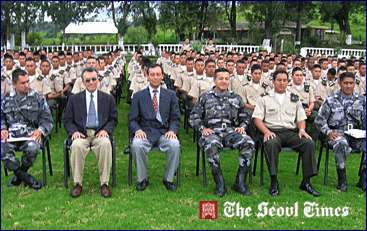
Social tensions between South and North Korea have escalated once again due to the sinking of the Cheonan. The two Koreas have remained technically at war with each other ever since the 1953 ceasefire ended the Korean War. If one considers the premise that their long-term struggle is a cold civil war with periodic hot flashes, then it could be argued that the protracted civil wars in Latin American countries like Colombia, Bolivia, etc. have followed similar patterns. However, the latter situation is now changing, and perhaps both Koreas could learn something from new developments regarding the implementation of Invincible Defense Technology IDT in Latin America.

The Latin American Military Prevention Wing

Read the whole article here, or click on any of the publications below.

Published in China Today, The Seoul Times, Pattaya Dailynews (Thailand), Kashmir Watch, ReviewNepal, The Seoul Times, Cyprus News, Business Ghana, OpEd News, and Australia.to

Radical Peace: People Refusing War, by William T. Hathaway

June 10, 2010

Radical Peace: People Refusing War

World peace depends on our collective consciousness. – William T. Hathaway

William T. Hathaway’s latest literary work, is a return to journalism. Radical Peace: People Refusing War, presents the first-person experiences of war resisters, deserters, and peace activists in the USA, Europe, Iraq, and Afghanistan. Just released by Trine Day, it’s a journey along diverse paths of nonviolence, the true stories of people working for peace in unconventional ways. The first, Chapter 1: The Real War Heroes, and last, Chapter 15: Conscious Peace, are both posted on OpEdNews.com.

William T. Hathaway is a political journalist and a former Special Forces soldier turned peace activist whose articles have appeared in more than 40 publications, including Humanist, the Los Angeles Times, Midstream Magazine, and Synthesis/Regeneration. He won a Fullbright grant to teach at universities in Germany, where he continues to reside. He is an adjunct professor of American studies at the University of Oldenburg. William and his wife also run a small TM center there.

Hathaway is the author of A World of Hurt (Rinehart Foundation Award), CD-Ring, and Summer Snow. He is currently working on WELLSPRINGS: A Fable of Consciousness, which focuses on applying Vedic knowledge to ecology. A selection of his writing is available at www.peacewriter.org.

William also spent 7 years, from 1987-1993, as an assistant professor in the Master’s in Professional Writing at MIU, now MUM. The last chapter of Radical Peace, Conscious Peace, discusses his TM practice, and the vision of possibilities it holds for world peace. You can click on the Chapter 15 link above or read it here:

I was sitting in full lotus, body wrapped in a blanket, mind rapt in deep stillness, breathing lightly, wisps of air curling into the infinite space behind my closed eyes. My mantra had gone beyond sound to become a pulse of light in an emptiness that contained everything.

An electric shock flashed down my spine and through my body. My head snapped back, limbs jerked, a cry burst from my throat. Every muscle in my body contracted — neck rigid, jaws clenched, forehead tight. Bolts of pain shot through me in all directions, then drew together in my chest. Heart attack! I thought. I managed to lie down, then noticed I wasn’t breathing — maybe I was already dead. I groaned and gulped a huge breath, which stirred a whirl of thoughts and images.

Vietnam again: Rotor wind from a hovering helicopter flails the water of a rice paddy while farmers run frantically for cover. Points of fire spark out from a bamboo grove to become dopplered whines past my ears. A plane dives on the grove to release a bomb which tumbles end over end and bursts into an orange globe of napalm. A man in my arms shakes in spasms as his chest gushes blood.

I held my head and tried to force the images out, but the montage of scenes flowed on, needing release. I could only lie there under a torrent of grief, regret, terror, and guilt. My chest felt like it was caving in under the pressure. I clung to my mantra like a lifeline to sanity. I was breathing in short, shallow gasps, but gradually my breath slowed and deepened, the feelings became less gripping, and I reoriented back into the here and now: my small room in Spain on a Transcendental Meditation teacher training course.

I lay on my narrow bed stunned by this flashback from four years ago when I’d been a Green Beret in Vietnam. I had thought I’d left all that behind, but here it was again.

I sat up and was able to do some yoga exercises but couldn’t meditate. Instead I took a walk on the beach. For the rest of that day and the next I was confused and irritable and could hardly meditate or sleep. But the following day I felt lightened and relieved, purged of a load of trauma, and my meditations were clear. My anxiety about the war was much less; the violence was in the past, not raging right now in my head.

Gradually I became aware of a delicate joy permeating not just me but also my surroundings. I knew somehow it had always been there, inhering deep in everything, but my stress had been blocking my perception of it. I felt closer to the other people on the course, connected by a shared consciousness. Then I started feeling closer to everything around me; birds and grass, even rocks and water were basically the same as me. Our surface separations were an illusion; essentially we were all one consciousness expressing itself in different forms. Rather than being just an isolated individual, I knew I was united with the universe, joined in a field of felicity. This perception faded after a few days, but it gave me a glimpse of what enlightenment must be like.

The whole experience was a dramatic example of what Maharishi Mahesh Yogi called “unstressing,” the nervous system’s purging itself of blockages caused by our past actions. Since my past actions had been extreme, the healing process was also extreme.

I had begun meditating in 1968, several months after returning from the war. I’d come back laden with fear and anger, but I had denied those emotions, burying them under an “I’m all right, Jack,” attitude. I was tough, I could take it, I was a survivor. Within certain parameters I could function well, but when my superficial control broke down, I would fall into self-destructive depressions. I finally had to admit I was carrying a huge burden of stress, and I knew I had to get rid of that before I could live at peace with myself or anyone else.

(more…)

Maharishi Mahesh Yogi on History International Channel (November 2007)

June 2, 2010

For those of you who missed the A&E biopic on Maharishi Mahesh Yogi, aired on their History International Channel, November 28, 2007. See this updated post with the complete documentary film. A translated voice-over in French is available in 5 parts on YouTube: Maharishi Mahesh Yogi – Documentaire – 1/5 2/5, 3/5, 4/5, 5/5.

ITN Factual, a production company based in London, UK, was commissioned by A&E, Arts and Entertainment channels, to do a film biography on Maharishi Mahesh Yogi. Producer/Director Fiona Procter came to Fairfield, Iowa in October 2007 and the show was aired on the History International Channel on Nov 28, 2007. Interviews included Drs. Bevan Morris and John Hagelin, David Lynch, Donovan, Mike Love, Teresa Olson, Jerry Jarvis, Alan Waite, Deepak Chopra, and others, with footage of students meditating at Maharishi School, Yogic Flying at Maharishi University, and visuals of the Tower of Invincibility, the Golden Dome, MUM Campus, and Maharishi Vedic City. There was historical footage of the Beatles. Segments from Alan Waite’s documentary on Maharishi, Sage for a new Generation, were amply used, and precious early personal footage from Eileen Learoyd’s private collection in Canada were found and portions sent to the producer, which appeared throughout the film. Enjoy!

Also Watch the 1968 film of Maharishi at Lake Louise. See New film shows David Lynch retracing Maharishi’s footsteps from North to South India and the start of the TM movement.

For more information on Maharishi’s Transcendental Meditation Program here is a list of some country websites: United States: http://www.tm.org | Canada: http://www.maharishi.ca | Latin America: http://www.meditacion.org | Brazil: http://www.meditacaotranscendental.com.br | England: http://www.t-m.org.uk | France: http://www.mt-maharishi.com | Germany: http://www.meditation.de | Australia: http://meditationsydney.org.au | New Zealand: http://www.tm.org.nz | Africa: http://www.tm-africa.org | South Africa: http://tm.org.za | India: http://www.maharishi-india.org/programmes/p1tm.html | Japan: http://www.maharishi.co.jp | China: http://www.tmchina.org. Find out where you can learn Transcendental Meditation in other parts of the world:  http://intl.tm.org/choose-your-country.

The Bat Segundo Show #100: David Lynch

May 31, 2010

The Bat Segundo Show #100 with special guest David Lynch discussing TM
BSS #100: David Lynch

CLICK TO LISTEN: 33:43
Author: David Lynch

Condition of Mr. Segundo: In absentia, terrified of meditation.

Subjects Discussed: Transcendental Meditation, true happiness, contending with stress, fear and anxiety, anger, the relationship between filmmaking and TM, inner happiness, walking vs. TM, Knut Hamsun, Einstein’s Theory of Everything, Dostoevsky’s 1866 publishing deal, on coming up with ideas, the art life vs. the business life, Frank Silva’s unexpected casting as Bob in Twin Peaks, and whether Lynch understands his own films.

EXCERPT FROM SHOW:

Lynch: Let’s talk about suffering. Like in movies, people die. Well, you say, you don’t have to die to show a death. And there’s all kind of suffering and torment and all these things in a story. And, for me, those things come from ideas. Now when you catch an idea, you see the thing. You hear the thing. You feel and see and hear the mood of it. And you see the character. You almost see what the character wears. And you see what the character says and how they say it. That it’s an idea that comes all at once. And you know that idea.

Podcast: Play in new window | Download

Samadhi is the beginning, not the end of Yoga

May 24, 2010


JUNE 2010 Issue

Samadhi is the beginning, not the end of Yoga

By Neil Dickie

Yoga or union of the mind with divine intelligence, begins when the mind gains Transcendental Consciousness. The process of diving within is the way to become established in yoga. —Maharishi Mahesh Yogi

This article is for the many people who suspect they could take their yoga practice to a higher level by practicing meditation, but who delay starting, thinking meditation to be either too difficult or too advanced for them.

One reason many assume meditation to be difficult is a common misunderstanding of the eight-limbed or Ashtanga system of yoga laid out in the revered Yoga Sutras of Patanjali. In the text of the Yoga Sutras, the eight limbs of yoga are laid out in the following order: the five yamas or personal virtues, such as ahimsa or non-violence, and satya, truthfulness. Then the five niyamas or rules of life, including shaucha, purification, and swadhyaya, study. Then pranayama, the breathing practices; then asanas, the poses of yoga; then three stages of mental practice. And finally, comes the eighth limb, samadhi, the union of the busy thinking mind with its deepest most silent level, the unified field of consciousness. Think of an individual wave settling down and experiencing the unbounded ocean.

However, despite the fact that Ashtanga translates as eight LIMBS, and not eight STEPS or stages, many have thought Patanjali meant that his eight-fold approach should be practiced only in step-by-step, sequential order, starting with the personal virtues and observances, and that only advanced practitioners should attempt samadhi.

Maharishi Mahesh Yogi created a stir in the world yoga community some 40 years ago when he travelled the world teaching Transcendental Meditation, a simple, easily-learned technique to bring the direct experience of samadhi. Maharishi was teaching anyone interested, irrespective of their knowledge of the other limbs of yoga. As the popularity of TM spread, so did concern in the yoga community. In Germany, an upset delegation of yogis came to him and demanded an explanation. They knew that Maharishi had been for many years the closest disciple of the Shankaracharya of Jyotir Math, Swami Brahmananda Saraswati, a highly respected spiritual leader and the elected custodian of the Vedic tradition in Northern India. But in spite of this traditional background, Maharishi was now teaching meditation to the masses. What could be the reason, they asked?

Maharishi welcomed the delegation and began by establishing common ground with them—his respect for the authority of Patanjali. He then, however, explained his view that Patanjali had, due to the long lapse of time, become badly misinterpreted. The order of Patanjali’s famous eightfold yoga had, he said, become the reverse of what Patanjali intended. “The practice of Yoga was understood to start with yama, niyama (the secular virtues), and so on,” Maharishi said, “whereas in reality it should begin with samadhi. Samadhi cannot be gained by the practice of yama, niyama, and so on. Proficiency in the virtues can only be gained by repeated experience of samadhi.”

For example, Maharishi said, one can only truly progress in ahimsa or non-violence as one grows in the realization that there is a common unity of all things. This unified reality of life is directly experienced in samadhi. Similarly, he said, asteya or non-covetousness can only be realized when one feels fully contented, and the only way to be truly happy inside is to realize the field of bliss-consciousness—again only possible through repeated experience of samadhi.

But there’s a second, perhaps even more common reason for the widespread belief that meditation is difficult—as it is generally taught, it is. Patanjali defines yoga as “the complete settling of the mind” (Yoga Sutras, 1:2). Our experience of teaching meditation during the past 20 years is that most other types of meditation today involve concentration, effort, and control. As such, they effectively prevent the mind from completely settling down. Maharishi’s Transcendental Meditation, in contrast, involves no concentration, effort or trying of any kind, and allows the mind to quickly and easily dive within to its silent core.

But can an easy, effortless meditation be “real” meditation, leading to enlightenment? Yes. Some have misunderstood that the simplicity of Maharishi’s TM means that it is watered down, or “westernized.” But TM is actually the revival of meditation in its pure and original form. It is simple and easy not because it is watered down, but because it is natural, in full accord with the nature of mind and body. That is also why it is so efficient. Nature has tremendous efficiency. Activity in nature always follows the path of least action. In the same way, the TM practitioner effortlessly dives within the mind, gains samadhi, and enjoys, even outside of meditation, steadily increasing access to that field of pure intelligence and infinite joy.

See www.tm.org or www.doctorsontm.com for information on the many published scientific studies on the benefits for mind, body and behaviour resulting from this practice.

Neil Dickie is a certified Transcendental Meditation instructor who treasures his daily yoga asana practice (neil.c.dickie108@gmail.com). For more information, or to find out the dates of upcoming free introductory talks, call 613-565-2030. Email: Ottawa@maharishi.ca

US Government National Health Center Highlights TM Study on Stressed College Students

May 14, 2010

Transcendental Meditation Helps Young Adults Cope With Stress

A recent study found that Transcendental Meditation (TM) helped college students decrease psychological distress and increase coping ability. For a group of students at high risk for developing hypertension, these changes also were associated with decreases in blood pressure. This could be good news for the many students experiencing academic, financial, and social pressures that can lead to psychological distress—especially in light of evidence that college-age people with even slightly elevated blood pressure are three times more likely to develop hypertension within 30 years.

Funded in part by NCCAM, researchers from Maharishi University of Management and American University studied 298 students from American University and other schools in the Washington, D.C., area. The researchers randomly assigned students to a TM group or a control (wait-list) group. They also created a high-risk subgroup, based on blood pressure readings, family history, and weight. The TM group received a seven-step course in TM techniques, with invitations to attend refresher meetings, and kept track of how often they practiced TM. At the beginning of the study and after 3 months, researchers tested all participants for blood pressure and psychological measures. The researchers noted that 30 percent of the participants dropped out before the end of the study.

Blood pressure decreased in the TM group and increased in the control group, but the differences were not significant overall (TM-control blood pressure differences were significant within the high-risk subgroup). However, compared with controls, the TM group had significant improvement in total psychological distress, anxiety, depression, anger/hostility, and coping ability. Changes in psychological distress and coping paralleled changes in blood pressure.

According to the researchers, these findings suggest that young adults at risk of developing hypertension may be able to reduce that risk by practicing TM. The researchers recommend that future studies of TM in college students evaluate long-term effects on blood pressure and psychological distress.

Reference

URL: http://nccam.nih.gov/research/results/spotlight/051410.htm

This page last modified May 13, 2010.

Twitter NCCAM

Transcendental Meditation Helps Young Adults Cope With Stress: http://go.usa.gov/ihN

Maharishi describes the nature of inner life: bondage and liberation, and gaining bliss consciousness through Transcendental Meditation

May 9, 2010

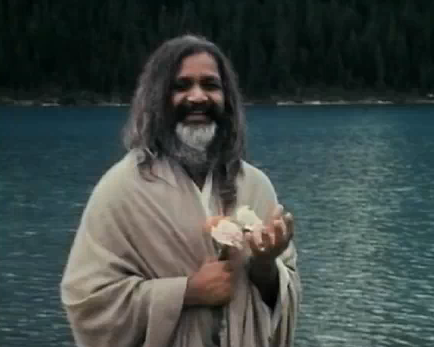
Maharishi at Lake Louise

The Canadian Broadcasting Corporation produced this beautiful documentary on Maharishi Mahesh Yogi, founder of the Transcendental Meditation technique, during his visit to Canada’s premier hotel Chateau Lake Louise,  June 10-14, 1968, the course location for Canadian meditators. I was very lucky to have been on that course and met Maharishi for the first time. All of the course participants lined up to present Maharishi with flowers for the CBC to film. It was used to open and close that documentary profile, which was made for the CBC program series called Telescope.

This CBC documentary remains one of the best films ever made on Maharishi. Filmed inside the hotel’s main lecture hall and outside with the backdrop of the majestic Canadian Rocky Mountains, it respectfully portrays Maharishi as a great spiritual teacher. They filmed him walking in front of the glacier lake, the image of which he used to describe the nature of inner life, bondage and liberation, and contacting and integrating bliss consciousness into daily life through the regular practice of Transcendental Meditation.

Posted here is an edited version of that documentary, minus the opening introduction, segues, and commercials, which was aired on Canadian national television during the Fall of 1968. Here is a partial transcription of that segment of the video. To view the whole video click on the title, Maharishi at Lake Louise. It can also be viewed on the Maharishi Channel on You Tube: Transcendental Meditation – Maharishi Mahesh Yogi at Lake Louise, Canada, 1968. Also, the Transcendental Meditation blog has a well-written comprehensive, historical, contextual description about this video by Bob Roth: Maharishi: A rare glimpse into the message of meditation from 40 years ago. It’s also embed here for you to enjoy.

The depth of the lake, and the ripples, and the beautiful reflection of the glacier, reminds me of the story of inner life. The mind is deep like a lake. The ripples on the surface represent the conscious mind, the activity of the mind on the surface. And the whole depth of the lake is silent. And that is the subconscious mind, which is not used by the wave. But if, the wave could deepen, and incorporate more silent levels of the water, the waves could become the waves of the ocean, the mighty waves.

This is what happens in Transcendental Meditation. The surface activity of the conscious mind deepens and incorporates within its fold the depth of the subconscious. And with practice, nothing remains subconscious. The whole subconscious becomes conscious, and a man starts using full potential of the mind.

And the reflection of the glacier on the water is like the impression of the objects that the mind perceives. And as long as the mind is not capable of maintaining its essential nature, which is bliss consciousness, so long the mind gets imprinted by the perceptions of the objects. And this is called the bondage of the mind. The mind loses bliss consciousness and gains the joy of the reflections of the world, the joy of the relative order, losing the bliss of the absolute eternal Being.

When the mind is not capable of maintaining its essential nature, bliss consciousness, and is overshadowed by the reflections of the object of perception, then only the object remains, and the subject, as if, becomes annihilated. This annihilation of the subjective nature within is a great loss. It’s a loss of eternal bliss at the cost of temporary joys. Such a life where the value of the matter dominates is called material life, and the spirit gets annihilated.

But, when through the practice of Transcendental Meditation, the mind goes deep within to the source of thought, transcends the thought, and gains bliss consciousness, and is capable of maintaining that even when it comes out into the worldly experience of objective nature, then it is called spiritual life—that the spirit is not capable of being overshadowed anymore by the objective experience. And this is spiritual life. This is life in eternal liberation. And without this, life is in bondage. A great loss. As if loss of a billion pounds, and gain of a million. Loss of eternal bliss consciousness and gain of a worldly fleeting joy.

The vision, the vision of the lake, brings about a great teaching of spiritual life. …

New Post: Watch the 1968 film of Maharishi at Lake Louise.

On September 30, 2014 I had posted how I learned #TMmeditation 47 years ago today. In there I share more information about the making of the CBC Telescope film, The Guru, of Maharishi at Lake Louise. Richard Day shared a story he had heard many years later about the director of the film who told Maharishi that he wanted to film him saying something that would encapsulate all his teachings. Maharishi said, “I’ll walk by the lake, you walk with me, and I’ll tell you everything about spiritual development.” He did it in one take!

Radish: MLG seeks healing through light and gems

May 6, 2010

Apr 28, 2010 10:18AM

MLG seeks healing through light and gems

By Linda Egenes

When Jim Fairchild, a 68-year-old college professor, signed up for a session of Maharishi Light Therapy with Gems (MLG), little did he know that this holistic new therapy would provide relief from a serious injury.

“Ever since a car ran over me when I was 3 years old, I’ve lived with constant pain and pressure in the back of my neck,” he says. “As a result, I’ve been on a lifelong quest for relief — consulting legions of chiropractors, massage therapists, and others. But nothing worked.”

At first, Fairchild found that light and gem therapy treatments simply made him feel more relaxed.

Then, to his surprise, he felt a profound shift in his level of pain. “I came out of a session feeling almost no discomfort in the back of my neck,” he says. “I quietly waited for the inevitable. But the pain didn’t return. My neck isn’t perfect, but the difference is profound. The amazing thing is that during the session I didn’t feel anything extraordinary in my physiology. Yet somehow relief came to me, without my even asking.”

The oldest and most refined members of the mineral kingdom, gems have long been known for their healing qualities. For thousands of years, the Ayurvedic tradition of India has employed gems for prolonging life span and promoting health, wealth, happiness, charisma and the fulfillment of desires. In fact, Ayurvedic texts describe mantras, gems and herbs as the three fundamental means to support the development of higher states of consciousness and perfect health.

Today the healing power of gems is available in an affordable new treatment called Maharishi Light Therapy with Gems (MLG), offered at The Raj Maharishi Ayurveda Health Spa in Fairfield, Iowa. In this treatment, the profound orderliness of 13 gemstones, each with their own unique crystalline structures, is made available to the mind and body. This occurs by using special “light beamers” which project soft light through the gems.

Dr. Keith Wegman, an MLG practioner at The Raj, explains, “The light frequencies act as a carrier for the orderly structure of the gems. They resonate with subtle frequencies of our physiology and trigger profound self-healing and self-repair.”

During the past year, over 2,000 treatments given at The Raj have provided strong evidence of the long-term benefits of this approach.

“Individuals have reported relief from chronic disorders, such as decreased anxiety and decreased joint, muscle, and bone problems, as well as improved emotional stability, better sleep and expanded self-development,” says Dr. Wegman. “Now a six-month research study is being conducted to quantify the long-term effects of the treatment.”

The results of MLG are different for each person. A woman from Montreal found relief from asthma, while Adile Esen from Turkey noticed her emotions were more stable.

“The feeling of nourishment and balance coupled with calmness and clarity have continued,” she says. “In addition to becoming more aware, open, and clear, I realize that even in very difficult situations that could have made me doubt and tremble, I have remained calm like the pearl at the bottom of the ocean.”

The equipment used in MLG treatments was developed over a period of 30 years by Dr. Yoachim Roller, a German gemologist, under the direct guidance of Maharishi Mahesh Yogi, who founded the Transcendental Meditation technique and Maharishi Ayurveda. Trained practitioners offer MLG exclusively at The Raj in Fairfield and in facilities around the world.

The Raj is the only place in North America to offer treatments using larger, more powerful instruments, affectionately called “Big Beamers.” The 13 Big Beamers contain 12 gems each, with a total of 145 gems to magnify the effect.

“The Big Beamers have a unique ability to transform any rigidity or obstruction to the flow of energy in the physiology,” Dr. Wegman says. “The transformation is more significant than with the regular beamers because the body is being submerged in profound coherence. The more powerful orderliness of the large beamers takes over any disorder, restoring balance in previously weak or compromised areas of functioning.”

Adds Dr. Wegman, “Gems are crystalline structures that are as old as our planet. Their inherent orderliness resonate with the inherent orderliness in the physiology, and that produces the profound results for mind and body that thousands of people have already experienced.”

For more information or to schedule Maharishi Light Therapy with Gems, contact The Raj Maharishi Ayurvedic Health Spa in Fairfield, Iowa, (800) 864-8714, extension 5300, or visit theraj.com/mlg/index.php.

David Lynch interviews Paul McCartney about meeting Maharishi and his first meditation

April 30, 2010

Here are links to two articles on the TM.org Blog with videos of David Lynch interviewing Paul McCartney about his experiences with Maharishi Mahesh Yogi and Transcendental Meditation. This was recorded by David Lynch Foundation Television during the rehearsal for the Change Begins Within Benefit Concert to teach 1 million at-risk students to meditate. Many celebrities performed on that April 4, 2009 concert. It will be broadcast on PBS starting April 29, 2012, 3 years later, on New York’s channel THIRTEEN.

Here is Heather Harnett’s opening, written a year after the concert, which will now be broadcast on PBS three years later, two years after Heather’s writing about it, all in the month of April.

What a night! A little more than a year ago, on April 4, 2009, former Beatle Sir Paul McCartney headlined a historic, one-night-only benefit concert promoting the Transcendental Meditation technique for the David Lynch Foundation at Radio City Music Hall in New York, entitled “Change Begins Within.” Paul McCartney was joined onstage by his former band-mate Ringo Starr and several other amazing musicians, including Donovan, Eddie Vedder, Sheryl Crow, Ben Harper, and Moby. Six-thousand energized music fans, foundation well-wishers, and meditation supporters packed the hall for what several press reports called “the musical event of a lifetime.”

Before the concert, before the hubbub and the crazy excitement and the buzz, before it all, David Lynch sat down, individually, with Paul and with Ringo for a quiet talk on camera. They candidly discussed their 40-plus year Transcendental Meditation practice, their meetings with Maharishi Mahesh Yogi, and how Maharishi and meditation have influenced their lives. It was the first time in decades that Paul and Ringo had spoken of those days that historians have said helped to transform the music, the culture, and the future of the world.

Click here to read the rest of the article: David Lynch Interviews Paul McCartney About Transcendental Meditation (Part 1) and watch Part 1 of the interview followed by Part 2, where Paul McCartney remembers his first meditation with Maharishi.

David Lynch interviews Paul McCartney about Meditation and Maharishi

David Lynch interviews Paul McCartney (Part 2)

See Ringo Starr Interview from the Change Begins Within Benefit Concert and The former Beatles Paul McCartney and Ringo Starr reunion for David Lynch’s benefit concert airs on New York’s THIRTEEN, Sunday, April 29.