Posts Tagged ‘the Beatles’

The Beatles “Dear Prudence”: A Portrait of Prudence Farrow Bruns, Maharishi and TM

September 6, 2013

Dear Prudence: A Portrait of Prudence Farrow Bruns

Enjoy this video portrait of Prudence Farrow Bruns, the inspiration for the Beatles song “Dear Prudence”. Prudence discusses her personal journey, meditating with the Beatles in India, the transformation her generation tried to bring about in the world, and the change that can only come from within through Transcendental Meditation.

Directed, shot and edited by Kryshan Randel, music by Mike Pellarin, produced by David Shaw for iTranscend TM, a concept created by Ashley Cooper. For more information on Transcendental Meditation, visit these websites: http://maharishi.ca (Canada) and http://www.tm.org (USA).

Visit the newly launched Dear Prudence Foundation and click on About Prudence to read about her journey and why she set up a foundation: http://dearprudencefoundation.org.

See these other interviews with Prudence: 1) Amitava Sanyal, Allahabad, for BBC News India: Prudence Farrow — subject of the Beatles song Dear Prudence — visits India’s Kumbh Mela, and two videos: 2) Ted Henry interviews “Dear Prudence” Farrow Bruns about her life with TM and Maharishi, and 3) MicCameraAction: PRUDENCE FARROW BRUNS.

Other iTranscend TM Portraits

Another video portrait made by Canadian filmmaker Kryshan Randel is about Paralympian Daniel Westley. Westley had represented Canada in the 1988 Paralympic Games in Seoul, South Korea. As Paralympic Games grew, Daniel went on to participate in both the summer and winter games in a wide range of sports that included everything from wheelchair racing to skiing. Read this inspiring story: Meditation key to finding balance for Paralympian Daniel Westley — special to The Vancouver Sun, which contains the video, Physical Meditation: A Portrait Of Daniel Westley.

Both videos appear on the iTranscend TM YouTube channel series along with other heartfelt testimonials from new meditators, meditators dicussing meditation, and portraits of veteran meditators — people from all walks of life telling their stories — a physiotherapist, bakery story owner, musician, students, sharing how they are realizing their potential through the profound life-changing benefits of their Transcendental Meditation practice. And this video is an edited composite of some celebrities talking about the value of meditation, TM, in their lives: iTranscend Hollywood.

See: Who was Dear Prudence the Beatles sang to in India? What happened to her? Here is her story.

Prudence’s memoir is now out: Dear Prudence: The Story Behind the Song.

Read this excellent article in the Pensacola News Journal: Woman behind Beatles ‘Dear Prudence’ reads at Open Books.

Les Crane interviews Maharishi Mahesh Yogi

July 6, 2013

This is a delightful find—early vintage Maharishi—interviewed by a popular LA television talk show host. Les Crane interviewed Maharishi Mahesh Yogi in September 1967 about a month after The Beatles had met and learned Transcendental Meditation from him. They go over the basics of what Transcendental Meditation is and is not. Maharishi is delightful, laughing and quipping throughout the interview. The one-hour show, minus commercials, is 49:30 minutes long.

67_beatles_maharishi-mahesh_yogi_002-580x389

Les asks Maharishi when he first heard of the Beatles and when they first met him. He then quotes the Beatles from the current (Sept 22, 1967) Time magazine cover story, THE BEATLES / Their New Incarnation, where they favorably describe Maharishi and how TM fulfilled their search for a genuine spiritual experience.

Les asked some good questions. He was an intelligent man. Halfway into the program Les opens up questions from the audience. He also introduces Efrem Zimbalist Jr. and mentions his association with Maharishi. Les then introduces Jerry Jarvis, national director of SIMS, and asks him to explain the Five Year Plan. Maharishi mentions Charles Lutes and his plan to build an Academy of Meditation in the US. Les asks what the world would look like if many people practiced Transcendental Meditation, and Maharishi gives him a very practical description.

At the end of the program Les apologetically prefaces what he’s about to say when he announces who his guests will be on the next show. “We have been talking about Transcendental Meditation and spiritual enrichment and fulfillment tonight. Tomorrow night we’re going to have a group of people on the program who believe that the way to find inner peace and happiness is an entirely different way. We’re gonna have a few representatives of the Sexual Freedom League on the program.” [laughter, a few more comments, then adds] “I had to say that because that’s what we do here, we look at everything.”

Maharishi: “To search is good.” Les, smiling: “To search is good.” Maharishi adds: “And to find fulfillment is really great.” [loud applause] Les: “Maharishi, thank you very much.” Maharishi: “Good luck to the whole nation through you.” Les: “Good bye. Bless you all.”

See this recent post of The Telegraph reporting on a recent TM study improving graduation rates saying the Beatles may have been on to something after all during their fabled journey to India.

Also see Maharishi interviewed on the BBC in 1967.

The BBC World Service program Witness, will air an interview with Theresa Olson, Monday March 3, 2014, 8:50 GMT. In the spring of 1959, Indian guru Maharishi Mahesh Yogi set off around the world to spread the teachings of Transcendental Meditation. Witness speaks to Theresa Olson, who was ten years old when the Maharishi came to stay in her parents’ house. A photo is shown of Maharishi taken from BBC1, Sunday July 5, 1964, to promote the upcoming interview on The Maharishi’s World Tour.

Another program worth watching from those early days is the 1968 CBC documentary of Maharishi at Lake Louise.

The most recent biography on Maharishi aired on A&E’s History Channel, 40 years after the BBC and Les Crane interviews.

A new BBC report, on the 50th anniversary of that visit to Bangor to learn more about Transcendental Meditation from Maharishi was published today, August 25, 2017. The Beatles: Historians say 1967 Bangor visit was a turning point. The report  includes interviews with people who were there at that time.

Maharishi explains the reason for TM’s worldwide popularity

Maharishi always had an interesting take on world events. In this recently posted 1968 video, he discusses where the worldwide popularity for Transcendental Meditation started. During his visit to England in the summer of 1967, he describes the countrywide concern that was being expressed over the previous 8 months about the deplorable drug problem among the youth. Thanks to Patti Harrison, The Beatles heard Maharishi was going to speak at the London Hilton and got front row seats. They wanted to meet him afterwards and it was arranged. Maharishi inspired them to want to do something good for the youth and they agreed. They wanted to learn how to meditate from Maharishi and he invited them to join him on the long train ride to Wales where he was going to lead a 3-day meditation course. Some reporters overheard their plans. When The Beatles met Maharishi at the train station, they were surrounded by over 50 press and hundreds of fans. The video contains footage from that time as well as photos taken at the lecture and on the train. There is also actual footage taken privately of their discussion, but it has yet to be made public.

Maharishi explains it was not the Beatles that created the worldwide publicity about TM, but the English press who reported on their wanting to learn to meditate, which, they felt would inspire the British youth to give up drugs in favor of meditation. An example of one of the English headlines was the report from the Archbishop of Canterbury congratulating The Beatles for starting Transcendental Meditation. Then the world press picked up this Beatles story and it spread globally. Maharishi emphasized it was not The Beatles, but the tense situation in the country at the time that brought about the news headlines. He said they wanted “to change the psychology of the children, and they succeeded, greatly. So this phase was behind the worldwide publicity.”

Save

Additions: #TranscendentalMeditation founder Maharishi Mahesh Yogi interviewed on Finnish TV in 1973. And Maharishi on the nature of a settled, silent mind in the November 1993 Science of Mind interview. And Rememberances of #TranscendentalMeditation and #MaharishiU founder Maharishi Mahesh Yogi.

Pages 12-13 of the September 2020 issue of Transcendental Meditation News in the UK under The Maharishi Interviews features a transcript of part 1 of Les Crane’s interview with Maharishi in Los Angeles, Autumn 1967. Part 2 continues in their next issue. Transcendental News, Vol 24. No 2, September 2020.

Who was Bungalow Bill from the Beatles White Album and what happened to him? He tells us! This post now includes mention of the new film, Meeting the Beatles in India, by Paul Saltzman. In the Q&A that followed, Rikki Cooke III, aka Bungalow Bill, explained why he thought the remaining Beatles left the ashram abruptly. It made a lot more sense than the usual rumor mentioned in the article. I posted a comment after the Variety article of what he said about it, and included related material.

Great article on TM helping students boost grades shows the Beatles were way ahead of their time

June 22, 2013

Here is that great article written by , Science Correspondent for The Telegraph, published June 11, 2013, 9:00PM BST: Transcendental Meditation may boost student grades. He says, It may have seemed simply a phase in pop history, but it seems the Beatles may have been on to something after all during their fabled journey to India.

BEATLES_2587635kIt seems the Beatles may have been on to something after all during their fabled journey to India.  Photo: GETTY IMAGES

A form of meditation made popular by John Lennon and his band mates during the “flower power” era has been found to improve students’ grades.

A study of school pupils found that performing two 20-minute sessions of Transcendental Meditation each day improves academic achievement.

The practice involves sitting still with eyes closed while chanting a mantra – also sometimes derided as “oming”.

It became synonymous with hippy culture in the 1960s after The Beatles embraced it following a visit to India where they were taught the technique by the late Maharishi Mahesh Yogi.

Now a growing body of research is suggesting it can have a positive effect on people’s lives.

Recent studies have shown that it can be used to treat high blood pressure and help people overcome psychological problems.

The latest research found that US school pupils who performed the meditation technique had higher graduation rates than those who did not.

The effect was even greater among those who had the lowest academic grades, the research conducted by the University of Connecticut and Maharishi University of Management, Iowa, found.

Researchers found that Transcendental Meditation increased the number of students graduating by 15 per cent while among those with the lowest academic grades, a further 25 per cent graduated compared to those not meditating.

Professor Robert Colbert, from the Neag School of Education at the University of Connecticut, said: “Transcendental Meditation appears to hold tremendous promise for enriching the lives of students.”

He added that the meditation technique was a viable method for turning around “poor student academic performance and low graduation rates”.

Sanford Nidich, a professor of education at Maharishi University of Management who conducted the research, added: “These results are the first to show that the Transcendental Meditation program can have a positive impact on student graduation rates.

“The largest effect was found in the most academically challenged students.

“Recently published research on increased academic achievement and reduced psychological stress in urban school students may provide possible mechanisms for the higher graduation rates found in this study.”

It is estimated that around 6 million people now practice Transcendental Meditation around the world.

The technique aims to concentrate the mind inwards by uttering the mantra and is intended to empty the mind of thoughts and feelings.

Proponents of the technique claim it can aid concentration and help to rid them of negative emotions.

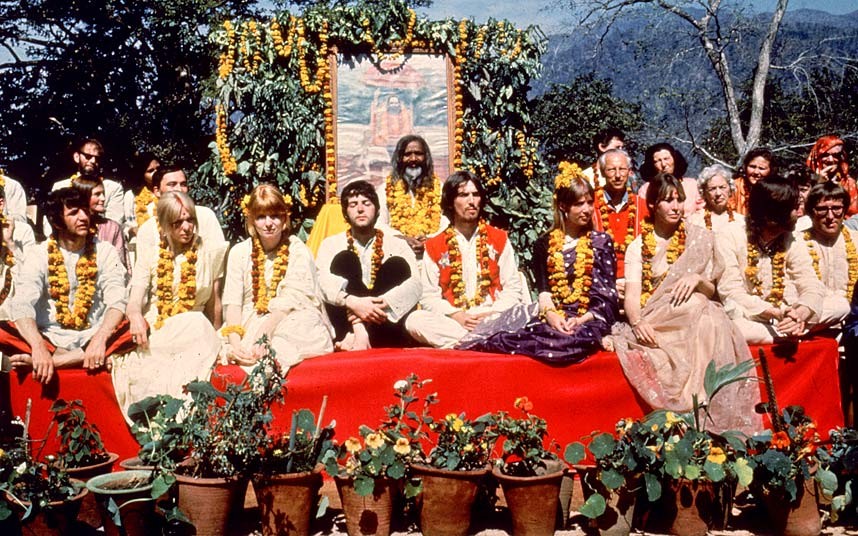
The Beatles’ time with Maharishi Mahesh Yogi, at his teaching centre in the foothills of the Himalayas in 1968, produced some of the most famous images of the Fab Four, dressed in white and draped in flower garlands.

It was also one of their most productive periods musically, with Lennon declaring that between them they wrote around 30 new songs during their visit to Rishikesh.

The tracks, which ended up on The Beatles, also known as the White Album, and Abbey Road, include Back in the USSR, Blackbird, Revolution and Mean Mr Mustard.

In an interview conducted in 2009, Paul McCartney and drummer Ringo Starr spoke candidly about how the meditation technique helped them.

Starr said: “Since then, sometimes a lot, sometimes a little, I have meditated. It is a gift he [the Maharishi] gave me.”

McCartney added: “It wasn’t all about meditation, it’s just you were focused – but yeah, there were very blissful moments.

“It is one of the few things anyone has ever given to me that means so much to me. For us, it came at a time when we were looking for something to stabilise us at the end of the crazy sixties.”

McCartney has also in the past called for Transcendental Meditation to be used in schools.

He said: “I believe that in the future meditation could be as commonplace in schools and society as eco-awareness is now. It interests me that an ancient cure may be the solution to a modern problem.”

The new research, which involved 235 students in their senior year at an urban school on the US east coast, was funded by the David Lynch Foundation, which has been campaigning to have meditation incorporated into the school day.

They claim that where meditation has been used in schools, it has helped to reduce stress and anxiety in pupils while also lowering suspension rates.

The foundation was set up two years ago by film director David Lynch after he used meditation to overcome his own anger issues.

Describing the difference it has made to his life, he said: “When I started meditating I had a real anger in me, and I would take this out on my first wife.

“Two weeks after I started meditating, this anger lifted.”

See EurekAlert! press release for the study: Transcendental Meditation positively impacts student graduation rates, new research shows.

See this related post on some of the news coverage: New study shows TM significantly improved school graduation rates, world press reports.

This article was later highlighted on the University of Connecticut Neag School of Education website on their Spotlight page reporting the latest news: Transcendental Meditation May Boost Student Grades.

See The former Beatles Paul McCartney and Ringo Starr reunion for David Lynch’s benefit concert airs on New York’s THIRTEEN, Sunday, April 29.

Ted Henry interviews “Dear Prudence” Farrow Bruns about her life with TM and Maharishi

June 9, 2013

This wonderful interview is also available from on Vimeo. Retired TV journalist Ted Henry conducts interviews with spiritual people for Souljourns. Last month he interviewed Prudence Bruns Farrow. You can also see the interview on their Vimeo channel: http://vimeo.com/67166559. Here is their introduction to the video:

From the very beginning Prudence Farrow Bruns recognized an added layer or texture to her life, a spiritual dimension that would take her deep within.

She was among the first in the West to become initiated into Transcendental Meditation and in the mid sixties she traveled to Rishikesh, India to learn to become a TM teacher. Her own teacher in India, Maharishi Mahesh Yogi who is credited for bringing TM to the world.

In India with her at this time, her sister and acclaimed actress, Mia Farrow, The Beatles, Mike Love of the Beach Boys, Donovan and others.

Prudence and her husband, Albert Bruns who is also a TM instructor, live in Seagrove along the Gulf of Mexico in Northwest Florida.

The interview was recorded in Seagrove, Florida in May, 2013.

See this related BBC news item: Prudence Farrow — subject of the Beatles song Dear Prudence — visits India’s Kumbh Mela. And this video: The Beatles “Dear Prudence”: A Portrait of Prudence Farrow Bruns, Maharishi and TM.

Who was Dear Prudence the Beatles sang to in India? What happened to her? Here is her story.

Prudence Farrow — subject of the Beatles song Dear Prudence — visits India’s Kumbh Mela

February 23, 2013

Beatles song muse visits India’s Kumbh Mela
By Amitava Sanyal, Allahabad, for BBC News India
February 21, 2013 | Last updated at 06:37 ET

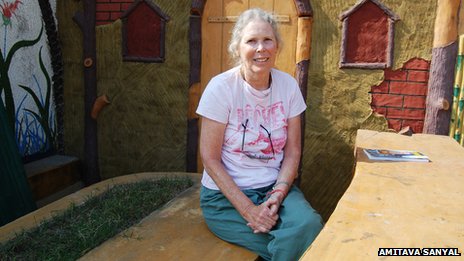
Prudence Farrow at Kumbh Mela
Prudence Farrow says the Beatles were “real people”

The subject of a Beatles song is among the many foreign pilgrims visiting India’s Kumbh Mela festival.

Prudence Farrow, about whom John Lennon wrote the song Dear Prudence, is also sister of Hollywood actor Mia Farrow.

The Kumbh Mela, which is held every 12 years, is billed as the world’s biggest gathering of humanity.

Millions of Hindu ascetics and pilgrims take a dip at Sangam, the confluence of the Ganges and Yamuna rivers in Allahabad city.

Ms Farrow says she waited for four decades to come to the Kumbh Mela.

She had first visited India in 1968 as a student of meditation and met the Beatles at Indian guru Maharishi Mahesh Yogi’s retreat in Rishikesh.

“I wanted to come to the Kumbh with the Maharishi, but that never happened,” she told the BBC. Her guru died in 2008.

This year Ms Farrow finally made it to the Kumbh Mela with her husband Albert Bruns.

‘Exotic’

“India has changed so much since I first came here,” says Ms Farrow, 65, sitting in the brightly-painted porch of her rented flat in Allahabad.

“Back then it was exotic. We were staying in the forest outside Rishikesh. Life was quite agricultural even in the cities.

“There were animals on the road, there were very few telephones and there was hardly any electricity where we were staying.”

Ms Farrow says she was in for a shock when she first arrived at the festival ground last month.

At first, she insisted on staying in one of the tens of thousands of tents that have been put up on the banks of the river.

Ms Farrow, who has a doctoral degree in South Asian studies and runs foundations to promote meditation, says she was in search of “an inner silence”.

But, ironically, the blare of three loudspeakers every morning at the festival grounds shattered her peace and she shifted into the city.

This was, she says, in sharp contrast to the peaceful times she spent with her sister Mia at her guru’s retreat in Rishikesh in 1968.

At the retreat, the Farrow sisters met the Beatles.

“Because of Mia there were too many people coming in and out of our block,” says Ms Farrow.

“And then in the evenings George Harrison would jam with John Lennon and others would join in. I wasn’t getting the silence.

“People said: ‘You are being too fanatical, you should come out.’ Yes, I was extreme because I thought it was a privileged time. I still think it was the most important time in my life.”

So while the rest of the students partied, Ms Farrow says she locked herself up in her room and practised meditation.

That is when, she says, Lennon, wrote the song Dear Prudence, which appears on the band’s White Album.

DEAR PRUDENCE

Dear Prudence, won’t you come out to play

Dear Prudence, greet the brand new day

The sun is up, the sky is blue

It’s beautiful and so are you

Opening verses of Dear Prudence, written by John Lennon

The song’s hand-written lyrics, lined with doodles, sold at a Sotheby’s auction in 1987 for $19,500 (£12,800).

“The reason he wrote I was beautiful – and there were much more beautiful people around – was because I was so much like George,” says Ms Farrow.

“George and I were there for very much the same reasons – we were both very spiritual and we wanted to find a solution for ourselves and the world. George would say that through his music he wanted to help people become more settled, more quiet and more sensitive.”

Ms Farrow says she did not want to meet the Beatles as “great people never lived up to their image”.

Did they disappoint her?

“What didn’t disappoint me was that they were still real people. They weren’t more important than anybody else,” says Ms Farrow.

“Fame has that quality – it corrupts you. You begin to feel that you’re separate from other people, you’re more powerful. But they didn’t have that.

“They were going through the same things as we were. That’s why they were the voice of the times.”

Article URL: http://www.bbc.co.uk/news/world-asia-india-21530477

See the Dear Prudence Foundation http://dearprudencefoundation.org

For information on Maharishi and his Transcendental Meditation technique visit: http://www.tm.org/maharishi

Also see Maharishi Mahesh Yogi on History International Channel (November 2007)

See: Who was Dear Prudence the Beatles sang to in India? What happened to her? Here is her story.

Here is a related post: Varanasi by Mary Oliver in A Thousand Mornings.

See Ted Henry interviews “Dear Prudence” Farrow Bruns about her life with TM and Maharishi, and an interview with PRUDENCE FARROW BRUNS by MicCameraAction after her return from the Kumbh Mela. She talks about her time with Maharishi and the Beatles in India and her new Dear Prudence Foundation to make Transcendental Meditation available to those who want it but need a scholarship to help pay for it. And this video: The Beatles “Dear Prudence”: A Portrait of Prudence Farrow Bruns, Maharishi and TM.

This is a funny video of Prudence’s sister, Mia Farrow: Dear Prudence.

Prudence’s memoir is now out: Dear Prudence: The Story Behind the Song.

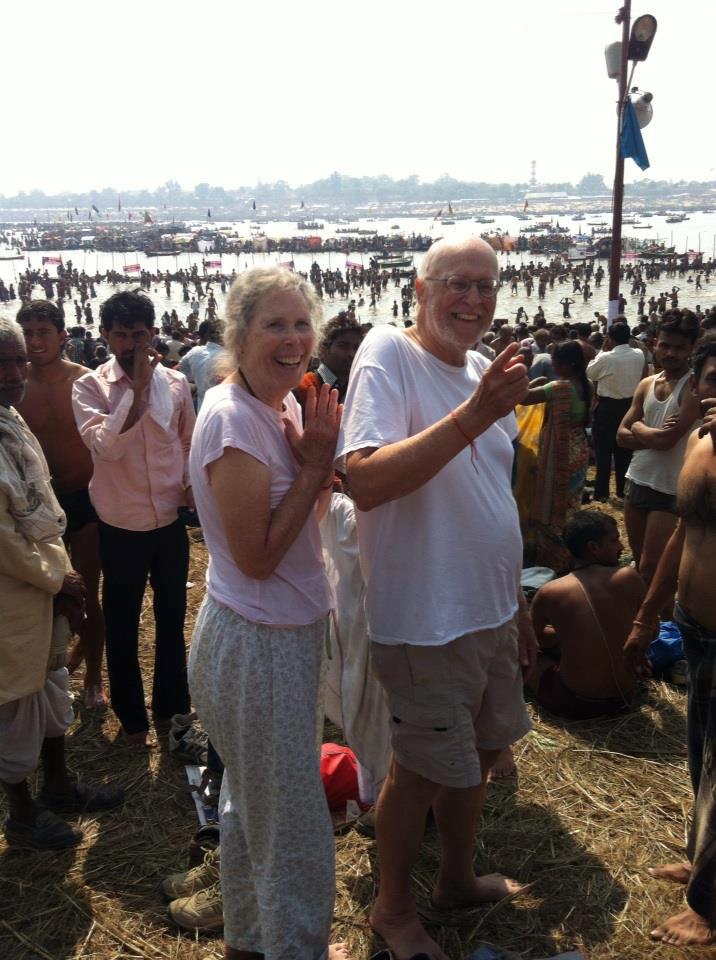
Here’s a photo of Prudence and Albert getting ready to bathe in the Ganges at the Kumbh Mela. I’ve never seen them looking so happy!

Prudence and Albert getting ready to bathe in the Ganges at the Kumbh Mela

Meditation could slash the risk of heart attack and stroke (and make you less angry) — Daily Mail

November 13, 2012

Meditation could slash the risk of heart attack and stroke (and make you less angry)

  • Twice daily mantra meditation, where a sound is made repeatedly, may also reduce blood pressure

By Anna Hodgekiss

PUBLISHED: 15:03 EST, 13 November 2012 | UPDATED: 15:03 EST, 13 November 2012

Twice daily mantra meditation, which involves making a sound repeatedly, lowers death rates from heart attack and strokes

Meditation helps reduce the risk of suffering a heart attack or a stroke, according to a new study.

Researchers found that Transcendental Meditation, made popular by the Beatles during the flower power era of the 1960s, could cut heart attack rates by half.

This type of meditation, which involves making a sound repeatedly, lowers death rates from heart attack and strokes.

In the new study, researchers found that people with heart disease who practised transcendental meditation for 20 minutes twice a day were 48 per cent less likely to have a heart attack, stroke or die from all causes compared with those who attended a health education class over more than five years.

Those practicing meditation also lowered their blood pressure and reported less stress and anger.

And the more regularly patients meditated, the greater their survival, said researchers who conducted the study at the Medical College of Wisconsin.

Lead researcher Dr Robert Schneider, director of the Institute for Natural Medicine and Prevention in Iowa, said: ‘We hypothesised that reducing stress by managing the mind-body connection would help improve rates of this epidemic disease.

‘It appears that transcendental meditation is a technique that turns on the body’s own pharmacy – to repair and maintain itself.’

For the study, researchers randomly assigned 201 people – with an average age of 59 – to participate in a transcendental meditation stress-reducing programme or a health education class about lifestyle modification for diet and exercise.

Transcendental Meditation was made popular by the Beatles during the flower power era of the 1960s

The average BMI of the people involved was 32 – classed as obese.

Both groups showed beneficial changes in exercise and alcohol consumption, and the meditation group showed a trend towards reduced smoking.

Although there were no significant differences between the groups in weight, exercise or diet, regular meditation was correlated with reduced death, heart attack and stroke.

Dr Schneider added: ‘Transcendental meditation may reduce heart disease risks for both healthy people and those with diagnosed heart conditions.

‘The research on transcendental meditation and cardiovascular disease is established well enough that doctors may safely and routinely prescribe stress reduction for their patients with this easy to implement, standardised and practical programme.’

The findings were published in the journal Circulation: Cardiovascular Quality and Outcomes.

Follow us: @MailOnline on Twitter | DailyMail on Facebook

More news coverage: Transcendental Meditation May Lower Heart Risk: WebMD Heart Disease Health Center and Transcendental Meditation may reduce death, heart attack and stroke in heart patients—AHA and Science Codex: Meditation may reduce death, heart attack and stroke in heart patients

The Daily Mail does not explain Transcendental Meditation properly. We do not repeatedly make a sound. It is a silent mental practice of experiencing the thought process at more refined levels until the mind transcends thought and arrives at an inner state of restful alertness. This natural level of deep rest releases stress and allows the body to repair itself resulting in improved health.

The Age features Transcendental Meditation and the Maharishi School in national education article

October 22, 2012

Australia’s The Age features Transcendental Meditation and the Maharishi School in a national education article written by Denise Ryan: School puts stress on staying calm: Meditation techniques embraced by the Beatles are helping students in Reservoir. October 22, 2012. (I added links.)
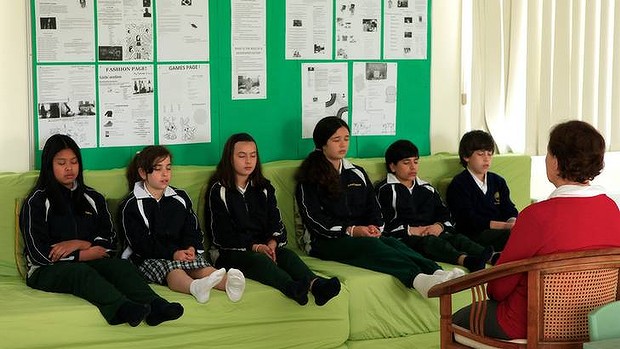
Students practise Transcendental Meditation at the Maharishi School in Reservoir. Photo: Eddie Jim

MOST children wouldn’t describe their primary school as “peaceful” or all their teachers and classmates as “kind”. But that’s how Bridgette Nicolosi views her new school.

The year 4 student says she used to feel “confused” in her former mathematics class, but since she has learnt Transcendental Meditation at the Maharishi School in Reservoir, she is no longer as “scared” of maths as she was. She also feels more accepted and included.

Isabelle Coates, the year 6 captain, is not surprised. She has compared how “calm and happy” she feels with the state of mind of friends at other schools. “I seem to be more relaxed,” she says. “I think if I didn’t meditate I would be more stressed.”

Fellow year 6 student Supreeya Bullock says meditation has helped her with schoolwork and in playing sport. Perrin Broszczyk says it has helped him relax and has improved his tennis.

These students are making big claims but their positive experiences from two 10-minute Transcendental Meditation sessions each day is backed by a wealth of international research.
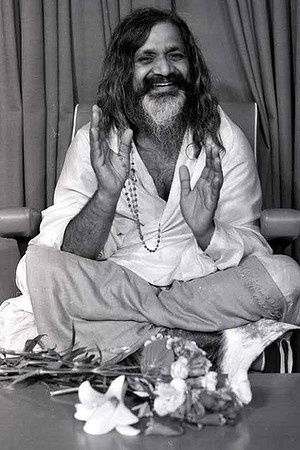
Maharishi Mahesh Yogi
Photo: Trevor Dallen

Transcendental Meditation was developed by Maharishi Mahesh Yogi and was first taught in India in the 1950s. Pop group the Beatles extolled its virtues, writing almost 50 songs while studying with Maharishi at his ashram in the foothills of the Himalayas in the late 1960s. Hollywood stars Mia Farrow and Shirley MacLaine also took it up. It is practised by millions world-wide, despite Maharishi’s death in 2008.

Some might regard the practice as New Age or bohemian but it has become mainstream, particularly in the US where it is used in some hospitals to help chronically or terminally ill patients manage their stress.

Principal Frances Clarke
Photo: Eddie Jim

Maharishi School founder and principal Frances Clarke says meditating in silence has profound results. Since the 1970s hundreds of research studies on Transcendental Meditation have been undertaken at more than 200 universities and research institutes across many countries.

These studies report benefits such as increased creativity, intelligence and learning ability, higher levels of brain function, improved memory and school behaviour. Studies have reported an increased sense of calm, decreased anxiety and reduced conflict.

When Ms Clarke founded this independent school with like-minded families in Bundoora in 1997, it had 20 students. The school gained a following since moving to Reservoir, drawing families from local suburbs such as Northcote. It now has 80 students, rising to 100 next year.

The school teaches the standard curriculum but adds a subject called Science of Creative Intelligence, and also the meditation sessions. In the extra class, students might do maths as part of learning such principles as that every action has a reaction.

An ancient system of architecture and design known as Maharishi Vedic principles have been included in two new buildings. For example, they are entered from the east, capturing early morning sun. The principles are different but are along the lines of Feng Shui, in that they seek to maximise health and success.

Ms Clarke first learnt to meditate at age 22. She found it helpful to deal with stress when she became a secondary school teacher. When she heard that the Maharishi School of the Age of Enlightenment in Iowa was getting outstanding results, she decided to visit.

The Iowa school is open entry yet it continues to record some of the top academic results in the state and its students regularly win awards for sports, science, art and problem-solving competitions. TV star Oprah Winfrey has highlighted the school’s results on her program.

Some US schools that deal specifically with Attention Deficit Hyperactivity Disorder have adopted Transcendental Meditation techniques after also witnessing its success at a Detroit Middle School.

A Maharishi School in Lancashire, England, has performed in the top 2.5 per cent of schools for 25 years, despite also being open entry. As a result, the education department has fully funded it. Other Maharishi Schools are being established there too.

Ms Clarke’s husband Larry, who has also taught Transcendental Meditation for many years, says it has a following in the US, Europe, South America and Thailand but has been slower to take off in Australia, despite the established benefits.

“It’s a bit of a sleepy hollow here, yet 6 million people have been trained world-wide.”

Transcendental Meditation differs from some other forms of meditation in that it allows the mind to effortlessly “transcend thought”.

“It does not require contemplation or concentration,” says Dr Clarke. He regards concentrating on breathing or an object, such as a candle flame, as an arduous practice where the mind is still active.

“In TM the mind becomes quieter and quieter until it is doing absolutely nothing. TM uses the natural tendency for the mind to move towards something more interesting or charming. It moves into subtler and subtler states until thought dissolves into silent wakefulness, or pure consciousness.”

Ms Clark says meditation helps children find their passion. “Around years 3 or 4 they discover what they love, and go for it.”

She says this is because children can concentrate. “Some schools spend all their time doing English and mathematics but our students focus so well they have time for everything else.”

The small scale also helps. “Students don’t get lost. Everyone has the opportunity to have a go at everything, whether it be a science or drama competition or to be in the school concert.”

Parents pay $1300 each term to send their children to this alternative school. At least one parent must practise or learn Transcendental Meditation also. The school offers a four-day course for parents. On weekends children meditate with their parents.

Students up to the age of 10 meditate with eyes open, walking about. Older children are seated in comfortable spots in the classroom. Ten-minute sessions are held about 9.30am and 3pm each day, which means students head home in a calm state. “But they don’t want to go home,” Ms Clark says. “It’s a small community and parents and students love to hang around after school.”

Teacher Samantha Russell loves the strong relationship between staff and parents. “I feel really sorry for my friends in other schools who don’t see the parents and don’t have the same objectives as them.”

She says parents talk to her about their experiences of meditating and it makes for a closer bond.

Students sometimes get a shock when they move from this environment to high school.

“They often express surprise that other students don’t want to learn and spend a lot of time mucking around,” says Ms Clarke.

She sees the government’s recent pressure on teachers to improve what they do as misplaced. “Transcendental Meditation develops the consciousness of the student so they are much more capable of learning. You can’t teach a class if children aren’t awake, alert or aware.”

Article URLs: http://bit.ly/TBUgpw and updated http://bit.ly/RqwoWW.

Earlier this year the Maharishi School was featured on Australian TV: Cool School: Melbourne school teaches meditation to students.

URLs for Maharishi School: http://www.maharishischool.vic.edu.au and TM in Australia: http://tm.org.au

Here is an image of the layout in Monday’s Age in Melbourne, Australia. Will replace it with a better resolution when available. (more…)

The 8.15 train to Nirvana: How you can meditate your stresses away… even on the daily commute

May 23, 2012
The 8.15 train to Nirvana: How you can meditate your stresses away… even on the daily commute

By Marianne Power
12 May 12, 2012

Last summer I bumped into an old colleague. We hadn’t seen each other for years and it transpired that in the previous 18 months, her mother had died of cancer, her father had moved in with her and she had been made redundant.

Yet she seemed remarkably calm. How on earth was she coping? After joking about the healing power of gin, she admitted her secret: she had learned how to meditate.

We have all read about the healing powers of meditation. Medical research has found that it can reduce the risk of everything from heart disease to strokes, depression and insomnia – but this was the first time I had seen its benefits up close.

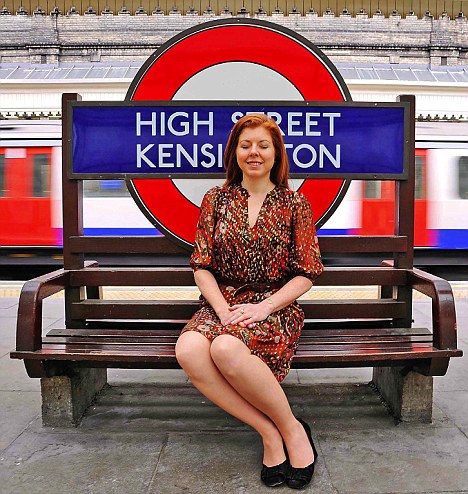
Down time: Marianne Power meditates as she waits for a Tube train in London

Soon I was meditating twice a day, too, even learning to fit it into train journeys to work or sneaking a few quiet minutes in a bathroom cubicle at the office.

Before I bumped into my colleague I was running on empty. By day I was stressed by silly things that made me snap at people.

By night I would try to unwind with too many hours of television and too many glasses of wine before lying awake in bed stewing over all my worries.

I was run-down, got every cold going and at my very lowest points was prescribed antidepressants. My friend recommended Transcendental Meditation, which is different from other forms of meditation.

Instead of focusing on your breathing, you are given a Sanskrit word, known as a mantra, that you repeat in your head. The idea is that the repetition of the sound calms your mind.

The practice was made famous by The Beatles, who became devotees after meeting its founder, Maharishi Mahesh Yogi, in the Sixties. Since then everyone from Clint Eastwood to William Hague and Nick Clegg has become a fan.

Latest research from Oxford University’s Department of Psychiatry has shown that meditation brings about neurological changes. After  a few months of meditation, the parts of the brain with a tendency to worry are switched off.

Clinical trials have proved that as a standalone treatment it can  prevent relapse of depression and is effective alongside medication.

But I was most interested in its effects in counteracting stress. And I can say that learning to meditate has changed my life.

At my first lesson I was given my mantra, which you don’t share with anyone, and told to close my eyes and repeat it again and again in my head. Straight away I was hooked.

There’s something about the sound vibration of the mantra going over and over in your mind that lulls you into a kind of trance. The repetition of the sound is like a lullaby.

You go into your own world and yet you are still aware of your surroundings. You’re neither awake, nor asleep, nor dreaming – just beautifully relaxed. It’s like a warm bath for your brain.

After that first lesson, I felt calm and focused and that night I enjoyed a longer, deeper sleep than I’ve had since I was a child. And I’ve been sleeping well ever since.

The more I meditate, the less I seem to be bothered by things. Situations that would once have sent me into a tailspin no longer have the same effect.

My heart doesn’t race in the way it once did; I have become more calm and rational; my concentration at work has also improved.

I think this is primarily because I am better rested and less stressed, but scans have shown that meditation actually increases the size of your hippocampus – the part of the brain associated with memory and learning. I also feel healthier.

I have had only one cold in the past seven months. And then there are the less tangible changes, the ones to your personality and relationships.

Friends have commented on the fact that I seem more relaxed. I  certainly feel more content, less inclined to snap or overreact.

So is this a miracle? Am I now the perfect person? Hardly. Like most of the good things in life, it takes work. Like going to the gym or eating well, you have to keep doing it even on days when you tell yourself you are too busy.

I meditate for 20 minutes morning and night. After breakfast, and then at 4pm – and on days when that’s not possible, on the train or in a taxi. Every little helps. It doesn’t matter whether I close my eyes for two minutes or 20, when I open them I feel better.

I have yet to experience the so-called ‘bliss’ that devotees talk about but I’m just so happy that I’ve found a tool that helps me perform well in the day and sleep better at night.

I wish I’d been taught this at school – it’s the best life skill I’ve ever learnt. But it’s not cheap.

When I turned up for the first open evening at my local TM centre (they’re all over the country), I was told that fees were charged according to income. I would have to  pay £490.

But I did it – and it was the best money I’ve ever spent.

uk.tm.org

Published by Associated Newspapers Ltd, part of the Daily Mail, The Mail on Sunday & Metro Media Group. Also published in Independent Online: The 8.15 train to Nirvana.

Here is a related article, The Power of Transcendental Meditation, by Julie Eagleton, another British journalist who also learned to meditate and wrote about it. Julie has covered arts & culture, fashion, food, health & beauty and travel. Find out more at http://www.julieeagleton.com.

Also see this article by Julie: Meditation Creativity Peace: A Documentary of David Lynch’s 16 Country Tour.

Olivia Harrison talks about George being inducted into the Rock and Roll Hall of Fame 2004

May 11, 2012

Olivia and Dhani Harrison accept award for George after Tom Petty and Jeff Lynne induct George Harrison Rock and Roll Hall of Fame 2004.

Here is a partial transcription of Olivia’s acceptance speech. Very beautiful and wise! Olivia is an exceptional person!

Here I go again. I can talk about George, you know, forever. But uh, I won’t. There was a quote by the Indian poet Tagore that George read to me one day. He said, “Blessed is he whose fame does not outshine his truth.” And here we are in the Hall of Fame. But the inductees are not chosen because of their fame, but because they expressed their truth through their music. George said that he tried to write songs that would, uh, still mean something years from now. And I think it’s safe to say that in spite of his immense fame his truth will never be out-shined or forgotten. (applause) Good.

Olivia went on to say that had George been there that night he would have thanked a lot of people. But she did thank one person in the room that George knew the longest in his life—”someone who looked after him, and all of them, from the time they were 13, for George, the end of his life, and that’s the mysterious Neil Aspinall.” And she thanked Neil for holding it together, otherwise the phenomenon (of the Beatles) might not have happened or stayed together as long as it did.

Seven years later, with Olivia’s help, . Also see: George Harrison: The not-so-quiet Beatle, article by Philip Goldberg in LA YOGA Magazine.

See George Harrison – The Last Performance (John Fugelsang), a rare and wonderful interview on VH1, where George and Ravi Shankar came in to talk about an album he had produced called, Chants of India. George also talked about a concert he gave for the Natural Law Party, and the need to educate students on how to raise their consciousness. He answered questions about his concert for Bangladesh, the first benefit concert of its kind; and how he introduced the Beatles to Transcendental Meditation when they met Maharishi Mahesh Yogi who was going to be speaking at the Hilton Hotel. He unexpectedly played some music, including a new song, Any Road, with the line, “If you don’t know where you’re going any road will take you there,” which came out on his posthumous album, Brainwashed.

I later found this sweet video clip of George posted Nov 29, 2019 by @GeorgeHarrison, the official Twitter feed for the Estate of George Harrison, on the 18th anniversary of his passing. Olivia Harrison described that moment: “There was a profound experience that happened when he left his body. It was visible. Let’s just say, you wouldn’t need to light the room, if you were trying to film it. He just…lit the room.” George was a great soul and we remember him today with much love and affection.

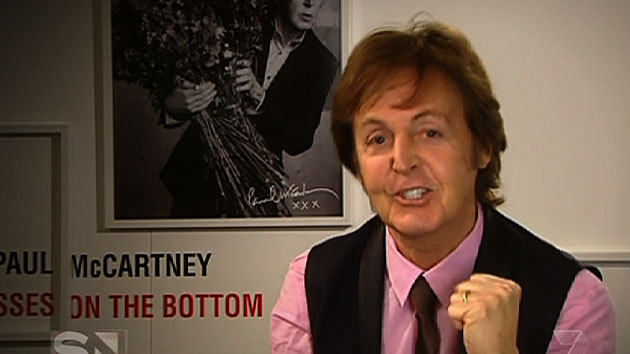
Sir Paul McCartney is interviewed on Australia’s Channel Seven’s Sunday Night, February 5, 2012

May 11, 2012

0205_sunnight_paulm_lrg_17isi85-17isi88Copyright © 2012 Seven Network Australia

On Sunday Night, February 5, 2012, Channel 7 reporter Ross Coulthart conducted an exclusive interview with Ex-Beatle Sir Paul McCartney for Channel Seven’s Sunday Night. Besides talking about his latest CD, Kisses on the Bottom, Paul answered questions about his earlier days in the Beatles and visit to Australia, his music, and his wives.

Speaking of Paul’s wives, here’s something I caught by surprise on YouTube while watching Paul McCartney on Ellen recorded November 2005—Nancy Shevell in the audience! Paul was still married to Heather Mills at the time. The lady in the front row audience shots 0:22–0:25, and 5:15–5:16 definitely looks like her.

According to Wiki, McCartney started dating Shevell in November 2007, before he finalized his divorce with Heather Mills. But this show was taped 2 years earlier in Nov 2005. Wonder if they knew each other back then, if she actually met Paul back in 2005 on the Ellen show? If not, 2 years seem to have passed until they started dating. Either way, it’s kind of prophetic! They announced their engagement three and half years later on 6 May 2011, and were married after five months on 9 October 2011. This one looks like a keeper. We wish them both much happiness. I especially love the beautiful song Paul wrote for Nancy, which they danced to on their wedding night, My Valentine.

Related: Paul McCartney and Nancy show up to see James play, and surprise the small Brighton club audience and ‘My Valentine’: Johnny Depp and Natalie Portman Star in Paul McCartney-Directed Video.