Posts Tagged ‘Rita Dove’

Enjoy cricket poems by Mary Oliver and Rita Dove from two points of view—the poet and the cricket

August 26, 2023

Do you remember hearing a cricket chirping at night? Did you enjoy listening to its song, or was it annoying? Two well-known poets wrote about their encounters with a cricket, but from different points of view—the poet and the cricket.

I first found this poem, Nothing Is Too Small Not to Be Wondered About, by Mary Oliver. Attentive to all creatures, including the smallest of them, she wonders what happened to the cricket after it stopped its singing.

I then came across another poem about a cricket, Postlude, by Rita Dove. But it’s written from the perspective of one with something to say, and the magic that can happen when we stop and listen.

1st cricket poem
Nothing Is Too Small Not to Be Wondered About 
Mary Oliver
The cricket doesn’t wonder 
    if there’s a heaven
or, if there is, if there’s room for him.

It’s fall. Romance is over. Still, he sings.
If he can, he enters a house
    through the tiniest crack under the door.
Then the house grows colder.

He sings slower and slower.
    Then, nothing.

This must mean something, I don’t know what.
    But certainly it doesn’t mean 
he hasn’t been an excellent cricket 
    all his life.

Mary Oliver, “Nothing Is Too Small Not to Be Wondered About.” Felicity: Poems. New York: Penguin Press, 2016.

I found that one on Best Poems, and then as it appears with line breaks on page 27 of Felicity posted at the University of Arizona Poetry Center under Poems of Love and Compassion.

2nd cricket poem

Postlude
Rita Dove

     Stay by the hearth, little cricket.
     —Cendrillon

You prefer me invisible, no more than
a crisp salute far away from
your silks and firewood and woolens.

Out of sight, I'm merely an annoyance,
one slim, obstinate wrinkle in night's
deepening trance. When sleep fails,

you wish me shushed and back in my hole.
As usual, you're not listening: time stops
only if you stop long enough to hear it

passing. This is my business:
I've got ten weeks left to croon through.
What you hear is a lifetime of song.
“Postlude” by Rita Dove, featured in The Paris Review Issue No. 235, Winter 2020.  Copyright © 2020 by The Paris Review, used by permission of The Wylie Agency LLC.  

Read Rita Dove’s impressive biography after the poem in Featured Poet published on Poetry Daily, a partnership between the Daily Poetry Association and George Mason University.

Read about Mary Oliver (1935-2019) and her astonishing poetry in this memorial acknowledgment to her poetic legacy. It contains links to articles, interviews, and poetry readings, as well as many of her favorite poems I’ve loved and posted over the years.

— Written and compiled by Ken Chawkin for The Uncarved Blog.
“Sanctifying Morning” is a poem by Ken Chawkin on one way to be “spiritual but not religious”

February 17, 2013

Sanctifying Morning is a poem I wrote four years and one month ago today. It may remind you of the phrase, “spiritual but not religious,” how millions of Americans now identify themselves, a trend I was not aware of until I learned about it from Philip Goldberg, author of American Veda. TM* is my way of being spiritual but not religious.

Sanctifying Morning

Charcoal in a church,
Incense-filled smoke,
Knees on the ground,
Wafer on a tongue —
Prayers ascend the sky.

It’s Sunday morning,
And I have my own rituals.
The smell of burnt toast sanctifies the morning air.
Orange rinds round out the debris of breakfast.
Fumes float upwards from a hot coffee cup.

Having pacified the body’s urges,
With no work to be done today,
Though the senses focus outward,
It’s time to bring them within,
And prepare for this peaceful morning.

I retire to my meditation room,
Sit comfortably, and close the eyes.
Thinking my mantra, effortlessly,
I descend to the depths of my mind,
And transcend.

My body follows —
Breath slows, and suspends,
Heart beats quieter,
Brain cells speak softly, in unison —
I’m at peace with myself.

This is the true communion of the spirit
Within the church of the Self.
No pews are required here
As one prepares to meet the maker
Of one’s life.

© Ken Chawkin
January 17, 2009
Fairfield, Iowa, USA

*TM stands for Transcendental Meditation. It’s not a religion. To me, it’s a spiritual practice that is compatible with any or no religion. Today millions of Americans admit to practicing some form of meditation. Members of different faiths practice Transcendental Meditation, including monks, nuns, priests and rabbis. Even atheists and agnostics meditate. You may too, some day, if you haven’t, already.

Publication and Update

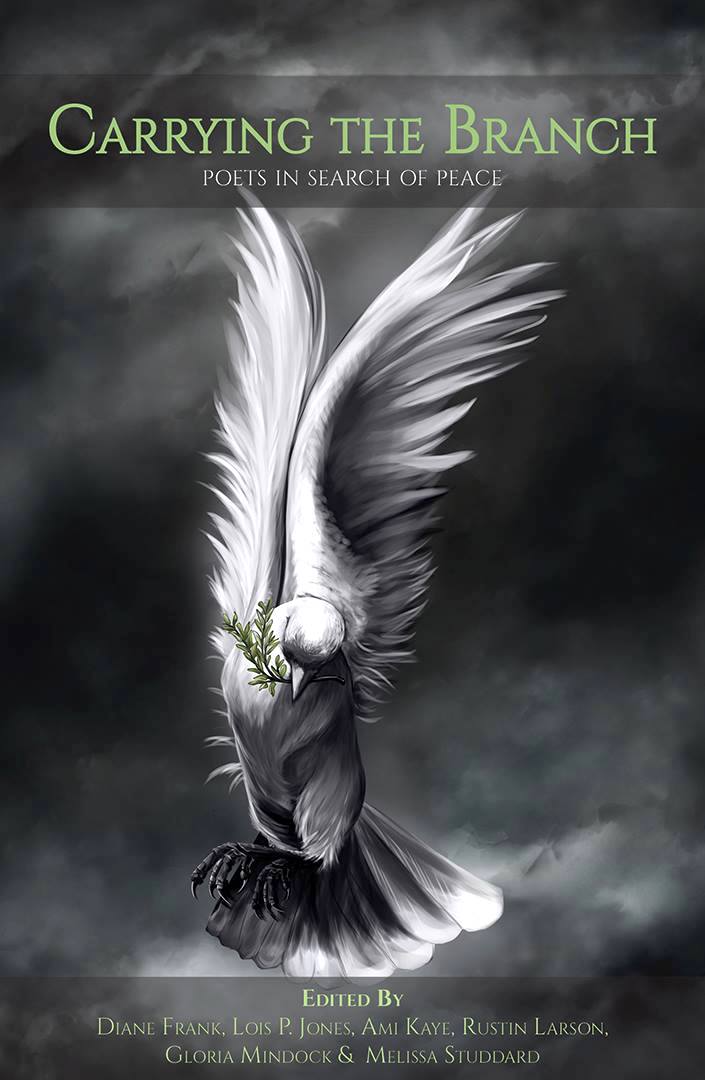
Carrying the Branch-Poets in Search of Peace

Thanks to Iowa poet and editor Rustin Larson for selecting “Sanctifying Morning,” which was later included in Carrying the Branch: Poets in Search of Peace. The book was published by Glass Lyre Press October 1, 2017 and edited by Ami Kaye. My poem is found on page 132. These other poets also submitted their poems and participated as editors soliciting poems and curating their sections for this anthology: Diane Frank, Lois P. Jones, Gloria Mindock, and Melissa Studdard. All profits after printing go to the Red Cross and Doctors Without Borders.

It is also an honor to be included among so many distinguished authors and poet laureates, like Robert Pinsky, W. E. Butts, Joy Harjo, Rita Dove, and Jane Hirshfield, to name a few collected here.

Blogger Chris Rice Cooper was the first to review our anthology, (January 17, 2018): Receiving & Giving Peace in the anthology CARRYING THE BRANCH POETS IN SEARCH OF PEACE . . . She put a lot of work into it with photos, excerpts, and links to an alphabetical listing of the poets and their websites. Next to my photo she provided the link to an article: PR to poetry – how things sometimes happen to Ken Chawkin.

After describing the different problem areas the poems deal with, Cooper says, “In this specific piece I’d like to focus on the poems that offer suggestions of acts and thoughts that we as individual human beings can do or think to bring peace into our own lives, the lives of our communities, and the lives of the entire world.”

Surprisingly, she includes my poem in her review: “In Ken Chawkin’s poem “Sanctifying Morning” the speaker of the poem experiences his own peace by having “church” in his own body, in his own home where he retreats to his meditation room and meditates mentally, emotionally, and spiritually.”

She concludes by saying, “There are numerous lessons to be learned from this anthology but the top two are:  we must love the enemy within and without ourselves; and we must transcribe our experiences down, rather on paper or canvas – only then will the next generation receive their rightful inheritance – their own branch of peace.”