Posts Tagged ‘medicine’

Cancer stories: Greg James restored balance with Maharishi Ayurveda and TM to enjoy his life again

October 28, 2012

FAIRFIELD — October is National Breast Cancer Awareness Month and The Ottumwa Courier asked cancer survivors and/or family members to share their stories. A few people wrote to tell of their experiences and their stories have been running often throughout this month. The editor thanks all the people who participated. Many said they wanted others to know about the experience and to always have hope. Here’s a story from a friend of mine, Greg James, in Fairfield. I never would have guessed he had been through so much, he seems so healthy to me.

Cancer stories: Restore balance and enjoy life

October 25, 2012

“No one has ever survived this kind of cancer,” the Harvard oncologist told me back in September 1988. “It is a rare and very fast-growing form of Non-Hodgkins Lymphoma. Sloane Kettering in New York City has only seen 50 cases in the last 10 years, and no white male 37-year heterosexual has ever survived.  You are Stage 4 with complications (massive pleural effusions).”

“What are his chances of surviving?” asked my family, and the doctor would only cross his fingers.

It was very ironic that I got this cancer, as I was on a media team that was making Deepak Chopra and Maharishi Ayurveda household words. I had been in perfect vibrant health, an active hiker, then (and now).

My father was a hospital administrator and consultant. I grew up with mixed signals: the doctors were brilliant and great people, but their system limited them to drugs and they couldn’t think out of the box; they are brilliant technicians but lack training in vital areas of nutrition and bedside manner. So, I was, from the outset what Bernie Siegel (author of “Love, Medicine, and Miracles”) called a “difficult patient.” Dr. Siegel noted that the patients who take an active interest in their treatment, asking frequent questions and sometimes going against medical advice, were the ones that survive.

It was quickly found that I had a tumor the size of a fist in my throat choking me. That explained a lot! The CHOP protocol worked quickly, dissolving that tumor, and I got through tumor necrosis (the breaking up of the tumor and the spread of that material throughout the body). I was re-admitted to Mass General Hospital in Boston again for a total lack of white blood cells and put on a rescue remedy. Then, two months after my first treatment, I was in Intensive Care Unit for 12 days fighting for my life against pneumonia.

After that, consulting with various doctors outside of the cancer complex at Mass General, I decided to quit the chemo, brain radiation and spinal taps in favor of rebuilding my body with special herbs from India and a rejuvenation protocol (now offered at The Raj in Fairfield). I was totally devastated by the chemo and lack of sleep caused by the Prednizone, and couldn’t hold down food from nausea. My body was trying to throw off the “emergency medicine” and get back to some balance. The Ayurvedic treatments were designed not to cure disease but to promote good health, but they gave me what I needed most: vitality, strength and some hint of happiness.

Meanwhile, the oncologists were upset that I had taken a break from chemo, etc., and told me they had gotten approval for a bone marrow transplant from Dana Farber Institute, a procedure that would “bring me to the brink of death, and then we will re-inject your bone marrow” and I was prescribed three years of continuing chemo, etc. after the transplant. My oncologist quoted a published study and told me that three out of 23 patients had survived this type of bone marrow transplant, which angered me. “You want me to bet my life on one chance in eight? Who is on drugs here, doctor? (I didn’t continue, and saved the insurance company $300,000)”

Ten months after I started, I was back to walking without leg braces (after losing strength from the chemo), and loving life again. I was grateful to have the best of “emergency medicine” and the best of alternative medicine. For a few years after, everyone and their brother was calling me to ask me to talk to their wife or cousin or whomever about their cancer treatment. My answer included these points: realize that the surface condition of cancer is a symptom of an underlying imbalance in the mind-body connection and that this must be restored, and it could be. If your condition is terrible, by all means take allopathic medicines, but don’t be afraid to break from it to get much-needed vitality back through expert-prescribed herbs and rejuvenation therapies. Take “rasayanas,” herbal supplements that promote longevity. First of all, go to an established Maharishi Ayurveda clinic and take the rejuvenation therapy; it will promote your recovery very quickly. And practice verified techniques for improving health, namely Transcendental Meditation. Be honest about your feelings: of course you are scared, that is natural; if you aren’t scared, then somebody isn’t being honest.

People ask me, “So your cancer is in remission?” and I answer, “My health was in remission briefly, but that has been restored.” I change the emphasis because too many people fear the problem without re-defining it: cancer is an opportunity, a forced opportunity, to go deep inside, bring out the strength you need and restore balance to enjoy life.

Greg James

Fairfield

Reprinted with permission from the author

Hard evidence grows for including meditation in government-sponsored health programs

October 17, 2012

Hard evidence grows for including meditation in government-sponsored health programs was released on EurekAlert! October 17, 2012.

More people still die from cardiovascular disease than any other illness. Dubbed the number one killer and the silent killer, modern medicine has been researching and incorporating complementary and alternative approaches to help treat and in some cases reverse and hopefully prevent this health problem at an earlier stage of the disease. One of those modalities is meditation.

A new research review paper on the effects of the stress-reducing Transcendental Meditation (TM) technique on the prevention and treatment of heart disease among youth and adults provides the hard evidence needed to include such evidence-based alternative approaches into private- and government-sponsored wellness programs aimed at preventing and treating cardiovascular disease.

The paper, “Prevention and Treatment of Cardiovascular Disease in Adolescents and Adults through the Transcendental Meditation® Program: A Research Review Update” is published in Current Hypertension Reviews, 2012, Vol. 8, No. 3.

• In teens, the TM technique has been found to reduce blood pressure, improve heart structure and improve school behavior. According to the paper, the technique has been shown to be a safe alternative. The NIH-sponsored clinical trials conducted with TM mentioned in this review did not observe any adverse effects from TM practice.

• In adults the technique reduced stress hormones and other physiological measures of stress and produced more rapid recovery from stress, decreased blood pressure and use of blood pressure medication, decreased heart pain in angina patients, cleared the arteries, reducing the risk of stroke, improved distance walked in patients with congestive heart failure, and decreased alcohol and tobacco use, anxiety, depression, and medical care usage and expenditures. The technique also decreased risk of death from heart disease, cancer, and all causes.

“These findings have important implications for inclusion of the Transcendental Meditation program in medical efforts to prevent and treat cardiovascular disease,” says Dr. Vernon Barnes, lead author and research scientist at Georgia Health Sciences University, in Augusta, Georgia.

“This review is potentially more important than individual research papers because it shows that TM has an integrated, holistic effect on all levels of cardiovascular disease,” says co-author, Dr. David Orme-Johnson.

Orme-Johnson says that no other meditation technique has been shown to produce this constellation of changes, especially when it comes to hard measures of cardiovascular disease.

Dr. Barnes said it was important to start preventing heart disease with adolescents before the disease sets. “Adding Transcendental Meditation at a young age could prevent future cardiovascular disease and save many lives, not to mention reduce the national medical bill by billions of dollars.”

This model shows how regular practice of the Transcendental Meditation Program may reduce chronic stress, which in turn reduces CVD risk factors and improves stress reactivity, thereby decreasing cardiovascular disease, and consequential morbidity and mortality.

Uniqueness of the Transcendental Meditation technique

The uniqueness of the outcomes of the TM technique may have something to do with the mechanics of the practice of the technique itself says Dr. Barnes. “Meditation practices are different from each other and therefore produce different results. And this is a very important consideration when evaluating the application of meditation as an alternative and complementary medical approach.”

A paper in Consciousness and Cognition discusses three categories to organize and better understand meditation. See Are all meditation techniques the same?

The two common categories are focused attention, concentrating on an object or an emotion, like compassion; and open monitoring, being mindful of one’s breath or thoughts, either contemplating the meaning of them, or just observing them.

Transcendental Meditation uses a different approach and comes under the third category of automatic self-transcending, meditations that transcend their own activity.

The TM technique does not employ any active form of concentration or contemplation, but allows the mind to effortlessly experience the thought process at more refined levels until thinking comes to a quiet settled state without any mental activity. The mind is awake inside and the body is resting deeply, a level of rest much deeper than deep sleep. It is this state of restful alertness that allows the body to make the necessary repairs to rebalance its normal functioning. This cumulative process resets the physiology and shows up as reduced symptoms of cardiovascular disease and improved health.

###

The EurekAlert! press release was publicized by other medical and science websites like Science Codex, PhysOrg, and PsychCentral: Meditation Technique Lowers Stress, Improves Cardiovascular Health. Medical News Today reported: Evidence Suggests That Meditation Should Be Included In Government-Sponsored Health Programs and embedded the video of Dr. Oz talking about TM. Holistic Future: Evidence shows Transcendental Meditation prevents heart disease

For a clear comprehensive understanding see Transcendental Meditation Visualized [Infographic].

South Asian Heart Center uses Transcendental Meditation to prevent and manage heart disease

May 12, 2012

South Asians are becoming painfully aware of the high incidence of heart attacks, often fatal, frequently among seemingly healthy, trim, and physically active close family & friends.

The South Asian Heart Center (SAHC) at El Camino Hospital in Mountain View, California has developed a four-pronged approach to prevent and successfully manage heart disease among men and women of South Asian descent living and working in America. Here is an introduction to their work presented by Executive Director Ashish Mathur, and SAHC Medical Director Cesar Molina, MD, FACC: South Asian Heart Center Helps South Asians Fight Heart Disease.

In this fourth of a four-part series on Therapeutic Lifestyle Changes Dr. Molina focuses on the importance of deep rest and its effect on heart-health and diabetes. He specifically covers the importance of meditation (or restful alertness) on longevity and health, and the science behind the effective technique of Transcendental Meditation (TM), which produces a “hypo-metabolic state of restful alertness.” Learn the evidence on the profound impact of this unique form of meditation on a whole class of chronic ailments. This is a very clear and comprehensive presentation!

South Asian Heart Center Webinar: TLC – Restful Sleep & Restful Alertness April 25, 2012, published on Apr 26, 2012 by sahcsathi.

At 26:26 of Part 4, Dr. César Molina begins talking about resting while awake with Transcendental Meditation and how it impacts our health, especially for South Asians and their propensity toward heart disease. One of the therapeutic modalities from the South Asian Heart Center is Transcendental Meditation as a stress-reduction technique. Dr. Molina reviews his talk starting at 56:18. He summarizes the lifestyle methodology to prevent heart disease and enhance longevity at the South Asian Heart Center: nutrition, physical activity, the importance of restful sleep, and the importance and benefit for stress reduction through Transcendental Meditation decreasing cardiovascular risk factors, decreasing hospital expenditures and admissions, and enhancing longevity.

Dr. César Molina presents Wednesday Lunch-hour Webinar Series TLC: Therapeutic Lifestyle Changes. Here are the 4 topics where you can download the video and a PDF of the main points and graphs for each talk. The recommendations can be applied to all Americans regardless of ethnicity or geographical location.

1. TLC: Therapeutic Lifestyle Changes Overview: May 2, noon
2. TLC: Exercise as Medicine: May 9, noon
3. TLC: The Dinner vs. the Diner: May 30, noon
4. TLC: Restful Sleep and Restful Alertness: June 20, noon

For more information: www.southasianheartcenter.org and www.tm.org.

50% reduction in PTSD symptoms within 4 weeks of Veterans practicing Transcendental Meditation

January 18, 2011

Reduction of PTSD Symptoms in Veterans with Transcendental Meditation

DavidLynchFoundation http://www.davidlynchfoundation.org/

Norman Rosenthal, M.D. (Clinical Professor of Psychiatry, Georgetown University Medical School): Over half a million of our veterans from Iraq and Afghanistan are suffering from Post Traumatic Stress Disorder. These are people who have been exposed to violence on the battlefield serving for our country. And, as one of my patients said, it can happen once in your life but a hundred times in your mind. The echos linger on.

Sarina Grosswald, Ed.D. (Cognitive Learning Specialist): With traumatic stress it’s really some enormous stress that’s more than the body can process, and it leaves a big impression on your brain. The estimates are that at least 30% of returning veterans are experiencing PTSD and really the estimates are that it’s probably much greater than that. I think that maybe as many as 50% who are experiencing these symptoms aren’t actually even seeking help.

Dr. Rosenthal: They get bombarded on a daily basis by memories and flashbacks and it’s a shocking statistic that 18 veterans every day commit suicide.

Dr. Grosswald: We’ve lost more to suicide than actually have been lost in combat. That’s the first time ever.

Dr. Rosenthal: One thing that we who are interested in Transcendental Meditation are seeking is could TM be one of the answers or one of the ways in which we can treat PTSD?

Dr. Grosswald: We put together a pilot study with returning veterans from the OEF-OIF war, which is the Iraq/Afghanistan war, and what we saw was for these young men there was, within 4 weeks, a 50% reduction in the PTSD symptoms. That’s pretty dramatic, I don’t think there’s anything that shows that level of response that quickly.

Dr. Rosenthal: Because of TM’s ability to settle down the nervous system, to quiet it down, to slow down the fight-or-flight response, I believe it is a very promising direction for us to explore. I think it’s definitely something we should be trying and testing and studying.

See AFP: Meditation soothes war veterans

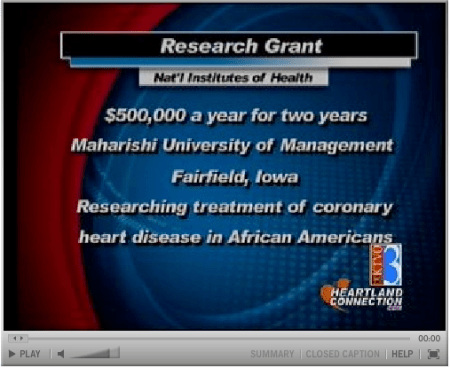
KTVO 3: M.U.M. Gets $1 Million Research Grant

September 26, 2009

MUM gets $1 million research grant

Friday, September 25, 2009 at 6:37 p.m.

FAIRFIELD, IOWA — University Receives $1 Million NIH Grant for Mind-Body Medicine Research

The National Institutes of Health recently awarded a grant of $500,000 per year for two years for research on the Transcendental Meditation® technique in the treatment of coronary heart disease in African Americans.

The research is a collaboration between Maharishi University of Management Research Institute’s Center for Natural Medicine and Prevention and Columbia University Medical School in New York.

The funding comes from the American Recovery and Investment Act, via the NIH-National Heart, Lung and Blood Institute.

About 21,000 applications were submitted to NIH for these specific funds, with just 3% receiving grants.

“This recent achievement continues to place MUM Research Institute and its research on the Transcendental Meditation technique and Maharishi Vedic MedicineSM programs in an elite category in academic medicine,” said project director Robert Schneider, M.D., F.A.C.C., and dean of the Maharishi College of Perfect Health.

The research will compare the effectiveness of cardiac rehabilitation with and without the Transcendental Meditation program, especially after a heart attack. The study will utilize positron emission tomography (PET) to image and quantify changes in heart disease in the patients.

The Center for Natural Medicine and Prevention team includes Sanford Nidich, EdD, Carolyn King, PhD, Maxwell Rainforth, PhD, John Salerno, PhD, Marilyn Ungaro, Laura Alcorn, and Linda Heaton.

See video: http://bit.ly/13D7d4

KTVO Medical News