Posts Tagged ‘Maharishi University of Management’

Drake University Honors Magazine’s main feature: Students find their center at Maharishi University

May 5, 2011

This post was moved to: Students find their centers at Maharishi.

I’ve removed the old post and replaced it with this newer one. You can access it here: Students find their centers at Maharishi. Now you don’t have to download the pdf of the article to read it, unless you want to see how it was laid out, and I’ve edited down the editor’s letter to the relevant section. It’s an excellent article, and a great example of an intelligent, open-minded student from a different university who was curious enough to want to find out what MUM was all about. She shares what she learned from visiting with students, faculty and administrators at MUM in this wonderful article.

Enjoy and share this with anyone who may be curious to find out more about Consciousness-Based education at Maharishi University of Management, especially potential students. They can always come to one of our Visitors Weekends and experience for themselves what it’s like to be at MUM.

Thank you.

Ken

Documentary shines a new light on rural energy

February 24, 2011

‘Sustain Angoon’ documentary shines a new light on rural energy

By Richard Radford | Capital City Weekly
Wednesday, February 23, 2011

“December and the Meter’s Spinning Backwards,” Southeast Alaska Conservation Council Energy Coordinator Dan Lesh wrote on the Sustain Angoon blog. He included photographs of the frozen landscape surrounding the demonstration house – the home of Angoon elders Peggy and Kelly Williams – and a video that indeed showed the electric meter rotating counterclockwise.

This is no small feat for a community which has energy costs that can add up to as high as $1,200 a household a month, about 6 to 8 times more expensive than in the Lower 48. Angoon is heavily dependent on non-renewable resources, and combined with a shrinking population and high unemployment, keeping up with the bills can prove to be a challenge.

What sent the wheel of progress spinning forward and the meter backwards? The Sustain Angoon Project, which tackled the problem of energy usage from several angles, involving a combination of weatherization, energy efficiency and renewable energy systems. The efforts of the project have culminated in a film, which will be shown this week at a special screening in Juneau.

The project has combined the collective efforts of several organizations including the Central Council of Tlingit and Haida Indian Tribes of Alaska, SEACC, the Tlingit-Haida Regional Housing Authority (THRHA), Angoon Business Center, and the Maharishi University of Management of Iowa.
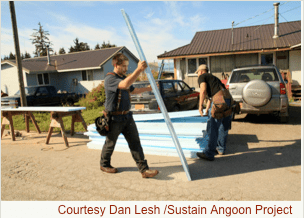
The Williams’ house was fitted out with new insulation and siding, caulking and sealing and duct repair. Improved high-efficiency lighting and Energy Star appliances were installed, monitored by The Energy Detective, or TED 5000, system. Solar panels were put up, including a solar hot water system.

Solar power is not the first thing one might think of when talking about energy in Southeast Alaska, but Lesh said that the system appears to be operational and effective.

“When you’re talking about a place that pays five times as much for energy, it doesn’t matter if you get one sixth of the sun,” he said.

The meter actually does run backwards on sunny days, Lesh said, though of course in the winter there are few hours of daylight, so at least during this time of year the new equipment doesn’t cancel out all energy usage.

There have been a few issues working out all the details of monitoring the solar hot water system, though there is anecdotal evidence from the Williams family who noticed that their boiler doesn’t kick on during sunny days.

They also put up a wind tower and hooked it up to the local school, which charges batteries that can run the washing machines. They have yet to set up a monitoring system for that, but so far it seems to be working.

Lesh said that the problem of high energy bills can’t be solved by just turning the lights out before leaving a room. On average citizens in places like Angoon, served by the Inside Passage Electrical Cooperative, use far less energy than residents of places like Juneau.

“So they turn the lights off, they use everything sparingly, but they may have something that’s on that’s draining power or leaky windows,” he said. “But they are head and shoulders above us [who live in cities] in terms of a lot of types of behavior in terms of energy efficiency.”

Renewable energy systems and weatherization are expensive, and Lesh said it will take time to work out how cost effective their implementations are.

“Not to say that our project should be replicated, but the kinds of discussions we’ve been generating should lead to more action along those lines,” he said. “Energy efficiency is low-hanging fruit that would make big differences in the villages.”

Newer to the project is Carrie Sykes, who started her position as the Business & Economic Development manager at Central Council in October. Sykes said she has worked with the THRHA on a joint application to expand similar ideas being explored in Angoon for other communities in Southeast with high energy costs like Kake and Hoonah.

Another project on the drawing board is a training program for local people in weatherization, which could help cut energy costs and provide jobs.

“When you put in this kind of stuff, you’ll need people who will be familiar in case something goes wrong,” she said.

Teaching and learning are the most important things to take away from the project as it progresses, Sykes said. The documentary will hopefully be a good tool to spark interest, especially with the younger generation.

“You really have to start educating, and start educating young,” she said. “We’re going to be getting the documentary to the schools, science teachers and all the tribes. We want to get it out there about all that can be done.”

Robert Gongwer, co-founder of the Iowa-based socially and environmentally conscious consulting firm Tidal Wave Group, said that there some in Angoon who doubted that the project would get pulled off, who were later “blown away when the electric meter started running backwards.”

“It was a big turning point, when it became real,” he said.

Gongwer co-directed the documentary, working on pre-production in Angoon in September of last year when the project was building up steam, and has recently put the final polish on the film. Coming from the outside, he was nervous about being able to give the best description of what was going on in Angoon. The goal was to be totally honest about the people, the community, and the energy providers.

He and his team wanted to make sure that the community was receptive to the project before getting involved. He was taken aback by the amount of hospitality shown to them by the residents of Angoon, regardless of any reservations they had about the potential of the project.

“We went to the [ANB Hall], and everyone was just so, so happy,” he said.

There is a respect for older people in Angoon, Gongwer said, and they are not only cared for, they are looked to for answers.

“It just really struck me as something that is really broken in the culture I’m from,” he said.

The concerns voiced by the elders of Angoon were first and foremost on Gongwer’s mind while working on the project.

“[An elder] told us her worst fear is to fly over Angoon with her grandchildren and tell them, ‘that’s where we used to live,'” he said.

The Sustain Angoon Project has shown the kinds of things that can be accomplished, Gongwer said, though there is still a lot more exploration to be done. The project isn’t the solution, but rather a demonstration of one take on a larger set of solutions. Maharishi University of Management Professor Lonnie Gamble, who also worked on the project, explained the situation as, “We don’t need a silver bullet, we need silver buckshot.”

“We’ve made some progress, that’s great,” Gongwer said, “but really the issue is how can we sustain progress? We just need to keep after it…maybe this [project] will help to change some laws, change some policies.”

“Sustain Angoon” will be shown at the Silverbow (120 Second Street) back room Thursday, Feb. 24 at 5:30 p.m. There will also be a discussion with members of the project. For more information or to follow new developments of the project, go online at www.sustainangoon.org.

Richard Radford may be reached at richard.radford@capweek.com

There are additional photos for viewing at the top right of the article. Go to: Click Thumbnails to View. Click on a photo, then click on it again for a larger view.  Here are the descriptions to go with some of those photos: Work on the house got underway in early fall of 2010. During sunny days, the electric meter actually runs backwards now. The community of Angoon came together to work on the energy project. The Williams’ house was fitted out with new insulation and siding, caulking and sealing and duct repair. Improved high-efficiency lighting and Energy Star appliances were installed, monitored by The Energy Detective, or TED 5000, system. Solar panels were put up, including a solar hot water system.

This article was also published in The Washington Examiner
Film looks at energy-saving efforts in Angoon

In this September 2010 photo provided by Tlingit and Haida Central Council, workers with the Sustain Angoon Project talk in the southeast Alaska village of Angoon. The Sustain Angoon Project tackled the problem of energy usage in the village from several angles, involving a combination of weatherization, energy efficiency and renewable energy systems. The efforts of the project have culminated in a film.

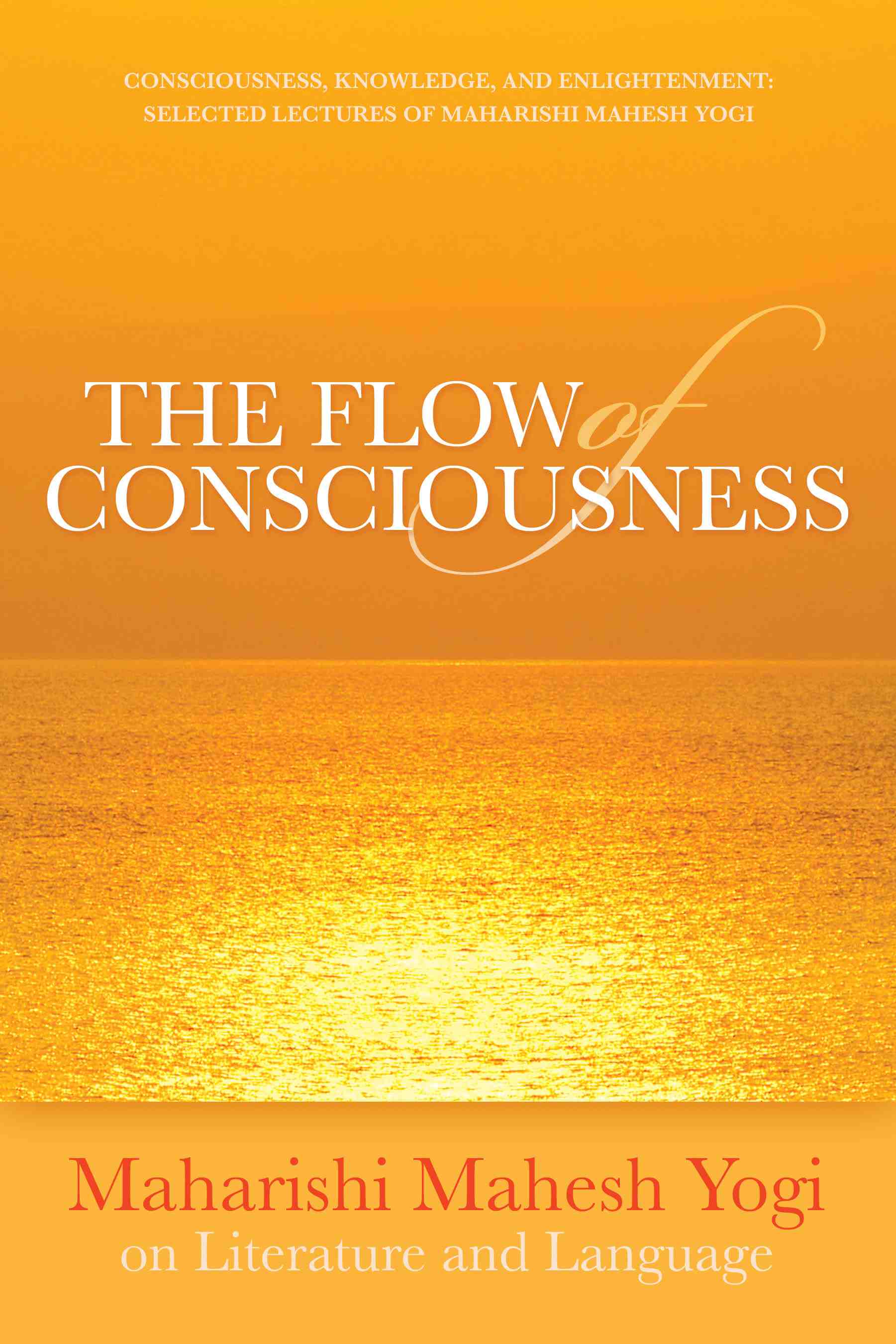
The Flow of Consciousness: Maharishi Mahesh Yogi on Literature and Language

November 3, 2010

THE FLOW OF CONSCIOUSNESS: Maharishi Mahesh Yogi on Literature and Language, 1971 to 1976, edited by Rhoda F. Orme-Johnson, Ph.D. and Susan K. Anderson, Ph.D.

For the first time, a selection of talks by Maharishi Mahesh Yogi, the founder of Maharishi University of Management, has been transcribed and published, with this volume on literature and language projected to be the first in a series publishing talks in many different disciplines. In response to MUM faculty talks on art, literature, government, education, and many other disciplines, Maharishi would give his profound insights into that discipline, a direction for research scholars, and a vision of how the study of consciousness would enrich and develop each area of academic inquiry and personal experience. A number of the talks were in response to presentations given at international symposia by leading scholars in their field, Nobel laureates, and such eminent professionals as R. Buckminster Fuller.

Over the years, Maharishi Mahesh Yogi recorded brilliant and inspiring lectures on the literary process, as well as critical theory and technique, emphasizing the relevance of the state of consciousness of both writer and reader. He explained how only from an expanded basis can the writer spontaneously experience and express refined emotions and ideas and only from such a basis can the reader hope to understand and enjoy such writings. Literature itself can be a means to evolve one’s consciousness through sounds, rhythms, and meanings, swinging the reader’s attention from concrete to abstract, purifying consciousness and producing bliss. A fully developed consciousness can express the ocean in a drop, and from that drop flows a river of meaning, power, and enjoyment.

Immersing oneself in the transcripts of Maharishi’s lectures allows readers to feel his presence, to hear his voice, his rhythms of speech, his humor, and to appreciate his skill as a teacher. His exposition of the power of poetry, particularly the poetry of the Veda, gives the reader a taste of his intellect and his profound understanding of language and literature. It is a journey through a great mind and an exploration of a topic familiar and beloved by all.

This volume is a valuable resource to teachers, students, and all readers of literature, to all those interested in higher human development and the literary process.

The 350-page book includes 14 talks given in the years 1971–76 and is available at Maharishi International  University Press.

The Review wrote an informative article, the first of six, in issue Vol. 26, #4, November 3, 2010, announcing the publication: First-Ever Book of Maharishi’s Lectures Explores Literature and Language.

MIU Press later offered The Flow of Consciousness with The Unmanifest Canvas as a discounted Art Book Combo.

Dean of Faculty Cathy Gorini spoke with Dr. Rhoda Orme-Johnson, the first interview in a new series on KHOE titled, “A Chat With The Dean.” This discussion focused on Dr. Orme-Johnson’s new book, “The Flow Of Consciousness,” transcripts of Maharishi Mahesh Yogi’s lectures. Drs. Gorini and Orme-Johnson settle into a warm discourse on the significance of Maharishi’s lectures, in particular, the field of literature. Recorded Oct 26, 2010. (mp3 47 mins, 16 MB)

(more…)

Stephen Collins to give Commencement Address at Maharishi University of Management

June 23, 2010

“7th Heaven” star, Iowa native, returns from L.A. to give commencement address

by Matt Kelley on June 23, 2010
in Education, Human Interest

An Iowa native and Hollywood actor, best known for his role on the long-running TV show “7th Heaven,” will be back in his home state this weekend to give a commencement address. Stephen Collins says he wants to speak to the graduates in southeast Iowa about what he calls counter-culturalism, specifically, how it’s considered not normal to eat healthy.

“It’s difficult, if you’re watching television, to find an advertisement for a food product that’s really good for you,” Collins says. “It’s not impossible, but it’s difficult. Various companies would take me to task on that but to me it’s counter-cultural to be really careful about what you eat.”

The 62-year-old Collins will speak at the graduation ceremony on Saturday in Fairfield at Maharishi University of Management. Collins practices transcendental meditation and says many people consider it counter-cultural to take care of their bodies and not to over-medicate themselves.

Collins starred as Reverend Eric Camden in all 241 episodes of “7th Heaven,” the longest-running TV series on the WB network. It ran from 1996 to 2007. “I loved doing 7th Heaven and I’m proud of it and I’m proud of our wonderful long run,” Collins says. “Whenever I kick off, it’ll probably be in the first sentence, if not the first paragraph of any obituary anybody writes about me, but that’s okay. I have done a lot of other things, but when you do something that runs 11 years, it changes people’s idea about who you are.”

Over three-and-a-half decades, Collins has appeared in more than 60 movies and TV shows, and is now starring in the new ABC series, “No Ordinary Family.” Collins was born in Des Moines, grew up in New York and now lives in Los Angeles — but still considers himself an Iowan.

“I love saying that I’m from Iowa because my mother’s family goes back in Iowa for many, many generations and is kind of a venerable Iowan family,” Collins says. “My great-great-grandfather was a fellow named James B. Weaver who was a Civil War general and a member of Congress and ran for president twice as a third-party candidate.”

Collins considers himself an actor first, but has also written two novels and is a musician. This will be his first college commencement address. Saturday’s graduation at Maharishi University will feature 235 students earning degrees, representing 41 countries.

Hear the full interview: 7th Heaven 6:20 MP3

US Government National Health Center Highlights TM Study on Stressed College Students

May 14, 2010

Transcendental Meditation Helps Young Adults Cope With Stress

A recent study found that Transcendental Meditation (TM) helped college students decrease psychological distress and increase coping ability. For a group of students at high risk for developing hypertension, these changes also were associated with decreases in blood pressure. This could be good news for the many students experiencing academic, financial, and social pressures that can lead to psychological distress—especially in light of evidence that college-age people with even slightly elevated blood pressure are three times more likely to develop hypertension within 30 years.

Funded in part by NCCAM, researchers from Maharishi University of Management and American University studied 298 students from American University and other schools in the Washington, D.C., area. The researchers randomly assigned students to a TM group or a control (wait-list) group. They also created a high-risk subgroup, based on blood pressure readings, family history, and weight. The TM group received a seven-step course in TM techniques, with invitations to attend refresher meetings, and kept track of how often they practiced TM. At the beginning of the study and after 3 months, researchers tested all participants for blood pressure and psychological measures. The researchers noted that 30 percent of the participants dropped out before the end of the study.

Blood pressure decreased in the TM group and increased in the control group, but the differences were not significant overall (TM-control blood pressure differences were significant within the high-risk subgroup). However, compared with controls, the TM group had significant improvement in total psychological distress, anxiety, depression, anger/hostility, and coping ability. Changes in psychological distress and coping paralleled changes in blood pressure.

According to the researchers, these findings suggest that young adults at risk of developing hypertension may be able to reduce that risk by practicing TM. The researchers recommend that future studies of TM in college students evaluate long-term effects on blood pressure and psychological distress.

Reference

URL: http://nccam.nih.gov/research/results/spotlight/051410.htm

This page last modified May 13, 2010.

Twitter NCCAM

Transcendental Meditation Helps Young Adults Cope With Stress: http://go.usa.gov/ihN

Maharishi University hopes to set the standard for “green” buildings

April 28, 2010

Maharishi University hopes to set the standard for “green” buildings

by Matt Kelley on April 26, 2010

in Education, Health & Medicine

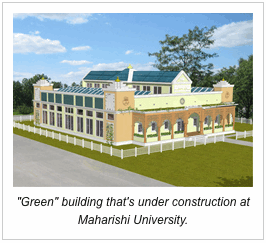
A new classroom and research building is under construction on a college campus in southeast Iowa that aims to set a new global standard for green buildings.

David Fisher, director of the Sustainable Living program at Maharishi University in Fairfield, says the building promises to be unlike any other structure on the planet.

“It will be off the grid completely with respect to electricity, heating, cooling, water and waste disposal,” Fisher says. “In addition, the building will be day lit throughout the building.”

Banks of solar panels will provide the electricity for the Sustainable Living Center, Fisher says, and solar energy is being used by workers during the construction phase, as well. During the warm months, he says the building will be kept cool using a geothermal system.

“The heating will be done with solar water heaters on the roof,” Fisher says. “We will have insulation provided in part by very local materials, that is compacted earth blocks which came from some earth right across the street that was being cleared out for a parking lot.” That dirt was compacted into 26,000 bricks that will make up the building’s insulation. The building’s skeleton will use whole tree post and beam techniques.

“Water will be all rainwater,” Fisher says. “It will be collected on the roof and stored in a cistern and, of course, for drinking purposes, it’ll all be filtered with (an ultraviolet) filter.” Fisher says the system for handling waste is also accounted for as a green effort. Fisher says, “We have a constructed wetland and we’re planning to use a system that’s similar to what they use in submarines and on space capsules, purifying the water with a system that puts very, very finely-divided bubbles through the water to keep it aerobic and to completely degrade all of the organic matter so as to purify the water.”

Fisher says the building is designed to meet the Living Building Challenge, the highest standard for sustainable design and green building in the world. It will also be the first to combine that standard with the standards of LEED Platinum certification, Building Biology and Maharishi Vedic Architecture.

The building will serve as the base for the university’s Sustainable Living major. It will have classrooms, a workshop, a meeting room, a greenhouse, a kitchen, a research lab, a recycling center and offices. Fisher says it’ll be a building that teaches. The one-point-seven million dollar project is expected to be complete late this year.

‘Green’ learning in sustainable classrooms

April 23, 2010

Local News April 23, 2010

‘Green’ learning in sustainable classrooms

Maharishi University of Management constructs an off-the-grid academic building for sustainable living majors

MATT MILNER Courier Staff Writer

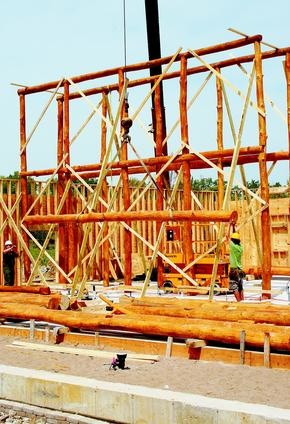
Matt Milner/The Courier Construction workers had to move carefully to avoid excessive damage to the tree trunks that will be a signature element in the new building for MUM’s sustainable living program. The school held a ceremony at the site on Thursday to mark Earth Day

FAIRFIELD — Builders and backers of the new home for sustainable living majors at Maharishi University of Management say nothing like it has been attempted anywhere.

It’s easy to believe them.

The construction brings together four basic philosophies. Three are focused on environmental impact and resource demands. The fourth is, as all new buildings at the college are, based on Vedic concepts. It’s a tough combination to pull off.

When complete, the building will be completely off the grid for electrical power, climate control and waste removal. The goal is creation of a building that meets the university’s needs for classroom and office space while demonstrating concepts the students learn inside.

Dr. David Fisher, director of the sustainable living department, thinks the building will help draw students. That has not been a problem for the program, which opened in 2003 with six students and now has 80 sustainable living majors. He called it an “incredible environmental building.”

It is not large as academic buildings go. That’s intentional.

“We didn’t want to make it too large because we’re trying to do so much,” Fisher said.

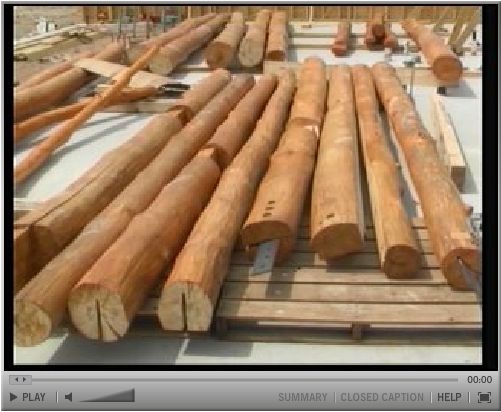
Right now the site doesn’t look markedly different from any other building under construction. Stud framed walls are the exterior on two sides. The other two are still open. The biggest clues that something different is going on are the nearly full-sized tree trunks that form part of one hallway. Others lay around the site, ready to be raised.

The trees being used are aspens. They are fast-growing and were harvested from a farm dedicated to sustaining its population. A slight sheen and a lack of bark are the only things that show they have been processed for construction. Builders said the trunks have strength similar to steel when they are maintained instead of sawed into boards.

Dal Loiselle, the developer and construction manager for the site, has worked on “green” building sites for 21 years. He said the costs are not all that different from those involved in traditional construction, provided the effort is made from the start. Adding environmentally friendly traits to an existing project can be expensive.

“It entails commitment, basically,” he said. “It’s just a matter of having the desire and doing it.”

Loiselle emphasized that none of the technology being incorporated is new. It’s off the shelf stuff that any builder can use.

The completed structure will be LEED platinum certified and meet the requirements for building biology, Vedic architecture and the Living Building Challenge. Students will have access to the roof and walls to study the concepts they learn in class. Monitors will track every shift in temperature, humidity and environmental change, wired into a website people can check from anywhere in the world.

Thursday’s ceremony was somewhere between a groundbreaking and a dedication, tied into Earth Day at MUM. It’s the 40th Earth Day, noted Fairfield Mayor Ed Malloy. He expressed the hope that the building’s edge-of-the-envelope attempt today will be standard in another 40 years.

Matt Milner can be reached at (641) 683-5359 or via e-mail at mmilner@ottumwacourier.com

KTVO-3: Greenest building in America in Fairfield

April 23, 2010

Video: http://www.heartlandconnection.com/news/video.aspx?id=447437

Maharishi University of Management’s new Sustainable Living Center is a building that will set a new standard for green building in America by being completely off the grid with respect to electricity, heating and cooling, water, and waste.

Greenest building in America in Fairfield

The new sustainable living center will be one of three buildings in the U.S. to meet the Living Building Challenge
By Alex Halfmann
Thursday, April 22, 2010 at 6:12 p.m.

FAIRFIELD, IOWA — One heartland university aims to practice what they preach, and what they preach exemplifies Earth Day.

Maharishi University of Management’s new Sustainable Living Center will be one of the greenest buildings in America when completed this fall.

The University’s sustainable living program will utilize the building, which will help students understand firsthand what they are learning.

“The students will be able to see in the building that they are occupying what we are teaching. This building will be off the grid completely in respect to electricity, heating, cooling, water, and waste disposal,” said Maharishi University’s Director of the sustainable living program David Fisher.

The building is designed to meet the Living Building Challenge, the highest standard for sustainable design and green building in the world.

“After a while, the U.S. Green Building Council realized there was a lot more buildings could do so they came up with the Living Building Challenge which is much more stringent than even the LEED Platnium. In fact, they have now gone to the 2nd version of the Living Building Challenge” Fisher said.

Parts of the project  literally come from the school’s backyard.

“We’re using compacted earth blocks that come from earth just across the street where they were clearing out a parking lot.  We took that soil, compacted it into 26,000 earth blocks, and so that will serve as thermal mass which will help insulate the building,” Fisher said.

While the building might look relatively bare on Earth Day, they expect the roof, complete with solar panels, to be installed by the end of next week. The site will then use only electricity generated on site.

The building will be one of the first three to achieve the Living Building Challenge’s standards. It will be unique because it will be the first to combine that standard with the standards of LEED Platinum certification.

TM activates DMN, the brain’s “ground state”

March 4, 2010

A new EEG study conducted on college students at American University found they could more highly activate the default mode network, a suggested natural “ground state” of the brain, during their practice of the Transcendental Meditation technique. This three-month randomized control study is published in a special issue of Cognitive Processing dedicated to the Neuroscience of Meditation and Consciousness, Volume 11, Number 1, February, 2010.

Specifically, the study found the TM technique:

  • Produces a unique state of “restful alertness,” as seen in the markedly higher alpha power in the frontal cortex and lower beta and gamma waves in the same frontal areas during TM practice.
  • Creates greater alpha coherence between the left and right hemispheres of the brain suggesting the brain is working as a whole.
  • Enhances an individual’s sense of “self” by activating what neuroscientists call the “default mode network” in the brain. (This is considered the natural ground state of the brain, glimpsed by neuroscientists during eyes-closed rest but more fully activated during Transcendental Meditation practice.)

“The finding of significant brain wave differences between students practicing the Transcendental Meditation technique and those simply resting with their eyes closed is especially convincing because subjects were randomly assigned to conditions, and testing was conducted by a researcher unaware of the experimental condition to which the subject had been assigned,” said David Haaga, Ph.D., coauthor and professor of psychology at American University.

“Research has already shown that simply closing one’s eyes and relaxing increases the default mode. A significant additional finding of this new study is that activity in the default mode increases during TM compared to simple eyes-closed rest,” said Fred Travis, Ph.D., lead author and director of the Center for Brain, Consciousness, and Cognition at Maharishi University of Management. “Different meditation techniques entail various degrees of cognitive control. Thus, activation patterns of the default mode network could give insight into the nature of meditation practices.”

Previous published research, funded by the NIH, shows TM practice decreases high blood pressure, atherosclerosis, cholesterol, stroke, and heart failure.

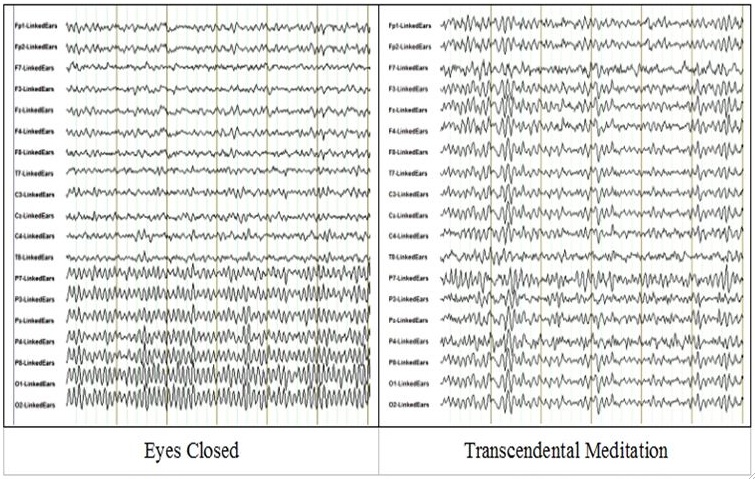
Comparative EEG Tracings

These raw EEG tracings during eyes-closed rest (left) and Transcendental Meditation (right) represent 18 tracings over 6 seconds. The top tracings are from frontal sensors; the middle tracings are from central sensors; the bottom tracings are from parietal and occipital sensors [back]. Note the high-density alpha activity in posterior leads during eyes-closed rest, and the global alpha bursts across all brain areas during Transcendental Meditation practice.

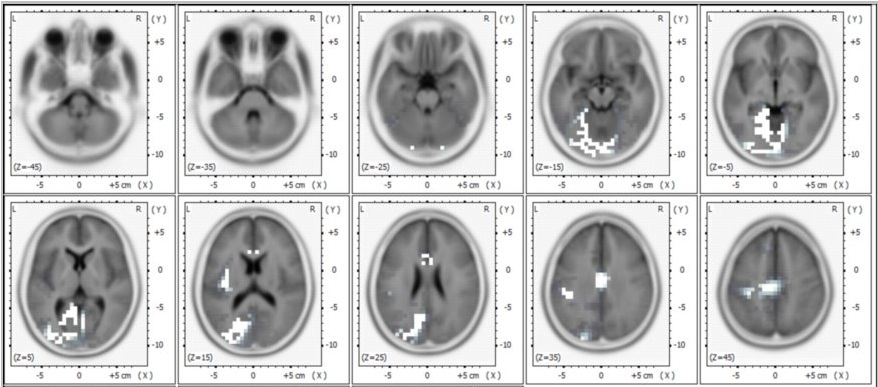
eLORETA Images of Significance Differences

These are eLORETA images of sources of alpha EEG during TM compared to eyes-closed rest in the default mode network (the white areas).

Images credit: Cognitive Processing, Volume 11 (2010), Issue 1

Article title: A self-referential default brain state: patterns of coherence, power, and eLORETA sources during eyes-closed rest and Transcendental Meditation practice, DOI: 10.1007/s10339-009-0343-2. Also on PubMed.

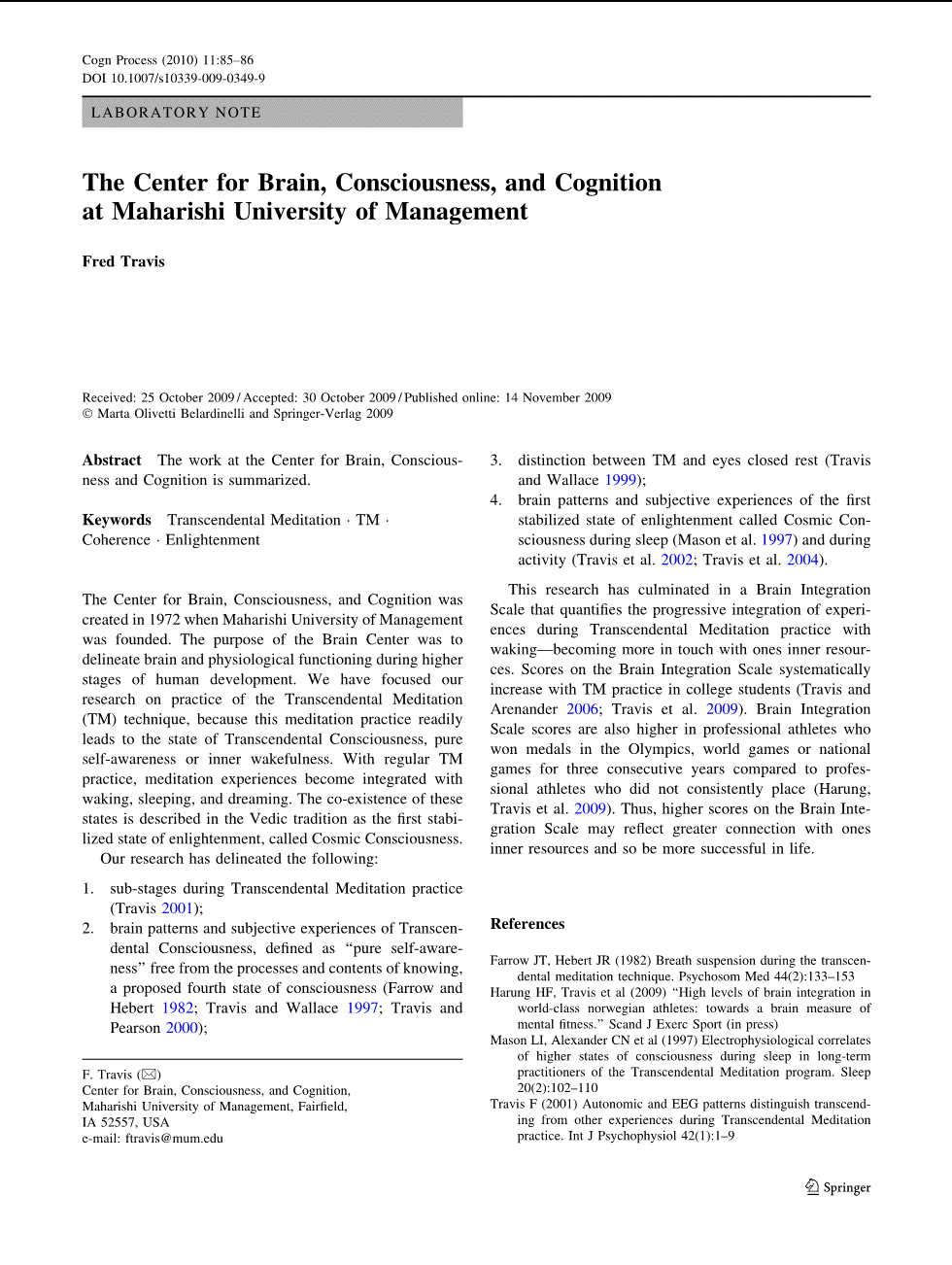
Laboratory Note: The work of the Center for Brain, Consciousness, and Cognition at Maharishi University of Management is summarized and featured in this same issue:

Fairfield’s Sustainable Living Coalition Builds Green Educational Center

January 22, 2010

Dec 23, 2009 01:39PM

All for intelligent design: Sustainable Living Coalition draws from nature’s wisdom

By Linda Egenes


Submitted
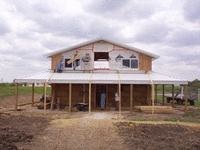
The Sustainable Living Coalition built this 1,200-square-foot straw-bale, post-and-beam barn as a main classroom and administrative space.

It started in 2004 when a few people in Fairfield were looking for a sponsor for an environmental conference.

“We decided to form our own non-profit and called it the Sustainable Living Coalition,” says Diana Krystofiak, a founding board member of the SLC. “The goal was to combine people from different sectors to create a more sustainable Fairfield, which could then become a model for other communities.”

From the start, a driving force behind the SLC’s vision and educational initiatives was Lonnie Gamble, who with permaculture expert Grover Stock, began teaching a ten-week permaculture course called Big Green Summer. Hundreds of interns trained with Gamble and Stock, living in Gamble’s home. But Gamble and his wife, Valerie, couldn’t donate their time, money and home to educate interns indefinitely. A campus was needed.

A permaculture demonstration site

Fast forward to the fall of 2009. It’s a warm November day at the newly inaugurated SLC campus on the north edge of Fairfield. Briggs Shore and Frank Cicela, two administrators, are there.

Shore, a 27-year-old dynamo who trained as an SLC intern and was hired last year as administrative coordinator, is clearly passionate about her job.

“We bought the land in 2006 with a grant from Iowa’s Great Places,” she says.

The purpose of the campus, she explains, is to become a working permaculture farm and educational center with classes and internships.

Shore explains, “permaculture is a way to take the principles of intelligent design, found in nature, and apply it to absolutely everything in your life — how you get your food, water, shelter, heat (and) power, and (how you) dispose of waste.”

Cicela adds, “we want this to be a model, to establish best practices for natural building and rural farming that people can take back to their own communities.”

At age 40, Cicela brings a wealth of experience to the SLC, having established a similar nonprofit called Sustainable Indiana, and shows remarkable dedication by taking an unpaid leave from his job at Clipper Wind Power in Cedar Rapids to spend every other week working for the SLC.

Shore points to the 1,200-square-foot straw-bale, post and beam barn that is the main classroom and administrative space for the campus. “We broke ground in January 2009,” she says.

The building is functional but awaiting funds for plastering the outer walls, covering the gravel floor with flagstone and completing a five-room dormitory loft. It was erected in just four months with the help of an Amish construction crew for the foundation and dozens of volunteers who provided the massive man hours necessary for straw-bale building.

“We’re completely off the grid, and we provide our own power and water,” says Shore. She points to the rain catchment system, ten photovoltaic solar panels and one-kilowatt wind turbine that supply electricity and high-speed Internet. “We’re high-tech while being sustainable, rustic while still being modern.”

A spirit of collaboration

“One of our missions is to partner with other people and organizations,” says Cicela.

Collaboration takes many forms. The campus adjoins and makes use of two other sustainable sites for its workshops: the Abundance Eco Village and the Mullenneaux extended-family acreage, which includes three sustainable cob, straw and clay homes.

“We’re a few off-the-grid communities who happen to be close together and really good friends,” explains Shore.

Other collaborators include Grinnell College and Maharishi University of Management.

A vision for the future

Future projects include building four-season dormitory space to house 50 interns, a hospitality center, an elderhostel, underground cisterns to store drinking water from the rain catchment system, wetland waste management system, permaculture food forest, edible landscaping, and seed money to extend educational offerings.

But ambitious as these plans are, Gamble sees a more visionary goal. “The SLC is a way to foster ecological, micro-enterprises,” he says. As an example, the SLC bought equipment and loaned it to help a local baker get started, and launched the Edible Cityscapes Project, an eco-business that sells fruit trees and provides free labor to plant them properly.

Another project in the works: a micro-enterprise center, to help fund sustainable businesses. And the SLC is providing land and sponsorship to a John Jeavons mini-farm center, one of three in the U.S. to be established this spring.

For more information about the SLC, contact Briggs Shore at briggsshore@gmail.com or visit sustainablelivingcoalition.org.

Linda Egenes is a book author and freelance writer. She lives in Fairfield, Iowa.

Radish magazine is published by Small Newspaper Group and distributed by Moline Dispatch Publishing Co., L.L.C., 1720 5th Ave., Moline, IL 61265