Posts Tagged ‘Maharishi Mahesh Yogi’

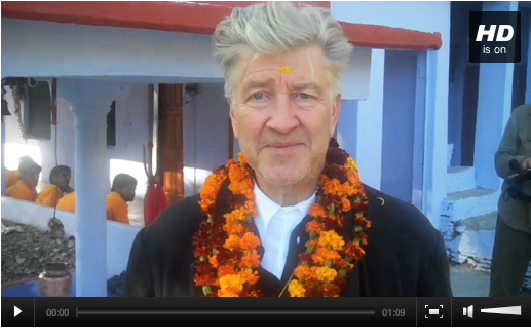
David Lynch on his next film, in Uttarkashi, India, at Maharishi’s house

December 13, 2009

December 10, 2009

DAVID IN INDIA – MAHARISHI’S HOUSE

http://dlf.tv/category/david-in-india/

David Lynch is in India right now, starting work on his film on Maharishi Mahesh Yogi—the founder of Transcendental Meditation. David’s first report comes to DLF.TV from high in the Himalayas, in the small town of Uttarkashi, known as the “Valley of the Saints,” where for thousands of years, seekers of truth have gathered to meditate and rise to enlightenment. Maharishi spent two years in silence in Uttarkashi, from 1953 to 1955, following the passing of his teacher, Guru Dev. More reports from David to follow.

You can also follow Bob Roth, DLF VP, who’s traveling with David, on Twitter. http://twitter.com/bobbyroth. Click back to Dec 4th and read up. Found this interesting comment in one of Bobby’s tweets: Fernando Sulichin and Rob Wilson who work with Oliver Stone and Spike Lee are producers—along with Tabrez who produced Slumdog Millionaire.

Fascinating stuff! This looks like it promises to be the definitive documentary on Maharishi. We all look forward to that, whenever it comes out, hopefully some time next year.

President Obama, Peace in the Middle East: Scientific solution to your political problem?

December 2, 2009

President Obama, Peace in the Middle East: Scientific solution to your political problem?

Wednesday, 02 December 2009 17:52

Peace in the Middle East is easily within our grasp, as indicated by a new scientific paper recently published in the “Journal of Scientific Exploration.”

The study addresses the possibility that a relatively small group of people practising the Transcendental Meditation™ and TM-Sidhi programme®, as founded by Maharishi Mahesh Yogi, twice daily together in a group can create peace in the Middle East.

The hypothesis is not new. Fifty studies have found that when 1% of the population practises Transcendental Meditation, or sufficiently large groups practise the TM-Sidhi programme together twice daily, it can have a positive influence on society as a whole. The studies show, for example, decreased violence, crime, car accidents, and suicides, and improved quality of life in a society. Critics had questioned the credibility of the evidence in light of the unconventional nature of the proposition.

Reduced conflict and improved quality of life in the Middle East:

August-September 1983

A composite sociological index closely tracks the size of a group practising the Transcendental Meditation and TM-Sidhi programme. (See details in text below.)

The new analysis addresses this question more thoroughly than previously. It presents new statistical evidence that all credible conventional explanations – such as military and political events, public holidays, and the weather – could not explain the observed statistically significant changes in sociological variables shown in an earlier study on the influence of groups practising the TM-Sidhi programme (Orme-Johnson DW, Alexander CN, Davies JL, Chandler HM, & Larimore WE. International peace project in the Middle East: The effect of the Maharishi Technology of the Unified Field. Journal of Conflict Resolution 1988 32:776-812, findings illustrated above). The observed changes in the Middle East included reductions in war deaths of 75%, war intensity of 45%, in crime of 12%, in fires of 30%, plus there were improvements in national mood of 27% and the stock market of 7% during the experimental period.

Although conventional factors did have a measureable influence on the level of violence and other sociological variables, the effect of the Transcendental Meditation group was, according to the researchers, both independent of these other factors and approximately two to five times stronger.

Brain research has found that Transcendental Meditation increases coherence in brain functioning. Lead author of the new study David Orme-Johnson, former Chairman of the Psychology Department at Maharishi University of Management, suggests that: “Given the assumption of Maharishi’s theory that individuals are the units of collective consciousness, increased coherence at the individual level could be expected to have a positive effect on the population level”.

According to a number of earlier studies, this effect is magnified when, in addition to Transcendental Meditation, the more advanced TM-Sidhi programme, which includes Yogic Flying, is practised in a group. In this case, the square root of 1% of a population practising Yogic Flying in a group is the threshold at which changes in social trends begin to be observed. Interestingly, this effect appears to be irrespective of national borders and different cultures. According to the theory, a group of 10,000 generating such an influence of coherence would be sufficient to noticeably influence the collective consciousness of the whole world.

If the science is so watertight, and the potential benefits so great, the obvious question, then, is: Why has no one yet established such a group anywhere in the world? One reason why policy makers have been reluctant to do so is that they take the view that conventional military and political factors must have more influence than Transcendental Meditation and Yogic Flying. However, the new research has shown that this assumption is quite incorrect.

A coherence-creating group of 10,000 people could be established for less than 0.2% of the world’s military expenditure, and yet, according to the research, could ensure a stable state of world peace.

The David Lynch Foundation for Consciousness-Based Education and World Peace, founded by the award-winning filmmaker, joined with Paul McCartney in April to raise funds to teach Transcendental Meditation to one million at-risk children. The benefit concert in New York is said to have raised £2m on ticket sales and fund raising continues. The philanthropic Foundation is already involved in teaching Transcendental Meditation in schools in the Middle East with the explicit aim of creating permanent peace in the region.

Dr. Orme-Johnson is available for interview: Tel 850-231-2866 See his website: http://www.truthabouttm.org
Dr. David Leffler is available for interview and to set up interviews with other military-related people. See this website: http://www.StrongMilitary.org  Tel 845-489-8653

David Lynch to shoot film about TM guru Maharishi Mahesh Yogi in India

November 18, 2009


Daily  News & Analysis

Wednesday, November 18, 2009 4:39:00 PM
David Lynch to shoot film about TM guru Maharishi Mahesh Yogi in India
ANI

Oscar nominated director David Lynch will make a film about Transcendental Meditation (TM) guru Maharishi Mahesh Yogi, according to reports. He will reportedly visit India next month in this connection.

This documentary film about the life and teachings and knowledge of Maharishi will involve interviews with people, including a 97-year man associated with him, reports suggest.

David Keith Lynch, 63, has been attempting to introduce TM in schools globally. The Guardian, British daily newspaper from London, described Lynch as “the most important director of this era.”

Welcoming Lynch to India for this new venture, acclaimed Indo-American statesman Rajan Zed, in a statement in Nevada (USA) today, urged world filmmakers to explore many finer and deeper things India offered, instead of just focusing on poverty and crime.

Zed, who is a chairperson of Indo-American Leadership Confederation, pointed out that planet’s most multidimensional country India had snowcapped mountains, palm-fringed and sun-washed beaches, glorious temples, colourful festivals, rich philosophy and spirituality, abundant historical sites, wildlife safaris, recharging treks, historic trade routes, cultural wealth, etc.

Maharishi, who died last year at an age of about 91, introduced TM technique worldwide, and wished to change the world with it.

He initiated ‘The Beatles’ and was associated with various celebrities like American rockers ‘The Beach Boys’, musician Mick Jagger, hairdresser Vidal Sassoon, Golden Globe winner Mia Farrow (Rosemary’s Baby), etc.

He reportedly established about one thousand TM centres worldwide and had about four million followers.

© 2005-2009 Diligent Media Corporation Ltd. All rights reserved

Cynthia Lennon, Pattie Boyd, and the Beatles

November 15, 2009

the armenian reporter

Cynthia, Pattie, and the Beatles

Former wives of John Lennon and George Harrison in Yerevan

Cynthia Lennon-Pattie BoydPattie Boyd and Cynthia Lennon during their live interview at the Special Events Auditorium. German Avagyan

by Maria Titizian

Published: Saturday November 14, 2009 in Cafesjian Center for the Arts

Yerevan – John Lennon and George Harrison were two of the four Beatles, one of the most iconic rock groups in history. Their former wives, Cynthia Lennon and Pattie Boyd, were in Yerevan for the grand opening of the Cafesjian Center for the Arts last week. They took part in a live interview with Michael De Marsche, the museum’s executive director, in the brand-new and beautifully appointed Special Events Auditorium, located at the top floor of the complex.

The first-time-ever joint appearance of Cynthia Lennon and Pattie Boyd, took place in Yerevan. Arranging for that to happen was no small feat, according to De Marsche, who recounted the many telephone calls and arrangements that the museum made to ensure their participation at the opening. Watching the interaction of these two phenomenal women on stage was like taking a trip down memory lane.

Those in attendance at the live interview at the Cafesjian Center for the Arts cut across a large swath of Armenian society, including Armenia’s deputy foreign minister Arman Kirakossian who was there with his family. Their nostalgia for the Beatles has a deeper meaning.

The music of the Beatles was repressed during the Soviet era but an underground culture was able to smuggle in and disseminate their music in innovative ways. Their influence was immense; some like the last Soviet leader Mikhail Gorbachev, would say that the cultural, social, and musical revolution they inspired manifested itself years down the road. “More than any ideology, more than any religion, more than Vietnam or any war or nuclear bomb, the single most important reason for the diffusion of the Cold War was the Beatles,” Mr. Gorbachev has said.

For over an hour, Cynthia and Pattie disclosed intimate moments they shared with their husbands and each other, from fame to drug abuse, to alcoholism, and eventually to break-ups both marital and musical. Those turbulent early years when the Beatles were on the road to becoming one of the most legendary music groups of all times, the wives were along for the ride. However, as they recounted, the ride wasn’t always smooth. Pattie Boyd was very honest when recalling that tumultuous time of her life, “With a lot of help from a psychotherapist I have learned and am a much stronger person now. I am thankful to be free.”

“We have survived,” Cynthia Lennon said. “We have lost so many people along the way.” Indeed, Paul McCartney and Ringo Starr are the sole surviving members of the Beatles. John Lennon was shot and killed in front of his apartment building on December 8, 1980, by Mark David Chapman. George Harrison died of lung cancer in his Hollywood Hills mansion on November 29, 2001.

Cynthia Lennon, nee Powell, met John Lennon at the Liverpool Art College in 1957. “We were young and very much in love,” she recalled. The two married in 1962, after Cynthia became pregnant with their son, Julian. Lennon left her shortly after their return from India in 1968 to be with Yoko Ono. In 1978, Cynthia wrote A Twist of Lennon, which included her own illustrations and poetry, and a later biography on the famous Beatle titled simply, John in 2005.

Pattie Boyd was a model and photographer. In the 60s she modeled in London, New York, and Paris and appeared on the UK and Italian covers of Vogue. She met George Harrison in 1964 when she was cast in The Beatles film “A Hard Day’s Night.” She said at the time that Harrison was “the most beautiful man I had ever seen.” They were married in 1966; Paul McCartney was the best man. They divorced in 1974, after which Boyd married Eric Clapton. One of the audience members asked her how she came to be with Clapton. “Eric kept coming over [to the house she shared with Harrison] and began declaring his love and passion for me,” she said. “Because I was being ignored by my husband and being young, I found it irresistible. Maybe if we weren’t so young, maybe we could have made it work.”

Boyd’s book, Wonderful Today: George Harrison, Eric Clapton and Me, which came out in 2007, was on the New York Times bestseller list.

For both Cynthia and Pattie, their fondest memories go back to the time they were all in India in 1968, after the Beatles renounced drugs and became followers of Indian mystic Maharishi Mahesh Yogi. “It was an idyllic, positive situation at the foothills of the Himalayas,” said Ms. Boyd. “I loved it there.”

“The holidays, the times we went away together” is what Cynthia Lennon remembers as the best times.

“When George, John, Cynthia, and I went to Tahiti and sailed on a boat” is what Pattie Boyd said was her fondest memory.

They were hard-pressed to reveal which Beatle song they liked most. “They’re all so different. It’s here, there, and everywhere,” said Cynthia. “But I think that Sergeant Pepper was the most unbelievable album.”

Pressed to say which Beatles song she liked most, Boyd – who is known to be the inspiration for some of George Harrison’s songs – said, “It’s difficult to say which one is my favorite, but ‘All You Need is Love,’ is so strong and profound.”

Someone from the audience wanted to know if there were any hidden messages in the Beatles’ songs. “No, people wanted there to be messages, but there weren’t any,” Cynthia assured the audience.

Questions were asked about what Cynthia’s son, Julian Lennon, was doing musically. Cynthia explained that he completed an album about a year ago, but is still trying to get the best deal, “hopefully by next year.”

Following the live interview, the two women were available for book signings and Pattie’s exhibition of photographs was opened to the public. Ms. Boyd spent a few minutes speaking with the Armenian Reporter, in between signing her books.

She said that this was her first visit to Armenia and to the region in general. “After this book signing, I can’t wait to go out and explore the city,” she smiled. “I want to go to Vernissage and the museum at Republic Square.”

About the Cafesjian Center for the Arts, she said: “I am so blown away; I think this is the most exciting building I have ever seen architecturally; it is so wonderful. I want to bring my friends from London here next year.” She went on to explain that the design of the museum, the different installations on each floor and the gardens were “absolutely beautiful. It’s so beautifully done and the attention to detail is exquisite.”

Cynthia Lennon and Pattie Boyd both seem to have have found peace and happiness. “I am very, very happy,” Cynthia explained. “The one person who has given me strength and hope is my son and my new husband…. It’s important to still have a sense of humor.”

(c) 2009 Armenian Reporter

Also see The Morton Report, by Jaan Uhelszki, Contributor, September 7, 2011: Pattie Boyd: Rock’s Most Beautiful Muse.

I remember you were the one who introduced everyone to the Maharishi. Tell me about that, and do you still do some kind of spiritual practice now?

Yeah, I still meditate. I was meditating. Along with a girlfriend I learned Transcendental Meditation and I told George about it. Then the Maharishi was coming to England and I wanted to see him. And I wanted George to meet him. At that time, Paul wanted to meet him as well. That’s why we all went and listened to his lecture, and he was obviously very happy when he heard that they were in the audience, and he wanted to meet them. When he did he suggested that we all go to Wales for a few days to learn more about meditation: he wanted to initiate them. It was really awful because while we were up there, their manager Brian Epstein died. It was just awful. One can think how extraordinary that the one person who had been guiding them throughout their career, from the beginning of their career, died, just as this spiritual leader is taking over.

Did it feel like a baton had been passed?

Yes. Well, no, it didn’t last for very long for some of them, but it did for George, for the rest of his life.

Also see Prudence Farrow — subject of the Beatles song Dear Prudence — visits India’s Kumbh Mela and The former Beatles Paul McCartney and Ringo Starr reunion for David Lynch’s benefit concert airs on New York’s THIRTEEN, Sunday, April 29

In this Prime Time Russia Today news spot, uploaded on Jul 17, 2011, a reporter asks Pattie Boyd about her trip to India with the Beatles in the context of a her photography exhibit.

Q: A section of this exhibit is dedicated to the Beatles and your trip with them to India, particularly George Harrison. How important was that time spent in India for you?

A: It was a very very special time. I loved being in India and I loved everything that we learned from Maharishi, which was an extended course on meditation. And it was very, it was wonderful being there at that time because the Beatles were particularly prolific. They wrote most of the songs for the White Album while we were in India.

Maharishi University students get academic credit for daily Transcendental Meditation (TM) practice

November 13, 2009

NewsBlaze

Published: November 12,2009
Send to a friend
Letter to the Editor
AddThis

Response to “Hindus Laud University of Colorado-Boulder Over Meditation Center”

Hindus Laud University of Colorado-Boulder Over Meditation Center

It seems that UCB is just starting to catch on. MUM, Maharishi University of Management, located in Fairfield, Iowa, has offered CBE, Consciousness-Based education, for 35 years, where students, faculty, and staff all practice TM, the Transcendental Meditation technique, twice a day.

Students receive RC credit, research in consciousness, as part of their curriculum. Meditation rooms are made available for students to practice their twice-daily non-religious TM technique. And there are two large golden domes over 25,000 square feet each, one for men and one for ladies, where students, faculty, staff, and meditating townspeople all gather twice a day, morning and evening, to practice TM and the TM-Sidhis program, including Yogic Flying, for world peace.

These ancient meditative practices revived by the founder, Maharishi Mahesh Yogi, dramatically lower stress-related risk factors and increase clarity and orderliness in brain functioning. The results show up in students’ academic and athletic performances as well as improved individual and social well-being. Students are happier and more productive, and don’t resort to alcohol or drug abuse, or express violent behavior.

For those who wish to worship according to their own faith, students attend multi-denominational services in town, and a room is also available for Muslim students who wish to use their prayer rugs to pray. MUM’s diverse student population of over 1000 comes from over 65 different countries this year. And enrollment is growing as more and more discover what this unique university has to offer.

All food is organic vegetarian, some of it grown locally in the university’s large green houses. Visit http://www.mum.edu or come for a Visitors Weekend. One of the most popular Visitors Weekends is the annual David Lynch Weekend. Also check out the David Lynch Foundation website for details.

Ken Chawkin
Media Relations Director
Maharishi University of Management
The David Lynch Foundation
E: kchawkin@mum.edu
W: http://www.mum.edu
W: http://www.davidlynchfoundation.org
B: https://kenchawkin.wordpress.com

Scattered Skies and Seas: New Paintings and Collages by Benjie Cabangis

November 8, 2009
MANILA BULLETIN
Benjie Cabangis: Allusions to Hot-tempered Nature
By PAM BROOKE A. CASIN
November 8, 2009, 1:38pm

It was the Beatles that did it. The impact of the quartet’s avant-garde music at that time was too palpable for anyone not to notice; the world has never seen anything like it. Theirs was cult-like. In England and elsewhere, the most famous musical men on the planet were always met with frenzied screams and sighs of admiration. In the Philippines, artists started following their footsteps and took impetus from the rich and powerful imagery of their songs. The young Benjie Cabangis was one of them.

The abstract artist says that the band’s White Album influenced him a lot. Released in 1968, the album cover was unlike any other. It was white and minimalist and had been stripped off of adornments and color that their previous albums boasted. Songs from the record were mostly inspired by the group’s sojourn in India to study meditation under the celebrated Maharishi Mahesh Yogi. Naturally, the songs were moving and possess simple guitar riffs and lilting melodies that captivated the hearts of many.

Cabangis’s oeuvre follows suit. (He also meditates first before proceeding to paint and practices transcendental meditation which Yogi founded. The artist attests that meditation helps him to clear his mind and focus on a painting). His current abstractions, collectively known as ‘Scattered Skies and Seas,’ may be a bit unobtrusive aesthetic-wise but the artist’s statement about it is no less than a powerful and ominous reminder to us all of nature’s wrath and provoking complexities.

Click here to read complete article.

A Fascinating Approach to Peace

October 19, 2009

NewsBlaze

Published: October 18, 2009

Letter to the Editor

A Fascinating Approach to Peace

Australia Needs a Defence System Beyond “Extended Deterrence”

Dear News Blaze editors:

Thank you for posting this intelligently written Op-Ed piece. Here are my comments for your consideration.

When asked about his new film, EVERY WAR HAS TWO LOSERS, a documentary based on the journals of American poet William Stafford, award-winning producer/director Haydn Reiss suggested it would be very satisfying to think that after viewing the film you would ask yourself, at a deep level, what you really believe about war. And the follow-up question of “How did I come to believe that?”

This Op-Ed, Australia Needs a Defence System Beyond “Extended Deterrence” is a fascinating approach to peace, one that should be seriously considered. I’ve just seen Mr. Reiss’s new film about war and peace, and this deeper solution is something that would resonate with both the poet and the filmmaker.

“I think we have been very successfully indoctrinated into accepting that war is a given, it’s what human beings do. The distinction is, and I think this is what Stafford is saying, is ‘Yes, we do and can make war. But what else can we do?’ The undiscovered possibilities in human behavior are what we should pursue. The die is not cast,” Reiss added; “imagination and creativity are not in short supply. That this is the real, pragmatic work of the world.”

Visit http://everywar.com to see the trailer, and think for yourself, about this question and this more rational scientific solution. At the same time, keep in mind what Einstein said about insanity—doing the same thing over and over again, expecting a different result; and what Schopenhauer said about the three stages that all truth passes through—”First, it is ridiculed. Second, it is violently opposed. Third, it is accepted as being self-evident.”

In watching his own struggle with the British Empire, Gandhi echoed a similar sentiment when he observed, “First they ignore you, then they laugh at you, then they fight you, then you win.” I’d like to think that this ancient scientific approach founded by the great Vedic Science revivalist, Maharishi Mahesh Yogi, would turn out to be a win-win situation for every nation on the planet. We now have the technology in our hands to finally fulfill this ancient hope for humanity—the ability to create and maintain permanent world peace.

Ken Chawkin
Media Relations Director
Maharishi University of Management
The David Lynch Foundation
E:  kchawkin@mum.edu
W: http://www.mum.edu
B: http://theuncarvedblog.com
W: http://www.davidlynchfoundation.org

Also see Every War Has Two Losers, a Haydn Reiss film on poet and conscientious objector William Stafford and PEACEFUL POETS: Filmmaker Haydn Reiss on Rumi and Stafford and the Power of Words.

Timeless Journey (Traveling with Maharishi)

October 2, 2009

This is the seat of the Shankaracharya of Jyotir Math high in the Himalayas in India, where Maharishi studied with his teacher, Guru Dev, from 1940 to 1953. Sali Peden was fortunate to have traveled back to Uttar Kashi with Maharishi and a small group of people. Here is her memory of that special time in a poem.


Timeless Journey

We reached the hill station,
worn from dusty heat and endless mountain curves,
just as dusk descended.

Far in the hills below,
the river,
where Shankara once bathed,
traced a thin course through the valley.

The ashram,
quiet, still
etched against the hills
in the fading light—
looked ancient, removed from time.

Here, eternal wisdom passed
from generation to generation,
pure, untouched by history’s course.

We moved in the breath of the greatest ones,
their presence, lively still.
Brilliant solemnity,
our ancient longings fulfilled.

—Sally “Sali” Peden


(Also see: Pilgrimage and To Jyotir Math by Sally Peden)

Powerful Peace-Creating Technologies

October 2, 2009

Powerful Peace-Creating Technologies

“Read On”

Mike Love, Not War

September 4, 2009

Picture 29
Mike Love, Not War
Get Ready for Good Vibrations
by Virginia McEvilley
Picture 28
It’s Endless Summer for Beach Boy Mike Love (third from right), as the band wraps up its summer 2009 tour in Fairfield, Iowa, and makes plans for its 50th anniversary celebration in two years.

It may come as a surprise that America’s best-selling band of all time has chosen Fairfield, Iowa, for the grand finale of its 48th annual summer tour. But for long-time lead singer Mike Love, playing Fairfield is nothing short of “special.” And though it has been many years since 1961 when the Beach Boys’ first hit single “Surfin’ ” was released and since Mike Love, together with his cousins Brian, Carl, and Dennis Wilson, hit the charts with the group’s first nationwide hit, “Surfin Safari,” the feelings of happiness generated for millions of people by the Beach Boys’ music is still as lively today as it was almost 50 years ago.

Since then, the Beach Boys have performed their original hit songs recounting the Southern California life experience thousands of times, recapturing the innocence of an era that propelled them to the top of their profession. Mike says he is proud to have been the lead singer for so many of the Beach Boys’ hits, and in spite of the loss of his cousins, Dennis and Carl Wilson, Mike’s experience has remained fundamentally positive.

“I still treasure all the great times we had together,” Mike says. “The loss of Carl Wilson 11 years ago was profound, but I still feel like he’s looking down on us whenever we do ‘Good Vibrations’ and ‘Kokomo.’ At first I thought no one could ever sing our songs like Carl, but as it turns out my son Christian has a beautiful voice and not only can sing Carl’s parts but actually sounds a lot like him. This is great because we like to keep the re-creation of these songs consistent to the best of our ability.” Whether it is to preserve the Beach Boys’ legacy or for the sake of all their loyal fans, this may be one reason why the momentum of the Beach Boys’ greatest hits has lasted until today.

The Beach Boys are, in fact, among the top three groups who recorded from the late ’50s to the early ’70s, along with the Beatles and the Supremes. The Pet Sounds album was voted the number one album of that era and “Good Vibrations” the number one single. The time that passed between “Good Vibrations” in 1966 and “Kokomo” in 1988 was the longest period of time between number one records of any group in history.

“The amazing thing about music,” says Mike, “is that as long as you have the right piece of music and your abilities intact, you can experience great success irrespective of how many years you’ve been at it.” This basic theme of optimism and positivity has pervaded most of the Beach Boys’ musical history.

And just as “Good Vibrations” differed from the earlier surfin’ songs in subject matter, Mike’s lifestyle began to differ from others in the group, and many of those in the recording business in general. While others chose drugs and alcohol as a method of relaxation, Mike chose Transcendental Meditation as taught by Maharishi Mahesh Yogi. Several group members learned the technique from Maharishi in Paris in December of 1967, but Mike was the only one to go to the widely publicized course in Rishikesh, India, two months later, which was also attended by the Beatles, Donovan, and Mia Farrow.

Mike remembers Paul McCartney coming to breakfast one morning strumming his acoustic guitar and playing “Back in the U.S.S.R.,” an experience Paul himself writes about in his autobiography. Mike often recounts other moments in India and has written a song entitled “Pisces Brother” about his 1968 birthday party at Maharishi’s ashram with the late Beatle George Harrison.

Recently, Mike has written a number of other songs that draw from his experience in India, music he says was inspired by Maharishi and the ancient Vedic scriptures. Some of these tunes include “Ram Raj,” “The World is My Family,” and “Make Love Not War.”

After his visit to India in the spring of 1968, Mike attended many meditation courses, becoming a teacher of Transcendental Meditation in Mallorca, Spain, in 1972. “Too many people in my family and my profession paid a heavy price with their health and well-being by not using the knowledge Maharishi made available to us,” Mike says. “This knowledge has relieved me of stresses that certainly would have otherwise accumulated to my detriment, and has also improved my life dramatically.” Mike also schedules regular Ayurvedic treatments for rejuvenation, often at the Raj Resort in Maharishi Vedic City just north of Fairfield.

When asked about retirement, Mike says, “I don’t think of retirement as it is viewed by most people in our society. People work for 20 to 30 years, then get a pension and move to Florida, play bingo, clip coupons, and go on group excursions. . . . For me, my goals would be to become more creative, more productive, and produce more positive, uplifting actions for humanity, while becoming more saturated in knowledge and spiritual life. The retirement of retiring to the self appeals to me—the kind of thing you read about in the spiritual literature of the East. Still, in the future, we may become more selective about how we present our music . . . .”

Mike says there are a lot of other things he envisions for the future. Currently, an Emmy Award-winning documentarian is interested in filming a biography about the Beach Boys for the PBS American Masters series. “So there’s really no need to talk in terms of retirement—there’s no retirement in sight for the Beach Boys at this time,” Mike says. “In fact, we’re really looking forward to our 50th anniversary celebration in two years. We’re getting offers to do concerts in Australia, Japan, Mexico, and the Caribbean.” Even though it can be tiring moving from place to place Mike admits he still enjoys touring. “What’s not to like!” he says.

This relentless positivity and optimism combined with a focus on health and spirituality are the foundations of Mike’s life. This has been his contribution to the Beach Boys since the beginning and is now the engine that drives the band. Together with “I Write the Songs” Bruce Johnston, who has been a Beach Boy on and off for decades, and several other musicians, including Mike’s son, Christian, and John Cowsill of the ’60s group The Cowsills, the good vibrations continue.

Now, for the first time ever, though he has been a frequent visitor to Fairfield over many years, Mike Love and the Beach Boys will be performing all the great songs here that have made them famous the world over as “America’s number one band.”

“Every year we play all the major cities—New York, L.A., Chicago, Dallas, Atlanta,” Mike says, “but those people have so many choices because a myriad of performers come through there. It’s almost like they become a little jaded. That’s why it’s special to go places we’ve never been before. It’s exciting and fun, and we’re inspired by the feeling of appreciation we get.

Don’t miss this special performance sponsored in part by the David Lynch Foundation, whose successful fundraising concert at NYC’s Radio City Music Hall this spring featured Paul McCartney, Ringo Starr, Donovan, Moby, Sheryl Crowe, and others, including Mike Love, who says, “I have great admiration for the David Lynch Foundation. The Love Foundation currently has a project for veterans with post-traumatic stress disorder to learn TM, but we’ve never been as organized and dynamic as the DLF. Their work is inspirational and makes me want to do even more.”

The Beach Boys perform the finale of their Endless Summer Tour in Fairfield on Labor Day Monday, September 7, 2:00 p.m. at the Fairfield Middle School Outdoor Field, 404 W. Fillmore. Tickets range from $12.00 to 37.50, available at http://www.fairfieldacc.com or (641) 472-2787.

Visit the index for more articles on music and musicians.
http://www.iowasource.com/music/2009_09.html

Watch Fairfield’s Beach Boys End of Summer Concert promo on YouTube. http://www.youtube.com/watch?v=t1rOugfBi1k

Related: Here’s an Interview With Mike Love of the Beach Boys posted May 29, 2012 on Stories of Success. At about the 9:55 mark Mike answers the question of what kept him from getting caught up in drugs and alcohol, with the responsibility of acting as a role model, by talking about his TM practice, dharma, and persevering to fulfill your chosen career path. http://vimeo.com/43009744