

For years, it has been ridiculed as a 1960s embarrassment. Now Transcendental Meditation is back in a big way. So were those hippies on to something all along?
By Laura Tennant
Sunday, 10 July 2011
 Remember M-People’s 1995 Top 10 hit instructing you to “search for the hero inside yourself”? A decade-and-a-half on, it seems that things have changed – these days, it’s not so much a hero as a guru that many of us are hoping to internalise. For strange as it may sound, among those of us who seek to surf the zeitgeist, the most fashionable thinker of 2011 may turn out to be Maharishi Mahesh Yogi, the founder of the Transcendental Meditation movement – and the fact that he passed to a better place in 2008 doesn’t appear to have discouraged us one bit.
TM, as its followers call it, is rapidly moving from kooky margin to respectable mainstream thanks largely to a burgeoning body of scientific research which indicates that regular meditators can expect to enjoy striking reductions in heart attack, stroke and early mortality (as much as 47 per cent, according to one study). And the apparent benefits don’t stop there: according k to a pilot study just published in the US journal Military Medicine, veterans of the Iraq and Afghanistan wars showed a 50 per cent reduction in their symptoms of post-traumatic stress disorder after eight weeks of TM.
Meanwhile, educational establishments which introduce a “quiet time programme” – as did Visitacion Valley Middle School in San Francisco – report drops in fights and suspensions, increased attendance and improvements in exam results. In this country, the Maharishi School in Ormskirk, Lancashire, gets glowing reports from Ofsted and achieves exceptional academic results.
An estimated four million people now practise TM globally – 20 minutes twice daily, as per the Maharishi’s prescription – many of them over the course of many decades, and there are some famous, and rather surprising, names on the list. Clint Eastwood, for example, has been doing it for 40 years, a fact he vouchsafed via video link at a fund-raising dinner for the David Lynch Foundation, an organisation set up by the film-maker to teach TM to school children, soldiers suffering post-traumatic stress, the homeless and convicted prisoners. Other celebrity adherents include Paul McCartney, Russell Brand, Martin Scorsese, Ringo Starr, Mary Tyler Moore, Laura Dern and Moby.
TM reaches far into the rational and sceptical world, too; the American philosopher Daniel Dennett does it, as does Dr Jonathan Rowson, head of the Social Brain project at the Royal Society for the Encouragement of Arts, Manufactures and Commerce (RSA) and a chess grandmaster (more from them later). Now a psychiatrist with 30 years’ clinical experience, Dr Norman Rosenthal has written a book, Transcendence: Healing and Transformation through Transcendental Meditation, which gathers all the available evidence for TM and urges healthcare professionals to offer it to patients suffering from mental illnesses ranging from mild depression to bipolar disorder.
While the research on the health benefits of TM is fascinating, there’s another, more compelling, reason why meditation is in the air just now. Done consistently, it seems to offer some sort of corrective to modernity, a respite from anxiety and the ability to really, truly relax, without chemical assistance; a break from our constant, restless and often doomed aspirations to be thinner, richer and more popular on Facebook; the welcome discovery that happiness is to be found not in retail therapy, but within.
Those spiritual cravings explain why Rosenthal’s book is now riding high at number 14 on America’s Publishers Weekly non-fiction list. And according to TM UK’s official representative, David Hughes, there’s a similar surge of interest on this side of the Atlantic; figures are vague, but he reports that “there’s definitely an ongoing increase month by month” to the estimated 200,000 people who have learnt TM in the UK since 1960.
I first began to ponder the notion of meditation while writing a piece on solitude. While aloneness might not be a state that comes naturally to most humans, without it, mental-health experts believe, it is impossible to be creative or even really to know oneself. It was the sheerest coincidence that on the day I contacted TM’s UK website they were preparing for Dr Rosenthal’s press conference.
Click on this link to read the rest of the article: http://t.co/795LCEz.
According to David Hughes, TM is a not-for-profit, charitable and educational foundation which, once it has paid its teachers and covered its costs, ploughs its revenue back into outreach programmes in the developing world. It is certainly not shy about proselytising; but if its impact on public health is as great as Dr Rosenthal believes, one could argue it has a moral responsibility to spread its message. As for me, I’m seriously considering introducing my children to a stress- and anxiety-busting daily ritual that seems to do no harm and may well do a great deal of good.
For more information on the movement, visit t-m.org.uk
A nicely edited version of this article was posted Tues Jul 12, 2011 in the Times of Oman: In search of a quiet time.

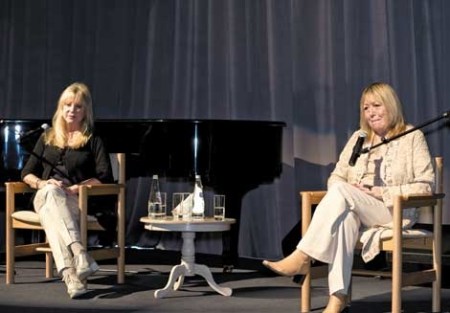 Pattie Boyd and Cynthia Lennon during their live interview at the Special Events Auditorium. German Avagyan
Published: Saturday November 14, 2009 in Cafesjian Center for the Arts
Yerevan – John Lennon and George Harrison were two of the four Beatles, one of the most iconic rock groups in history. Their former wives, Cynthia Lennon and Pattie Boyd, were in Yerevan for the grand opening of the Cafesjian Center for the Arts last week. They took part in a live interview with Michael De Marsche, the museum’s executive director, in the brand-new and beautifully appointed Special Events Auditorium, located at the top floor of the complex.
The first-time-ever joint appearance of Cynthia Lennon and Pattie Boyd, took place in Yerevan. Arranging for that to happen was no small feat, according to De Marsche, who recounted the many telephone calls and arrangements that the museum made to ensure their participation at the opening. Watching the interaction of these two phenomenal women on stage was like taking a trip down memory lane.
Those in attendance at the live interview at the Cafesjian Center for the Arts cut across a large swath of Armenian society, including Armenia’s deputy foreign minister Arman Kirakossian who was there with his family. Their nostalgia for the Beatles has a deeper meaning.
The music of the Beatles was repressed during the Soviet era but an underground culture was able to smuggle in and disseminate their music in innovative ways. Their influence was immense; some like the last Soviet leader Mikhail Gorbachev, would say that the cultural, social, and musical revolution they inspired manifested itself years down the road. “More than any ideology, more than any religion, more than Vietnam or any war or nuclear bomb, the single most important reason for the diffusion of the Cold War was the Beatles,” Mr. Gorbachev has said.
For over an hour, Cynthia and Pattie disclosed intimate moments they shared with their husbands and each other, from fame to drug abuse, to alcoholism, and eventually to break-ups both marital and musical. Those turbulent early years when the Beatles were on the road to becoming one of the most legendary music groups of all times, the wives were along for the ride. However, as they recounted, the ride wasn’t always smooth. Pattie Boyd was very honest when recalling that tumultuous time of her life, “With a lot of help from a psychotherapist I have learned and am a much stronger person now. I am thankful to be free.”
“We have survived,” Cynthia Lennon said. “We have lost so many people along the way.” Indeed, Paul McCartney and Ringo Starr are the sole surviving members of the Beatles. John Lennon was shot and killed in front of his apartment building on December 8, 1980, by Mark David Chapman. George Harrison died of lung cancer in his Hollywood Hills mansion on November 29, 2001.
Cynthia Lennon, nee Powell, met John Lennon at the Liverpool Art College in 1957. “We were young and very much in love,” she recalled. The two married in 1962, after Cynthia became pregnant with their son, Julian. Lennon left her shortly after their return from India in 1968 to be with Yoko Ono. In 1978, Cynthia wrote A Twist of Lennon, which included her own illustrations and poetry, and a later biography on the famous Beatle titled simply, John in 2005.
Pattie Boyd was a model and photographer. In the 60s she modeled in London, New York, and Paris and appeared on the UK and Italian covers of Vogue. She met George Harrison in 1964 when she was cast in The Beatles film “A Hard Day’s Night.” She said at the time that Harrison was “the most beautiful man I had ever seen.” They were married in 1966; Paul McCartney was the best man. They divorced in 1974, after which Boyd married Eric Clapton. One of the audience members asked her how she came to be with Clapton. “Eric kept coming over [to the house she shared with Harrison] and began declaring his love and passion for me,” she said. “Because I was being ignored by my husband and being young, I found it irresistible. Maybe if we weren’t so young, maybe we could have made it work.”
Boyd’s book, Wonderful Today: George Harrison, Eric Clapton and Me, which came out in 2007, was on the New York Times bestseller list.
For both Cynthia and Pattie, their fondest memories go back to the time they were all in India in 1968, after the Beatles renounced drugs and became followers of Indian mystic Maharishi Mahesh Yogi. “It was an idyllic, positive situation at the foothills of the Himalayas,” said Ms. Boyd. “I loved it there.”
“The holidays, the times we went away together” is what Cynthia Lennon remembers as the best times.
“When George, John, Cynthia, and I went to Tahiti and sailed on a boat” is what Pattie Boyd said was her fondest memory.
They were hard-pressed to reveal which Beatle song they liked most. “They’re all so different. It’s here, there, and everywhere,” said Cynthia. “But I think that Sergeant Pepper was the most unbelievable album.”
Pressed to say which Beatles song she liked most, Boyd – who is known to be the inspiration for some of George Harrison’s songs – said, “It’s difficult to say which one is my favorite, but ‘All You Need is Love,’ is so strong and profound.”
Someone from the audience wanted to know if there were any hidden messages in the Beatles’ songs. “No, people wanted there to be messages, but there weren’t any,” Cynthia assured the audience.
Questions were asked about what Cynthia’s son, Julian Lennon, was doing musically. Cynthia explained that he completed an album about a year ago, but is still trying to get the best deal, “hopefully by next year.”
Following the live interview, the two women were available for book signings and Pattie’s exhibition of photographs was opened to the public. Ms. Boyd spent a few minutes speaking with the Armenian Reporter, in between signing her books.
She said that this was her first visit to Armenia and to the region in general. “After this book signing, I can’t wait to go out and explore the city,” she smiled. “I want to go to Vernissage and the museum at Republic Square.”
About the Cafesjian Center for the Arts, she said: “I am so blown away; I think this is the most exciting building I have ever seen architecturally; it is so wonderful. I want to bring my friends from London here next year.” She went on to explain that the design of the museum, the different installations on each floor and the gardens were “absolutely beautiful. It’s so beautifully done and the attention to detail is exquisite.”
Cynthia Lennon and Pattie Boyd both seem to have have found peace and happiness. “I am very, very happy,” Cynthia explained. “The one person who has given me strength and hope is my son and my new husband…. It’s important to still have a sense of humor.”
(c) 2009 Armenian Reporter
Also see The Morton Report, by Jaan Uhelszki, Contributor, September 7, 2011: Pattie Boyd: Rock’s Most Beautiful Muse.
I remember you were the one who introduced everyone to the Maharishi. Tell me about that, and do you still do some kind of spiritual practice now?
Yeah, I still meditate. I was meditating. Along with a girlfriend I learned Transcendental Meditation and I told George about it. Then the Maharishi was coming to England and I wanted to see him. And I wanted George to meet him. At that time, Paul wanted to meet him as well. That’s why we all went and listened to his lecture, and he was obviously very happy when he heard that they were in the audience, and he wanted to meet them. When he did he suggested that we all go to Wales for a few days to learn more about meditation: he wanted to initiate them. It was really awful because while we were up there, their manager Brian Epstein died. It was just awful. One can think how extraordinary that the one person who had been guiding them throughout their career, from the beginning of their career, died, just as this spiritual leader is taking over.
Did it feel like a baton had been passed?
Yes. Well, no, it didn’t last for very long for some of them, but it did for George, for the rest of his life.
Also see Prudence Farrow — subject of the Beatles song Dear Prudence — visits India’s Kumbh Mela and The former Beatles Paul McCartney and Ringo Starr reunion for David Lynch’s benefit concert airs on New York’s THIRTEEN, Sunday, April 29
In this Prime Time Russia Today news spot, uploaded on Jul 17, 2011, a reporter asks Pattie Boyd about her trip to India with the Beatles in the context of a her photography exhibit.
Q: A section of this exhibit is dedicated to the Beatles and your trip with them to India, particularly George Harrison. How important was that time spent in India for you?
A: It was a very very special time. I loved being in India and I loved everything that we learned from Maharishi, which was an extended course on meditation. And it was very, it was wonderful being there at that time because the Beatles were particularly prolific. They wrote most of the songs for the White Album while we were in India.

Mike Love, Not War
Get Ready for Good Vibrations
by Virginia McEvilley

It’s Endless Summer for Beach Boy Mike Love (third from right), as the band wraps up its summer 2009 tour in Fairfield, Iowa, and makes plans for its 50th anniversary celebration in two years.
It may come as a surprise that America’s best-selling band of all time has chosen Fairfield, Iowa, for the grand finale of its 48th annual summer tour. But for long-time lead singer Mike Love, playing Fairfield is nothing short of “special.” And though it has been many years since 1961 when the Beach Boys’ first hit single “Surfin’ ” was released and since Mike Love, together with his cousins Brian, Carl, and Dennis Wilson, hit the charts with the group’s first nationwide hit, “Surfin Safari,” the feelings of happiness generated for millions of people by the Beach Boys’ music is still as lively today as it was almost 50 years ago.
Since then, the Beach Boys have performed their original hit songs recounting the Southern California life experience thousands of times, recapturing the innocence of an era that propelled them to the top of their profession. Mike says he is proud to have been the lead singer for so many of the Beach Boys’ hits, and in spite of the loss of his cousins, Dennis and Carl Wilson, Mike’s experience has remained fundamentally positive.
“I still treasure all the great times we had together,” Mike says. “The loss of Carl Wilson 11 years ago was profound, but I still feel like he’s looking down on us whenever we do ‘Good Vibrations’ and ‘Kokomo.’ At first I thought no one could ever sing our songs like Carl, but as it turns out my son Christian has a beautiful voice and not only can sing Carl’s parts but actually sounds a lot like him. This is great because we like to keep the re-creation of these songs consistent to the best of our ability.” Whether it is to preserve the Beach Boys’ legacy or for the sake of all their loyal fans, this may be one reason why the momentum of the Beach Boys’ greatest hits has lasted until today.
The Beach Boys are, in fact, among the top three groups who recorded from the late ’50s to the early ’70s, along with the Beatles and the Supremes. The Pet Sounds album was voted the number one album of that era and “Good Vibrations” the number one single. The time that passed between “Good Vibrations” in 1966 and “Kokomo” in 1988 was the longest period of time between number one records of any group in history.
“The amazing thing about music,” says Mike, “is that as long as you have the right piece of music and your abilities intact, you can experience great success irrespective of how many years you’ve been at it.” This basic theme of optimism and positivity has pervaded most of the Beach Boys’ musical history.
And just as “Good Vibrations” differed from the earlier surfin’ songs in subject matter, Mike’s lifestyle began to differ from others in the group, and many of those in the recording business in general. While others chose drugs and alcohol as a method of relaxation, Mike chose Transcendental Meditation as taught by Maharishi Mahesh Yogi. Several group members learned the technique from Maharishi in Paris in December of 1967, but Mike was the only one to go to the widely publicized course in Rishikesh, India, two months later, which was also attended by the Beatles, Donovan, and Mia Farrow.
Mike remembers Paul McCartney coming to breakfast one morning strumming his acoustic guitar and playing “Back in the U.S.S.R.,” an experience Paul himself writes about in his autobiography. Mike often recounts other moments in India and has written a song entitled “Pisces Brother” about his 1968 birthday party at Maharishi’s ashram with the late Beatle George Harrison.
Recently, Mike has written a number of other songs that draw from his experience in India, music he says was inspired by Maharishi and the ancient Vedic scriptures. Some of these tunes include “Ram Raj,” “The World is My Family,” and “Make Love Not War.”
After his visit to India in the spring of 1968, Mike attended many meditation courses, becoming a teacher of Transcendental Meditation in Mallorca, Spain, in 1972. “Too many people in my family and my profession paid a heavy price with their health and well-being by not using the knowledge Maharishi made available to us,” Mike says. “This knowledge has relieved me of stresses that certainly would have otherwise accumulated to my detriment, and has also improved my life dramatically.” Mike also schedules regular Ayurvedic treatments for rejuvenation, often at the Raj Resort in Maharishi Vedic City just north of Fairfield.
When asked about retirement, Mike says, “I don’t think of retirement as it is viewed by most people in our society. People work for 20 to 30 years, then get a pension and move to Florida, play bingo, clip coupons, and go on group excursions. . . . For me, my goals would be to become more creative, more productive, and produce more positive, uplifting actions for humanity, while becoming more saturated in knowledge and spiritual life. The retirement of retiring to the self appeals to me—the kind of thing you read about in the spiritual literature of the East. Still, in the future, we may become more selective about how we present our music . . . .”
Mike says there are a lot of other things he envisions for the future. Currently, an Emmy Award-winning documentarian is interested in filming a biography about the Beach Boys for the PBS American Masters series. “So there’s really no need to talk in terms of retirement—there’s no retirement in sight for the Beach Boys at this time,” Mike says. “In fact, we’re really looking forward to our 50th anniversary celebration in two years. We’re getting offers to do concerts in Australia, Japan, Mexico, and the Caribbean.” Even though it can be tiring moving from place to place Mike admits he still enjoys touring. “What’s not to like!” he says.
This relentless positivity and optimism combined with a focus on health and spirituality are the foundations of Mike’s life. This has been his contribution to the Beach Boys since the beginning and is now the engine that drives the band. Together with “I Write the Songs” Bruce Johnston, who has been a Beach Boy on and off for decades, and several other musicians, including Mike’s son, Christian, and John Cowsill of the ’60s group The Cowsills, the good vibrations continue.
Now, for the first time ever, though he has been a frequent visitor to Fairfield over many years, Mike Love and the Beach Boys will be performing all the great songs here that have made them famous the world over as “America’s number one band.”
“Every year we play all the major cities—New York, L.A., Chicago, Dallas, Atlanta,” Mike says, “but those people have so many choices because a myriad of performers come through there. It’s almost like they become a little jaded. That’s why it’s special to go places we’ve never been before. It’s exciting and fun, and we’re inspired by the feeling of appreciation we get.
Don’t miss this special performance sponsored in part by the David Lynch Foundation, whose successful fundraising concert at NYC’s Radio City Music Hall this spring featured Paul McCartney, Ringo Starr, Donovan, Moby, Sheryl Crowe, and others, including Mike Love, who says, “I have great admiration for the David Lynch Foundation. The Love Foundation currently has a project for veterans with post-traumatic stress disorder to learn TM, but we’ve never been as organized and dynamic as the DLF. Their work is inspirational and makes me want to do even more.”
The Beach Boys perform the finale of their Endless Summer Tour in Fairfield on Labor Day Monday, September 7, 2:00 p.m. at the Fairfield Middle School Outdoor Field, 404 W. Fillmore. Tickets range from $12.00 to 37.50, available at http://www.fairfieldacc.com or (641) 472-2787.
Visit the index for more articles on music and musicians.
http://www.iowasource.com/music/2009_09.html
Watch Fairfield’s Beach Boys End of Summer Concert promo on YouTube. http://www.youtube.com/watch?v=t1rOugfBi1k
Related: Here’s an Interview With Mike Love of the Beach Boys posted May 29, 2012 on Stories of Success. At about the 9:55 mark Mike answers the question of what kept him from getting caught up in drugs and alcohol, with the responsibility of acting as a role model, by talking about his TM practice, dharma, and persevering to fulfill your chosen career path. http://vimeo.com/43009744
Transcendental meditation
Dismissed by cynics, applauded by medics, transcendental meditation is nothing if not controversial
‘It was a great gift,’ said Sir Paul McCartney earlier this year. ‘For me it came at a time when we were looking for some stability towards the end of the crazy ’60s. It’s a lifelong gift that we can call on any time.’
At a press conference for Change Begins Within (an initiative that hopes to get one million children involved in transcendental meditation, or TM, put together by Twin Peaks director David Lynch), Macca’s fond enthusiasm was somewhat at odds with the general malaise that soured the Beatles’ meditation retreat back in 1968. After the fab four followed Maharishi Mahesh Yogi (the man credited with introducing the Indian-Himalayan meditation technique to the West) to Rishikesh, India, John Lennon dismissed him as a charlatan. Though he apologised for his youthful outbursts later, it seemed impossible that a Beatle-tarnished reputation could ever be wiped clean.
Not so. By the mid-’70s some 40,000 Americans per month were reportedly signing up for classes, many of whom found the simple, schedule-friendly techniques so beneficial that they practise it to this day. David Lynch, a practitioner since 1973, has said that a mere fortnight of twice-daily practice was all it took to reduce the angers and anxieties that controlled his life at the time. ‘Those negative things started lifting,’ he said recently. ‘It sounds strange, but I appreciated and enjoyed the doing of things more.’ It’s not just the ageing hippies who talk it up, either. Empirical evaluations have shown that the technique can have an effect on human physiology, reducing stress levels significantly and even having some positive effect on heart diseases. Even the science bods are recommending it now.
‘It’s practised by people of all levels of intelligence, of all ages, cultures and religions,’ explains Surendra Kumar, a teacher at the Creative Intelligence Consultancy in Dubai. ‘There are many reasons they come to us. Some just want to learn, others come for health reasons and many just want to be happy in life.’ Surendra is willing to travel to teach keen students – a kind of TM delivery service, if you will. In fact, he recently finished a TM course in Abu Dhabi, which was hailed a success by its participants.
A misconception commonly held is that TM has religious connotations – possibly cultish in nature. Again, this was an unfortunate by-product of the Maharishi’s association with The Beatles: George Harrison, in particular, was an enthusiastic advocate of Indian religions, and many observers jumped to conclusions. ‘It has nothing to do with religion,’ says Surendra with the air of a man who has had to deal with this line of questioning before. ‘It’s a peaceful mental activity that takes the mind to deeper levels of the thinking process. Though it was only introduced to the Western world 50 years ago, it’s as old as life itself.’ It is estimated that six million students have studied TM in that short space of time, a number that puts it slightly beyond the realms of cult status.
But, why TM rather than other forms of meditation? Put simply: people seem to find it easier. Whereas other techniques require you to blank the mind (often the largest hurdle for many students), or focus on a single aspect, TM uses a repetitive technique – a series of vocal vibrations or sounds, often with no meaning – to lull the mind into a peaceful state, ‘transcending’ the regular thoughts and conundrums that bombard us from minute to minute.
Unfortunately, the mumbo jumbo associated with TM is hard to avoid. Wondering what the effects of ‘bliss consciousness’ and ‘self-referral intelligence’ might be, we spoke to Arif Dawood, a participant on the recent Abu Dhabi course. ‘I’ve done several types of meditation and heard about TM a long time ago,’ he explains. ‘I would say it’s one of the easiest to practise and, although it’s too early to notice any major benefits, it certainly makes me feel very relaxed.’
If it’s so easy, why bother finding a teacher? Well, just as you might benefit from instruction in the gym, an experienced teacher can help shape the techniques to suit your situation. Whether you come to it as a student of relaxation, for health reasons, or even via an out-of-control Beatles obsession, one thing quickly becomes apparent: transcendental meditation may be as old as the hills, but in this frenetic modern world where instant results are imperative, you might find it’s a lifelong gift you wouldn’t wish to return.
For more information on arranging a TM course in Abu Dhabi, call the Creative Intelligence Consultancy on 050 207 0347 or email info@tm.ae. A website will soon be up and running at http://www.tm.ae
Time Out Abu Dhabi 30 August 2009
3 Comments:
Posted by: Dr. Jean Tobin on 01 Sep ‘ 09 at 03:54
Thank you for this article highlighting the benefits of Transcendental Meditation. I’ve read quite a few articles on the subject and your treatment is more precise and fair than most. I wanted to share with your readers a summary of the research on TM. TM distinguishes itself not only in how easy it is to practice, when learned from a qualified teacher, (TM.org) but also in how effective it is when compared with other mental techniques. There has been so much rigorous research validating the benefits of TM in all areas of life. The majority of these studies compared TM to other practices or control groups. 350 peer-reviewed research studies were conducted on over 10,000 subjects who were practicing the TM technique. These studies included numerous randomized controlled trials, along with eight meta-analyses of 597 separate studies on the effects of meditation. The studies were conducted at Harvard Medical School, Yale Medical School, Stanford Medical School, University of PA, University of Kentucky, and more than 200 other independent institutions, and were done by 360 scientists from 29 countries. Learning TM was the best decision I ever made. It has improved my life in every possible way. Thanks again for bringing your readers attention to an important topic.
Posted by: kennyji on 31 Aug ‘ 09 at 18:37
This has to be the most intelligently written article so far assessing the value of the Transcendental Meditation technique for the average individual that I’ve come across. It sifts out the misunderstandings of a confused past and enlightens its readers to the practical benefits of this simple but effective technique for living a less stressed and more productive fulfilling lifestyle. Thank you.
Posted by: Archie on 31 Aug ‘ 09 at 15:21
I love TM and have been practicing it twice a day for over 35 years. It has enriched my life in ways that I never could have expected but would never want to have had to do without. Yes, it has been a lifelong gift that I wouldn’t return for anything in the world. Thank you, Maharishi.
 The Uncarved Blog