Posts Tagged ‘education’

New research shows Transcendental Meditation improves standardized academic achievement

March 21, 2011

New research shows TM improves standardized academic achievement
A study with at-risk urban middle school students
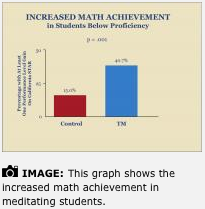
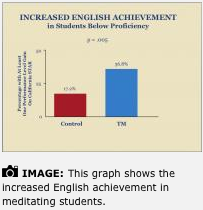
The Transcendental Meditation® technique may be an effective approach to improve math and English academic achievement in low-performing students, according to a new study published in the journal Education.

The study was conducted at a California public middle school with 189 students who were below proficiency level in English and math. Change in academic achievement was evaluated using the California Standards Tests (CST).

“The results of the study provide support to a recent trend in education focusing on student mind/body development for academic achievement,” said Dr. Ronald Zigler, study co-author and associate professor at Penn State, Abington. “We need more programs of this kind implemented into our nation’s public schools, with further evaluation efforts.”

Students who practiced the Transcendental Meditation program showed significant increases in math and English scale scores and performance level scores over a one-year period. Forty-one percent of the meditating students showed a gain of at least one performance level in math compared to 15.0% of the non-meditating controls.

Among the students with the lowest levels of academic performance, “below basic” and “far below basic,” the meditating students showed a significant improvement in overall academic achievement compared to controls, which showed a slight gain.

“This initial research, showing the benefits of the Quiet Time/Transcendental Meditation program on academic achievement, holds promise for public education” said Sanford Nidich, EdD, lead author and professor of education at Maharishi University of Management. “The findings suggest that there is an easy-to-implement, value-added educational program which can help low-performing minority students begin to close the achievement gap,” said Dr. Nidich.
The middle school level is of particular concern to educators because of low academic performance nationally. Sixty-six percent of eighth-grade students are below proficiency level in math and 68% are below proficiency level in reading, based on 2009 National Assessment of Educational Progress data.

Faculty surveyed as part of the project reported the Quiet Time/Transcendental Meditation program to be a valuable addition to the school. They reported the students to be calmer, happier, and less hyperactive, with an increased ability to focus on schoolwork. In terms of the school environment, faculty reported less student fights, less abusive language, and an overall more relaxed and calm atmosphere since implementation of the program.

The study was supported by the David Lynch Foundation.

Study Facts

• This study evaluated change in academic achievement in public middle school students practicing the Transcendental Meditation program compared to non-meditating controls. A total of 189 students (125 meditating and 64 non-meditating students), who were below proficiency level at baseline in English and math, were evaluated for change in academic achievement, using the California Standards Tests (CST).

• Ninety-seven percent were racial and ethnic minority students.

• The Transcendental Meditation program was practiced in class twice a day as part of the school’s Quiet Time program for three months prior to posttesting.

• The Transcendental Meditation program was taught in the context of a school-wide Quiet Time program in which students voluntarily chose the Quiet Time program in which they wanted to participate.

• The Transcendental Meditation technique is a simple, natural, effortless technique that allows the mind to settle down and experience a silent yet awake state of awareness, a state of “restful alertness.” Practice of this stress reduction program does not involve any change in beliefs, values, religion, or lifestyle.

• Compared to eyes-closed rest, research has found that Transcendental Meditation practice is characterized by decreased activation or arousal of the autonomic nervous system, as reflected in decreased breath rate and lower sympathetic nervous system activity. The Transcendental Meditation program has been shown to increase electroencephalographic (EEG) brain integration and coherence, especially in the frontal area of the brain, responsible for higher-order processing.

• Other published research on high school and college students has shown reduced psychological distress, improved positive coping ability, decreased blood pressure, reduced cardiovascular reactivity to stressful stimuli, reduced absenteeism, and decreased school suspensions.

• Results of the current study indicated improvement for meditating students compared to controls on English scale scores (p = .002) and math scale scores (p < .001). A greater percentage of meditating students improved at least one performance level in math and English compared to controls (p values < .01).

• A matched-control subgroup of 50 students in each group yielded similar results.

Facts on Academic Achievement

• According to the National Assessment of Educational Progress (NAEP), 68% of eight grade students nationally are below proficiency level in reading and 66% are below proficiency in math, based on 2009 data.

• Nearly 1.3 million students did not graduate from high school in 2010.

• For further facts please see the National Assessment of Educational Progress: http://nces.ed.gov/nationsreportcard/subjectareas.asp
Also see Alliance for Excellence in Education website http://www.all4ed.org/files/UnitedStates.pdf

###

Posted today, March 21, 2011: New research shows Transcendental Meditation improves standardized academic achievement. Source: EurekAlert!

Also reported in South Africa by health24:Meditation improves maths and English

Also see: San Francisco Bay Area News: From time-out to quiet time: meditation comes to SF schools

This new article: The San Francisco Examiner—Meditation program mends troubled Visitacion Valley Middle School

TM Blog reports (with video): “Meditation mends troubled school in San Francisco” – SF Examiner, and Struggling students find TM improves academic achievement: New research.

MUM BLOG Reports: Transcendental Meditation: Improving academic performance.

See Related Research: Transcendental Meditation Effective Antidote to Record Stress Levels in School Students.
Pathways Magazine: Taking Care Of The Student – The Forgotten Element In Education

February 18, 2011

Taking Care Of The Student – The Forgotten Element In Education

The surgeon general said that America is swimming in an ocean of stress. If this is true, our children are drowning in it. ~ Robert Roth, Vice President of the David Lynch Foundation

A teacher of a Montgomery County high school describes the 7:30 AM morning: kids with hoods pulled over their eyes, practically sleepwalking. At their desks, students are slumped over, exhausted – sleep deprived.

A school counselor describes a student whose deep anxiety constricts her ability to understand a basic math concept, and another student whose pressure to succeed is so intense that anxiety escalates into insomnia, depression, and feelings of suicide.

In most schools in our country, the student himself, and his instrument of learning – his physiology – are being ignored. We are experiencing – possibly promoting – epidemics of sleep deprivation and stress in our schools, and in the general public. Not only do we not pay attention to students’ physical health, we do the opposite: impose physical and mental strain – sometimes to the breaking point – often with serious, long-term results for both physical and emotional health.

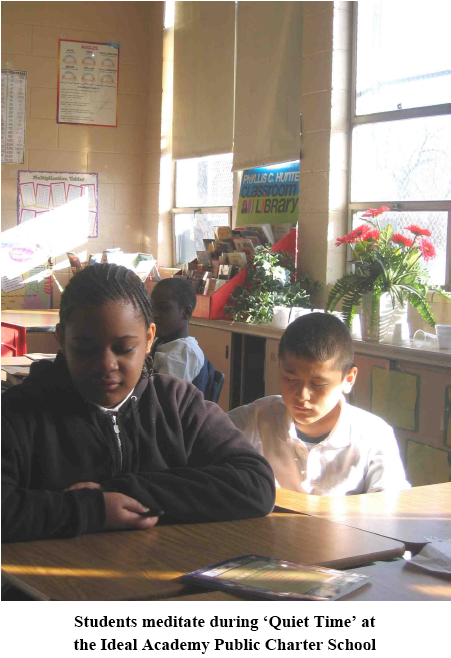
In this article, we look at some recommendations and programs addressing this problem. We begin with refreshing our understanding of the goal of ideal education. Next we look at sleep deprivation, stress, anxiety, and related problems of ADHD and depression, and the impact on student health and learning. Next, advice by professionals who work in this field of stress and adolescence will be presented. Finally, we look at promising examples where recommendations are successfully implemented: a school in D.C., the Ideal Academy Public Charter School, experiencing remarkable results by incorporating “Quiet Time” into the daily routine; and breakthrough research on ADHD and “Quiet Time” from several middle schools.

WHAT DOES EDUCATION REALLY MEAN?

All that lies before us and all that lies behind us are tiny matters compared to what lies within us. ~ Emerson.

Education comes from the Latin root ‘educere’, meaning to ‘draw out from within’ or to ‘lead forth’. ‘Education’ means something other than filling up the mind with information. Socrates said, “Education is the kindling of a flame, not the filling of a vessel.” It involves cultivating the
student’s inner genius, innate intelligence, creativity, consciousness.

Quite clearly the two great things for which we aim are the improvement of intelligence and the deepening and the extension of the feeling of friendliness and love. ~ Aldous Huxley

A student truly being educated is not merely learning information. He is cultivating the quality of his awareness: becoming more awake, clear, creative. He is developing his character: virtues of friendliness, helpfulness, compassion. And cultivating a love of learning and sense of vitality: feeling interested, enthusiastic, capable, confident.

The qualities we often find in great people – flexibility, curiosity, energy, receptivity to new ideas, and lovingness – are first found in children and then maintained through adulthood. ~ Dr. Melanie Brown, Attaining Personal Greatness: One Book for Life

But what are we doing to cultivate these qualities in our students? It seems clear that we often forget the meaning and goal of education.

Click on the above title for a Google docs quick view of the entire article, including photos, and/or download the PDF of Taking Care Of The Student – The Forgotten Element In Education, originally printed in the Winter 2009 issue of Pathways Magazine, Washington, DC.

Hollywood Today reports on American Indian Conference

September 20, 2009


American Indian Conference to Focus on Health, Sustainability

September 20, 2009

Stocel+drum

STOLCEL of the WSANEC First Nation performs traditional recitation at international conference in Holland

Leaders of Native Indian tribes from around the US and Canada will gather on the campus of Maharishi University of Management in Fairfield, Iowa, for an international conference September 25-27 entitled “Building Healthy, Sustainable American Indian Communities.”

Conference speakers include Joe A. Garcia, president of the National Congress of American Indians; Robert Cook, president of the National Indian Education Association; Lucille Echohawk, strategic advisor for the Casey Family Programs; and Kevin Skenandore, acting director of the Bureau of Indian Education.

Conference hosts and participants include the Hocak Elders Council, Inc., the Indian Health Services (IHS), the National Congress of American Indians (NCAI), the National Indian Education Association (NIEA), the Bureau of Indian Affairs (BIE), Winnebago Tribal Health Services (WTHS), the Winnebago Treaty Hospital-IHS, and the David Lynch Foundation.

For more information see conference website and video on TM and Diabetes Among Native Americans: http://www.americanindiansustainableconference.org/

See Indian Country Today article, Sustainability quest: http://bit.ly/4vNhWo

Also News From Indian Country article, Indian Country leaders meet in Iowa to explore new approaches to sustainable communities: http://bit.ly/JUOM7

Canadian First Nations participants include STOLCEL [John Elliott], Tekahnawiiaks [Joyce King], and Tim Paul. STOCEL is a cultural and language custodian for his [Saanich] People and speaks extensively on culture and language and history; Tekahnawiiaks [Joyce King] is currently the Director of the Akwesasne Justice Department and is on the Mohawk Council of Akwesasne; and Tim Paul, is Executive Director of the Maliseet Nation Conservation Council of New Brunswick. http://mncc.ca/

STOLCEL will be receiving an honorary Ph.D. from M.U.M. for his lifelong work to revive the mother tongue of the Saanich People, his contribution as Co-Founder of FirstVoices, the world’s first web-based Aboriginal language archive, and for his discovery of the connection between the traditional language of his people and the underlying intelligence of Nature available in the sounds and structure of Veda, which he made in collaboration with M.U.M. founder Maharishi Mahesh Yogi. [See BACKGROUNDER on STOLCEL]

Tekahnawiiaks [Joyce King] will be speaking twice at the conference: on Education, and on Safeguarding Culture and Language. She lives on the Akwesasne Reserve near Cornwall, Ontario, along the border between Canada and NY State. Her bio is available online: <http://www.tekahnawiiaks.com/bio.html>.

Tim Paul will speak on his own experience with TM and the lowering of his blood sugar levels, as well as his keen interest in the “eco village” model at MUM, and the desire of the Maliseet Nation Conservation Council to incorporate many of the “sustainable technologies” demonstrated there, in his own Maliseet communities throughout New Brunswick.

The conference will showcase Consciousness-Based education, prevention-oriented health care, renewable energy, organic agriculture, and cultural preservation.

Researchers will also present the results of several controlled studies on the effects of the Transcendental Meditation® technique for reducing acute stress and behavioral problems among hundreds of at-risk American Indian youth at the Winnebago (Nebraska), Pine Ridge (South Dakota), and Passamaquoddy (Maine) reservations.

Findings to date show the Transcendental Meditation technique promoted higher scores on standardized state tests of mathematics and reading, 25% less absenteeism, a 20% drop in disciplinary incidents, and 30% higher graduation rates among the meditating young people compared to controls.

“The timing is perfect for this conference because the need is so great among the tribes,” said John Boncheff, who is co-director of the Transcendental Meditation program at the Winnebago reservation. “The Transcendental Meditation technique is not only helping students perform better in school, but it’s also helping both adults and children to overcome the terrible epidemic of diabetes, which strikes up to 80 percent of all American Indians.”

Dr. Boncheff said that it’s also helping American Indians reconnect with their spiritual heritage and traditional culture.

—————————–

BACKGROUNDER

STOLCEL [John Elliott]

(Photos available upon request)

STOCEL is a descendant of the hereditary family of Chiefs of the WSANEC [Saanich] People and lives on the Tsartlip Reserve near Victoria, Vancouver Island, British Columbia. He is the Co-Founder of ‘First Voices’, the world’s first web-based Aboriginal language archive. This web-based archive allows predominantly oral tradition languages of any aboriginal nations to be recorded, uploaded, saved, and learned in perpetuity by future generations online, rather than becoming obscure or obsolete when the Elders or fluent speakers pass away. As a result of his initial inspiration, there are now over 60 First Nations archiving their languages online, with 35 of those now publicly available for First Nations’ youth and non-mother tongue speakers to learn their languages: <http://www.firstvoices.com/>.

STOCEL is the Chair of the Subcommittee on Language for the First Nations Education Council for British Columbia, as well as the Chair of the Saanich Native Heritage Society, and is an active member on the Board of Governors of the First People’s Cultural Foundation. He has been teaching, developing curriculum, and preserving aboriginal languages for thirty years.

STOLCEL holds First Nations’ Language Certification from the British Columbia College of Teachers. He has taught in all grades and is now teaching Grades 7-10 in the SAANICH Tribal School as well as SENTOTEN for adults at the University of Victoria.

STOLCEL is being honored with of the degree of Doctor of Natural Law Honoris Causa by Maharishi University of Management for his work to bring out the connection of traditional language and the underlying field of Nature that upholds every culture in peace and progress.

In STOLCEL’s words: “There is never time enough time in the day for all the work that has to be done. Our languages are the key to ancient knowledge. Inside each language is the pattern of how to live in harmony with the earth and all the living things. More today, than ever, this knowledge is needed. Each time another language dies forever, our ancient connections to all life, our knowledge of the plants the animals, the trees and our mother earth is lost.”

Canadian Contact: Christopher Collrin, 506-471-5598, collrin@gmail.com

US Contact: Ken Chawkin, 641-470-1314, kchawkin@mum.edu