Posts Tagged ‘David Lynch Foundation’

Transcendental Meditation Effective Antidote to Record Stress Levels in School Students

November 16, 2011

Transcendental Meditation Effective Antidote
To Record Stress Levels in School Students
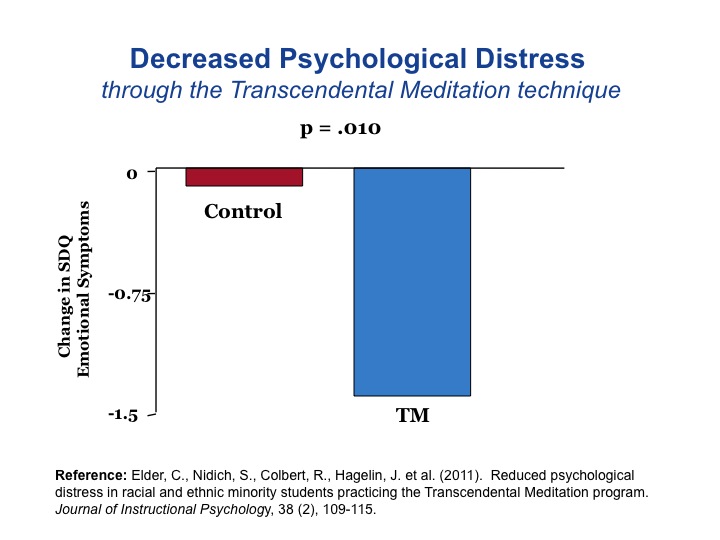
This graph shows a 36 percent reduction in psychological distress in 106 at-risk racial and ethnic minority students practicing the Transcendental Meditation technique compared to controls over a period of 4 months (p=.010). Significant decreases were also found in trait anxiety and depressive symptoms.

With record levels of student stress reported in a recent UCLA survey, can a simple stress-reducing meditation technique be a viable solution?

A new study published in the Journal of Instructional Psychology found the Transcendental Meditation (TM) technique significantly decreased psychological distress in public school students. The study, conducted with at-risk minority secondary school students, showed a 36 percent reduction in overall psychological distress. Significant decreases were also found in trait anxiety and depressive symptoms.

Rising Stress Levels Affect Emotional and Physical Health

The percentage of students in the UCLA survey reporting good or above-average high school emotional health dropped from 55.3 percent in 2009 to 51.9 percent in 2010. This marks the lowest level within the past 25 years.

Dr. Charles Elder, MD, lead author of the TM study, and investigator at Kaiser Permanente Center for Health Research, emphasized the important implications of the findings on reduced stress. “It is vital that we start addressing the high levels of emotional stress being reported by high school and college students. Decreased stress can have a positive impact on mental health, and can also reduce the risk for hypertension, obesity, and diabetes—major risk factors for heart disease,” explained Dr. Elder.

Educational research has also linked student stress to negative school behavior and poor academic performance.

Promising Findings for Education

“These new findings on reduced stress, along with the recent research on academic achievement gains, hold tremendous promise for public education,” said Sanford Nidich, EdD, principal investigator, and professor of education at Maharishi University of Management. “There is a growing body of evidence showing Transcendental Meditation to be an easy to implement, value-added educational program that promotes emotional health and increases academic achievement in at-risk students,” said Dr. Nidich.

A total of 106 secondary school students, 87% racial and ethnic minorities, took part in the study. Results showed that over a four-month period, students practicing Transcendental Meditation as part of their schools’ Quiet Time program exhibited significant reductions in psychological distress factors compared to controls.

According to James Dierke, 2008 National Association of Secondary School Principals—National Middle School Principal of the Year, “Stress is the number one enemy of public education, especially in inner-city schools. It creates tension, violence, and compromises the cognitive and psychological capacity of students to learn and grow. The TM/Quiet Time program is the most powerful, effective program I have come across in my 39 years as a public school educator for addressing this problem. It is nourishing children and providing them an immensely valuable tool for life. It is saving lives.”

The study was supported by the David Lynch Foundation.

Study Facts

  • This study evaluated change in psychological distress factors in students practicing the Transcendental Meditation program compared to non-meditating controls. A total of 106 students (68 meditating and 38 non-meditating students), took part in the study. The study included students from four public secondary schools.
  • Eighty-seven percent were racial and ethnic minority students, including 26% Hispanic, 25% African American, and 19% American Indian.
  • The Transcendental Meditation program was practiced in class twice a day as part of the schools’ Quiet Time program for four months prior to posttesting.
  • The Transcendental Meditation program was taught in the context of school-wide Quiet Time programs in which students voluntarily chose the Quiet Time program in which they wanted to participate.
  • Transcendental Meditation is a simple, natural, effortless technique that allows the mind to settle down and experience a silent yet awake state of awareness, a state of “restful alertness.” Practice of this stress-reduction program does not involve any change in beliefs, values, religion, or lifestyle.
  • Compared to eyes-closed rest, research has found that Transcendental Meditation practice is characterized by decreased activation or arousal of the autonomic nervous system, as reflected in decreased breath rate and lower sympathetic nervous system activity. The Transcendental Meditation program has been shown to increase electroencephalographic (EEG) brain integration and coherence, especially in the frontal area of the brain, responsible for higher-order processing.
  • Other published research on high school and college students has shown reduced psychological distress, improved positive coping ability, decreased blood pressure, reduced cardiovascular reactivity to stressful stimuli, reduced absenteeism, and decreased school suspensions.
  • Results of the current study indicated significant reductions in overall psychological distress (p=.010) and trait anxiety (p=.035) compared to controls. Within-in group differences in depressive symptoms were found for meditating students (p=.003).

Source: EurekAlert!

Reported on: Science Codex, sciencenewslinemedicine, PsychCentral: Meditation May Help Ease School Stress, Times of India: Beat stress with transcendental meditation (IANS), The Behavioral Medicine Report: Transcendental Meditation Significantly Decreased Psychological Distress In Public School Students, among others.

TM Blog: New research finds TM helps ease school stress, Ken Chawkin.

See related study: New research shows Transcendental Meditation improves standardized academic achievement.


David Lynch Foundation launches Veteran’s Day national meditation initiative

October 14, 2011

David Lynch Foundation launches Veteran’s Day national meditation initiative

Veteran’s Day falls on 11.11.11. and the David Lynch Foundation is hosting a national meditation initiative for veterans.

The charitable organization is teaming up with online fundraising network Crowdrise, to raise funds for its veteran’s outreach – Operation Warrior Wellness – which has the goal of providing stress-reducing Transcendental Meditation to 10,000 veterans who suffer from post-traumatic stress and their families.

Here’s how it works: Donate $11 or more to Operation Warrior Wellness on Crowdrise and you are automatically entered to win the Warrior Wellness Gift Pack – which includes the Operation Warrior Wellness commemorative coin, OWW t-shirts and hoodies, and books by the iconic filmmaker David Lynch, the NY Times bestselling author Dr. Norman Rosenthal, and WWII fighter pilot Jerry Yellin. The value of the gift pack is approximately $200.

Recent published research has shown a 50% reduction in PTSD symptoms among meditating veterans, as well as greater resiliency, reduced cardiovascular disease, decreased substance abuse and decreased medical expenditures.

Russell Brand, Clint Eastwood, Martin Scorsese, Donna Karan, Candy Crowley, and many decorated veterans have partnered together in support for Operation Warrior Wellness. Explained Vietnam veteran Dan Burks, “The experience I had from Transcendental Meditation basically saved my life.”

To make a donation to the Operation Warrior Wellness Veteran’s Day Campaign and enter the give-away please visit: crowdrise.com/operationwarriorwellness.

For more information on the David Lynch Foundation’s veteran’s initiative, please visit operationwarriorwellness.org.

See: Finding Her Son Again – Julia George and Iraq Veteran David George:

Also see: Medication or Meditation for Veterans with PTSD?, Author Veteran Jerry Yellin To Sign Four Books Proceeds To Benefit Operation Warrior Wellness, Huffington Post: What Meditation Did for Me: A War Vet’s Story, Wall Street Journal: A Transcendental Cure for Post-Traumatic Stress by David Lynch and Norman E. Rosenthal.

Author Veteran Jerry Yellin To Sign Four Books Proceeds To Benefit Operation Warrior Wellness

October 14, 2011

Jerry Yellin will be doing a book signing on Saturday evening, November 5, from 7:30-8:30 at the Fairfield Library meeting room. Receipts from the sale of his four books will benefit Operation Warrior Wellness, a division of the David Lynch Foundation. Here is an article promoting this event written by Jerry’s son, Steven Yellin. Jerry’s books are listed at the end of this article.

A WWII P-51 Pilot Talks About Healing His Soul Through Meditation

On March 7, 1945, Jerry Yellin, a current resident of Fairfield, Iowa landed on a small strip of land in the middle of the Pacific Ocean. For the next six months he saw sights that would haunt him for the next 35 years.

The strip of land was Iwo Jima.

28,000 soldiers died on Iwo Jima. Had the American commanders known in advance how many casualties there were going to be in taking that island, they never would have invaded. Jerry was a P-51 fighter pilot who strafed the island for the Marines, and then flew 19 missions over Japan.

When Jerry returned to the States, he took those memories and images of what he saw on Iwo Jima with him. Everyday and many horror-filled dreaded nights, he relived the images of war. Time passed, the memories did not.

Though he didn’t die on Iwo, the memories of Iwo were slowly killing him. Then in 1975 Jerry learned the Transcendental Meditation program. Slowly, the memories of war started to fade from his mind. For the first time, he started to reconnect with himself on a deep level and experience the joys of life that were absent for so long. Though he had married a wonderful woman and had four great sons, he couldn’t really feel the flow of life until he learned to meditate. Years later, he said unequivocally that TM saved his life.

Last year, a friend of his called and said that her son was having a difficult time adjusting from the many military tours of duty he had done. Jerry met with him and as a former soldier that had seen combat, tried to console him. It didn’t work. Two weeks later that young man committed suicide. A little known fact is that more soldiers commit suicide each month than die in combat in Iraq and Afghanistan.

Jerry was devastated because he knew exactly what this young soldier experienced. He felt that something had to be done to prevent these kinds of suicides and the ruined lives of soldiers caused by Post-Traumatic Stress. So he contacted the David Lynch Foundation, a non-profit organization that has been teaching Transcendental Meditation to at-risk youth around the world since 2006. They immediately said they were interested and Operation Warrior Wellness was launched.

Since then Jerry has talked about OWW to military groups all over the country. The response has always been the same—this is an organization that needs to be successful because the problem is so acute. “We send our young men and woman to fight,” says Jerry, “and then, when they return, we can’t really help them integrate into society successfully, because what they saw and heard are so devastating to their souls.”

The four books Jerry Yellin will be signing are:

The Resilient Warrior, Healing the Hidden Wounds of War: stories of veterans of war who suffer from Post Traumatic Stress and how Transcendental Meditation helps cure them.

Of War and Weddings, A Legacy of Two Fathers: an autobiographical story of one American and one Japanese soldier who hated each other in their youth and came to be family by the marriage of their two youngest children in 1988.

The Blackened Canteen: a true story of 23 Americans who were killed on June 20, 1945, and the Japanese man who buried their remains in a common grave next to the 2000 Japanese citizens their bombs helped to kill.

The Letter: literary fiction about a powerful American Senator who goes through life hating people of different religions only to find out that his birth mother and father were everything he hated.

###

The David Lynch Foundation teamed up with Donna Karan’s Urban Zen Foundation on June 7, 2011, to garner support for their shared goal: to help veterans who are suffering with Post-Traumatic Stress reclaim their lives. In this video, former WWII captain and fighter pilot Jerry Yellin speaks out about the horrors of returning to civilian life after experiencing the trauma of combat—and how he overcame the hidden wounds of war through the practice of Transcendental Meditation. More articles on Jerry Yellin are posted here on this blog.

Click here to download a beautifully-designed poster announcing the book-signing event.

Upcoming Event: David Lynch Foundation launches Veteran’s Day national meditation initiative

See Huffington Post: What Meditation Did for Me: A War Vet’s Story | Wall Street Journal: A Transcendental Cure for Post-Traumatic Stress by David Lynch and Norman E. Rosenthal | Medication or Meditation for Veterans with PTSD?

The Norwich Guidon: Rooks experiment with meditation

October 8, 2011

Rooks experiment with meditation

By Thomas Carson
Norwich Guidon Staff Writer
Published: Tuesday, October 4, 2011

Norwich University has received a $40,000 grant from Foundations of America to conduct a study on how to lower stress among rooks. One rook platoon is using Transcendental Meditation (TM) twice a day, every day, to see if meditating helps, according to Dr. Peg Meyer, director of academic achievement and educational effectiveness.

“The big thing about the TM practice is that it is an individual tool, people will say, ‘What about a team performance or a platoon performance’ but it is really about what it does for you,” said Shelby Wallace, the director for student success. “I have been TM’ing for almost a year now this December, and it has definitely helped with a level of prioritization.”

“I can handle situations in a more effective way, and reduce my stress, so I have seen a lot of positive results in a personal and professional way,” said Wallace.

Last February, Norwich conducted a study with the men’s lacrosse team to test TM.

“The spring study was more or less an intro for the university to take a cross section of students, staff and faculty who were trained, as well to learn a little more about the TM practice to understand if this was something that we wanted to do,” said Wallace.

After seeing good results, Meyer, Wallace and President Richard W. Schneider went to New York to meet with the David Lynch Foundation to get trained in TM and to see its effects firsthand.

After receiving the grant, Norwich sent out emails to the rooks of 4th Company, 3rd Platoon, asking if they would participate.

Twenty-eight rooks volunteered.

“I received an email, I volunteered, and now I am apart of this great study,” said Frank Ruscito, an 18-year-old freshman study of war and peace major from Rome, N.Y. “I feel it has worked better than I expected.”

“I see other people falling asleep (in class), and I am energized and focused,” Ruscito said. “I’m doing much better in my classes than I expected.”

The 4-3 platoon cadre are trained in TM and do it with the platoon, as well as by themselves when needed to. The rooks are free to meditate whenever they please as well. The platoon meditates at 0800 and between 1620 and 1630 as a platoon.

“My stress levels are down. As far as academics, everything seems to be clicking very well,” said Scott Heimann, a 18-year-old freshman computer security major from Colorado Springs, Colo. “I do believe with the help of the TM, my rookie knowledge is sticking very well.” Heimann added, “I strongly believe that I will continue TM after rookdom.”

“It has helped me with my academics tremendously. I feel more alert, I can focus better on my homework,” said Timothy Hunter, a 18-year-old freshman biology major from Stratham, N.H. Hunter also described how the effects of the TM helped him with his rookie knowledge, and how it relieved the stresses of balancing the rook environment and school work.

All the rooks who were interviewed said TM should be done by everyone; and that they will continue doing TM.

“I feel more organized, I feel I have more energy, I’m more productive, and it helps relieve stress,” said Madison Dupouy, a 22-year-old senior physics major from Saratoga Springs, N.Y.

Dupouy went to a dinner for people interested in this new study. After discovering that TM actually helped him with his academics, his stress and his energy level, Dupouy decided to get involved as one of the cadet officers who will oversee the study.

“I have always been interested in meditation,” said Brandon Jennings, a 21-year-old senior history major from Gales Ferry, Conn. Jennings found out about the study, and when he tried it for himself he noticed an improvement in his energy levels, organization habits and his academics.

“I took 23 credits with two seminar classes last semester, and I got a 3.407 GPA for the semester,” said Jennings. These good results got him interested in being a part of the study, and he became one of the officers in charge.

Related:

Fairfield Resident Helps Veterans Recover

September 10, 2011

Eastern Iowa News Now

Fairfield Resident Helps Veterans Recover

Posted September 9, 2011 10:50 pm
by Kathleen Serino/SourceMedia Group News

FAIRFIELD – Meditation is the best medicine for military veterans, some say.

Filmmaker David Lynch is set to announce on Sunday a $500,000 matching grant to teach Transcendental Meditation to veterans and active military with Post-Traumatic Stress Disorder (PTSD), according to a news release from Operation Warrior Wellness, an outreach campaign sponsored by the David Lynch Foundation.

Lynch is inviting major donors to match the grant, which he hopes will be met by Veteran’s Day, Nov. 11, the release says. And Hollywood actors like Russell Brand and Paul McCartney are responding, said Jerry Yellin, co-chair of the initiative that he helped create in March 2010.

Yellin, a World War II veteran, Fairfield resident and author of “The Resilient Warrior, Healing the Hidden Wounds of War,” said he is currently giving four free presentations to 150 veterans in Minnesota on behalf of the campaign.

The 87-year-old said he suffered from PTSD for 30 years before he found Transcendental Meditation (TM), and now talks to veterans, active soldiers and their families about his story and how much it helped him recover.

“These guys are doing exactly what they should be doing and I hope they get their funding,” said Norman Rosenthal, MD, psychiatrist and clinical professor at Georgetown University.

Rosenthal, 61, a researcher on TM and PTSD said, “This very gentle technique had a very powerful effect within a month.”

“It relieves stress, and all of these guys have gone through stress. Big time,” said Yellin of the TM technique.

Yellin said his outreach continues with wife, Helene, and Vietnam veteran Dan Burks, also from Fairfield, to visit military bases, academies and other military organizations.

This entry was posted in War and tagged David Lynch, Fairfield Iowa, Jerry Yellin, Operation Warrior Wellness. Bookmark the permalink.

Responses:

Ken Chawkin says:
September 10, 2011 at 10:39 am

Thank you, Kathleen, for this inspiring and hopeful story. For more information, visit http://www.operationwarriorwellness.org/.

Also seeStar Tribune: Meditation brings peace to war vets | Medication or Meditation for Veterans with PTSD? | The Chippewa Herald: Soldiers with PTSD may benefit from meditation technique | WEAU13News: Veterans learn about meditation for treating post traumatic stress (includes video) | TwinCities.com Pioneer Press: Ruben Rosario: Recovered veteran’s latest mission: helping those like him | Global Good News: Health: Recovered veteran’s latest mission: helping those like him | Stars and Stripes: Celebrities push for transcendental meditation to treat PTSD


Medication or Meditation for Veterans with PTSD?

September 9, 2011

 National Office • 654 Madison Avenue • Suite 806 • New York, NY 10065 Tel: 212-644-9880 • OperationWarriorWellness.org

MEDICATION OR MEDITATION
FOR VETERANS WITH PTSD?

Filmmaker David Lynch Announces $500,000 Matching Grant
to Teach Transcendental Meditation to 10,000 Veterans

Iconic filmmaker David Lynch will announce this September 11 a $500,000 matching grant to be used to teach the Transcendental Meditation technique to 10,000 veterans with post-traumatic stress disorder (PTSD) and their families.

Lynch is inviting philanthropists and foundations to match the offer by Veterans Day, November 11, 2011.

Hollywood directors Clint Eastwood, Martin Scorsese, and George Lucas, as well as Dr. Mehmet Oz, Paul McCartney, Jerry Seinfeld, and Russell Brand have joined Lynch in support of the outreach.

Lynch’s veteran’s initiative comes from Operation Warrior Wellness (OWW), a division of the David Lynch Foundation, a 501(c)(3) nonprofit established in 2005 to bring Transcendental Meditation to at-risk populations.

Jerry Yellin, a distinguished World War II fighter pilot and national co-chair of Operation Warrior Wellness, said the need is urgent for Lynch’s initiative. “We are in a crisis of epidemic proportions. More soldiers died from suicide last year than died in combat. This is unconscionable. We must give our active duty personnel and our veterans something more than a handful of pills to help them overcome the nightmare of PTSD. Research shows Transcendental Meditation is the best way to go.”

Ed Schloeman, a Marine Vietnam service disabled veteran and national co-chair of Operation Warrior Wellness, says Americans need to help their military, now:  “I call on civilian America to support the men and women who are returning from Iraq and Afghanistan—alive but wounded. Let’s come together for our military, as they have come together for us.”

Evidence-Based Meditation

According to Norman Rosenthal, M.D., psychiatrist, clinical professor of psychiatry at Georgetown University Medical School, and author of the New York Times bestseller, Transcendence, research on the Transcendental Meditation technique on OEF-OIF veterans as well as Vietnam veterans demonstrates its effectiveness for reducing symptoms of PTSD—and treating a number of the disorders associated with the illness. Findings include:

Reduced PTSD: 40 to 50 percent reduction in PTSD symptoms, including depression, anxiety, flashbacks, and insomnia (see PTSD)

Greater resiliency: Reduced stress levels and quicker recovery from stress (see Resiliency to stress)

Reduced cardiovascular disease: Decreased blood pressure, harmful cholesterol, and atherosclerosis; and a 47 percent reduction in cardiovascular-related mortality (see Cardiovascular disease)

Decreased substance abuse: Decreased smoking, alcohol, and drug abuse (see Substance abuse)

Decreased medical expenditures: 14 percent reduction in annual medical expenditures, as compared to the norm (see Decreased healthcare utilization)

“Operation Warrior Wellness is giving our dedicated service men and women a meditation technique that is a traumatic stress buster—it’s not hocus-pocus,” said David Lynch. “When they get this simple, effortless technique they will get their lives back.”

Operation Warrior Wellness is working with veterans’ service organizations, army bases, and military colleges to bring Transcendental Meditation to active duty personnel and veterans and their families.

• For more information on how to contribute to the matching grant campaign of Operation Warrior Wellness, please contact Heather Hartnett at 212-644-9880, or email Heather@OperationWarriorWellness.org.

• Veterans of four wars, from WWII to the present, launched the OWW initiative in December 2010. Researchers and celebrities joined founding veterans Jerry Yellin, Ed Schloeman, and Col. Brian Rees, MD, at a press conference and inaugural gala event at the Metropolitan Museum of Art in New York City.

• In June this year, CNN anchor, Candy Crowley, hosted an event honoring the initiative at American University in Washington, DC. Crowley concluded: “The initial research offers so much hope: reduced anxiety, depression, hypervigilance, and insomnia, as well as reductions in substance abuse, violent behavior, and suicidal tendencies—better than many things being tried and at far less a cost.”

• For recent press coverage of Operation Warrior Wellness visit the OWW News and Archives.

• More news coverage, including  interviews, and the NYC OWW launch at Urban Zen, is also available on this blog’s archive.

• To arrange press interviews with leaders of Operation Warrior Wellness, please contact Steve Yellin at 641-455-9999, or email Steven@OperationWarriorWellness.org.

News Reports: , Paul McCartney Examiner: Paul McCartney lends support to 9/11 TM veterans outreach | The PR Newswire press release, Medication or Meditation for Veterans With PTS?, was also posted by: The Sacramento Bee | MarketWatchDigitalJournal.com | Hola Arkansas | SunHerald.com | SYS-CON MediaRedOrbitMedIndia | Virtual Press Office: Filmmaker David Lynch Announces $500,000 Matching Grant to Teach Transcendental Meditation to 10,000 Veterans | SourceMedia Group: Kathleen Serino for Eastern Iowa News Now: Fairfield Resident Helps Veterans Recover (more articles listed there) | Odewire: Diving deep with David Lynch | Wall Street Journal: A Transcendental Cure for Post-Traumatic Stress by David Lynch and Norman E. Rosenthal | Huffington Post: What Meditation Did for Me: A War Vet’s Story.

DETAILS: critical eye: Meditation Nation

August 14, 2011

Meditation Nation

Power brokers no longer motivate or medicate—they meditate. How Transcendental Meditation returned as the new status symbol.

Photograph by Adam Voorhes
September 2011 Issue

A funny thing happened on the way to enlightenment. The quest got stripped of yogic posturing, Buddhist trappings, and even the last vestige of spirituality and turned into a search for the kind of clarity that might help us all in our worldly pursuits. Which is why movers and shakers are again embracing that seventies mainstay Transcendental Meditation. You’re likely to hear it spoken of reverentially in interviews: Russell Brand, whose wildman behavior was cartoonish in its intensity, credits TM with helping him to conquer his heroin, sex, and alcohol addictions. “After meditation,” he has said, “I felt this beautiful serenity and selfless connection.” And where celebrities venture (the latest wave of TM-ers includes the likes of Hugh Jackman and Naomi Watts), many of us are likely to follow. The rolls of practitioners have tripled in the past three years, according to the Transcendental Meditation Program, the practice’s national organization.

“The game-changer, I think, is David Lynch and his foundation,” says Dr. Norman E. Rosenthal, the Georgetown University psychiatry professor who wrote the recent best seller Transcendence: Healing and Transformation Through Transcendental Meditation. Lynch, the surrealist director of Twin Peaks, Blue Velvet, and Mulholland Dr., had been quietly practicing TM since, yes, the seventies, but about six years ago he came out of the closet, launching a foundation to promote the practice and later publishing a manifesto, Catching the Big Fish: Meditation, Consciousness, and Creativity.

It’s a process perfectly matched to our self-interested times—”no pain, but a lot of gain,” according to Rosenthal. Bob Roth, an executive director of the David Lynch Foundation, who taught TM to Brand and Moby, explains that when the mind has been calmed with the help of a mantra, a Sanskrit word given to each TM grad, it will effortlessly sink below the level of thought to “pure consciousness.” Practically speaking, sit in a chair, close your eyes, and silently repeat the mantra for 20 minutes. Once you get the hang of it, Lynch says, you cut the elevator cables of your normal-thinking mind to descend to a place that feels different. You may experience a connection with the universe or a mental light show, what Rosenthal calls “four-star graphic effects.” At the very least, you should be blissfully relaxed, which is the foundation of the health benefits that have been measured in the medical research amassed, much of it funded by the government. The deep tranquillity TM promotes quiets the body’s “fight or flight” stress response, lowering blood pressure and anxiety and combating depression.

Maharishi Mahesh Yogi, the so-called giggling guru, who hosted the Beatles and Mia Farrow, among others, was the innovator who stripped Hindu meditation practice of its religious baggage and repackaged it as a systematic, stress-reducing, creativity-building technique. Lynch, a disciple, is responsible for adding a fresh civic-mindedness to the game. His foundation aims to bring TM free of charge to those most in need of its calming effects—at-risk kids, prison inmates, veterans suffering from post-traumatic stress. That, of course, means fund-raising benefits, which means reeling in rich folk and entertainers (many introduced to TM by Lynch and Roth), all of which attracts media coverage and an increased brand awareness among those in the general public who might be willing to shell out $1,500 for the basic course.

“It was straight out of The Great Gatsby,” Rosenthal says of the poolside benefit party thrown this past June at the Malibu home of Juicy Couture cofounder Pam Levy and her TV-director husband, Jefery Levy. One imagines the vibes spreading to their neighbor Ryan Kavanaugh, CEO of Relativity Media, the freshly minted Converse-wearing, 36-year-old movie mogul who practices TM twice a day. Kavanaugh, who started out as a stockbroker, has leveraged his connections by allying with the New York hedge fund Elliot Associates, among other investors, giving his company the billions required to dominate Hollywood film production. But his secret weapon is his risk-assessment algorithm, a high-tech quantitative analysis of the big picture that he says allows him to make money even on box-office dogs.

As the New York hard-chargers who flock to the TM courses Roth teaches at the Center for Leadership Performance soon learn, this kind of success is not coincidental. According to published research, TM enhances neural activity in the part of the brain that houses the decision-making “executive center.” “The businesspeople say they’re more focused during the day,” Roth says. As do the other Gotham heavy hitters who’ve evangelized for TM and the Lynch Foundation, from Jerry Seinfeld and Heather Graham to Ben Foster and Howard Stern. Leave it to Mr. Katy Perry himself, speaking at a gala fund-raiser at the Metropolitan Museum of Art this past winter, to get at the essence of TM’s guilt-free marriage of creativity and commerce: “I literally had an idea drop into my brain the other day while I was meditating which I think is worth millions of dollars.”

Also on Details.com
Celebrity Om-Meter: The Top 10 Moments in Meditation History
Retreat, Relax, Recharge: Inside the World’s Best Spas
How to Avoid the Office Strain
Guy-Friendly Alternatives to Yoga

Prop Styling by Robin Finlay

A Transcendental Cure for Post-Traumatic Stress by David Lynch and Norman E. Rosenthal

July 13, 2011
THE WALL STREET JOURNAL OPINION JULY 13, 2011
A Transcendental Cure for Post-Traumatic Stress
One study of soldiers showed a 50% reduction in symptoms after eight weeks of meditation.

By DAVID LYNCH and NORMAN E. ROSENTHAL

War wounds come in many forms. Some are obvious, such as scars, gashes and amputations. Others, the psychological ones, are less visible but equally devastating. The numbers in this second group are staggering: The military’s latest mental health survey of combat troops in Afghanistan found that 20%—one in five—suffer from post-traumatic stress disorder.

People with combat-related PTSD often suffer from periods of emotional numbness and depression that may coexist or alternate with intense anxiety and delusional thinking. Their days may be afflicted by flashbacks to traumatic situations. Their nights are often disrupted by sleeplessness and nightmares, from which they awake drenched in sweat as though back on the battlefield.

Yet most veterans with PTSD do not receive adequate treatment for various reasons, including fear of stigma, a dearth of effective treatments, and insufficient government resources. Gen. Peter Chiarelli, vice chief of staff of the U.S. Army, recently acknowledged that, “The therapies used for treatment of brain injuries lag behind the advanced medical science employed for treating mechanical injuries.”

Clearly, there is a need for new, creative approaches: Transcendental Meditation, better known as TM, is a promising candidate. An ancient Vedic technique developed in India, TM was brought to the West in the late 1950s by Maharishi Mahesh Yogi. It involves sitting comfortably with eyes closed for 20 minutes twice a day while thinking a mantra. It does not require adherence to any religious belief system or ritual practices. Yet to date there are over 340 peer-reviewed papers describing the beneficial effects of TM on the mind and body.

lynch

The David Lynch Foundation recently hosted an event to help raise funds to teach TM to our wounded warriors returning home from Iraq and Afghanistan. We heard from veterans of three wars: Jerry Yellin, a fighter pilot in World War II who flew 19 missions over Japan; Dan Burks, who served in Vietnam; and David George, a veteran of Operation Iraqi Freedom. Despite differences in age and wartime experiences, these men had two things in common: All suffered terribly from PTSD, and all experienced tremendous relief from TM. Life became once again peaceful and even joyful for them.

What was clear from these men’s stories was how great a toll their symptoms took on their families, as well as on themselves. In a poignant video, Mr. George’s mother described the transformation of her son from a courteous young man into a hard-drinking, depressed and deeply disturbed veteran, who she feared would take his own life or someone else’s.

All that changed when Mr. George began to meditate on a regular basis. According to Ms. George, TM saved her son’s life.

In a study of Vietnam vets conducted by James S. Brooks and Thomas Scarano and published in the Journal of Counseling and Development in November 1985, TM outperformed the conventional psychotherapy of the day. More recently, a pilot study of five Iraq and Afghanistan veterans published in the June 2011 issue of Military Medicine showed a 50% reduction in PTSD symptoms after just eight weeks of practicing TM.

There is a scientific basis for the observed benefits of TM for combat-related PTSD. In several studies, TM has been shown to buffer fight-or-flight responses, which are thought to be overactive in people with PTSD, as evidenced by their hypervigilance, anxiety and exaggerated startle responses.

In addition, TM has been found to reduce blood pressure and decrease the risk of heart attacks and strokes—other conditions in which an overactive fight-or-flight response may play a role. In a similar manner, TM may modulate nervous system responses, thereby allowing affected veterans to relax and leave behind the traumas of war.

Regardless of how TM helps, the mounting evidence leads to one conclusion: If a simple, low-cost technique like TM can substantially alleviate the suffering of even some of the thousands of veterans afflicted with PTSD, how can we afford not to give it a try?

Mr. Lynch is a filmmaker and the founder of the David Lynch Foundation. Dr. Rosenthal is a clinical professor of psychiatry at Georgetown University Medical School and the author of “Transcendence: Healing and Transformation Through Transcendental Meditation” (Tarcher-Penguin, 2011).

Photo credit: Associated Press
Link to article: http://on.wsj.com/rg8tYC

WSJ: LETTERS: VA Meditating on Good Therapies, July 22, 2011

In “A Transcendental Cure for Post-Traumatic Stress” (op-ed, July 13) David Lynch and Norman E. Rosenthal pose a challenge for the federal agency entrusted with caring for our nation’s 23 million veterans: “If a simple, low-cost technique like TM can substantially alleviate the suffering of even some of the thousands of veterans afflicted with PTSD, how can we afford not to give it a try?” In fact, Transcendental Meditation has received substantial attention at the Department of Veterans Affairs, the Department of Defense and the National Institutes of Health. Indeed, meditation and other forms of complementary and alternative medicine are already used at VA to help veterans suffering from PTSD. We have embarked on a series of clinical investigations to evaluate all forms of meditation, TM among them, in order to determine whether this promising technique can produce results consistently for our patients, and which kind of meditation, from among several practiced widely today, would be most helpful to them. VA is beginning demonstration projects across the country in different care settings. We are looking for a simple, natural, culturally neutral and repeatable technique that can augment existing PTSD treatments. These studies require us to be open to new techniques for prevention and treatment, as well as structured in our approach to determining their value and efficacy. The studies already conducted, and those currently underway, are listed at http://tinyurl.com/3gx74o3.

The promising personal experiences mentioned in the article and the dedicated efforts of our VA, DoD and NIH team offer us all hope for finding more effective treatments for PTSD. We can’t afford not to.

W. Scott Gould

Deputy Secretary

DVA

Robert A. Petzel, M.D.

Under Secretary for Health

DVA

Washington

ABC News: Study finds meditation helps soldiers overcome trauma, PTSD

June 28, 2011

Study finds meditation helps soldiers overcome trauma, PTSD

Short video link: http://bcove.me/dug2ceme

By Cynne’ Simpson WJLA – ABC 7

June 28, 2011 – 06:45 pm

More than 20 percent of soldiers returning from Iraq and Afghanistan suffer from post-traumatic stress disorder, according to the Department of Defense.

New research suggests one way to combat the symptoms is through meditation.

David George was sleeping in his cot during his deployment to Iraq when a car bomb exploded 25 yards away.

“I turn the lights on, and see a white cloud billowing into the room,” the 27-year-old recalls. “All the windows were blown out.”

Since then, he’s struggled with PTSD, is often anxious, angry and depressed. At one point, back at home in Maryland, he stopped himself from buying a pistol.

“I never bought a pistol because I was pretty sure I was going to shoot myself,” George said.

His mother noticed a change in her son’s behavior, too. “When he came back, he was not the boy I raised,” Julia Elena George said.

Medications and therapy didn’t help. George started drinking heavily.

Then he joined a study for veterans with PTSD using transcendental meditation, a mind-based practice involving repeating a mantra to focus one’s thoughts.

“It made me feel, and that’s the biggest sense I lost,” George said. “From that moment, I knew it was something I’d do for the rest of my life.”

The study’s findings are published in this month’s Military Medicine journal. The study found participants saw their symptoms reduced by half within two months of participating in the meditation.

Dr. Norman Rosenthal says transcendental meditation settles down the nervous system.

“People become calmer, less reactive, less jumpy,” he said. “I think the time is right for us to seriously consider this as a viable treatment.”

George meditates twice a day and says he finally feels like himself again.

“There’s something else than pills or therapies or substance abuse – there’s yourself that you can always count on,” he said.

George is working with operation warrior wellness and the David Lynch foundation to reach their goal to help 30,000 veterans through transcendental meditation in the next three years.

Short URL: http://wj.la/kKqDh3

Meditation Promoted For Troops With PTSD

June 9, 2011

Alternative treatment promoted for soldiers suffering from PTSD

Washington (CNN) — Celebrities and a medical researcher want to convince the Defense Department this week that meditation could help the increasing number of military personnel suffering from post-traumatic stress.

Star-studded events in New York and Washington are bringing together people experienced in transcendental meditation with soldiers suffering from post-traumatic stress disorder, or PTSD.

Designer Donna Karan hosted a reception in Manhattan on Tuesday evening, and movie director David Lynch (“Blue Velvet,” “Mulholland Drive”) and CNN anchor and correspondent Candy Crowley will headline a Washington event Wednesday to kick off a campaign the sponsors hope will teach 10,000 veterans how to meditate.

A Georgetown Medical School clinical professor, Dr. Norman Rosenthal, said he has the facts, figures and testimonials to show that meditation can be a low-cost, low-risk alternative to strong narcotics often prescribed by government doctors.

The Pentagon and the Department of Veterans Affairs “are big institutions,” Rosenthal said in a telephone interview. “Our hope is someone will raise an eyebrow and say, “Well, well.”

He includes case studies in his new book, “Transcendence-healing and Transformation through Transcendental Meditation.”

In one case, he quotes a Marine gunner on a Humvee who saw heavy fighting in Iraq. The Marine wrote that PTSD symptoms disrupted his sleep and derailed his family life upon his return to the United States, but “TM (transcendental meditation) has helped with organizing, prioritizing and just being calmer overall. I just feel better.”

Rosenthal says a simple seven-step process has quick results. “What do we have to lose? It is so cheap, and it is safe,” he told CNN.

The military, meanwhile, is facing a number of challenges over the use of powerful drugs prescribed for a variety of stress-related ailments, with increased risk of sometimes deadly, accidental overdoses. The Army’s assistant surgeon general, Brig. Gen. Richard Thomas, told CNN recently that he thinks there has been over-reliance on prescription drugs.

“It reflects how we are in society. We do have a tendency to rely on prescription meds,” he said.

And the Pentagon, according to Thomas, is receptive to nondrug treatments.

“Whether it be acupuncture or biofeedback or yoga therapy, there is a host of other things we can provide to patients to take care of them right, other than narcotics,” Thomas said at the Pentagon. “Narcotics may still have a role, but it doesn’t have as big a role and there are alternatives, and that’s the key.”

Rosenthal said he and his fellow researchers, who published their findings in the journal Military Medicine, found that meditation can help an individual control emotions and thoughts and deal with common PTSD complaints of anxiety, depression, sleeplessness and anger.

He compares his latest efforts to win government support to his early uphill battle researching and publicizing his findings after he first diagnosed seasonal affective disorder, or SAD.

His research on military PTSD and meditation has a pilot study of five veterans. He brushes aside any suggestions that this is too small a sample.

“When you get a powerful intervention, you see a signal,” Rosenthal said. “And how do you get interest without a pilot study?”

His book says of 1.64 million U.S. military personnel sent to the Iraq and Afghanistan war zones between 2001 and 2008, one in seven met criteria for PTSD.

“Half of these veterans had never sought any kind of help for their symptoms, probably because of the stigma of being labeled with a psychiatric disorder,” Rosenthal wrote. “Of those who sought help, half received inadequate treatment.”

Link to article: http://edition.cnn.com/2011/US/06/08/ptsd.meditation

This story was picked up in over 50 major US media outlets as: Meditation Promoted For Troops With PTSD.

See ABC NEWS/Health: Meditation Heals Military Vets With PTSD

See: Donna Karan and David Lynch collaborate to launch “Operation Warrior Wellness-NYC”

See EurekAlert press release on Dr. Norman Rosenthal’s pilot study: TM Reduces Veterans PTSD Symptoms by 50%

And other entries on Operation Warrior Wellness here.