The only person I was familiar with was the brilliant guitarist Orianthi. I had not heard of Vanessa Amorosi before. She can really sing the blues! What a perfect pairing!!
After hearing their awesome performance I searched for the original and discovered Gary Moore, another amazing musician! Impressed with both, I had to create this post.
Still Got the Blues (For You) by Northern Irish guitarist Gary Moore was originally released in 1990 as the title track for what would become his multi-million-selling eponymous album. It was a return to the Blues music of his youth. He died at 58. (April 04, 1952 – February 06, 2011)
Speaking of getting the blues from unrequited love, one song I remember from my youth was Since I Fell for You sung by Lenny Welch. He really expressed that kind of emotional pain, something most teenagers could identify with at the time.
The biggest hit version, arranged and conducted by Archie Bleyer, was the Lenny Welch recording of it in 1963, reaching No 4 on the U.S. Billboard Hot 100 chart and No 3 on the Easy Listening chart.
Gary Moore’s friendship with George Harrison
While doing research for this post I discovered two interesting videos that revealed Gary Moore’s friendship with George Harrison. George said they were neighbors, and that he was impressed with Gary’s playing.
In this 1990 Countedown interview, George mentioned when he and Jeff Lynn were producing a recording in his home studio it needed a particular style guitar solo. It would take them a while to do it. So George called up Gary who came over and nailed it in 5 minutes. It turned out to be the lead guitar riff for The Traveling Wilburys playing She’s My Baby!
Guitarist Jeff Beck’s unexpected passing earlier this year took the rock world by surprise. He died suddenly of bacterial meningitis. He was 78. R.I.P. (June 24, 1944–January 10, 2023)
A guitar player’s guitar player, Jeff Beck was considered one of the top five of all time. An eight-time Grammy winner, he was inducted twice into the Rock and Roll Hall of Fame—as a member of the Yardbirds, and for his own Jeff Beck Group.
Once news of his sudden passing came out, many of us searched his music online. I was impressed by his amazing virtuosity and versatility. Equally at home in different musical genres, he had his own unique style of playing that defied categorization. Jeff never sang; his guitar did.
Part of Gene’s comment explains: “He is a fusion of blues, soul & progressive rock. He could manipulate the strings, whammy bar, volume & tone knobs simultaneously, with technical mastery, to seamless & absolutely dazzling effect. He had voice on the guitar that was exceedingly rare and distinct.”
Accompanying Jeff were Vinnie Colaiuta on drums, Tal Wilkenfeld on bass guitar, and Jason Rebello on keyboards. Amazing musicians in their own right, they produced an exciting cohesive sound. The joy they shared making great music together showed on their smiling faces. One highlight was Jeff using a glass bottleneck slide to delicately tap out high notes at the lowest position on the strings in Angel (Footsteps), which drew a standing ovation from the audience, and a pleasing smile from Jeff. The evening’s 21 performances included a few surprise guest appearances, like Joss Stone and Eric Clapton. But the one that stood out for me was Imogen Heap. She sang and riffed her way through a jazzy-bluesy performance of Blanket, weaving her magic, enthralling the lucky attendees. The band grooved, and Jeff deftly, tastefully, contributed two short sublime solos (1 & 2). The camera caught a few famous musicians in the crowd, among them lifelong friend Jimmy Page beaming after A Day in the Life. Jeff concluded the night with the hauntingly beautiful Where Were You, from his 1989 album Jeff Beck’s Guitar Shop. Jeff was interviewed on the success of the 5-night run at Ronnie Scott’s. He talked about each musician and every song on the set list. The show was edited into a 1-hour program for broadcast on the BBC. In 2009, it was released on DVD, Blu-ray, Multi-Format, and Prime Video. In 2015, a Deluxe Edition came out with all 28 songs on 2 CDs (1h 54m), including the Extra 7-song Rockabilly set with Beck and the Big Town Playboys, available on Spotify.
I embedded those previously listed videos for your enjoyment, plus one.
Jeff Beck beautifully played all of Women of Ireland, Live in Moscow at Crocus City 2010, and with violinist Lizzie Ball Live at Madison Square Garden 2013. “Mná na hÉireann” (Women of Ireland), a poem written by Ulster poet Peadar Ó Doirnín (1704–1796), became famous as a song.
It seems appropriate to conclude with Jeff Beck playing Elegy for Dunkirk featuring classical singer Olivia Safe, the 10th and final number on his album Emotion & Commotion (2010). The album was nominated for 5 Grammy awards and won two.
Elegy for Dunkirk is part of the OST composed by Dario Marianelli for the film Atonement (2007). It was performed by the English Chamber Orchestra featuring pianist Jean-Yves Thibaudet and cellist Caroline Dale. In 2008, it won the Academy Award for Original Music Score and the Golden Globe Award for Best Original Score. Marianelli also received three awards for Film Score of the Year, Best Original Score, and Film Music Composition of the Year for “Elegy for Dunkirk” in the International Film Music Critics Association Awards.
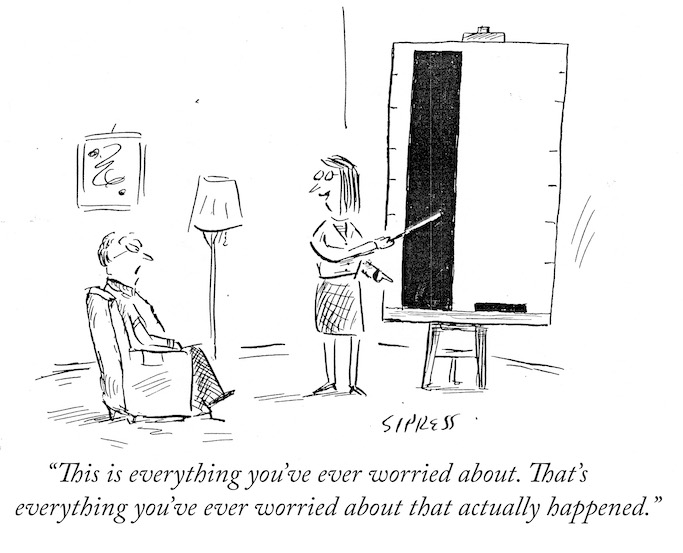
This is a very funny cartoon with a Jewish New Yorker sense of humor! Emily Carey posted it on her Instagram as Confrontation therapy — imagined by Bob Mankoff. To learn more about this celebrated cartoonist and humorist, visit bobmankoff.com.
In response, Selena Palmer posted a joke, but with this self-deprecating ethnic twist: How many Jewish mothers needed to change a lightbulb?…None…I’ll suffer here, in the dark.
Coming back to Bob Mankoff, his most famous cartoon still makes me laugh. Drawn in 1993, a business executive on the phone looks at his appointment calendar and asks the caller a question.
He would later use that as the title of his memoir. See his March 27, 2014 New Yorker article: The Story of “How About Never”. He concluded the article with a P.S. mentioning his appearance on a CBS show. New Yorker cartoon editor Bob Mankoff lets 60 Minutes cameras into the weekly process of picking the magazine’s famous cartoons. The segment in S46 E26 aired the previous Sunday, March 23, 2014.
The more I read this poem—Once in the 40’s by William Stafford—the more I love it. It may seem simple, but it quietly surprised me at the end. I subscribe to the Academy of American Poets newsletter and it appeared in a list of poets whose birthdays are in January. Stafford’s is the 17th.
Once in the 40’s
We were alone one night on a long
road in Montana. This was in winter, a big
night, far to the stars. We had hitched,
my wife and I, and left our ride at
a crossing to go on. Tired and cold—but
brave—we trudged along. This, we said,
was our life, watched over, allowed to go
where we wanted. We said we’d come back some time
when we got rich. We’d leave the others and find
a night like this, whatever we had to give,
and no matter how far, to be so happy again.

—William Stafford (1914-1993)
Bill had married Dorothy Hope Franz in 1944. He must have been 30 at the time, and she 28. Although, Dorothy’s obituary (1916-2013) says they married in 1943. In any case, this poem recalls an event that must’ve taken place once in the 40’s, in the early years of their marriage when they were very much in love and carefree, before they settled down to raise a family. The nostalgia factor makes a lot of sense. It’s relatable.
It also reminds me of being surprised with a nostalgic feeling when reading the last line in Mary Oliver’s poem, Coming Home.
I love this sweet and rare interaction between this girl and a bird. It’s as if Snow White and The Sound of Music collaborated to create “a golden hour miracle.” The description below explained what had happened. A bird had crashed into their window and was dazed. We see their delighted daughter holding the bird and singing Edelweiss to it while compassionately caressing it. You can hear the bird chirp feebly. This must have helped to get it back on its feet, or in this case, off, since “she flew away fit as a fiddle.” What a magical moment!
Gable Swanlund’s mother posted this video of her and the bird on her Instagram account. The video has hundreds of thousands of likes and over ten thousand comments! It’s bound to put a smile on your face.
I saw this beautiful watercolor painting online and was so impressed with its zen-like quality I had to post it. Along the Potomac by Margaret Pearson seems appropriate for this time of year. The different textures in the sky and on the river along with the various shades of black and white contribute to the gloomy atmosphere in this stark winter scene. But the sun must be shining through the clouds since we see the picnic table casting its shadow onto the brightly colored sandy beach at the bottom.
“Along the Potomac” by Margaret Pearson, member of the Potomac Valley Watercolorists, a juried society of watercolor painters based in the Maryland/Virginia/D.C. area.
John Ford and the horizon line
I am reminded of what John Ford, played by David Lynch, said to a young Steven Spielberg at the end of The Fabelmans, the semi-autobiographical film about his life. Ford asks Spielberg what he knows about art and tells him to look at different paintings in his office and describe them. Spielberg’s descriptions miss the main point. It’s all about where the horizon line is placed in a picture. Ford tells him if it’s at the top or at the bottom, it’s interesting, but if it’s in the middle, it’s boring. The horizon line in Margaret Pearson’s painting is in the lower half—another reason for it being interesting.
I added that clip in this recent blog post on Steven Spielberg, where he tells Martin Scorsese how he was able to get David Lynch to play John Ford. He also reveals that he and his wife had learned TM 3 years ago from Bob Roth at DLF, and had mentioned it to David Lynch in the hopes of softening him up to take the role. Visit that post to get the full story.
World Journal of Social Science publishes study showing that group practice of the TM and TM-Sidhi techniques by √1% of a population decreased multiple stress indicators in the U.S.. Scientists call for a group to create world peace.
During a five-year demonstration period, a group of 1725 meditators practiced the Transcendental Meditation and TM-Sidhi techniques twice daily to create coherence in US collective consciousness. Murders, rapes, aggravated assaults, robberies, infant mortality, drug-related deaths, vehicle fatalities, and child deaths by injuries all decreased, by 6% to 21% compared to the seven previous years. When the size of the group decreased over the next five years, stress began to increase again on all indicators. (Summary for EurekAlert! Press Release.)
Every year during 2000 to 2006 there were tens of thousands of stress-related tragedies in the U.S.. Official statistics from the FBI and Centers for Disease Control indicate that there were 15,440 murders, 93,438 rapes, and 86,348 child and adolescent deaths from accidents each year to give a few examples. This current study, published in the World Journal of Social Science, is the longest and most comprehensive of 50 studies to demonstrate what has been named the Maharishi Effect, in honor of Transcendental Meditation (TM) and Maharishi International University (MIU) founder Maharishi Mahesh Yogi.
The results can be seen in the chart below. The blue line indicates that during the Baseline period of 2000 to 2006 the size of the TM and TM-Sidhi group located at Maharishi International University in Fairfield, Iowa increased to reach the √1% of the U.S. population (1725 people) and stayed there for five years during the Demonstration period from 2007 to 2011. All stress indicators immediately started decreasing. In the Post period when the size of the group size began to decline the rate of decrease in stress slowed and then it reversed and began to increase.
Indicators of Stress in the United States
The size of the MIU TM and TM-Sidhi Group is indicated by the blue line, the eight indices of stress in the United States are represented by the lines in different colors, and the US stress index—the mean of all eight variables—is indicated by the red line. The figure shows a phase transition to a global reduction of negativity in the U.S. when the critical threshold of the √1% of the U.S. population was practicing the TM and TM-Sidhi program together in a group. When the Group size dropped significantly, the trend was reversed.
Lead author Dr. David Orme-Johnson said: “What is unique about this study is that the results are so visually striking and on such a large scale. We see reduced stress on multiple indicators at the predicted time for the entire United States over a five-year period. And when the size of the group declined, national stress began increasing again. Clearly, the group was causing the effect.”
“What is unique about this study is that the results are so visually striking and on such a large scale. We see reduced stress on multiple indicators at the predicted time for the entire United States over a five-year period. And when the size of the group declined, national stress began increasing again. Clearly, the group was causing the effect.”
Lead author Dr. David Orme-Johnson
Co-author Dr. Kenneth Cavanaugh commented: “This study used state-of-the-art methods of time series regression analysis for eliminating potential alternative explanations due to intrinsic pre-existing trends and fluctuations in the data. We carefully studied potential alternative explanations in terms of changes in economic conditions, political leadership, population demographics, and policing strategies. None of these factors could account for the results.”
The fact that all variables started decreasing only after the square root of one percent of the U.S. was reached indicates a phase transition. Like when water does not turn to ice until 32◦ F is reached, national stress did not start decreasing until the U.S. √1% transition threshold was achieved.
The fact that all variables started decreasing only after the square root of one percent of the U.S. was reached indicates a phase transition. Like when water does not turn to ice until 32◦ F is reached, national stress did not start decreasing until the U.S. √1% transition threshold was achieved.
The chart shows that in 2013 when the size of the TM and TM-Sidhi group quickly dropped all stress indicators abruptly increased. Apparently, the rapid drop in national coherence shook the nation.
The scientists used regression analysis to estimate how many deaths and events were reduced by the meditator group. For example, image 2 shows the red dotted line representing the Baseline trend projected into the Demonstration and Post periods. During the Demonstration period drug-related deaths (the black line) fell to 14% below their Baseline trend and were another 15 % lower during the Post period, for a total of 79,941 fewer drug deaths. The chart also shows that in the absence of the coherence creating group drug deaths eventually returned to their Baseline level.
Drug-Induced Deaths in the U.S.
IMAGE 2: The red dotted line is the number of Drug Deaths forecasted from the Baseline trend. The black line is the actual number of Drug Deaths. Similar analyses were conducted for all variables and the results are displayed in the Table.
TABLE: RESULTS OF REGRESSION ANALYSES. The first column shows the number of events per year during the Baseline period (Intercept). The second column shows the change per year during the Baseline (Slope). The third, fourth, fifth, and sixth columns show the thousands of events averted during the Demonstration, during the Post periods, the total events averted, and percent change, respectively. The last column shows the estimated total events averted by each individual participant in the MIU TM and TM-Sidhi group.
The unified field level of natural law
The finding that the effect was holistic, causing all variables to move up and down together, supports the theory expressed by both Maharishi from the Vedic perspective and by quantum physicist and MIU president Dr. John Hagelin from quantum field theory that the TM and TM-Sidhi groups are creating coherence in collective consciousness from the unified field level of natural law. This is big. It is evidence of the existence of the unified field from a completely different approach than using particle accelerators and detecting gravity waves.
This discovery of the unified field is more than just an intellectual knowledge. It is arguably the most immediately highly practical technological discovery in the history of science. The invention of the wheel mobilized humanity. The printing press, radio, the telephone, the internet, and satellites increased our ability to communicate with each other across vast distances and time. The discovery of DNA opened our minds to the subtle mechanics of natural law underlying the evolution and growth of all life forms. These are among the greatest scientific discoveries of all time. But what discovery can reduce human suffering as comprehensively as group meditation?
Relationship between individual and collective consciousness
The paper reviews the many concepts of collective consciousness as they have occurred throughout history in the sciences and humanities. None have practical applications as Maharishi’s does and none have been so empirically verified.
The paper discusses Maharishi’s theory, which holds that every individual automatically contributes to collective consciousness and reciprocally, collective consciousness influences every individual. This is universally true whatever the form of government—democracy, republic, monarchy, communism, or dictatorship.
It is essential for every individual to use evidence-based technologies to reduce their own stress and at the same time, the responsibility of every government to provide these technologies to everyone.
The paper summarizes the hundreds of studies showing that practice of TM increases coherence in the individual, as indicated by such measures as increased brain coherence, decreased anxiety, depression, and anger, increased creativity, increased IQ and emotional and social intelligence, and decreased PTSD symptoms, prison recidivism, drug and alcohol addictions, and sickness rates in all categories of disease. More coherent individuals form a more coherent society.
The Howard and Alice Settle Foundation
A grant for 75 million dollars from the Howard and Alice Settle Foundation provided stipends for participants to be in the group and provided funding to bring several hundred visiting TM-Sidhi experts from India to further augment the MIU group. Dr. Orme-Johnson commented: “This is a lot of money, but the savings from the 10% reduction in crimes would save over 200 billion dollars, not to mention all the other savings from reducing other sources of stress in the country.”
Scientists call for a group to create world peace
The paper concludes with a call to create a permanent √1% group for the whole world, 8,000 participants practicing the TM and TM-Sidhi program together in one place. And as an engineering safety factor, a √1% group on every continent is needed. The world is so interconnected, no one is safe until everyone is safe, all living in harmony. This is easily within reach of any government or the world’s wealthiest citizens. The person who does it will be remembered as the greatest leader in history.
IMAGE 3: GROUP MEDITATION AT MAHARISHI INTERNATIONAL UNIVERSITY. Since 1979 twice daily group meditations have been held at MIU in Fairfield, Iowa for the purpose of creating coherence in the U.S. and world collective consciousness.
. . . . .
JOURNAL: World Journal of Social Science. ARTICLE TITLE: Field-Effects of Consciousness: A Seventeen-Year Study of the Effects of Group Practice of the Transcendental Meditation and TM-Sidhi Programs on Reducing National Stress in the United States. PUBLISHED: Dec 14, 2022. DOI:10.5430/wjss.v9n2p1 METHOD OF RESEARCH: Data/statistical analysis. SUBJECT OF RESEARCH: People. ADDITIONAL INFORMATION: The published article contains 5 Tables and 10 Figures (Graphs).
In it, Spielberg mentions how he and his wife had learned TM, Transcendental Meditation, 3 years ago through the David Lynch Foundation. He also revealed how the idea came up to ask David Lynch to play the role of John Ford in the film, how he pulled it off, and how David Lynch prepared for his cameo role. Apparently, David was unrecognizable as he took on the persona of the late, great filmmaker.
Entertainment writer Tomris Laffly was at the Q&A and posted several video clips of that conversation on Twitter, for which we are grateful.
I am watching Steven Spielberg & Martin Scorsese discuss THE FABELMANS. DGA today is a house of worship, ♥️ pic.twitter.com/uLAkT8W1px
And here is a part of that movie clip they talked about, especially the cigar-lighting scene, which Amanda Dugan just tweeted of David Lynch as John Ford in The Fabelmans. She later sent me the full YouTube clip of David Lynch as John Ford, which I’ve embedded here.
David Lynch playing John Ford being directed by Steven Spielberg in a semi-autobiographical film about his life.
Later added: On Jan 5, 2023, Jimmy Kimmel asked Laura Dern to share the story of how Steven Spielberg asked her to get David Lynch to play the role of John Ford in his film. She was the catalyst in bringing both of these master film directors together to “pay homage” to the master filmmaker they both admired. It’s from 4:36-6:40 and is cued up below.
At the bottom of The Film Stage article, they embed a video from 11 years ago — Spielberg/Grazer/Howard – “John Ford” — of Spielberg recounting in detail the real-life story, when he was 15, of meeting John Ford, which, decades later, would became the ending for The Fabelmans.
In this later video by The Back Focus: David Lynch’s Strange & Surprising Acting Career, Brandon Hardesty quotes Spielberg at 21:23 saying: “I got to know David when he played John Ford in The Fabelmans. Here was one of my heroes — David Lynch — playing one of my heroes. It was surreal and seemed like a scene out of one of David’s own movies.”
The Rock world has been reeling from the news of the unexpected death of Christine McVie, the longtime co-lead vocalist, keyboardist, and songwriter for Fleetwood Mac. She died Wednesday, November 30, 2022, after a short illness. She was 79. Christine was surrounded by family members at a London hospital when she passed.
Many condolences and remembrances have been pouring in this past week, especially from members of the band attesting to how much she was loved and appreciated as a person and, of course, as one of their foundational musicians. This E News! video contains several quotes from both band and family members alike. Good Morning America aired Celebrating the life and legacy of Fleetwood Mac’s Christine McVie.
One of the things that came up in my Instagram feed was this post from Far Out Magazine: Christine McVie on Writing Songbird. They included the audio portion from a Dec 17, 2017 BBC Desert Island Discs interview with Christine McVie that dealt with how she came to write her famous song. They also transcribed that part of the conversation in the Instagram post. Raised on Radio also posted the interview on YouTube. The Songbird section starts at 3:18. You can click CC to see their words.
In a recent post, I quoted Brendan Graham, who said, “the truly special songs write us; we don’t write them. We don’t find them; they find us.” Christine McVie described exactly that kind of magical experience.
She couldn’t sleep, and an unknown song was in her head. “I had to play this song. It was as if I’d been channeled or something!” It came to her at 3 in the morning. “The whole song, complete, chords, words, everything within half an hour,” she explained. Fortunately, she had a piano in her room, but no tape recorder. So she kept playing it without sleeping for fear of forgetting it, until she went into the studio at 9 o’clock the next day to record it on a two-track tape. “I just felt as if it was a universal kind of prayer or something. I just don’t know where it came from. This never happened to me since or before.”
‘Songbird’ would arguably become McVie’s signature song. Originally released as the B-side to ‘Dreams’ in 1977, it ended up on Fleetwood Mac’s world-conquering Rumours album. It wasn’t her biggest hit for the group, but the ballad was a frequent closer at Fleetwood Mac concerts, especially after McVie rejoined in 2014.
At 2:03 there’s a photo of Christine wearing a top with the words, Nobody’s Perfekt. This is doubly funny, not only because of the misspelling of the word, perfect, but also because it’s her family name! She was born Christine Anne Perfect. She told Peter Robinson of The Guardian: “I used to joke that I was perfect until I married John.”
Christine’s Family, Early Background, and Later Recognition
Christine Anne Perfect was born on July 12, 1943 to Cyril Percy Absell Perfect and Beatrice Edith Maud Perfect. They also have a son named John. Christine’s family contributed considerably to her development. Her grandfather was the organist at Westminster Abbey. Her father was a concert violinist and music lecturer at St. Peters College of Education at Saltley in Birmingham. Her mother was a medium, psychic, and faith healer. After her brother brought home a Fats Domino songbook, she switched from playing classical piano to blues-based rock and roll.
She studied sculpture at school with the intention of becoming an art teacher and met blues musicians who invited her to join a band. She later left a window-dressing job in London to become a full-time musician. She would soon be invited to join an early version of Fleetwood Mac who would go on, through various iterations, to become one of the top-selling bands of all time.
An introvert by nature, McVie’s creative and spiritual influences informed her musical career and kind personality. She impacted her bandmates in positive ways, at times, the quieter center holding them together as they spun out of control due to the excessive drug-fueled lifestyles and rocky romantic relationships of that era. But they turned their melodramas into musical hits. McVie would be honored with many awards, and in 1998, was inducted with Fleetwood Mac into the Rock and Roll Hall of Fame.
MOJO’s Tribute to Fleetwood Mac singer-songwriter Christine McVie
Christine McVie: Her 20 Greatest Songs. In tribute to Fleetwood Mac singer-songwriter Christine McVie, who passed away this week, MOJO selects the best tracks from across her career. They also included Christine McVie Remembered. In memory of Christine McVie, who has sadly passed away aged 79, MOJO revisits our 2017 interview with Fleetwood Mac’s singer-songwriter.





 The Uncarved Blog