Archive for the ‘Sustainable Living’ Category

Andy Bargerstock reveals a costly disconnect in Lean companies not completely walking their talk

November 12, 2013

Standard Costing Very Costly, New Research Shows

Lean Accounting expert, Andrew Bargerstock, PhD, CPA, Director of Maharishi University’s MBA Programs, will present new research findings that show for the first time, empirical evidence of the waste inherent in Lean manufacturing companies that still use a standard costing accounting model. His talk, “The failure of standard accounting systems in Lean companies,” will be presented this week at the local chapter of the Institute for Management Accounting (IMA) during their Fall Conference in Cedar Rapids, Iowa.

Fairfield, Iowa (PRWEB) November 12, 2013

Andrew Bargerstock, PhD, CPA, Director of MBA Programs at Maharishi University of Management

Andrew Bargerstock, PhD, CPA, Director of MBA Programs at Maharishi University of Management

Lean Accounting expert, Andrew Bargerstock, PhD, CPA, Director of Maharishi University’s MBA Programs, will present new research findings that show for the first time, empirical evidence of the waste inherent in Lean manufacturing companies that still use a standard costing accounting model. Lean management principles are based on the generic elements of organizational development from companies like the Toyota Motor Corporation who build long-term customer loyalty while streamlining operational processes.

Dr. Bargerstock says, “Many mature lean manufacturers continue to use standard costing when it is no longer useful. This wasteful practice costs companies millions of dollars.” Professor Bargerstock will present his findings this Thursday, November 14 at 1pm, at the regional chapter of the Institute for Management Accounting (IMA) during their Fall Conference in the Double Tree Hotel in Cedar Rapids, IA. His presentation will include a summary of the research study and a model of a three-tiered system of organizational performance metrics that drive lean innovations.

“Companies are still attached to standard costing because it is the staple of business schools emulating General Motors operational controls from the 1950s. Lean offers a new model for operational controls. Our research is the first to show that mature Lean companies who still use standard costing accounting systems are leaving money on the table.” Professor Bargerstock says.

Lean manufacturing is a sustainable, cost-saving, adaptive and highly efficient manufacturing management process originated by Toyota Motor Company in the 1980’s, and since adopted worldwide by hundreds, even thousands of manufacturers. The Lean strategy can be applied to any type of organization profit or non-profit.

Wasted money, lost profits, weaker earnings

The new research, done at Maharishi University of Management, a 4-year Iowa college of arts and sciences that integrates practice of the Transcendental Meditation® technique into its curriculum, shows that many companies using Lean manufacturing processes are not discarding standard costing, and as a result, are missing significant additional savings, losing profits and weakening the bottom line. “Companies using Lean manufacturing, but not using Lean Accounting are losing money by clinging to an antiquated costing model.” Dr Bargerstock says.

This is the first empirical study to test a prediction made by many Lean Accounting theorists, that mature lean manufacturing enterprises will discard standard costing systems. Anecdotal evidence suggested that companies may be holding onto standard costing, but no empirical study has verified the observed behavior.
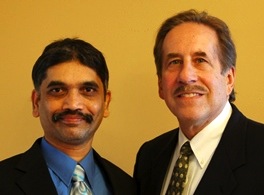
Manjunath Rao, PhD and Andrew Bargerstock, PhD

Rao and Bargerstock

In 2011 and 2013, Bargerstock and one of his PhD students, Manjunath Rao, published articles in the Management Accounting Quarterly on the research conducted at MUM. The article published in Summer 2013 MAQ is entitled, “Do Lean Implementation Initiatives Have Adequate Accounting Support?”

Dr. Bargerstock was the chair of Rao’s dissertation committee. Lean accounting experts and academics at the Institute for Management Accounting collaborated on the research. The article describes the analysis of some of the data gathered during Rao’s dissertation research. The study found that in a sample of mature lean manufacturing companies, lean accounting implementation lags behind lean operations implementation, which may give rise to inadequate accounting support in lean initiatives.

A former Fortune 500 executive and national consultant for federal and state governmental agencies and private corporations, Dr. Bargerstock was selected as the 2009 Excellence in Lean Accounting Professor by the Lean Enterprise Institute (LEI), one of the leading non-profit associations dedicated to the education and promotion of Lean Management in the country. LEI, along with the co-sponsorship of the IMA, have also recognized two of Prof. Bargerstock’s PhD students during the last three years as Lean Accounting Student of the Year.

See a short video of Dr. Bargerstock outlining the main points for his talk to the IMA, and an additional segment on the success of MUM students in the MBA Lean Accounting Program.

Founded in 1971, Maharishi University of Management (MUM) offers Consciousness-Based℠ Education, a traditional academic curriculum enhanced with self-development programs like the Transcendental Meditation® technique. Students are encouraged to follow a more sustainable routine of study, socializing and rest without the typical college burnout. All aspects of campus life nourish the body and mind, including organic vegetarian meals served fresh daily. Located in Fairfield, Iowa, MUM is accredited by The Higher Learning Commission and offers bachelor’s, master’s, and doctoral degrees in the arts, sciences, humanities, and business. Visitors Weekends are held throughout the year. For more information, call the Admissions Office at 800-369-6480 or visit http://www.mum.edu.

PRWeb: http://www.prweb.com/releases/Lean/IMA/prweb11309348.htm or bit.ly/19Z629I

Posted on: Virtual-Strategy Magazine and other top news outlets.

In an effort to encourage more faculty to attend the The Lean Accounting Summit, organizers interviewed Andy Bargerstock on Friday, October 18, 2013 in Orlando, FL. He was asked to share what he had learned from previous summits. Of all the interviewees, they selected Andy to go in their LEAF (Lean Education Advancement Foundation) newsletter. You can see both here: A Special Letter to Lean Accounting Summit Participants from the LEAF Board of Directors.

Maharishi University of Management’s Ye Shi Named Lean Accounting Student of the Year

October 26, 2013

Maharishi University of Management PhD candidate, Ye Shi (Linlin), was awarded the 2013 Lean Enterprise Institute’s annual Excellence in Lean Accounting Student Award during their Lean Accounting Summit this month in Orlando, Florida. This award continues a pattern of recognition for MUM from LEI: Dr. Andrew Bargerstock was named Lean Accounting Professor of the Year in 2009, and Manjunath Rao was selected as Lean Accounting Student of the Year in 2011 for his PhD dissertation.

Tabitha Dubois (right), LEI's Director of Finance and Administration, gave the Lean Accounting Student Award to MUM’s Ye Shi, and the Lean Accounting Professor Award to WWU's Dr. Audrey Taylor.

Tabitha Dubois (right), LEI’s Director of Finance and Administration, gave the Lean Accounting Student Award to MUM’s Ye Shi, and the Lean Accounting Professor Award to WWU’s Dr. Audrey Taylor.

Fairfield, Iowa (PRWEB) October 25, 2013

By Ken Chawkin

Maharishi University of Management PhD candidate, Ye Shi (Linlin), was awarded the 2013 Lean Enterprise Institute’s annual Excellence in Lean Accounting Student Award during their Lean Accounting Summit this month in Orlando, Florida. The Lean Enterprise Institute (LEI) is a non-profit educational association, which recognizes students who have been actively engaged in research, education, and the development of Lean Accounting and accounting for Lean.

Andrew Bargerstock, PhD, CPA, director of MUM’s MBA programs, had nominated Linlin for this award based on her accomplishments in lean accounting. “We are very happy that Lin Lin’s accomplishments are recognized by one of the biggest names in Lean Accounting, James Huntzinger, in his role as the chair of the Student of the Year selection committee for Lean Enterprise Institute (LEI) and the Lean Accounting Summit.”

Jim Huntzinger

Jim Huntzinger, president and founder of Lean Frontiers

On September 23rd Jim Huntzinger, president and founder of Lean Frontiers, and author of Lean Cost Management: Accounting for Lean by Establishing Flow, notified Linlin of her selection as Lean Accounting Student of the Year. Huntzinger founded the Lean Accounting Summit in 2005, as well as produced many other Lean summits.

As to why she was selected, Jim Huntzinger said, “Linlin was recognized as LEI Lean Accounting Student for 2013 due to her commitment to help others understand and develop a deep understanding of the new paradigm in Lean Accounting. We hope that she will continue to deepen her knowledge of this area and encourage more students and faculty to join the Lean Accounting adventure, and utilize her PhD research to both deepen and further her understanding of lean accounting.”

This award continues a pattern of recognition for MUM from LEI. Dr. Andrew Bargerstock was named Lean Accounting Professor of the Year in 2009, and Manjunath Rao was selected as Lean Accounting Student of the Year in 2011 for his PhD dissertation.

Linlin completed both the MBA in Accounting (2011) and the Post-graduate Certificate in Lean Accounting (2012) at MUM. In September 2013 she began her second year of teaching three of the two-credit courses in the Lean Accounting Certificate program.

In collaboration with Dr. Bargerstock, Linlin has developed case studies to illustrate how to implement kaizen methodologies to improve accounts payable processing. Linlin is currently taking coursework in the PhD program at MUM and expects to begin her dissertation next year.

Linlin is passionate about Lean, which she says is “the great strategic thinking that leads to true sustainable development. Lean accounting is an advanced way of articulating business through present and real financial numbers compared to the historical and sometimes misleading numbers provided by traditional accounting.”

Linlin says Lean enables better communication and employee engagement, and greatly enhances leadership. She adds, “It’s also a great illustration of how to do less and accomplish more, which is a fundamental principle of our university’s educational approach, Consciousness-Based Education.”

Ye Shi (Linlin) with MUM Professor Andrew Bargerstock at the 2013 Lean Accounting Summit

Ye Shi (Linlin) with MUM Professor Andrew Bargerstock at 2013 Lean Accounting Summit

Linlin says she is thrilled and honored to be recognized as the Lean Accounting Student of the year. “I am grateful for the support from MUM, Lean Frontiers, LEI and IMA. I appreciate the guidance and support from Dr. Andrew Bargerstock and other mentors and friends. Without them, any personal development for me would not have been possible.”

The summit offered Linlin, and other participants, the opportunity to meet with elite academic lean professionals and business lean practitioners. “It’s thought provoking to hear the speakers from different fields articulating the Whys and Hows of lean accounting based on their empirical research and practical experience. To be able to talk to them face to face and exchange opinions during the open discussions was fantastic. Also, the Q&A session with the executive team from the renowned Institute and the rest of the speakers provided the practical solutions for any problems people may encounter during lean transformation. It was really exciting to learn the live examples and have the inspiring conversations.”

Included in Linlin’s award was a complimentary registration at the Summit and $500 towards her travel expenses.

Photos of LEI Award Winners are available at garrethoover.com/LEI. Tabitha Dubois (red dress), Director of Finance and Administration for LEI, gave the Excellence in Lean Accounting Student Award to MUM’s Ye Shi, and the Excellence in Lean Accounting Professor Award to Dr. Audrey Taylor, Professor of Accounting at Western Washington University.

Founded in 1971, Maharishi University of Management (MUM) offers Consciousness-Based℠ Education, a traditional academic curriculum enhanced with self-development programs like the Transcendental Meditation® technique. Students are encouraged to follow a more sustainable routine of study, socializing and rest without the typical college burnout. All aspects of campus life nourish the body and mind, including organic vegetarian meals served fresh daily. Located in Fairfield, Iowa, MUM is accredited by The Higher Learning Commission and offers bachelor’s, master’s, and doctoral degrees in the arts, sciences, humanities, and business. Visitors Weekends are held throughout the year. For more information, call the Admissions Office at 800-369-6480 or visit http://www.mum.edu.

Source: PRWeb: MUM’s Ye Shi Named LEI’s 2013 Lean Accounting Student of the Year

In an effort to encourage more faculty to attend the The Lean Accounting Summit, organizers interviewed Andy Bargerstock on Friday, October 18, 2013 in Orlando, FL. He was asked to share what he had learned from previous summits. Of all the interviewees, they selected Andy to go in their LEAF (Lean Education Advancement Foundation) newsletter. You can see both here: A Special Letter to Lean Accounting Summit Participants from the LEAF Board of Directors.

Also posted on AndyB’s Blog: MUM’s Ye Shi Named LEI’s 2013 Lean Accounting Student of the Year

See MUM MBA Students Win at CAPSIM: The Role of Business Simulation Competitions in Higher Education.

See: Maharishi University’s Rao and Bargerstock published in Management Accounting Quarterly.

See Maharishi University MBA Students Win National Business Simulation Competition.

William T. Hathaway’s Wellsprings: A Fable of Consciousness, concerns future eco-crisis and TM

October 19, 2013

Wellsprings coverWellsprings: A Fable of Consciousness, William T. Hathaway’s just-published book, concerns Transcendental Meditation and the environmental crisis. It is set in 2026 as the earth’s ecosystem has broken down under human abuse. Water supplies are shrinking. Rain is rare, and North America is gripped in the Great Drought with crops withering and forests dying. In the midst of environmental and social collapse, an old woman and a young man set out to heal nature and reactivate the cycle of flow by using techniques of higher consciousness. But the corporations that control the remaining water lash out to stop them. A blend of adventure, ecology, and mystic wisdom, Wellsprings: A Fable of Consciousness is a frightening but hopeful look into a future that is looming closer every day.

Bob, 18, and Jane, 77, meet at a California hot springs and set out together on a quest. Jane is convinced North America’s water has retreated into a deep subterranean aquifer, and she is searching for the place where it comes close enough to the surface to access it. She teaches him to meditate, and their visions help them find the cavern that connects to the water.

A selection:

Jane and I drive around to the north side of Mt. Shasta, hoping to be able to sense the subterranean springs from there. In the moonlight the mountain looks like a silver pyramid soaring up from the horizon into the starry purple night. The ancient volcano is lord of all it surveys. Veils of clouds are blowing around its peak.

We find a grassy glade in the forest, but the grass is dry and brittle and the tree branches droop from the drought. As we are spreading our blankets out to meditate, motion on the other side of the clearing catches our eyes. Out of the trees steps a black-tailed doe. She sees us and pauses, one foot raised, sniffing, listening, looking. Jane and I stare enthralled. As the doe gazes at us, our eyes join across the space, across the species. Communication flows between us: cautious curiosity about a fellow creature. She breaks contact, begins nibbling, then looks back at us as if saying, As long as you stay on your side, it’s OK.

We watch her in delight until she trots off, then we close our eyes to meditate. At first my mantra goes with my heartbeat then slows and goes with my breath. The sound stretches out into a long hum floating through me. I seem to be beyond my skin, filling the whole clearing. I feel like I’m sinking into the earth. I want to hold on, to keep from disappearing, but something tells me to let everything go. I free-fall through space, then realize it’s impossible to fall because there’s no down. I’m hovering … like a dragonfly over water. The sound fades away, leaving me without thoughts. I seem to expand beyond all space and boundaries to unite with everything. For a moment I know I am everything, the whole universe, but as soon as I think, I’m everything, I’m not anymore. I’m just Bob Parks sitting on a blanket over cold ground.

I start the mantra again. Its whisper clears my thoughts away, and my mind becomes quiet. Part of me is watching the quietness of my mind and enjoying it. I never knew I had this watching part before. It doesn’t need to think. It’s just there, aware of everything but separate from it — a wise old part of me.

I realize I’m off the mantra, drifting on thoughts, so I pick up the sound again and follow it as it gets fainter and finer until it becomes more visual, pulsing light behind my closed eyes. It seems to shine into something, a big cavern that’s inside of me but also outside of me. The boundaries between me and everything else disappear — no difference now between inside and outside. I can see dimly into the cavern. The walls and ceiling are crystal, its facets glinting in the mantra light. Below them in all directions stretches a vast dark sea of water, its ripples gleaming. It’s deep, deep as the earth, and I want to plunge in and dive all the way to the bottom. I’m sitting above it. Down there beneath me, beneath these rocks and dirt, rests the water.

I can sense this sea’s immensity, stretching from California under the Great Basin of Nevada, Utah, and Arizona, the parched American desert, the last place the corporate drillers would’ve looked. We’re sitting by the tip of it closest to the surface. From here it goes deeper and deeper, soaking through strata of sand and porous rock, a huge aquifer waiting to be freed and flow again.

I want to jump up and yell, “I found it!” but that thought makes it disappear. I take a deep breath and am back sitting cross-legged on my blanket. Too stunned to say anything, I lie back and feel the ground under me, this good ground with all that good water under it.

###

A further sample of Wellsprings: A Fable of Consciousness is posted at http://www.cosmicegg-books.com/books/wellsprings.

William T. Hathaway’s other books include A World of Hurt (Rinehart Foundation Award), CD-Ring, Summer Snow, and Radical Peace: People Refusing War. He and his wife, Daniela, direct the Transcendental Meditation Center in Oldenburg, Germany. A selection of his writing is available at www.peacewriter.org.

REVIEWS & ENDORSEMENTS

….. Although this is a little book (only 100 pages), its message is huge. It has so much to offer in the way of warning and of hope. It tells a vital truth about our connection with all life and with water, which is the basic component of life and which unifies us with all other forms of life. Hathaway warns us that we must do something about the ecological disaster that we are facing, and in order to succeed at this awesome task we must change our consciousness. This “Fable of Consciousness” provides an engaging lesson in unified consciousness and how to achieve it through meditation. It is a must read! ~ Jan Krause Greene, Goodreads

William Hathaway’s new novella, “Wellsprings – A Fable of Consciousness” – is a coming of age story located in a not too distant, nor unlikely, future. Hathaway weaves concepts of unifying consciousness as a mechanism for addressing environmental crisis in an age of corporate ownership of all natural resources. A second, though important, theme of the book is that we can control our reactions to situations. This is an important message in a time when everything seems to push us towards non-reflective responses. Hathaway’s novel serves as both a teaching tool and a cautionary tale. ~ Rowan Wolf, Author

Also see: Radical Peace: People Refusing War, by William T. Hathaway.

And here is another TM-based novel written from a different perspective: Writers’ Voices interviews B. Steven Verney, author of “The Best of All Possible Worlds.”

Iowa Senator Tom Harkin inspires M.U.M.’s Class of 2013 with his Top Ten Rules to Live By

June 2, 2013

Iowa Senator Tom Harkin Inspired M.U.M.’s Class of 2013 with his Top Ten Rules To Live By at the University’s largest graduating class.

In true David Letterman-style, Iowa Senator Tom Harkin presented the M.U.M. Class of 2013 with his top-10 list—Harkin’s Top Ten Rules To Live By. Senator Harkin gave the Commencement Address after receiving an honorary doctorate from the University and inspired everyone with his humorous wit and down-to-earth wisdom.

Senator Tom Harkin receives an honorary doctoral degree from M.U.M. President Dr. Bevan Morris.

Senator Tom Harkin receives an honorary doctoral degree from M.U.M. President Dr. Bevan Morris. / Ken West Photography

Iowa Senator Tom Harkin received an honorary Ph.D. from Maharishi University of Management before delivering the Commencement Address at the start of M.U.M.’s Graduation exercises, which took place last Saturday, May 25, 2013, in the Maharishi Patanjali Golden Dome of Pure Knowledge.

The University’s 38th Commencement graduated its largest class ever of 334 students from 54 countries, out of the 88 represented on campus. The Class of 2013 included 251 graduates and 83 undergraduates. Check this link to see a menu of videos from M.U.M.’s Commencement 2013 http://www.mum.edu/commencement-2013. See the full PRWeb press release here bit.ly/17bxT6k for more details.

Senator Harkin was awarded a Doctor of Laws Honoris Causa degree for his extraordinary lifelong service and compassionate and progressive leadership for the state of Iowa and the United States of America. He has served in the Senate since 1985 and also served in the House of Representatives from 1975–1985. He is chairman of the Senate Committee on Health, Education, Labor and Pensions and is the seventh most senior Senator overall.

In his introduction, M.U.M. president Dr. Bevan Morris said, “We honor you for a lifetime of service to the State of Iowa and the United States of America, and your compassionate and progressive leadership. You have recognized that the quality of American life is shaped by the quality of American education.”

He said that Senator Harkin has been a very good friend of the University and greatly enjoyed all his visits here. “He has given us advice and encouragement for all the University’s programs—for natural methods of prevention of disease, organic agriculture, sustainable living, our Sustainable Living Center, as well as to our town, which is rising to being one of the greenest in the nation, under the leadership of Mayor Ed Malloy.”

Senator Harkin began his commencement address on a humorous note. He thanked the University for this distinguished award and said, “I come before you with a measure of humility. I realize I was probably selected to be your speaker today because Oprah wasn’t available.” This elicited a lot of laughter as he was referring to Oprah’s visit to Fairfield last year, which she aired, including a profile of the Maharishi School on the M.U.M. campus.

He then went on to say, “But I do want you to know of my highest respect and admiration that I have for this university, for what you have done, what you have become here, in Iowa, the nation, and the world, and especially for what I consider to be the best holistic approach to education and wellness in life at any university anywhere on the globe.”

He was referring to Maharishi University’s unique system of Consciousness-Based education and leadership role in wellness research and sustainability. M.U.M. was designated as a Center for Natural Medicine and Prevention and has received over $25 million from the NCCAM and NHLBI over the past 20 years to conduct collaborative medical research on the use of Transcendental Meditation as a complementary alternative approach to treat hypertension and cardiovascular disease in underserved minority populations, the results of which have been published in top peer-reviewed scientific journals.

The most recent study was published and publicized by the American Heart Association. Last year the AHA Journal Circulation published a long-term study showing a 48% lower risk of heart attack, stroke and death in a group already afflicted by heart disease that learned the practice of Transcendental Meditation. And this year the AHA published a paper recommending Transcendental Meditation as the only meditation practice that has been shown to lower blood pressure.

“Graduation,” Harkin said, “is one of the five great milestones in life; the others being birth, marriage, death, and the day you finally pay off your student loans.”

“I know exactly what you’re thinking. You’re wondering, ‘How long is that guy gonna talk?’ The answer is not long.”

To answer he quoted advice from Father John Ryan, the Irish priest in his hometown when he was first asked to give a commencement address. The role of a commencement speaker is like the body at an old-fashioned Irish wake: “They need you in order to have the party but they don’t expect you to say very much.”

Senator Harkin said he chose a method for the day’s occasion that has imparted wisdom to millions of people throughout the years—“I speak of course, not of the Ten Commandments, but of David Letterman’s top ten list.” But his were more like suggestions for students to choose, depending on which ones they liked.

Harkin’s Top Ten Rules To Live By

10. Don’t panic. You will find a job. Don’t worry. “My confidence is based on one thing — because you came to the right school. I have nothing, as I said, but admiration for what this university has accomplished in such a short period of time. In a unique way you have put the ‘higher’ in higher education.”

“You folks would agree with William Butler Yeats who said that education is not about filling up a bucket but lighting a fire. And you carry that one step further. At this university education is also about training, focusing, freeing the mind. It’s about raising consciousness. Here you have been beautifully prepared intellectually and spiritually for all the challenges you will face in the world out there, so you should go forth with confidence.” He encouraged students to move to smaller Iowa towns to make a contribution.

(more…)

Students build tiny house in M.U.M.’s Sustainable Living Program — Andy Hallman, Fairfield Ledger

May 16, 2013

Students build tiny house

Article and Photos by ANDY HALLMAN | May 16, 2013

This slideshow requires JavaScript.

A class at Maharishi University of Management is building a “tiny house,” just 12-feet-by-20-feet, for one of its teaching assistants to live in.

The class is appropriately called “Tiny Houses” and is taught out of the Sustainable Living Department. The teaching assistant and M.U.M. student who will live in the house is Heather Caldwell, who will share the tiny home with her daughter, Ellie, and son, Henry.

Ellie said the house “looks awesome.”

“There’s not excess space, so it’s going to encourage us to go outside more,” she said.

Henry said he thought the house would be bigger than it seemed Wednesday.

“I’m thinking of having a hatch in my room so I can go out onto the roof,” he said. “I think I’ll get used to the size of it.”

Caldwell and her family plan to move into the house in June.

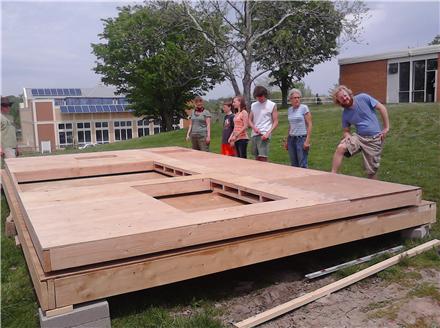
The eight-member class is a little more than two weeks old. Caldwell designed a floor plan for the home. The entire class built walls and a floor according to Caldwell’s specifications. Wednesday afternoon, the class wanted to see the fruits of its labor so it assembled the floor and walls outside the library on the M.U.M. campus.

No heavy machinery was used to install the walls. About 12 people, including the class members and a few stray volunteers, hoisted the walls into place by hand.

Wednesday’s construction project was simply a demonstration to show Caldwell and the class what the tiny house would look like once it’s done. The class will disassemble the house and move it to its more permanent location near Abundance EcoVillage.

Mark Stimson, head of the building track in the M.U.M. Sustainable Living Program, is the professor for the class. He said his class’s project is part of a growing movement of people building small homes. One of the reasons people are turning to such tiny houses is financial.

“You can build your own home for just a few thousand dollars,” he said. “You can live without a mortgage. It’s a lifestyle and priority choice. If your priority is not to be a slave to your house but to live in a nice, tight, comfortable little house, and spend your money on other things, then you might consider building a tiny house.”

Stimson said Caldwell spent about $4,000 on building materials for the home.

Another major reason people choose to build small dwellings is to conserve energy. The small homes are easy to heat and cool. Stimson said many rely on renewable sources of energy such as solar power to heat them in the winter.

“A lot of them have no utility bills,” he said. “They produce all of their own energy.”

Caldwell’s home will feature large glass windows on the south side to take advantage of the sun’s rays in the winter.

Stimson said most of his students had no experience in construction prior to his class.

“We’re only two weeks into the class and they are already working at a clean, professional level,” he said. “It’s gratifying to me to see the change from three Mondays ago when we started the course till today. They’ve really come a long way. I tell my students that when they’re done with this course, they should be able to go anywhere in the country and be under a roof in two weeks.”

The class spends several hours per day in hands-on construction projects and also studies architecture in a traditional classroom setting. All the students in the class create a floor plan for a home they would like to build.

In order for the class to build a tiny house, someone has to pay for the materials. Stimson said that does not present a problem because people in Fairfield are lining up for tiny homes, especially now that students are donating their labor to build them.

Fairfield’s city ordinances do not allow a house of such small size to be built within the city limits, which is part of the reason Caldwell will build hers outside the city limits near Eco Village. Another reason she is building it there is because she wants to start a community of tiny homes.

Caldwell said she got the idea to move into a tiny house in December. She liked the idea of building an inexpensive home, and she was looking for a senior project to complete in order to graduate.

“In the Sustainable Living Program, we’re all about reduce, reuse and recycle,” she said. “We’re all very close here at the university. It’s cool to have classmates, who are people I care about, help build your house.”

Stimson said the course teaches students how to use space efficiently and creatively, which is especially necessary in a tiny house where there is so little of it.

“One thing in the house serves two or more functions,” he said. “[Caldwell’s] reading nook is going to turn into a guest bed. Some people put their dish drainers right above the sink, which is also where they store their dishes, so you don’t have to dry your dishes and put them in a cupboard. You just let them drain down into the sink.”

Caldwell said solar panels will supply electricity to her home. Her septic system will employ a composting toilet. Heat will be supplied by the solar panels and a wood stove. The house will be 12 feet high on one side and 11 feet high on the other. Rain will be collected from the roof for use in the house.

The course on tiny houses premiered earlier this year. Stimson said the class is so popular he has agreed to teach it next year and most likely will for many years.

Published with permission from The Fairfield Ledger, this article covered almost the entire front page, including three large photos down the right side, and another one on the back inside page with the rest of the article.

More news coverage: Tiny House’ offers big benefits to save energy and money — KTVO’s Kate Allt reports from MUM.

‘Tiny House’ offers big benefits to save energy and money — KTVO’s Kate Allt reports from MUM

May 15, 2013

Tiny House’ offers big benefits to save energy and money

by Kate Allt | Posted: 05.15.2013 at 4:48 PM
Students and volunteers raise the walls on Heather Caldwell's tiny house. / KTVO's Kate Allt

Students and volunteers raise the walls on Heather Caldwell’s tiny house. / KTVO’s Kate Allt

FAIRFIELD, IOWA — We often say that bigger is better, but a tiny house movement sweeping the country is proving otherwise.

Fairfield has several tiny houses, most of them about the size of a typical college dorm room. Wednesday, students in the Sustainable Living program at Maharishi University started construction on the newest one — a 12-foot-by-20-foot home designed by student Heather Caldwell.

“A lot of people believe that – in the tiny house movement – that we just consume too much, we’re living in spaces that are way too big, we don’t need that much space,” Caldwell said. “And so these people are building tiny houses to live in them. The thing that I’m interested in once I graduate is not only building tiny houses, but building a community, tiny house communities. So there’s a tiny house movement right now where a lot of people individually are building tiny houses and pretty soon we’ll see more tiny communities popping up and that’s what I’m majoring in.”

The building course is new at Maharishi University, but they plan to teach it for a long time.

“It’s a global movement, people are doing it everywhere and the idea is to downsize and simplify and to lower your energy demands and to be able to live off of renewable energy,” said Professor Mark Stimson, of Maharishi’s Sustainable Living Program. “One of the greatest things is — well, two things — to become self-reliant. It used to be in the old days in this country everybody knew how to build their own house, but since then we’ve gotten kind of specialized in all that. So this is sort of going back to that era of self reliance. And then the greatest part also is just the idea of living mortgage-free. If you can save a few thousand dollars or just salvage materials from places, you can build a very comfortable, snug home for very little money and not have to pay a mortgage for 20 or 30 years.”

Heather designed every element of her tiny house and will be moving on with two kids, four cats and a dog.

“I didn’t believe it at first,” said Heather’s daughter, Ellie. “It’s one of those projects our parents say they’re going to do and then they don’t do. But it’s happening, so it’s fun.”

Caldwell said one of the most challenging aspects is utilizing the small space available to make a fully functioning home.

“One of the big keys to tiny houses is finding multiple uses for the same spot,” she said. “Like the reading nook in the tiny house is also a guest bed and it also houses the dining room table which slips out from underneath and that’s our dining room table.”

Heather’s family hopes to move in in late June and will live in the tiny house for a year. On top of being smaller and more energy-efficient, Heather’s house is also being designed to be entirely off the grid, with solar-powered windows, composting and mud plaster.

To learn more on Heather’s house and to see progress over the next few weeks, visit her blog by clicking here.

To learn more about the Sustainable Living program at MUM, click here.

House Beautiful: living in a remarkable Maharishi Vastu retirement home on Saltspring Island, BC

April 25, 2013

House Beautiful: The gift of constraint
Grania Litwin / Times Colonist
April 18, 2013

This slideshow requires JavaScript.

It’s the home of Vincent and Maggie Argiro, natives of the States who had heard about the friendly island and decided to build a remarkable retirement home there.

Based on an ancient form of Indian architecture — called Maharishi Sthapatya Veda, or Vastu — the home is designed to increase occupants’ health and happiness.

It certainly feels calming and harmonious the moment you enter through the lotus flower gate, cross a lavender-edged terrace and step into the two-storey glass foyer.

The L-shaped building is reflected in an L-shaped pool, and the entire house is oriented to the cardinal directions. Light floods into every room from east and west, through interior and exterior windows, as well as skylights — perhaps one reason the house is supposed to boost clarity and creative thinking.

“A vastu house is said to be a fortune-creating house too,” said Vincent, who seems pretty creative already.

He is a world leader in three-dimensional, advanced visualization software design. His Vital Images Inc. — now a division of Toshiba Medical — produces medical-imaging software, a diagnostic tool used in hospitals worldwide by radiologists, cardiologists, oncologists and other specialists needing to explore inside the body.

In the couple’s home, everything from orientation and proportion to property slope and relationship to nearby bodies of water is governed by vastu design. By great good fortune, soon after arriving on the island, they found an ideal 3.8-hectare site with panoramic views stretching from Mount Baker to Black Tusk in the Garibaldi Range 132 kilometres away.

Designer Everest Lapp said it was a very demanding project. “Siting the building was difficult, as it had to be within a certain envelope with very particular dimensions. Everything was very detailed and exacting.

“In some cases, we had to move a wall a quarter of an inch. Even the rockwork was redone at one point. I’d never done a fireplace like this before, with a high window in the back. I didn’t even know it was possible.”

There were compensations, though.

“The Argiros* are amazing people with so much depth, and although their expectations were very high and it was super-challenging, creating this house has enriched my career,” Lapp said.

“I sometimes wondered if it would come together, but there is no doubt in my mind that Vincent can do anything he wants. He is very, very bright.”

The 3,800-square-foot home has a feeling unlike anything she has experienced, Lapp said. “There is an energy — something ethereal about it.”

Vincent knew a designer called Everest would be up for the challenge.

“She is a former national mountain-biker and snowboarder and I heard there was no slope she couldn’t go down,” he joked, adding he likes challenges, too.

“I read a book years ago with a quote I’ve always remembered: ‘Constraints are gifts to creative people.’ It’s been my maxim and guiding principle all my life,” said the innovator, who is still an active consultant and mentor to other entrepreneurs — and an electric-vehicle buff who has a Tesla Roadster and a Model S, both of which were the first of their kind in B.C.

“In this architecture, we had to follow the rules exactly, the tolerances were very small, up to 1/16th of an inch,” he explained. “But we could be very creative within them.”

Maggie said their island builder, originally from Switzerland, was very precise, too, and really got on board.

“This house was absolutely the toughest I’ve ever built, and I was up there more than two years,” said Robert Huser.

“A lot of the stuff you just don’t see … all the floor joists, for instance, had to be ripped down. A 2×10 is actually 2×9.5, and we had to make them 2×8-and-three-eighths. But the Argiros are great people and it was cost-plus [pricing].”

The owners used as many local craftspeople and materials as possible, said Maggie, who designed the glass catwalk with Lapp. It’s made of kiln-cast, textured glass fabricated in the Vancouver Glass Studio of Joe Berman on Granville Island. A totem beside the stairs was commissioned from First Nations carver Doug LaFortune, depicting eagles and sea otters.

“There is a great spirit in this house,” said Maggie, noting that during construction, there were many coincidences. Time and again, just when they needed something, it would appear: A container of wood, originally headed for Japan, suddenly became available; a barn full of rare wood was discovered at the 11th hour.

The house has hydronic in-floor heat, a forced-air system used mainly for ventilation, a high-efficiency heat pump for hot water and a backup propane generator.

“We need the generator when the power goes out; it can be out for three or four days up here,” said Vincent, and 80 per cent of the lights are LED, which use 80 per cent less energy than incandescent bulbs.

The eco-friendly home is filled with small details, such as a small deck with outdoor shower off the master bath, and a ladder to a rooftop perch. “It’s my cubbyhole,” Vincent said. “You know the old song Up On The Roof? Well I have that bug. I love sitting up there.”

Hanging on the stairway wall is a massive marble slab from an area of southern France famous for Paleolithic cave paintings. “There are amazing iron deposits near Lascaux and when I saw this piece, I immediately thought: That is nature’s painting and it should not be cut up for countertops.

“It weights 800 pounds and hanging it was the most dangerous, demanding part of this whole building.”

Vincent devised stainless-steel rails for it to sit in and a framework of aircraft aluminum bolted onto a reinforced wall.

Maggie’s favourite haunt is the kitchen she designed.

“For years I worked in a postage-stamp-sized kitchen,” said the former home economist, who worked for Continental Mills, testing and developing recipes. “So this is wonderful.

“My main thing is workflow and efficiency. You come in with groceries, put them in the refrigerator, wash and prep them here, chop here, cook here, choose the dishes here, serve here. It works beautifully,” she said, moving clockwise around the area. Her island includes a baking centre with tin-lined drawers.

The commercial fan above her Wolf range was tricky to install at the large window, but she wanted to enjoy the view and check on her outdoor Italian pizza oven.

Vincent is most proud of the “smart home” technology he programmed himself.

“The house has a whole set of rhythms that adjust the lights and thermostats every day, every season. This nervous system shuts down all non-essential power at night, or when we’re on holiday.

“Almost all the wires go dead. The whole house is de-energized, so radiation of all kinds drops dramatically when we sleep, and the house idles at less than 500 watts.”

Vincent explained they took their time finding a place to retire in their mid-50s and toyed with the idea of building a home in Minneapolis, “but it never felt right. Then we heard about Saltspring, this magical community of talented and special people.”

They love the island and their peaceful new house.

“It’s as if there are no walls, no ceilings,” said Maggie. “You feel that nothing stands between you and nature.”

This demanding Saltspring Island home brings out the best in creative design and artisans. The Argiro home is the 5th video, Saltspring Lotus, in a series called, House Beautiful, published by Debra Brash, April 20, 2013 for timescolonist.com.

© Copyright 2013

At the time of this article Vincent Argiro was a trustee of Maharishi University of Management. Vincent and Maggie Argiro were major donors of M.U.M.’s Argiro Student Center.

Grania Litwin is the daughter of Eileen Learoyd, a columnist at the same newspaper who helped Maharishi establish TM in Canada.

Maharishi University featured in ALT magazine

April 24, 2013

Journalism students from Grandview University in Des Moines, Iowa came to Maharishi University of Management in Fairfield, Iowa to find out what we were all about. The result of that visit is this article, MAHARISHI, which can be found in Volume 7 of ALT Magazine. You can see it online, pages 25-26/33, http://altmagonline.com/Maharishi, and can download a PDF to see the layout as it appears in print on pages 46-49, http://altmagonline.com/wp-content/uploads/2013/04/ALTVol7.pdf.

IMG_1157

Google describes Transcendental Meditation as “A technique for detaching oneself from anxiety and promoting harmony and self-realization by meditation and repetition of a mantra.”

In a Southeastern Iowa town, TM, or Transcendental Meditation®, is the method the Maharishi community eats, sleeps and breathes.

Maharishi Mahesh Yogi developed the TM technique that the students of the Maharishi University of Management, a liberal arts school (M.U.M.), use everyday to decompress and get away from the stresses of college and everyday life.

STUDENT PERSPECTIVES

Hannelore Clemenson, a 32-year-old student from Des Moines and single mother, has been a student for two years at MUM and practices TM daily.

Clemenson found Fairfield and TM by word of mouth. Her dance teacher suggested going to MUM and when she thought her son was missing out on “small town life” she made the trip to Fairfield and hasn’t left.

Clemenson said, “I came across this school ten years ago and it was always a possibility and something definitely different from all the other schools I had been to before. If I was going to go back to school with my son it was going to have to be a special place.”

The soft-spoken Clemenson said MUM provides students with a Consciousness-Based℠ education that helps get rid of fatigue and stress and keeps students awake in class. M.U.M. uses block scheduling, which means they have only one class a month and attend six days a week.

IMG_1110-300x200Clemenson said the classes are very hands on, which allows her to pursue music depending on which class she has that particular month. With the block scheduling, students take one class for an entire month, allowing them to do more in-depth projects.

Class is only part of the MUM college experience. Clemenson, along with the rest of the M.U.M. students, are required to take a six-week course that introduces the students to Maharishi’s knowledge. In the second week, students are taught how to meditate and learn the proper technique of meditation. Students are required to meditate for 20 minutes before coming to their morning class, and after their morning class is completed they do a ten-minute meditation, which Clemenson said is very helpful.

“That’s really benefited me, even though it’s not a full meditation. I have a lot of stomach problems, so when I started meditating before I went to eat it helped soothe me,” Clemenson said.

When the afternoon classes end around 2:45 p.m., students take a break and attend their second full meditation together.

Clemenson said, “It’s a really nice way to unwind and shake your eyes from the computer screen. It’s just 20 minutes, twice a day, it’s the most incredible thing. I’ve noticed it’s changed me little by little. All these things have improved; the way I operate, the way I think and react to things, it’s just happened and I’m grateful everyday that I do this.”

Clemenson said, “Learning TM was the best thing that’s happened to me; it’s sweet to have that be a part of everybody’s life.”

AHEAD OF ITS TIME

IMG_1143Have you ever been in a building that creates more energy then it uses? Or in a building that is held up by tree logs and made entirely of Earth blocks? It’s unlikely because many of us haven’t been to Fairfield, Iowa to visit Lawrence Gamble and his Sustainable Living Center.

The Sustainable Living Center on the Maharishi campus is a classroom, a workshop and an office building, all while not leaving behind a carbon footprint.

On a sunny day, the center will generate ten or twenty times more power than what is actually used and on an annual basis, the building produces 30% more than what they use, for not only electricity, but for heating and cooling as well. The building has produced 3,000 more kilowatts than what it’s used.

The building is one of a kind, made entirely of earth blocks that were formed by former M.U.M. students and large tree logs that support the building. Everything in the building is all-natural.

The paint that goes on these earth blocks is made of sand, chopped straw and cow manure which helps everything stick together. The building is heated by a flow of water running throughout the entire center and is lit only by strategically placed windows. In classrooms, the desks that students sit in are hand-made from wood.

MISTER GREEN

Gamble, the Curriculum Director for the Department of Sustainable Living, said, “A large percentage of energy in a building like this is for lighting, and there are environmental consequences for building solar panels and wind generators, so we want to use that energy really wisely.”

Gamble continued by saying the classrooms stay lit by, “Putting the windows in the right places.” The building has taller windows that allow more light to enter and the main corridor is designed to let light in.

Gamble said, “In our program, what we are designed to do is give students the skills to be successful in a world that doesn’t exist yet. We are giving them a way of looking at the world with a new set of eyes, and we are trying to give them a broad perspective.”

Sustainable Living Programs are comparable to environmental science classes, and the area that M.U.M. and Gamble decided to focus on was environmental problem solving.

“We rolled our sleeves up and got right to work asking ourselves what are the practical things we can start doing now,” Gamble said. “The development of consciousness, which is kind of the central unique feature of M.U.M., is essential to this whole process.”

Another feature to the Sustainable Living Center is the Greenhouse or student lounge. The windows in the Greenhouse face south and this is one of the main ways the building is heated. Solar panels sit on top of the Greenhouse and provide shade in the summertime. With the sun’s position in the summer, the panels shade the windows so that the building does not get unnecessary heat, keeping the building cool.

Gamble said, “We like to do a lot of project based learning. I’ve taken kids to an island off the coast of Alaska.”

He said that him as well as a group of students over a period of years, helped setup solar powered energy in an Alaskan Village.

The students that worked on that project learned how to install solar panels and when they returned they started their own company. Last year, they sold a million dollars worth of solar panels.

Gamble, as well as every other professor at M.U.M. believes TM is essential for a student to fully maximize their potential in the classroom.

Gamble said, “Transcendental Meditation has such a simple way of allowing your mind to settle down, get deep rest and have that experience of being inside you that everything in nature is connected. Then when you come out of that meditation and you study sustainable living, you are intellectually exploring how everything is connected.”

MEDITATION BENEFITS

Transcendental Meditation, TM, benefits more than studying habits. According to tm.org, the techniques help develop the brain and increase creativity and intelligence while improving decision making and problem solving skills.

THE BRAIN OF TM

Dr. Fred Travis, Director for the Center of Brain, Consciousness and Cognition at M.U.M. studies the brain to understand consciousness.

Travis said, “The brain is the interface between us and the world. The brain is a way that allows us to actually see the world and interact with the world.”

Travis, who taught at Iowa Wesleyan College in Mount Pleasant, Iowa, said M.U.M. is different from other places he’s taught at.

“It’s quite unlike any other place,” Travis said. “The students don’t have their heads on the table, they keep you on your toes with very challenging questions.”

Travis said that when the brain is stressed and tired, it doesn’t allow you to take in as much information as it would if you were rested and aware. By adding TM it opens the student’s mind and brain to an entirely new way of thinking.

Travis observed that stress takes frontal executive circuits off line and so keeps students from being able to see larger implications of what they are learning.  He noticed that the students he taught at Iowa Wesleyan were are able to follow the lecture, but he couldn’t tell them everything that he knew.

“What you would be giving them is very much superficial, facts and how the facts relate,” Travis said. “The more fundamental ideas of underlying principles and how this relates to the meaning of life and how it relates to the environment, you can’t go into that because they don’t have the framework to take it in.”

Travis believes that the scheduling at M.U.M. plays a major role in how the students succeed in the classroom.

“At M.U.M., students take one class at a time. Instead of juggling two or three courses at once, you can focus on one subject,” Travis said. “The part of your brain used when you focus is the memory center. The part of the brain during multitasking is that part of your brain that has to do with sequencing.”

Travis said, “TM practice adds another engine to learning. Learning requires localized areas of the brain to function. In contrast, TM practice is a process of transcending and the brain is restful and alert as suggested by global alpha brain coherence.”

With regular TM practice, these brain changes are seen during a person’s daily activity after meditation practice. This gives a new platform to see the world. You are more awake, and more alert.

Writers Joey Aguirre & Stephanie Ivankovich Designer Allie McFayden Photographer Stephanie Ivankovich

I asked Fred Travis to revise his quotes to appear closer to what he said. – Ken Chawkin

1. Dining Hall 2. Argiro Lobby Flags 3. SLC Tree Posts 4. SLC Earth Blocks 5. Veda Bhavan:CBCC

See this article from Drake University journalism honor students: Students find their centers at Maharishi.

Our Conscious Future: Leading Visionaries Offer TED-Style Talks at Maharishi University April 20

April 19, 2013

Fairfield, Iowa (PRWEB) April 18, 2013

The Institute of Science, Technology and Public Policy at Maharishi University of Management presents a visionary conference event titled, Our Conscious Future.

On Saturday, April 20th, eight remarkable thought leaders and innovators will converge on the MUM campus to present TED-style talks that will go right to the heart of what it means to be fully human in the 21st century.

Each speaker will explore different facets of mind, body, society and consciousness and present the most recent discoveries and solutions to help enhance individual life and change the world. These ideas are emerging to create new paradigms for humankind—paradigms that can potentially enrich individual life and change the world.

The short presentations, featuring world-class speakers and local luminaries, will be in the style of the intellectually stimulating TED Talks that are popular on the Internet.

Featured speakers and their topics include:

Dr. Pamela Peeke, internationally-renowned physician, scientist, “medutainer” and expert in the fields of nutrition, stress, and fitness explores the neurological basis of food addiction: Your Brain’s Reward Center: Hacked By a Cupcake.

Father Gabriel Mejia, a renowned humanitarian who has rescued over 100,000 children off the streets of Columbia, restoring their rights and dignity, offering them a brighter future: Love and Transcendence: The Secrets of Lasting Rehabilitation.

Thomas McCabe, mathematician, entrepreneur, author and software pioneer, who has shifted his focus from an exploration of how algorithms think to the math of how we think: Inner Genius, Empathy & the Math of Your Mind.

John Hagelin, world-renowned quantum physicist and peace proponent has forged a connection between quantum mechanics, our inner experience, and lasting peace: Higher States: Harnessing the Power of Consciousness to Fulfill Your Desires and Change the World.

Robert Keith Wallace: from his breakthrough discovery of a fourth major state of consciousness to recent developments in the brain signatures of high-performance individuals, this ground-breaking scientist continues to expand our vision of human potential. Dr. Wallace will present The Neurophysiology of Peak Performance, with neuroscientist Fred Travis who has published papers on this topic.

Lonnie Gamble: with the mind of an engineer, the dedication of an educator and the heart of a community activist, this sustainability bioneer has blazed a visionary trail in the sustainability movement: The Sustainability Revolution & the Transformation of Humankind.

Prudence Farrow Bruns, Sanskrit scholar and film producer, the meditative muse for the Beatles’ “Dear Prudence” offers her personal insights on the evolution of yoga in the West, beginning with her seminal time in India with Maharishi and the Beatles: The “Dear Prudence” Story.

Special Music Performances by the Chamber Singers of Southeast Iowa, MUM’s International Ensemble, and more. Additional Speakers to be Announced.

Saturday, April 20 • 1:00-4:30 & 7:45-9:30 pm • Dalby Hall • Argiro Student Center • MUM campus • Register Now • Space is Limited

For information and to register, see http://www.mum.edu/our-conscious-future

Admission is $25 general, $15 for staff, faculty, and IAA, and $10 for MUM students.

Please check the website and register online for Free Online Streaming Option. Now available: Our Conscious Future Schedule of Presentations.

Founded in 1971, Maharishi University of Management (MUM) offers Consciousness-Based℠ Education, a traditional academic curriculum enhanced with self-development programs like the Transcendental Meditation® technique. Students are encouraged to follow a more sustainable routine of study, socializing and rest without the typical college burnout. All aspects of campus life nourish the body and mind, including organic vegetarian meals served fresh daily. Located in Fairfield, Iowa, MUM is accredited by The Higher Learning Commission and offers bachelor’s, master’s, and doctoral degrees in the arts, sciences, humanities, and business. Visitors Weekends are held throughout the year. For more information, call the Admissions Office at 800-369-6480 or visit http://www.mum.edu.

Related news in The Fairfield Ledger and Radio Iowa:

Dr. Pamela Peeke to speak at Maharishi University visionary conference event

Maharishi University conference focuses on health: Pam Peeke speaks on food addictions

Related articles by Linda Egenes for Enlightenment: The Transcendental Meditation® Magazine:

How the TM Technique Can Help Stop Food Addiction: An Interview with Dr. Pam Peeke

Saving the Disposable Ones: TM Practice Offers a New Life to the Street Children of Colombia

Replays available on Livestream:

Part one starts @10:00: http://new.livestream.com/mum/events/2039710/videos/16900526
Part two starts @28:00: http://new.livestream.com/mum/events/2039710/videos/16941492

MUM Achievements reported on the event: MUM Hosts Conference on Consciousness 

UPDATED

See Our Conscious Future Highlights here. Visit the Consciousness Talks Archive to see these and other inspiring presentations.

Save

The Smithsonian’s 20 Best Small Towns to Visit in 2013. Fairfield, Iowa is in the Top 10 (No. 7)

March 23, 2013

Best-Small-Towns-Illustration-631

The 20 Best Small Towns to Visit in 2013

What makes a small town big on culture? For the second year running, we sought a statistical answer to this question by asking the geographic information company Esri to search its databases for small towns and cities—this time, with populations of less than 15,000—that have exceptional concentrations of museums, art galleries, orchestras, theaters, historic sites and other cultural blessings.

Happily, the top towns also boast heartwarming settings where the air is a little fresher, the grass greener, the pace gentler than in metropolitan America. Generally, they’re devoted to preserving their historic centers, encouraging talent and supporting careful economic growth. There’s usually an institution of higher learning, too.

Most important are the people, unpretentious people with small-town values and high cultural expectations—not a bad recipe for society at large. As a sign on a chalkboard in Cleveland, Mississippi (our No. 2), puts it, “Be nice. The world is a small town.”

Best-Small-Towns-Fairfield-IA-praying-large

Maharishi Patanjali Golden Dome (© Charles Ledford)

7. Fairfield, IA

Fairfield sits in an undulating landscape with farmhouses, silos, barns and plenty of sky. A railroad track runs through town and there’s a gazebo on the square. You have to stick around to learn about things you’d never find in Grant Wood’s American Gothic, like the preference for east-facing front doors. That’s the orientation prescribed by Transcendental Meditation movement founder Maharishi Mahesh Yogi, whose followers went looking for a place to start a university and landed in the cornfields of southeast Iowa.

The Maharishi University of Management now offers B.A.’s in 13 fields, among them Vedic science and sustainable living. With students riding bikes and plugged into iPods, it looks like any other college campus, except for twin gold-domed buildings where practitioners gather to meditate twice a day.

Fairfield could stand as a case study from The Rise of the Creative Class, Richard Florida’s book on the link between educated populations and economic development. Fairfield got the one when the college opened its golden domes, drawing accomplished people who saw its sweetness; it got the other when they started dreaming up ways to stay. “Everyone who arrived had to reinvent themselves to survive,” said mayor (and meditator) Ed Malloy.

The economy started perking in the 1980s with e-commerce and dot-coms, earning Fairfield the name “Silicorn Valley,” then launched start-ups devoted to everything from genetic crop-testing to investment counseling. Organic farmer Francis Thicke keeps the radio in his barn tuned to Vedic music; his Jerseys must like it because everyone in town says that Radiance Dairy milk is the best thing in a bottle.

But there’s more than mellow. The new Maasdam Barns Museum, with buildings from a farm that raised mighty Percheron horses, displays agricultural machines made by the local Louden Company. A walking tour passes the rock-solid, Richardson Romanesque courthouse, a Streamline Moderne bank, Frank Lloyd Wright-inspired residences and myriad examples of Vedic architecture.

Artists and performers find they can afford to live in Fairfield. ICON, which specializes in regional contemporary art, joins galleries and shops in hosting a monthly art walk, featuring the work of some 300 local artists.

The striking new Stephen Sondheim Center for the Performing Arts welcomes acts from chamber groups to Elvis impersonators. The soon-to-open Orpheum Theater will offer something that is dying out in big cities—an art movie house.

Solar panels help banish electricity bills at Abundance Eco Village, an off-the-grid community on the edge of town. But it’s less about altruism than well-being in Fairfield. Take, for instance, the quiet zones, recently instituted at railroad crossings to silence incessant train whistles; newly planted fruit trees in city parks; and Fairfield’s all-volunteer, solar-powered radio station, producing 75 homegrown programs a year. “Fairfield,” says station manager James Moore, a poet, musician, tennis teacher and meditator, “is one of the deepest small ponds you’ll find anywhere.”

Visit an interactive map at the end of the Fairfield article on the Smithsonian site and click on the pins for photos and more information.

Related news coverage: Fairfield Ledger: Smithsonian Magazine names Fairfield 7th best small town in America to visit. KTVO: Fairfield makes Top 10 in list of small towns to visit. Des Moines Register: Iowa town ranks No. 7 on list of Best Small Towns to Visit.

Here is a scan of part of the two-page spread in the print edition of the Smithsonian magazine. At the top is a wonderful photo Charles “Stretch” Ledford took inside Café Paradiso of the mural in the background and a couple having coffee in the foreground. The head covering and look on the face of the lady at the table matches the shawl covering the head of the female artist in the mural behind her. They share the same sideways glance to the left, and even share the same orange color on their clothing! Stretch said: “I had my lens trained on her and kept the composition for at least 10 minutes, probably 15 +, waiting for her to turn just the right way.  I have about a dozen or so shots, but knew the winner would be when she turned.  Eventually she did, I was lucky enough to still have my finger on the shutter, and I made the shot.”

Smithsonian-Fairfield