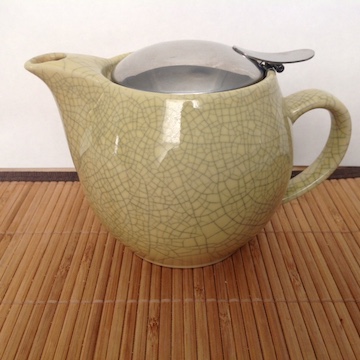
Teapot Poem
This teapot, a gift for you,
sat on your kitchen table.
Later, we shared it, together.
Now, it sits alone, with me.
© Ken Chawkin
Fairfield, Iowa
May 1, 2016
Scroll down to Responses (5th) to read how this poem came about.

Teapot Poem
This teapot, a gift for you,
sat on your kitchen table.
Later, we shared it, together.
Now, it sits alone, with me.
© Ken Chawkin
Fairfield, Iowa
May 1, 2016
Scroll down to Responses (5th) to read how this poem came about.
While feeding Sali lunch today I whispered in her ear that she radiates goodness and joy. It is her inner nature. It shows in her smile, no matter what changes she’s going through with the illness. Whether they know it or not, it’s the main reason the staff love Sali. Why I love her.
Later in the day, as I was washing my hands, those thoughts came back to me. I composed them in my head as a haiku, then stretched it out to a tanka, and immediately wrote it down. It has a Zen-like quality to it.
Sali’s essential nature
so it’s down to this
no mind, just bliss, and a smile
essential nature
that’s why everyone loves you
you radiate what we are
© Ken Chawkin
Fairfield, Iowa
Jan 5, 2016
I also told her about the eternal nature of love, of our love. Circumstances may change—we get old, sick, and die, but that part of us goes on, is eternal. I do believe that love is our essential nature. If we reincarnate, come back, we look for it, for that person who radiated it, reflected it back to us, with whom we shared the unifying fulfilling magic of a more enlightening love.
The Gita says, Karma is unfathomable, but I add, Love is eternal, and transformational! See Coming Back For Love In Five Favorite Romantic Films, especially the first and last films on the list.
See William Stafford—The Way It Is, including the Vedic expression I added. It extends the poem’s theme to its ultimate spiritual conclusion.
This is my favorite poem by William Stafford—The Way It Is. I had found a verse from one of the Vedas that extends the theme in the poem to its ultimate conclusion and added it after his poem. I call the grouping uncommon thread … cosmic thread.
Besides this musical video of the poem by Daniel Austin Sperry, it is also available digitally on his new album: Cutting Loose ~ A Tribute To William Stafford. I’ve been listening to the CD and it’s beautiful! I’m ordering some as holiday gifts. You may want to as well.
You can order it on his website where he’s offering bulk discounts on a Five Pack and Ten Pack of CDs. For more videos and news follow him on Facebook.com/PoetrySandwich.
Enjoy other Stafford poems posted on The Uncarved Blog, some of which have also been recorded by Daniel Sperry like, William Stafford—You and Art, and the last poem he wrote the morning of the day he died: “Are you Mr. William Stafford?”
Daniel Sperry is an innovative, genre-stretching cellist, composer, and evocateur from Ashland, OR, who specializes in creating Musical Portraits for individuals as markers for special occasions and as gifts for loved ones. He performs all over the country in house concerts featuring these portraits, the poetry of Rumi, Hafiz and others along with his original music, opera arias, and standards.
See this wonderful video: Moments with Daniel Sperry: Cello in Lithia Park from Daniel Sperry on Vimeo. Read the Ashland Daily Times Article about Daniel in Lithia Park. Discover more about The Story of Daniel.
On November 28, 2007, Maharishi Mahesh Yogi, founder of the Transcendental Meditation technique, was featured in a biographical documentary on the International History Channel. ITN Factual, a UK-based production company, was commissioned by A&E to produce it.
During an interview with the folks at TMhome I had mentioned it, but they wanted to save it for a second article by itself. That article was published this week along with the complete film, which aired 8 years ago this coming weekend. Some of you may have seen it, or heard about it but never got see it. Well, now you can.
Previously unseen historical footage of Maharishi had been located and edited segments were provided to the producer/director Fiona Procter. Some of the people I had arranged to be interviewed for the film were David Lynch, Donovan, Mike Love, Bob Roth, Theresa Olson, Alan Waite, Bevan Morris, and John Hagelin. Jerry Jarvis was included when the producer was in Los Angeles.
Sally Peden was also interviewed for the film but did not make final cut. However, she provided additional valuable information for the producer to better understand and appreciate the scope of Maharishi’s contribution to the world. Parts of that interview were transcribed and included in the article on how the film came to be made. Read the complete article and watch the film on the TMhome website: International History Channel documentary on Maharishi Mahesh Yogi: How it was made: The story behind the film. The film is also posted on The Uncarved Blog.
Below is the last poem William Stafford wrote in his Daily Writings, the morning of the day he died. He was 79 (Jan 17, 1914–Aug 28, 1993).
An unintended prophetic literary epitaph, you wonder if he knew on some deep level that his life was coming to a close?
In a way, the poem beautifully sums up his life as an awake poet, effortlessly creating (It was all easy) from the revelatory moment where, “For that instant, conceiving is knowing; the secret life in language reveals the very self of things.”*
Kim Stafford says a friend told him his father’s “imagination was tuned to the moment when epiphanies were just about to come into being.” Kim continues: At such a moment, ambition could be fatal to what we seek. Take a deep breath and wait. What seeks you may then appear.**
There is a reproduction of this poem in his own handwriting opposite the inside title of his posthumously published book, The Way It Is: New & Selected Poems, William Stafford, Graywolf Press (1999).
There was no title to the handwritten poem, just the date of the entry, 28 August 1993. It appears on page 46, and underneath the date is the title:
“Are you Mr. William Stafford?”
“Yes, but. . . .”
Well, it was yesterday.
Sunlight used to follow my hand.
And that’s when the strange siren-like sound flooded
over the horizon and rushed through the streets of our town.
That’s when sunlight came from behind
a rock and began to follow my hand.
“It’s for the best,” my mother said—”Nothing can
ever be wrong for anyone truly good.”
So later the sun settled back and the sound
faded and was gone. All along the streets every
house waited, white, blue, gray; trees
were still trying to arch as far as they could.
You can’t tell when strange things with meaning
will happen. I’m [still] here writing it down
just the way it was. “You don’t have to
prove anything,” my mother said. “Just be ready
for what God sends.” I listened and put my hand
out in the sun again. It was all easy.
Well, it was yesterday. And the sun came,
Why
It came.
Listen to a beautiful musical rendition of this poem by Daniel Austin Sperry from his album: Cutting Loose ~ A Tribute To William Stafford. Follow him on Facebook.com/PoetrySandwich for updates and musical videos. Visit http://cellomansings.com. Buy the digital album online or email to order the CD cellomansings@gmail.com.
See William Stafford—The Way It Is, also recorded by Daniel Sperry, as well as William Stafford—You and Art. Enjoy other favorite Stafford poems posted on The Uncarved Blog.
*Early Morning: Remembering My Father, William Stafford, by Kim Stafford, Graywolf Press (2002), page 289, referencing his National Book Award Acceptance Speech in 1963.
**Ibid, page 136. “What seeks you may then appear” and in the poem, “Just be ready for what God sends” remind me of the ancient rishis, the Vedic seers who were so awake inside that they heard the Veda humming to itself within their own consciousness; they cognized the richas, the hymns of the Veda that sought them out.
That quality of wakefulness, innocence and readiness—a subtle receptivity to what may be given, or realized, is described in Rk Veda, 5.44.14: Yo jagara tam richa kamayante. He who is awake, the richas seek him out. (Peter Freund’s Favorite Sanskrit Expressions, page 3.)
See Maharishi Mahesh Yogi describe the process of Vedic cognition during a 1976 European symposium on Science and Consciousness: He Who Is Awake the Hymns Seek Him Out.
Haiku of Sali Eating
Burp…hiccup…giggle…
Sounds Sali makes while eating
Tell us she’s all right
11-13-15
© Ken Chawkin
Fairfield, Iowa
Last Friday night, as I was walking into Revelations for some dinner, I saw a sign in the window for a poetry reading by a friend I knew. It also said a birthday cake would be shared afterwards. I bought a big bowl of soup and headed downstairs. The place was packed and I had to stand at the back by a desk having my soup. The birthday poet was Karen Karns. Her husband, Don (aka, Ark-hal) Karns, offered me his seat, but the owner brought me a chair in time. Don, Karen and I used to work together as Maharishi Ayurveda technicians in the late ’80’s & early 90’s.

Karen Karns has a Masters in Divinity from Earlham School of Religion, a Quaker seminary, and is a Life Counselor. She has twenty years of experience in Fairfield, Iowa offering individual, pre-marital & couples counseling, which she continues to do in the afternoons. As a Sidha, Karen has been on the Invincible America Assembly continuously since its inception in 2006!
I’ve always found Karen to be a very friendly, cheerful, compassionate and gentle person. You’d never know she had reached retirement age. Maybe all that meditation has kept her looking eternally young and beautiful, inside and out!
Now I discover she’s a poet! Karen was shy about reading her poems in front of an audience, but she did well. The last poem took our collective breath away as she shared an intimate experience of a poem coming to her during a deep meditation in the Ladies Golden Dome.
When a poem comes to you and you don’t write it down, you never forgive yourself. That’s what happened to Karen the first time. But, luckily for her, and us, it came back again during her next meditation in the dome and she quickly wrote it down. This happened during Guru Purnima this year, a special gift. I’ll let her words speak for themselves as the poem asks us, tells us, what could be more intimate.
WHAT COULD BE MORE INTIMATE
than these shimmering sheets of light
enfolding the features of each face
as we meditate in silence together,
our spines, divining rods for the deepest
currents and reservoirs of peace.
What could be more intimate
than to be held captive by this
moment, its piracy complete
with all the spoils and riches
from past and future laid
immediately at our feet.
What could be more intimate
than this play of hide and seek,
peeking around corners, into doors—
only to find ourselves hidden
in the marrow of every beam
and rafter in our own huge house.
What could be more intimate
than the waking up of sleep
inside itself
spellbound by the sound
of its own sweet voice
humming an ancient lullaby.
What could be more intimate
than the filling and emptying,
the steady pump of liquid love
as it funnels its way into the portals
and pathways of our bodies, joyfully
mothering each tender cell.
What could be more intimate
than the downpour and drench of bliss.
What could be more intimate than this?
Karen Karns
Guru Purnima 2015
I was so blown away I had to post it on my blog. Luckily she agreed, so I could share it with all of you. I also took her photo to go with the poem.
When I asked Karen if she just wrote it down as a scribe or if she had to work at it, she replied, “I scribed and scrubbed both,” with a smiley face.
That’s been my experience too—creative expression is a collaborative process, especially when the muse whispers something to you! You start with a seed idea, words, even lines, if you’re lucky, and you work at it until it’s done, you polish it until it’s right. Karen sure got this one right!
The discussion on Vedic cognition at the end of “Are you Mr. William Stafford?” is very relevant to Karen’s experience as a poet!
While feeding Sali lunch yesterday I would joke and make her smile and laugh. It was sweet. No matter how lousy I was feeling before, she made me feel better. I told her she had a happy heart and a blissful soul, and thanked her for making me feel happier. That’s when I wrote the first two lines. I thought about it some more and the next day when I came in to feed her, the last two lines came out spontaneously. She is my muse. Even though Sali is severely compromised on so many levels, she still maintains her inner nature, an inspiration to us all!
Sally has a happy heart
And a deeply blissful soul
When she laughs it all comes out
Leaving me smiling and whole
© Ken Chawkin
August 7, 2015
Fairfield, Iowa
Also see Sally’s Smile (Haiku for Nurse Dan) and Tanka For Sali Upholding Her Wonderful Nature.
At the Lake
A fish leaps like a black pin — then — when the starlight strikes its side —
like a silver pin. In an instant the fish’s spine alters the fierce line of rising
and it curls a little — the head, like scalloped tin, plunges back, and it’s gone.
This is, I think, what holiness is: the natural world, where every moment is full
of the passion to keep moving. Inside every mind there’s a hermit’s cave full of light,
full of snow, full of concentration. I’ve knelt there, and so have you,
hanging on to what you love, to what is lovely. The lake’s
shining sheets don’t make a ripple now, and the stars are going off to their blue sleep,
but the words are in place — and the fish leaps, and leaps again from the black plush of the poem, that breathless space.
~ Mary Oliver ~
Rolf Erickson’s Mirror Lake creates a cosmic connection for the reader.
Enjoy these other lovely poems by Mary Oliver: Summer Day, Varanasi, Praying, Wild Geese, Sunrise, White Owl Flies Into And Out Of The Field, The Journey, One, The Loon, and When Death Comes, which was included in her obituary Jan 17, 2019.
See this remembrance of Mary Oliver (1935-2019) and her astonishing poetry, with links to articles, interviews, and readings, as well as more of her favorite poems I’ve loved and posted over the years.
— Written and compiled (citing sources) by Ken Chawkin for The Uncarved Blog.