Archive for the ‘Articles’ Category

Give TM a chance to prevent more wars

March 28, 2010

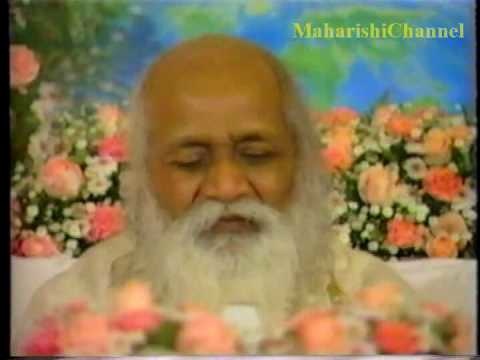
News from southeastern Connecticut | Click here for photos of Maharishi, and with The Beatles, in Bangor, Wales, August 24+26, 1967.


Article published Mar 28, 2010

All these ex-military dudes are saying is give TM a chance

By RAYMOND E. SEEBALD and DAVID R. LEFFLER

Wars start in the minds of men, and cycles of conflict ensue. So, too, can wars be prevented in the minds of men, but not always in the conventional way one might think. A new technology of defense has now emerged from a most unexpected quarter and has scientifically shown itself to have intriguing potential to prevent war and create peace.

Here’s the background: The underlying cause of war is accumulated social stress. Stress builds up. Differences arise. Groups take sides. Mediation fails to resolve the differences. Enemies form and arm.

Military organizations theoretically provide a deterrent to conflict, but when social division and enemies directly challenge the execution of national policy, military force can be activated and deployed to protect the nation. Armed conflict follows, with unpredictable outcomes. Even if conflict temporarily solves the problem for the winner, the underlying social stress is increased, fueling more violence and more terrorists.

No stress, no tension

In contrast, the absence of collective stress translates into the absence of tension between competing sides, thereby reducing the probability of hostilities.

Today, an opportunity exists to overcome this cycle of conflict by deploying a scientifically verified technology of defense that neutralizes social stress.

This technology operates on the most fundamental and powerful level of human consciousness, and is accessed and harnessed through a surprising and most unconventional channel-meditation.

In more than 50 studies published in scientific journals, Transcendental Meditation (TM) has been documented to powerfully reduce violence and criminal activity and even to calm open warfare.

Here’s how we believe it works: Just as radio or TV transmitters beam signals through an unseen electromagnetic field, groups of meditating people can generate a strong wave of coherence and positivity through an underlying field of collective consciousness. Stress and tension diminish. The larger the group, the greater the effect.

Specifically, the studies demonstrate that when the required threshold of meditators is crossed – approximately the square root of 1 percent of a given population – crime goes down, quality of life indices go up, and war and terrorism abate. Scientists have named this phenomenon the Maharishi Effect, after the founder of Transcendental Meditation, the late Maharishi Mahesh Yogi, who envisioned this possibility for creating global harmony.

In 1993, a two-month Maharishi Effect experiment was implemented in Washington, D.C. The findings published in Social Indicators Research showed that crime fell 24 percent when the peace-creating group reached its maximum size.

A decade before, during fighting in the Middle East, large assemblies of meditators repeatedly caused battlefield casualties to drop dramatically. A global-scale study published in the Journal of Offender Rehabilitation documented a 72 percent drop in international terrorism.

Our armed forces are responsible for defending the country. We suggest they consider adding an unconventional force – a consciousness corps, so to speak – to enhance their mission. Create a coherence-creating group of meditating soldiers exceeding the square root of 1 percent of the population of the United States. It would only take approximately 1,750 personnel.

Really not far-fetched

Admittedly, the idea of fighting terrorism with meditation sounds far-fetched. But the idea of an Internet would have seemed crazy, too, just a generation ago. Now, we communicate across oceans and access a universe of information simply by typing into some invisible field.

At one time, meditation was considered “mystical.” Now, doctors prescribe it and even the government funds research on the health effects of meditation. That’s because hundreds of studies show it effectively reduces individual stress and improves health. Why not put it to the test to improve global health?

As part of its responsibility to protect the nation, the U.S. military is obligated to thoroughly examine scientifically proven methods for preventing war and terrorism. All that is necessary is to provide the proper training for a group of military personnel or indeed, any large group within the country.

With all the conventional methods we utilize to protect life, liberty, and freedom, we should also be open to trying new, creative ideas, no matter how unconventional they seem.

Retired Coast Guard Capt. Raymond E. Seebald was a military aide to presidents Ronald W. Reagan and George H.W. Bush from 1986-1990. As captain of the Port in Chicago he developed post 9/11 security standards for U.S. ports. He graduated from the U.S. Coast Guard Academy in 1977. David R. Leffler is an Air Force veteran and executive director of the Center for Advanced Military Science (CAMS). He served eight years in the U.S. Air Force.

The authors served as associates of the Proteus Management Group at the Center for Strategic Leadership, U.S. Army War College.

“Heyam Dukham Anagatam” — Avert the danger that has not yet come

March 20, 2010
Click here for India News from Daily India

How transcendental meditation can prevent war and terrorism

From ANI

Washington, March 20: A new research paper has pointed how militaries worldwide could use the Transcendental Meditation and TM-Sidhi program, founded by Indian spiritual guru Maharishi Mahesh Yogi, as a non-religious and scientifically verified way to prevent war and terrorism.

When used in a military context, these meditation practices are known as Invincible Defense Technology (IDT).

The research paper describes the concept of a “Prevention Wing of the Military,” a group of military personnel that practices the advanced TM-Sidhi program twice daily as a group.

A group that reaches a critical threshold in size has been scientifically shown to reduce collective societal stress.

The paper hypothesizes that war, terrorism, and crime are caused by collective societal stress.

The absence of collective stress translates into the absence of tension between countries, between religious groups, or even within individual terrorists.

The paper proposes that, by applying this non-lethal and non-destructive technology, any military can reduce societal stress and prevent enemies from arising.

If IDT prevents the emergence of enemies, the military has no one to fight, so the nation becomes invincible.

Over 50 scientific studies have found that when 1percent of a given population practices Transcendental Meditation, or when sufficiently large groups practice the TM-Sidhi program together twice daily, measurable positive changes take place throughout society as a whole.

The studies show decreased violence, crime, car accidents, and suicides, and improved quality of life in society.

The paper reviews IDT research, such as a study published in the Yale University-edited Journal of Conflict Resolution showing that an intervention by a civilian group in Israel resulted in a 76 percent reduction in war deaths in neighboring Lebanon.

Seven subsequent, consecutive experiments over a two-year period during the peak of the Lebanon war found that war-related fatalities decreased by 71 percent, war-related injuries fell by 68 percent, the level of conflict dropped by 48 percent, and cooperation among antagonists increased by 66 percent.

A follow-up study published in the Journal of Social Behavior and Personality found that the likelihood that these combined results were due to chance is less than one in a quintillion.

A global-scale study published in the Journal of Offender Rehabilitation documented a 72 percent drop in international terrorism when IDT groups were large enough to affect the global population.

According to David R. Leffler, the research paper’s author, “This new approach, derived from the ancient Vedic tradition of India, is supported by over 50 scientific studies. IDT can create victory before war, and can assist in peacemaking, peacekeeping, and peacebuilding.”

Copyright Asian News International/DailyIndia.com

I used the photo of Maharishi from a similar article on IndiaTalkies website posted by Nitesh on Mar 20th, 2010 and filed under Science / Technology.

TM brings relief to veterans suffering from post-traumatic stress disorder (PTSD)

March 19, 2010

Medill on the Hill reporters are undergraduate students in Northwestern University’s Medill School of Journalism. They serve as mobile journalists, filing quick updates on news events around Washington, especially from Capitol Hill; as enterprise reporters finding original stories; and as Web producers and reporters. They are covering Washington and posting stories to Medill on the Hill aimed at a young audience to report on how and why what happens in Washington matters to 18- to 24-year-olds. The students’ work is supervised by Medill Associate Professors Mary Coffman and Matt Mansfield, who are based in the school’s Washington program.

The war within: Overcoming trauma, veterans find strength in meditation and yoga

by Samantha Michaels

Mar 05, 2010

WASHINGTON — When David George finished his military tour in Iraq a few years ago, he departed a war zone and returned home to Brookeville, Md.

Physically removed from the battlegrounds, however, his body hadn’t yet shaken the battle.

“One day I was standing in line at a [store] and I smelled burning rubber,” he said. “All of a sudden my brain turned on a switch: I started sweating, my heart started pounding, hyper vigilance kicked in. Everything went into war mode, just standing in line trying to buy chips and soda.”

Like a growing number of veterans, this 26-year-old infantryman was diagnosed with post-traumatic stress disorder (PTSD), a severe anxiety condition which results from trauma. Estimated to afflict more than 300,000 Iraq and Afghanistan veterans, PTSD is often treated with counseling and medication.

But in George’s case, salvation came with meditation, not medication.

“With meditation, I had a break from the anxiety attack that had become my life,” he said.

In January, the Department of Defense announced it would allocate $1 billion of its 2011 budget to research and care for traumatic brain injuries like PTSD. As the number of PTSD cases skyrockets and the military devotes more funds to treating them, George’s story provides a glimpse into the promise of alternative therapies like meditation and yoga.

“Even if we’re army strong, we’re still human,” said Sue Lynch, executive director of There and Back Again, a non-profit organization that uses yoga, meditation and a number of other therapies to promote wellness among servicemen. “We have emotions which are going to come out somehow, so why not learn tools to shift recovery into a positive experience of self-care?”

Invisible Wounds: Military Veterans and Mental Health

Since the beginning of the Iraq and Afghanistan wars, mental health has been a growing concern for the military. Between 2001 and 2007, one in seven combat veterans sought help for mental illness, and according to VA records, about half of these cases involved PTSD. One in five patients seen last year in VA’s health care facilities had a mental health diagnosis.

Experts believe the prevalence of PTSD may be even greater, because VA records exclude a number of patients, including veterans treated at storefront VA Centers, active-duty soldiers, and veterans who have not sought treatment.

PTSD can manifest as nightmares, flashbacks, insomnia, anger, depression or hyper vigilance. Attempting to deal with these symptoms, many veterans withdraw from friends and family.

“In order to do the things we did over there, and to live with the things we saw, you’ve got to be angry,” said George, one of 47 soldiers injured during a car bombing in Iraq. “It’s a disgusting feeling that’s part of war culture, and only war culture. When you come home you’re told to forget about it, because you can’t act or feel that way. You try to detach that anger from yourself, though it’s a part of you and your brain.”

Soldiers undergo physical training before deployment, but they often lack emotional tools to cope with trauma.

“When things break down it’s along other axis as well—emotional and spiritual dimensions,” said Colonel Brian M. Rees, a medical corps command surgeon who served in Afghanistan and Iraq.

Yoga: Reintegrating mind with body

To overcome the breakdown, some veterans use yoga.

“In combat there’s trauma and you feel helpless, and then you go to the VA and you’re on medication and you feel helpless,” said Lynch, a veteran of Operation Iraqi Freedom. “Yoga gives control to the vets, allowing them to take charge.”

During war, a soldier’s mind may go blank to avoid stress—a survival mechanism which often lingers with negative consequences after conflict.

“Victims of trauma carry a brokenness, a division of mind and body that needs to be reintegrated,” said David Alan Harris, an award-winning therapist who worked with former child soldiers in Sierra Leone.

The term “yoga” is derived from the Sanskrit word “yuj,” which means “to unite” or “to integrate.” Often incorporating exercise, breathing and meditation, it promotes balance.

“Body-based techniques help PTSD patients self-sooth,” said Rebecca Milliken, a licensed counselor and dance movement therapist who has worked with prison inmates. “They identify parts of their bodies that feel safe and relaxed, so when a flashback comes, they can go to a safe place in their minds.”

For Eric Fretz, a Navy veteran who served three deployments off the Persian Gulf, yoga helped relieve severe stress and depression.

“I’d be out running and thinking about stuff, and I’d start crying, and I couldn’t stop,” he said. “That’s off-putting for somebody who’s never had an issue of emotional control…Yoga became a life vest, and I was clinging to it.”

At some VA medical centers, veterans take classes in Yoga Nidra, an ancient practice that resembles guided meditation. The technique uses relaxation and breathing exercises to deconstruct the thoughts and emotions which trigger PTSD.

Yoga classes provide group support for veterans who have withdrawn from family and friends.

“The kind of camaraderie that exists in a VA hospital among veterans would be a great resource to draw on in building the trust that’s necessary for exploration through movement,” said Harris.

Still, yoga instructors face a challenge: some soldiers are skeptical of the practice.

“There’s a soldier culture of manliness that isn’t a perfect fit for yoga,” said Fretz, who added that the poses can ultimately leave “even the toughest guys whimpering.”

Transcendental Meditation: Targeting the Mind

A number of military physicians also believe meditation can help veterans recover from PTSD. Some experts say Transcendental Meditation (TM) is particularly beneficial.

Practiced twice daily for 15 minutes, TM is a self-awareness technique of Indian origin. Sitting with eyes closed, participants enter a state of restful awareness. The physical effects are helpful for PTSD patients who operate under heightened stress levels.

“Severe stress can shut down the prefrontal cortex, which is like the commander-in-chief of the brain,” said Dr. Sarina Grosswald, the executive director of PTSD and stress-related disorders for the David Lynch Foundation. “TM rebalances the brain chemistry.”

During TM, the body reaches a level of rest equivalent to deep sleep—undergoing a reduction in heart rate, breath rate and blood flow to the limbs. At the same time, blood flow to the brain increases, reactivating the prefrontal cortex and improving communication with other areas of the brain.

“TM creates the brain waves associated with settled-ness,” said Grosswald. “As you experience it over and over, these brain connections get stronger, and the connections related to trauma begin to fade away.”

Dissatisfied with his medication, George relieved pain with drugs and alcohol before discovering TM. With meditation, he reconnected with himself.

“Practicing TM was like being in the zone—like when you’re ready to kiss somebody, you both know it’s right and a spark flies in your chest,” he said. “Except it was something I triggered within myself, something I did to myself. Within the first month I realized I was an individual that I’d been ignoring.”

Despite success stories, experts face obstacles as they promote TM on a greater scale. Rees has led scientific studies to gain support, but he said people don’t always recognize TM’s distinctive benefits.

“There is a lack of differentiation between TM and other meditative techniques,” he said.

Still, he continues to recommend TM to military patients.

“We should be exploring TM,” he said. “It’s a stone that has remained unturned.”

Investing in mental armor

Secretary of Veterans’ Affairs Eric Shinseki called PTSD treatment “central to the VA’s mission” when the White House announced a proposed $125 billion budget for the Department of Veterans’ Affairs in February. Spending requests allocate $5.2 billion for mental health, an 8.5 percent increase in current spending.

The military is examining alternative PTSD therapies, but meditation and yoga advocates say they should do more.

“It’d be great if yoga could be part of our out-briefing,” said Fretz. “In general, the resources for returning veterans could be allocated better.”

A combination of medicines, psychotherapy and mind-body approaches may be most effective.

“We have suffered from an either-or approach that’s very western,” said Rosa E. Garcia-Peltoniemi, a clinical psychologist at The Center for Victims of Torture. “We say it’s either the body or the mind, but in actuality, it’s both.”

Therapists suggest that yoga and meditation can be preventative measures, not simply therapies.

According to Grosswald, the military takes an academic approach to stress reduction, requiring soldiers to complete stress management courses before deployment. If soldiers were equipped with meditation and yoga, they might be less likely to develop PTSD during combat.

“You can teach somebody something from a book, but a lot of that goes out the window when trauma happens,” she said. “With TM, you’re training the brain so the threshold for stress is different… Soldiers could come back to a baseline quicker, responding in a clearer way.”

However, meditation and yoga classes require trained instructors, which may be in short supply. Fretz said he had access to two yoga instructors in Iraq, but most soldiers are not so lucky.

“If the instructors leave, then the yoga stops,” he said.

Although the Department of Veterans’ Affairs has hired 6,000 new mental health professionals since 2005, raising the number to 19,000, experts say more therapists are needed. A person learns TM through one-on-one instruction with a trained practitioner, which can be expensive.

Still, advocates say it is ultimately cost-effective.

“Health care costs and professional resources can be saved because people wouldn’t spend years going through health counseling in VA medical centers,” said Grosswald.

For George, the investment in meditation has been worth it. TM relieved his PTSD symptoms, but it also led to less expected improvements. After learning the technique, he became a faster typist and a better drummer. Dyslexic since childhood, he noticed that reading was more pleasurable. He stopped drinking and began to prioritize himself.

“I really do treat myself like my best friend now,” he said. “Medications took away the symptoms, but they didn’t leave me the same. TM has left me better.


Great Donovan interview on The Huffington Post

March 19, 2010

Mike Ragogna: From Atlantis to Los Angeles’ El Rey: A Conversation with Donovan

Military Application of Transcendental Meditation Gaining Acceptance

March 18, 2010

Paper on Invincible Defense Technology published in peer-reviewed Pakistani journal

The Journal of Management & Social Science published a paper titled “A New Role for the Military: Preventing Enemies from Arising – Reviving an Ancient Approach to Peace,” indicating that the military application of the Transcendental Meditation technique has merit. The paper discusses how militaries worldwide could use the Transcendental Meditation® and TM-Sidhi® program, founded by Maharishi Mahesh Yogi, as a non-religious and scientifically verified way to prevent war and terrorism.

Permalink to this article

Paul McCartney and Nancy show up to see James play, and surprise the small Brighton club audience

March 18, 2010

BRIGHTON NEWS Proud Sir Paul cheers on Macca Jnr

3:34pm Thursday 11th March 2010

By Jackie Stevens

Paul McCartney and his girlfriend Nancy dropped into a dingy basement venue in Brighton to watch his son James play to a crowd of 70 punters this week.

For a performer used to playing 50,000-seater stadiums, Brighton’s Audio must have taken Paul McCartney back some 50 years to the earliest beginnings of his career.

But if he found the venue for one of his 32-year-old son’s first public gigs humble, he wasn’t giving it away, as he was every inch the proud father, dancing, cheering and capturing every moment on a small hand-held video camera as James played a storming rock concert.

Sir Paul and Nancy Shevell, who’d arrived straight from a Paris fashion show looking like a rock chick, knew every word of every song as James alternated blistering rock tunes, like New York Times, with delicate acoustic numbers and some stunning piano performances, including the haunting Spirit Guide.

Paul and Nancy sang along – even as James shrieked his way through the expletive-ridden Glisten – dancing about in the corner by the cigarette machine, whistling and whooping, even heckling after some songs.

While James, backed by a three-piece band, gave an impressive vocal performance, at times sweet and beautiful, at others reaching high notes that might defy his tenor father; between songs he merely muttered their titles and barely smiled throughout the tight 50 minute set.

Paul, however, gave him a lesson in showmanship just making the trip across the empty dance floor to the bar.

Passing by the stage, balancing three pint-glasses of soda water in his hands, Macca Senior called to his son, “Hello James, how are you?” James, preparing for his next song, ignored him in a‘yeah, dad,’ embarrassed-teenager kind of way.

But while playing, James often looked across to his father and dedicated two songs to him. The second, “I Love You Dad,” which James played on a mandolin, was the only one Paul didn’t sing along to – though Nancy did, enthusiastically.

After he’d sung the final, “I love you Dad, more than you can know.” Paul called out, “I love you too.”

James finished with Angel – not a Robbie Williams cover but a catchy melodic song which seems to refer to his mum, Linda, who died in 1999 when he was only 20.

It’s become a favourite with his ever-growing Facebook fanclub – and will probably be his first hit once he has taken his pick of the major record labels, including Warner, EMI and Universal, who are keen to sign him up and release the album that has been 10 years in the making.

As soon as the last chord faded, James scurried off, leaving the crowd cheering and demanding an encore.

“Just one more!” someone said. “Two more!” shouted Paul McCartney, but James did not reappear.

After the concert James and Paul mingled with the audience, posing for photos.

James, who seemed fazed by the surge of the crowd wanting autographs, commented that it was the first time his father had seen him play in public. “It’s been great – very special.”

Asked why there was no encore, he said, “We didn’t have any more to play; we need more tunes.”

James has another seven gigs to play on his 14 day UK tour, which is his first worldwide.

Asked why he’s kept it so low-key, with barely any promotion, he said, “We just need to perfect it first.”

Coming from someone who had just proved himself an accomplished multi-instrumentalist and impressive vocalist, one wonders what standards he is setting himself.

Paul and Nancy, unaccompanied by any security, exited by the front door and, before jumping into his car, Paul happily waved to surprised passers-by on Brighton seafront, before heading back to Peasmarsh.

© Copyright 2001-2010 Newsquest Media Group

PS: There is another fine article on James published in the Daily Record: James McCartney: I was in the womb when dad sang Mull of Kintyre.. now I want musical career of my own

The close-up photo of Paul and James McCartney was taken from The Sun.

Also see Audience Goes Wild for James McCartney | Paul McCartney’s son says he’s ready to follow in dad’s footsteps | McCartney wins over Fairfield audience in U.S. debut concert | James McCartney Performs on GDLA | James McCartney sings Angel on David Letterman.

I discovered some surprising connections between Nancy Shevell, Paul McCartney’s new wife, and his first wife, Linda McCartney, and Barbara Walters. See Who Is Nancy Shevell, Paul McCartney’s New Wife?

Donovan GDLA and Off-Ramp Interviews

March 15, 2010

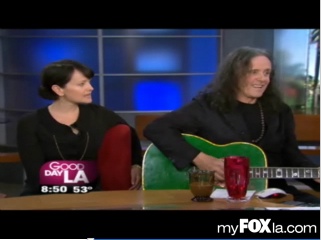
Donovan and Astrella on GDLA

Monday, 15 Mar 2010, 11:40 AM PDT

Los Angeles – Legendary singer Donovan was one of the few artists to collaborate on songs with Beatles and he has played with folk greats Pete Seeger, Joan Baez and Bob Dylan, and has even played with rock legends the Rolling Stones.

Donovan and daughter Astrella visit by “Good Day LA” to talk about a benefit concert for the David Lynch Foundation.

Donovan will be joined by his daughter Astrella Celeste to headline a benefit concert for the David Lynch Foundation on Friday, March 19 at the El Rey Theater in Los Angeles.

For more info on the concert log onto:  www.donovan.ie/en/


Off-Ramp Special Podcast – Donovan in Concert

Monday, March 8, 2010.

They gave us the keys to the podcast, so now we can send out special editions when we’ve got great stuff to share … like 60s icon Donovan and his guitar in studio. This is the full version of the piece we’ll run this weekend on the broadcast edition of Off-Ramp.              Download

Donovan Live at the Mohn Broadcast Center

Donovan is headlining a concert at the El Rey Theatre March 19th to benefit the David Lynch Foundation, which works to teach at-risk schoolkids to meditate. Donovan learned how to meditate with the Beatles and the Maharishi back in the 1960s. In our Off-Ramp interview, Donovan talks about the old days, reducing students’ stress and reliance on ADHD drugs, and the benefits and drawbacks of fame. He also sings three of his favorites. (COME INSIDE for info on the concert, a link to Lynch’s foundation, and to see who is taller — Donovan or Off-Ramp host John Rabe.)

1 comment

Gary Kaplan
5 days, 19 hours ago

Sublime! Donovan is our hero. What a great service he is doing for mankind.

Donovan & Friends Perform Benefit Concert for David Lynch Foundation

March 15, 2010

Donovan headlines benefit concert on March 19

Proceeds to benefit Transcendental Meditation program

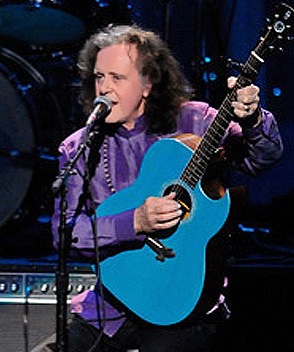
Legendary folk-rock-pop troubadour Donovan, known for hits such as “Mellow Yellow,” “Sunshine Superman,” “Hurdy Gurdy Man” and more, will headline a benefit concert for the David Lynch Foundation on Friday, March 19 at the El Rey Theater.

Doors will open at 7:30 p.m. Tickets are $25 for general admission and $110 for VIP seating and a meet and greet with Donovan after the show, and can be purchased through Ticketmaster.

“The Beatles and I brought back from India the lost art of meditation,” Donovan said. “Now, with David Lynch, we pass it on to thousands of students worldwide. Join us to help save the world.”

He will be joined by his daughter Astrella Celeste and backing band Jerry Vivino, Scott Healy and Mike Merritt from the Conan O’Brien late night band, Danny Saber on guitar with special guests Jack Maness from Sublime, The Global Sound Lodge featuring Lanny Cordola and Matt Sorum of Guns N’ Roses, Velvet Revolver and The Cult, Amrita Sen and more.

Matthew St. Patrick, from Six Feet Under, will host the evening performances.

The El Rey Theater is located at 5515 Wilshire Blvd., Los Angeles 90036.

About Donovan
Donovan was one of the few artists to collaborate on songs with Beatles Paul McCartney, John Lennon and George Harrison. Donovan has played with folk greats Pete Seeger, Joan Baez and Bob Dylan, as well as rock musicians Jimmy Page, Jon Bonham and John Paul Jones of Led Zeppelin, Jeff Beck, and Brian Jones of The Rolling Stones.

Recently Donovan completed the successful album “Beat Cafe” as well as a new box set, “Try For The Sun: The Journey of Donovan,” and a book, “The Autobiography of Donovan: The Hurdy Gurdy Man” (Arrow Books).

Donovan is now heading up the musical wing of the David Lynch Foundation, fulfilling his 40-year interest in Transcendental Meditation. Donovan, his wife Linda, Paul McCartney and Ringo Starr are currently promoting Transcendental Meditation in schools.

About The David Lynch Foundation
The David Lynch Foundation for Consciousness-Based Education and World Peace was founded in July 2005 by award-winning filmmaker David Lynch with the immediate goal of teaching one million at-risk youth to meditate. The foundation has already provided more than 100,000 scholarships for students to learn the Transcendental Meditation technique, as well as inmates and guards in prisons, formerly homeless men in re-entry programs, soldiers with PTSD returning from Iraq and Afghanistan, and American Indians suffering from diabetes.

Sources: The David Lynch Foundation & David Lynch Foundation Television

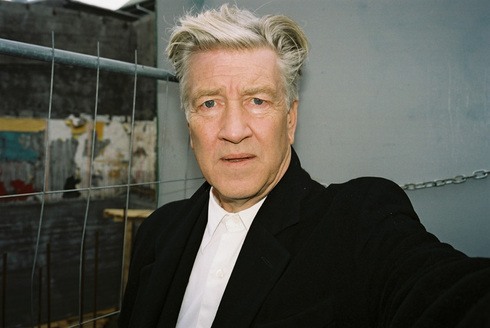
David Lynch in Reykjavik, Iceland

March 5, 2010

David Lynch Answers Grapevine Questions On TM

He also thinks Icelanders are, in fact, very hip.

11.5.2009
Words by Haukur S. Magnússon

As you probably know by now, Grapevine cover-star (and awesome director) David Lynch ventured to Iceland this month to preach the gospel of Transcendental Meditation and announce a nationwide project to bring “enlightenment, prosperity and peace to the people of Iceland.” We were of course intrigued by all this, and set up an interview with the man who’s self-portrait graces the cover of our latest issue. However, his answers didn’t make it back to us in time to run it in the print-edition of Grapevine, so we just did a little article about our experiences at his lecture (as well as a side-bar explaining TM) but they’re here now, ripe for your reading.

Grapevine: Can you explain shortly what Transcendental Meditation means to you personally?

Personally, Transcendental Meditation is a way to bring great bliss from within.

Does the practice affect all areas of your life – or does it inhabit its own special corner? Is it, for instance, reflected in your art in some way (for instance thematically or in the process of creation)?

Transcending, they say, is a holistic experience so it does affect all areas of life in the most positive way. With brain research, they see on the EEG machine a most wondrous phenomenon. When a person truly transcends (i.e., experiences the deepest level of life – the ocean of pure totality of consciousness within) the entire brain is engaged.

Transcending is the only experience in life that engages the full brain – total brain coherence it’s called. For me, it serves the work in the following ways: I have found that i have much more happiness in the doing. I have found that ideas flow more freely. I have found intuition (the #1 tool of the artist) growing more and more and i feel the heavy weight of negativity (anxieties, nervousness, worries, fatigue, depressions, angers, fears) lifting and therefore much more freedom in life and work.

Are there times where you are more involved in the practice, where you lean on it more heavily?

I have meditated twice a day for 36 years.

How did your brief visit to Iceland come about? Is this something that has been in the works for a while, or was it a spontaneous idea? Have you made such visits to other nations or regions over the years?

The visit to Iceland came about seemingly spontaneously. My Icelandic friend, Joni Sighvatsson [producer Sigurjón Sighvatsson], and I were talking on the telephone a month before my visit. We were both speaking of Iceland’s bankruptcy and thought Iceland could really use Transcendental Meditation and a peace creating group to bring peace, security, affluence and prosperity.

A whole bunch of things came together and it was really great to feel the receptivity and the growing determination of many to get these programs going in Iceland. Iceland is the 20th country i have visited talking about meditation and peace.

If I understand you correctly, you are presenting TM as a failsafe way to bring ones life to harmony. Does TM, then, offer “complete freedom from the world’s strife and confusion” or is it rather a “useful tool” for maintaining a well-balanced life?

Enlightenment does bring complete freedom from the world’s strife and confusion. But balance is the thing. Balance doesn’t mean a compromise. I think true balance brings totality – the full potential of the human being. Full potential of the human being is called enlightenment. Enlightenment answers all questions, ends all suffering and all negativity. Maharishi calls supreme enlightenment having 200% of life – 100% of all that which is unmanifest and 100% of all manifestation – totality, unity.

At your Háskólabíó event, as well as in press releases sent out prior to it, the word “science” got thrown around a lot. For instance, you emphasized that the project was “not an experiment, but rather a scientific demonstration of 50 years of research verifying the benefits of the Transcendental Meditation program for the individual and entire society.”

Furthermore, the TM program’s official web-site enshrouds itself very much in an “air of science,” if you will, taking on the appearance of a major pharmaceutical company rather than a foundation that’s presenting the ancient, spiritual act of inward meditation with possible religious connotations.

Appearances aside, i think many of our readers are interested in knowing whether you consider TM to be:

A) A plain, scientific method (something purely physical

B) An exercise program for the mind)

C) A religion

D) A form of spiritualism without any religious affiliations.

This is a very interesting and good question you have asked. For me, i started Transcendental Meditation for this thing called enlightenment and this thing called bliss. And i saw it as a spiritual path. We live in what they call a “scientific age” and many people think meditation is some kind of mysticism, some kind of Eastern religion, or some kind of path that requires renunciation or giving up of worldly pleasures.

Maharishi’s Transcendental Meditation is for what they call the “householder.” that means men and women in activity. Nothing needs to be given up when practicing Transcendental Meditation. One just adds 20 minutes of meditation in the morning and evening and that does everything.

Maharishi wanted Transcendental Meditation to be researched from a scientific point of view and that’s why there have been the 600 or 700 research studies over the years. Many people find a comfort knowing that TM and its benefits have been objectively verified by science.

It is such an interesting time because quantum physics for instance has now discovered and verified the existence of the unified field at the base of all matter and mind – at the base of anything that is a thing. This unified field is the same field that one experiences when transcending. Quantum physicists says that everything that is a thing has emerged from this field of unity in a process they call “spontaneous sequential symmetry breaking.” ancient Vedic science – the science of consciousness – has always known about this unified field. And Vedic science knows precisely the numerous steps consciousness goes through from the unmanifest level of unity to all levels of manifestation. It is so great to see that with each step forward modern science takes, it verifies the ancient Vedic science.

The unified field is for quantum physics – and Vedic science – the home of all the laws of nature. These laws hold everything and we’re coming to a point where the spiritual aspects of life can be written in a physicist’s equation.

Transcendental Meditation is not a religion, it’s a mental technique that opens the door for any human being to the unified field – the deepest level of life. It is an ancient form of meditation and a real gift because it gives “effortless transcending” because the mantra Maharishi gives turns the awareness 180 degrees within. And once pointed within, one naturally and effortlessly dives deeper because each deeper level of mind and intellect has more happiness. The human mind always wants to go to fields of greater happiness, so it effortlessly dives, and at the border of intellect, effortlessly transcends and experiences the ocean of totality of consciousness, infinite happiness, bliss, unified filed, transcendent, home of all the laws of nature, constitution of the universe, etc, etc.

It is the experiencing of the unified field that does everything for the human being. Intellectual knowledge is great, but it will never bring total fulfillment. It is this profound experience of unity – of bliss – of pure consciousness that is missing from our lives. Once a person gets this experience on a daily basis – reestablishes his or her connection with this oneness, then things really begin to change for the better. Every time we experience this deepest level of life, we infuse some of it and we begin to rapidly unfold our full potential

This ocean of consciousness within has qualities; it is an ocean of infinite intelligence, creativity, happiness, love, energy, peace. All these qualities begin to expand. The side effect of the expansion of consciousness is negativity begins to recede. Things like tension, anxieties, stress, sorrow, depression, hate, anger and fear begin to lift away. This brings freedom, and those all-positive qualities expanding bring great benefits to all aspects of life. So it is a scientific and spiritual path. People from all religions practice Transcendental Meditation as well as agnostics and atheists.

Experience this field of unity and watch things get better.

Is there a system of ethics connected to the practice of TM?

No.

Aside from the above, are you yourself a man of religion? If so, does TM in any way affect your religious practices, or are the two completely separate?

Religious people who practice TM say that because understanding grows, they understand their religion more. And because appreciation for all things grow, they appreciate their religion more.

What about the Maharishi Mahesh Yogi? How closely did you follow his teachings, especially those unconnected to TM? I am referring, for instance, to the Maharishi Vedic sciences, in terms of their approach to health, architecture, agriculture and music.

Maharishi, among other amazing contributions revived the ancient Vedic knowledge and put all the Vedic texts back together into a systematic science of consciousness. Veda means pertaining to total knowledge. It is a huge science – so beautiful – telling us so many things for a life to flow with mother nature. But again if Maharishi had only brought Transcendental Meditation, that effortless technique that allows us to experience pure consciousness, that would have been amazing in and of itself. Get that experience and all the rest will follow.

Did you consider any of the cult allegations that were widespread in the seventies and eighties?

Of course I experienced the discomfort of this false accusation. I always wondered why people called TM a cult. I never felt I belonged to some group. I took this technique as a personal thing. I never wanted to be in any club or group. I wanted to go my own way, make my own decisions.

Expanding consciousness actually glorifies differences. All diversity is appreciated fully in the light of total unity. Meditators do not all become the same, on the contrary they each become more and more themselves. However i have found a common link between meditators – I like being with them as they all reflect a great deal of happiness.

These days, all of these misconceptions about TM are disappearing and only a few strange voices rail against this meditation for reasons unknown to me. So many varied human beings have benefited from this technique that anyone with even an ounce of intelligence can see that it is the most positive of practices.

Finally, can you share your favorite memory of your brief visit? What stood out, if anything?

I was very impressed by the numerous paintings I saw in almost every building I entered. It seems that everyone in Iceland is an art collector and appreciates art. This was very impressive to me and the rapidly changing weather was astonishing also. I was also impressed by the camaraderie among Icelandic people – and their hipness.

Source: The Reykjavik Grapevine – Life

TM activates DMN, the brain’s “ground state”

March 4, 2010

A new EEG study conducted on college students at American University found they could more highly activate the default mode network, a suggested natural “ground state” of the brain, during their practice of the Transcendental Meditation technique. This three-month randomized control study is published in a special issue of Cognitive Processing dedicated to the Neuroscience of Meditation and Consciousness, Volume 11, Number 1, February, 2010.

Specifically, the study found the TM technique:

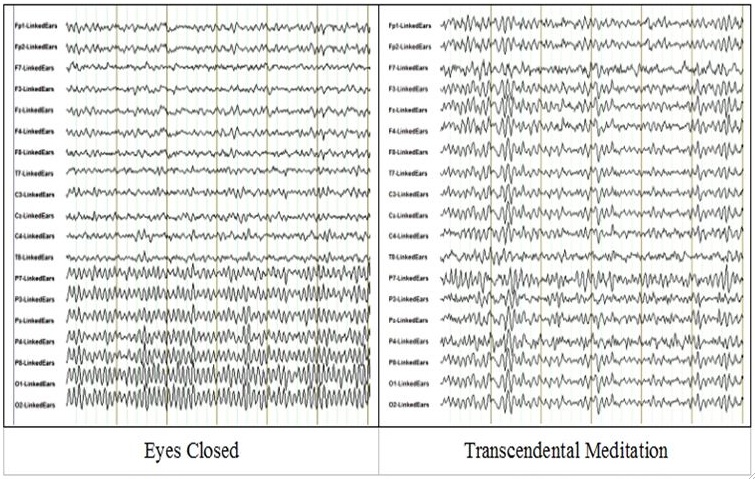
  • Produces a unique state of “restful alertness,” as seen in the markedly higher alpha power in the frontal cortex and lower beta and gamma waves in the same frontal areas during TM practice.
  • Creates greater alpha coherence between the left and right hemispheres of the brain suggesting the brain is working as a whole.
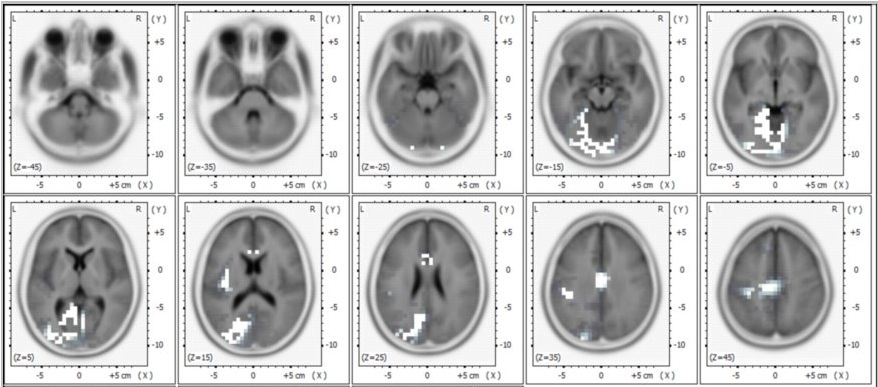
  • Enhances an individual’s sense of “self” by activating what neuroscientists call the “default mode network” in the brain. (This is considered the natural ground state of the brain, glimpsed by neuroscientists during eyes-closed rest but more fully activated during Transcendental Meditation practice.)

“The finding of significant brain wave differences between students practicing the Transcendental Meditation technique and those simply resting with their eyes closed is especially convincing because subjects were randomly assigned to conditions, and testing was conducted by a researcher unaware of the experimental condition to which the subject had been assigned,” said David Haaga, Ph.D., coauthor and professor of psychology at American University.

“Research has already shown that simply closing one’s eyes and relaxing increases the default mode. A significant additional finding of this new study is that activity in the default mode increases during TM compared to simple eyes-closed rest,” said Fred Travis, Ph.D., lead author and director of the Center for Brain, Consciousness, and Cognition at Maharishi University of Management. “Different meditation techniques entail various degrees of cognitive control. Thus, activation patterns of the default mode network could give insight into the nature of meditation practices.”

Previous published research, funded by the NIH, shows TM practice decreases high blood pressure, atherosclerosis, cholesterol, stroke, and heart failure.

Comparative EEG Tracings

These raw EEG tracings during eyes-closed rest (left) and Transcendental Meditation (right) represent 18 tracings over 6 seconds. The top tracings are from frontal sensors; the middle tracings are from central sensors; the bottom tracings are from parietal and occipital sensors [back]. Note the high-density alpha activity in posterior leads during eyes-closed rest, and the global alpha bursts across all brain areas during Transcendental Meditation practice.

eLORETA Images of Significance Differences

These are eLORETA images of sources of alpha EEG during TM compared to eyes-closed rest in the default mode network (the white areas).

Images credit: Cognitive Processing, Volume 11 (2010), Issue 1

Article title: A self-referential default brain state: patterns of coherence, power, and eLORETA sources during eyes-closed rest and Transcendental Meditation practice, DOI: 10.1007/s10339-009-0343-2. Also on PubMed.

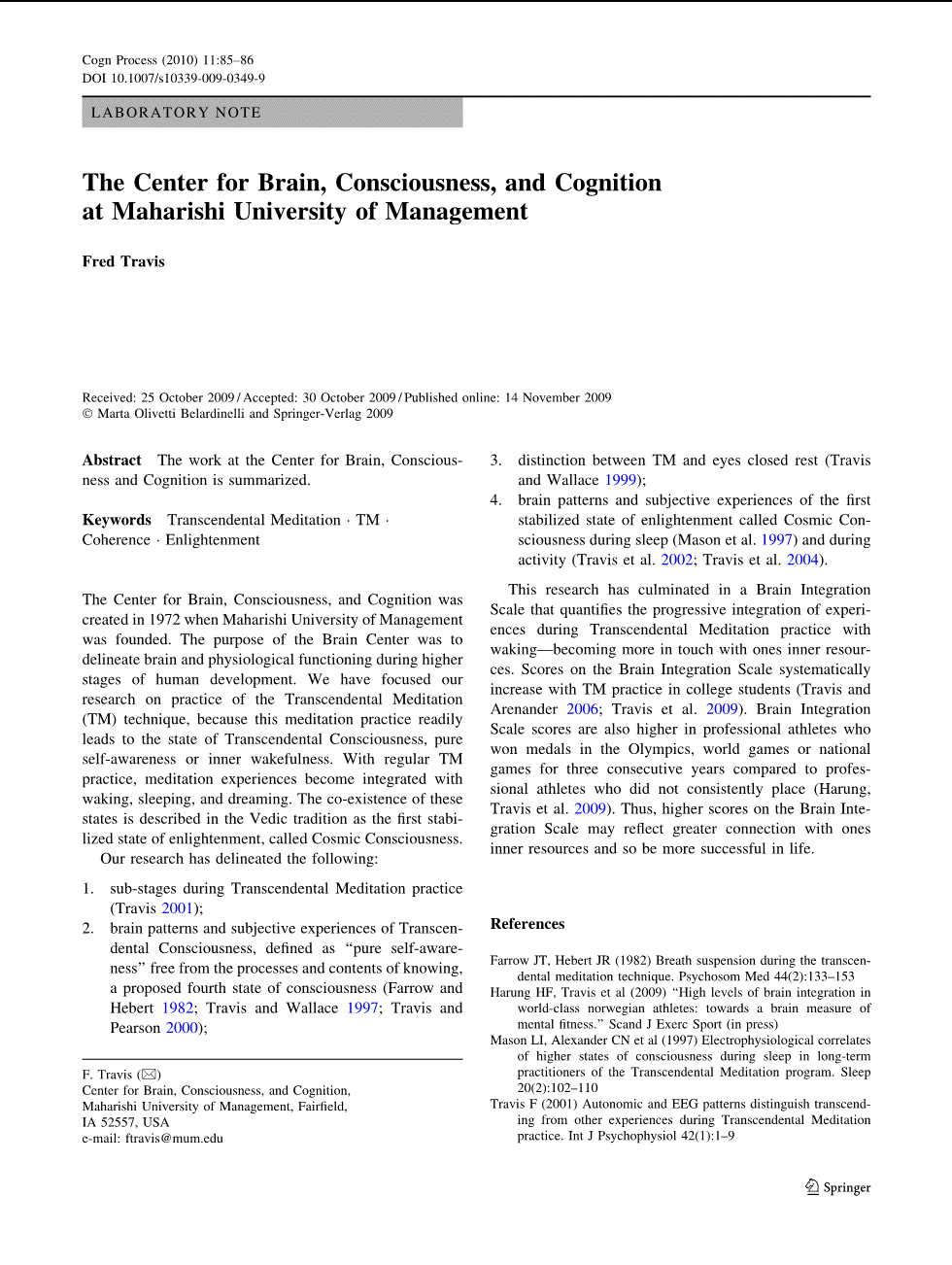
Laboratory Note: The work of the Center for Brain, Consciousness, and Cognition at Maharishi University of Management is summarized and featured in this same issue: