
Archive for the ‘Education’ Category

THP: Keeping Your Prefrontal Cortex Online: Neuroplasticity, Stress and Meditation

August 12, 2010

Keeping Your Prefrontal Cortex Online: Neuroplasticity, Stress and Meditation

As we go through life, our brain is always changing and adapting, say neuroscientists. During the first 18-20 years of life the brain is developing circuits that will form the basis of decision-making for a lifetime. Brain researchers have found that unhealthy lifestyles can inhibit normal brain development in adolescents and lead to impaired judgment and destructive behavior that carries over into adulthood. Traumatic experiences, alcohol and drug abuse, growing up neglected in a broken home, living in fear of violence and crime, or even a bad diet can interfere with development of the frontal lobes, the brain’s executive system. This can cause behavioral problems. Brain researcher Dr. Fred Travis explains: “When a person’s frontal lobes don’t develop properly, he lives a primitive life. He doesn’t — and can’t — plan ahead. His world is simplistic, and he can only deal with what’s happening to him right now. Thinking becomes rigid: ‘You’re either with me or against me,’ or ‘Me and my gang are good, and everyone else is bad.'”

The good news: meditation improves brain function

Brain researchers have also found that the brain can be changed in a positive direction through healthy lifestyle choices. This ability of the brain to reorganize its network of neurons is called “neuroplasticity.” Studies recently published in Cognitive Processing show that brain development can be enhanced — not only during adolescence but at any age — through the practice of meditation, and that different meditation techniques have different effects on the brain. For example, during the Transcendental Meditation (“TM”) technique there is increased alpha coherence in the brain’s frontal areas. “Within a few months of practice of the TM technique,” says Travis, “we see high levels of integration of frontal brain connectivity. And interestingly, that integration does not disappear after meditation. Increasingly and over time, this orderly brain functioning is found in daily activity.”

When the different parts of the brain are better integrated they work together more harmoniously — our brain is healthier. Higher levels of brain integration are associated with higher moral reasoning, emotional stability and decreased anxiety, according to a 1981 study in the International Journal of Neuroscience. Research shows that world-class athletes have higher brain integration than controls. Brain integration is important because one’s environment and circumstances are constantly shifting, and you need a flexible, integrated brain to successfully evaluate where you are, where you want to be and the necessary steps to get there.

Keeping your prefrontal cortex “online”

The prefrontal cortex — said to be the brain’s executive center or “CEO” — plays a crucial role in higher judgment, discrimination and decision-making. When we are overly tired or under intense mental, emotional or physical stress, our brain tends to bypass its higher, more evolved rational executive circuits, defaulting to more primitive stimulus/response pathways. We respond to challenges without thinking, making impulsive, shortsighted decisions. When the brain’s CEO goes “offline,” strong emotions such as fear and anger can adversely color or distort our perception of the world. Interestingly, the brain’s crucial frontal area is where the highest levels of EEG coherence are typically recorded during TM practice, indicating improved communication between the prefrontal cortex and other parts of the brain.

When a person transcends during meditation (goes beyond the active levels of the mind), the experience is commonly reported as a state of deep silence and inner wakefulness, without particular qualities or attributes — just pure consciousness. According to research studies, such as the previously mentioned study in Cognitive Processing, it is this ‘transcendental’ experience that creates the more efficient, integrated brain functioning seen during TM practice. While focused attention and other mental processes activate local brain areas, the experience of transcending activates the whole brain, enabling different parts of the brain to function together better as a whole.

Helping kids grow healthier brains

Fortunately, transcending is easy — we’re hardwired for it. With proper instruction and right practice, anyone can do it, including students with ADHD. Experiencing the quiet, transcendental field of orderliness deep within the mind doesn’t mean conjuring up a new outlook on life or accepting new beliefs, nor does it require an attitude change. It’s a natural, universal experience that produces a healthy response in the brain.

With help from the David Lynch Foundation and other private benefactors, thousands of at-risk students are now learning meditation during structured, in-school programs around the world. Researchers monitoring the results are finding that meditation improves learning ability, memory, creativity and IQ. Findings such as these may be opening a new frontier of research — establishing an expanded, more enlightened view about what is possible for the human brain.

VIDEO of Dr. Fred Travis, Director, Center for Brain, Consciousness, and Cognition in Fairfield, Iowa: Brain Plasticity and Transcendental Meditation with Dr Fred Travis.


Read More: Meditation, Neuroplasticity, Transcendental Meditation, Living News

Also see: THP: How Meditation Techniques Compare

Good article about meditation

August 12, 2010

Learning Meditation

Posted on Megapremium.info, a free press release and article directory
10.08.2010 | Author: Nick | Posted in Education

According to some polls, 10% or more of all US citizens now run through some type of meditation. People of all ages, including ten-year old kids in their schools, are closing their eyes and going inward for self-development.

Reasons for education to meditate vary widely: relief from stress seems to rank high on the list, but improved health ranks as a very close second reason. During the much-sentimentalized 1960s, meditation became famous largely due to Maharishi Mahesh Yogi and the popularity of his Transcendental Meditation (TM) program. Maharishi was canny enough to take his authentic, ancient practice and have modern science verify its benefits. Thus began the introduction of meditation and the quest for enlightenment in the modern, scientifically oriented west, although both had long been intrinsic to culture in the east.

Once Transcendental Meditation courses became widespread, the media began reporting about it. After celebrities, like the Beatles, Donovan, and later Merv Griffin and Clint Eastwood, talked publicly about their benefits from the TM technique, other schools of meditation sprang up like wildflowers. Every time you turned around a would-be guru was touting his or her path, none of them significantly scientifically researched, but offering a myriad of results nonetheless. Eventually the phone book was filled with choices, publications on yoga and on meditation filled the shelves in bookstores, and your next-door neighbor’s eighteen-year old hung out a shingle and taught you to focus on your breath.

So what is it all about? According to the more profound texts about meditation, its purpose is to unite the conscious mind with the universal cosmic basis of life. This is the pure form of Yoga, which in Sanskrit, means union. The experience of transcending relative phases of perception to experience silent, absolute, non-changing existence is open to all, according to the texts and teachers. The value of this supreme realization of the silent Infinite is found in the finite routines of daily life. Self-realization becomes self-actualization—greater energy, intelligence, creativity, compassion, tolerance and bliss–when we open our eyes after meditation. The results are worth the trip down the path—it is just a matter of which is the most effective path.

According to some scholars, techniques that involve concentration can tire the mind and not produce the transcendent state that one desires. Although the transcendent state finds the mind highly concentrated, it is not the technique of concentration that is the means to that end. Methods that involve focus or concentration keep the mind bound and active in individual perception, disallowing unboundedness.

Contemplative practices, such as visualization, prayer, mindfulness and any method that involves letting the mind wander or involves being attentive to the wandering mind, all keep the mind actively engaged in thought. This is counter-productive to transcending thought.

One of the reasons the TM technique continues, for example, to be widely practiced is that it doesn’t fit into either of the categories discussed—it is neither contemplation nor concentration, and therefore easily adapted by persons of varied natures, ages, personalities and intellectual capacity. Because it involves neither religion nor philosophy nor change in lifestyle, it appeals to those who wish a secular self-help approach to self-development. Although no meditation program offers a quick fix, some are more likely to deliver tangible benefits more quickly.

If you are looking for the whole kit and caboodle—a package of belief, lifestyle and doctrine—every religion from Christianity to Buddhism has a meditation component. It may not be your preference to change your lifestyle and belief system, so do your research before engaging in something that might be far too consuming for you. The Internet has endless information (and misinformation) as does your local library and bookstore.

Whether you call it Nirvana, the Tao, the Self, or the Kingdom of Heaven Within, it is real; please enter.

The Green Parent: “Balancing the brain”

August 9, 2010

Here is a wonderful article, Balancing the brain, from the August/September issue of The Green Parent magazine. The article is based on a talk given in the UK last year by Fred Travis, PhD, brain researcher, and director of the Center for Brain, Consciousness and Cognition at Maharishi University of Management in Fairfield, Iowa, USA. Written by David Hughes, it explains how a child’s brain benefits from the practice of the Transcendental Meditation technique. “The technique promotes a balanced brain and thus a stable child, well prepared to deal with the challenges of a rapidly changing world without picking up stress.” Since this issue of the magazine is not yet available online, here is a PDF of the cover and the article with photos: TM_TGP36

Conscious TV: John Hagelin – The Core of Nature

July 30, 2010

Science – Dr John Hagelin – ‘The Core Of Nature’ – Interview by Iain McNay (watch this programme) Author of “Manual for a Perfect Government“, John Hagelin, Ph.D. is a quantum physicist and leading proponent of peace. Stood for President of the US in 1990 and received over 2 million votes. Conducted pioneering research at CERN (the European Centre for Particle Physics) and SLAC (the Stanford Linear Accelerator Centre). His scientific contributions in the fields of electroweak unification, grand unification, super-symmetry and cosmology include some of the most cited references in the physical sciences. He is also responsible for the development of a highly successful Grand Unified Field Theory based on the Superstring. Dr Hagelin is therefore at the pinnacle of achievement among the elite cadre of physicists who have fulfilled Einstein’s dream of a “theory of everything” through their mathematical formulation of the Unified Field, the most advanced scientific knowledge of our time. Dr Hagelin is currently Director of the Institute of Science, Technology and Public Policy, a leading science and technology think tank, and International Director of the Global Union of Scientists for Peace, an organization of leading scientists throughout the world dedicated to ending nuclear proliferation and establishing lasting world peace. John talks about his life, his work and the benefits of meditation. Visit Dr John Hagelin’s website: http://www.hagelin.org. Watch John Hagelin on Conscious TV.

Other videos worth watching: John Hagelin, Ph.D., Speaks on the Nature of Consciousness and the Universe | Dr. John Hagelin: Look Within to Understand the Universe | John Hagelin — “Only Higher Consciousness Can Transform Our World” — Beyond Awakening Blog.

KTVO News: Solar power at Maharishi University

July 22, 2010

Solar power at Maharishi University

by Matt Buhrman

With a flip of the switch, solar power is taking over one construction site in the Heartland.

FAIRFIELD, IOWA — Fairfield Mayor Ed Malloy and State Representative Curt Hanson (D-Fairfield), officially started the solar electricity of the Utility Cottage at Maharishi University on Thursday afternoon.

The renewable energy will be used to power all the equipment needed to complete construction on the university’s new Sustainable Living Center (SLC).

The SLC will set a new standard for green building in America by being completely off the grid with respect to electricity, heating and cooling, water, and waste…and it is the first of its kind on any campus in the world.

“As much as we are very excited about what we mark today, we know that in the very near future this will be commonplace. But let this building be a great demonstration model in the meantime to show others how this is done,” Mayor Malloy said.

“Use this as a learning tool and learn from the experiments that are taking place in this building, and perhaps get more of us off the power grid, more of us off foreign oil, more of us energy efficient,” Representative Hanson said.

The SLC will serve students in the university’s Sustainable Living major. Among its features, the building will have classrooms and workshops.

“I know that our future leaders that will really influence education, politics, and society at large are going to be studying and training in this building, at this university. And for that we are very fortunate, and I am very proud,” Mayor Malloy said.

“Hopefully it’s going to be studied by a lot of engineers all over the United States and maybe we can export some of these ideas to the whole nation. So I’m very happy to be here and learn more about this cutting-edge technology,” Representative Hanson added.

Also recognized on Thursday afternoon were students and other community leaders who played a major role in this green initiative.

Video is courtesy of KTVO Television and heartlandconnection.com

Solar Energy to Power Completion of MUM’s Sustainable Living Center

Solar Energy to Power Completion of MUM’s Sustainable Living Center

July 19, 2010

Maharishi University of Management

MUM to Launch Renewable Energy System

Solar panels provide power to complete construction of Sustainable Living Center


Photo credit: Robbie Gongwer

Fairfield, Ia, July 20, 2010 – On Thursday, July 22, at 2 pm, Fairfield’s ‘green’ mayor, Ed Malloy, will flip the switch on the solar electricity of the Utility Cottage to use only renewable energy to power all the equipment needed to complete construction of Maharishi University of Management’s (MUM) new Sustainable Living Center. (SLC)

The Sustainable Living Center will set a new standard for green building in America by being completely off the grid with respect to electricity, heating and cooling, water, and waste, and will be the first of its kind on any campus anywhere in the world.

On Earth Day, Whole Tree Posts and Beams were put in place, walls were tilted up, and roof trusses were placed on top of them. The entire shell of the building is now complete and is expected to be ready for occupancy in late fall.

Four Building Philosophies

The Sustainable Living Center features four green building philosophies. It has been designed to meet the Living Building Challenge, the highest standard for sustainable design and green building in the world. It will be one of the first three to achieve this. And it will be unique because it will be the first to combine that standard with the standards of LEED Platinum certification, Building Biology, and Maharishi Vedic Architecture.

Architects talk about 2030 as the year when all buildings will be built this way, sustainable and without a carbon footprint. But MUM is doing it now, with existing technologies and materials. “There’s no other building like this going up in the nation, or in the world for that matter, that we know of,” said nationally known green building expert Mike Nicklas, FAIA, founder and president of Innovative Design, the building’s Project Architects.

To date, Innovative Design has designed over 4750 buildings and more than 100 schools that use renewable energy solutions. Mike Nicklas is the Technical Architect for this project, and Jon Lipman, AIA of Fortune-Creating Buildings, is the Design Architect. Mr. Lipman was responsible for the initial concept, and for the design and Vedic architecture throughout the project.

A Building That Teaches

The Sustainable Living Center will serve students in the university’s Sustainable Living major. It will have classrooms, workshop, meeting room, greenhouse, kitchenette, research lab, recycling center, and offices, as well as east and west covered verandas and a porch on the north.

It has been designed as a building that teaches. In addition to embodying sustainability, it will allow students to monitor performance and energy efficiency and make adjustments.

“The Sustainable Living Center will be a living, evolving building,” said David Fisher, head of the MUM Sustainable Living Department, who helped plan the building. “The building itself is an educational tool, not just a passive one like most classroom buildings. It will provide participatory education where students will be continually adding to, or altering, the building and grounds as well as systematically checking its effectiveness.”

Off the Grid

The Sustainable Living Center will be completely off of the energy and utility grid. Every feature will exemplify healthy and sustainable green building — and will be geared to teaching those principles.

Construction uses all non-toxic materials from local sources, as defined by the Living Building Challenge requirements. All energy will be provided from solar panels on the building and from an outside wind turbine. Rainwater catchment will be the complete source of the building’s water, with purification of drinking water via ultraviolet technology. Wastewater will be treated onsite using a constructed wetland. Natural day lighting will illuminate the entire interior. Geothermal technology will assist with heating and cooling.

An Embodiment of Sustainability That’s Feasible and Practical

This achievement is remarkable because none of the systems in the building are new or experimental, according to developer and construction manager Dal Loiselle. “The Sustainable Living Center is being constructed using ‘state-of-the-shelf technologies,’” he said. “This building proves that we can meet our environmental goals for our built environment with the materials, technologies, and green building protocols we already possess.”

A Community Oriented Toward Sustainability

Sustainability has become a major focus at Maharishi University of Management, which has long used techniques for living in harmony with natural law, including the Transcendental Meditation technique and other Vedic technologies including Vedic Architecture. The University has filed a climate action plan to be 100% carbon neutral by 2020 as part of the American College and University Presidents Climate Commitment.

Fairfield, too, has taken a strong direction toward sustainability, hiring a sustainability coordinator and moving ahead with its Go Green Strategic Plan to become a sustainable city. In 2009, MSN.com named Fairfield Mayor Ed Malloy as one of the nation’s 15 greenest mayors — alongside the mayors of New York, Seattle, San Francisco, Chicago, and Salt Lake City.

“Our city will benefit enormously by having this building on the campus of MUM as a demonstration of a new standard of design and will reinforce our commitment in Fairfield to changing the culture towards a more sustainable future,” Mayor Malloy said.

Industry-Educational Partnerships Industry leaders in green technologies provide sponsorships

The Sustainable Living Center features four green building philosophies, is entirely off grid and has amassed an impressive list of leading corporate sponsors. These industry-educational partnerships showcase a new level of leadership, cooperation and sustainable capitalism unique to green building and sustainable development within the state, nation and world at large.

The Sustainable Living Center has benefited by in-kind donations from these nationally recognized leaders in green building materials: Serious Materials (high performance windows); Pittsburgh Corning (FoamGlas insulation); Gerdau AmeriSteel (rebar); United States Gypsum Corporation (Aqua Tough-paperless drywall); Green Building Supply; SpiderLath Inc (lath mesh to support exterior stucco); and GlobalWatt (PV panels).

GlobalWatt is excited about participating in this special project and is proud to be a Platinum Sponsor. MUM SLC will be one of the very first customers to receive PV panels off the line at their new Saginaw, Michigan manufacturing plant, a former automotive facility. “We are pleased to partner with MUM on this historic educational green building,” says GlobalWatt Director of Sales, Dave Slivinski.

Wege Foundation Grant

There seems to be a Michigan connection here. With GlobalWatt in Michigan, the Kresge Foundation is headquartered in metropolitan Detroit, in the suburb community of Troy, Michigan. They provided MUM with a Planning Grant, and possibly an upcoming Challenge Grant.

Another Michigan foundation, the Wege Foundation, provided a $100,000 grant to fund the Maharishi University of Management Sustainable Living Center to help it achieve the Living Building Challenge. Peter M. Wege, who built Steelcase, Inc. into the largest office-furniture manufacturer, is an environmentalist who founded the Wege Foundation to promote environmental activities primarily in Grand Rapids, Michigan, where Steelcase, Inc. is headquartered. The board of the Wege Foundation made an exception and funded the MUM SLC in Fairfield, Iowa because it is a nationally significant sustainable building. This is the largest Foundation grant the Maharishi University of Management Sustainable Living Center has received to date. In appreciation for this gift the University will name the largest classroom in the Sustainable Living Center, the Peter M. Wege Classroom and Event Center.

The Building will also be a showcase for the public, and will feature meeting rooms, a real-time energy and renewable systems monitor, and displays of materials and building systems featured in the building to showcase partnerships with leading technologies and materials manufacturers. For more information please contact: Marco Sunseri @ 641-472-7000 x2449.

Available for media interviews: Sustainable Living department head David Fisher, construction manager Dal Loiselle, Fairfield Mayor Ed Malloy, and design architect Jon Lipman, AIA. Contact Ken Chawkin, Director of Media Relations.

• • •

Also available here: http://www.mum.edu/sustain/slc and http://www.prweb.com/releases/2010/07/prweb4290894.htm

See KTVO News Report: Solar power at Maharishi University With a flip of the switch, solar power is taking over one construction site in the Heartland. http://www.youtube.com/watch?v=cU69q2P_R4c

Miraculous Turnaround in a Stressed Israeli Arab High School after Implementing the TM Program

July 19, 2010

The Second Miracle of Daburia

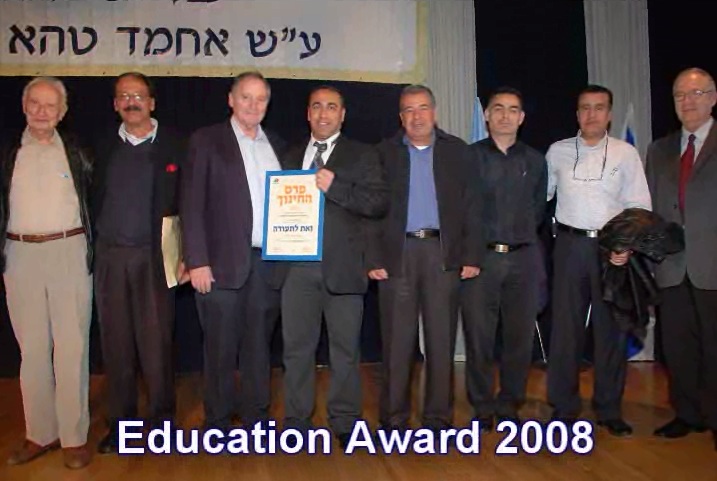
On July 14, 2010, Maharishi’s Global Family Chat included a special broadcast on News from Israel involving the Transcendental Meditation program. Dr. Reuven Zelinkowsky reported on the success of implementing the TM porgram in the Daburiya High School, an Arab school in Israel that was about to close due to poor academic performance by the students and problems in the school. After the TM program was implemented, there were dramatic improvements in all areas including the school achieving 2nd place in the National Education Award in 2008 and placing 3rd in the National Education Award in 2009. This is the first time that any school in Israel received the award in two consecutive years.

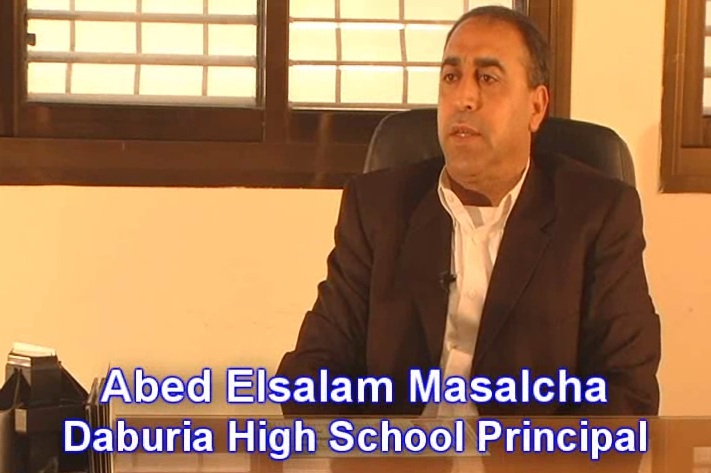
The principal of the Daburia High School, Abed Elsalam Masalcha, explained why his school received the 2008 National Education Award. He said it was because of the way they tackled the discipline problem—with meditation. “Meditation is at the core of everything we did.” He went on to elaborate how using the Transcendental Meditation program addressed and solved the core problem of disciplining a student’s behavior.

We have seen that in order to change the student’s behavior, or to overcome the discipline problem, we need to change something within the students. What I mean to say that it is not enough to make rules and try to make everyone follow them. In fact you don’t change their behavior at all. That is why we adopted meditation. So practicing meditation, the students will start to really change. Not just for a year, or two or three. We are giving the student the possibility, that throughout his life, he will not only succeed at school for a short time, but through the meditation, also succeed throughout his life.

When the school received the 2009 National Education Award, the committee justified its decision with these words:

The award was given to the school for its program in preventing violence and improving the school’s environment based on the Consciousness-Based Education program. This Consciousness-Based Education program is based upon the development of both students and teachers abilities and uncovers the unlimited creative potential of the human being. The program prevents the problems by tackling them at the root and provides the base for actualization of both the scholastic aspirations of the students, teachers and parents.

The most important element of the Consciousness-Based Education program is the Transcendental Meditation program. It is a simple, natural, mental technique that improves behavior and the ability to learn. It elicits success and enjoyment in learning, creates a focused atmosphere in the classroom, improves academic achievement, increases self-esteem, reduces violence and chaos and increases teacher satisfaction in their work.

The teachers, school board and parents are involved at all levels of the program and closely follow the process in the school.

You can also view the Daburiya High School video, The Second Miracle of Daburia here: http://www.cbe.org.il/video/daburia_jE.wmv. The You Tube short link is: http://bit.ly/bYF6On. If you wish to download the actual video go to: http://www.cbe.org.il/video/cbe.htm. This miracle is happening in hundreds of schools around the world. For details visit www.davidlynchfoundation.org.

ABC News/Nightline: Transcendental Meditation in Vedic City, Iowa

July 6, 2010

Transcendental Meditation Thrives in Iowa

Adherents of Transcendental Meditation Have Called Hawkeye State Home Since ’70s

By JOHN BERMAN and MAGGIE BURBANK

July 5, 2010 —

Travel to an Iowa cornfield to find an entire town that meditates en masse. More Photos

When you think of Iowa, you think of cornfields, you think of caucuses, you think of old-fashioned country-living.

Chances are, you don’t think of meditation and communal living.

Welcome to Maharishi Vedic City, Iowa — the only city in the country built on the tenets of transcendental meditation, for meditators, by meditators.

Meg and Erik Vigmostad moved here from St. Louis in 1982.

“We wanted to come to a meditating community,” said Meg Vigmostad. “We had two children at the time, one of them was an infant, and we felt like it was the best place to bring up our children.”

Watch the full story tonight on “Nightline” at 11:35 p.m. ET

Vigmostad acknowledged that the couple’s families thought they were “crazy” for making the move. Crazy, because those words, “transcendental meditation,” sound, well, different. Many people first heard of transcendental meditation, or TM, in the 1960s, when the Beatles started following Maharishi Mahesh Yogi, the official founder of TM.

“Transcendental meditation is a simple technique practiced for about 15-20 minutes sitting comfortably in a chair with the eyes closed,” said Bob Roth, national director of the TM program. “It allows the body to get a profound state of rest while the mind just settles down and experiences a state of inner wakefulness, inner calm, inner coherence.”

The followers of Mahesh Yogi — mostly from East and West Coast universities — moved to Iowa en masse in 1974 to set up their own college, the Maharishi University of Management. The group chose Iowa because that is where they could find the land.

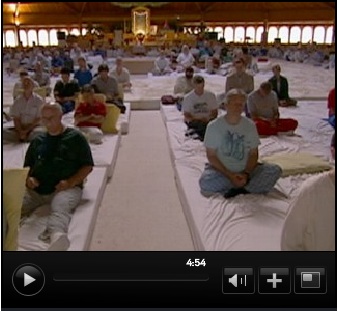
Now the settlement features two huge domes, one for men and one for women, with residents streaming in to meditate together twice a day.

But at the university and in the city, the commitment to Vedic principles of natural law and balance, derived from ancient Sanskrit texts, goes far beyond meditation. The community has banned the sale of nonorganic food within its boundaries. And that’s not all.

“The primary characteristics of Vedic architecture, the most obvious one, is that ideally, buildings face east, the direction of the rising sun,” said Jon Lipman, the country’s leading Vedic architect.

‘Greater Happiness’

Lipman says the buildings at the university and most new houses in town are constructed in line with ancient precepts.

“Just like the organs in the human body, there is a right place for different kinds of functions within a building,” Lipman said.

“And so, a kitchen is typically in one location. A living room in a house is typically in another location.”

Every Vedic building has a silent core known as a Bramastan, which is lit by a skylight and is never walked on. Lipman claims miraculous effects.

“The results are that, families find that their lives are improved, that there’s greater family harmony, that there is greater financial success, there’s greater happiness,” said Lipman. “There are many many cases where members of a family had disharmony between them, and it dissolved when they moved into a Vedic home. There are many cases where even such things as chronic diseases were abated by moving into a Vedic home.”

Lipman said “it’s a real challenge” to be poor, unhappy or unhealthy if you live in a Vedic building.

The Vigmostads live in a Vedic house, and seem like happy customers.

“It feels harmonious, it feels orderly, there’s a lot of silence here that was definitely not in our other house that we owned,” said Meg Vigmostad.

The talk of order and inner peace might sound unbelievable. But it is also the work of Vedic City to make it all … believable. Fred Travis, director of a university facility called the Center for Brain Consciousness and Cognition, demonstrated an EEG monitor of neurological electrical activity that he said shows that TM makes the brain more organized.

“What this is measuring is the electrical activity of the brain,” Travis explained as a member of the community hooked up to the machine sat and meditated.

“You see this one going up and down?” Travis said, pointed to a gauge. “Look at the one next to it. It goes up and down in a similar way. This is called coherence. When the similarity of two signatures are very close, it suggests those two parts of the brain are working together.

Neurologist Gary Kaplan, a proponent of TM, said such “coherence” will bring happiness, success — even world peace.

“What we notice is that this electrical activity becomes more harmonious or coherent between left and right hemispheres,” Kaplan said. “There have been studies that have documented that the TM technique, when practiced in large groups, seems to have some effect on society in general, whether it’s in war-torn areas where people are sitting to meditate together, or in high-crime areas that the trends reverse when you have larger groups meditating together.”

David Lynch and TM

It is a lot to digest — but then you don’t really have to. The TM followers insist they are not a cult. They all have normal jobs, for the middle of Iowa, and they are not out to recruit you. They just want you to know the option is there.

Famed filmmaker David Lynch spends a lot of time in Vedic City. He started the David Lynch Foundation, which, in the last four years, has provided scholarships for over 100,000 kids to learn to meditate for free in schools across the country.

“It’s not a religion. It’s not against any religion, it’s not mumbo-jumbo. It truly does transform life,” Lynch told ABC News. “Kids come to school and they meditate together for 15 minutes in the morning. And before they go home they meditate for 15 minutes. A lot of them come from, you know, bad situations, and so this gives them this thing you know, at the beginning and the end of the day, the rest of the time you just watch the violence stop. Watch relationships improve. Watch happiness in the hallways, in the classroom, watch creativity flow more and more, watch that heavy weight that we are living under gently lift away.”

“Nightline” was told there wasn’t enough time to properly learn transcendental meditation on a short trip to Vedic City. But to get a feeling of the Vedic way of life, we did visit the Ayurveda Health Spa in Vedic City — the leading spa of its kind in the country. Ayurveda is a system of health and healing involving food and behavior that originated in India thousands of years ago.

“We take your pulse, we put three fingers on the right hand,” explained Mark Toomey, an Ayurvedic health expert at the spa. “And it’s what I would say is like plugging into the inner intelligence of the body.”

Toomey said he can learn a lot from feeling a person’s pulse. He demonstrated on our correspondent.

“It’s a strong pulse,” Toomey said. “That means that, good expression of intelligence. It’s clear. Your pulse has a little bit of tension there, so maybe you’re working a little too hard, too many deadlines.”

Next up was the Shirodhara treatment.

“So what we’re going to be doing is pouring this oil for about 20 minutes on your forehead, in a continuous stream,” said Toomey. “Your job is just to relax and enjoy.”

And what’s so wrong with that? In Vedic City, they have made that their way of life … in the middle of Iowa.

“We really have all we need here,” said Meg Vigmostad. “You can go to a city anytime. But this is sort of a haven, you know? And it’s a place of comfort, and community.”

Copyright © 2010 ABC News Internet Ventures

This edited version finally aired: http://bit.ly/cDxWqj and was posted earlier this year: http://wp.me/pD0BA-Gp

The Connexion, France’s English-Language Newspaper, interviews David Lynch

June 27, 2010

David Lynch’s French connections

Connexion edition: May 2010

FRANCE has been kind to David Lynch; he’s an officier of the Légion d’honneur (a rare thing for a foreigner); French production companies have supported his last three films and he has twice won best foreign director from the French-based César cinema awards. The feeling is mutual he tells Connexion.

You’re quite a frequent visitor to France

This is one of my favourite places in the world. I’ve had a lot of support in France for my films and I love Paris. I’m doing a lot of work here now. I’m here on average maybe twice a year.

Do you see much of the rest of the country at all?

Well, when I go to the Cannes Film festival I see the south of France but mainly I’m coming to Paris. I stay in a hotel here.

Would you like to live here?

For sure, if I have the money I’d like to get a place here. It would be in Paris. I’m doing a lot of lithographs here. I’m working in a place called Idem Print Studio. It’s incredible – a 150 year old printing shop. It’s the real thing. It’s got a mood you can’t believe.

You’ve had exhibitions here as well

Yes I had a big exhibition at the Fondation Cartier and a big exhibition of lithographs in the north of France.

When did you first visit France?

My first trip was 1965. I came here with my friend Jack Fisk. I was kind of lost and just travelling around.

What were your first impressions?

Paris is I think the most beautiful city in the world. It’s inspiring to me. It’s a place that’s just packed with all the arts. It’s a great, great celebration of all the arts. It’s just got the feel.

Has it ever inspired any scenes in your films?

(pauses) Let’s see. I don’t know. I don’t think so…but it’s still inspiring.

You made The Cowboy and the Frenchman in 1988 for a project with Le Figaro (The French as seen by…) Have your opinions changed much since then?

We live in a world of change. Everything is always changing but that film was kind of a cliché – both an American and French cliché film and there’s probably still truth to that.

What would you say about the French away from the clichés then?

Well as I said, they’re lovers of art. They champion the arts more than any other country in the world, they support the arts more than any other country I think, and this is very important to me. Plus they’ve got great food, great wine, incredible knowledge of materials and design. It’s a really high-end life.

Do you have any particular things that you like to do when you’re in France?

I like to work.

Is it always work or do you get to relax here?

I usually come to work and that’s the most enjoyable thing. I don’t really like vacations. I like to work here a lot.

Who are your influential French figures?

I like so many of the artists that work in France. When you come here and connect the place to the work, you see that it must have been so inspiring for them to be here. It sort of feeds the work this place. It’s a great country to live the artlife.

Would you ever make a film here?

For sure, if the ideas came. You don’t just arbitrarily say ‘I’m going to make a film in Paris.’ The ideas have to come and then if the ideas came and Paris was the setting, then absolutely, it would be a joy.

There’s some bits of French that makes their way into your films. Do you have any affinity for the French language?

No I don’t speak French. I just murder the language.

Why choose to use French?

Things appear from ideas. You don’t just say I want some French here. Ideas come along and who knows exactly how that happens but they come along and then there it is.

So it’s like there’s a little bit of France swimming around out there?

There’s everything swimming around and sometimes that will conjure an idea, that’s how it all goes. Ideas, ideas, ideas.

Do you have any particular favourite foods in France?

Oh yes, I like the foie gras. I like vin rouge Bordeaux. I like all the French pastries and I like the galettes. It’s hard to get a bad meal in France.

What’s brought you and your meditation project to France?

The David Lynch Foundation for Consciousness-Based Education and World Peace has helped start well over 100,000 students to meditate. It’s in several schools in US, both private and public. Some of these were the worst schools in their state and in one year the schools had been completely changed. It’s not just France it’s in so many countries now. There’s a project in the West Bank in Palestine, in Africa, many countries in Europe, Iceland, Canada.

What’s the connection that’s brought you to Lille?

The Maharishi Mahesh Yogi came over to Lille, 50 years ago this month. It’s a celebration of him coming to France.

How do you feel Transcendental Meditation (TM) is received in France as opposed to the US?

France and Germany will probably be among the last countries where the penny drops and they say ‘wait a minute this is a great thing’. I base that on many, many misunderstandings. The misunderstanding of this world ‘cult’ or ‘sect’ which is very unfortunate. This is absolutely not true. It’s not a religion or against any religion. It’s a technique, an ancient form of meditation for the human being that opens the door to the treasury within; unbounded, infinite eternal consciousness. Life improves almost over night when people experience ‘the big self’ – the unified field within. The lack of knowledge and misunderstandings are ridiculously huge here.

But little by little they’re saying there’s got to be something to this. In other places the misunderstandings have almost disappeared and it’s a normal thing for people to meditate in schools, in homes, wherever. It’s as normal as breathing and life improves rapidly. The world is full of stress and this is a stress buster beyond the beyond. All these stress related illnesses that people suffer, so much of the behaviour is dictated by stress – you practise this thing and it frees you from stress.

Grades go up, relationships improve, health improves. Everything gets better.

The main sticking point for France is not the meditation aspect but the money aspect – how would you respond to critics?

That’s another crazy thing. People will spend money on almost anything but when it comes to meditation they say it’s a scam. It’s because they haven’t yet had the experience or they don’t see the change in one of their friends who’s had this experience. Once they start seeing this transformation in other people they realise that this is nothing to spend for this life transforming thing. The money they save from the doctors is going to be huge. You want a legitimate teacher of Transcendental Meditation and it’s about 90 mins a day over four days to learn the technique. The teachers, they need to live and have a place to stay and a car to drive. It’s so well worth the money there’s nothing to talk about.

You’ve met President Sarkozy – how do you find him?

I love him. I think he’s filled with energy. He’s got a great energy and a great caring for France.

You’ve spoken with him about TM as well. Has he helped you with this project up in Lille?

No, because I think people are not quite ready to go out on a limb and say let’s do this thing because of these strange misunderstandings or lack of knowledge but the times are changing. To experience this is life transforming.

You put it in a school that’s in trouble, you put it into a school that’s in great shape it will just get better. It’s a human being thing.

Awards, art and films

Won the Cannes Film Festival’s Palme d’Or for Wild at Heart in 1990. In 2002 he presided over the festival jury.

Won two Cesar Awards (the French equivalent of Baftas) for Elephant Man in 1982 and for Mulholland Drive in 2002.

He was made a chevalier of the Légion d’honneur in 2002 and then made an officier by President Nicolas Sarkozy in 2007.

Sarkozy says he is a fan, declaring that Lynch’s Elephant Man convinced him that “cinema was a highly important matter”

An exhibition of 25 years of Lynch’s work as a painter, sculpture, photographer and musician entitled The Air Is On Fire went on show in Paris in 2007 at the Fondation Cartier.

From his 2006 book Catching the Big Fish:
“I love the French. They’re the biggest film bugs and protectors of cinema in the world. They really look out for the filmmaker and the rights of the filmmaker, and they believe in final cut. I’ve been very luck that I’ve been in with some French companies that have backed me.”

When American TV channel ABC dropped Mulholland Drive (originally conceived as a series) after seeing the pilot episode it was French production company StudioCanal that provided the funding to turn it into the award-winning film.

StudioCanal also provided funding for Lynch’s Inland Empire and The Straight Story.

Lynch is by no means guaranteed hits among audiences in France. At the Cannes festival in 1992 his film Twin Peaks: Fire Walk with Me was booed following its screening.

Transcendental Meditation – a way for peace that rarely passes quietly

Transcendental Meditation is never far from criticism, principally for its direct approach of charging money for courses instructing people how to carry out the technique. It was founded by the Maharishi Mahesh Yogi in the 1950s and spread around the world as famous faces such as The Beatles, The Rolling Stones, Clint Eastwood, Jane Fonda and Mia Farrow took it up.

In 2005 David Lynch announced that he had been practising the technique for 32 years.

That year he founded the David Lynch foundation to promote meditation in schools. The foundation’s latest project aims to reduce stress and violence at 10 schools in Lille by funding meditation courses for students and teachers.

Milvudes (Mission interministérielle de vigilance et de lutte contre les dérives sectaires) which monitors religions and possible cults in France says their main concern with TM is a “lack of transparency” within the group. Milvudes spokeswoman Claire Barbereau said: “It is presented as a technique for meditation but there is a strong spiritual movement in the background.” She said people could find themselves pushed to adhere to the movements beliefs which were not necessarily linked to meditation.

Ms Barbereau said they had received no complaints about the group for many years. Milvudes does not keep a list of ‘cults’ “because we are concerned with what they do, not what they are.” It was up to the Ministry of Education to see whether the David Lynch Foundation’s plan was an effective way of helping children improve performance at school, she added.

Stephen Collins to give Commencement Address at Maharishi University of Management

June 23, 2010

“7th Heaven” star, Iowa native, returns from L.A. to give commencement address

by Matt Kelley on June 23, 2010
in Education, Human Interest

An Iowa native and Hollywood actor, best known for his role on the long-running TV show “7th Heaven,” will be back in his home state this weekend to give a commencement address. Stephen Collins says he wants to speak to the graduates in southeast Iowa about what he calls counter-culturalism, specifically, how it’s considered not normal to eat healthy.

“It’s difficult, if you’re watching television, to find an advertisement for a food product that’s really good for you,” Collins says. “It’s not impossible, but it’s difficult. Various companies would take me to task on that but to me it’s counter-cultural to be really careful about what you eat.”

The 62-year-old Collins will speak at the graduation ceremony on Saturday in Fairfield at Maharishi University of Management. Collins practices transcendental meditation and says many people consider it counter-cultural to take care of their bodies and not to over-medicate themselves.

Collins starred as Reverend Eric Camden in all 241 episodes of “7th Heaven,” the longest-running TV series on the WB network. It ran from 1996 to 2007. “I loved doing 7th Heaven and I’m proud of it and I’m proud of our wonderful long run,” Collins says. “Whenever I kick off, it’ll probably be in the first sentence, if not the first paragraph of any obituary anybody writes about me, but that’s okay. I have done a lot of other things, but when you do something that runs 11 years, it changes people’s idea about who you are.”

Over three-and-a-half decades, Collins has appeared in more than 60 movies and TV shows, and is now starring in the new ABC series, “No Ordinary Family.” Collins was born in Des Moines, grew up in New York and now lives in Los Angeles — but still considers himself an Iowan.

“I love saying that I’m from Iowa because my mother’s family goes back in Iowa for many, many generations and is kind of a venerable Iowan family,” Collins says. “My great-great-grandfather was a fellow named James B. Weaver who was a Civil War general and a member of Congress and ran for president twice as a third-party candidate.”

Collins considers himself an actor first, but has also written two novels and is a musician. This will be his first college commencement address. Saturday’s graduation at Maharishi University will feature 235 students earning degrees, representing 41 countries.

Hear the full interview: 7th Heaven 6:20 MP3