Archive for the ‘Education’ Category

Russell Brand Interviews Quantum Physicist At David Lynch Foundation Gala

December 6, 2011

DECEMBER 5, 2011, 6:00 PM ET

By Michelle Kung

Russell Brand Interviews Quantum Physicist At David Lynch Foundation Gala

With his manic energy and cheeky vocabulary, British comic Russell Brand hardly seems like a poster boy for Transcendental Meditation.

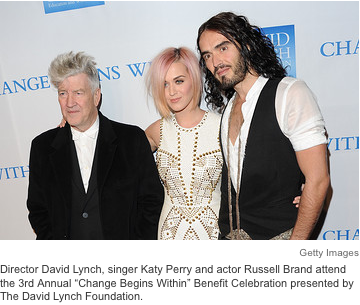
But Mr. Brand, who credits the meditation technique for helping him stay sober, is indeed a practitioner of TM and served as a master of ceremonies Saturday night for the David Lynch Foundation’s annual “Change Begins Within” benefit at the Los Angeles County Museum of Art. He was performing gratis, and hoped his good will would buy him “some wiggle room to act subversively and deviously.”

Mr. Brand was introduced by talk show host Ellen DeGeneres, who Mr. Brand turned onto TM a year ago, and in turn introduced David Lynch. Though best known to American audiences as the director of atmospheric films like “Blue Velvet” and the television series “Twin Peaks,” Mr. Lynch has also been an avid meditator for over three decades and created the David Lynch Foundation in 2005 to help implement meditation programs for both at-risk students and veterans suffering from post-traumatic stress disorder.

Mr. Lynch summed up his thoughts about TM by producing a painting of a tree and explained to the audience, which included actors like Marcia Gay Harden, Kristen Bell and honoree Russell Simmons, that the key to meditation was to “water to root” of the mind and “enjoy the fruit” of the ensuing knowledge. He also introduced his psychiatrist Norman Rosenthal to the crowd, who thanked his client for his “confidential” introduction and explained the health benefits of transcendental meditation — a subject they have written about for The Wall Street Journal’s opinion page.

After hearing first-person account from war veterans and current high school students about how TM has personally affected their lives, Mr. Brand wrapped up the evening by interviewing quantum physicist John Hagelin — a situation that seemed to fill the actor full of glee. We’ve embedded the interview below:

(The included interview was from last year’s Change Begins Within Gala Event in New York City. You can see this year’s interview here, and the complete Third Annual David Lynch Foundation Benefit Gala, which took place December 3rd, 2011 at the Los Angeles County Museum of Art.) See Ellen DeGeneres and Russell Brand raise awareness about TM for overcoming traumatic stress.

Third Annual David Lynch Foundation Benefit Gala

December 5, 2011

Third Annual David Lynch Foundation Benefit Gala

The Los Angeles County Museum of Art
Ellen DeGeneres, Russell Brand, Russell Simmons, David Lynch and more.

Meditating stars, leaders of veterans groups, and top scientists and educators gather to raise funds and celebrate the success of the David Lynch Foundation’s many outreaches to help people in need overcome traumatic stress and transform their lives from within. For more information on DLF empowering veterans, underserved youth, and other disadvantaged groups to overcome traumatic stress through meditation visit http://www.davidlynchfoundation.org. Watch News Conference View Event Photos.

Watch a replay of this Benefit Gala, and other past events, at the David Lynch Foundation website. Also watch a replay of the David Lynch Foundation Launch of Operation Warrior Wellness Los Angeles, and related media coverage: David Lynch gives $1M to teach vets meditation. And WSJ: Russell Brand Interviews Quantum Physicist At David Lynch Foundation Gala. Leslie Hendry reviews David’s talk in How Hippie Meditation Helps Us All. See People Magazine photo of Katy Perry and her dapper husband Russell Brand make a cozy pair at the Change Begins Within benefit gala in Los Angeles on Saturday, and another one where Perry popped up at the David Lynch Foundation’s Change Begins Within benefit celebration in Los Angeles on Saturday. See Ellen DeGeneres and Russell Brand raise awareness about TM for overcoming traumatic stress.

Russell Brand Does Stand-Up for Transcendental Meditation

November 29, 2011

Medical Unit

By Susan Donaldson James

Nov 29, 2011 2:39pm

Russell Brand Does Stand-Up for Transcendental Meditation

Comic actor Russell Brand credits his sobriety with practicing Transcendental Meditation.

Russell Brand, who credits Transcendental Meditation for helping him stay off addictions to alcohol, drugs and sex, will do a stand-up comedy show tonight at the Palace of the Fine Arts in San Francisco to benefit the David Lynch Foundation.

Brand has said publicly that meditation had helped him find a “deeper state of happiness.”  Other celebrities — including Oprah and Ellen DeGeneres — are devotees of TM.

“What it felt like to me was the dissolution of the idea of myself,” he said at a press conference last year. “Like, I felt separateness evaporated, this tremendous sense of oneness. I’m quite a neurotic thinker, quite an adrenalized person. But after meditation, I felt this beautiful serenity and selfless connection. My tendency towards selfishness, I felt that exposed as a superficial and pointless perspective to have.”

Brand, who is best known for his films, “Get Him to the Greek” and “Arthur” –  and for being the husband of pop start Katy Perry – gave up alcohol nearly a decade ago. He has said,  ”I was really, really committed to that drug addiction.”

The David Lynch Foundation, the brainchild of the filmmaker of the same name, has been committed to helping those who suffer from trauma since 2005. The often dark and abstract director credits his creativity with 37 years of meditation.

Their meditation programs have helped those in the military, who are at higher risk for post-traumatic stress and in schools where students grow up in a climate of fear with bullying, violence and substance abuse. They also work with other at-risk populations like Native Americans and the homeless.

The Lynch foundation now teaches 150,000 students for free in 350 schools around the world; 15 of them are in the United States.

Click here for video of David Lynch discussing His First Meditation.

“It’s not a religion,” Lynch told ABC last year. “It’s not against any religion, it’s not mumbo-jumbo. It truly does transform life. Kids come to school and they meditate together for 15 minutes in the morning. And before they go home they meditate for 15 minutes. A lot of them come from, you know, bad situations, and so this gives them this thing you know, at the beginning and the end of the day, the rest of the time you just watch the violence stop. Watch relationships improve. Watch happiness in the hallways, in the classroom, watch creativity flow more and more, watch that heavy weight that we are living under gently lift away.”

Brand learned TM at the foundation headquarters in Fairfield, Iowa, during a time when he was making a  documentary on happiness with directors Oliver Stone and Albert Maysles.

David Lynch Foundation Executive Director Bob Roth asked Brand if he wanted to learn TM. “I have all the time in the world,” Brand responded, according to foundation spokesman Ken Chawkin. “He taught him and he loved it and came back a second time.”

Brand went to India, where he was married to Perry last year, to research the film. The comedian is a vegetarian and devotee of Buddhism and Hari Krishna. He also practices yoga.

Oprah also meditated with 500 other women at the “dome” in Iowa, according to Chawkin. ”Her companies are now instructed as part of their daily routine,” he said. “It’s awesome. She really got it.”

On Dec. 3, Brand will join actress Ellen DeGeneres and Def Jam’s Russell Simmons in Los Angeles for another benefit performance. The foundation will webcast from their website  a live global news conference on Dec. 2 on its gift of $1 million to teach veterans to meditate. The celebrity event will be replayed online Sunday, Dec 4.

Various studies funded by the David Lynch Foundation have shown that those under stress, particularly ethnic and racial minorities, can reduce their stress levels by 36 percent by practicing TM. Students in “quiet programs” that include meditation have also shown higher rates of achievement.

 ”It allows the thinking process to naturally settle down,” said Chawkin. “And just automatically and quietly you transcend beyond to the source of thought within. You are twice as deep as the deepest point of sleep, while awake inside.”

Brand has said that his stress was rooted in his celebrity. “I used to be poor, now I’m not,” he said last year at a conference with young people. “I didn’t used to be famous, now I am. And I thought that both of these significant transitions would bring a certain amount of satisfaction.

“They did a bit, initially as being famous gives you enormous access to– given there are some young people here– partners in physical nocturnal activities.”

SHOWS:

User Comments

Brand is FUNNY but when he talks about profound stuff like how TM helps him he is REALLY good. I wish I could be there tonight!

Posted by: quirkysquirrel | November 29, 2011 November 29, 2011, 3:15 pm

I’m really impressed with David Lynch’s work as well as Russell Brand speaking up and stepping up to help promote David’s foundation. TM has been a remarkably helpful and profound practice for me, in all areas of my life. Whether you are a vet, a student, a down and out artist to be or a person who could use more chill, more health, more creativity in your life – it’s a fantastic tool.

Posted by: Tlccabin | November 29, 2011 November 29, 2011, 6:42 pm

——–

The David Lynch Foundation will host two events: a live global news conference, webcast from the Beverly Hills Hotel in Los Angeles, Friday, December 2, 11 AM (PT), 2 PM (ET); and the Third Annual David Lynch Foundation Benefit Gala, Saturday, December 3, 5 PM (PT), 8 PM (ET) at the Los Angeles County Museum of Art, which will replay online Sunday, December 4, at 5 PM (PT), 8 PM (ET). Click here for more information: http://www.davidlynchfoundation.org/emailing/2011_11_29.html.

Also see: An Evening of Stand-Up With Russell Brand — a Benefit for the David Lynch Foundation Tuesday, November 29th at the Palace of Fine Arts in San Francisco | The SF Examiner: Russell Brand makes it to the Palace | The Times of India: Russell Brand to headline comedy show for charity | Examiner.com: Russell Brand makes San Francisco laugh for The David Lynch Foundation | What do Stephen Collins, Ellen DeGeneres, Russell Brand, Russell Simmons, David Lynch and Oprah have in common?

Maharishi University Sustainable Living Students Are Going Green In The Heartland—KTVO Report

November 23, 2011

Going green in the Heartland

Sustainable living students at Maharishi University in Fairfield are creating instruments that can be utilized for a “green”, environment-friendly lifestyle.

FAIRFIELD, IOWA — The future of sustainable energy may be right here in the Heartland.

At Maharishi University in Fairfield, about 90 students are enrolled as sustainable living majors. They create and use different types of equipment that contribute to a “green”, environmentally friendly lifestyle.

Lonnie Gamble is a professor in the program, which he sees as cutting edge.

“The program is really designed to give students the skills to help design, build and maintain sustainable communities,” Gamble said. “As such, it involves re-thinking every aspect of human endeavor in terms of sustainability. And a big part of that is energy, because energy is involved in everything that we do.”

The students work in groups to create and utilize their projects. Jimmy Leritz and his group took leftover vegetable oil from local restaurants and converted it to deisel fuel, that they use to fuel their school bus and the students’ own vehicles.

“This is so inspiring,” Leritz said. “To run an engine off of veggie oil, it really shows what we can do with the future of green energy.”

Robert Belding-Miller and his group built a wind tower as a source of energy.

“We’re trying to make this building entirely sustainable, so that’s a really good wind generator that will generate enough energy to power several classrooms here,” Belding-Miller said.

Yet another group project was the construction of an “information wall”, consisting of two differently colored light bulbs to alert the building’s visitors to the current status of energy supply.

“We have a yellow light for our solar system,” student Josh Wilson said. “As long as that light is on, we can use energy as much as we need to, to turn on our lights and to power our presentations. We’re excited that we have this system, because we’re able to show that even in an existing, old building, that there are things you can do to lower your energy usage.”

The focus on renewable energy is only just beginning, but the projects created by these students are the first steps toward a sustainable lifestyle.

“The work that these students are doing here at the sustainable living program is part of an effort that I think every human on the planet is going to be involved with,” Gamble said. “These guys are really on the leading edge of it. It’s very rewarding for me to work with young people in this way.”

3.2 News banner

HUFFPOST: David Lynch: Why I Meditate

November 22, 2011
David Lynch
Award-winning director, writer, producer

Why I Meditate

Posted: 11/22/11 08:23 AM ET

Dear HuffPost Friends,

I’ve been asked to write something about meditation today. A question was, “Why do I meditate?” I practice Transcendental Meditation as taught by Maharishi Mahesh Yogi. Before I started TM, I looked into many different kinds of meditation, and something about each of them said they weren’t for me. When I heard about Transcendental Meditation from my sister who had started, I liked what she told me in relation to all the other forms I had looked into. And as I’ve said, I’d heard a change in my sister’s voice. I heard more happiness and more self-assuredness. And I said, “I want this Transcendental Meditation.”

I guess people start meditation for many different reasons, but each person who starts will get the benefit they are looking for, and many other benefits as well. I became interested in meditation because I heard a phrase, “True happiness is not out there. True happiness lies within.” And this phrase had a ring of truth to me, but the phrase doesn’t tell you where the within is, nor how to get there.

One day it hit me that meditation would be the way to go within.

The beauty of Transcendental Meditation is that it gives effortless transcending. It is not a trying form of meditation, not concentration, nor contemplation. It is a unique form of meditation, a mental technique, an ancient form of meditation brought back by Maharishi for this time.

At the base of all matter and all mind there is an eternal field, which is beyond the field of relativity — it is non-relative, absolute. This field has many names. For quantum physicists it is called the Unified Field. It is also known as The Transcendent, Being, The Source, Totality, Ocean of Pure Bliss Consciousness, The Self. This field is that level of life, which has always been, it is, and will be forever.

When a human being truly transcends and experiences this deepest level of life, they’re able to infuse some of that consciousness and begin to expand whatever consciousness they had to begin with. All of us human beings have consciousness, but not every human being has the same amount. The potential for each of us is infinite consciousness, enlightenment, total fulfillment, infinite bliss, liberation.

Tied to consciousness are all-positive qualities, intelligence, creativity, happiness, love, energy, power and peace. With the regular practice of Transcendental Meditation, a person can transcend many times in each meditation and really see huge life-transforming benefits. Those all-positive qualities grow more and more each day. And the side effect is that negativity begins to receded. Stress, anxiety, tension, sorrow, depression, hate, anger and fear begin to lift and this is such a great sense of freedom for the human being. All the stressful things are still out there, all the negative things are still out there, but because the all-positive things are still growing, those negative things have less and less power to hurt us.

For me, I felt so much relief from this heavy weight of negativity lifting. And as I say, I felt the suffocating rubber clown suit of negativity dissolving, and it was such a feeling of bright freedom. I got more and more happiness in the doing of things, ideas seemed to flow more freely. I felt more energy for the work and I began to see other people as people I liked more and more. I felt healthier and more comfortable in my body. The whole world looked better.

There is an expression, “The world is as you are.” I think it means that it can be the same old world, but when we change — in a more positive way — that same old world looks better and better.

The David Lynch Foundation for Consciousness Based Education and World Peace was started to raise money to give the technique of Transcendental Meditation to any student who wanted it anywhere in the world. So far we have helped 250,000 students learn this technique and get the benefits. The foundation has also branched out to funding programs for prisoners, prison guards, children suffering from child prostitution, the homeless, Native Americans suffering from diabetes and alcoholism, veterans suffering with Post Traumatic Stress Disorder. And it’s always the same. No matter what the suffering is or how much stress or torment there is, when people get this technique they get happier. They start feeling better. They start seeing that suffering lift and they say they get their lives back and see a good future.

It’s a human being thing to transcend. Many people have transcended without a technique, but they don’t know how it happened. Transcendental Meditation is a technique that gives a person an opportunity to transcend — first time, every time.

There are so many programs in the world to help people. But unfortunately most of them are surface solutions, and surface solutions will never work. They’ll never address the deep torment, suffering, anger or hate inside the person. When a person can transcend and infuse those all-positive qualities from that beautiful field of pure consciousness within, it’s like cleaning the machine and infusing it with gold.

Einstein said you can’t solve a problem at the level of the problem, you have to solve it from beneath the problem. We can’t get deeper than the Unified Field — The Ocean of Consciousness, Being. This field is also known as the Kingdom of Heaven, which lies within. Think about it, how beautiful it is to sit quietly, close the eyes, start a technique and visit the Kingdom of Heaven each day.

Veterans suffering from Post Traumatic Stress Disorder, from what I’ve heard, are not getting the help that truly lets them have their lives back, which truly relieves their suffering in a real way. Now there have been testimonials from veterans who have gotten the technique of Transcendental Meditation, and it is beautiful to hear their stories of how this has saved their life and helped the lives of their friends and family.

Maharishi revived a great technique, which is a blessing to human beings. Take advantage of it, make hay while the sun shines.

Your friend,

David

Transcendental Meditation Effective Antidote to Record Stress Levels in School Students

November 16, 2011

Transcendental Meditation Effective Antidote
To Record Stress Levels in School Students

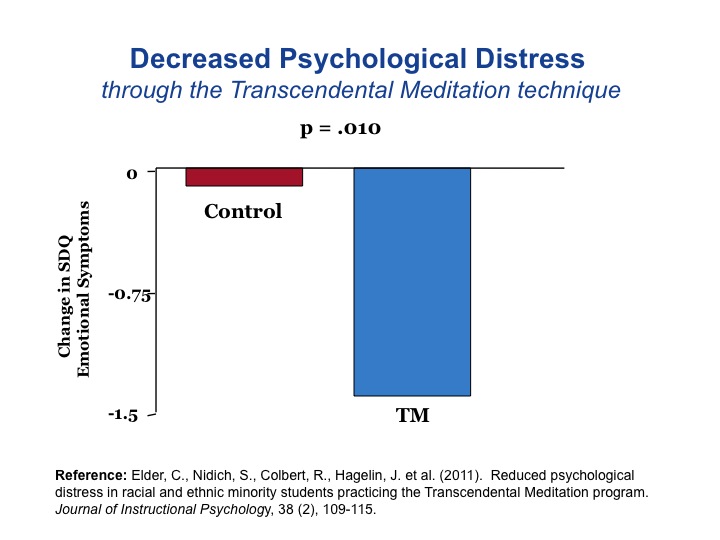
This graph shows a 36 percent reduction in psychological distress in 106 at-risk racial and ethnic minority students practicing the Transcendental Meditation technique compared to controls over a period of 4 months (p=.010). Significant decreases were also found in trait anxiety and depressive symptoms.

With record levels of student stress reported in a recent UCLA survey, can a simple stress-reducing meditation technique be a viable solution?

A new study published in the Journal of Instructional Psychology found the Transcendental Meditation (TM) technique significantly decreased psychological distress in public school students. The study, conducted with at-risk minority secondary school students, showed a 36 percent reduction in overall psychological distress. Significant decreases were also found in trait anxiety and depressive symptoms.

Rising Stress Levels Affect Emotional and Physical Health

The percentage of students in the UCLA survey reporting good or above-average high school emotional health dropped from 55.3 percent in 2009 to 51.9 percent in 2010. This marks the lowest level within the past 25 years.

Dr. Charles Elder, MD, lead author of the TM study, and investigator at Kaiser Permanente Center for Health Research, emphasized the important implications of the findings on reduced stress. “It is vital that we start addressing the high levels of emotional stress being reported by high school and college students. Decreased stress can have a positive impact on mental health, and can also reduce the risk for hypertension, obesity, and diabetes—major risk factors for heart disease,” explained Dr. Elder.

Educational research has also linked student stress to negative school behavior and poor academic performance.

Promising Findings for Education

“These new findings on reduced stress, along with the recent research on academic achievement gains, hold tremendous promise for public education,” said Sanford Nidich, EdD, principal investigator, and professor of education at Maharishi University of Management. “There is a growing body of evidence showing Transcendental Meditation to be an easy to implement, value-added educational program that promotes emotional health and increases academic achievement in at-risk students,” said Dr. Nidich.

A total of 106 secondary school students, 87% racial and ethnic minorities, took part in the study. Results showed that over a four-month period, students practicing Transcendental Meditation as part of their schools’ Quiet Time program exhibited significant reductions in psychological distress factors compared to controls.

According to James Dierke, 2008 National Association of Secondary School Principals—National Middle School Principal of the Year, “Stress is the number one enemy of public education, especially in inner-city schools. It creates tension, violence, and compromises the cognitive and psychological capacity of students to learn and grow. The TM/Quiet Time program is the most powerful, effective program I have come across in my 39 years as a public school educator for addressing this problem. It is nourishing children and providing them an immensely valuable tool for life. It is saving lives.”

The study was supported by the David Lynch Foundation.

Study Facts

  • This study evaluated change in psychological distress factors in students practicing the Transcendental Meditation program compared to non-meditating controls. A total of 106 students (68 meditating and 38 non-meditating students), took part in the study. The study included students from four public secondary schools.
  • Eighty-seven percent were racial and ethnic minority students, including 26% Hispanic, 25% African American, and 19% American Indian.
  • The Transcendental Meditation program was practiced in class twice a day as part of the schools’ Quiet Time program for four months prior to posttesting.
  • The Transcendental Meditation program was taught in the context of school-wide Quiet Time programs in which students voluntarily chose the Quiet Time program in which they wanted to participate.
  • Transcendental Meditation is a simple, natural, effortless technique that allows the mind to settle down and experience a silent yet awake state of awareness, a state of “restful alertness.” Practice of this stress-reduction program does not involve any change in beliefs, values, religion, or lifestyle.
  • Compared to eyes-closed rest, research has found that Transcendental Meditation practice is characterized by decreased activation or arousal of the autonomic nervous system, as reflected in decreased breath rate and lower sympathetic nervous system activity. The Transcendental Meditation program has been shown to increase electroencephalographic (EEG) brain integration and coherence, especially in the frontal area of the brain, responsible for higher-order processing.
  • Other published research on high school and college students has shown reduced psychological distress, improved positive coping ability, decreased blood pressure, reduced cardiovascular reactivity to stressful stimuli, reduced absenteeism, and decreased school suspensions.
  • Results of the current study indicated significant reductions in overall psychological distress (p=.010) and trait anxiety (p=.035) compared to controls. Within-in group differences in depressive symptoms were found for meditating students (p=.003).

Source: EurekAlert!

Reported on: Science Codex, sciencenewslinemedicine, PsychCentral: Meditation May Help Ease School Stress, Times of India: Beat stress with transcendental meditation (IANS), The Behavioral Medicine Report: Transcendental Meditation Significantly Decreased Psychological Distress In Public School Students, among others.

TM Blog: New research finds TM helps ease school stress, Ken Chawkin.

See related study: New research shows Transcendental Meditation improves standardized academic achievement.


Chandrika Tandon Benefit Concert in Iowa Helps Launch Global Peace Initiative

November 9, 2011

Chandrika Tandon Benefit Concert in Iowa Helps Launch Global Peace Initiative to Support 10,000 Maharishi Vedic Pandits

November 9, 2011: (MAHARISHI VEDIC CITY, IOWA) Leaders of the Global Peace Initiative hosted a Vedic Visitors Weekend, November 4 to 6, at Maharishi Vedic City in southeast Iowa, attracting Indo-Americans from cities as far away as Los Angeles and New York.

All the participants assembled for one purpose: to experience a weekend devoted to peace and all things Vedic: Vedic education, Vedic health, Vedic agriculture, and Vedic architecture.

The weekend culminated with Grammy-nominated world music artist, Chandrika Tandon, performing a stunning sold-out benefit concert at the Stephen Sondheim Theatre.

“The combination of different instruments and Chandrika’s voice revealed to me what World Music should be all about,” said Vinod Nayagar, a university student who attended the concert.

“All the sounds emerged from the same source, they resonated and built on each other’s vibrations at the subtlest, most blissful level of creation. The sounds were indistinguishable at transcendental moments—they created a harmony and unity from sound, which is the true purpose of music,” Mr. Nayagar said.

Ramani Ayer, retired CEO of the Hartford Financial Group and current Director of Development for the Global Peace Initiative, who served as a host of the weekend, said, “We invited Indo-Americans from around country to experience how powerful, valuable and relevant the practical application of ancient Vedic wisdom, as developed by Maharishi Mahesh Yogi, is to our daily lives and to the improvement of society.”

Leading Scientists Present Research on Meditation and World Peace

Fred Travis, Ph.D., Director of the Center for Brain, Consciousness, and Cognition at Maharishi University of Management in neighboring Fairfield, Iowa, is one of the world’s leading researchers on the brain, consciousness and meditation. His scientific presentation during the weekend on the effects of Transcendental Meditation on brain functioning was highlighted by slides and graphics illustrating the beneficial changes that occur as a result of regular TM practice.

From EEG signatures and connectivity maps, Dr. Travis showed how different meditation practices impact different parts of the brain. “Most meditations fall into two categories,” Dr. Travis said.

“First are ‘focused attention’ techniques, which require you to concentrate on an object, or a particular word or phrase. The second are ‘open monitoring’ techniques, which involve being mindful of your thoughts or breath without interfering with them. This approach attempts to still the mind and become an uninvolved witness to activity. But these attempts are on the surface level of the mind,” he said.

Dr. Travis then identified a third category—“automatic self-transcending”—a process that allows the mind to transcend its own activity. “This is the Transcendental Meditation technique, during which the mind transcends effortlessly, and arrives at the depth of consciousness, the source of the thinking mind, transcendental consciousness, or Samadhi,” Dr. Travis said.

Dr. Travis said that after several months of TM practice, the brain begins to demonstrate increased connectivity, even outside of meditation. “The brain functions more holistically, which accounts for the meditating student’s improved academic achievement. The student is able to absorb, integrate, and express knowledge more effectively,” Dr. Travis said.

Dr. G.V. Naidu, who traveled from St. Louis to attend the conference, said, “The scientific documentation of ‘The Neurophysiology of Enlightenment’ by Dr. Travis was impressive. And a subsequent presentation by physicist Dr. John Hagelin was a climax of the conference.”

World-Renowned Physicist Explains Global Peace Initiative

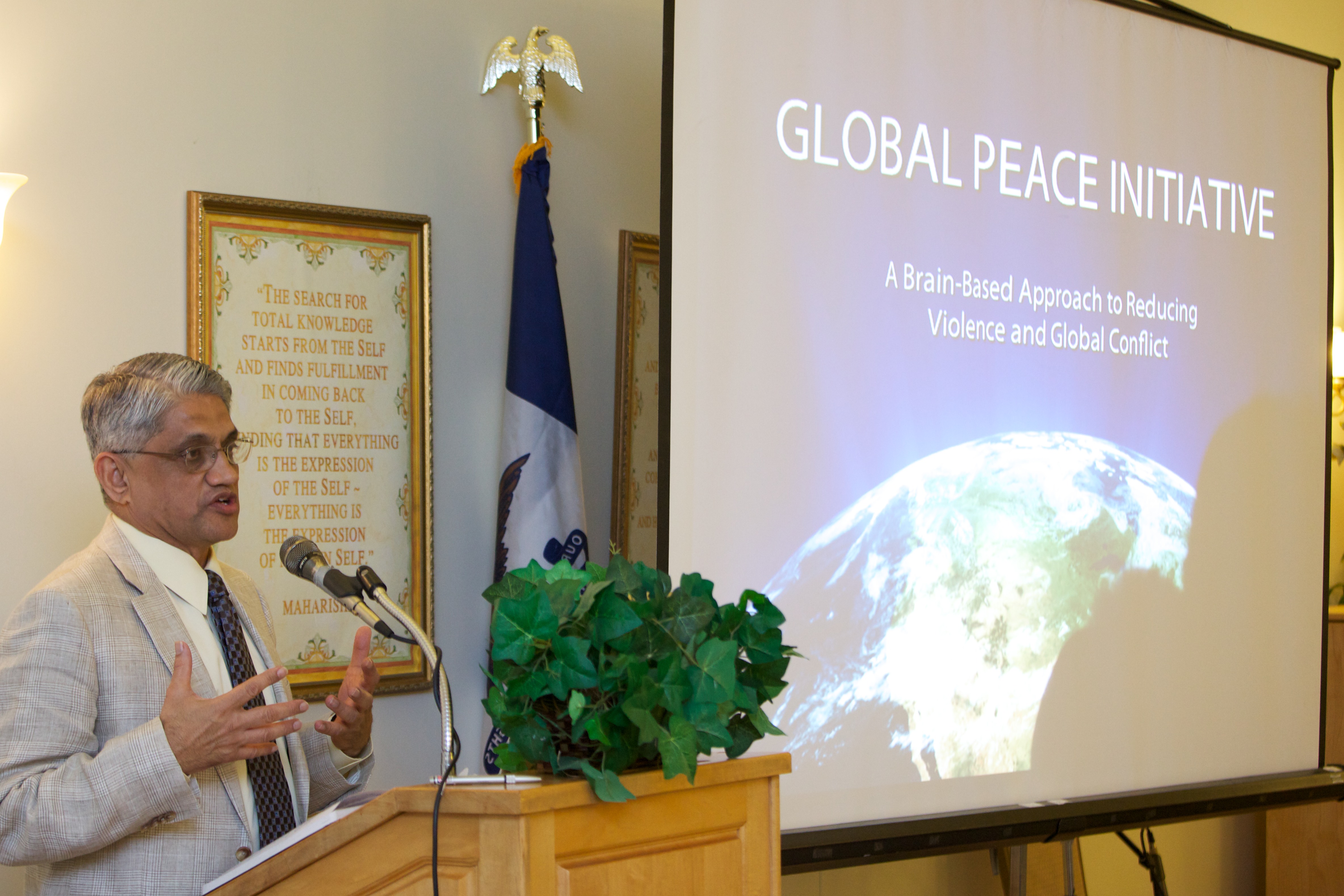
John Hagelin, Ph.D., a Harvard-trained, internationally renowned quantum physicist, provided the modern scientific understanding and corroborating scientific research documenting how groups of experts in the Transcendental Meditation and advanced TM-Sidhi program can neutralize violence and conflict and create world peace.

“Extensive research published in peer-reviewed scientific journals verifies that Transcendental Meditation dramatically reduces acute individual stress and its deleterious effects on brain and behavior far more effectively than other methods,” Dr. Hagelin said.

“But perhaps more interesting and important are the 23 published studies which show that relatively small numbers of people practicing the Transcendental Meditation and TM-Sidhi program together in a group can reduce crime, violence, and war throughout the entire population,” he said.

Citing studies conducted in the Middle East showing reductions in war death and violence by 70 percent, Dr. Hagelin said, “There is no approach to peace that has been so thoroughly tested and rigorously established. And now, since the arrival in America five years ago of the large group of Vedic Pandits, there has been a significant decrease in violent crime in America’s largest cities. We are mobilizing to add more numbers to the group, to create an even more positive effect in America.”

Thousands of Maharishi Vedic Pandits to Create Global Peace Effect through Yoga and Yagya

Ramani Ayer provided a vision of the goal of the Global Peace Initiative: To maintain permanent peace-keeping groups of 9000 Vedic Pandits in India and 1250 Vedic Pandits in the United States—the number established by research that is sufficient to create a concrete and demonstrative positive global effect.

“The Vedic Pandits’ daily practice of the TM and TM-Sidhi program establishes their consciousness in Yoga, the pure field of intelligence, at the basis of all creation. And their Vedic recitation from that deep and pure level creates a powerful influence of peace for humanity. This perfect combination of Yoga and Yagya will help create a much higher quality of life for the whole world’s population,” Mr. Ayer said.

The Global Peace Initiative is building an endowment fund to create and maintain these large groups of Vedic Pandits in perpetuity.

Maha Rudrabhishek with 121 Maharishi Vedic Pandits

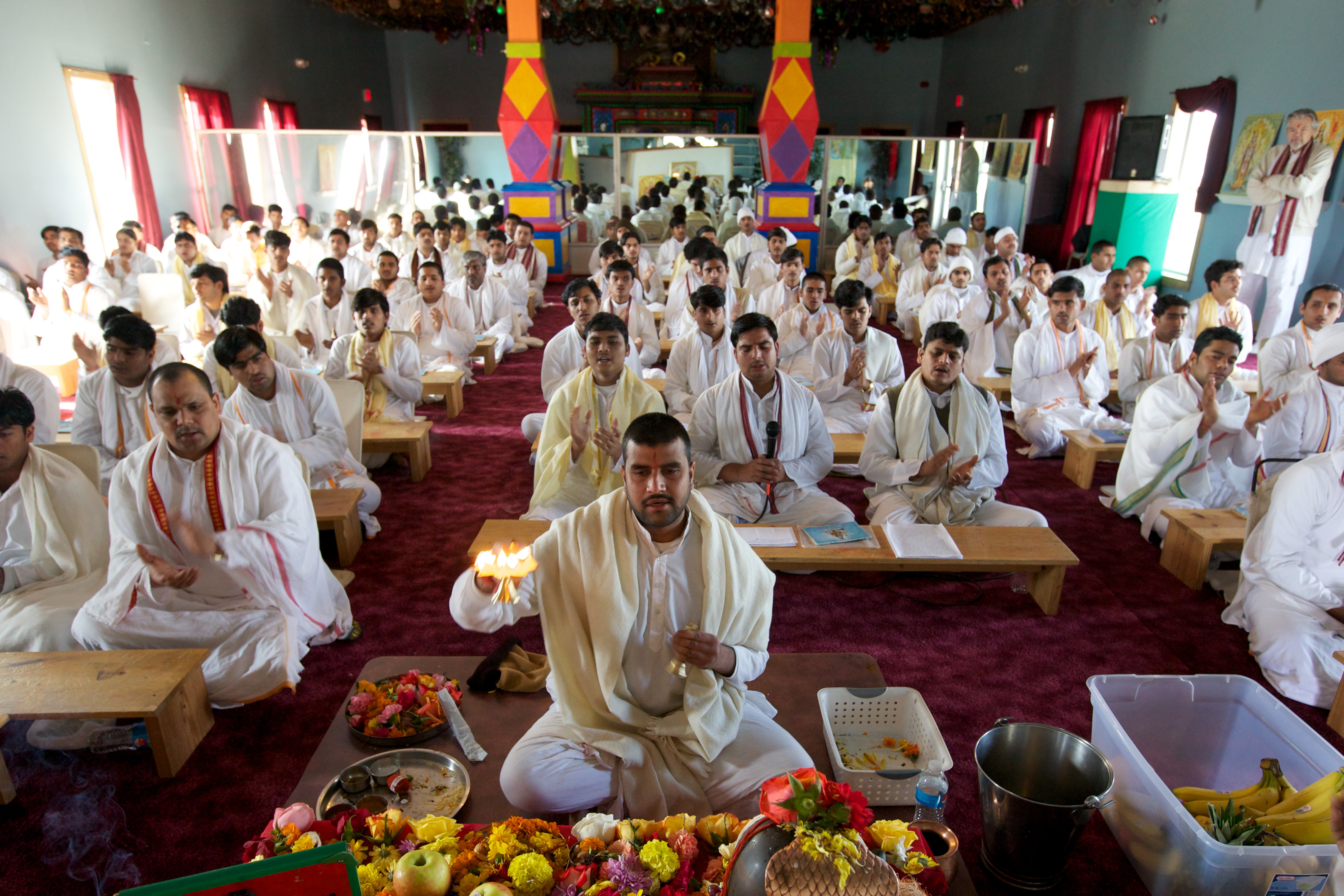
Another sublime highlight of the weekend was the performance by 121 Maharishi Vedic Pandits of Rudrabhsihek.

“It’s an amazing sight to drive over the rolling hills of Iowa and see spread before you a campus where nearly 1000 Maharishi Vedic Pandits from India reside,” said Meenakshi Ghai, from Chicago’s western suburbs, who made the four-hour drive from Chicago with her daughter-in law to attend the weekend. “It was a non-stop wonderful experience packed into 36 hours.”

Mohan Pillai from Long Island, New York, who attended the conference with his family, said, “I cannot describe in words what is was like to hear such a powerful chanting of the Rudrabhishekam. The inner feeling was so good—it was beyond words. I could understand how such large groups of well-trained Vedic Pandits can create peace.”

G.V. Naidu expressed enthusiasm for the global initiative: “We were pleasantly surprised to see that Maharishi Vedic Vishwa Vidyalaya is training thousands of Vedic Pandits here in America as well as in India. These Vedic Pandits are propagating and sustaining ancient Vedic culture. At the same time, they are conducting fundamental research on the positive effects of meditation—far more than any other organization. I wish more people will participate in future seminars conducted by Maharishi University of Management,” Mr. Naidu said.

Mr. Ayer concluded: “As Indians who cherish the Vedic tradition in our hearts, we should feel very proud that this great knowledge has given us a practical means to create peace in the world.”

For more information, visit www.GlobalPeaceInitiative.org and www.VedicPandits.org.

Also see Global Peace Initiative: 13 Questions and Answers with Ramani Ayer, Chandrika Tandon Concert to Benefit 1000 Maharishi Vedic Pandits Launches Global Peace Initiative, and Lavina Melwani interviews Chandrika Tandon on her Grammy Award nomination.

The Chronicle of Higher Education: Notes From Academe: The Spokesman Who Kept Calling

October 13, 2011

April 22, 2005

The Spokesman Who Kept Calling

By THOMAS BARTLETT

Each morning I punch my code into The Chronicle’s voice-mail system. Most of the time, the messages are from sources calling me back or editors with a few “minor queries” about a story I’ve turned in. Sometimes, however, they’re from Norman.

Hi Tom. Norman here. I’ve been reading a wonderful biography of Thomas Wolfe and I found out the most interesting thing: He drank 12 to 18 cups of coffee every day! No wonder he was manic and high and low and sideways. When I wrote my books, I certainly drank coffee, but if I had four or five I thought that was a lot. How many do you have? One, probably. Or two?

Norman Zierold is a spokesman for Maharishi University of Management, a Fairfield, Iowa, institution dedicated to “the full awakening of consciousness.” The last time I talked to him we discussed the recent suicide of Hunter S. Thompson and how Thompson worshiped F. Scott Fitzgerald. Norman believes the final page of The Great Gatsby is about as close to perfection as prose is likely to get. I can’t argue with that. He is also a fan of W. Somerset Maugham; I’ve never read anything by the British novelist and playwright, but I plan to, on Norman’s recommendation.

For more than two years, Norman and I have spoken on the phone at least once a month. Sometimes it’s been once a week. He has sent me scores of e-mail messages and who-knows-how-many packages containing detailed information about the university’s latest project. In all that time, I haven’t written a single word about Maharishi University.

That’s not because there isn’t plenty to write about. For instance, did you know that much of the food served in the university’s cafeteria is grown by students? Did you know that students and faculty members meditate twice a day in two gold-domed buildings? Were you aware that the university has received more than $20-million from the National Institutes of Health to study the effect of meditation on reducing heart disease, hypertension, and stroke?

Interesting stuff. But other stories have come along and Maharishi always gets pushed to the back burner. It’s just what happens.

And yet despite — or perhaps thanks to — my failure to write about Maharishi, Norman has continued to call, more often than any other college spokesman — more often, in fact, than anyone else I can think of, including friends and family. If Norman were anyone else, I would tell him politely to buzz off. But Norman is not anyone else. The truth is, I like talking to Norman. And over the last couple of years, I’ve gotten to know a lot about him.

For example, I know that Norman, who is 78, graduated from Harvard University in 1949 with a bachelor’s degree in politics and government. “God, that was boring,” he says of his time at the elite institution. Norman went on to get his master’s in literature from the University of Iowa. After that he enrolled in the doctoral program in French literature (which helps explain why, in some e-mail messages, he addresses me as “Cher Tom”).

He never completed his Ph.D. Instead, he became a writer. Norman wrote several books about Hollywood, including The Moguls: Hollywood’s Merchants of Myth and a biography of Greta Garbo. He also wrote true-crime books like Little Charley Ross: America’s First Kidnapping for Ransom, the story of a 4-year-old boy who, in 1874, was lured into a buggy by two men who later demanded money from his father (the boy was never found). The book, published in 1967, led to an appearance on the Today show. Norman was interviewed by Barbara Walters who, before the segment began, rubbed her leg against his in what seemed to him a suggestive fashion. She then explained that this was the signal that meant they were about to go on the air. Norman felt relieved.

Because he wrote about Hollywood frequently, Norman hobnobbed with big stars like Groucho Marx and Mae West. He edited the first volume of Anthony Quinn’s autobiography, helping trim a 1,000-page manuscript into something readable. In the early 1960s, Norman was the editorial director of the now-defunct Theatre Arts Magazine. He also wrote a science-fiction novel titled The Skyscraper Doom, in which the buildings of New York start to melt from the top down. It has to do with a mysterious gold liquid and the goddess Athena.

By the early 1970s, Norman had tired of Hollywood and book-writing. He was in his mid-40s and was “looking for something new in life,” he says. He stumbled onto transcendental meditation and it turned out to be just what he needed. Soon he was teaching meditation and writing freelance articles on the side to pay the bills. He did that for a long time. Then a few years ago he took a job in Maharishi University’s public-relations office.

Technically, Norman works part time. But if you call his office, he’s there. If you send him an e-mail message, you’ll get a speedy reply — even on weekends. He says he can’t help it: “The excitement builds and one loses track of time and works far beyond the routine hours.”

And Norman is genuinely excited about Maharishi University. He believes in the power of meditation, that it can make people healthier and more focused (and there’s research that seems to back him up, too). And he believes that college students who meditate have an advantage over those who do not.

But Norman does not stay strictly “on message.” For instance, we might start out discussing the benefits of meditation and end up talking about Pauline Kael. Norman was friends with the revered New Yorker movie critic, a fact he mentioned in passing recently. She liked his books. He told me this as if it wasn’t a big deal, as if everybody had been buddies with Pauline Kael.

Norman was understandably taken aback when he learned that I wanted to write about him. Like any good university spokesman, Norman would prefer that the institution get the attention. But he agreed to cooperate, if somewhat reluctantly. I was reluctant, too. I wrote in an e-mail message to Norman that I was concerned that once the article was finished he would stop calling. He told me not to worry. “You may be sure that we’ll continue to be in touch after you complete your piece,” he wrote.

I hope so, Norman. You know the number.


http://chronicle.com Section: Notes From Academe Volume 51, Issue 33, Page A56. Members can see the article online here, without the image. Click on Read the rest of this entry to see a pdf of the article with the nifty cartoon of Norman Zierold and Thomas Bartlett. Here’s are two articles by Norman Zierold you might like to read: Embody: focus on TM: Iconic Filmmaker David Lynch has a viable solution to a pressing problem and THE REMARKABLE DAVID LYNCH FOUNDATION — written by Norman Zierold for Healthy Referral.

Transcending a Different Type of PTSD — Helping Children of the Night

October 11, 2011

OPINION

Transcending a Different Type of PTSD — Helping Children of the Night

By

Published October 08, 2011 | FoxNews.com

Lately there has been a storm of publicity – and deservedly so – about post-traumatic stress disorder (PTSD) in veterans of our wars in Iraq and Afghanistan.

The public has become better educated about this potentially disabling disorder and its symptoms, such as hypervigilance, an exaggerated tendency to startle, flashbacks, nightmares and emotional numbness, to name just a few.

Mental health professionals have emphasized the need to diagnose and treat PTSD wherever it arises.  In this piece, I would like to draw attention to yet another group suffering from PTSD – child victims of prostitution who, against all odds, are trying to go straight and choose a different path in life.

I recently visited a home for such children in the Los Angeles suburbs, part of an organization aptly named “Children of the Night,” which has been operating since 1979 under the guidance of its founder and director, Dr. Lois Lee.

The organization is the most comprehensive social services agency in the country for rescuing America’s children from prostitution – a term Lee prefers to “trafficking,” which she considers too sanitized and not shocking enough for a problem that ought to be shocking but too often hides in plain sight of ordinary citizens.

The story of the young prostitute usually starts with early sexual abuse by a trusted care-giver, creating a trauma that continues to fester in the developing mind and brain of the young person, often resulting in emotional and behavioral difficulties.

The young person runs away – or drifts away – from home and, vulnerable to entrusting his or her safety to untrustworthy adults, goes on to be re-abused by those who pretend to offer love and shelter.

It is an ugly story that inclines us to avert our eyes, change the channel or click on a different web link.  I ask you to resist this natural aversion because these are our children and they can be helped with proper understanding and care. — Lee estimates that her organization has assisted over 10,000 young people since its inception.

In Lee’s opinion, all these children suffer from PTSD.  They are seething with rage, which they either direct outwards – screaming, lashing out, throwing things – or inwards by cutting themselves.

Stressed out in body and mind, many complain of abdominal pains so severe that they need to be taken to the emergency room.  They suffer nightmares and sleep disorders that wake them up at all hours.  Sometimes their distress during sleep is so bad that paramedics need to wake them and help settle them down.

Consider one of these young people, “Annie,” an 18-year-old graduate of the Children of the Night.  When she first came to the program, Annie experienced many symptoms of PTSD.

Like the other girls, she would panic when she saw a black limo driving down the street with its lights off, which reminding her of the pimps in her former life.  Triggered by all sorts of fears and memories, Annie would scream and throw things.  An apparently innocent TV show might remind her of evenings when she and her pimp would watch that same show together in earlier times.  One flashback would lead to another until her system was boiling over with intolerable panic and rage.

All the children in the program receive psychotherapy, but Annie did not find it particularly useful.  One thing that has made a big difference for her is Transcendental Meditation (TM), a technique that Lee has incorporated into her program in the last few years, with excellent results.

According to Annie, TM has reduced the impact of her flashbacks, has made her less angry, and less likely to her take out her distress on others.  As she puts it, “TM helps me calm down and center myself throughout the day, and focus on my schoolwork and tasks. It has also helped me trace back my emotions to when I was really young.  I realize that I couldn’t cry or tell people they had hurt my feelings.  I chose anger instead of hurt.”

The beneficial effects of TM on the PTSD symptoms of the Children of the Night have also been documented for traumatized veterans of combat, and are consistent with the known effects of TM in settling down fight-or-flight responses, which are exaggerated in people with PTSD.

Of Dr. Lee and Children of the Night, Annie says, “The program has done everything for me.  If not for the program, I would have died on the streets.”

Annie’s words are all the more poignant as there are so many other children who have not had the good fortune to stumble across Lee and her program. Keep your eye out for them and spare a thought for how we as a society can prevent the horrible problem of child prostitution and take care of those who have already fallen prey to it.

Norman E. Rosenthal, M.D. is Clinical Professor of Psychiatry at Georgetown University Medical School and author of “Transcendence: Healing and Transformation Through Transcendental Meditation” (Tarcher-Penguin, 2011).

Also see: Children of the Night, movie director David Lynch expand work and Meditation Helps Homeless Children, and another Fox News Opinion piece by Dr. Rosenthal: Could Transcendental Meditation Help Veterans Suffering From Post-Traumatic Stress Disorder?

The Norwich Guidon: Rooks experiment with meditation

October 8, 2011

Rooks experiment with meditation

By Thomas Carson
Norwich Guidon Staff Writer
Published: Tuesday, October 4, 2011

Norwich University has received a $40,000 grant from Foundations of America to conduct a study on how to lower stress among rooks. One rook platoon is using Transcendental Meditation (TM) twice a day, every day, to see if meditating helps, according to Dr. Peg Meyer, director of academic achievement and educational effectiveness.

“The big thing about the TM practice is that it is an individual tool, people will say, ‘What about a team performance or a platoon performance’ but it is really about what it does for you,” said Shelby Wallace, the director for student success. “I have been TM’ing for almost a year now this December, and it has definitely helped with a level of prioritization.”

“I can handle situations in a more effective way, and reduce my stress, so I have seen a lot of positive results in a personal and professional way,” said Wallace.

Last February, Norwich conducted a study with the men’s lacrosse team to test TM.

“The spring study was more or less an intro for the university to take a cross section of students, staff and faculty who were trained, as well to learn a little more about the TM practice to understand if this was something that we wanted to do,” said Wallace.

After seeing good results, Meyer, Wallace and President Richard W. Schneider went to New York to meet with the David Lynch Foundation to get trained in TM and to see its effects firsthand.

After receiving the grant, Norwich sent out emails to the rooks of 4th Company, 3rd Platoon, asking if they would participate.

Twenty-eight rooks volunteered.

“I received an email, I volunteered, and now I am apart of this great study,” said Frank Ruscito, an 18-year-old freshman study of war and peace major from Rome, N.Y. “I feel it has worked better than I expected.”

“I see other people falling asleep (in class), and I am energized and focused,” Ruscito said. “I’m doing much better in my classes than I expected.”

The 4-3 platoon cadre are trained in TM and do it with the platoon, as well as by themselves when needed to. The rooks are free to meditate whenever they please as well. The platoon meditates at 0800 and between 1620 and 1630 as a platoon.

“My stress levels are down. As far as academics, everything seems to be clicking very well,” said Scott Heimann, a 18-year-old freshman computer security major from Colorado Springs, Colo. “I do believe with the help of the TM, my rookie knowledge is sticking very well.” Heimann added, “I strongly believe that I will continue TM after rookdom.”

“It has helped me with my academics tremendously. I feel more alert, I can focus better on my homework,” said Timothy Hunter, a 18-year-old freshman biology major from Stratham, N.H. Hunter also described how the effects of the TM helped him with his rookie knowledge, and how it relieved the stresses of balancing the rook environment and school work.

All the rooks who were interviewed said TM should be done by everyone; and that they will continue doing TM.

“I feel more organized, I feel I have more energy, I’m more productive, and it helps relieve stress,” said Madison Dupouy, a 22-year-old senior physics major from Saratoga Springs, N.Y.

Dupouy went to a dinner for people interested in this new study. After discovering that TM actually helped him with his academics, his stress and his energy level, Dupouy decided to get involved as one of the cadet officers who will oversee the study.

“I have always been interested in meditation,” said Brandon Jennings, a 21-year-old senior history major from Gales Ferry, Conn. Jennings found out about the study, and when he tried it for himself he noticed an improvement in his energy levels, organization habits and his academics.

“I took 23 credits with two seminar classes last semester, and I got a 3.407 GPA for the semester,” said Jennings. These good results got him interested in being a part of the study, and he became one of the officers in charge.

Related: