Posts Tagged ‘nature’

3 beautiful and profound short poems by Hafiz about the nature of God within us

October 23, 2014

Hafiz reveals the brilliant, compassionate nature of God within us

Here are 3 beautiful and profound short poems by Hafiz that reveal the hidden compassionate nature of God within us, and in a God-realized person. Published in “A Year With Hafiz: Daily Contemplations,” and translated by Daniel Ladinsky, each poem is for a specific day of the year.

Hidden

Even the shadow of God is brilliant, so brilliant,
so much so even God has trouble looking at
Himself as that . . . unless He is more disguised,
hidden in illusion, hidden as He can be, in us.

May 19, page 155

* * * * *

It Is My Nature

It is the nature of this world to share
its burden with you.

And it is my nature to remove it from
your back.

August 19, page 255

* * * * *

Once A Young Woman Said To Me

Once a young woman said to me, “Hafiz, what
is the sign of someone who knows God?”

I became very quiet, and looked deep into her
eyes, then replied,

“My dear, they have dropped the knife. Someone
who knows God has dropped the cruel knife

that most so often use upon their tender self
and others.”

January 31, page 33

Other beautiful poems by Hafiz are also posted here: Hafiz’s poem, God Pours Light, awakens the soul and frees the mind from debating words about it | Winding up the year with inspiration from Hafiz | Hafiz via Ladinsky describes the spiritual transformation of loving deeply within himself | For Hafiz the role of an enlightened poet is to connect humanity with the joy of the divine | Hafiz said to leave something in the marketplace, and Jesse Winchester sure did before he left us | Hafiz, via Ladinsky, reminds us when we love those in our care we are brought closer to God

Mary Oliver’s Summer Day is filled with wonder

June 23, 2014

The Summer Day

Who made the world?
Who made the swan, and the black bear?
Who made the grasshopper?
This grasshopper, I mean–
the one who has flung herself out of the grass,
the one who is eating sugar out of my hand,
who is moving her jaws back and forth instead of up and down,
who is gazing around with her enormous and complicated eyes.
Now she lifts her pale forearms and thoroughly washes her face.
Now she snaps her wings open, and floats away.

I don’t know exactly what a prayer is.
I do know how to pay attention, how to fall down
into the grass, how to kneel down in the grass,
how to be idle and blessed, how to stroll through the fields,
which is what I have been doing all day.
Tell me, what else should I have done?
Doesn’t everything die at last, and too soon?
Tell me, what is it you plan to do
with your one wild and precious life?

~ Mary Oliver ~

(New and Selected Poems, Volume I)

The question that Mary Oliver asks her readers at the end of this poem reminds me of the ones she asks at the end of her Swan poem. 

Related: Mary Oliver’s poem, Praying, is a lesson on attention, receptivity, listening and writing, and Mary Oliver’s transcendent experience At the Lake, put into words, might leave you breathless.

Other poems: The Journey by Mary Oliver | Wild Geese by Mary Oliver, photo by Ken West | Varanasi by Mary Oliver in A Thousand Mornings.

See this remembrance of Mary Oliver with links to more of her poems.

Redwood Forest Haiku, two versions, inspired by a photo my sister took in a Redwood Forest Park

August 24, 2013

I signed up with Instagram so I could see the pictures my sister took on her vacation to Mendocino in Northern California. They drove north to Humboldt County to see the California Redwood Coast Park Forest. Among the beautiful photos she posted, this one of the Giant Redwoods, considered the largest trees in the world, inspired me to write this haiku. Here is that photo, and two haiku versions, for your enjoyment.

Redwood Forest

Redwood Forest Haiku

~1~

In Redwood Forests
There are Giants among us
Who Hold The Silence

~2~

In Redwood Forests
There are Giants among us
Holding The Silence

© Ken Chawkin
Fairfield, Iowa
written 8/23/2013
posted 8/24/2013

See Being in Nature, a gift from a tree, with links to other tree poems. See Redwood forest photo and haiku inspire others.

Nature’s Bi-Cycle, a poem from/for the child in us

August 8, 2013

I wrote a poem the first day on my job working for the Vancouver Board of Parks and Recreation as a paper-picker in Queen Elizabeth Park. It was in the mid-1990’s, during the wintertime. The job kept me active, walking miles each day, spent mostly in nature, in a beautiful park setting. And I made more money doing that than teaching kids writing after school at a Sylvan Learning Center in North Vancouver. It was what I needed at the time. But that’s a whole other story.

The park attendant would leave each year to go to California for the winter. Some friends who had done the job for him the previous winter introduced us. A fellow poet and a meditator (not TM), we shared common interests. He offered me the job and said I could stay in the caretaker facility he lived in across the street from Q.E. Park in Hillsdale Park. In exchange I would cover his utilities. I just had to get his boss’s approval, who did hire me, but wasn’t happy about the arrangement. He said there were people ahead of me in line for such a hard-to-come-by job. But it worked out well and he later hired me for the summer in Stanley Park when the caretaker returned from California.

I was lucky to get that prized job, doing simple work, like cleaning the park facilities and picking up trash. I also appreciated the beautiful park settings and composed poems as I walked the grounds. I actually amused myself that first day. I thought of how things grew from seed to tree, and their interrelationships with the animals. Dark berries turned white in winter and the birds who ate them caught my attention as I thought of the cycles in nature.

My inner child loved composing and hearing the sounds and meanings of the words. Every time I shared this poem with kids, they’d squeal with delight! Maybe the child in you will like it too.

NATURE’S BI-CYCLE

Berries are meant to be eaten by birds
who poop out the seeds contained in their turds
this process prepares seeds to sprout in the spring
’til one day they’re trees and in them birds sing

© Ken Chawkin

Read Park Poems from Ken Chawkin for more details on this story and other poems inspired from Q.E. Park and others I visited in the Greater Vancouver area.

Mary Oliver’s poem, Praying, is a lesson on attention, receptivity, listening and writing

March 14, 2013

Praying

It doesn’t have to be
the blue iris, it could be
weeds in a vacant lot, or a few
small stones; just
pay attention, then patch

a few words together and don’t try
to make them elaborate, this isn’t
a contest but the doorway

into thanks, and a silence in which
another voice may speak.

~ Mary Oliver ~

(Thirst)

Another example of this theme is her poem, Mindful, in this later post: Attentive to and delighting in her surroundings, Mary Oliver lived a life writing astonishing poetry.

An inspiration for a poem came to me from such receptivity to a tree. The first words entered my mind while admiring it. I wrote them down, and the next morning, I rewrote them as a stanza, and then the sequential stanzas naturally followed, reiterating what Mary Oliver describes. It was as if I was given a creative seed and it sprouted. This gift from the tree was much appreciated. I later called it Being in Nature. Its sequel, trees, was about the nature of trees, and what we can learn from them. Another poem once came to me from a rock with a sense of humor. You can read RIVER ROCK SPEAKS in my Vancouver Park Poems.

An early encounter with nature inspired my creativity. It turned into my first published poem, which won an award: ODE TO THE ARTIST, Sketching Lotus Pads at Round Prairie Park.

Her poem also reminds me of The nurturing effect of rainwater in Mary Oliver’s poems Lingering In Happiness At Blackwater Pond and William Stafford’s poem, B.C., which I later added.

Read about Mary Oliver (1935-2019) and her astonishing poetry in this memorial acknowledgment to her poetic legacy. It contains links to articles, interviews, and poetry readings, as well as many of her favorite poems I’ve loved and posted over the years.

— Written and compiled (citing sources) by Ken Chawkin for The Uncarved Blog.

‘Tis the Season To Be Jolly … Or SAD? Article for Ageless Living by Helen Foster-Grimmett

December 14, 2012

‘Tis the Season To Be Jolly … Or SAD?
By Helen Foster-Grimmett

Tonight, my husband told me that this article lacked pizzazz. I said: “Sorry, my serotonin is seasonally challenged – no sparkle.” I find myself standing in front of travel agency windows mesmerized by posters of sun-drenched Hawaii, Mexico, Barbados. Mauritius looks delicious.

By Christmas – the season to be jolly – some people have been feeling sad, down, or downright depressed since the onset of autumn. And they’ll motor on through to the first buds of spring feeling the same way. If you are one of those people, you may be experiencing Seasonal Affective Disorder (SAD). According to the Canadian Mental Health Association, about five million Canadians experience the “winter blues,” a mild form of Seasonal Affective Disorder. At least two to three percent have symptoms severe enough to be diagnosed as “SAD” – an apt acronym. People with SAD often feel a sense of happiness on a cloudy day when the sun peeks through the clouds, then deflated when the clouds cover the sky again. It’s as if the clouds are a manifestation of their minds. For people with SAD, those inner clouds can be dark, and they sometimes don’t lift until the spring flowers bloom and sunshine is more constant. The Canadian Mental Health Association tells us that women are more at risk for Seasonal Affective Disorder than men: eight times as many women as men report having SAD. Although the reasons for this are not defined, one suggestion is that women may spend more time indoors with their children than men and, therefore, less time in sunlight.

Sunless and SAD
Experts are not sure what causes SAD, but they generally link it to lack of sunlight. SAD is rare in those living within 30 degrees of the equator, where daylight hours are consistently long and bright. It is more common in northern countries, including Canada, where bright winter sunlight is sparse. Lack of light may upset our cycles and other rhythms. It may cause problems with a brain chemical called serotonin, which affects mood. People with mild winter blues manage to cope throughout the season. However, those diagnosed with SAD could feel more severe symptoms, including:
• Depression, apathy, negative thoughts, loss of self-esteem
• Sleep problems
• Lethargy, fatigue
• Overeating or little appetite
• Difficulty with concentration and memory
• Withdrawn – finding it hard to be around people
• Anxiety
• Inability to deal with stress
If you are affected by any of these symptoms, take heart: there are remedies that work wonders for SAD.

Relief for SAD Symptoms
Millions of people with SAD have been helped by the work of Dr. Norman Rosenthal, a world-renowned psychiatrist. Rosenthal and his team at the National Institute of Mental Health pioneered research that first led to describing Seasonal Affective Disorder, and the use of light therapy to treat it.

According to the Seasonal Affective Disorder Association in the UK, “light therapy has been shown to be effective in up to 85 percent of diagnosed cases.” Light therapy is now routinely prescribed for SAD in northern countries, but at the time Rosenthal and his team first used it, the results were dramatic. In his New York Times best-selling book Transcendence, Dr. Rosenthal recalls a comment from one of his colleagues. He had noticed a remarkable change in a patient who had been having light therapy for SAD for just one week: “I don’t know what treatment she is receiving, but she’s blooming like a rose!” A vivid metaphor for our need for light from the life-giving sun.

Dr. Rosenthal’s other guide for readers who suffer from SAD is called Winter Blues. This book provides a self-test that readers can use to evaluate their own seasonal mood changes, presents remedies for SAD, research on the use of medication, and new recipes to counterbalance unhealthy winter food cravings. A cautionary caveat: if you or someone you know is seriously depressed, it is imperative to seek professional advice, as depression can be debilitating or even life-threatening.

The good news? The incidence of Seasonal Affective Disorder decreases with age. So for all you seniors out there, as we approach the holiday season, ‘tis truly the season for you to be jolly!

Helen Foster-Grimmett writes on issues of health, education, and stress management. These days you may find her outside travel agency windows, looking wistful. Article references available upon request.

This is Helen’s 2nd article for the Canadian magazine, Ageless Living. You can read her first article there: The Answer To Cancer.

For more information on Dr. Norman Rosenthal, his work and books: Winter Blues, and Transcendence, visit: http://normanrosenthal.com.

What To Remember When Waking by David Whyte

April 30, 2012

WHAT TO REMEMBER WHEN WAKING

In that first
hardly noticed
moment
to which you wake,
coming back
to this life
from the other
more secret,
moveable
and frighteningly
honest
world
where everything
began,
there is a small
opening
into the new day
which closes
the moment
you begin
your plans.

What you can plan
is too small
for you to live.

What you can live
wholeheartedly
will make plans
enough
for the vitality
hidden in your sleep.

To be human
is to become visible
while carrying
what is hidden
as a gift to others.

To remember
the other world
in this world
is to live in your
true inheritance.

You are not
a troubled guest
on this earth,
you are not
an accident
amidst other accidents
you were invited
from another and greater
night
than the one
from which
you have just emerged.

Now, looking through
the slanting light
of the morning
window toward
the mountain
presence
of everything
that can be,
what urgency
calls you to your
one love? What shape
waits in the seed
of you to grow
and spread
its branches
against a future sky?

Is it waiting
in the fertile sea?
In the trees
beyond the house?
In the life
you can imagine
for yourself?
In the open
and lovely
white page
on the waiting desk?

~ David Whyte ~

(The House of Belonging)

Thanks to Joe Riley of Panhala for posting this one!

Here are some complementary poems by John O’Donohue you may also enjoy reading: For a New Beginning and The Inner History of a Day.

And here are two poems I wrote on the subject: Upon waking uP by Ken Chawkin and A Wake-Up Haiku.

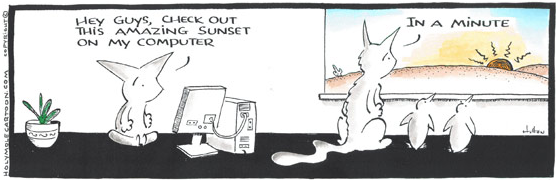
Rick Hotton and Holy Molé make us laugh and learn “what is essential is invisible to the eye”

January 12, 2011

“And now here is my secret, a very simple secret; it is only with the heart that one can see rightly, what is essential is invisible to the eye.”
—Antoine de Saint-Exupery, The Little Prince

Copyright © 2011 Rick Hotton. All Rights Reserved.

Look familiar? Is this how you see reality—only what’s in front of you on your computer screen? Technology may be an extension of our senses to more effectively interact with the world, but it can also be what cuts us off from it. Sometimes we need a little humor to break this mistake of the intellect and make us see the light of day!

Rick Hotton, creator of the award-winning cartoon Holy Molé, opens our hearts and minds with insightful humor. His characters make us laugh and realize there’s more to life than meets the eye.

To find out how Holy Molé was born and to uncover the path of creator Rick Hotton, a dedicated martial artist turned math teacher and now cartoonist, read Behind Holy Molé’s Rick Hotton by Danielle Hope Hier.

Danielle describes the characteristics and spiritual significance of a mole as the main character in Rick’s cartoon and compares it to his outlook on life. She encapsulates his approach in this paragraph:

Through martial arts, math, and Molé, Hotton has captured the essences of working the body, the mind, and the spirit. The quest for knowledge is the thread that ties all three of these forms together, in what might otherwise appear as three completely separate entities.

Danielle asked Rick why he chose a cartoon as a way of expressing elements of his own spiritual journey. I love his answer.

He replied, “But for me, if I could get people to laugh, even if just for a moment…” He paused before rephrasing his next thought: “Being joyful is a state of grace.”

The January 2011 issue of Edge Magazine published an article by Randy Moore on Rick Hotton and the Mindful Art of Holy Molé. It’s interesting to note that both Danielle and Randy are also martial artists and writers.

If you like Rick’s sense of humor, visit www.holymolecartoon.com to sign up and have cartoons delivered to your Inbox. Also follow him on Facebook, Holy Molé Cartoon, to see his photo stream.

Speaking of a common thread that’s invisible to the eye, see William Stafford—The Way It Is. Twenty-five years ago I wrote Seeing Is Being, a poem about a more enlightened way of seeing the world.

This post is very relevant to the theme of how social media cuts us off from the world shown in the Holy Molé cartoon: Two innovative creative videos remind us how social media can destroy not build relationships.

Years later: this cartoon by Bill Bliss (@blisscartoons) of two cats looking at a sunset evokes a similar reaction as the cats in Rick Hutton’s characters above, only it’s what I ask myself after spending hours on my computer scrolling the internet and watching YouTube videos!

Years later I saw a similar quote to The Little Prince from Helen Keller: “The best and most beautiful things in the world cannot be seen or even touched. They must be felt with the heart.”

An animated film with an all-star cast was made of that wonderful book. A little girl lives in a very grown-up world with her mother, who tries to prepare her for it. Her neighbor, the Aviator, introduces the girl to an extraordinary world where anything is possible, the world of the Little Prince. See The Little Prince (2015); original title: Le petit prince (1h 48m), available to rent or buy on Amazon.

— Written and compiled (citing sources) by Ken Chawkin for The Uncarved Blog.

Egrets Painting and Poem

October 10, 2009

Egrets in Morning Light by Australian artist Gareth Jones–Roberts*

Translated

on the edge of space
two egrets in morning light
woken from a dream

—haiku by Ken Chawkin
Spring, 2001, Melbourne, Australia

*Photo of painting used by permission from the artist (1935–2013)
(Click painting to enlarge it.)

During a 3-month stay in Melbourne, Australia, I was fortunate to have met the artist through a mutual friend, his physician, and mine at the time, Dr. Graham Brown. Gareth’s painting was hanging on Graham’s office wall. I asked him who the artist was and he told me it was one of his patients. He gave it to him in exchange for learning Transcendental Meditation. Graham was also a TM Teacher. I was so taken by the painting that I wrote this haiku and shared it with him. One day, Graham asked me if I would like to come along to visit Gareth and share the haiku with him. I jumped at the chance and met Gareth, his wife and their son. Lovely people! He showed me around his studio and I shared the haiku with him. He liked it very much. I shared more poems with him. We hit it off and we stayed in touch over the years. He was a special soul!

This poem was published in two poetry books: The Dryland Fish, An Anthology of Contemporary Iowa Poets (2003), contained in 13 Ways to Write Haiku: A Poet’s Dozen; and in This Enduring Gift — A Flowering of Fairfield Poetry (2010), included in Five Haiku.