Posts Tagged ‘MUM’

“Moving America Forward,” a national TV show hosted by William Shatner, to feature Fairfield

March 6, 2014

Fairfield to be featured on national TV
By ANDY HALLMAN for The Fairfield Ledger, Jan 30, 2014
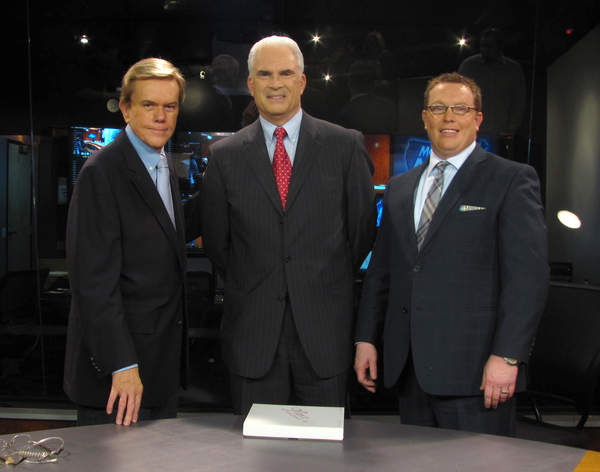
Doug Llewelyn, left, interviewed Fairfield Mayor Ed Malloy, center, and Fairfield Iowa Convention and Visitors Bureau executive director Rustin Lippincott last week in Los Angeles for the television show, “Moving America Forward.” The two men were interviewed as part of the show’s episode on Fairfield’s entrepreneurial spirit. The episode will air later this year at a time and channel to be announced. Llewelyn is perhaps best known to television audiences for hosting “The People’s Court” with Judge Joseph Wapner.

Doug Llewelyn, left, interviewed Fairfield Mayor Ed Malloy, center, and Fairfield Iowa Convention and Visitors Bureau executive director Rustin Lippincott last week in Los Angeles for the television show, “Moving America Forward.” The two men were interviewed as part of the show’s episode on Fairfield’s entrepreneurial spirit. The episode will air later this year at a time and channel to be announced. Llewelyn is perhaps best known to television audiences for hosting “The People’s Court” with Judge Joseph Wapner.

In the past few years, Fairfield has been in the national spotlight as numerous television programs and magazines have publicized what makes this town such a great place to live.

This year appears to be no different. That’s because Fairfield will be featured on a television show called “Moving America Forward,” hosted by William Shatner. The show will focus on the town’s entrepreneurial spirit and how this affects the residents’ quality of life.

Fairfield Mayor Ed Malloy and Fairfield Iowa Convention and Visitors Bureau executive director Rustin Lippincott flew to Los Angeles last week to be interviewed for the show. Their interviewer was Doug Llewelyn, who is most famous for hosting “The People’s Court” with Judge Joseph Wapner, which aired from 1981 to 1994.

The episode about Fairfield will air on YouToo TV this spring. After it airs on television, viewers can see it on the website YouTube.

Lippincott said he and Malloy chatted with Llewelyn for a few hours before taping began to give him an idea of what Fairfield is all about.

“We touched on what it’s like to live in Fairfield, and we covered the areas that make us a great place to live,” said Lippincott.

Fairfield will be the first town “Moving America Forward” has featured on its show, which normally highlights the accomplishments of individual business owners rather than whole cities. Lippincott said the show’s producers heard about Fairfield through the Smithsonian Magazine, which in 2013 named Fairfield the seventh-best small town to visit.

“Fairfield was recognized for fostering the environment that helped these businesses grow,” he said. “What makes this a unique recognition is we have 9,000 people but we have accomplished so much. That is, at its core, why we were recognized by ‘Moving America Forward.’”

Malloy said he began talking to the show’s senior producer Ruth Collins last year, who informed him Fairfield was a candidate for a spot on the show.

“She said they had done some research on our city and they found it fascinating, with all these different elements such as the entrepreneurship, sustainability and arts and culture,” he said. “She said, ‘We’d like to know more,’ so we sent them links to some of our websites.”

Collins said Fairfield was chosen from a pool of 70 candidate cities.

Malloy said Fairfield is often referred to as “Silicorn Valley,” a play on “Silicon Valley” near San Francisco, for the numerous technology and computer companies that were born here. He said many of those businesses were started in the late 1980s by software engineers educated at Maharishi International University, now known as Maharishi University of Management.

“Everyone who came to study and wanted to stay had to bring their own livelihood with them,” he said. “Because there were so many people who had a background in computers, there were a good dozen to 20 companies that were developing software. It became a phenomenon that these companies were originating from a small town in Iowa.”

Malloy said a financial journalist was doing a story about the entrepreneurial boom in Fairfield at the time, and referred to this technological enclave as the country’s “Silicorn Valley.”

During their interview with Llewelyn, Malloy and Lippincott mentioned not only the town’s strong IT sector but also its many other strengths such as manufacturing, tourism, education and agricultural economy.

The taped interview with Llewelyn lasted 15-20 minutes. Although Shatner is the host of the show, he was not on set for the interview. He introduces the clips and provides commentary throughout the show.

Malloy was filmed answering a set of questions about Fairfield. Shatner will be filmed asking those questions, and the two clips will be spliced together to make it appear Shatner is talking directly to Malloy.

Lippincott said the answers he and Malloy gave to the questions were not scripted, although the producer had an idea of what they would say from talking about their town with Llewelyn that morning.

In addition to the interviews with Malloy and Lippincott, the segment on Fairfield will include still photographs and silent camera footage of noteworthy places and events in town to be shown during the interviews. Malloy said he and others submitted videos to the producer, and the producers will get more video footage on their own later.

Even if residents miss the opportunity to watch the episode when it’s broadcast on television, chances are they will be able to view the video later. That’s because three Fairfield entities pooled their resources to purchase the video to use as a promotional tool once “Moving America Forward” is done with it.

Rights to the video cost $11,700, and the three entities who chipped in to purchase it were the city of Fairfield, the Fairfield Economic Development Association and the Fairfield Iowa Convention and Visitors Bureau. The three entities will own the video collectively.

Malloy said he felt the asking price to purchase the video was a bargain. He said he is glad the city will be able to show the “Moving America Forward” segment on the Fairfield Media Center’s public access cable channel, FPAC–9.

Reprinted with permission from The Fairfield Ledger

Related articles on Fairfield, Iowa’s entrepreneurial spirit:

@DMRegister’s Rox Laird Features Fairfield, Iowa’s Civic Collaboration and @MaharishiU’s Sustainable Living Center

Des Moines Register: Oprah in Iowa: Fairfield meditation segment airs Sunday

The Iowan: Sizing Up Small Towns: Rethinking Success in Rural Iowa: Fairfield Thinks Inclusively

See an article on The Power of the Entrepreneurial Class: Turning Fairfield, Iowa into a Rural Renaissance City, by Burt Chojnowski, published in the Economic Development Journal.
KTVO reports on Maharishi University of Management’s Visitors Weekend

February 19, 2014

Maharishi University of Management holds Visitors Weekend
by KTVO Newsdesk
Posted: 02.09.2014 at 6:42 PM

FAIRFIELD, IOWA — Prospective students from various states and even countries made the trek to Fairfield on Friday for Maharishi University of Management’s Visitors Weekend.

It isn’t your typical Visitors Weekend at Maharishi University of Management.

The three-day event began Friday and ended Monday with various educational sessions by professors throughout the weekend.

“So they really have a chance to come here and not just get a two-hour campus tour and there’s our fancy buildings,” said Brad Mylett, Dean of Admissions. “But to really go deep into every facet of Consciousness-Based Education and what M.U.M. has to offer.”

Such sessions included a creativity, digital media, and the future presentation by Gurdy Leete.

“We’re seeing this huge, amazing change in the world of media where the formerly, separate silos of media–like print media, broadcast media, film media, music media–all those boundaries are disappearing,” said Leete. “Many of the old companies are dying and being reborn in new form.”

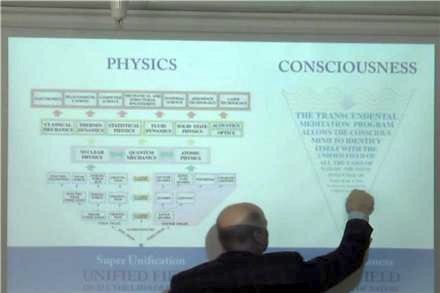
maharishi visitors weekendVisitors were also treated to a modern physics lecture by renowned physicist Dr. John Hagelin.

Beth Stone made the trip from Orlando, Florida and was particularly intrigued by Dr. Hagelin’s knowledge and experience with Transcendental Meditation.

“I practice T.M. myself and was looking for a program that is more complete,” said Stone. “That’s focused on learning and not just giving information out.”

Graduates of M.U.M. even come back to help coordinate the weekend and share their experiences to the prospective students.

“It prepares you not only for the real world, but for yourself,” said graduate Elisabeth Fowler. “And it helps you to understand who you are as an individual, and allows you to become prepared for any experience that comes your way.”

Visitors Weekends like this see much success with 60 percent of prospective students enrolling in the next academic year.

M.U.M. holds visitors weekends ten times a year, one in every month except January and August.

For more information visit http://www.mum.edu or call the Admissions Office at 800-369-6480.

Fairfield, Iowa, The Spiritual Sister City, published in Lawrence, Kansas Magazine

February 11, 2014

Susan KrausSunflower Publishing sent Susan Kraus to Fairfield, Iowa to write a travel piece for one of their magazines, Lawrence Magazine, the premier quarterly magazine for Lawrence, Kansas.

Lawrence Magazine Spring 2014Their Spring 2014 issue includes an article on Fairfield, Iowa filed under Journey by travel writer Susan Kraus. Titled, The Spiritual Sister City, the description reads: With a little meditation in the heartland, a rural town in southeast Iowa transforms into a cultural and educational center.

Susan timed her visit last summer to take in a First Fridays Art Walk. Besides exploring Fairfield, she also toured the Maharishi University of Management campus, and learned about Transcendental Meditation, Consciousness-Based Education, and Sustainable Living. She brought her husband, who, decades earlier, when he was a university student, had learned TM.

Susan is also a social worker and her husband works at a university in the video department. They had lunch with Ken West, also from Kansas, who had done some photography in an area Susan was familiar with. They shared a lot about the Kansas and Iowa landscapes, and used some of Ken’s photos for the piece.

Susan wrote an accurate assessment of what she found here in such a refreshing way. You can read her story by clicking on this PDF: Lawrence Magazine spring 2014 for MUM.

See a related article by Des Moines Register editorial columnist Rox Laird. His Sunday Opinion piece features the collaborative civic-minded town of Fairfield and Maharishi University’s Sustainable Living Center. Fairfield defines community action: Jefferson County town shows how to ‘manufacture dreams’ through civic collaboration. MUM obtained permission to make this wonderful article available as a reprint. You can see it beautifully laid out on their website link.mum.edu/GreenFF.

@MaharishiU Accounting Prof Andrew Bargerstock prepares students for XBRL certification – Ledger

January 17, 2014

College students learn difficult accounting program
By ANDY HALLMAN | Jan 16, 2014

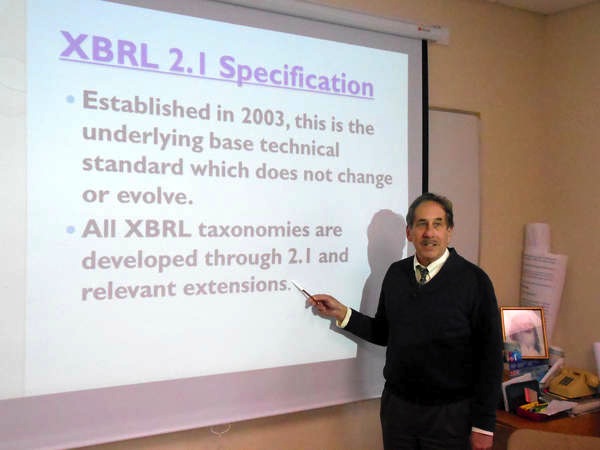
Maharishi University of Management accounting professor Andrew Bargerstock teaches a class in which students are certified in an accounting program called Extensible Business Reporting Language. M.U.M. is the first college in the world to offer certification in the program as part of its academic curriculum. / Photo by: ANDY HALLMAN

Maharishi University of Management accounting professor Andrew Bargerstock teaches a class in which students are certified in an accounting program called Extensible Business Reporting Language. M.U.M. is the first college in the world to offer certification in the program as part of its academic curriculum. / Photo by: ANDY HALLMAN

Accounting students at Maharishi University of Management are getting a leg up on the competition.

Those students have the opportunity to become certified in a worldwide accounting standard. According to M.U.M. accounting professor Andrew Bargerstock, the university is the first in the world to offer this certification as part of its curriculum.

The standard is called Extensible Business Reporting Language, often referred to simply as XBRL. It is a way of creating an accounting document that allows the information to be easily transferred to government agencies such as the Federal Deposit Insurance Corporation or the Securities and Exchange Commission.

The program requires a high level of computer coding knowledge. Bargerstock said learning how to use the program is no easy task because the students are bombarded with tons of technical computer jargon unfamiliar to most accountants.

“Accountants typically don’t have a lot of training in IT [information technology],” Bargerstock said. “They’ll know how to run ‘Quickbooks’ and ‘Excel,’ but they don’t know anything about the underlying coding. It’s a bit of a challenge. It takes a little bit longer for the water to seep into the sponge – a very dry sponge.”

Bargerstock and 11 of his students have been certified in XBRL, so he knows just how difficult the program is to learn.

“I failed the test the first time I took it, and had to go over it and over it again,” he said.

The certification training is done online and includes instructional audio files. The first time Bargerstock tuned in to one of the audio courses, he reacted by saying to himself, “This is way beyond what I was expecting. There was so much jargon it sounded like a foreign language.”

Learning XBRL is no picnic but once the students complete the necessary training they will stand out from their peers. Recruiting firms have told Bargerstock XBRL certification will put M.U.M.’s students at the top of the pile of résumés when it comes time to look for a job.

“In job interviews, people will say whatever they need to to get the job, and they’ll be a chameleon who changes from day to day,” he said. “This certification shows the students have taken the initiative to learn something.”

The federal government has required businesses and organizations to submit their accounting records in XBRL format since 2011. Bargerstock said the advantage of XBRL is the numbers only have to be entered in the original accounting document and not in every report created from that document. When it comes time to create the reports for the various government agencies, each agency extracts from the document whatever it needs to create its own report.

In the past, accountants would have to tediously fill out reports for each government agency. Now, those reports are created automatically by the computer thanks to the way the information is coded.

Bargerstock introduced his students to XBRL certification last fall. Although he helped the students with their certification, they trained for the certification on their own outside of class and did not receive academic credit. Another group of six students began taking a class with Bargerstock in November in which they were receiving academic credit while obtaining XBRL certification. Those students will finish their class in February.

Reprinted with permission from The Fairfield Ledger. The article was on the front page of Thursday’s Ledger, five columns across the middle of the page, with a photo.

Added point of clarification from Andy Bargerstock: “The certification training does not teach the technical side (tagging) of XBRL. XBRL certification training is the first step towards competency. If any of our certified students get hired, they will need 2-3 months of intensive training in the technical aspects of XBRL.”

Related: @LauraSimon reports on @MaharishiU Accounting students gaining certification in new worldwide financial reporting standard.

MUM’s Executive VP Craig Pearson’s visit to South Africa coincided with Nelson Mandela’s funeral

January 13, 2014

Fairfield man guest speaker in South Africa
Craig Pearson’s visit coincided with Nelson Mandela’s funeral
By ANDY HALLMAN | Jan 13, 2014 | The Fairfield Ledger
Photos: Courtesy of CRAIG PEARSON

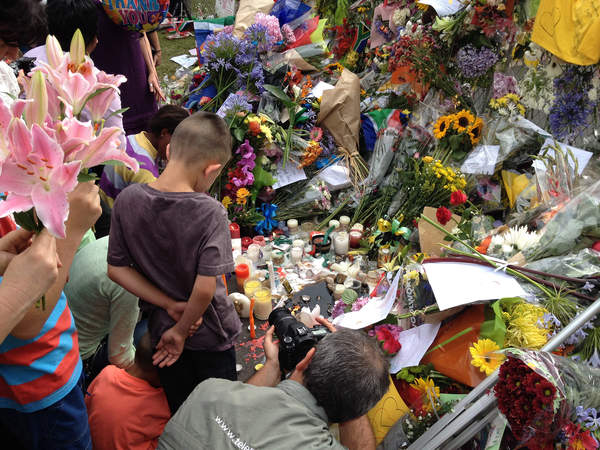
Courtesy of: CRAIG PEARSON People deliver flowers, candles and cards to the home of former president Nelson Mandela in Johannesburg, South Africa, after his death Dec. 5. Maharishi University of Management’s executive vice president Craig Pearson was in the country at the time of Mandela’s death and witnessed how the public responded with kind gestures to the man they admired so much.

People deliver flowers, candles and cards to the home of former president Nelson Mandela in Johannesburg, South Africa, after his death Dec. 5. Maharishi University of Management’s executive vice president Craig Pearson was in the country at the time of Mandela’s death and witnessed how the public responded with kind gestures to the man they admired so much.

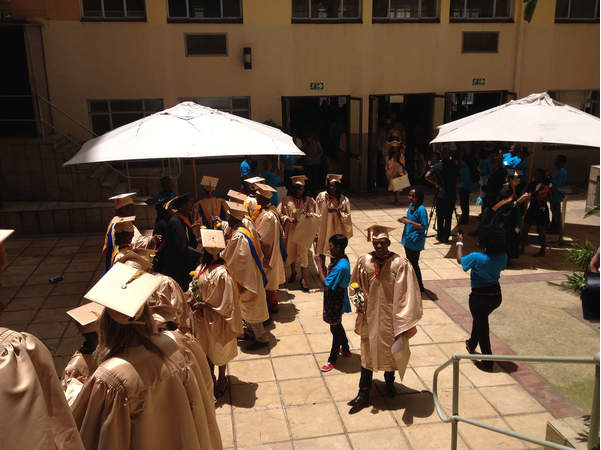
Pearson was in South Africa on official business to give the commencement address at Maharishi Institute in Johannesburg. The institute is a sister organization of M.U.M. and the students who graduated from it received M.U.M. degrees. (Courtesy of: CRAIG PEARSON)

Pearson was in South Africa on official business to give the commencement address at Maharishi Institute in Johannesburg. The institute is a sister organization of M.U.M. and the students who graduated from it received M.U.M. degrees.

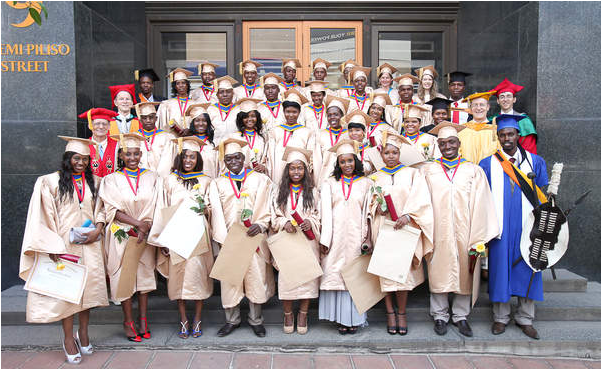
The students pictured are the first graduating class of Maharishi Institute in Johannesburg, South Africa. Maharishi University of Management’s executive vice president Craig Pearson, far right in second row, delivered the commencement address at the institute’s graduation ceremony in December. (Courtesy of: CRAIG PEARSON)

The students pictured are the first graduating class of Maharishi Institute in Johannesburg, South Africa. Maharishi University of Management’s executive vice president Craig Pearson, far right in second row, delivered the commencement address at the institute’s graduation ceremony in December.

Maharishi University of Management’s executive vice president Craig Pearson received quite the honor in December when he was asked to give a college commencement address in South Africa.

Pearson just so happened to be in Johannesburg when all eyes were on the country after the death of former president Nelson Mandela on Dec. 5. Pearson was able to witness first-hand the outpouring of support and admiration the locals had for the man who symbolized the nation’s struggle against racial separation.

Upon his arrival in the country Dec. 2, the M.U.M. vice president learned he was staying a mere five blocks from Mandela’s home. Pearson planned to walk by the home to take photos, which would not be too difficult since it was normally a quiet street. Within a few days, the street outside Mandela’s home was packed full of people dropping off flowers and singing songs in honor of their fallen leader.

On the morning of Mandela’s death, Pearson opened his laptop to check the news. He saw a headline that read, “The World Mourns,” and he knew right away what it was about.

“When I went down to take photos outside his home, instead of empty streets there were hundreds and hundreds of people,” he said. “People of every age and skin color were standing there. Singing spontaneously came from this epicenter of the crowd and it rang out until everyone joined in.”

Pearson saw a “mountain range of flowers and hand-written notes” placed on the gate outside Mandela’s home.

“Some of the notes were from children who expressed how they felt about their leader with quotes from ‘Madiba,’ as they called him, which is his tribal name,” Pearson said. “He was also referred to as ‘tata,’ which means ‘father.’”

The Associated Press dubbed Mandela a “master of forgiveness” for his insistence on a peaceful cessation to the state-enforced racial separation known as “apartheid.” Mandela brought apartheid to an end after he became president of the country in 1994. Mandela became the country’s first black president after spending 27 years in prison for championing equality against the white-minority government.

“The significance of what he accomplished goes far beyond the borders of the country,” Pearson said.

After the memorial service for Mandela at a large soccer stadium, South Africans approached Pearson to tell him they were touched by the words of President Barack Obama, who spoke during the service.

Maharishi Institute in Johannesburg held an assembly the day after Mandela died. Pearson was asked to speak at the assembly, and he said it was clear from the other speakers how much Mandela meant to everyone.

“It’s extraordinary to see a leader be so beloved by the people these days,” he said. “Mandela was not without opposition for a long time, but once he became president and people saw he was a harmonizing force, then there was full support for him. I told the students they have a leadership role to play by building on his legacy.”

Pearson said when he visited Mandela’s home he was only able to see the roof because the rest was obscured by a wall. He said that was not unusual and that nearly every house in the city has a wall around it topped with barbed wire.

“They’re beautiful walls and the city has beautiful tree-lined streets,” he said. “Johannesburg claims to have the largest man-made forest, and it really is a forest of a city. When you go on a hill you can see all the trees covering the streets.”

Pearson said Mandela lived in a well-off neighborhood but his house did not seem any more extravagant than his neighbors.

Maharishi Institute, where Pearson gave his commencement address, began in 2006 and is affiliated with M.U.M. in Fairfield. In fact, the students at the institute are actually earning degrees from M.U.M.. In some cases their instruction is provided online and in other cases a professor from M.U.M. travels to South Africa to teach a class in person. The 27 students who received their diplomas in December are the first to graduate from the institute. Pearson said the institute hopes to expand in the near future by adding 1,000 students in February.

Despite the end of state-sanctioned racial discrimination in 1994, blacks still lag far behind whites in educational attainment. Pearson said the institute was founded in Johannesburg to correct for the lack of higher education for blacks.

Students at the institute receive 1.5 years of free education and then begin a work-study program. One form work-study takes is to work at a call center in the same building as the school. Students who don’t work in the call center work as janitors or some other occupation that maintains the school.

“People living in the shanties may get an education through high school but their opportunities for college education are pretty miniscule,” he said. “Maharishi Institute takes the students who are ready for college and gives them a college education at no cost. One student told me he might be in a gang if not for the institute.”

Reprinted with permission from The Fairfield Ledger. The Monday Ledger ran this front page story five columns across with all three photos, two from South Africa, plus one of Craig Pearson. Dr. Pearson also spoke at the graduation of several managers at Neotel, one of the top communications companies in South Africa, who received MBA degrees from MUM.

Also see MUM Executive Vice President Comments on Nelson Mandela and more photos at  link.mum.edu/Mandela.

@MaharishiU’s Dr. Robert Schneider presents @TMmeditation research to @uiowa Hospitals and Clinics medical staff

January 9, 2014

Doctor touts health benefits of Transcendental Meditation
Written by Sara Agnew, Iowa City Press-Citizen
Jan. 7, 2014 8:55 PM

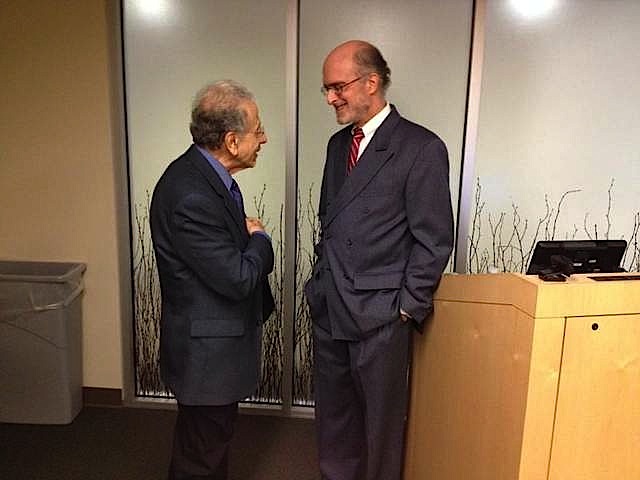
Dr. Francois Abboud, left, talks with Dr. Robert H. Schneider, who spoke with medical staff at University of Iowa Hospitals and Clinics Tuesday about how the practice of Transcendental Meditation can reduce the risk of heart disease and lower blood pressure. / Sara Agnew / Iowa City Press-Citizen

Dr. Francois Abboud, left, talks with Dr. Robert H. Schneider, who spoke with medical staff at University of Iowa Hospitals and Clinics Tuesday about how the practice of Transcendental Meditation can reduce the risk of heart disease and lower blood pressure. / Sara Agnew / Iowa City Press-Citizen

If you want to reduce your risk of cardiovascular disease and lower your blood pressure without taking medication, Dr. Robert H. Schneider has a suggestion: Transcendental Meditation.

Schneider says he has been involved in studies that show this type of meditation can reduce the rate of death from cardiovascular disease by 30 percent and from cancer by 40 percent.

The key is you need to know the “techniques” of Transcendental Meditation to experience the benefits — sitting with your eyes closed for 10 minutes won’t cut it.

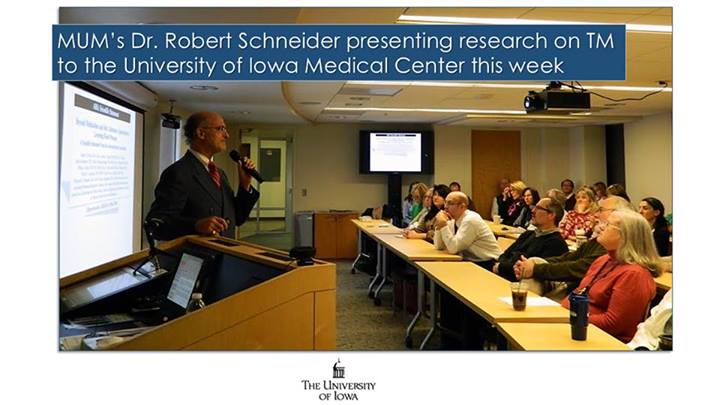
That’s the message Schneider shared with about 40 hospital personnel Tuesday during an hourlong presentation called MIND-BODY-HEART: Evidence for Meditation in Hypertension and Cardiovascular Disease at University of Iowa Hospitals and Clinics. It was his first visit with staff and doctors at UIHC.

“It was breakthrough,” he said of his visit.

Schneider is director of the Institute for Natural Medicine and Prevention and dean of medical programs at Maharishi University of Management in Fairfield. As a physician and scientist, Schneider has spent the past 30 years researching evidence-based natural approaches for treating heart disease, high blood pressure, stress and other cardiovascular factors. Over the past 20 years, he has received more than $20 million in research grants from the National Institutes of Health for his natural approaches to treating heart disease.

Much of his work centers on the benefits of Transcendental Meditation.

Schneider said TM is an effortless technique for “automatic self-transcending.” It allows your mind to settle inward beyond thought to experience the source of thought — pure awareness. This is the most silent and peaceful level of consciousness and what many who practice TM call your innermost self.

“It takes a technique that you learn in an eight-hour course,” Schneider said. “Once you have the technique, it happens quite easily.”

Schneider said humans have an “inborn ability” to practice this type of meditation.

“But we have lost this simple and natural technique,” he said.

Schneider said much of his research about the correlation between mind and body were affirmed last June when the American Heart Association announced that Transcendental Meditation is the only meditation practice that has shown to lower blood pressure. In addition, AHA reported lower blood pressure through TM is associated with substantially reduced rates of death, heart attack and stroke.

Ultimately, Schneider said the AHA recommended that TM be recommended for consideration as an alternative treatment for individuals with blood pressure greater than 120/80 mm Hg.

Schneider said he learned about TM 40 years ago as a college student.

“I was always interested in how we can tap into the body’s own cell repair and healing abilities,” he said. “I thought I’d try it and see if it works.”

He read the research and gave TM a try.

“I found I could study better and learn better and had more energy,” Schneider said.

Later, when he was a fellow in hypertension at the University of Michigan Medical School, Schneider took an interest in the connection between the brain and heart.

“I thought maybe we could use the brain to lower blood pressure,” he said.

Schneider believes his years of research on managing the mind-body connection is paying off as organizations such as the AHA begin recognizing the benefits of TM.

During his presentation at UIHC, Schneider highlighted a 2012 study that showed blacks with heart disease who practiced TM regularly were 48 percent less likely to have a heart attack, stroke or die from all causes compared with blacks who attended a health education class over more than five years.

Those practicing TM also “lowered their blood pressure and reported less stress and anger,” Schneider said.

Schneider is interested in researching how TM can be used to help military veterans recover from post-traumatic stress disorder.

Dr. Francois Abboud, the namesake of UI’s Cardiovascular Research Center, asked, “How will I know if I am meditating correctly?”

Linda Rainforth, a certified TM teacher from Iowa City, said people who are practicing TM reach a “deep, deep level of silence and stillness” in which they experience an “expansion of the mind.”

One listener wondered whether men or women followed through most consistently in practicing TM during research studies.

“Men and women both get results,” Schneider said. “But in some of our studies, there was slightly more compliance with the women.”

If you go

Learn more about Transcendental Meditation by attending one of the following presentations by certified teachers in TM. All presentations will be at the Iowa City Public Library, meeting room E.
• 7:30 to 8:30 p.m. Thursday.
• 3 to 5 p.m. Saturday.
• 6:30 p.m. Jan. 16.
TM sessions also can be by appointment by calling Iowa City Transcendental Meditation Program at 936-1986, 641-472-0827 or 641-919-7282. For more information, go to www.tm.org.

MUM's Dr. Robert Schneider presenting research at UIMC

Dr. Robert Schneider was also interviewed by Steve Smith on KMCD’s MUM Spotlight Show about the American Heart Association’s recommendation of Transcendental Meditation to lower high blood pressure. He also reported on his visit to UI’s Medical Center. Steve asked some great questions. It was a lively discussion. Listen here: http://fairfieldiowaradio.com/audio/spotlight%201-9.mp3. (20:45)

See Dr. Schneider on New Zealand Television’s Breakfast ONE News describing the value of TM for heart health. http://tvnz.co.nz/breakfast-news/meditating-your-heart-video-5602306

@LauraSimon reports on @MaharishiU Accounting students gaining certification in new worldwide financial reporting standard

January 7, 2014

Accounting students at Maharishi University are gaining certification in new worldwide standard in finance

Posted: 01.06.2014 at 6:39 PM by multi-media journalist Laura Simon reporting for ABC KTVO News on the Heartland Connection.

FAIRFIELD, IOWA — Accounting students at Maharishi University are gaining certification in a new worldwide standard for exchanging financial and accounting information.

Extensible Business Reporting Language, or XBRL is required by the agencies of the U.S. government as well as a growing list of international organizations. Balance sheets and income statements are considered examples of this type of documentation. The professor of the course and director of MUM’s MBA program says an XBRL certification makes students more marketable for the workforce.

“More and more there’s going to be this demand for people to know the technical standard that is required to prepare reports and communicate data to these federal agencies and as a result, we have been beginning to train our students to train for careers possibly in XBRL,” Andy Bargerstock, PhD, said.

The course is one credit hour and is offered two to three times a year based on the demand of students wishing to learn XBRL.

Laura Simon gave us a link to the full unedited XBRL Interview 1 6 14.

The full PRWeb press release sent out with our own video is now posted on the MUM website: MUM Accounting Students First in World to Learn New Reporting System Required by US Government Agencies. Click on this link to view it http://link.mum.edu/xbrl.

Related: @MaharishiU Accounting Prof Andrew Bargerstock prepares students for XBRL certification – Ledger.

@MaharishiU Dean of Faculty, Dr. Cathy Gorini, interviews author Steven Verney on MUM’s KHOE

January 2, 2014
Steve Verney Cathy Gorini

Steve Verney  Cathy Gorini

Author Steven Verney is interviewed by Dr. Cathy Gorini, Dean of Faculty at M.U.M. on the KHOE radio program “A Chat with the Dean.” Titled “The Best of all Possible Worlds” Steven Verney’s novel is based on his experiences as a teacher of Maharishi Mahesh Yogi‘s Transcendental Meditation.

Steven sprinkles gems of Maharishi’s knowledge before the reader along with threads of life-changing experiences many teachers of TM will relate to while going about the business of bringing enlightenment to the individual and the world and balancing life in the “real world.” Readers have found it difficult to put down this well-written book.

Click to listen: Steven Verney and Cathy Gorini – mp3 58 min, 16.8MB

A generous percentage of book sales will benefit the David Lynch Foundation teaching Transcendental Meditation to at-risk populations.

To find out more about Steven and his book, read this post and listen to an earlier interview on KRUU FM: Writers’ Voices interviews B. Steven Verney, author of “The Best of All Possible Worlds”.

Visit Steve’s new website one of his son’s designed for him http://steveverney.com and blog. Read the overview of the book and see the Xlibris Book Trailer: The Best of All Possible Worlds.

Steven is at work on his second book, about a lama that got away. The main protagonist is also a philosophy professor. I’ve read an excerpt and can’t wait to see the book when it comes out. If it’s anything like his first one, which I thoroughly enjoyed, then we’re in for another treat!

@MaharishiU Sustainable Living students build adobe house from scratch in Texas desert

December 19, 2013

MUM Students Build Adobe House From Natural Desert Materials

Maharishi University’s Sustainable Living students study natural building and travel to the Texas desert to put up a 14′ x 14′ adobe bunkhouse made primarily from indigenous materials mum.edu/AdobeHousePR

MUM students build adobe house from scratch in Texas desert

MUM students build adobe house from scratch in Texas desert

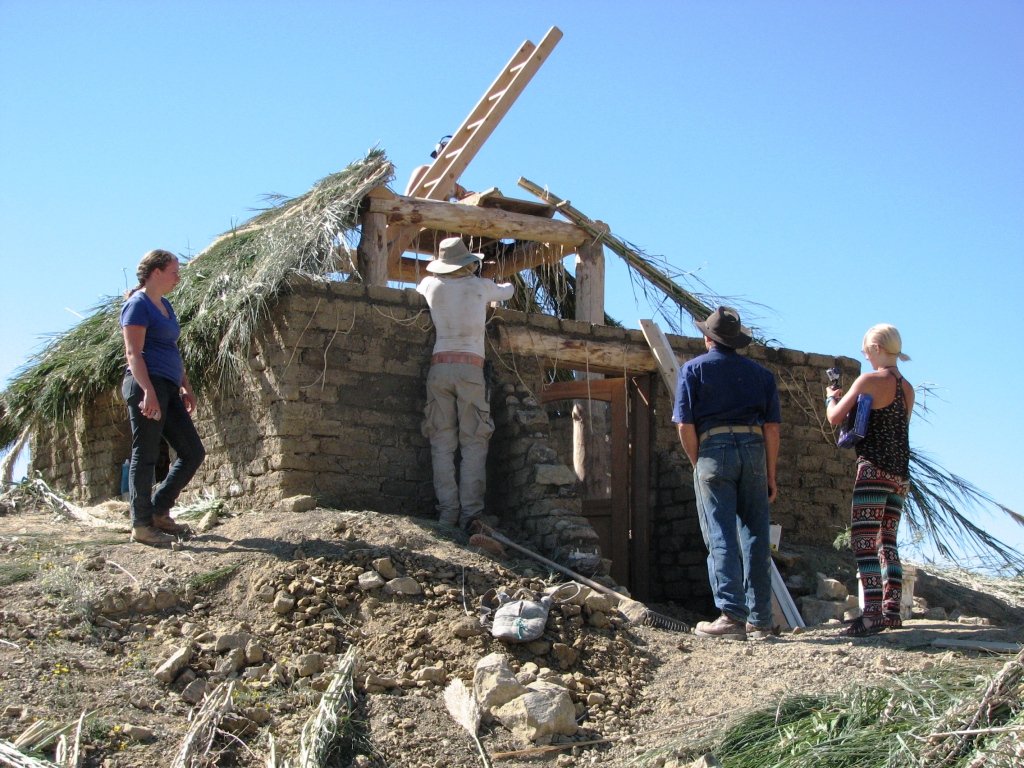
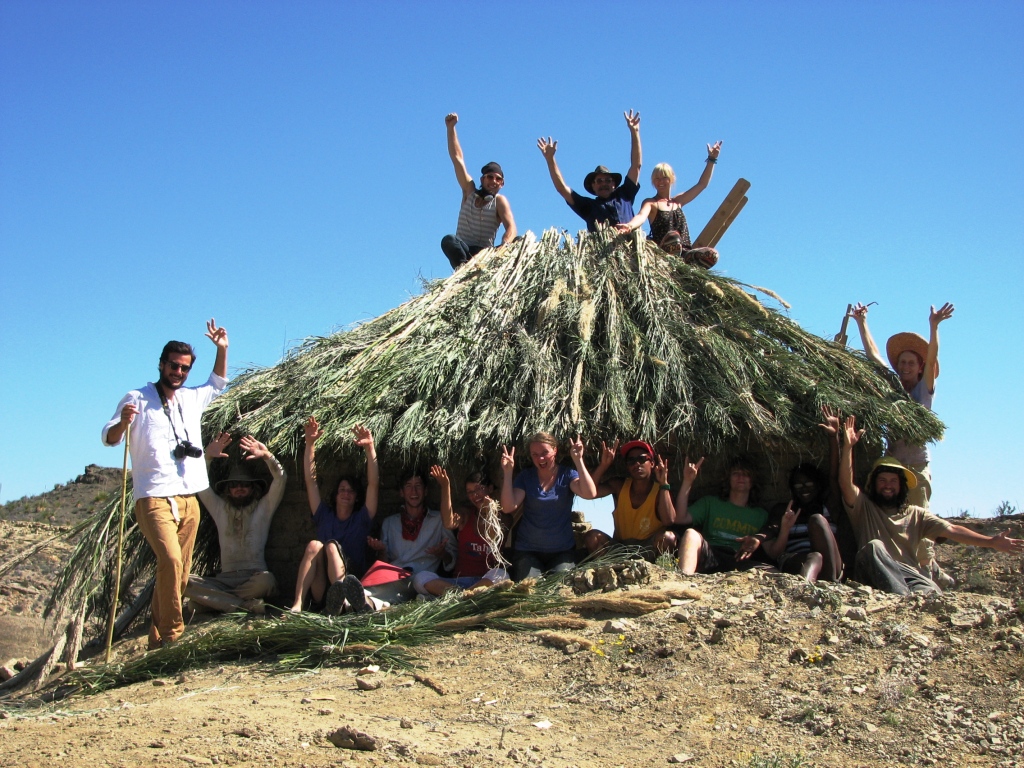
As a continuation of the Sustainable Living Program at Maharishi University of Management where students learn how to build a tiny house, a group of 12 students traveled to the Texas desert during their October Natural Building class and spent 11 days putting up a 14 x 14 adobe house made primarily from local materials.

They first made 850 adobe bricks from soil near the construction site, created a frame of posts and beams from dead spruce trees harvested beforehand on campus, and then topped the structure with a waterproof thatched roof made of river cane.

“It really has an amazing feel,” said course instructor Mark Stimson. “It’s rectilinear and oriented toward the cardinal directions, and adobe walls give it an ancient, grounded feeling.”

Intended to serve as a bunkhouse for future visitors, it sits on land owned by Mr. Stimson and his wife that’s adjacent to Big Bend National Park. Also on site is a tiny house students built last year.

In addition to learning practical construction skills, the students had the opportunity to experience an extraordinary landscape that includes deep vertical canyons, distant mountains, and rock-outcroppings dating back 500 million years, fossils, petrified wood, and a hot spring on the Rio Grande River. Plus the occasional tarantula and scorpion.

“The students had a transformative experience,” Mr. Stimson said. “They’ve never seen anything like this desert, with its vast scale. The heights and distances reset your perspective on things.”

Mr. Stimson’s desert site is 80 miles from the nearest town on a road too rugged for ordinary cars. The students prepared and canned all their food in advance. That alone was a learning exercise in planning and execution.

They traveled to the site via the Sustainable Living Department bus powered by biodiesel fuel that was made by the students and staff member Steve Fugate.

Every aspect of the construction required learning new skills. The students began their work on campus, creating a plan and estimating the amount of materials they would need.

Once on site, the students learned to sift the soil used for the bricks, moisten it with water, and then use forms to create the bricks. Once skilled, they were able to make a brick in less than a minute.

But then the bricks, all 17,000 lbs. of them, had to be carried up a long hill. The students formed a chain, and accomplished the task with aplomb.

“The students were confronted with many challenges in this remote desert region,” said Stimson, “but in the process they learned a lot about teamwork, leadership, self-sufficiency, and how to be flexible in the changing conditions they encountered.”

He related an incident of the students trying to prepare and dry adobe bricks, when an early morning desert fog prevented the sun from drying them out. It happened three or four days in a row. Of the many things they planned for, he said, the desert wasn’t one of them! But the sun burned it off by noon each day, and the adobe blocks dried enough to be used.

In order to comply with Maharishi Vedic℠ architecture, they learned how to perfectly align the building by using the North Star and the meridian transit off the sun.

“It’s within a quarter or even one-eighth of a degree of being perfectly aligned,” Mr. Stimson said.

He said his desert site is intended to serve as a retreat for campus groups and students in other departments, as well as the Sustainable Living students.

MUM students complete adobe house from scratch in Texas desert

MUM students complete adobe house from scratch in Texas desert

Commenting on the success of this course and the happiness of the students who participated in it, Professor Lonnie Gamble, Co-Director of the Sustainable Living Department said, “They’re happy because they’re taking their part in creating the world that they want to live in. I think it brings out a great joy, a great satisfaction, something that many of them have been looking for at other institutions before they’ve come here.” http://link.mum.edu/AdobeHouse

Part of this report was taken from The Review, Vol. 29, #6, November 27, 2013. For more information visit http://link.mum.edu/AdobeHousePR.

Read the description under this video posted on the MaharishiUniversity YouTube channel with more details describing how the students prepared for their trip, built their tools when they got there, gathered and processed the local materials to construct the adobe house.

Founded in 1971, Maharishi University of Management (MUM) offers Consciousness-Based℠ Education, a traditional academic curriculum enhanced with self-development programs like the Transcendental Meditation® technique. Students are encouraged to follow a more sustainable routine of study, socializing and rest without the typical college burnout. All aspects of campus life nourish the body and mind, including organic vegetarian meals served fresh daily. Located in Fairfield, Iowa, MUM is accredited by The Higher Learning Commission and offers bachelor’s, master’s, and doctoral degrees in the arts, sciences, humanities, and business. Visitors Weekends are held throughout the year. For more information, call the Admissions Office at 800-369-6480 or visit http://www.mum.edu.

Source: PRWeb: http://www.prweb.com/releases/MUM-SL/AdobeHouse/prweb11363060.htm

Finding the needle in a haystack: MUM teaches data-mining class – Andy Hallman/Fairfield Ledger

December 14, 2013

Finding the needle in a haystack MUM class teaches students how to find useful information in a sea of data

Article & photo by ANDY HALLMAN, news editor for The Fairfield Ledger Dec 13, 2013

Maharishi University of Management professor Anil Maheshwari teaches a class on data mining at the school. The students learn how to glean insights from enormous data sets to help businesses serve their customers, among many other things.

Maharishi University of Management is becoming a key player on the national stage for its research into data mining.

Data mining refers to techniques for finding useful knowledge in a vast sea of information. Due to a recent partnership between IBM and MUM, university students have free access to IBM software to help them crunch huge data sets. They’re using those tools from IBM in a course titled “Business Intelligence and Data Mining,” taught by MUM professor Anil Maheshwari.

The IBM Academic Initiative offers participating schools course materials, training and curriculum development to 6,000 universities and 30,000 faculty around the world.

Maheshwari said modern computers have taken number crunching to new heights. They allow programmers to find correlations between sometimes seemingly unrelated variables. This kind of computing power is valuable for businesses because it allows them to fine-tune their advertisements.

Businesses collect reams of information about the demographics of their customers. Data mining allows them to sort through this information to find out who buys the product, such as whether the customers are mostly male or female, young or old, single or married, etc. Learning which variables are important and which are not is key to a successful marketing campaign.

“Data mining is just like mining into diamond,” he said. “You need a lot of skill and tools but also an artistic edge of identifying the diamond.”

Maheshwari said data mining holds the promise of being able to answer questions the way contestants do on a game show such as Jeopardy! He even mentioned a computer called “Watson” that has competed on the show. The computer is fed the question and then generates an answer based partly on how the words in the question correspond to encyclopedia articles in its database. Data mining power has reached a point where Watson’s sophisticated algorithms can arrive at the correct answer even when the question employs puns.

A computer that can answer questions after searching through a database would be useful to doctors who are trying to predict whether a symptom in a patient is likely to lead to a malignant or benign tumor. Data mining computers could search through thousands of cases to find which variables, symptoms in this case, predicted malignant tumors and which predicted benign tumors.

Such technology could be applied in other realms, too, such as finding out which students were likely to drop out of school based on data about previous drop outs.

Maheshwari said collecting large amounts of data is easier than most people think considering so much of it is publically available on the Internet. He said the government gathers massive amounts of data for everything under the sun. Accessing the data is not the tricky part – knowing how to separate the wheat from the chaff is. Actually, Maheshwari said the analogy he prefers is finding a needle in a haystack, because the vast majority of data in a database is useless in answering the researcher’s question.

In response to the growing need for experts in information technology such as data mining, MUM has introduced an online graduate certificate program in Management Information Systems. The program can be completed entirely online in one to two years.

This front-page news story is reprinted with permission from the Fairfield Ledger. Click on this link to see how it appears in that issue: FFLedger12-13-13_1A.

For more on the story, including a video interview with Anil Maheshwari, see http://link.mum.edu/DataMining.