Posts Tagged ‘Maharishi University of Management’

Maharishi University places 4 winning MBA teams in top 10 at international CAPSIM competition

August 9, 2012

M.U.M. Students Excellent In CAPSIM Competition
by Johnny Mangano
Published on Aug 9, 2012 by KTVOtv

FAIRFIELD, IA — Four MBA teams from the Maharishi University of Management placed in the top 10 of the international CAPSIM Foundation simulation.

The simulation tests MBA students acumen in areas such as sales forecasting, inventory management, operations management,  human resources, finance, and quality management.

M.U.M. competed with other schools across the continent including Villanova and Drexel even though enrollment at the school is just around 1,000 students.

The competition is spread out over a six month period and is very rigorous.

Dr. Andrew Bargerstock, Director of MBA Programs at M.U.M. led the students in this endeavor.

In the past three years, M.U.M. has placed teams in the top ten of the competition with a team actually placing first last year.

When asked whether he values that or this year with four teams placing in the top ten, Dr. Bargerstock preferred the latter because it speaks to how deep and knowledgable his MBA students are.

The simulation is scored on a Balanced Scorecard concept which measures both short and long term growth across four perspectives: financial, customer, internal business processes, and learning and growth.

The four teams were named Chester, Digby, Baldwin, and Andrews.

The Chester team placed in the 97th percentile and included Enkhbat Byambaakhuu, Laxman Bhandari, Visakha Ly, Phirada Khuon, and Nan Cao.

The Digby team was in the 95th percentile and included Seka Ellepo, Njei Akuro, Gurmu Negeri, and Eshetu Debru.

The Baldwin team finished in the 93rd percentile with team members Xiaoxu Chen, Zhou Jiang, Yue Pan, Daina Zhang, and Bo Wu.

The Andrews team placed in the 90th percentile with Eliana Freeman, Mokhlis Awad, Joseph Marquez, and Mila Zhang.

For more information on MUM’s Accounting MBA program visit: http://www.mum.edu/accounting-mba.

Also listen to the KMCD August 9 MUM Spotlight Show with Andy Bargerstock, MUM Professor and Director of MBA programs, as he discusses the significance of the CAPSIM simulation within the Accounting MBA program at MUM and how it prepares his students to compete and win against other top universities in North America.

See the MUM Blog: Four MBA Teams Place in International Competition and Dr. Andrew Bargerstock’s blog: MUM’s Four MBA CAPSIM Teams All Finish in Top 10.

Also see last year’s winning teams, one taking first place: Maharishi University MBA Students Win National Business Simulation Competition and Students Place 1st in National Business Simulation and MBA Students Win National Business Competition and this video: CAPSIM winners: MBA teams at Maharishi University of Management.

Fairfield and Ames war veterans team up to bring meditation (TM) to fellow Iowa vets with PTSD

July 26, 2012

Meditation, fellow veteran help Colo reservist heal from PTSD

Written by Daniel P. Finney for the Des Moines Register

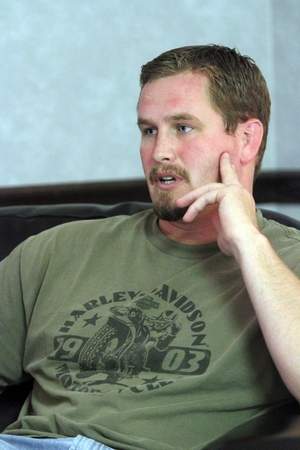
Luke Jensen has found Transcendental Meditation to be a help to him as he copes with the aftereffects of his service in the war in Afghanistan.  Christopher Gannon/The Register

Luke Jensen was in bad shape when Jerry Yellin reached out to him last year.

Jensen, a 32-year-old U.S. Army Reserve veteran of the Afghanistan war, was suffering from post-traumatic stress disorder.

He yelled at his wife and two daughters. He stormed about his Colo home. He rarely slept. He drank until he passed out. He overdosed on his anti-anxiety medication. One dark night, in front of his youngest daughter and wife, he held a loaded gun up to his head.

“I thought about suicide on a daily basis,” Jensen said. “It was that bad.”

Also an Army veteran, Yellin contacted Jensen after reading a profile in The Des Moines Register last year detailing Jensen’s struggles.

Yellin, a New Jersey native who lives in Fairfield, told Jensen he felt the same way after his World War II service. Yellin, 88, had lived with suicidal thoughts and anhedonia — an inability to experience pleasure from usually enjoyable activities — for 30 years until he and his wife, Helene, discovered Transcendental Meditation.

“I read that story and I knew I had to get to Luke,” Yellin said. “I don’t want anyone to live with the hell I did for 30 days let alone 30 years. I believed I could help.”

The pair seek to bring their message to more veterans Saturday in Fairfield. Both will speak at “Healing the Hidden Wounds of War” at 2 p.m. at the Fairfield Arts and Convention Center. The seminar is free. Scholarships also will be awarded free of charge to veterans and their spouses to learn the technique and practice it for six months.

The event is sponsored by Operation Warrior Wellness, which promotes Transcendental Meditation to veterans struggling with their experiences in war. Operation Warrior Wellness is sponsored by filmmaker David Lynch, known for the TV series “Twin Peaks” and “The Straight Story,” a film about a man’s journey from Iowa to Wisconsin to visit his estranged brother.

Transcendental Meditation is based on an Indian philosophy that trains the mind and consciousness to realize a benefit by focusing on a mantra, a meaningless word that helps bring about calm and reduce stress. The technique dates back more than 5,000 years, but it became especially popular in the U.S. during the 1960s when championed by charismatic guru Maharishi Mahesh Yogi.

Iowa and meditation have a long history. Followers established the Maharishi University of Management in Fairfield in 1974, considered the world’s largest training center for the technique.

The U.S. Department of Defense does not specifically offer meditation technique, though officials are not opposed to the practice as a way to mitigate PTSD and other war-related disorders.

“When you’re talking about PTSD, it is a toolbox issue,” said Col. Greg Hapgood, spokesman for the Iowa National Guard. “There is no one-size-fits-all solution. We wouldn’t discourage veterans from informally reaching out to anything that some have found to be a positive.”

Some skeptics dismiss the technique as hokum, but Yellin and Jensen believe their meditation has alleviated years of struggles. Yellin got into the technique after his wife, Helene, saw the Maharishi on “The Merv Griffin Show” in 1975. The couple lived in Florida at the time and called a local Transcendental Meditation teacher.

“After the war, I lived my life without purpose,” Jerry Yellin said. “As a fighter pilot, I had purpose. I came home. I got married. I had four sons. I was a father in presence. I was a husband in presence. But I had no purpose.”

In the years after the war, Yellin struggled to work. He held as many as 30 jobs. He worked for his wife’s father several times. His office was in a nine-story building and he often thought about jumping to his death.

“I loved my children and I loved my wife, so I didn’t,” he said. “But I thought about it a lot.”

The meditation, Yellin said, helped him process decades-old memories from the war. He flew strafing runs to support U.S. Marines on Iwo Jima, where 7,000 Marines and 21,000 Japanese soldiers died.

“The Marine mortuary was right behind our station,” Yellin recalled. “I saw hundreds upon hundreds of bodies being buried. I saw thousands of Japanese dead being pushed into mass graves.”

He carried a hatred for the Japanese people until 1988, when one of his sons married the daughter of a former Japanese Zero pilot. The meditation helped him make peace with his memories and become a better husband, father and now grandfather, he says.

Oddly, Yellin said the feeling he gets when he meditates is similar to the feeling he got when he flew fighter planes.

“It’s a warrior’s technique,” he said. “When you go to battle, you’re in the zone. I became the airplane. I can tell you how many aircraft I shot down. I can remember the aftereffects of what I did, but I can’t remember what I did to make that happen. You become one with the moment.”

The same warrior’s technique also helped Jensen make his peace. He and his wife, Abi, both practice. After returning from service, he couldn’t sleep despite a regimen of pills specifically prescribed to make him drowsy.

After his first session, Jensen slept better than he had before the war. He felt “a great weight lifted off my shoulders. It really made me a better person in every conceivable way.”

Both Jensen and Yellin acknowledge some skeptics doubt Transcendental Meditation. Some worry the practice will interfere with their religion. Yellin, however, said his meditation makes him a better Christian.

“This is not psychology,” Yellin said. “This is not religion. It’s a healing practice. If you served your country in war and you’re suffering, it’s worth a try.”

warrior wellness

For more information on Operation Warrior Wellness, visit iowaveterans.eventbrite.com.

David J Gudenkauf· Top Commenter

Great article! Keep writing about these veterans returning back from combat zones and how difficult it is to transition into a normal lifestyle. Once you keep raising awareness, the “Investment” will be forced on politicians to continue the promises of CARE they are planning to cut from these traumatized citizens. Ask those people in that Aurora theater how long it will take to recover from the incident of that gun fight and you can get a basic understanding of a veteran leaving a normal family and spending a YEAR’s worth of those days living like that and then being expected to act “normally” like nothing happened. Then when they need help, a government tells them that they should look elsewhere because it is not in the defense funds anymore (even though they put them there in the first place).

Jean Welch Tobin

I have spoken to a number of veterans who have learned the TM technique and their stories mirror the stories told here. I encourage all veterans, men and women, to take advantage of this opportunity.

Also posted on DefenseTracker.com: Meditation Helps Reservist Heal and Wounded Times Blogspot and Altoona Herald-Index.

Fairfield Ledger cover article by Diane Vance: Combat stress subject of public forum Saturday

July 26, 2012

Combat stress subject of public forum Saturday
Travis to speak at forum

By DIANE VANCE, Ledger staff writer | Jul 25, 2012

Jerry Yellin

Two U.S. Army veterans, more than five decades apart in age, and a five-wars-with-U.S.-involvement difference, will share their stories and their experiences in making peace with the effects of war and combat, in the hope of reaching other wounded veterans.

World War II P-51 fighter pilot, Fairfield resident, author and co-chair of Operation Warrior Wellness, Jerry Yellin and Luke Jensen, a 12-year Army Reserves Military Police soldier, Operation Enduring Freedom/Afghanistan veteran from Story County will join in a public forum at 2 p.m. Saturday at the Fairfield Arts & Convention Center.

The forum, Healing the Hidden Wounds of War, is open to everyone at no charge.

“The military is experiencing an extreme suicide rate,” said Yellin. “The July 23, 2012, Time magazine has a story, ‘War on Suicide’ on the cover. One U.S. soldier commits suicide each day. Why?”

Another chilling statistic: More soldiers have died by suicide than have been killed in combat in Afghanistan.

“A representative from the Surgeon General’s office is coming to our forum in Fairfield,” said Yellin.

Yellin and Jensen are authorities on the effects of combat stress and Post Traumatic Stress Disorder. Yellin describes suffering from it for 30 years; Jensen is healing after struggling for nearly two years.

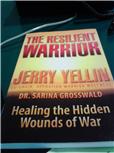
Yellin tells his story in his published book, “The Resilient Warrior.” He was 17-years-old on the day Japan attacked the U.S. navel fleet at Pearl Harbor, Dec. 7, 1941.

“It felt as if someone had invaded my home, and I had to do something about it,” he wrote.

When talking about his story, Yellin says, “I lost 16 friends, other pilots. Do you want to hear their names?”

And he recites the 16 names beginning 69 years ago, how they died and when they died.

Yellin flew 19 long-range bombing missions over Japan from his base in Iwo Jima, in the company of 11 “other young pilots, all of them friends,” none who lived to return home.

But he returned home, to New Jersey, in December 1945. In his book, he describes himself as a former captain, a combat squadron leader, and a fighter pilot, but “emotionally I was just a 17-year old high school graduate. I was a lost soul, with no one to talk to and no real life experiences to fall back on,” he wrote.

“During the war, I had a purpose, it was clearly defined,” said Yellin from his 88-years’ perspective. “When I came home, I was completely empty.

“I developed an addiction — to golf,” he said. “I had no interest in working, no interest in furthering my education.

“I had dreams about my friends killed, I had nightmares about the ones lost and no bodies recovered,” he said. “I couldn’t think about the guys killed during the day.”

“Stress is like a virus of the brain,” said Yellin. “It needs something to relieve that stress. The best way I’ve found for relieving that stress is Transcendental Meditation.”

His wife Helene saw Maharishi Mahesh Yogi on the Merv Griffin TV show in 1975, and became interested in learning TM. After his wife and one of his sons learned, Yellin also decided to take the TM course.

“Thirty years after World War II, I found TM could take my stress away,” said Yellin.

His other three sons also learned and eventually, the family moved to Fairfield.

Since 2010, Yellin has been on a mission to help veterans, and their families, from any wars, learn TM to relieve stress, he said.

“I don’t want other veterans to go through what I went through,” he said.

Through Operation Warrior Wellness, supported by the David Lynch Foundation, offering this help, learning TM, is given at no cost to veterans and families.

Yellin has spoken about PTSD and TM in New York, Washington, D.C., South Dakota and Los Angeles. But it isn’t only from the podium to large crowds he makes his appeals; Yellin also deals up close and personal.

A year ago, his son brought home the Des Moines Register with a front-page story that grabbed Yellin’s attention.

“I don’t read newspapers a lot,” he admitted. “But the July 17, 2011, Register had the story of a young man, Luke Jensen and his family living in Story County, ‘A War with PTSD.’”

Luke Jensen

Des Moines Register writer Reid Forgrave wrote about Jensen, who grew up in a loving family, always wanted to be in law enforcement and joined the Army Reserves after high school.

The news story tells about Jensen’s hiring at the police department in Nevada, Iowa, in 2001, his yearlong deployment after 9/11 to seaports around the country, then upon returning, his advancement in local law enforcement. He worked on the Central Iowa Drug Task Force as an undercover cop, making drug buys, drug busts and felony arrests.

By 2009, he and his wife had two young daughters. His unit was called up to deploy to Afghanistan. He wasn’t looking forward to leaving his family, but it was his commitment and he would be deploying with his close-knit group of military buddies. But then, just before the unit left the states, the mission changed and the unit was split into smaller groups and dispersed to seven separate bases.

Jensen experienced soldiers dying and artillery fire shaking his bed day and night. Within a month, he felt defenseless, helpless, sleepless and eventually hopeless. He lost 25 pounds and experienced panic attacks all day long. He sweated profusely and was depressed. After 53 days he was medically evacuated.

Going through seven weeks of therapy at Fort Campbell, Ky., before returning to Iowa didn’t help. Relaxation classes, yoga and prescriptions didn’t help.

One April night in 2010 Forgrave wrote, Jensen finished drinking a 12-pack of beer and argued with his wife. He got his 45-caliber pistol and “stalked around his house, crouched toward the floor, making strange noises. ‘You don’t know what I’ve seen!’ he screamed at his wife” at 3 a.m.

When she said she was calling police, after locking herself and daughters in the bathroom, Jensen screamed he’d kill himself, wrote Forgrave.

That one-night crisis de-escalated, but Jensen was still very unbalanced. Then he lost his job as a Story County deputy. The family started going in debt.

Jensen vacillated between not sleeping and sleeping all the time. His blood pressure, at age 32, was very high. He was put on blood pressure medication. And he kept thinking about suicide, something he hadn’t really stopped thinking about since serving in Afghanistan.

He continued with counseling therapy and took a job in Story County Veteran Affairs Office, helping other veterans access services and file claims. He was making improvements, accepting his war experiences and his mental breakdown from it.

That’s the story Yellin read in the newspaper last summer. The following day, he called Story County Veterans Affairs Office and asked for Jensen.

“Yeah, he called me at the office,” said Jensen. “He told me he was an 87-year-old guy who knew what I’d been going through.”

“I told him about TM and offered to bring Luke and [his wife] Abi to Fairfield and learn TM, and it wouldn’t cost him anything,” said Yellin. “I told him I’d do anything I could for him. We put them up in a Fairfield inn, fed them and each of them took the TM course.”

It was all paid for through Operation Warrior Wellness.

“Jerry [Yellin] and I are still in constant contact,” said Jensen. “He wants to help other veterans and so do I. I have Jerry’s book in my office. I have brochures about TM and offer them to anybody who’s interested. Anytime I go to a conference or a training for Veterans Affairs, I do some local promoting about Transcendental Meditation and Operation Warrior Wellness. It has sparked some interesting conversations. And since I’m 33 and have been to Afghanistan, more younger veterans are finding their way into the office.”

Jensen said in the year since learning TM he has been able to get off his anxiety medications and sleep-aides, lower the doses on his blood pressure medication and depression medication.

“I’m sleeping much better,” he said. “I’m attending night classes through William Penn University, studying business management.

“I’ve recommended TM to family members, and besides my wife, an uncle and a cousin also learned.”

Abi also appreciates Yellin’s outreach.

“I felt we had a lot of support from family and had close military ties with Luke’s unit. I thought when he came home, we’d just go back to our former lives,” she said. “Even though I knew he had suicidal thoughts, I thought all that would go away once he was home again. I thought I was strong enough to overcome all of this.

“I didn’t want to know about all the hidden wounds, I didn’t want Luke to be changed,” she said. “One thing I’ve always adored about Luke is he’s a very tender, loving father.

“But I got to the point of being so overwhelmed,” said Abi. “I had a lot of anxiety about money. Seeing the changes in Luke was scary.”

She said learning TM over a weekend last summer, gave her hope.

“After one week of practicing TM, I could face what I needed to do, about money, about healing … it just blows me away,” she said. “Luke and I meditate together. It has helped so much. He’s better, a better husband, a better father, a better man, even now than he was before going to Afghanistan. He’s a happy guy to be around. And he’s become a good public speaker, I’m looking forward to this forum on Saturday.”

Yellin encourages anyone interested in the topic to attend Saturday’s forum

“We prefer if people register at www.operationwarriorwellness.org/iowa if they are attending,” he said.

Travis to speak at forum

Along with Luke Jensen and Jerry Yellin, Fred Travis. a professor at Maharishi University of Management and director of the Center for Brain, Consciousness and Cognition, will present information at Saturday’s forum, Healing the Hidden Wounds of War.

Travis is a published researcher about the functions of the brain and effects of Transcendental Meditation on the brain.

“The main point to remember, is experience changes the brain,” he said.

That is, whatever we view, are exposed to, listen to, learn or experience, affects our brains.

“Post Traumatic Stress Disorder is a natural response to an unnatural event,” said Travis. “The brain’s Amygdala attaches an emotional tag to any experience to remember it.

“PTSD is a way of the brain wanting you to remember an event, except it also causes hyper vigilance and low self-esteem and makes those experiencing PTSD not trust others,” said Travis.

“Just as experience can change the brain, Transcendental Meditation can change the brain,” he said. “When meditating in TM, the person transcends thought, which allows the brain to reset itself. If affects the body and the mind.

“How can I say this? Because we have research to back it up.”

Front page article reprinted with permission from The Fairfield Ledger

See: Military veterans speak on need to increase resiliency: by Diane Vance, Fairfield Ledger  |  WHO TV 13: WARRIOR WELLNESS: Healing Hidden Wounds  |  Des Moines Register: Fairfield and Ames war veterans team up to bring meditation (TM) to fellow Iowa vets with PTSD  |   KTVO: Veterans speak out on post-traumatic stress, offer a proven way to heal PTSD  |  Healing the Hidden Wounds of War: open forum for Iowa veterans and their families affected by PTSD, sponsored by Operation Warrior Wellness  |  Mark Newman: Courier: Iowa soldier seeks peace of mind through meditation and medication  |  KTVO News: How one soldier regained his life with help from WWII veteran and TM for PTSD  |  TM Blog: “TM saved my life”—Suicidal Afghanistan war veteran who suffered from PTSD

Celeb Spiritual Report: Jane Mag, May, 2004: David Lynch: One significant day in my life

July 24, 2012

One significant day in my life

By David Lynch

Jane – May, 2004

A significant event occurred in my life the day I learned that our human physiology, our body, is made of consciousness.

Consciousness???

“What???” I asked out loud in wonder.

I learned that our human physiology is so magnificent and complex, and so exquisite in its design and makeup, as to be wondrous beyond imagination. We are spun out of unbounded, infinite, eternal consciousness.

I learned that underlying all matter is a vast, unbounded, infinite and eternal field of consciousness called the Unified Field. I found out that modern science started taking this field seriously about 25 years ago and that all matter is unified at this level in a state of perfect symmetry, or balance. The entire universe emerges from this field in a process called “spontaneous sequential symmetry breaking.”

Are you still with me?

I also learned that there is another science called Vedic Science. This Vedic Science is ancient, and it has always talked of the Unified Field.

Interesting!

Veda, I learned, means “total knowledge.” The home of total knowledge is the Unified Field. It is also the home of all the laws of nature. The branches of Veda, 40 in total, make up the language of the Unified Field, the impulses of this eternal field.

I realized this Unified Field is quite an interesting place. It is not manifest and is full, meaning it is no thing, yet all things in potential. It manifests and permeates all things: the whole universe, everything, while still remaining full and not manifest.

Amazing!

Is this mind-boggling or what?

Now comes the hippest part. I have learned that any human being can “experience” the Unified Field.

Really?

Or: So what?

Why in the world would we care to experience the Unified Field?

First, another question.

Have you ever heard that most of us human beings use only 5 percent of our brain, our mind? Have you ever wondered what in the heck the other 95 percent is all about?

This is the beautiful part coming up.

The “experience” of the Unified Field actually unfolds “enlightenment”—higher states of consciousness culminating in Unity Consciousness, the highest state of consciousness. These higher states use that 95 percent of the brain. That is what the 95 percent is there for—to give us permanent, all-time enlightenment.

Now, what is enlightenment? If you were a light bulb, let’s say, your “glow” might light up your whole house and surrounding yard. In enlightenment, your “glow” would be unbounded, infinite and eternal. That would be some glow!

Enlightenment is fulfillment. Supreme fulfillment. Unbounded, infinite, eternal bliss, consciousness, intelligence, creativity, harmony, dynamic peace.

Enlightenment, I have learned, is our “full potential.” It is the birthright of every human being to enjoy enlightenment.

Is this good news? I think it is such good news.

In Vedic Science, the Unified Field is called “Atma.” Translated, that is “Self”—the Self of us all.

The Unified Field is not something foreign, or even something far away. It is right within each of us at the base of our mind, the source of thought. A great sage from the Himalayas, Maharishi Mahesh Yogi, brought a beautiful gift to our world in the form of Transcendental Meditation. Transcendental Meditation is an easy and effortless, yet supremely profound, technique that allows any human to dive within and experience that unbounded ocean of pure bliss, pure consciousness, the Unified Field, our Self.

It may be interesting for you to know that millions of people are practicing Transcendental Meditation all around the world. People from all religions, and all walks of life. Over 600 studies have been done in universities and research institutes validating the profound benefits of Maharishi’s Transcendental Meditation Program.

Having this kind of knowledge and technologies of consciousness available to us in this age is, in my mind, a significant event. Yet the “experience” of that Unified Field is the most significant event, because it unfolds what we truly are—totality.

David’s movies include Eraserhead, Dune, Blue Velvet and Mulholland Drive. He is looking forward to Creating World Peace Day, to be held mid-September at the Maharishi University of Management in Fairfield, Iowa (www.mum.edu).

Copyright 2004 Fairchild Publications, Inc.

Back to the David Lynch articles page.

Jane – May, 2004 – David Lynch’s Celeb Spiritual Report

Veterans speak out on post-traumatic stress, offer a proven way to heal PTSD

July 18, 2012

Jerry Yellin, WWII Veteran and author of four books, speaks with fellow vet Luke Jensen on how they survived PTSD.  KTVO’S Kate Allt

FAIRFIELD, IOWA — Across the country, more and more veterans are returning home from war with symptoms of post-traumatic stress. Veterans who have been home for decades still struggle with traumatic experiences and memories.

Two Iowa veterans are inviting all soldiers from all wars and their families to the Sondheim Center in Fairfield, Iowa on July 28 to hear how a unique lesson went miles to improve the quality of their lives.

Jerry Yellin is not only a veteran of World War II and the author of four books, he has dedicated his life to helping veterans of all wars and their families. Yellin met Vietnam vet Ed Schloeman in 2010 and after both of them learned Transcendental Meditation, and saw the immediate benefits to their health and well-being, Operation Warrior Wellness was born.

Yellin knows first-hand what combat can do to a person’s mental and physical health.

“On August 14, the war was over and I came home and I was an empty shell at the age of 21,” he said. “Combat took everything out of me. I had a pure purpose for life, pure purpose for living, pure purpose for serving my government, serving my country, and then no purpose of life for 30 years. Stressed out, many jobs, and then I learned Transcendental Meditation, and I got my life back. There are hundreds upon hundreds of thousands of families – not only soldiers – but families, suffering from post traumatic stress and stress is relieved by Transcendental Meditation.”

Yellin firmly believes that Transcendental Meditation, or TM, saved his life. His, and many others. He has saved countless testimonials from veterans across the country who have seen the effects of TM work wonders on them and their families.

Luke Jensen of Des Moines is just one example. He returned from Afghanistan three years ago a broken man.

“I tried many, many things that did not work for me,” Jensen said. “And my family continued to push me to try new things, to get help when I first got back from Afghanistan. I wasn’t having any luck with anything or getting relief from anything until I learned TM with Jerry. It can change your life, and it did for myself and for Jerry and for many other veterans who went through – I know veterans who went through much worse, more experiences than I did and it helped them.”

Even scientists say TM has a relieving effect on the brain, and helps get rid of traumatic and stressful experiences stored into memory. Dr. Fred Travis, at the Center for Brain, Consciousness, and Cognition at Maharishi University, said the brain is not constant and unchanging. Rather, experience changes the brain, and oftentimes, traumatic or stressful experiences leave a permanent effect on the brain, and the amygdala – the fear center – is permanently turned on.

The way to reverse that change in the brain is to offer a direct opposite experience, one of calmness and deep thought.

“What Transcendental Meditation seems to do is turns off the amygdala and suddenly the person – remember, the brain is the interface between inner and outer – so now suddenly the person can see the situation in a different way,” said Dr. Travis. “This is what we see in the research of veterans of the Vietnam era, of Iraq, of Afghanistan, is the process of transcending from TM helps them very quickly reduce flashbacks, eliminate the anger and anxiety inside allowing them to sleep, allowing their heart and feelings to flow towards other people.”

“It helped me become a person, helped me become a better person, better husband, better father, a better person with a purpose in life,” Yellin said. “And I would like every veteran to expose themselves to this modality of Transcendental Meditation.”

This news report aired Wednesday, July 18, 2012 on ABC 3 and CBS 3.2.

To learn more about the July 28, 2 pm event – Healing the Hidden Wounds of War – at the Sondheim in Fairfield, or to register, visit http://operationwarriorwellness.org/iowa.

Find out more here: Healing the Hidden Wounds of War: open forum for Iowa veterans and their families affected by PTSD, sponsored by Operation Warrior Wellness

Here is a wonderful  interview with Jerry Yellin and Lisa Cypers Kamen of Harvesting Happiness Talk Radio July 18th. You can listen online to Jerry Yellin, Operation Warrior Wellness and Debbie Gregory, Military Connection or download the the podcast.

Other news coverage:  WHO-TV 13 News: WARRIOR WELLNESS: Healing Hidden Wounds with Meditation for Veterans  |  Des Moines Register: Fairfield and Ames war veterans team up to bring meditation (TM) to fellow Iowa vets with PTSD  |  Fairfield Ledger cover article by Diane Vance: Combat stress subject of public forum Saturday Story County Veteran Once Suicidal Finds Relief from PTSD with Transcendental Meditation: AmesPatch article by Jessica Miller

Breaking Down Net Zero Building: Reality or Wishful Thinking? by Ashley Halligan

July 4, 2012

In a recent article “Breaking Down Net Zero Building: Reality or Wishful Thinking?” Ashley Halligan, analyst for Software Advice, interviewed several experts to gather insight about the growing trend of net zero building. She took the time to speak with experts Brian Anderson, Founding Partner of Anderson Porter Design; Dru B. Crawley, former Commercial Buildings Team Lead for the Department of Energy and current Director of Building Performance at Bentley Systems; Jeff Blankman, McCormick’s Sustainable Manufacturing Manager; and Blake Bisson, VP of Sales & Marketing at Ekotrope.

Her article uses a case study of McCormick’s recent achievement of net zero following retrofits and energy efficiency efforts at its 363,000 square foot food distribution.

The experts weigh in with suggestions for both current facility retrofits and recommendations for projects intended to achieve net zero in its design phase, and ends with whether they think this is an achievable status on a wide-scale basis. With the Energy Independence and Security Act of 2007, all commercial buildings will, after all, be required to achieve net zero by 2050.

Pike Research Zero Energy GraphThis chart, provided by Pike Research, demonstrates how a reduction in consumption paired with alternative energy resources like PV panels can create an energy equilibrium–resulting in net zero usage.

Read the complete story here.

Here are a few clearly explained reviews of the article posted at enerdynamics, green lodging news, ecocloud, and other energy conscious design and building blogs referencing it.

Here is a related article, BIM + Project Management Software: The Next Generation of LEED Credit Tracking, by , ERP Analyst for Software Advice.

See these related reports of a university building and a business in Iowa to reach net zero: Maharishi University of Management to open new Sustainable Living Center, a net-zero energy bldg. (see additional coverage listed at the end of this article) and The Sky Factory meets ‘net zero’ goal with huge solar array | Sky Factory goes solar | Bloomberg Business Week: The Sky Factory meets ‘net zero’ goal with huge solar array [The Gazette, Cedar Rapids, Iowa]. Video reports: KTVO: Heartland business becomes first entirely solar-powered company in Iowa | The Sky Factory Goes Solar and KTVO News: Groundbreaking Sustainable Living Center a source of pride in Fairfield | WHO TV: BEYOND GREEN: Building Produces Extra Energy

Research breakthrough: High brain integration underlies winning performances

June 18, 2012

Research breakthrough: High brain integration underlies winning performances

World-class performers in management, sports and music often have uniquely high mind-brain development

Scientists trying to understand why some people excel—whether as world-class athletes, virtuoso musicians, or top CEOs—have discovered that these outstanding performers have unique brain characteristics that make them different from other people.

A study published in May in the journal Cognitive Processing found that 20 top-level managers scored higher on three measures—the Brain Integration Scale, Gibbs’s Socio-moral Reasoning questionnaire, and an inventory of peak experiences—compared to 20 low-level managers that served as matched controls. This is the fourth study in which researchers have been able to correlate the brain’s activity with top performance and peak experiences, having previously studied world-class athletes and professional classical musicians.

“What we have found,” says Fred Travis, director of the Center for Brain, Consciousness, and Cognition at Maharishi University of Management in Fairfield, Iowa, “is an astonishing integration of brain functioning in high performers compared to average-performing controls. We are the first in the world to show that there is a brain measure of effective leadership.”

“Everyone wants excellence,” says Harald Harung of the Oslo and Akershus University College of Applied Sciences in Norway. “Yet, current understanding of high performance is fragmented. What we have done in our research, is to use quantitative and neurophysiological research methods on topics that so far have been dominated by psychology.”

Dr. Travis, Dr. Harung, and colleagues have carried out a total of four empirical studies comparing world-class performers to average performers. This recent study and two others have examined top performers in management, sports, and classical music. In addition, a number of years ago Dr. Harung and colleagues published a fourth study on a variety of professions, such as public administration, management, sports, arts and education.

Measured Brain Activity

The studies carried out by the researchers include measurements of the performers’ brains by using electroencephalography, EEG. Hospitals use this equipment and method to determine possible brain injuries after traffic accidents. EEG, however, can also be used to look at the extent of integration and development of several brain processes.

The researchers looked at three different measurements that all reflect how well the brain works as a whole: 1) Coherence, which shows how well the various parts of the brain cooperate, 2) Amount of alpha waves, which reflect restful alertness, and 3) How economically or effectively the brain works.

The three measurements are then put together in an expression of brain refinement, the Brain Integration Scale.

World-class performance has so far been mostly regarded from a psychological point of view, especially speaking of management. Researchers often explain management skills as a result of special personal or psychological characteristics that some have, and others don’t.

“Our research in brain activity and brain integration is done from more of a natural science angle. By such means, we hope we are closer to an effective and comprehensive understanding of why some succeed better than others,” says Harung.

In all the groups of top performers, measurements were checked by using control groups. The controls were average performers, such as low-level managers or amateur musicians. The data gave one surprising result: Among the musicians, both the professionals and the amateurs turned out to have a high level of brain integration. In the two other studies, this measurement showed major differences between the persons with top-level performance and the control groups.

“We believe that for musicians, the explanation might be that classical music in itself contributes to such integration, regardless of your performance level,” says Dr. Harung.

Peak Experience

The researchers found it’s not just that their brains function differently; the world-class performers also had particular subjective experiences that were associated with their top performances.

Called peak experiences, these experiences are characterized by happiness, inner calm, maximum wakefulness, effortlessness and ease of functioning, absence of fear, transcendence of ordinary time and space, and a sense of perfection and even invincibility.

The first study was done on world-class athletes selected by the National Olympic Training Center in Norway and the Norwegian School of Sport Sciences. Besides screening athletes’ brains using EEG, each athlete was interviewed about their experiences while performing at their very best. The result was a wide range of peak experiences.

Former cross-country skier Thomas Alsgaard, who won 11 gold medals in Olympic Games and World Championships, said:

“The senses are so open that you have the ability to receive signals that are almost scary: In a way it is a ‘high.’ I receive an unbelievable amount of information. Much, much more—10-20 times more information—than what I manage to take in if I sit down and concentrate and try to perceive things. But I am so relaxed. And the more relaxed I am, the more information I register.”

Another athlete who participated in the research is the Norwegian handball keeper, Heidi Tjugum, who was part of the Norwegian national team that won one World Championship, one European Championship, two European Cups and a number of silver and bronze medals. She says:

“Sometimes I have felt that I am an observer—I just watch what happens. This is a good feeling. It is a very beautiful feeling; it is not that I feel I don’t have control. But it goes by itself—in reality I do not have to initiate anything at all. Extremely here and now—nothing else matters.”

These statements are similar to those the researchers gathered from other top-class performers, both among the musicians and the business leaders. As seen, they found a significant difference amongst the top performers and controls on several quantitative measures.

“Therefore, there must be some common inner attributes and processes that make top performers able to deliver at top level, regardless of profession or activity,” says Travis. “We found this common inner dimension to be what we called higher mind-brain development.”

Higher mind-brain development includes that various aspects and parts of the brain work together in an integrated way. Among world-class performers this integration is especially well developed.

Presenting a New Theory

The researchers have developed a new theory, a Unified Theory of Performance, which suggests that higher levels of mind-brain development form a platform for higher performance, regardless of profession or activity.

“It seems like these mind-brain variables represent a fundamental potential for being good, really good, in the particular activity one has decided to carry out,” says Harung.

For all three recent studies the researchers also found that top-level performers outscored the control groups in a test of moral development. Higher moral development implies an expanded awareness where one is able to satisfy the interests of other people and not just their own needs. Harung finds it remarkable that high levels of performance, in a wide spectrum of activities, are connected to high moral standards.

“This should give an extra push to act morally, in addition to a better self-image, fewer sleepless nights and a good reputation,” Dr. Harung says. “The key to top-level performance, therefore, seems to be that we make more use of our inherent capabilities.”

Implications of the Research

The discovery that the brains of world-class performers have similar characteristics raises some important questions, such as: 1) Is there a way one can develop one’s brain to have more of these characteristics and thereby perform at a higher level? And 2) Can measuring a person’s brain predict the potential for someone to be a world-class performer?

These and other researchers have actively explored whether meditation techniques, for example, can help to actively cultivate one’s brain. Research by Dr. Travis and others has found that Transcendental Meditation practitioners do have greater EEG coherence, greater presence of alpha waves, and, in some advanced practitioners, a very efficiently functioning brain. A coherent brain is a high-performing brain.

In addition, researchers have been exploring possible applications to predict performance ability in general and leadership ability in particular. For example, if a corporation has preliminarily selected five candidates for its CEO position, the above measures could be administered to aid in the final decision. Or these measures can be used to assess the effectiveness of training or education in increasing an individual’s performance capacity.

###

Scientific Literature

1. Harung, H. S., Travis, F., (2012) Higher mind-brain development in successful leaders: testing a unified theory of performance. Cognitive Processing Vol 13, Number 2, 171-181, DOI: 10.1007/s10339-011-0432-x

2. Harung, H. S. (2012). Illustrations of Peak Experiences during Optimal Performance in World-class Performers: Integration Eastern and Western Insights. Journal of Human Values, 18(1), 33-52, doi:10.1177/097168581101800104

3. Travis, F., Harung, H. S., & Lagrosen, Y. (2011). Moral Development, Executive Functioning, Peak Experiences and Brain Patterns in Professional and Amateur Classical Musicians: Interpreted in Light of a Unified Theory of Performance. Consciousness and Cognition, 20(4), 1256-1264

4. Harung, H.S., Travis, F., Pensgaard, A. M., Boes, R., Cook-Greuter, S., Daley, K. (2011). Higher psycho-physiological refinement in world-class Norwegian athletes: brain measures of performance capacity. Scandinavian Journal of Medicine & Science in Sports, Vol 21, Issue 1, pages 32, February 2011, doi: 10.1111/j.1600-0838.2009.01007.x

5. Harung, H. S., Heaton, D. P., Graff, W. W., & Alexander, C. N. (1996). Peak performance and higher states of consciousness: A study of world-class performers. Journal of Managerial Psychology, Vol. 11, No. 4, pp. 3-23

Related Articles

New study sheds light on “peak experiences” in world-class performers | New research looks at brain integration in top athletes and in long-time meditators | ‘Brilliant minds’—New Research on the Brain State of Virtuoso Musicians and How it Relates to TM | ScienceDaily: Musicians’ Brains Highly Developed | Freakonomics: Do Musicians Have Better Brains?

Source: EurekAlert!

Latest Study

Does Practice Make Perfect Or Are Some People More Creative Than Others? Study finds brain integration correlates with greater creativity in product-development engineers. The study was discussed on TMHome: Brain integration, the key to creativity, citing Medical News Today’s report on the study. Science writer Fiona Macrae had some questions for researchers Fred Travis and Yvonne Lagrosen before she completed her article for The Daily Mail: Forget ‘practice makes perfect’ – meditation is the key to success, study claims.

CNN anchor Candy Crowley gives Commencement Address at Maharishi University of Management

June 10, 2012

Fairfield, Iowa: On May 26, 2012, 268 students graduated from Maharishi University of Management including the largest class of undergraduate students (72) in over 20 years. Graduate diplomas were awarded to 196 students, including 5 doctoral degrees. The graduating students represented 37 different countries. After the US, the countries with the largest number of graduates were Nepal (55) and Ethiopia (54).

Candy Crowley, CNN’s Emmy Award-winning chief political correspondent and host of State of the Union, delivered the commencement speech.

In her commencement address, Ms. Crowley recounted stories from her professional and personal life to illustrate the most important life lessons she learned over decades. “To get to where you want to go, you first have to stand and be who you are,” she said. Ms. Crowley encouraged students to be unafraid to live their lives, be heroic, and find the beauty in what they do. “Be honest and demand honesty in life,” she said.

Ms. Crowley has been practicing the Transcendental Meditation technique since 2009. Along with Dr. Mehmet Oz, she was a co-host of the David Lynch Foundation “Change Begins Within” benefit gala at the Metropolitan Museum of Art in New York City in 2010. She also hosted the 2011 launch for DLF’s Operation Warrior Wellness in Washington, DC, and the recent Military Summit on Resilience, the Brain, and Meditation.

“Candy is a woman of supreme honesty, integrity, compassion, and wit,” said Dr. Bob Roth, MUM trustee and executive director of the David Lynch Foundation. “She was deeply inspired by her meetings with the students and faculty of Maharishi University of Management — and the students and faculty were inspired by her wisdom. She wants to come back soon.”

During the ceremony, Ms. Crowley received the Maharishi Award in the area of Information and Inspiration for her distinguished and internationally acclaimed work in journalism. The award was presented by Josh Wilson, outgoing president of MUM Global Student Council, on behalf of the students of MUM.

Fairfield Ledger: Crowley speaks to M.U.M. grads

May 29, 2012

Crowley speaks to M.U.M. grads

By DIANE VANCE, Ledger staff writer | May 29, 2012

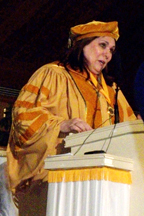
Photo by: DIANE VANCE/Ledger photo Candy Crowley, CNN’s award-winning political corresponent and anchor of “State of the Union,” speaks to Maharishi University of Management graduates during commencement Saturday. She told the graduates, “Take those broad sweeps and move through your life unafraid.”

Commencement speaker Candy Crowley told graduates ages 20 to 66, she wants their dreams to come true, but she also asked the Maharishi University of Management Class of 2012 to watch for the “un-dreams.”

Crowley, CNN’s award-winning political correspondent and anchor of “State of the Union,” flew into Fairfield Friday, getting a brief glimpse of the community and campus.

“I’m looking forward to the trip,” she said by phone Friday while riding to the airport in Washington, D.C. “I’ve been talking with one of the folks who attended school there and it’s fascinating.”

Crowley’s dream upon college graduation when she was in her 20s didn’t turn out, she told graduates.

“I was engaged and prepared to move [from the east coast] to California, have five boys and iron my husband’s shirts for work,” she said. “Some of God’s best gifts are unanswered prayers.

“Instead, I’ve been on the rooftops in Marrakech [Morocco]; slept in the Sahara and rode on camel back to the top of the dunes to watch the sunrise in the company of a king; visited China with three different presidents; and I’m married to the man I love and I have two wonderful sons,” she said. “Those were my un-dreams.”

Crowley said she learns something new each day on her job. She shared insights gained from political figures she’s interviewed over the decades.

“From Bob Dole I learned the three Bs of speeches: Be on time; be brief; and be seated,” she said.

“One of my heroes is John Lewis, an original member of the [Civil Rights] Freedom Riders. He was a keynote speaker at Martin Luther King’s [1965] ‘March on Washington.’ He is the fiercest quiet man I’ve ever met.”

“You have to know where people come from to understand where they’re at.”

Lewis was born and raised in 1940, in Troy, Ala., the third son of sharecroppers. He studied nonviolence, organized sit-ins and by 1963 had been arrested 24 times for his activism.

Since 1987, Lewis has served in the U.S. Congress, representing Georgia’s Fifth District.

“I asked John if he were ever scared,” said Crowley. “He told me no, he knew that even if he was killed, the movement would continue. It was greater than him.”

“To get to where you want to go, you have to stand and be who you are. Do your revolution your way and let others do it their way.”

She talked about interviewing people on the streets of New York City in the aftermath of 9/11.

“I heard stories about loved ones who always went to work in the towers on time, but that particular morning, the cat threw-up — the daughter was so upset dad drove her to school that day and wasn’t at work when the planes hit,” she said. “And others said their loved one never went to the towers, but an old high school friend was in town and visiting a mutual friend at work in the towers, so this family member joined them and died.

“The fear after 9/11 made me braver,” said Crowley. “Life is so random. Take those broad sweeps and move through your life unafraid. Keep moving, life takes care of itself. Be unafraid to live your own life.”

She shared about Tom Ridge, the first secretary of Homeland Security.

“Tom Ridge was a Marine grunt in Vietnam,” she said. “He has a hard time talking about his time in Vietnam, but I asked him what lingers. He said it is the nights. At night, he had time to look up at the sky, which was very quiet and beautiful. Stars were more abundant because there was no competition from city lights. He found beauty there in the midst of horror and battle.”

“You’ve made the decision to come here, to this university. It gets tougher as you move on into the world, but find the beauty in what you’re doing,” she said.

As a self-professed political junkie, Crowley said the week George H.W. Bush was going to announce a running mate in 2000, also was the week of a long-standing tradition of a large family reunion in Michigan.

“I was unsure if I should attend the reunion, and I decided if I was that unsure, I should listen to my gut, which said attend the reunion,” she said. “So that became what I call the ‘death-bed test.’ What will you think of a decision on your deathbed? I’m pretty sure I won’t be wishing I’d stayed at work to hear Dick Cheney named as the running mate.”

At a friend’s recommendation, Crowley learned Transcendental Meditation in 2008 in Washington, D.C.

“It re-centered everything for me,” she said in her phone interview.

Reprinted with permission from The Fairfield Ledger

Related: Candy Crowley visits KRUU-FM before delivering Commencement Address at Maharishi University and CNN’s Candy Crowley to give Commencement Address at Maharishi University of Management.

CNN anchor Candy Crowley gives Commencement Address at Maharishi University of Management is now available on the YouTube channel.

KTVO’s Kate Allt: From the earth to your plate; one university’s lesson in sustainable agriculture

May 25, 2012

From the earth to your plate; one university’s lesson in sustainable agriculture

By Kate Allt

Friday, May 25, 2012

Greenhouses at Maharishi University KTVO’s Kate Allt

FAIRFIELD, IOWA — The cafeteria at Maharishi University is like no other dining hall on any campus in the country. Every meal is vegetarian and organic, and many of the ingredients are grown right on campus by students and staff.

Ayurvedic food preparation, which pays particular attention to seasonal foods, is a growing trend and the roots of the movement are planted in the greenhouses at Maharishi University.

“This greenhouse has been here since 2004; we put it up,” said Steve McLaskey, Director of the Maharishi organic farm. “The university had been organic – the food service had been organic for quite a number of years before that and then in 2003, they decided to take the next step and grow as much of their own food as possible.”

Maharishi’s greenhouse is the first of its size to grow crops year-round in a cold climate. The students and staff who work with the plants have learned much more than identifying a cucumber from a zucchini.

“I get a lot of satisfaction out of growing good produce and providing it to the university,” McLaskey said. “We also sell at the Golden Dome market, the little market on campus, and at the farmer’s market, and I get a lot of comments from customers who appreciate the quality, the freshness.

“When we’re eating good food, then the action that happens from putting good things in is more directed and its more focused,” said Molly Haviland, a MUM student. “So it goes along with the principle of do less, accomplish more.”

James Gavin, a worker at the greenhouse, said he has learned so much from working at the greenhouse and it has improved his quality of life.

“This greenhouse is a real opportunity for all of us… and for the county, I think,” he said.

“I really encourage everyone to grow their own garden and to look up alternative methods of making sure everything is natural, no chemicals, and everything like that,” said student Sultan Salah. “So I would say the experience of working with fresh vegetables is probably the best experience.”

“We grow some of the tastiest vegetables there are,” said Edward Hipp, another greenhouse worker. “When its fresh off the plant, it doesn’t get much better than that.”

Then – fresh off the plant – the food goes to the Maharishi kitchens, where vegetarian, organic recipes and Ayurvedic methods are utilized.

“We’re trying to keep all the Ayurvedic guidelines in touch with the recipes so that it still tastes really good for everybody,” said Sharon Stinogel, Maharishi Executive Chef. “So it’s kind of a challenge, but it’s fun.”

“Since we’ve arrived here at Maharishi, we’ve shared the fact that organic and vegetarian is out there,” said Ken Zimmerman, food service director at Aladdin Food Management Services. “There’s a lot of our accounts that do offer organic vegetarian but not on a wide range like we do here in Fairfield.”

The cafeteria serves 800 to 1,000 people a day and after the meal, the leftover food is collected to be turned into compost, completing the cycle back to the earth.

1 comment:

Sharalyn Pliler · Maharishi University of Management

In my book, THE RELUCTANT VEGETARIAN, I make the point that it’s ever more important to eat organic than it is to be a vegetarian, but at the MUM cafeteria, where I love to go to eat, we can have it all. Good food, safe food, and good company. :-) I love MUM!