
Dr. John Hagelin: Look Within to Understand the Universe

October 2, 2010

Supreme Master Television sent their film crew here last year to produce several respectful profiles on Consciousness-Based Education at Maharishi School and Maharishi University of Management, and also featured our organic vegetarian food services. They produced a feature on the Maharishi Effect for World Peace, and one on Dr. Fred Travis, director for MUM’s Center for Brain, Consciousness and Cognition, for their “Science & Spirituality” series. They recently returned to conduct an interview with Dr. John Hagelin for the same program.

Supreme Master Television’s profile on Dr. Hagelin: “Dr. John Hagelin: Look Within to Understand the Universe” aired in two parts on their “Science & Spirituality” program: Part 1 (Aug. 30, Mon) and Part 2 (Sept. 27, Mon) at 4am, 10am, 4pm, 10pm in Central Time. This excellent interview has now been archived and can be viewed in two parts:

Part 1: http://www.suprememastertv.com/bbs/tb.php/download/8239
Part 2: http://www.suprememastertv.com/bbs/tb.php/download/8399

The main philosophy of Supreme Master Television is vegetarianism to save the planet. They enjoyed coming here, meeting everyone, and especially loved eating our organic vegetarian and vegan food. Their motto is: Be Veg, Go Green 2 Save the Planet www.suprememastertv.com

Other videos worth watching: Conscious TV: John Hagelin – The Core of Nature and John Hagelin, Ph.D., Speaks on the Nature of Consciousness and the Universe. And this interview: John Hagelin — “Only Higher Consciousness Can Transform Our World” — Beyond Awakening Blog.

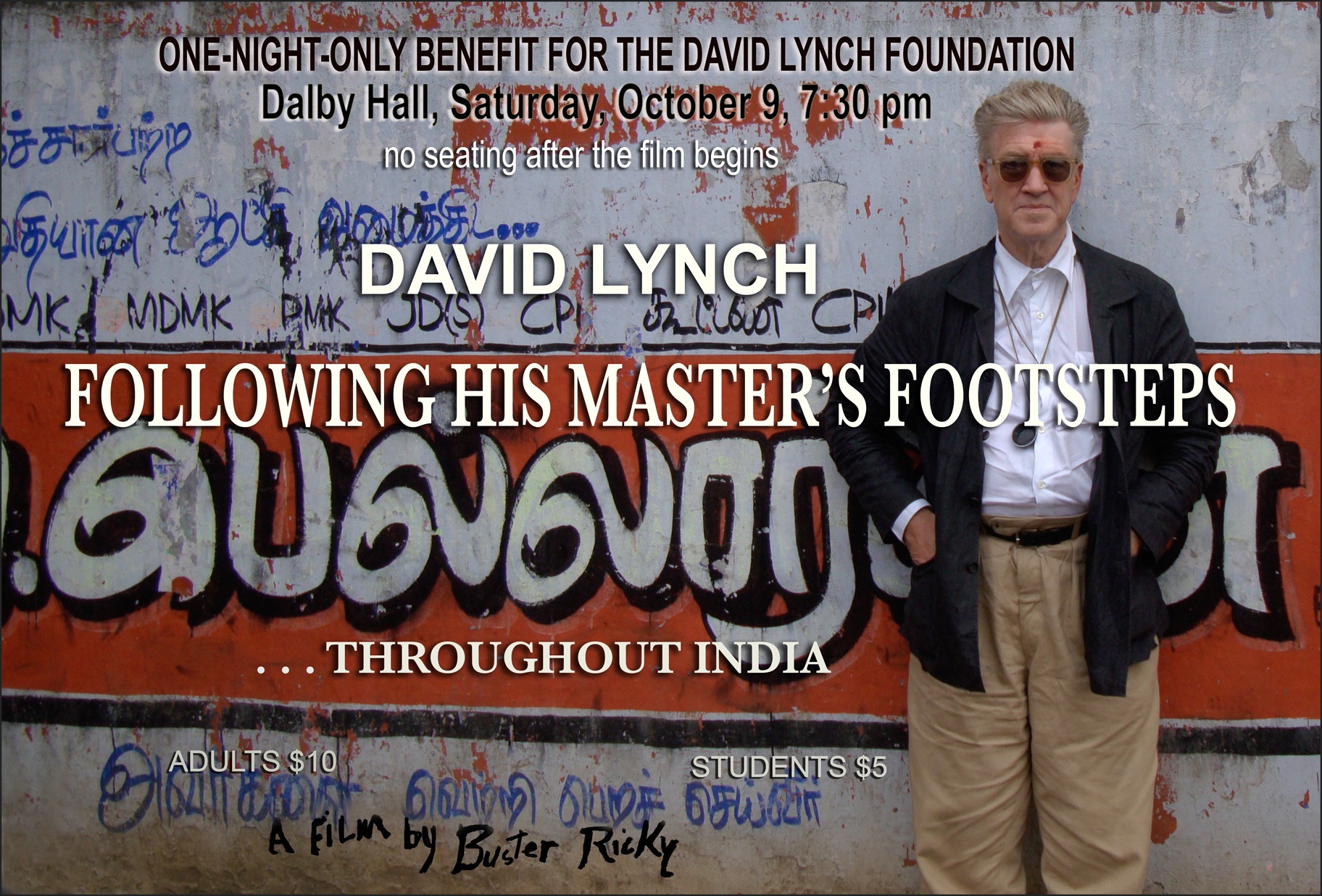
New film by Richard Beymer on David Lynch Following His Master’s Footsteps Throughout India

October 1, 2010

You are Invited to a Sneak Preview

Richard Beymer’s Stunning New Film from India
“David Lynch Follows His Master’s Footsteps”

Saturday, October 9 • 7:30 pm
Dalby Hall, Argiro Center • Maharishi University of Management

$10 General Admission • $5 Students

Tickets can be purchased at MUM Bookstore & Flying Leap Art Space

All proceeds go to the Maharishi School of the Age of Enlightenment

Be in your seat promptly at 7:30 p.m!
There will be no seating once the film begins!

In December 2009, David Lynch retraced Maharishi’s travels across India in the years before Maharishi inaugurated his Spiritual Regeneration Movement in 1957. Richard Beymer’s stunning new documentary follows David up into the Himalayas, to Jyotir Math, where Maharishi spent much of 13 years with his teacher, Guru Dev; and to Uttar Kashi, where Maharishi spent two years in silence following the passing of Guru Dev in 1953. We go with David to Jabalpur, near the birthplace of Maharishi; and to Ramashram, Kanyakumari, and Trivendrum–all rare and special sites integral to the founding of Maharishi’s movement. Richard’s filmmaking is artful, magnificent, and captures the behind-the-scenes look and feel as David and his traveling buddy, Bob Roth, make their way with awe, humor, and dogged persistence to each new destination. See David Lynch at his best: wise, funny, insightful, and inspired.

Source: PEACETOWN, USA

108 line poem for Maharishi (April 5, 2002)

October 1, 2010

This poem was written in honor of Maharishi on April 5, 2002, in Fairfield, Iowa, as a token of appreciation for all the gifts of knowledge and love He gave us and brought to the world; and for the few but meaningful comments He said about me while working on a project with a buddy in 2001. Maharishi’s upliftment, humor, care and concern for my welfare were beyond anything I would have imagined. This poem was printed out and placed on His desk by a friend in Holland but I don’t know if He ever saw or heard it. Some things have changed, like the Pandits now forming at the Brahmasthan of India. But I am posting it as it was written, in memory of my having learned TM 43 years ago on September 30, 1967, in Montreal, Quebec, Canada. I met Maharishi in person for the first time 9 months later at Lake Louise, a most memorable occasion captured beautifully in the CBC TV documentary, Maharishi at Lake Louise, posted on this blog. Several other interactions occurred between Maharishi and my family, all governors, throughout our lives—precious moments to last a lifetime.

Workshop Makes Case for Meeting Architecture 2030 Challenge Today

September 27, 2010

COSC hosts “2030 Now: Case Study of MUM’s Sustainable Living Center” on Sept. 28 in Des Moines.

West Des Moines, IA (September 24, 2010) –With buildings consuming more energy than any other sector, Architecture 2030 issued The 2030 Challenge to the global architecture and building community, asking them to meet sustainability standards of a zero carbon footprint by year 2030. As of July 2010 40% of all U.S. architecture firms have adopted the Challenge.

Center on Sustainable Communities (COSC) hosts a dynamic green building workshop that illustrates how to attain The 2030 Challenge right now, using readily available building technology and products. Fairfield’s Maharishi University of Management (MUM) Sustainable Living Center is the first of its kind and is the subject of “2030 Now: Case Study of MUM’s Sustainable Living Center” happening on Tuesday, Sept. 28 from 5:00-7:00pm at the John & Mary Pappajohn Education Center located at 1200 Grand Avenue in Des Moines. The workshop is free and those interested in attending are asked to register by contacting COSC’s Leslie Berckes at 515-707-2787 or Leslie@icosc.com.

Presenters of the program include Masaki Furukawa, architect of the Sustainable Living Center, and Dal Loiselle, developer and general contractor. Together, they will review how the Sustainable Living Center surpasses LEED platinum standards, complies with the Living Building Challenge and has already achieved The 2030 Challenge by using methods and materials readily available in Iowa now.

“2030 Now: Case Study of MUM’s Sustainable Living Center” is an extension of COSC’s Re-Building a Sustainable Iowa statewide training program. COSC is able to temporarily offer its Re-Building a Sustainable Iowa sessions for free through funding from the Iowa Department of Economic Development and the U.S. Department of Housing and Urban Development.

About COSC

Center on Sustainable Communities (COSC) is a non-profit membership organization founded in 2005 that serves as Iowa’s trusted educational resource for sustainable building. As the recognized leader in providing education and connecting resources, COSC empowers individuals and communities to make everyday decisions that promote sustainability, resulting in a better quality of life for all Iowans. COSC’s schedule of residential, commercial and energy-specific workshops can be found at www.icosc.com.

###

Contacts:

Lynnae Hentzen, Co-Founder/Executive Director
COSC – Center on Sustainable Communities
515-707-0732, Lynnae@icosc.com

Siobhan Spain, Communications Specialist
COSC – Center on Sustainable Communities
515-707-2783, Siobhan@icosc.com

Two Love Tanka

September 23, 2010

Love Tanka I

No matter the place
Home is being together
The Soul is settled

Disease may separate us
But Love takes care of our hearts

.

Love Tanka II

For peace to be here
The Soul has to be settled
And the Heart nurtured

Disease brings Separation;
Compassion, Devotion—Love

.

Ken Chawkin
September 22, 2010, 9 p.m.
With Sali at Parkview Care Center
Fairfield, Iowa, USA

.

Also see UNDECIDED and COMMITTED

THP: How Meditation Techniques Compare

September 23, 2010

Posted: September 22, 2010 04:50 PM

How Meditation Techniques Compare — Zen, Mindfulness, Transcendental Meditation and more

Meditation shopping? Sounds like an oxymoron, right? Yet millions of Americans are seeking tools to turn within. As a nation we’ve tried to fix our problems with everything from psychotherapy and Prozac to positive thinking and politics. Now people everywhere are ready to close their eyes and take a dive — not to escape, but to more fully be.

Having lectured on meditation for 25 years, I find that audiences no longer need to be convinced of meditation’s practical benefits. But people do often ask, “Aren’t all meditation techniques basically the same?”

Experts in the venerated traditions of meditation have always marveled at the mind’s subtlety, appreciating its keen responsiveness and sensitivity to different mental procedures. Great master teachers of meditation have recognized that the various techniques engage the mind in different ways and naturally produce different results. With advancements in neurophysiology, scientists are now identifying distinctions among varieties of meditation practices.

The Myth of the Relaxation Response

The old “scientific” myth that meditation practices all induce the same, general state of physiological rest — called the “relaxation response” — has been overturned. Though many practices provide relaxation, decades of research show that not all techniques produce the same physiological, psychological or behavioral effects.1

Recently a doctor came to me for meditation instruction. He had learned a “relaxation response” technique in a class on integrative medicine during his training at Harvard. He was attracted to meditation by the promise of deeper insight into consciousness — access to the mind’s hidden, transcendent potentialities. He enjoyed the relaxation technique but yearned for deeper experience and understanding.

Reviewing the science journals, the doctor arrived at the same conclusion reached by leading meditation researchers: the “relaxation” model was based on inconclusive evidence and had never been substantiated. Hundreds of published studies on meditation techniques show varying effects from different practices — ranging from measures of rest much deeper than the “relaxation response” to physiological states no different from sliding back into your easy chair.

The emerging paradigm: three major categories of meditation

Meditation labs have sprung up at universities across the country–places such as Yale, UCLA, University of Oregon, UW Madison and Maharishi University of Management. Their contributions have helped researchers identify three major categories of techniques, classified according to EEG measurements and the type of cognitive processing or mental activity involved:

  • Controlled focus: Classic examples of concentration or controlled focus are found in the revered traditions of Zen, Tibetan Buddhism, Qiqong, Yoga and Vedanta, though many methods involve attempts to control or direct the mind. Attention is focused on an object of meditation–such as one’s breath, an idea or image, or an emotion. Brain waves recorded during these practices are typically in the gamma frequency (20-50 Hz), seen whenever you concentrate or during “active” cognitive processing.2
  • Open monitoring: These mindfulness type practices, common in Vipassana and Zazen, involve watching or actively paying attention to experiences–without judging, reacting or holding on. Open monitoring gives rise to frontal theta (4-8 Hz), an EEG pattern commonly seen during memory tasks or reflection on mental concepts.3
  • Automatic self-transcending: This category describes practices designed to go beyond their own mental activity–enabling the mind to spontaneously transcend the process of meditation itself. Whereas concentration and open monitoring require degrees of effort or directed focus to sustain the activity of meditation, this approach is effortless because there is no attempt to direct attention–no controlled cognitive processing. An example is the Transcendental Meditation technique. The EEG pattern of this category is frontal alpha coherence, associated with a distinct state of relaxed inner wakefulness.4

2010-09-22-graph.jpg
Some techniques may fall under more than one category: Guided meditation is controlled focus if the instruction is, “Hold attention on your breath.” But if the instructor says, “Now just watch your thoughts, letting them come and go,” then you’re probably doing open monitoring–and your EEG would say for sure.

Different practices, different results

Without the scientific research (or until we have a cell phone app for measuring our EEG and biochemistry), meditative states and their effects remain subjective. Brain research, along with findings on psychological and behavioral effects, gives a more objective framework for health professionals or anyone to determine which meditation technique might be most beneficial for a given purpose.

For example, research suggests that concentration techniques may improve focusing ability. A study on advanced Buddhist monks–some of whom had logged more 10,000 hours of meditation — found that concentrating on “loving kindness and compassion” increased those feelings and produced synchronous gamma activity in the left prefrontal cortex — indicating more powerful focus.

The effect of open monitoring or non-judgmental observation is said to increase even-mindedness in daily life; studies on mindfulness-type practices indicate better pain management and reduction of “negative rumination.”

For relief from stress, research suggests that an automatic self-transcending technique might serve you better than a practice that keeps the mind engaged in continuous mental effort. Because of the natural mind/body relationship, the more deeply settled the mind, the more deeply rested is the body. Studies show that the deep rest of “transcending” calms the sympathetic nervous system and restores physiological balance — lowering high blood pressure, alleviating chronic anxiety and reducing stress hormones such as cortisol.

More research is needed to verify benefits of controlled focus, but there are numerous studies on mindfulness practices and automatic self-transcending, with over 600 studies on the Transcendental Meditation technique alone.

As meditation becomes a new frontier of scientific research, more and more people are becoming aware of the mind’s enormous potential for impacting health and wellbeing. I find that most meditators are no longer concerned that a technique might come from the East or have roots in a spiritual tradition–their main concern is that the practice works, and science can help remove the guesswork.

Americans are opting for meditation to counterbalance a life that’s been plugged in, outer directed and over stimulated, and we’re turning to something as simple as our own inner silence.

Whether you’re an athlete aiming for the “zone,” an executive striving for peak performance or a harried mother needing some serenity, a reliable meditation practice can be your best friend.

1. Orme-Johnson, Walton, 1998. American Journal of Health Promotion 2(5), 297-299.
2. Lutz, Greischar, Rawlings, Ricard, Davidson, 2004. Proc Natl Acad Sci U S A 101,16369-73.
3. Cahn, Delorme, & Polich, 2010. Cognitive Processing 2010 11(1):39-56.
4. Travis et al, 2010. Cognitive Processing 11(1), 21-30.

————————————————————————————

Also see: THP: Keeping Your Prefrontal Cortex Online: Neuroplasticity, Stress and Meditation

And: Are all meditation techniques the same?

See this article and infographic on Three Categories of Meditation.
Vanity Fair’s James Wilcott: Beam Me Up, Bucky

September 16, 2010

Beam Me Up, Bucky

by James Wolcott September 15, 2010, 12:31 PM

How pleasing and inspiring it is to be able to watch two of my inspirational heroes, Maharishi Mahesh Yogi and Buckminster Fuller, engaging on stage in 1971, joined together in the spirit of optimism and mission in an orbital docking of East and West, ancient wisdom and modern science, Yankee know-how and Vedic holistics. The universality of their message is even more vital today, when so much of America wants to curl up in an angry fetal ball, resisting the future, denying global dynamics and evolving consciousness, reducing everything to Ayn Randian black-white oppositions, insisting on acting like the strutting top dog of the planet and civilization while throwing squalling tantrums over not getting its way. A quarter of this country thinks they deserve their own privileged cabin on Spaceship Earth, everyone else be damned or bombed into submission, and they’re going to end up in the cargo section if they don’t open their grizzled minds.

Such a contrast these two make: Bucky, in his professorial glasses and “second-rate bank clerk” wardrobe (his look a deliberate gambit to de-accentuate himself, as he explains here), parked behind a desk, and Maharishi, in his white robes, abundant, untamed hair, beads, sitting cross-legged on a bouquet-flanked platform. Bucky is usually thought of as “all brain,” a cosmic engineer of endless expounding, but his testimony here–about how the contemplation of suicide in 1927 pivotally turned his thought inward and then expansively outward–is quite moving and plainspoken. Those wishing to know more about Bucky and the work being conducted in his name and purpose can visit the Buckminster Fuller Institute. It’ll help spiral you above and beyond election cycles and the Wagnerian white noise of media chatter.

Embody: focus on TM: Iconic Filmmaker David Lynch has a viable solution to a pressing problem

September 9, 2010

This excellent cover feature article on David Lynch and TM is featured in the focus on section of the Autumn 2010 issue of Embody, a British national magazine for members of CThA, the Complementary Therapists Association. The article, TRANSCENDENTAL MEDITATION, Iconic Filmmaker David Lynch has a viable solution to a pressing problem, pages 10-13, is written by Norman Zierold, and reprinted with permission by the Complementary Therapists Association www.ctha.com. The article is not available online but you can download a PDF of it here: David Lynch EMAUT10.

Two other TM-related articles in the Industry News of this issue include Invincible Defense Technology and Doctors Prescribe Meditation on pages 16–17: P16-17 EMAUT10.

Here is a more recent article: THE REMARKABLE DAVID LYNCH FOUNDATION — written by Norman Zierold for Healthy Referral.

Enjoy this delightful article on Norman Zierold: The Chronicle of Higher Education: Notes From Academe: The Spokesman Who Kept Calling.

The Guardian: My hero: David Lynch

August 16, 2010

My hero: David Lynch by Paul Murray

‘He’s violent and original, but most of all he’s brave’

The Guardian, Saturday 14 August 2010

I was 15 when Twin Peaks, David Lynch‘s surreal murder-mystery-soap-opera, first aired on TV. Until then, I’d found the suburbs of Dublin where I grew up almost terminally boring. They were art-proof; there was nothing interesting you could say about them – or so I thought. Lynch’s dreamlike vision of suburbia uncovered the violence, mystery and dark magic of a world that I, in my naivety, had dismissed. Spectral white horses appeared in living rooms, detectives practised Zen; in the bravura opening sequence of one episode, a terrifying journey down a network of fibrous tunnels was revealed to be a close-up of an ordinary ceiling tile. Everything held an unknowable secret; for me, that was an invaluable lesson.

Beneath the surrealism, Lynch’s work abides by fiercely held principles. While in some ways he is an old-school romantic, with a fondness for beautiful ingénues and the kind of clean-cut heroes you find only on the screen, his films are defiantly unconventional. For all our postmodernity, we remain quite traditional in our regard for logic, and a film such as Lost Highway, whose antihero, without explanation, turns into someone else halfway through, is genuinely shocking.

Look Lynch up on YouTube and you’ll find a polite, soft-eyed man with a carefully swirled quiff and a dark suit, probably making a speech about Transcendental Meditation. I don’t know much about his life, but he seems a good example of Flaubert’s dictum about being regular and orderly in your life so you can be violent and original in your work. He’s violent and original, but most of all he’s brave. It takes real courage not to make sense. The scariest thing about making art is that you don’t know what you’re doing; the temptation to fall back on established forms is a strong one. Lynch has the ability to trust in nothing but his vision, and for all its weirdness, that vision is one of great beauty – the expression of an almost childlike fascination with and love for the world.

This article appeared on p4 of the Guardian review section of The Guardian on Saturday 14 August 2010. It was published on guardian.co.uk at 00.05 BST on Saturday 14 August 2010. Click here, to see the comments, and an unusual photo of David Lynch taken by photographer Sarah Lee for The Guardian.

THP: Keeping Your Prefrontal Cortex Online: Neuroplasticity, Stress and Meditation

August 12, 2010

Keeping Your Prefrontal Cortex Online: Neuroplasticity, Stress and Meditation

As we go through life, our brain is always changing and adapting, say neuroscientists. During the first 18-20 years of life the brain is developing circuits that will form the basis of decision-making for a lifetime. Brain researchers have found that unhealthy lifestyles can inhibit normal brain development in adolescents and lead to impaired judgment and destructive behavior that carries over into adulthood. Traumatic experiences, alcohol and drug abuse, growing up neglected in a broken home, living in fear of violence and crime, or even a bad diet can interfere with development of the frontal lobes, the brain’s executive system. This can cause behavioral problems. Brain researcher Dr. Fred Travis explains: “When a person’s frontal lobes don’t develop properly, he lives a primitive life. He doesn’t — and can’t — plan ahead. His world is simplistic, and he can only deal with what’s happening to him right now. Thinking becomes rigid: ‘You’re either with me or against me,’ or ‘Me and my gang are good, and everyone else is bad.'”

The good news: meditation improves brain function

Brain researchers have also found that the brain can be changed in a positive direction through healthy lifestyle choices. This ability of the brain to reorganize its network of neurons is called “neuroplasticity.” Studies recently published in Cognitive Processing show that brain development can be enhanced — not only during adolescence but at any age — through the practice of meditation, and that different meditation techniques have different effects on the brain. For example, during the Transcendental Meditation (“TM”) technique there is increased alpha coherence in the brain’s frontal areas. “Within a few months of practice of the TM technique,” says Travis, “we see high levels of integration of frontal brain connectivity. And interestingly, that integration does not disappear after meditation. Increasingly and over time, this orderly brain functioning is found in daily activity.”

When the different parts of the brain are better integrated they work together more harmoniously — our brain is healthier. Higher levels of brain integration are associated with higher moral reasoning, emotional stability and decreased anxiety, according to a 1981 study in the International Journal of Neuroscience. Research shows that world-class athletes have higher brain integration than controls. Brain integration is important because one’s environment and circumstances are constantly shifting, and you need a flexible, integrated brain to successfully evaluate where you are, where you want to be and the necessary steps to get there.

Keeping your prefrontal cortex “online”

The prefrontal cortex — said to be the brain’s executive center or “CEO” — plays a crucial role in higher judgment, discrimination and decision-making. When we are overly tired or under intense mental, emotional or physical stress, our brain tends to bypass its higher, more evolved rational executive circuits, defaulting to more primitive stimulus/response pathways. We respond to challenges without thinking, making impulsive, shortsighted decisions. When the brain’s CEO goes “offline,” strong emotions such as fear and anger can adversely color or distort our perception of the world. Interestingly, the brain’s crucial frontal area is where the highest levels of EEG coherence are typically recorded during TM practice, indicating improved communication between the prefrontal cortex and other parts of the brain.

When a person transcends during meditation (goes beyond the active levels of the mind), the experience is commonly reported as a state of deep silence and inner wakefulness, without particular qualities or attributes — just pure consciousness. According to research studies, such as the previously mentioned study in Cognitive Processing, it is this ‘transcendental’ experience that creates the more efficient, integrated brain functioning seen during TM practice. While focused attention and other mental processes activate local brain areas, the experience of transcending activates the whole brain, enabling different parts of the brain to function together better as a whole.

Helping kids grow healthier brains

Fortunately, transcending is easy — we’re hardwired for it. With proper instruction and right practice, anyone can do it, including students with ADHD. Experiencing the quiet, transcendental field of orderliness deep within the mind doesn’t mean conjuring up a new outlook on life or accepting new beliefs, nor does it require an attitude change. It’s a natural, universal experience that produces a healthy response in the brain.

With help from the David Lynch Foundation and other private benefactors, thousands of at-risk students are now learning meditation during structured, in-school programs around the world. Researchers monitoring the results are finding that meditation improves learning ability, memory, creativity and IQ. Findings such as these may be opening a new frontier of research — establishing an expanded, more enlightened view about what is possible for the human brain.

VIDEO of Dr. Fred Travis, Director, Center for Brain, Consciousness, and Cognition in Fairfield, Iowa: Brain Plasticity and Transcendental Meditation with Dr Fred Travis.


Read More: Meditation, Neuroplasticity, Transcendental Meditation, Living News

Also see: THP: How Meditation Techniques Compare