David Lynch speaks with LA Times health writer Jeannine Stein about Transcendental Meditation

March 20, 2012

Five Questions: David Lynch on transcendental meditation

David Lynch talks about TM and his David Lynch Foundation for Consciousness-Based Education and World Peace.

By Jeannine Stein, Los Angeles Times
March 17, 2012
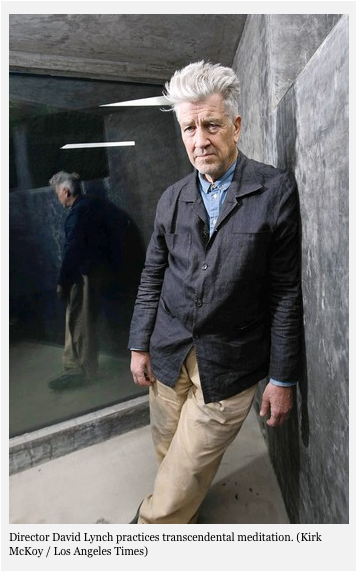
We know filmmaker David Lynch for the dark surrealism of “Eraserhead,” “Blue Velvet,” “Inland Empire” and “Twin Peaks,” as well as for his deep, abiding love of coffee.

Lynch is also passionate about transcendental meditation, which he first took up “on a beautiful, sunny Saturday morning” in 1973. That passion spawned a book, “Catching the Big Fish,” and the David Lynch Foundation for Consciousness-Based Education and World Peace.

Lynch spoke about what TM means for him and why others should try it too.

PODCAST: David Lynch

Can you describe how you discovered TM?

I didn’t know anything about meditation, and I thought it was a waste of time. Then I heard a phrase that true happiness is not out there, true happiness lies within. And I started thinking about that, and it had a ring of truth. It hit me that maybe meditation was the way to go within.

One day my sister called, and she said she started TM, and I heard a change in her voice — more happiness, more self-assuredness. And I said, “This is what I want.”

I was filled with an anger and sorrows and doubts and melancholy. And I took it out on my first wife. I made her life pretty much a hell. So I start transcendental meditation, and two weeks later she comes to me and says, “What is going on? This anger, where did it go?” Things lift away so naturally.

Your foundation started with introducing TM into schools. What changes have you seen in students who have been through the program?

They say stress is hitting kids at a younger and younger age. There’s violence, bullies, there’s very little learning, and it’s not fun to learn. [With TM] they get more intelligence, they have more creativity, more energy, more happiness, and then when the teacher says something, understanding is growing. The teachers say, “Now Billy can focus, and Suzy is just blossoming.” Kids start finding what they really love and finding a way to do it.

The foundation has now expanded to other realms, such as introducing TM to veterans and prisoners.

Prisoners get this technique and they get super, super happy. And they get this ability to pause before they do something. So something that people say is, “Before I started meditating, I just reacted. Now, with meditation, I have this pause and this reasoning: Do I really want to blow this man’s head off with a .357 Magnum in my hand?” And then the answer is, “No, I don’t think so.” They have time to think.

Is it hard to meditate in certain places?

You can do it anywhere. One of my best meditations was in kind of a little closet room with a wall that was by a sidewalk. All during my meditation, there was some guy jackhammering the concrete sidewalk. But as he jackhammered, it jiggled the bliss in me and I was just flying high. It was so beautiful.

Are coffee and TM compatible?

For me, coffee and transcendental meditation go together like a horse and carriage. You don’t have to give up anything to do TM. I think most meditators go easy on the coffee, naturally.

I smoke cigarettes too, and most meditators say the urge to smoke kind of lifted away when they started meditating. Not me! My urge to smoke got greater. I just love tobacco.

I eat pretty good, but I just love these things, and that’s the way it is.

jeannine.stein@latimes.com

Copyright © 2012, Los Angeles Times

Also see HUFFPOST: David Lynch: Why I Meditate and The Wall Street Journal: 20 ODD QUESTIONS (with David Lynch).

Transcendental Meditation Drastically Turns Life Around For Veteran With PTSD

March 15, 2012

Transcendental Meditation Drastically Turns Life Around For Veteran With PTSD

Posted on March 15, 2012 by admin

David George Uses the Power Within for PTSD Stress Relief

By Christine Leccese

At first glance, David George’s story sounds similar to many service members returning from Iraq or Afghanistan. While deployed in Iraq, he witnessed and was part of a traumatic event. His compound was car bombed and about 50 people were injured. And he saw it all. About a year after returning home, he was anxious, depressed, drank a lot, and prone to recklessness. His life was spinning out of control. The rest of David’s story, however, is different than that of many returning veterans with PTSD, and one that Operation Warrior Wellness made possible for him.

After returning from Iraq, the barracks’ normal sounds would make David’s heart pound. A slamming door or artillery practice in the distance could cause him to panic. The smell of burning rubber could take him right back to the war. Stopping at a red light at night? Forget it. That made him feel like a sitting target. He describes the keyed up feeling he had day and night: “You know that feeling you have just before a race? That jittery feeling? I had that all the time.”

David sought help from a bottle  — Jack Daniels and whiskey could bring him a little relief, but that, of course, brought its own problems. He had several car crashes, and didn’t care whether he lived or died. His mother was frantic and said she woke up every morning not knowing whether her son would be dead or alive. Relationships and lost jobs were casualties of David’s PTSD. He wanted it to stop so he sought help. The VA was treating him with medication, but it wasn’t making a difference for David.

Here’s where David’s story takes a twist. One day, while listening to the radio in between classes, he heard an ad for a research study that was looking at the effects of transcendental meditation on PTSD. Someone had told him about TM a year or so earlier, but he could not afford to take the classes to learn how to do it. He jumped at the chance to be part of the research study, and signed up.

The first time he practiced TM, he noticed that for that 20 minutes he was free of anxiety. He started looking forward to the next day’s practice knowing that he would have another 20 minutes without anxiety. Then, the calm that he felt during his TM practice started seeping into other parts of his day. Eventually, David’s symptoms subsided.  He credits it all to TM.

“The first time I meditated, I experienced this relief from the constant anxiety attack my life had become,” David said. “You have to give yourself a chance to make yourself feel better, because no one else is going to do it for you.”

David says that he will never stop meditating. “I’m so happy and I’ll never stop. It has this compounding effect and gets better every day.”  Today, David meditates for about 20 minutes twice a day. If he is stressed about something, he’ll do a little 10-minute meditation. When he sits up in bed in the morning, he meditates, and also if he has any other opportunities, such as sitting in the waiting room of a doctor’s office. Transcendental meditation turned David’s life around, and could be a great option for other people with PTSD. If you are wondering whether your own symptoms are likely a result of PTSD, depression, anxiety, or alcohol use, you can take a free, anonymous screening. Service members who want to learn more about TM can check out Operation Warrior Wellness.

Christine Leccese is the marketing and communications manager for Military Pathways.

Related articles: Medication or Meditation for Veterans with PTSD? | David Lynch Foundation launches Veteran’s Day national meditation initiative | A Transcendental Cure for Post-Traumatic Stress by David Lynch and Norman E. Rosenthal | ABC News: Study finds meditation helps soldiers overcome trauma, PTSD | Meditation Promoted For Troops With PTSD | How meditation saved the life of a veteran with PTSD.

Sali’s Shakti (a two-tanka poem)

March 13, 2012

Sali’s Shakti
(a two-tanka poem)

They say your power
Used to shine…from your bright mind
Now…it’s through your heart

From you…flow Beauty and Grace
Love lights…in your eyes and face

How does this happen…
That I love you even more…
You fulfill my heart…

This force that draws…me…to you
Wants to make…a One…from two

© Ken Chawkin
March 12/13, 2012
Fairfield, Iowa, USA

Vermont Public Radio: Transcendental Meditation Studied For Military Use

March 12, 2012

VPR News: VPR’s Steve Zind reports on research underway at Norwich University that uses Transcendental Meditation as a tool to make better soldiers and inoculate them from the psychological trauma of combat.

Transcendental Meditation Studied For Military Use
Monday, 03/12/12 12:44pm

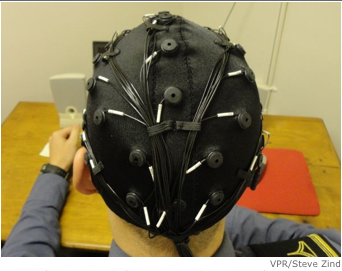
A Norwich University Cadet Wearing A Cap Designed to Monitor Brain Activity.

The military devotes a lot of money and resources to training for combat and to treating post-combat stress. Now there’s research underway at Norwich University in Northfield that uses a tool more associated with peace than warfare to prepare military men and women.

The study is looking at whether Transcendental Meditation will not only make better soldiers, but inoculate them from the psychological trauma of combat.

VPR’s Steve Zind has this story on a group of cadets that some are calling ‘Oom Platoon’.

From Vermont Edition: Dairy’s Value-Added Future

Related: The Norwich Guidon: Rooks experiment with meditation

Takumi is not ‘lost in translation’ in this beautiful film about Japan’s diverse artisan tradition

March 8, 2012

Takumi: Japan’s Artisan Tradition

I think you’ll find this beautiful video both informative and fascinating. It’s a documentary about traditional Japanese artisans hosted by Robert Yellin, an American living in Japan who’s become a ceramics expert.

Some of you may know Steven Yellin. Robert happens to be one of his brothers. And you probably remember hearing their father, Jerry Yellin, talk about his WW II experiences as a young fighter pilot who, years later, would make peace with his enemy after one of his sons, Robert, had gone to Japan for a year and ended up marrying a Japanese girl, whose father had also been in the war. See Jerry Yellin: Healing the Hidden Wounds of War and Jerry Yellin discusses Operation Warrior Wellness.

Robert Yellin has been living in Japan since 1984. He fell in love with the art of Japan, especially Bizen pottery, and the concept of Wabi-sabi, the aesthetic of things in life being imperfect, impermanent, and incomplete, yet each with their own unique natural beauty captured in a work of art. His passion and broad knowledge of Japanese pottery led him from collector, to columnist and author, to ceramics art gallery owner.

The Robert Yellin Yakimono Gallery offers some of the finest works available in Japan online at JapanesePottery.com or at his gallery located near the Silver Pavilion (Ginkakuji) in a magnificent old Sukiya-style home in Kyoto. You can read some of his articles on Japanese pottery in various magazines, including a ceramics column in The Japan Times.

Robert also authored a beautiful book about sake utensils that was later translated into English as Ode to Japanese Pottery. Read the rave reviews listed on his sister website from the Clay Times and Ceramics Today, and check out his Japanese Pottery Blog.

When Steve Jobs came to Japan and wanted to learn about Japanese pottery, he asked for Robert Yellin to be his guide. With this video, Robert inspires thousands of viewers about Japan’s cultural treasures.

This slideshow requires JavaScript.

Takumi: Japan’s Artisan Tradition is one of five short episodes in a series called Japan: Fascinating Diversity. Five presenters—well-known foreign specialists with extensive knowledge and insight on Japan—guide viewers to intriguing destinations, introducing them to Japan’s fascinating culture and heritage along the way.

They also take viewers to the Tohoku region of northeastern Japan, which was devastated by the Great East Japan Earthquake and Tsunami of March 11, 2011. The people of Japan are continuing their tireless reconstruction efforts, which shows every sign of recovery. The film’s goal is to help viewers around the globe rediscover the appeal of Japan.

In this episode of the series, Robert explores the diverse forms of Takumi with veteran artisans, savoring samples of Japan’s pottery, indigo dyeing and lacquer ware traditions. His tour also includes a visit to a museum, a tea house, and ends in a Ryokan, a traditional Japanese inn.

For an American, Robert knows a lot about Japanese culture. He even speaks and moves like a native; his intonations and mannerisms are Japanese—refined and respectful.

With his expertise in Japanese ceramics, Robert acts as a cultural ambassador, helping to give a boost to Japanese tourism for the Ministry of Foreign Affairs by inspiring people from all over the world to visit.

I truly enjoyed watching this beautiful short documentary film. I think you will too. Robert sums it up nicely when he says, “It’s been an amazing journey. Every place we visited there’s been something new to learn. It’s been a joy to see how people still create handmade beauty in different regions. All the beauty in Japan—it’s all based on this spirit of craftsman, or Takumi. And that really is the foundation—what Japan has to offer the world.”

Click the title to see this beautiful video (17:48) on the MOFA YouTube channel. Japan: Fascinating Diversity (Takumi: Japan’s Artisan Tradition) © 2012 Ministry of Foreign Affairs of Japan

Related post: kintsugi: japanese pottery inspires poetry

This interview was streamed live on Aug 11, 2020: Deep-Dive Into Appeal of Japanese Pottery with Robert Yellin. Also join Robert on an online tour he gave for Kyoto Journal of Japanese ceramic art in Kyoto at the Robert Yellin Yakimono Gallery. Follow him on Instagram @ry_yakimono_gallery_kyoto. More listed on https://linktr.ee/ryygkyoto.

The Iowan: Beyond LEED: Maharishi University’s Sustainable Living Center

March 5, 2012

[potluck] Beyond LEED

Fairfield, Iowa – March 1, 2012

MUM Sustainable Living Center

Maharishi University of Management's Sustainable Living Center

Compiled by Carol Bodensteiner and Mary Gottschalk

More and more new or renovated structures in Iowa trumpet their commitment to reducing demands on air, water, and energy resources — some even achieving platinum status in LEED (Leadership in Energy and Environmental Design) certification (currently the highest level recognized by the U.S. Green Building Council). The folks at the Sustainable Living Center (SLC) in Fairfield are aiming higher.

Rising to the Living Building Challenge (an international performance-based certification program) and incorporating both Building Biology principles and Maharishi Vedic architecture guidelines, the SLC design introduces such features as the use of naturally hygroscopic materials to self-regulate humidity, the use of natural building materials, and complete water and energy self-sufficiency — the ability to go off the grid.

According to David Fisher, Director of the Sustainable Living Program at Maharishi University of Management (MUM), this higher standard is “doable with current technology.” For example, the combination of insulation, solar and wind powers, and geothermal heat will allow the SLC to generate excess electricity, which will be contributed back to the campus power grid. Similarly, by collecting rainwater for drinking and running black/gray water through a peat moss filtering system for irrigation, the building will have net zero water usage.

In addition to being resource-neutral (and, possibly, resource-positive), the SLC has other unique features, including 16 whole aspen tree trunks that provide major structural support for the building and 26,000 earthen blocks manufactured by MUM students out of local clays. To avoid any toxic chemicals, plaster has been made from sand, cow manure, and soil; paints are milk-based with color pigments derived from clay, minerals, and spices.

When the building opens this spring as classroom and office space for the Bachelor of Science program in Sustainable Living, the SLC will still be a work in progress, says Fisher. “But we’re going to open so our students can share in the experience of showing the construction industry how it can be done.” — M.G.

For information on the Sustainable Living Center, contact David Fisher at dfisher@mum.edu and visit thesustainablelivingcenter.com. Learn more about Building Biology and Vedic architecture online at baubiologie.de (choose English language) and maharishivastu.org.

Rendering courtesy Sustainable Living Center

Related article: Iowa Outdoors: Fairfield’s Abundance EcoVillage: Harmonious Living With Nature — Off The Grid.

For more information about The Iowan check out these three options:

The Inner History of a Day by John O’Donohue

March 4, 2012

The Inner History of a Day

No one knew the name of this day;
Born quietly from deepest night,
It hid its face in light,
Demanded nothing for itself,
Opened out to offer each of us
A field of brightness that traveled ahead,
Providing in time, ground to hold our footsteps
And the light of thought to show the way.

The mind of the day draws no attention;
It dwells within the silence with elegance
To create a space for all our words,
Drawing us to listen inward and outward.

We seldom notice how each day is a holy place
Where the eucharist of the ordinary happens,
Transforming our broken fragments
Into an eternal continuity that keeps us.

Somewhere in us a dignity presides
That is more gracious than the smallness
That fuels us with fear and force,
A dignity that trusts the form a day takes.

So at the end of this day, we give thanks
For being betrothed to the unknown
And for the secret work
Through which the mind of the day
And wisdom of the soul become one.

John O’Donohue (1954–2008)

From To Bless the Space Between Us: A Book of Blessings.

Related: What To Remember When Waking by David Whyte.

Also see For a New Beginning by John O’Donohue.

John O’Donohue was an inspiring Irish philosopher, poet, and mystic who lived in the West of Ireland. His native tongue was Gaelic. His Ph.D. dissertation in the field of philosophical theology developed a new concept of Person through a re-interpretation of Hegel. He insisted in his work on beauty as a human calling and a defining aspect of God, and much of his writing drew from pre-Christian Irish Celtic perspectives. He was well known for his bestselling book Anam Cara. In the year of his death his book of blessings, Benedictus, was published. For a list of his books visit Amazon.com.

Listen to Krista Tippett interview John O’Donohue On Being: The Inner Landscape of Beauty.

Later added: John O’Donohue’s 4 short lines say it all for poets.

 — Written and compiled (citing sources) by Ken Chawkin for The Uncarved Blog.

What Turkish Sufi poet Yunus Emre realized — everything was found within his cosmic body

February 28, 2012

Ever come across a poem that encapsulates what you’ve read lately or thought about in the past? I found one today in a book I was sampling on Amazon, The Drop That Became the Sea: Lyric Poems, a collection of poems written by Yunus Emre, (1240-1321), translated by Kabir Helminski and Refik Algan.

Yunus Emre was the first in a great tradition of Turkish Sufi troubadours who celebrated the Divine Presence as the intimate Beloved and Friend. Called the greatest folk poet in Islam, the songs of this Sufi dervish are still popular today.

He was a contemporary of Rumi, who lived in the same region of Anatolia. Rumi composed his collection of stories and songs for a well-educated urban circle of Sufis, writing primarily in the literary language of Persian. Yunus Emre, on the other hand, traveled and taught among the rural poor, singing his songs in the Turkish language of the common people.

A story is told of a meeting between the two great souls: Rumi asked Yunus Emre what he thought of his great work the Mathnawi. Yunus Emre said, “Excellent, excellent! But I would have done it differently.” Surprised, Rumi asked how. Yunus replied, “I would have written, ‘I came from the eternal, clothed myself in flesh, and took the name Yunus.'” That story perfectly illustrates Yunus Emre’s simple, direct approach that has made him so beloved.

The poem I’m referring to begins, We entered the house of realization. Inside they find the earth and sky, night and day, the planets, the many veils in the body, what the scriptures say, and more. In that realized state, the poet witnesses everything inside the body; the infinite within the finite, the eternal within the temporal. His body is cosmic, an expression of totality.

It reminded me of the work of Maharaja Adhiraj Rajaraam (Professor Tony Nader, MD, PhD), a neuroscientist and Vedic scholar. Under the guidance of His Holiness Maharishi Mahesh Yogi, Professor Nader showed how the individual is cosmic.

The body, he says, is a manifestation of Natural Law—the Veda and Vedic Literature—the underlying blueprint that creates the individual body and the cosmic body, the Universe, a microcosm of the macrocosm. Yatha pinde tatha brahmande. See link to video at end of this article.

One aspect of the Vedic Literature is Jyotish, Vedic Astrology. Dr. Tony Nader shows a precise one-to-one relationship between the fundamental structures and functions of human physiology (Individual life) and the fundamental structures of Natural Law (Cosmic life). These fundamental structures of Natural Law connect individual intelligence with cosmic intelligence — the basic structures of the human nervous system with their cosmic counterparts. In this chart, the nine Grahas (planets), are shown where they are found in the different aspects of our physiology and their influences.

This first book by Dr. Nader, Human Physiology — Expression of Veda and the Vedic Literature, discusses all 40 aspects of the Vedic Literature and their expressions in the body.

Over a decade in the making, Dr. Nader’s new book, Ramayan in Human Physiology, reveals an understanding of the underlying unity that makes us human — the eternal reality of the Ramayan in the structure and function of the human physiology. Surprisingly, the Ramayan is not just a mythic tale assigned to an ancient culture in a distant past, but a description of the universal transformations continually taking place within our own bodies. Here is a book preview.

Yunus Emre expresses a similar understanding in poem #4, page 20, chapter I, The Dervish Way, in The Drop That Became The Sea.

We entered the house of realization,
we witnessed the body.

The whirling skies, the many-layered earth,
the seventy-thousand veils,
we found in the body.

The night and the day, the planets,
the words inscribed on the Holy Tablets,
the hill that Moses climbed, the Temple,
and Israfil’s trumpet, we observed in the body.

Torah, Psalms, Gospel, Quran—
what these books have to say,
we found in the body.

Everybody says these words of Yunus
are true. Truth is wherever you want it.
We found it all within the body.

A related example was highlighted by Dr. Nader in a press conference when he referenced ‘Abdu’l-Bahá [quoting The Imam Ali], from The Secret of Divine Civilization: “Dost thou think thyself only a puny form, when the universe is folded up within thee?”

Speaking of microcosm-macrocosm, here is an interesting saying from The Conversations (Maqalat) of Shams of Tabriz (Hazret Shams al-Din of Tabriz), Rumi’s master, which gives you a different perspective on the internal life of a saint:

The microcosm is hidden in the creation of man
and the macrocosm is the outer universe.
But for prophets the outer universe is the microcosm
while the inner universe ıs the macrocosm.

These two videos of Maharishi Mahesh Yogi answering questions from the press: As is the cosmic life, so is the individual life, and I am the Self, I am the body, I am the Veda, I am the universe, I am totality, explain the cosmic significance of these Vedic expressions and their practical applications in our daily lives.

See this New Video: Dr. Tony Nader speaks about the Ramayana in Human Physiology, which explains how the whole body is made of Veda, which also structures the cosmic body, the universe, and how the activities described in the Ramayana are a scientific description of the growth and evolution of the human physiology to it’s fully developed enlightened state.

See Sufi poet Hakim Sanai says transcend belief to enter into the mystery.

See Yunus Emre says Wisdom comes from Knowing Oneself — a Singularity that contains the Whole

Sufi poet Hakim Sanai says transcend belief to enter into the mystery

February 27, 2012

Sufi poet, Hakim Sanai, best known for The Walled Garden of Truth, is revered as one of the 3 great Sufi teachers, along with Attar and Rumi. He says a lot in these few choice words:

Belief brings me close to You
but only to the door.
It is only by disappearing into
Your mystery
that I will come in.

See What Turkish Sufi poet Yunus Emre realized — everything was found within his cosmic body and Yunus Emre says Wisdom comes from Knowing Oneself — a Singularity that contains the Whole.

Iowa Outdoors: Fairfield’s Abundance EcoVillage: Harmonious Living With Nature — Off The Grid

February 23, 2012

The March/April 2012 issue of Iowa Outdoors has an 8-page spread (pages 52-59) featuring Fairfield’s Abundance EcoVillage. The article, Harmonious Living With Nature, was written by Mindy Kralicek with photos by Clay Smith.

Iowa Outdoors is a magazine of the Iowa Department of Natural Resources. Their editorial mission is to strive to open the door to the beauty and uniqueness of Iowa’s natural resources, inspire people to get outside and experience Iowa and to motivate outdoor-minded citizens to understand and care for our natural resources.

This feature article has over 20 colorful photos with text. Some of the topics discussed are Maharishi Sthãpatya Veda Architecture, Permaculture Systems, the use of solar panels, wind turbines, earth air tubes, living off the grid, sustainable communities. Check next month to see if they’ve posted it online. For now, you can download a PDF of this beautiful article here: Off The Grid.

It’s much easier to read the article in the original magazine layout with the photos and additional text (instructions how to order at the end of this article). The next best thing is to download the PDF of it. But for those who can’t, I also copied and pasted the article below without the photos and accompanying text.

Read the rest of this entry »