Archive for the ‘Writing’ Category

Breath and fire in the heart feed each other as essential creative forces in Erica Jong’s poetry

April 11, 2020

I’ll admit my ignorance here. All I remember of Erica Jong was her early 70’s infamous best-selling novel, Fear of Flying. I had no idea that she had become such a prolific award-winning writer. Besides being a famous author, she is also a fine poet. She says, “The poetry is the source of absolutely everything I do.” I discovered some of her impressive poems looking inside Becoming Light: New and Selected Poems, and on poetry websites PoemHunter and Poeticous.

Filled with life and passion, Jong uses breath, air, wind, “prana whistling in the dark;” and fire, “a flame in the heart,” “a living lantern,” as imaginary ways to describe the creative forces within the heart of a poet. They are beautifully expressed in these 3 poems: Alphabet Poem: To the Letter I, Poem to Kabir, and Zen & the Art of Poetry. There may be other poems with these motifs I have yet to discover, but these caught my attention for their shared imagery and theme of being a poet, a writer.

Alphabet Poem: To the Letter I (12th/last stanza, 3rd poem in Becoming Light) 

We are all one poet 
and always 
we have one 
communal name, 
god's name, nameless, 
a flame in the heart, 
a breath, 
a gust of air, 
prana whistling in the dark. 
i dies— 
but the breath 
lingers on 
through the medium 
of the magic 
alphabet 
and in its wake 
death is no more 
than metaphor. 

Poem to Kabir   

Kabir says 
the breath inside the breath 
is God   

& I say to Kabir 
you are the breath inside that breath 
which is not to say 
that the poet is God–   

but only that God 
uses the poet 
as the wind 
uses 
a sail.

Zen & the Art of Poetry
 
Letting the mind go,
letting the pen, the breath,
the movement of images in & out
of the mouth
go calm, go rhythmic
as the rise & fall of waves,
as one sits in the lotus position
over the world,
holding the pen so lightly
that it scarcely stains the page,
holding the breath
in the glowing cage of the ribs,
until the heart
is only a living lantern
fueled by breath,
& the pen writes
what the heart wills
& the whole world goes out,
goes black,
but for the hard, clear stars
below.

In the last section of What You Need to Be a Writer, Jong comes clean, listing her fears, then describes what it really takes to be a writer — having something to say so intensely, that it “burns like a coal in your gut…pounds like a pump in your groin,” and concludes with having “the courage to love like a wound that never heals.” Ah, the human condition.

& then there’s all 
I did not 
say:   

to be
a writer
what you need
is
 
something
to say:
 
something
that burns
like a hot coal
in your gut
 
something
that pounds
like a pump
in your groin
 
& the courage
to love
like a wound
 
that never
heals.

In a Mother’s Day Playboy interview last year, the first question daughter and writer Molly Jong-Fast asks her mother is how she knows things, especially what’s happening to women in the socio-political arena. Jong answers: “I think a writer is someone who lives like a wound that never heals. And if you’re a writer, you feel the rumblings in the air.” It’s interesting how she uses the same metaphor for a writer to love or live like “a wound that never heals.” How she’s been bravely living her life.

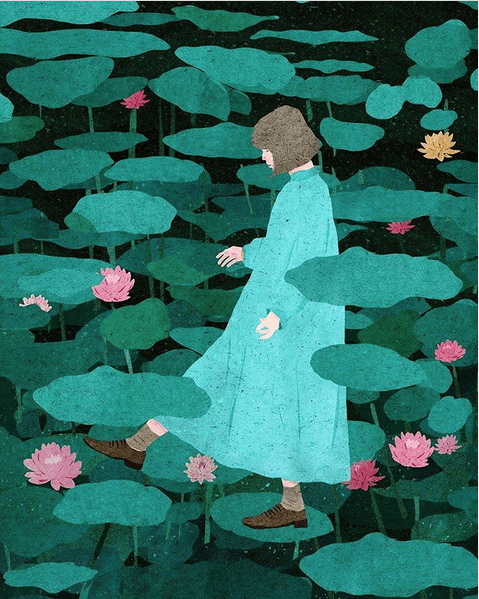
I found this beautiful ethereal painting online, Walking Lily, by Vietnamese artist Xuan Loc Xuan

April 1, 2020

I found a beautiful painting on Colossal by Vietnamese freelance illustrator Xuan Loc Xuan. Titled, Walking Lily, it is also posted on her Instagram page. Her work is available at Toi Art Gallery.

“Life creates art while art changes life.” – Xuan Loc Xuan

Xuân Lộc Xuân was born in Vietnam. Her name means “Spring.” She lives and works in Ho Chi Minh City, Vietnam. Xuan Loc Xuan studied Fine Arts at HCM University, the biggest art school in the south of Vietnam. She’s been working as a freelance illustrator for several years. She uses traditional and digital tools to draw. Her designs tend to be minimalistic and the use of color is a main factor in her artworks. For her, “life creates art while art changes life.”

Independent journalist & editor of The Floating Magazine/TFM Studio, Payal Khandelwal interviewed Xuan via email. She introduces her: Xuan Loc Xuan dresses up melancholy in vibrant colors in most of her artworks, and the results are breathtaking. Having grown up as an introvert child in a large family, Xuan always felt an inherent sense of loneliness and sadness. And the essence of those feelings drips down into most of her work. Her subjects are always shying away from the audience. They are either glancing sideways or have their back to the world, and are always lost in their own thoughts. Most of Xuan’s work also has a very ethereal feel to it. Read the interview: People: Xuan Loc Xuan.

This is a magical, mystical image. I love the various shades of green in the picture, their textures, especially the girl’s dress, the different colored flowers. She appears contemplative, in her own world. This work holds an otherworldly, timeless silence. I found a companion piece, Water Lily, of a boy sleeping among the same water lilies, or lotuses.

Lily could be the girl’s name and/or the lilies, but these are lotuses. Their larger pads and flowers rise high above the water, whereas most water lilies, pads and flowers, float on the water, with some flowers rising a few inches above it. Maybe the word means the same for both in their language, but these are different species.

I learned that distinction over three decades ago in the fall, when a friend and I encountered many tall, large lotus pads and pods at the second Round Prairie Park pond in Fairfield, Iowa. There had been a drought that summer, and many stood high above the lowered water level. She began sketching them, and I attempted to write about the process in a poem as an observer. After several attempts, I gave up, switched perspectives, and surprisingly, the poem wrote itself; we had become the observed! You can read the poem and more about what happened afterwards in Ode to the Artist Sketching Lotus Pads at Round Prairie Park.

I submitted the poem to a poetry competition at Sparrowgrass Poetry Forum and forgot about it. Much to my surprise, on a very special day, I found out by Registered Mail that I had won their Distinguished Poet Award, which included a $100 check! They mailed the plaque separately, published the poem, and sent me a copy of Treasured Poems of America, their anthology, which contained my award-winning poem.

The editor requested a follow-up poem. The only thing I could write about was that mysterious, creative interaction that took place between us and the lotuses. He published Sometimes Poetry Happens in their next issue. Those experiences gave me the confidence to keep writing, and a flood of poems continued to flow from me, for which I was very thankful.

I like Walking Lily so much I ordered a large print of it to hang in my entrance way on the wall above the small antique green cabinet. I was given a 20% discount on my first order and free shipping, a nice surprise!

Another beautiful artwork is of a stunning sunrise or sunset in “A Fjord” painted by Norwegian artist Adelsteen Normann.

Xuan Loc Xuan later posted a new painting on her Instagram called Ocean Blue. It would make for a nice companion piece to Walking Lily. Both girls appear in magical realms where nature and imagination live together in one seamless reality. I love it!

John O’Donohue’s 4 short lines say it all for poets

January 27, 2020

These 4 short lines by John O’Donohue describe how he lived his creative life—amazed by each revelatory moment, turning them into poems.

Fluent

I would love to live
Like a river flows,
Carried by the surprise
Of its own unfolding.

— John O’Donohue

Enjoy 3 more of his lovely poems: A Blessing of Solitude (Anam Cara: A Book of Celtic Wisdom); The Inner History of a Day and For a New Beginning (To Bless the Space Between Us: A Book of Blessings).

Mary Oliver lived her life that way: “To pay attention, this is our endless and proper work,” and put it into a 3-line poem, Instructions for living a life: Pay attention. / Be astonished. / Tell about it

William Stafford expressed the same notion in his talks and poems of being innocent, spontaneous, and responding creatively in the moment: A Course in Creative Writing, You and Art, and When I Met My Muse.

This poem my son wrote when he was in 6th grade epitomizes this idea: INSPIRATION, a poem by Nathanael Chawkin.

These poems I wrote on the process share in that same sentiment: Writing; Storytelling; and Sometimes Poetry Happens, which turned out to be a commentary on this revealed poem, ODE TO THE ARTIST: Sketching Lotus Pads at Round Prairie Park.

In our efforts to fluently express ourselves, writing, primarily, is a process of self-discovery. Burghild Nina Holzer says journal writing allows us to discover who we are and what we have to say.

Talking to paper is talking to the divine. Paper is infinitely patient. Each time you scratch on it, you trace part of yourself, and thus part of the world, and thus part of the grammar of the universe. It is a huge language, but each of us tracks his or her particular understanding of it.

WHO ARE YOU?, a poem in the film, Words and Pictures, invites us to write and discover who we are. There’s a fascinating story behind it.

In the words of Donald Hall, “Writing is the process of using language to discover meaning in experience and to communicate it.”

In this collection of Writers on Writing–What Writing Means To Writers, Hall also wrote:

A good writer uses words to discover, and to bring that discovery to other people. He rewrites so that his prose is a pleasure that carries knowledge with it. That pleasure-carrying knowledge comes from self-understanding, and creates understanding in the minds of other people.

Because of Transcendental Meditation Nick Cave stopped fearing the end of the world and evolved

November 13, 2019

A friend sent me a special post by a famous rocker writing to a fan about his TM practice on his website. I checked online and found last year’s piece by Russell Cunningham, a production editor on sport for the Guardian. This revealing article serves as an appropriate introduction: Nick Cave is showing us a new, gentler way to use the internet.

During these confrontational times, “the quiet reflections of Cave spread peace and compassion and love through a medium renowned for its ability to spread division. In this growing treasure trove of letters to the world, he is showing how to use the web beyond the hubbub of social media, to engage in more reflective and rewarding conversations. That’s no bad thing.”

In issue #69/November 2019 of Nick Cave’s letters, known as The Red Hand Files, the entry is titled: How do I stop fearing the end of the world? He answers a fan’s question: Do you practice meditation? I’ve never read such a profoundly transparent and lyrical testimonial—how TM has evolved him personally and creatively!

He posts a picture of DEMOCRITUS MEDITATING AT THE END OF THE WORLD 1662, and then this answer.

Do you practice meditation?

MATTHAIS, FRANKFURT, GERMANY

Dear Maia and Matthais,

The filmmaker, David Lynch, described the practice of Transcendental Meditation as catching the big fish. I read that he has been practising it since he had a breakdown around the time of making Eraserhead, over forty years ago. He claims he has never missed a meditation. If that is true, I am greatly impressed. The basics of TM are taught during a three session course, at the end of which your teacher gives you a personal mantra. Anyone can do it. It is effortless and there is nothing to get right or wrong. I have been practicing for around six years and found it to be instantly and radically beneficial. So, to answer your question, Maia, from the first time I meditated, I stopped fearing the end of the world.

I found that it also helps with low-level anger, uncommunicativeness, resentments, impatience, passive-aggression, depression, self-obsession, hatred of the world, blaming others, wanting to murder and maim people and a host of other maladies that I had been dragging around and allowing to define me. Meditation modulated my calamitous internal thinking, and the freaked-out tyrant residing in my head that represented the worst possible version of myself was largely deposed.

I also found those big fish down there in the depths, the deep creative ideas which David Lynch talks about, wild, bright and thrilling; but more importantly, I found a fundamental understanding of the next right thing to do, of making the choice of the least destructive course of action.

Unlike some meditation techniques that focus on a life lived entirely within the present moment, Transcendental Meditation seems to radiate backwards and forwards in time, evoking our common humanity and our deep connection to the earth’s inheritance, as it layers us in meaning. It may not hold back the end of the world, but it reduces the element of fear, allowing us to administer to the world more effectively. TM also implements a kind of mysterious reinstating of the soul, a honeying of life, a merciful acceptance of suffering, and reminds us of the incredible privilege it is to be alive.

Love, Nick

###

Visit his website for news, tour dates, music, books, films, videos, lyrics, and more: https://www.nickcave.com. Also Wikipedia: Nick Cave.

November 22, 2023: On Being with Krista Tippett shared a deep conversation with Nick Cave on Loss, Yearning, Transcendence.

August 13, 2024: The Late Show with Stephen Colbert: Nick Cave On Singing With Johnny Cash And The Joyful, Uplifting Vibe Of His New Album, ‘Wild God’. The lead singer and songwriter of Nick Cave and the Bad Seeds joins Stephen for a discussion of his latest album and some of his most powerful artistic experiences, including recording a song with Johnny Cash as the legendary artist was near death. Stephen also mentions Nick’s 2022 book of the year, Faith, Hope and Carnage, created from more than forty hours of intimate conversations with the journalist Seán O’Hagan about creativity, grief, and the power of music. At 11:38 in the interview, Stephen, who has had his own share of loss and grief, tells the audience about the accidental death of Nick’s teenage son, and asks him how he has dealt with grief. At 19:09 Stephen asks Nick about The Red Hand Files and asks him to read one letter he had written in reply to a fan’s concerns about living. Enjoy Stephen Colbert’s extended conversation with Nick Cave and check out his latest album ‘Wild God’ when it comes out on August 30th. Excellent interview!

Dec 2, 2025 All There Is: CNN: Nick Cave and Anderson Cooper on loss, love and the ‘jagged edges’ of grief. I posted a comment there about how meditation (TM) helped Nick lighten his heavy emotional load.

Musician Nick Cave has experienced the death of two of his sons. He tells Anderson Cooper how, over time, these losses have changed his relationship with the world; expanding his heart and widening his “capacity for love.” 

Nick Cave feels things like loss and grief deeply, yet he can clearly articulate those feelings. He tells Anderson Cooper how he was so overcome with grief at the unexpected death of his son that it was difficult for him to do basic things. One of them was meditation. At 34:24 Nick tells Anderson how meditating helped him deal with grief. Nick describes one meditation where he was surprised to experience a kind of lightness where the heaviness had lifted, and for a moment he felt that “things were okay.” 

— Written and compiled (citing sources) by Ken Chawkin for The Uncarved Blog.

Tony Walsh @LongfellaPoet’s poem, Take This Pen, inspires Brits to contribute to @PoetryDayUK

September 7, 2019

National Poetry Day, the UK-wide celebration of poetry, celebrates its 25th anniversary on 3 Oct: the theme is truth. Enjoy, discover & share!

I came across this tweet by Tony Walsh @LongfellaPoet about this event: Delighted to share this. Please watch/tag/share. It’s my poem Take This Pen, beautifully illustrated by the wonderful @chrisriddell50. It’s an inspiration piece to launch #tellyourtruthpoem for @PoetryDayUK.

Enjoy this powerful poem and video that is sure to inspire young and old alike to creatively express their own truth in a poem. Read more on this international superstar poet, teacher, and performer Tony Walsh Poet.

Very relevant is this poem, WHO ARE YOU? in the 2013 film, Words and Pictures, inviting students to create and become who they are.

Here’s one of my earliest poems about this magical creative process: Sometimes Poetry Happens: a poem about the mystery of creativity.

My son wrote this wise and amazing poem when he was 11 years old: INSPIRATION, a poem by Nathanael Chawkin.

This post—The perils of praise or blame for young writers. New ways to help students find their own voice—is a treasure trove of knowledge and teaching strategies by poets, writers, and innovative educators.

A powerful message in a Shadow and Light poem

August 31, 2019

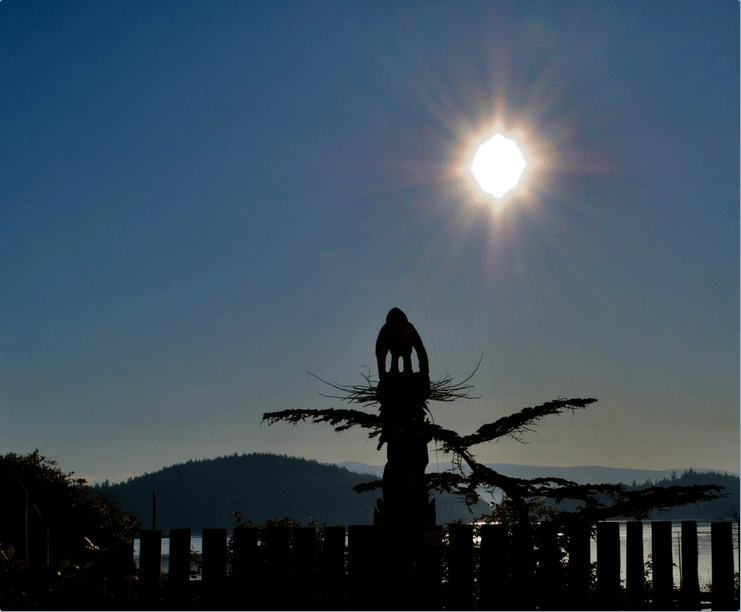
Here is another beautiful blog post by westcoastwoman. I had liked and posted an earlier one, Afterglow. She said this photo became the muse for the poem. It was a happy accident. In our discussion she “tried to photograph this totem at daybreak and twilight and finally in frustration a full on ‘throw away’ sun-in-the-lens shot. This is the one that stuck for me. Shadow and Light ….. loved it.” Yes, it is stunning, and the short, succinct poem it inspired delivers a powerful message!

Shadow and Light

August 30, 2019

©westcoastwoman “hollyhock”

Don’t look…..
into the Light
Don’t shoot…..
into the Light

Rules…

Light exposes shadow,
Shadow, Light.

Rules…

Meant to be broken
Light without Shadow
Half Life
Half Love
Half Question

Unlived, Unloved, Unspoken.

©westcoastwoman 2019

Sage advice from William Shakespeare in the film “All Is True” on how to become a truthful writer

August 18, 2019

I’ve never let the truth get in the way of a good story. — William Shakespeare*

I love this quote, and the one below, on becoming a writer, both spoken in All Is True, an intriguing film about the final years of William Shakespeare’s life (April 23, 1564 – April 23, 1616). Brilliantly written by Ben Elton, it was produced and directed by the lead actor—an unrecognizable Kenneth Branagh as William Shakespeare. Other notables are master Shakespearean actors Judi Dench, and Ian McKellen.

Earlier on, a stranger approaches Shakespeare, who had returned home to Stratford after his London Globe Theater had burned down, and attempts to ask him a question. Shakespeare starts giving him the usual advice and tries to dismiss him. The stranger finally asks him how he was able to know everything: “There is no corner of this world you have not explored, no geography of the soul, which you cannot navigate.” After some humble bumbling, he clearly gives him this powerful advice: 

If you want to be a writer,
and speak to others and for others,
speak first for yourself. Search within.
Consider the contents of your own soul… your humanity.
And if you’re honest with yourself, then whatever you write, all is true.

This contrasts dramatically with what his unmarried, bitter daughter Judith keeps saying, that nothing is true. The reason for this clash between daughter and father slowly reveals itself bit by bit as unresolved family issues are finally addressed. I highly recommend seeing this brilliant film. I watched it twice. Also see the DVD Bonus Features.

After the renowned Globe Theatre burns to the ground, William Shakespeare returns to Stratford, where he must face a neglected family and a painful past.

*Reminds me of this quote by Pablo Ruiz Picasso: Art is the lie that enables us to realize the truth.

Related posts on writing: Writers on Writing–What Writing Means To Writers | Elizabeth Gilbert—Some Thoughts On Writing | Words of Wisdom on Writing from Literary Lights | Burghild Nina Holzer inspires us to write and discover who we are and what we have to say | Timeless advice on writing from famous authors | Writing—my early poem on the writing process | INSPIRATION, a poem by my son as a young student | The perils of praise or blame for young writers. New ways to help students find their own voice, with links to more content.

Op-Ed recommends TM for student mental health

August 9, 2019

The Scarsdale Inquirer published an Op-Ed piece by Margo L. Baum, August 2, 2019. Margo and I graduated from the same masters program in education at MUM in Fairfield. She asked if I would share her article. I offered to post it on my blog and added hyperlinks. Here is her story. It is very timely advice given the growing mental health crisis in America!

TM: A simple technique could help Scarsdale student

After reading the article about teen mental health (“Helping teens in affluent communities cope with mental health,” Scarsdale Inquirer, July 26), I wonder, what is mental health? Is it simply the absence of anxiety, depression and stress?

As a Scarsdale High School graduate, I understand the pressure to achieve. However, in my teens I wanted more than aspiring to good grades, attending an Ivy League school and making six figures. I didn’t know what I wanted until I found something that transformed my life.

At age 17, I learned a simple mental technique called Transcendental Meditation, which I have now practiced for 45 years. TM became a source of inner development that created a solid foundation of inner strength and bliss within me. From this experience, I believe the missing component of mental health for teens is inner development. I credit TM for providing me with an inner sanctum of peace and saving my life. Due to my experience, I feel the desire to help others lessen the stress of daily life, especially our youth.

As an elementary school teacher, I have witnessed the stress on students of having to gain knowledge of subjects and yet not be taught how to gain inner fulfillment. We train the mind and intellect of our youth to get into better and better elementary, middle, high schools and colleges. But, having achieved all this, are the students balanced, happy, loving adults? More importantly, is the journey from child to adult filled with love, happiness and a balance of heart, mind and spirit? Or is it a path riddled with stress, anxiety and depression?

I have watched students battling anger, low self-esteem, social troubles and academic issues change through instruction in TM. Students around the world have learned this simple mental technique and have had their lives transformed.

Students at The Thacher School, the oldest coed private boarding school for high school students in California, face many of the same issues that impact students from affluent communities: the stress of standardized tests, the pressure to get into good colleges, massive amounts of homework due daily, the pressure to excel in sports, etc.

Thacher students learned TM and found positive results. Michael K. Mulligan, head of the school, said, “Students today are under more pressure than ever to succeed. Standardized testing and grades play increasingly important roles in secondary and college placement outcomes — and many of our youngsters and teens are showing signs of folding under the stress of homework, grades, testing and parental expectations. Our kids need a break, and Transcendental Meditation is one great answer to helping them find rest, peace and calm. Simple, easy and effective, TM has provided for our students … a critical time-out from the stresses of the day. Our students who learned this technique last year report more peace and silence in their day and more resilience in their activities. It has been a gift and a blessing in their lives.”

The use of meditation as an intervention may seem ridiculous to some. Yet, many of the greatest ideas and inventions of our times started out as seemingly insane. For example, my father, the late Dr. Gilbert Baum, was a pioneer in diagnostic ultrasound. The chief of staff at the Veterans Administration Hospital, where my father did his research, told my dad, “Baum, I thought you were certifiable to think you could use sound to see.” 

A new paradigm in imaging in the health field came about due to my father’s endless zeal to follow what he knew to be beneficial to the world. 

TM has been scientifically validated in more than 600 research studies to reduce stress, anxiety, anger and depression. The research also indicates a greater sense of inner calm develops and a stronger sense of self. In some cases insomnia is alleviated.

The David Lynch Foundation has given TM to veterans, domestic violence victims, and students in schools around the world, transforming the lives of individuals from darkness to light.

Why not give TM to SHS students to develop inner contentment? Why not create a new paradigm of mental health for our youth? When inner development and outer achievement go hand in hand, the result will be true mental health for Scarsdale students.

Margo L. Baum, of Brite Avenue, received her bachelor’s in education from Boston University and her master’s in education from Maharishi University of Management, an accredited university in Fairfield, Iowa. She has taught elementary school and creative writing workshops around the world.

This west coast Afterglow stays with you awhile

June 16, 2019

This is a beautiful blog post by westcoastwoman—the photo, quote, and six-sentence description. She intimately makes the universal personal. Click here to see the many responses to it, including mine. Having spent some time on the west coast of Canada I appreciate how she captured the magic in words. The experience cannot be pinned down. It’s transcendent—”in-between-time” and “neither here nor there.” The deep silence of nature’s transitions between night and day, twilight and predawn, are like a metaphor for our own inner experiences—the gaps between waking, dreaming and sleeping, and the silent unbounded backdrop to them, our own transcendental Self.

Afterglow

June 12, 2019

DSC_2188
photo credit westcoastwoman ©

“Everyday a new picture is painted and framed, held up for half an hour, in such lights as the Great Artist chooses, and then withdrawn, and the curtain falls. And then the sun goes down, and long the afterglow gives light.”

Henry David Thoreau

Afterglow

Every night they come, the watchers of the sun-set, drawn down by the need to see the light extinguish behind the islands and the sea.

I want to share with them as they slowly rise and disperse that the setting of the sun is only a prelude to the experience they had been called to witness, but I stay silent.

It is this time between the setting sun and rising moon, this short extension of the day, this in-between-time when my heart and mind settle for just a moment.

I watch as the sky paints itself with each night’s original palette, wanting only to share with those who can look out from the same place and feel the colours as they appear, understand the need for silence.

In these moments when I am neither here nor there, anything is possible, magic is afoot and I am caught in the afterglow of another original creation as it slowly fades from sight.

The darkness takes the light, the starlings swoop once more in perfect unison over the water, I share with all who stand watching… being neither here nor there, a silent good night.

©westcoastwoman 2019

Written in response to GirlieontheEdge’s Six Sentence Story Word Prompt. Prompt word: Extension.

###

This reminds me of a poem I wrote down while waking from a dream in a foreign land. It was during the predawn, when “the moon bows / before the rising sun.” See: Indonesian Mystery Poem honoring Nyi Roro Kidul.

On August 30, 2019 she posted Shadow and Light, a powerful poem inspired by a stunning photograph. I posted it as A powerful message in a Shadow and Light poem.

The perils of praise or blame for young writers. New ways to help students find their own voice.

April 13, 2019

The teaching of writing has evolved over the decades. Teachers used to praise students for duplicating what they were instructed to write, or criticized and graded poorly for not meeting established norms. This practice of praise or blame created consequences that were detrimental to the writer. They doubted their own natural ability to express themselves in writing, wondering whether it was good or not.

W.S. Merwin, in his poem, Berryman,* about his college professor John Berryman, asks him “how can you ever be sure that what you write is really any good at all?” He gives him an unexpected honest answer.

I had hardly begun to read
I asked how can you ever be sure
that what you write is really
any good at all and he said you can’t

you can’t you can never be sure
you die without knowing
whether anything you wrote was any good
if you have to be sure don’t write

Nearly three decades after he mentored Merwin, Berryman would encapsulate his advice to young writers in this Paris Review interview, on the perils of praise and blame.

I would recommend the cultivation of extreme indifference to both praise and blame because praise will lead you to vanity, and blame will lead you to self-pity, and both are bad for writers.

It’s interesting to see this explanation—how praise (fame) or blame (criticism) might influence a young writer’s psychology, and therefore his or her creative output and development as a writer. Advising them to stay true to themselves, remain unswayed by public opinion, would allow them to maintain their own integrity as artists.

David Lynch is another artist who always follows his own muse and tells young filmmakers to do the same. Answering a student’s question about his creative process, he says we’re nothing without an idea. Using a fishing analogy, he explains that a desire for an idea is like a bait on a hook. He gives a detailed account of how he falls in love with ideas, turns them into a script, and transforms them into a film, or other works of art. To catch bigger fish, you have to dive deeper. David describes daydreaming and TM as ways to get there. He tells students to stay true to their vision, to meditate, and most importantly, to always have the final cut.

In this interview, he answers the same question, but from a different perspective: In the other room, the puzzle is all together, but they keep flipping in just one piece at a time.

Learning by doing: writing and teaching

When writers and poets were asked to teach creative writing, some conveyed the enterprise as a process to be explored and unfolded, not as a specific product to be reproduced. What they said made sense. I practiced their suggestions and discovered my own process of becoming a writer and a poet.

I also shared their strategies with my students facilitating them as writers. The most important takeaway was this: If you took care of the writer, the writing would take care of itself.

I enjoyed asking younger students questions to find out what they were passionate about, to help them uncover their own voice. If they said something interesting, I had them write it down, then asked them to combine their thoughts into a rough draft. I had them listen to what they had written by reading it aloud to me, to use their skills as a reader. Once involved in the process they naturally wanted to clarify their writing, to include relevant details, to edit their work. They had become intrinsically motivated writers!

Here are a few favorite writers who inspired me along the way.

What some favorite poets, writers and teachers say about writing

(more…)