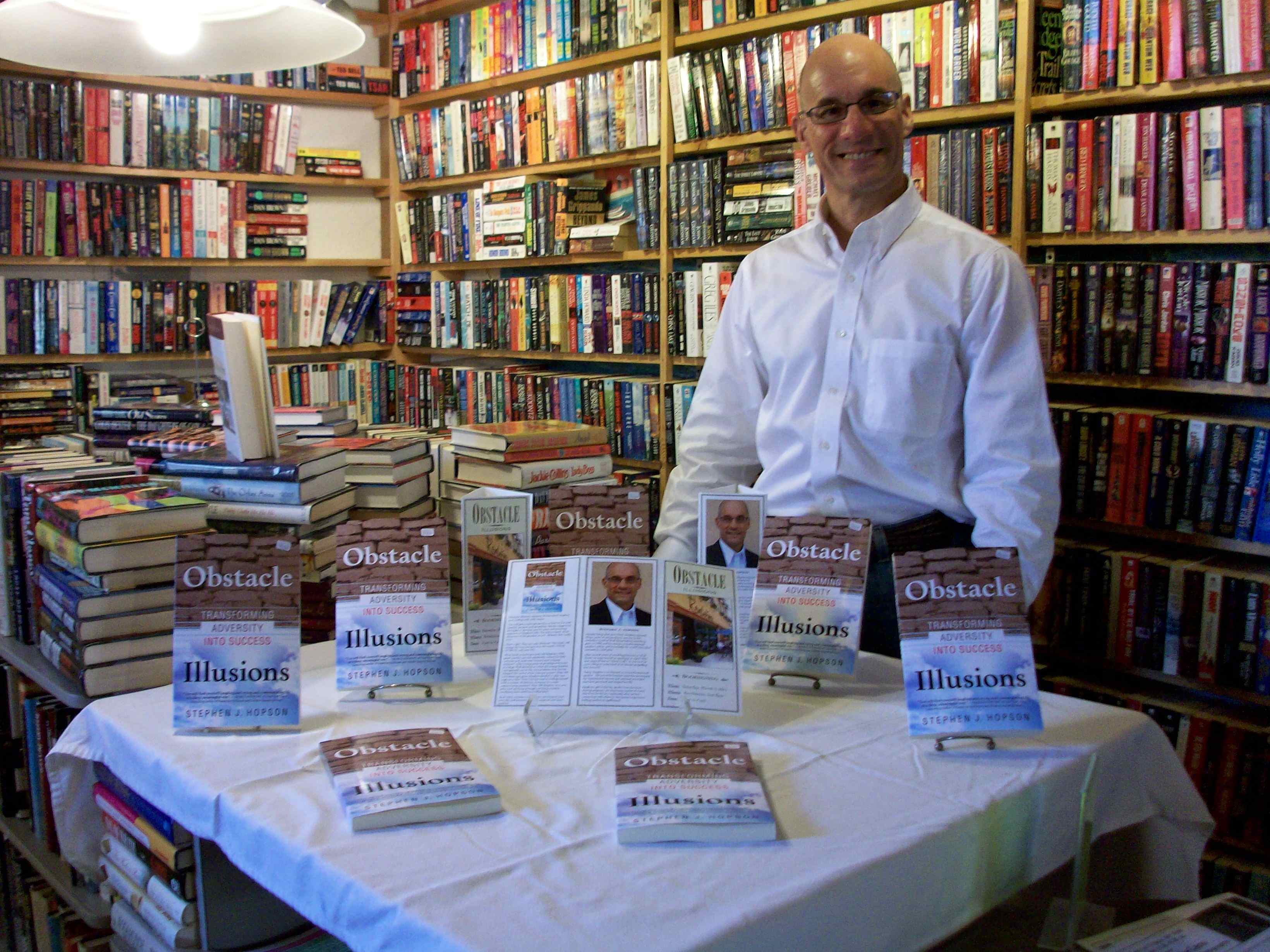
Despite being deaf since birth, Stephen J. Hopson enjoyed fifteen years of extraordinary success in the turbulent world of Wall Street before switching gears in 1996 and becoming a transformational speaker, author and eventually a pilot. His latest book is Obstacle Illusions: Transforming Adversity Into Success.
Speaking Freely airs weekly on Tuesdays, 1-2 pm, and again on Thursdays, 8-9 am. Listen online at: KRUU-LP 100.1 FM. Dennis interviews prominent people from business, politics, sports, entertainment, and non-profits. His angle is to ask intelligent and thought-provoking questions and allow guests to speak in detail about their area of expertise and interest. He tries to have people come on who represent diverse points of view.
Telling a story is speaking out anew
what you always knew you knew
but didn’t know you knew it
until you heard yourself saying it
and in the telling of it, you,
the teller, become the listener too.
The teller and the listener
together both discover
the process of finding out
what the story is all about
as one draws the story out of the other
and the story tells itself from cover to cover.
Below are a few of many quotes by famous writers on writing found in Learning by Teaching, Selected Articles on Writing and Teaching, by Donald M. Murray. When I volunteered to become a writing facilitator at MIU in the mid-80s, this was our bible. It had a huge transformational effect on me. I used these writing principles when I helped young students write at the Sylvan Learning Center in North Vancouver, BC, Canada. I also learned writing techniques from Writing Down the Bones: Freeing the Writer Within, by Natalie Goldberg, and shared them with my students, and later in other writing workshops with older animation students, and friends.
The whole idea is to facilitate the writing process, to see what it would reveal to the writer, rather than focus on producing a specific piece of writing. I remember reading what Donald Graves had to say about teaching writing, something like: “If you take care of the writer, the writing will take care of itself.” Donald Graves studied with Donald Murray, and went on to conduct research in the classroom on how to teach children to becoming writers. His seminal book, Writing: Teachers & Children at Work, has become a classic and revolutionized the teaching of writing in schools.
For Donald Murray, “Writing is the process of using language to discover meaning in experience and to communicate it.”
Here’s what some famous writers, poets, and playwrights have to say about writing and their process.
Edward Albee: Writing has got to be an act of discovery. . . .I write to find out what I’m thinking about.
C. Day Lewis: First, I do not sit down at my desk to put into verse something that is already clear in my mind. If it were clear in my mind, I should have no incentive or need to write about it….we do not write in order to be understood; we write in order to understand.
William Faulkner: It begins with a character, usually, and once he stands up on his feet and begins to move, all I do is trot along behind him with a paper and pencil trying to keep up long enough to put down what he says and does.
E. M. Forster: Think before you speak, is criticism’s motto; speak before you think is creation’s.
Donald Hall: A good writer uses words to discover, and to bring that discovery to other people. He rewrites so that his prose is a pleasure that carries knowledge with it. That pleasure-carrying knowledge comes from self-understanding, and creates understanding in the minds of other people.
William Stafford: I don’t see writing as a communication of something already discovered, as “truths” already known. Rather, I see writing as a job of experiment. It’s like any discovery job; you don’t know what’s going to happen until you try it.
Sometimes people ask me for help or suggestions about how to write, or how to get published. Keeping in mind that this is all very ephemeral and personal, I will try to explain here everything that I believe about writing. I hope it is useful. It’s all I know.
I believe that – if you are serious about a life of writing, or indeed about any creative form of expression – that you should take on this work like a holy calling. I became a writer the way other people become monks or nuns. I made a vow to writing, very young. I became Bride-of-Writing. I was writing’s most devotional handmaiden. I built my entire life around writing. I didn’t know how else to do this. I didn’t know anyone who had ever become a writer. I had no, as they say, connections. I had no clues. I just began.
I took a few writing classes when I was at NYU, but, aside from an excellent workshop taught by Helen Schulman, I found that I didn’t really want to be practicing this work in a classroom. I wasn’t convinced that a workshop full of 13 other young writers trying to find their voices was the best place for me to find my voice. So I wrote on my own, as well. I showed my work to friends and family whose opinions I trusted. I was always writing, always showing. After I graduated from NYU, I decided not to pursue an MFA in creative writing. Instead, I created my own post-graduate writing program, which entailed several years spent traveling around the country and world, taking jobs at bars and restaurants and ranches, listening to how people spoke, collecting experiences and writing constantly. My life probably looked disordered to observers (not that anyone was observing it that closely) but my travels were a very deliberate effort to learn as much as I could about life, expressly so that I could write about it.
Back around the age of 19, I had started sending my short stories out for publication. My goal was to publish something (anything, anywhere) before I died. I collected only massive piles of rejection notes for years. I cannot explain exactly why I had the confidence to be sending off my short stories at the age of 19 to, say, The New Yorker, or why it did not destroy me when I was inevitably rejected. I sort of figured I’d be rejected. But I also thought: “Hey – somebody has to write all those stories: why not me?” I didn’t love being rejected, but my expectations were low and my patience was high. (Again – the goal was to get published before death. And I was young and healthy.) It has never been easy for me to understand why people work so hard to create something beautiful, but then refuse to share it with anyone, for fear of criticism. Wasn’t that the point of the creation – to communicate something to the world? So PUT IT OUT THERE. Send your work off to editors and agents as much as possible, show it to your neighbors, plaster it on the walls of the bus stops – just don’t sit on your work and suffocate it. At least try. And when the powers-that-be send you back your manuscript (and they will), take a deep breath and try again. I often hear people say, “I’m not good enough yet to be published.” That’s quite possible. Probable, even. All I’m saying is: Let someone else decide that. Magazines, editors, agents – they all employ young people making $22,000 a year whose job it is to read through piles of manuscripts and send you back letters telling you that you aren’t good enough yet: LET THEM DO IT. Don’t pre-reject yourself. That’s their job, not yours. Your job is only to write your heart out, and let destiny take care of the rest.
As for discipline – it’s important, but sort of over-rated. The more important virtue for a writer, I believe, is self-forgiveness. Because your writing will always disappoint you. Your laziness will always disappoint you. You will make vows: “I’m going to write for an hour every day,” and then you won’t do it. You will think: “I suck, I’m such a failure. I’m washed-up.” Continuing to write after that heartache of disappointment doesn’t take only discipline, but also self-forgiveness (which comes from a place of kind and encouraging and motherly love). The other thing to realize is that all writers think they suck. When I was writing “Eat, Pray, Love”, I had just as a strong a mantra of THIS SUCKS ringing through my head as anyone does when they write anything. But I had a clarion moment of truth during the process of that book. One day, when I was agonizing over how utterly bad my writing felt, I realized: “That’s actually not my problem.” The point I realized was this – I never promised the universe that I would write brilliantly; I only promised the universe that I would write. So I put my head down and sweated through it, as per my vows.
I have a friend who’s an Italian filmmaker of great artistic sensibility. After years of struggling to get his films made, he sent an anguished letter to his hero, the brilliant (and perhaps half-insane) German filmmaker Werner Herzog. My friend complained about how difficult it is these days to be an independent filmmaker, how hard it is to find government arts grants, how the audiences have all been ruined by Hollywood and how the world has lost its taste…etc, etc. Herzog wrote back a personal letter to my friend that essentially ran along these lines: “Quit your complaining. It’s not the world’s fault that you wanted to be an artist. It’s not the world’s job to enjoy the films you make, and it’s certainly not the world’s obligation to pay for your dreams. Nobody wants to hear it. Steal a camera if you have to, but stop whining and get back to work.” I repeat those words back to myself whenever I start to feel resentful, entitled, competitive or unappreciated with regard to my writing: “It’s not the world’s fault that you want to be an artist…now get back to work.” Always, at the end of the day, the important thing is only and always that: Get back to work. This is a path for the courageous and the faithful. You must find another reason to work, other than the desire for success or recognition. It must come from another place.
Here’s another thing to consider. If you always wanted to write, and now you are A Certain Age, and you never got around to it, and you think it’s too late…do please think again. I watched Julia Glass win the National Book Award for her first novel, “The Three Junes”, which she began writing in her late 30’s. I listened to her give her moving acceptance speech, in which she told how she used to lie awake at night, tormented as she worked on her book, asking herself, “Who do you think you are, trying to write a first novel at your age?” But she wrote it. And as she held up her National Book Award, she said, “This is for all the late-bloomers in the world.” Writing is not like dancing or modeling; it’s not something where – if you missed it by age 19 – you’re finished. It’s never too late. Your writing will only get better as you get older and wiser. If you write something beautiful and important, and the right person somehow discovers it, they will clear room for you on the bookshelves of the world – at any age. At least try.
There are heaps of books out there on How To Get Published. Often people find the information in these books contradictory. My feeling is — of COURSE the information is contradictory. Because, frankly, nobody knows anything. Nobody can tell you how to succeed at writing (even if they write a book called “How To Succeed At Writing”) because there is no WAY; there are, instead, many ways. Everyone I know who managed to become a writer did it differently – sometimes radically differently. Try all the ways, I guess. Becoming a published writer is sort of like trying to find a cheap apartment in New York City: it’s impossible. And yet…every single day, somebody manages to find a cheap apartment in New York City. I can’t tell you how to do it. I’m still not even entirely sure how I did it. I can only tell you – through my own example – that it can be done. I once found a cheap apartment in Manhattan. And I also became a writer.
In the end, I love this work. I have always loved this work. My suggestion is that you start with the love and then work very hard and try to let go of the results. Cast out your will, and then cut the line. Please try, also, not to go totally freaking insane in the process. Insanity is a very tempting path for artists, but we don’t need any more of that in the world at the moment, so please resist your call to insanity. We need more creation, not more destruction. We need our artists more than ever, and we need them to be stable, steadfast, honorable and brave – they are our soldiers, our hope. If you decide to write, then you must do it, as Balzac said, “like a miner buried under a fallen roof.” Become a knight, a force of diligence and faith. I don’t know how else to do it except that way. As the great poet Jack Gilbert said once to young writer, when she asked him for advice about her own poems: “Do you have the courage to bring forth this work? The treasures that are hidden inside you are hoping you will say YES.”
Watch this great TED Talk by Elizabeth Gilbert: Your elusive creative genius as she muses on the impossible things we expect from artists and geniuses — and shares the radical idea that, instead of the rare person “being” a genius, all of us “have” a genius. It’s a funny, personal and surprisingly moving talk.
Here’s a good resource of Writers on writing – an updated reading list of 70 notable meditations by Bradbury, Didion, Sontag, Hemingway & more http://j.mp/1huxG1S posted by Maria Popova@brainpicker.
If you enjoy reading inspiring true life stories, Obstacle Illusions: Transforming Adversity into Success is for you. And if you’re a journalist, here’s an amazing human-interest story you may want to cover!
Born profoundly deaf, Stephen J. Hopson didn’t let that stand in the way of fulfilling his dreams. His mother taught him to speak at home and sent him to public school. He attended college and got his first job working in a bank. He eventually left this secure position to further his career as an award-winning Wall Street stockbroker.
At five years old, he told his parents he would become a pilot and was dismissed as being foolish, but as an adult he made aviation history by becoming the world’s first deaf instrument-rated pilot.
Stephen credits his grade 5 teacher for transforming his young life, which gave him the confidence to do anything he set his mind on. “One of the stories includes the three words that forever changed my life as a skinny, bucktoothed kid who wore monstrous hearing aids, and although appeared happy-go-lucky on the outside, had low self-esteem because I was having a very difficult time in school.”
As you will see, Stephen is a risk-taker. A personal experience made him realize that his real purpose and passion at this stage of his life was to become a global transformational speaker and author. In the late 1990’s, he left his lucrative Wall Street job, and after learning how to fly, decided to go back to college. He graduated from MUM in 2010 and continued writing his life story.
Because he wanted to inspire others to overcome their shortcomings, usually imaginary, the way Stephen had experienced his life; he turned his life’s journey into a book entitled, Obstacle Illusions: Transforming Adversity into Success. Through his writings and speeches Stephen is inspiring thousands of people worldwide to believe in themselves and achieve the impossible.
His book contains 25 stories from his life and the lessons he learned from them. Each chapter ends with exercises that ask readers to reflect on their own lives and see beyond their obstacles. His publisher says this is the greatest self-help book ever. “I absolutely recommend it to anyone needing inspiration to get back in the game and win big time!” Read a sample, Chapter 11, from Obstacle Illusions: Harry the Arrogant Bank Boss.
Obstacle Illusions is available from 1st World Publishing, on Amazon,Barnes&Noble, and can also be ordered from Stephen’s website. Mr. Hopson will host a book signing at Revelations in Fairfield on Saturday, March 5, 2:00-4:00 p.m.
Besides in-person interviews, Stephen can also communicate using online video relay services where he and the interviewer speak on the phone while a live operator signs to him on his laptop in real time. Let me know if you’d like to speak with Stephen and I’d be happy to arrange an interview for you. Visit Stephen’s website for more information and a video: http://www.sjhopson.com/.
I enjoyed reading Stephen Hopson’s book Obstacle Illusions: Transforming Adversity into Success. He comes across as a very sincere hard-working risk-taker who wants to keep changing and evolving, learning from each experience—something that hopefully will inspire others to do the same and get out of the rut they’ve allowed themselves to wallow in. Stephen’s transparency will allow readers to see themselves more clearly.
I mention this because Stephen innocently shares his realizations of all that happened to him in his life. He sees it was all for him, and not to him; he’s not a victim. Those incidents and people allowed him to learn, grow, and evolve as a human being. They were there to help him fulfill his life’s ambitions, whether he knew it or not at the time.
Read the book in chronological order. If you don’t you could be missing out on a very special experience. The last chapter is very powerful. It’s the climax of the book. I was literally shaking with excitement as tears were rolling down my cheeks. Even though this chapter is out of chronology, Mr. Hopson was wise to have placed it at the end of the book.
Stephen’s story also demonstrates the power of gratitude when we lovingly, unselfishly want to thank those for whom we are grateful. Events move in our favor to fulfill such a pure desire in ways we never would have imagined, bringing great joy to everyone involved.
Inscription from Rilke about words and the essence of language. On the fifteenth of February, 1924, Rainer Maria Rilke inscribed these lines on the copy of The Duino Elegies he gave his Polish translator:
Happy are those who know: Behind all words, the Unsayable stands; And from that source alone, the Infinite Crosses over to gladness, and us—
Free of our bridges, Built with the stone of distinctions; So that always, within each delight, We gaze at what is purely single and joined.
Mentioned in Nine Gates: Entering the Mind of Poetry, Essays by Jane Hirshfield, page 56, in her chapter, The World is Large and Full of Noises: Thoughts on Translation (HarperCollins, 1997).
In this poem, Rilke is letting his translator know that he should just work with the spirit of the poem and not get hung up on translating it word for word, but to capture its essence in his own language.
There’s another message here: When we know the Infinite Unsayable Source of words, which is our own essential nature, it creates freedom from distinctions, like divisive judgments, self-imposed and on others, the fear of differences, and transforms us with the more harmonious unifying values of life. This is liberating and fulfilling. We begin to see things as they are, and enjoy their essence, enjoy our Self.
During our practice of the Transcendental Meditation technique, the mind effortlessly goes beyond words, to the source of thought; it transcends. The mind expands to its full dignity; it becomes saturated with bliss consciousness; and the body releases accumulated stresses; it becomes freer, more flexible. After meditation, our outlook is clearer, we’re happier, and naturally focus on the beautiful in everything and everyone. This brings us delight. It increases our capacity to love; we feel more at home in the world. TM founder Maharishi Mahesh Yogi reminds us that the world is as we are. The Talmud agrees: “We do not see things as they are, we see things as we are.” (Nine Gates, p. 119)
In closing, here is a multiple-haiku poem I wrote on the creative process, after hearing Maharishi discuss how the Infinite, wanting to know it’s own nature, collapses to a point, and then refers back to itself. This self-referral process continuously goes on within the unmanifest Infinite source—a singularity containing the togetherness of all possibilities. This self-interacting dynamics sequentially creates the primordial sounds of nature’s language, the Veda, which reverberate and manifest into the whole universe, the unity of all diversities, Nature’s poetry creating a universe. See Coalescing Poetry: Creating a Universe (in 7 haiku forms).
Writing is a series of letting go’s
of our preconceived notions of how it goes
and allowing a deeper part of you to tell you what it knows;
when the writing’s good, it shows.
Because, ultimately, when we do,
that recognition of what’s true,
comes from the deepest part of you.
So let the writing speak to itself,
and let the writer listen, for
They want a wilderness with a map—
but how about errors that give a new start?—
or leaves that are edging into the light?—
or the many places a road can’t find?
Maybe there’s a land where you have to sing
to explain anything: you blow a little whistle
just right and the next tree you meet is itself.
(And many a tree is not there yet.)
Things come toward you when you walk.
You go along singing a song that says
where you are going becomes its own
because you start. You blow a little whistle—
How fine will your breath become
from listening to these words?
How soft will they seem to be
as they settle through the mind
like silent snowflakes falling
from a windless winter sky?
I often marvel at the mystery—
how words can work
on a listener’s heart and mind,
upon hearing a poet’s thoughts,
a poet’s breath, flowing
from an inner voice—
a windless wind, speaking
through a voiceless voice.
This poem came out of the inspiration listening to the Diane Rhem Show: Bill Moyers on Poetry, when she invited him on to talk about his latest PBS special on the Poetry Festival he had attended and filmed, and his new book of it, “Fooling With Words: A Celebration of Poets and Their Craft” (William Morrow). They had invited 3 poets: Marge Piercy, former poet laureate Mark Strand, and Jane Hirschfield, to call in and discuss the inspiration for a poem they had written and share it with the listening audience. The effect on the Festival audiences was also discussed. See Celebrating Poetry Month with one of my poems, Poetry—The Art of the Voice, and what inspired it, with links to the program, book, and each poet reading their poem.


 The Uncarved Blog