Archive for the ‘Videos’ Category

Beautiful film on Algerian artist Malek Salah by Amine Koudier

November 30, 2009

Malek Salah: Majnûn Laylâ – Artist

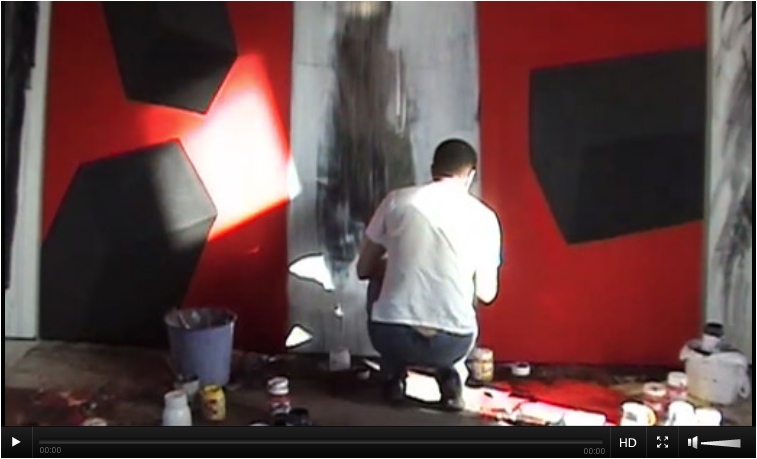
Enjoy this short film about the Algerian contemporary artist Malek Salah as he prepares for the inaugural exhibition titled ‘Majnûn Laylâ’ for the new Modern Art Museum of Algiers, the first of its kind in the Arab world. The film brings deep insight into Salah’s world—his creative process, the information contained within his work, his relationship to his art, and through it, with the Algerian society.

This beautiful film of a meditating Algerian artist, Malek Salah, is a fine example of a famous artist profiled by one of our MUM students, who later became a videographer for DLF.TV. The young filmmaker, Amine Koudier, a senior student at the time in MUM’s digital media class, was asked to make this film to accompany an opening exhibit of the new Modern Art Museum of Algiers (MaMa), the first of its kind in the Muslim world.

When Amine showed it to me I was really impressed and encouraged him to translate and add English sub-titles and enter it into competitions. I ended up helping him with the French to English translation, and he won first place wherever he entered it. He took the top 2008 Award of Excellence in the student category from the Iowa Motion Picture Association and Winner in the student film category of 2008 Landlocked Film Festival.

David Lynch visited the students when he was here last year and commented on this film. He said he loved the artist, his work, and what he had to say about it, and how Amine had portrayed it—high praise for a student. Amine was later hired to work at David Lynch Foundation Television upon graduating. Read an excellent article in the Iowa Source written by Mo Ellis about him and the film.

Watch the 13-minute film Malek Salah: ‘Majnun Layla’ on DLF.TV, on Vimeo, or on YouTube Part 1 and Part 2. Also see David Lynch Foundation Television to premiere David S. Ware: A World of Sound. The Ware and more profiles by Amine and other DLF.TV filmmakers are available here.

This blog post was published November 30, 2009. After working for the David Lynch Foundation, Amine would become a teacher of Transcendental Meditation and later taught TM and filmmaking at Maharishi University. He gave a wonderful interview to Nylon Magazine, and later invited a photographer from the Ottumwa Courier into his classroom as part of her profile on the university.

Connect Savannah: Extreme closeup: Ben Foster

October 27, 2009

Extreme closeup: Ben Foster

October 27, 2009

The young star of ‘The Messenger’ is honored following Saturday’s screening

With Woody Harrelson in
With Woody Harrelson in “The Messenger.”

Since his breakout role on HBO’s Six Feet Under, Ben Foster has appeared in one high–profile feature film after another. He played the mutant Angel in X–Men: The Last Stand, drug–addled teen Jake Mazursky in the crime drama Alpha Dog, and psychotic cowboy Charlie Prince in the western remake 3:10 to Yuma. Foster’s new film is The Messenger, in which he and Woody Harrelson are emotionally scarred veterans of the Iraq war, assigned “the worst job in the Army” Stateside — notifying family members that a loved one has been killed overseas.

Against orders and against logic, Foster’s character falls for a young widow, played by Samantha Morton.

Foster, Harrelson and writer/director Oren Moverman will attend Saturday’s screening of The Messenger at the Trustees Theater; afterwards, both actors will receive awards from the Savannah Film Festival.

The Messenger — the first film to put Foster’s name not only above the title, but above those of his co–stars — has been getting rave reviews. There’s talk of an Oscar nomination for Foster.

At 29, Foster has more good notices under his belt that many film actors twice his age. He is known for his piercing eyes and quiet intensity — and his ability to deliver the goods, even when the film itself is substandard (see the recent Pandorum).

It occurred to me that Jake Mazursky in Alpha Dog and Charlie Prince in 3:10 to Yuma are like different generations of the same character. Do you ever worry you’re getting typecast as the intense, crazy guy?

Ben Foster: I’m sure on some level some psychologist could have a field day with me on the roles that I end up doing. It’s really project to project, and where I’m at and who I get to play with.

You left Iowa at 16 and went to L.A., and started working almost immediately. Do you ever pinch yourself?

Ben Foster: Oh certainly, every day. I was talking to my mom about this very thing not a few days ago. I’m incredibly lucky. There are so many gifted people who aren’t at the right place at the right time, for whatever reason. That’s not to say it’s been an easy road. And at the end of it, hopefully, I’ll be able to keep playing.

What do you look for in a role?

Ben Foster: It really depends on where you’re at. This idea of only doing projects that speak to the deepest corners of your inner core, that’s somewhat laughable to say these days, and where this industry is at. That being said, I’m not going to choose a job and spend two or four months of my life with strangers making something if I didn’t believe that we could create something collectively that was exciting. Sometimes it turns out really well, and other times… there are limitations. Creative limitations, financial limitations, time.

Do you ever realize this while the film is in production — “This one’s not going to be so great, but I’ve committed” — or do you always have to believe it’s going to be a great movie?

Ben Foster: I gotta go in thinking that each one’s going to be special. It doesn’t have to be the greatest film of all time, but if you don’t have that belief… you know, only you can blow your own candle out. And it adds up if you’re doing things that you don’t believe in. If you’re approaching a role as an actor approaching a role, there’s too much distance. It doesn’t feel good, and people don’t respond to it, and it’s just not worth the time. Sometimes, it works out well.

You recently co–starred with Dennis Quaid in Pandorum. The reviews were… well, not good. What were you thinking as you read the script?

Ben Foster: It was a fairly innocent read. It held my attention. I was very apprehensive about doing it, but I spoke with Christian Alvart, the director, and he had a very specific idea of how he wanted to shoot it… I turned it down again.

I think they came back to me three times, and I guess like I felt I was taking myself too seriously and thought “I’d certainly like to go to the movies and be entertained.” I hadn’t done a proper sci–fi picture before, so I gave it a shot.

You played astronauts in a broken spacecraft. What was shooting that like?

Ben Foster: It didn’t turn out — in the experience, nor in the final product — the way that it was presented to me. And that’s fairly frustrating.

How did you approach The Messenger?

Ben Foster: The Messenger has certainly been a labor of love. I’m pretty press–shy, but for The Messenger I’m going on a full tour, and that’s not limited to the fact that I’m just proud of the film as a whole; more importantly, I’m proud of the questions it asks.

I was drawn to it initially because of Oren. It was the only script that dealt with the war, that I had read, that presented the results of warfare without taking an overtly political side. To get lost in that world… it’s having the opportunity to learn things that I don’t know about. I’ve had friends in the military, but the opportunity to spend time with vets, and the soldiers that have come back, it was truly a life–changing experience.

We went to Walter Reed Hospital and spent time in the amputee ward. The head of Casualty Notification for the United States was on set with us every day. I wouldn’t say it was an easy shoot, but the space that Oren created and the resources for research, allowed us all to get lost. And getting to work with Woody Harrelson, who I think handed in one of his finest performances. Harrelson is my brother. I’d do anything for that man!

And Samantha Morton and Jenna Malone… I can’t imagine that anyone gets an opportunity to do too many that stick with you to this degree.

Do you go looking for fresh challenges?

Ben Foster: I guess the challenge is: I’m beyond compelled to put myself in a situation where I could experience something that ordinarily I wouldn’t have the opportunity to. So yes, it’s exciting. It’s mostly exciting to work with people who give a shit.

You practice transcendental meditation. What does TM do for you?

Ben Foster: It’s a technique, twice a day. It’s not a religious or even a dogmatic technique, it’s an ancient, simple, quiet, internal technology that you do with yourself. It’s basically gettin’ rid of the static. It’s tuning, you know?

It’s not as simple as just saying “clearing your head.” It’s a rooting and a tuning, if that makes any sense.

There’s just so much input in the world, and we absorb this. And our families, and our work, there’s so many demands. And what this does, it’s a reset button. So it allows me more energy, when I take 30–45 minutes in the morning.

Yeah, it’s a pain in the ass on set. If my call time’s 5 in the morning, I gotta get up at 4. But what it gives me during the day is just a resource of energy, and the ability to hear what I’m actually thinking, rather than spitting back what I’ve been told.

It’s up to you how you use it. It’s like eating well and getting a good night’s sleep: You’re going to perform better — whatever action you’re doing, with friends or family, or your job or on your own. It’s just a stabilizing resource of energy, and clarity of thought.

What’s next for you?

Ben Foster: I just finished shooting a film in Armenia called Hear — it’s kind of a meditative road movie. And now I’m on my way to New Orleans to shoot some guns with Jason Statham. It’s a remake of the Charles Bronson movie The Mechanic.  cs

Savannah Film Festival: The Messenger screening

Where: Trustees Theater, 216 E. Broughton St.

When: At 7:30 p.m. Saturday, Oct. 31

Tickets: $5–$10, at (912) 525–5050

Woody Harrelson and Ben Foster Tribute accompanies the screening

See the trailer for the film here.
Also see: Extreme closeup: Woody Harrelson

Here’s a great CNN interview with Ben Foster talking about the soldier’s job in The Messenger.

LAist: Zachary Sluser’s Short Film “Path Lights”

October 27, 2009

Short Films: More Than the Art of the Calling Card?

BobbyTyping

We are certainly in a sea change when it comes to media, but for every time someone has cried that the end is nigh, books, newspaper, film–whatever is on its deathbed in a given news cycle–continues to push ahead, continues to march on. In the case of Hollywood, YouTube, Netflix and OnDemad have continued to pull film out of the theater, a process that began with VHS and video rental, and deeper into the home. These media and formats may seem better suited for shorter work, yet feature-length films still reign supreme. But with studios tightening their purse strings and the budget needed for a feature film almost always far beyond the bank balance and fund raising prowess of up-and-coming filmmakers, directors without studio backing have to find other ways to show their vision. So short films–which find their way through world by playing at film festivals and in any variety of online platforms–are the go to, if not most desirable, format for directors looking for that big feature film break.

LAist spoke to one such LA-based director, Zachary Sluser, who’s latest short film, “Path Lights” is making its Los Angeles debut tonight at the AFI Mark Goodson Theater after having played at a number of film festivals around the country, including the Woodstock Film Festival in upstate New York. Based on a short story by author Tom Drury published by The New Yorker in 2005, “Path Lights” was shot in Los Angeles in the spring of this year.

“I think that short films are primarily made as calling cards, either as truncated versions of a feature length or as stand-alone pieces that showcase the director’s style and capabilities. I do think that no matter what the intention is for making the film, once it is being made, it should stand alone as it’s own piece of art,” Sluser said about the role of short film in Hollywood. Considering all of the calling card shorts that must be floating around Los Angeles and remembering those that managed to become something much more–Tod Haynes’ “Superstar,” the all-Barbie cast Karen Carpenter biopic, is a stand out that comes to mind–it seems strange that our city, so synonymous with film, doesn’t have much in the way of outlets for screening and viewing shorts. New York City, so strongly associated with book publishing, offers much more for authors writing short fiction–the short story and novel being analogous to the short and feature film in many ways–with its glut of reading series and various print outlets, including The New Yorker, where Drury’s story was published.

Described as a “thought-provoking, comedy-noir that puts a human spin on the tradition of detective hero films,” the plot follows Bobby (John Hawkes)–who makes his living doing voiceovers for serial detective pulps–as he makes his way through a mystery that appears in his own life. An avid film buff, Sluser kept the noir history, both in film and literature, of LA in mind in shooting the film. “Because Bobby is the voice for these detective serials on tape, and he himself is very much the opposite of the classic “Sam Spade” detective, we chose to use the film noir grammar in ways that show how out of his element Bobby is,” in dealing with mystery outside of the sound studio, Sluser said. “So I think it makes sense that the film is set in the quiet neighborhoods of Pasadena. Close enough to the film noir history in LA, and at the same time quite removed.”

“Path Lights” is screening tonight at 8:00 PM at AFI Mark Goodson Theater in the Mayer Library Building (2021 N. Western Ave.).

By Willy Blackmore in Arts & Events on October 27, 2009 10:00 AM

A Fascinating Approach to Peace

October 19, 2009

NewsBlaze

Published: October 18, 2009

Letter to the Editor

A Fascinating Approach to Peace

Australia Needs a Defence System Beyond “Extended Deterrence”

Dear News Blaze editors:

Thank you for posting this intelligently written Op-Ed piece. Here are my comments for your consideration.

When asked about his new film, EVERY WAR HAS TWO LOSERS, a documentary based on the journals of American poet William Stafford, award-winning producer/director Haydn Reiss suggested it would be very satisfying to think that after viewing the film you would ask yourself, at a deep level, what you really believe about war. And the follow-up question of “How did I come to believe that?”

This Op-Ed, Australia Needs a Defence System Beyond “Extended Deterrence” is a fascinating approach to peace, one that should be seriously considered. I’ve just seen Mr. Reiss’s new film about war and peace, and this deeper solution is something that would resonate with both the poet and the filmmaker.

“I think we have been very successfully indoctrinated into accepting that war is a given, it’s what human beings do. The distinction is, and I think this is what Stafford is saying, is ‘Yes, we do and can make war. But what else can we do?’ The undiscovered possibilities in human behavior are what we should pursue. The die is not cast,” Reiss added; “imagination and creativity are not in short supply. That this is the real, pragmatic work of the world.”

Visit http://everywar.com to see the trailer, and think for yourself, about this question and this more rational scientific solution. At the same time, keep in mind what Einstein said about insanity—doing the same thing over and over again, expecting a different result; and what Schopenhauer said about the three stages that all truth passes through—”First, it is ridiculed. Second, it is violently opposed. Third, it is accepted as being self-evident.”

In watching his own struggle with the British Empire, Gandhi echoed a similar sentiment when he observed, “First they ignore you, then they laugh at you, then they fight you, then you win.” I’d like to think that this ancient scientific approach founded by the great Vedic Science revivalist, Maharishi Mahesh Yogi, would turn out to be a win-win situation for every nation on the planet. We now have the technology in our hands to finally fulfill this ancient hope for humanity—the ability to create and maintain permanent world peace.

Ken Chawkin
Media Relations Director
Maharishi University of Management
The David Lynch Foundation
E:  kchawkin@mum.edu
W: http://www.mum.edu
B: http://theuncarvedblog.com
W: http://www.davidlynchfoundation.org

Also see Every War Has Two Losers, a Haydn Reiss film on poet and conscientious objector William Stafford and PEACEFUL POETS: Filmmaker Haydn Reiss on Rumi and Stafford and the Power of Words.

Australia Needs a Defence System Beyond ‘Extended Deterrence’

October 18, 2009

Australia Needs a Defence System Beyond ‘Extended Deterrence’

Shared via AddThis

Every War Has Two Losers, a Haydn Reiss film on poet and conscientious objector William Stafford

October 18, 2009

EVERY WAR HAS TWO LOSERS

A Poet’s Meditation on Peace

A FILM BASED ON THE JOURNALS OF WILLIAM STAFFORD

Haydn Reiss (producer/director) has been making independent films for twenty years that often focus on writers and poets. As a producer for hire his clients include organizations working on the front lines of education, the environment, culture, human rights, politics and health. In 1998, Reiss directed the award-winning RUMI: Poet of the Heart, which was seen on over 100 PBS stations and screened in festivals around the world.

EVERY WAR HAS TWO LOSERS tells the story of how one man, William Stafford (1914-1993), chose to answer the call to war. It is a story of confronting beliefs that swirl around war — Isn’t war inevitable? Even necessary? What about the enemy? Stafford refused to fight in World War Two and served four years in camps for conscientious objectors. Later he was the winner of the National Book Award for poetry.

Other participants appearing in the film include Coleman Barks, Robert Bly, John Gorka, Maxine Hong Kingston, Michael Meade, W.S. Merwin, Naomi Shihab Nye, Kim Stafford, and Alice Walker.

Director Haydn Reiss first met Stafford in 1990 and later produced a one-hour documentary, William Stafford & Robert Bly: A Literary Friendship. That film chronicles the similarities and differences between these two close friends and great poets. Approaches to writing, teaching and the meaning of poetry are all explored in this lively and engaging film. (The film is included as a DVD extra on EVERY WAR HAS TWO LOSERS)

Interview with Haydn Reiss:

Q: What’s the genesis of the film?

HR: In 2006, I read the book the film is based on and that was edited by his son Kim, “Every War Has Two Losers: William Stafford on Peace & War” (Milkweed Editions 2004). It’s fifty years of excerpts from Bill’s journals related to war and reconciliation. As with all of Stafford’s writings, there is a sense of a deep intelligence at work that stays human and available to the reader. There’s humor, heartbreak and a general sense, or assertion, that we human beings are capable of doing better with each other. I’m a father of young children and I have to believe that’s true. More importantly, I had to try and make a contribution to that effort and that’s what I attempted with the film.

Q: How does the book differ from the film?

HR: Obviously there’s a lot more writing and poems in the book than the film. The challenge was to pull journal entries that could be arranged in some form or fashion and create an overall arc to the film. A beginning, middle and end has not been much improved upon in the world of storytelling. All the material could be endlessly mixed since there was no inherent order to it other than chronological. So mix it we did some untold number of times until the cylinders seemed to line up and my editor and I had something we liked. The film brings in its own ingredients of music, images and a remarkable collection of participants.

Q: What do you hope the film does for the viewer?

HR: It would be very satisfying to think that after viewing the film you would ask yourself, at a deep level, what you really believe about war. And the follow-up question of “How did I come to believe that?” I think we have been very successfully indoctrinated into accepting that war is a given, it’s what human beings do. The distinction is, and I think this is what Stafford is saying, is “Yes, we do and can make war. But what else can we do?” The undiscovered possibilities in human behavior are what we should pursue. The die is not cast; imagination and creativity are not in short supply. That this is the real, pragmatic work of the world.

View trailer, download PBS station airings August-September 2010, bios, and purchase a DVD of Every War Has Two Losers.

Also see PEACEFUL POETS: Filmmaker Haydn Reiss on Rumi and Stafford and the Power of Words and A Fascinating Approach to Peace.

John Hagelin, Ph.D., Speaks on the Nature of Consciousness and the Universe

October 3, 2009

John_Hagelin_Ph.D.

Will Arntz, director of What the Bleep Do We Know?!, asks John Hagelin, Ph.D., about the nature of consciousness. Dr. Hagelin explains the unity underlying and giving rise to the diversity of creation, and the deepest unified level of human consciousness, as being one and the same. This 2-part interview is available on empowured.com along with other related videos: Unified Field Physics: John Hagelin, Ph.D on Consciousness.

Other videos worth watching: Conscious TV: John Hagelin – The Core of Nature | Dr. John Hagelin: Look Within to Understand the Universe | John Hagelin — “Only Higher Consciousness Can Transform Our World” — Beyond Awakening Blog | John Hagelin at TEDxWomen 2012 – YouTube | The Power of The Collective, by John Hagelin

Replay of American Indian Sustainable Conference

September 30, 2009

Watch the replay of the the press conference which served as a brief overview to the American Indian Sustainable Conference (54:35 minutes) http://www.americanindiansustainableconference.org/webcast/replay.html. Check back later for further excerpts from the weekend.

KTVO 3: M.U.M. Gets $1 Million Research Grant

September 26, 2009

MUM gets $1 million research grant

Friday, September 25, 2009 at 6:37 p.m.

FAIRFIELD, IOWA — University Receives $1 Million NIH Grant for Mind-Body Medicine Research

The National Institutes of Health recently awarded a grant of $500,000 per year for two years for research on the Transcendental Meditation® technique in the treatment of coronary heart disease in African Americans.

The research is a collaboration between Maharishi University of Management Research Institute’s Center for Natural Medicine and Prevention and Columbia University Medical School in New York.

The funding comes from the American Recovery and Investment Act, via the NIH-National Heart, Lung and Blood Institute.

About 21,000 applications were submitted to NIH for these specific funds, with just 3% receiving grants.

“This recent achievement continues to place MUM Research Institute and its research on the Transcendental Meditation technique and Maharishi Vedic MedicineSM programs in an elite category in academic medicine,” said project director Robert Schneider, M.D., F.A.C.C., and dean of the Maharishi College of Perfect Health.

The research will compare the effectiveness of cardiac rehabilitation with and without the Transcendental Meditation program, especially after a heart attack. The study will utilize positron emission tomography (PET) to image and quantify changes in heart disease in the patients.

The Center for Natural Medicine and Prevention team includes Sanford Nidich, EdD, Carolyn King, PhD, Maxwell Rainforth, PhD, John Salerno, PhD, Marilyn Ungaro, Laura Alcorn, and Linda Heaton.

See video: http://bit.ly/13D7d4

KTVO Medical News

Video on the David Lynch Foundation

September 22, 2009

How David’s Foundation Started

This 3 minute video premiered at the “Change Begins Within” benefit concert at Radio City Music Hall in New York City on April 4th, 2009. The video provides a compelling introduction to the purpose and goal of the David Lynch Foundation, which is to provide scholarships for one million at-risk youth to meditate—students who are struggling to learn and live in an atmosphere of intense stress, disease, and violence.