Archive for the ‘Videos’ Category

Donovan GDLA and Off-Ramp Interviews

March 15, 2010

Donovan and Astrella on GDLA

Monday, 15 Mar 2010, 11:40 AM PDT

Los Angeles – Legendary singer Donovan was one of the few artists to collaborate on songs with Beatles and he has played with folk greats Pete Seeger, Joan Baez and Bob Dylan, and has even played with rock legends the Rolling Stones.

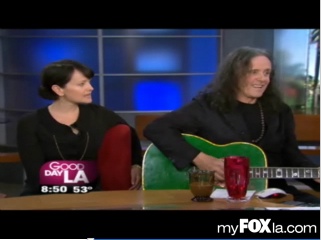
Donovan and daughter Astrella visit by “Good Day LA” to talk about a benefit concert for the David Lynch Foundation.

Donovan will be joined by his daughter Astrella Celeste to headline a benefit concert for the David Lynch Foundation on Friday, March 19 at the El Rey Theater in Los Angeles.

For more info on the concert log onto:  www.donovan.ie/en/


Off-Ramp Special Podcast – Donovan in Concert

Monday, March 8, 2010.

They gave us the keys to the podcast, so now we can send out special editions when we’ve got great stuff to share … like 60s icon Donovan and his guitar in studio. This is the full version of the piece we’ll run this weekend on the broadcast edition of Off-Ramp.              Download

Donovan Live at the Mohn Broadcast Center

Donovan is headlining a concert at the El Rey Theatre March 19th to benefit the David Lynch Foundation, which works to teach at-risk schoolkids to meditate. Donovan learned how to meditate with the Beatles and the Maharishi back in the 1960s. In our Off-Ramp interview, Donovan talks about the old days, reducing students’ stress and reliance on ADHD drugs, and the benefits and drawbacks of fame. He also sings three of his favorites. (COME INSIDE for info on the concert, a link to Lynch’s foundation, and to see who is taller — Donovan or Off-Ramp host John Rabe.)

1 comment

Gary Kaplan
5 days, 19 hours ago

Sublime! Donovan is our hero. What a great service he is doing for mankind.

Peter Wallace’s story of how he met Maharishi

February 16, 2010

PETER WALLACE SPEAKS TO VEDIC SCIENCE CLASS

Listen to TM movement pioneer Peter Wallace’s address to the Masters in Vedic Science class on the campus of Maharishi University of Management, via KHOE 90.5 FM – World Radio – Including Maharishi Gandharva Veda Music Channel.  (mp3 90min, 82MB)

Emmerich Galler later created a video of Peter’s talk with images of Anandamayi Ma, Maharishi, Guru Dev, and others. Also read his notes. 

Here is another KHOE interview: Peter Wallace is interviewed by Dean of Faculty Cathy Gorini, in this installment in a series on the history of the TM Movement. Peter tells how his younger brother Keith, who did pioneering research on Transcendental Meditation, got involved. Keith is now Chairperson of the Department of Physiology & Health at M.U.M. Peter also speaks of the power and profundity of the Invincible America Assembly, of which he is a participant, as a manifestation of the greatness of Maharishi’s teaching. Recorded Oct 2 2011. (mp3 55min, 19MB)

Here is a 41:30min video interview uploaded by on Sep 3, 2011: Peter Wallace—Early History TM Movement and Maharishi

Short Transcription:

Jim Mayhew: My name is Jim Mayhew I am the founding facilitator of the Yogic Flyers for Heaven on Earth Foundation and today I have the great pleasure and privilege of interviewing a man that has been involved in the TM Movement right from the very beginning one of the first people to meet Maharishi. He has wonderful stories to tell of the early parts of the TM Movement. Very interesting insights to share, so without further ado… his name is Peter Wallace, by the way and he is from a family who has been very devoted to Maharishi for many years, and he is an successful artist and art dealer, his passion is Russian art and maybe if we have time later with the camera we will share some of his… So without further ado share some of your insights and experiences you had mentioned when you had first met Maharishi…

Peter Wallace: I guess it started really in Paris when I had an experience an existential experience to take charge of my own life and direct it in such a way that it would have some meaning. That involved figuring out what the meaning of life was and it involved doing something about it.

Other interesting related posts

Dr. Neil Paterson, Minister of Administration of the Global Country of World Peace, shared a relatively unknown chronology of how Maharishi’s private peace-creating efforts saved our world from total self-destruction. Watch this inspiring archived report from July 09, 2016 on Maharishi Global Family Chat.

Les Crane interviews Maharishi Mahesh Yogi | Who was Dear Prudence the Beatles sang to in India? What happened to her? Here is her story. | Watch the 1968 CBC film of Maharishi at Lake Louise | Watch the 2007 International History Channel documentary on Maharishi Mahesh Yogi

Mashable: David Lynch Goes Mobile

February 10, 2010

Mashable | The Social Media Guide
About 15 hours ago Christina Warren 7

From “Eraserhead” to MMS: David Lynch Goes Mobile

Award-winning director (and three-time Oscar nominee) David Lynch (of Blue Velvet and Twin Peaks fame) and the David Lynch Foundation Television have teamed up with mobile video marketer Mogreet to bring video MMS messages to Lynch fans.

We spoke with Mogreet and the David Lynch Foundation about the technology, the purpose of the campaign and how the DLF is using social media and technology to further its message.

Spreading a Message With Mobile Video

The ever-increasing pace of smartphone adoption only underscores the growing importance of mobility. As we’ve seen with everything from mobile app stores to the Red Cross’s text message for Haiti campaign, mobile is an extremely valuable platform for brands and nonprofits to get their messages across.

Videovideo is an important communication driver, too, and when you combine the two technologies together, you end up with something potentially amazing.

Last month, we wrote about Thwapr, a company that specializes in doing mobile-to-mobile video. We see mobile video messaging as something that’s only going to continue to grow, especially as more and more companies realize just how many users are able to actually view video on their phones.

One of the companies that is really focused on mobile video marketing is Mogreet. Mogreet works with companies so that they can send video MMS messages to users that request their information. Because virtually every mobile phone sold since 2005 or so can support MMS messages that include video playback, the potential audience for these sorts of messages is huge.

I spoke with James Citron, the CEO of Mogreet, and he told me that the company has more than 2,700 device profiles in its database, meaning that if you have a cell phone, chances are, it can play one of Mogreet’s video MMS messages. Each video is encoded in a variety of different formats and it is sent to phones in the best format for that phone, so that users of an iPhone get a different experience than someone using a Motorola Razr, but each user gets the best possible experience for his or her device.

While this has primarily been used for commercial advertisers, Mogreet is interested in getting into the non-profit space too, because that’s perhaps an even better market for this sort of service. Think about it, what if you could donate and then get a video message back showing someone who is helped by your donation saying thanks? Or what if you could see what is going on in Haiti or some other place that needs aid? The non-profit organization’s message might be that much more powerful. After all, images often speak louder than words.

To that end, Mogreet decided to work with the David Lynch Foundation and bring some of Lynch’s talents — and messages — to his fans.

David Lynch Goes Mobile

The David Lynch Foundation Television is dedicated to documenting programs that awaken creativity and transform lives. To that end, the foundation has a website, DLF.TV, that has lots of video content of David Lynch and of people the Foundation has helped, as well as of other artists and friends who have support the Foundation’s vision.

The first mobile video message that the DLF will be sending to fans is of a short film that Lynch directed featuring the musician and artist Ariana Delawari. Delawari’s debut album, Lion of Panjshir was recorded in Kabul and Los Angeles, and reflects the cultures of both places. Delawari’s decision to return to Afghanistan in 2007 to record the album influenced her work and its overall sound. Like Lynch, Delawari is a student of transcendental mediation and like Lynch, it has also influenced her life and her work.

Lynch directed a six-minute short showing off Delawari’s style and voice. The style is unmistakable Lynch, from the background to the sound mix to the camera angles. It’s also a piece that works well when viewing on the web or on a mobile phone. To spread the word about Delawari — and to kick off a mobile-type of initiative — fans can text ‘LYNCH’ to 647338.

It’s an interesting approach to spread a message from an always-interesting director. It’s also something we expect to be a growing trend, especially as nonprofits start to embrace the power of mobile.

What do you think about mobile video? Are you a fan of David Lynch? What do you think of this initiative? Let us know!

Tags: , , , , ,

User reviews: video

LAFCA Choose David Lynch’s “Mulholland Drive” Best of the Decade

January 12, 2010

Best of the Decade: “Mulholland” Tops LA Critics’ List

by Peter Knegt (Updated 5 hours, 22 minutes ago)
posted on January 12, 2010

An image from David Lynch’s “Mulholland Drive,” named the best film of the decade in a survey by the LAFCA.

The Los Angeles Film Critics Association (LAFCA) announced their selections for the best of the 2000s, with “Mulholland Dr.,” from director David Lynch, topping the list.  The LAFCA’s choices were announced today by Brent Simon, President of LAFCA. This is the organization’s inaugural survey of the decade in cinema.

“Famously salvaged from a rejected TV pilot, Lynch’s film stands as both a cautionary tale and a mascot for the triumph of art and personal vision in an industry that, from where we sit, often seems actively devoted to the suppression of both,” the organization said in an essay announcing its choice.

“Deep love, respect and gratitude to the L.A. Film Critics Association for choosing Mulholland Dr. as the film of the decade,” said director David Lynch when informed of the distinction, in a statement. “I am really thrilled by this honor, thank you.”

“Mulholland Dr.” beat out 189 other selected titles, which were chosen by 41 LAFCA members who participated in the vote. In 2001, “Mulholland Dr.” was the group’s runner-up for best picture, placing second to Todd Fields’ “In the Bedroom.”

The film also topped a recent list of the best 150 movies of the decade published on the Film Comment website, and the recent indieWIRE survey of nearly one hundred film critics and bloggers, with Wong Kar-wai’s “In The Mood for Love” at number two and Edward Yang’s “Yi Yi” at number three. “In The Mood For Love” was surprising omission from the LAFCA list.

The top 10 Films of the Decade list from LAFCA:

1. Mulholland Dr. –  David Lynch
2. There Will Be Blood –  Paul Thomas Anderson
3. Eternal Sunshine of the Spotless Mind –  Michel Gondry
4. Brokeback Mountain –  Ang Lee
5. No Country for Old Men –  Joel and Ethan Coen and Zodiac –  David Fincher (tie)
6. Yi Yi –  Edward Yang
7. 4 Months, 3 Weeks and 2 Days – Cristian Mungiu and The Lord of the Rings – Peter Jackson (tie)
8. Spirited Away –  Hayao Miyazaki
9. United 93 – Paul Greengrass (tie) and Y Tu Mama Tambien –  Alfonso Cuaron (tie)
10. Sideways –  Alexander Payne

The rules of the selections, as explained by the LAFCA: “Each critic was invited to submit a weighted ballot of 10 films. On ranked ballots, the No. 1 choice received 10 points, No. 2 received 9 points, No. 3 received 8 points, and so on. On unranked ballots, each film received 5.5 points. The organization freely allowed votes for franchises (i.e., The Lord of the Rings trilogy), short films (The Heart of the World), films that premiered at festivals in the ‘90s but didn’t play U.S. theaters until the ‘00s (Audition), films that premiered at festivals in the ‘00s but won’t play U.S. theaters until the ‘10s (Wild Grass), and even films that were made four decades ago (Army of Shadows).”

Check out the LAFCA’s 2009 awards here.

A personal note: How auspicious, as today, Jan 12, is also the birthday celebration of David’s guru, His Holiness Maharishi Mahesh Yogi, founder of the TM technique, of whom David is making a documentary film.

Max Perelman to present “The Green Dragon” at M.U.M. and discuss Sustainable Building in China

January 9, 2010

The Sustainable Living Department of Maharishi University of Management will offer a free showing of the film, The Green Dragon, in Dalby Hall on Monday, January 11, 8:00 pm, at the Argiro Student Center.

The Green Dragon, a documentary film, tells the story about the potential for expanding sustainable construction and development in China. This film portrays the sheer scale of China’s construction industry while engaging the viewer in the reality of how this industry works. It also provides an in-depth discussion of the barriers and opportunities for China to ‘go green.’

“The rapid development of China’s green building movement, from nothing in 2000 to what is now, approximately 4 million m2 of green building construction (not including sustainable developments), is a story worth telling,” says Ken Langer, President, EMSI, an international leader in green building and sustainable community design consulting. For reference, the US now has 12.5 million sqm after 30 years of a green building movement.

Max Perelman

Max Perelman is the research director and co-producer of the Green Dragon Media Project,  a 9-week research and filming expedition to 9 cities along China’s east coast. Interviewees included Chinese government officials as well as the leaders of major developers, professional services firms and product manufacturers.

Based in California, Max Perelman will be in Iowa to show the film, followed by a Q & A session. “Before making this film I had no idea of what an amazing journey I was embarking on. I had been told that over half the world’s construction takes place in this one country, but only when you see it do you believe it.”

Max Perelman is a LEED Accredited Professional and is a project manager with BuildingWise, LLC a high performance building consulting firm headquartered in Moss Landing, CA. Max is also the president of American Environmental & Agricultural, Inc., an import/export and trade consulting firm specializing in environmental technologies and focused on trade between Asia and North America. He is also an advisor to the Joint US-China Cooperation on Clean Energy. Max speaks and reads Japanese and Mandarin Chinese.

Max has a BA from Cornell University, as well as an MBA and MA in International Environmental Policy from the Monterey Institute of International Studies. He has presented at a number of green building conferences including the USGBC’s Greenbuild 2007 in Chicago and WestCoastGreen 2008 in Silicon Valley. He has also published research in the Woodrow Wilson Center’s China Environment Series.

Max’s recent volunteer work includes fundraising for strawbale construction in the Chinese provinces of Heilongjiang and Sichuan, and volunteering for the local Pacific Grove, CA city government as a Planning Commissioner.

While visiting M.U.M. and Fairfield, Max Perelman will also meet with students, faculty, and community leaders, and anyone else interested in sustainable building, international environmental policy, and urban development in China and the US.

This event is free and open to the public.

For more information, email sustainableliving@mum.edu and visit the film’s website www.greendragonfilm.com.

ABC Nightline News Report on TM, M.U.M., Maharishi Vedic City, and David Lynch in Iowa

January 8, 2010

A positive Iowa news report for your enjoyment and edification. (Postponed again, sorry.) Just aired last night, July 5, 2010. http://bit.ly/cDxWqj


http://abcnews.go.com/Nightline/transcendental-meditation-vedic-city-iowa/story?id=9218475

Transcendental Meditation Thrives in Iowa
Adherents of Transcendental Meditation Have Called Hawkeye State Home Since ’70s
By John Berman and Maggie Burbank
Jan. 8, 2010

When you think of Iowa, you think of cornfields, you think of caucuses, you think of old-fashioned country-living.

Chances are, you don’t think of meditation <http://abcnews.go.com/Entertainment/popup?id=7249295>  and communal living.

Welcome to Maharishi Vedic City, Iowa — the only city in the country built on the tenets of transcendental meditation <http://abcnews.go.com/Health/MindMoodNews/story?id=7263240> , for meditators, by meditators.

Meg and Erik Vigmostad moved here from St. Louis in 1982.

“We wanted to come to a meditating community,” said Meg Vigmostad. “We had two children at the time, one of them was an infant, and we felt like it was the best place to bring up our children <http://abcnews.go.com/Health/MindMoodNews/story?id=7263240> .”

Watch the full story tonight, Jan 8, 2009 on “Nightline” <http://abcnews.go.com/nightline>  at 11:35 p.m. ET

Vigmostad acknowledged that the couple’s families thought they were “crazy” for making the move. Crazy, because those words, “transcendental meditation,” sound, well, different. Many people first heard of transcendental meditation, or TM, in the 1960s, when the Beatles started following Maharishi Mahesh Yogi, the official founder of TM.

“Transcendental meditation is a simple technique practiced for about 15-20 minutes sitting comfortably in a chair with the eyes closed,” said Bob Roth, a national director of the TM program. “It allows the body to get a profound state of rest while the mind just settles down and experiences a state of inner wakefulness, inner calm, inner coherence.”

The followers of Mahesh Yogi — mostly from East and West Coast universities — moved to Iowa en masse in 1974 to set up their own college, the Maharishi University of Management. The group chose Iowa because that is where they could find the land.

Now the settlement features two huge domes, one for men and one for women, with residents streaming in to meditate together twice a day.

But at the university and in the city, the commitment to Vedic principles of natural law and balance, derived from ancient Sanskrit texts, goes far beyond meditation. The community has banned the sale of nonorganic food within its boundaries. And that’s not all.

“The primary characteristics of Vedic architecture, the most obvious one, is that ideally, buildings face east, the direction of the rising sun,” said Jon Lipman, the country’s leading Vedic architect.

‘Greater Happiness’
Lipman says the buildings at the university and most new houses in town are constructed in line with ancient precepts.

“Just like the organs in the human body, there is a right place for different kinds of functions within a building,” Lipman said.

“And so, a kitchen is typically in one location. A living room in a house is typically in another location.”

Every Vedic building has a silent core known as a Bramastan, which is lit by a skylight and is never walked on. Lipman claims miraculous effects.

“The results are that, families find that their lives are improved, that there’s greater family harmony, that there is greater financial success, there’s greater happiness,” said Lipman. “There are many many cases where members of a family had disharmony between them, and it dissolved when they moved into a Vedic home. There are many cases where even such things as chronic diseases were abated by moving into a Vedic home.”

Lipman said “it’s a real challenge” to be poor, unhappy or unhealthy if you live in a Vedic building.

The Vigmostads live in a Vedic house, and seem like happy customers.

“It feels harmonious, it feels orderly, there’s a lot of silence here that was definitely not in our other house that we owned,” said Meg Vigmostad.

The talk of order and inner peace might sound unbelievable. But it is also the work of Vedic City to make it all … believable. Fred Travis, director of a university facility called the Center for Brain Consciousness and Cognition, demonstrated an EEG monitor of neurological electrical activity that he said shows that TM makes the brain more organized.

“What this is measuring is the electrical activity of the brain,” Travis explained as a member of the community hooked up to the machine sat and meditated.

“You see this one going up and down?” Travis said, pointed to a gauge. “Look at the one next to it. It goes up and down in a similar way. This is called coherence. When the similarity of two signatures are very close, it suggests those two parts of the brain are working together.

Neurologist Gary Kaplan, a proponent of TM, said such “coherence” will bring happiness, success — even world peace.

“What we notice is that this electrical activity becomes more harmonious or coherent between left and right hemispheres,” Kaplan said. “There have been studies that have documented that the TM technique, when practiced in large groups, seems to have some effect on society in general, whether it’s in war-torn areas where people are sitting to meditate together, or in high-crime areas that the trends reverse when you have larger groups meditating together.”

David Lynch and TM
It is a lot to digest — but then you don’t really have to. The TM followers insist they are not a cult. They all have normal jobs, for the middle of Iowa, and they are not out to recruit you. They just want you to know the option is there.

Famed filmmaker David Lynch spends a lot of time in Vedic City. He started the David Lynch Foundation, which, in the last four years, has provided scholarships for over 100,000 kids to learn to meditate for free in schools across the country.

“It’s not a religion. It’s not against any religion, it’s not mumbo-jumbo. It truly does transform life,” Lynch told ABC News. “Kids come to school and they meditate together for 15 minutes in the morning. And before they go home they meditate for 15 minutes. A lot of them come from, you know, bad situations, and so this gives them this thing you know, at the beginning and the end of the day, the rest of the time you just watch the violence stop. Watch relationships improve. Watch happiness in the hallways, in the classroom, watch creativity flow more and more, watch that heavy weight that we are living under gently lift away.”

“Nightline” was told there wasn’t enough time to properly learn transcendental meditation on a short trip to Vedic City. But to get a feeling of the Vedic way of life, we did visit the Ayurveda Health Spa in Vedic City — the leading spa of its kind in the country. Ayurveda is a system of health and healing involving food and behavior that originated in India thousands of years ago.

“We take your pulse, we put three fingers on the right hand,” explained Mark Toomey, an Ayurvedic health expert at the spa. “And it’s what I would say is like plugging into the inner intelligence of the body.”

Toomey said he can learn a lot from feeling a person’s pulse. He demonstrated on our correspondent.

“It’s a strong pulse,” Toomey said. “That means that, good expression of intelligence. It’s clear. Your pulse has a little bit of tension there, so maybe you’re working a little too hard, too many deadlines.”

Next up was the Shirodhara treatment.

“So what we’re going to be doing is pouring this oil for about 20 minutes on your forehead, in a continuous stream,” said Toomey. “Your job is just to relax and enjoy.”

And what’s so wrong with that? In Vedic City, they have made that their way of life … in the middle of Iowa.

“We really have all we need here,” said Meg Vigmostad. “You can go to a city anytime. But this is sort of a haven, you know? And it’s a place of comfort, and community.”

Copyright © 2010 ABC News Internet Ventures
——————————————————–

Here are two of my favorite famous relevant quotes on understanding truth and accepting the changes they bring for the better—a paradigm shift.

All truths are easy to understand once they are discovered;
the point is to discover them.
— Galileo Galilei (1564–1642)

All truth passes through three stages.
First, it is ridiculed. Second, it is violently opposed.
Third, it is accepted as being self-evident.
— Arthur Schopenhauer (1788-1860)

Amazing Video: EXTREME SHEPHERDING

January 5, 2010

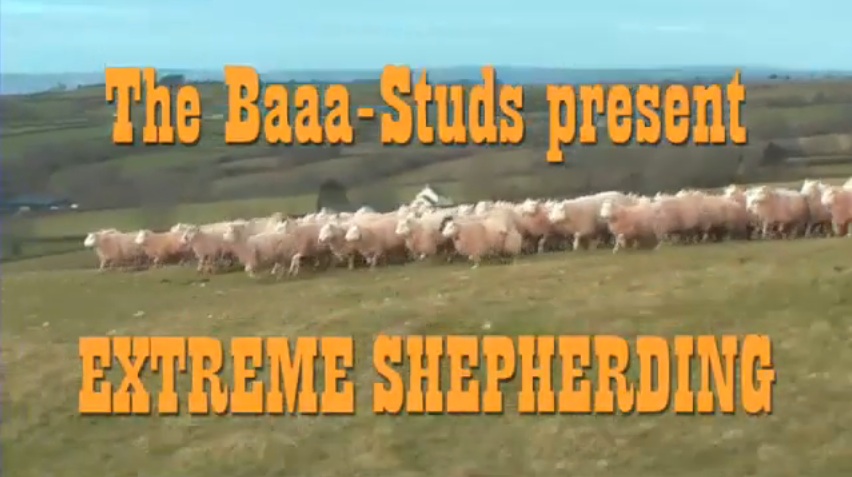
These creative characters (BaaaStuds) took to the hills of Wales armed to the teeth with sheep, LEDs and a camera, to create a huge amazing LED display. Of sorts. Looks like they did it as a promotional video for the Samsung LED TV. CBS interviewed these Welsh shepherds and got the story behind this hugely successful (around 14 million views by now) viral video campaign. It seems Samsung commissioned a commercial in which lit up sheep move to choreographed movement, Elizabeth Palmer reports. Harry Smith spoke with the Scottish men behind the sheep.

David Lynch on his next film, in Uttarkashi, India, at Maharishi’s house

December 13, 2009

December 10, 2009

DAVID IN INDIA – MAHARISHI’S HOUSE

http://dlf.tv/category/david-in-india/

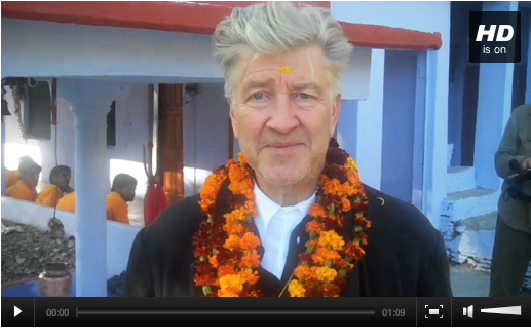
David Lynch is in India right now, starting work on his film on Maharishi Mahesh Yogi—the founder of Transcendental Meditation. David’s first report comes to DLF.TV from high in the Himalayas, in the small town of Uttarkashi, known as the “Valley of the Saints,” where for thousands of years, seekers of truth have gathered to meditate and rise to enlightenment. Maharishi spent two years in silence in Uttarkashi, from 1953 to 1955, following the passing of his teacher, Guru Dev. More reports from David to follow.

You can also follow Bob Roth, DLF VP, who’s traveling with David, on Twitter. http://twitter.com/bobbyroth. Click back to Dec 4th and read up. Found this interesting comment in one of Bobby’s tweets: Fernando Sulichin and Rob Wilson who work with Oliver Stone and Spike Lee are producers—along with Tabrez who produced Slumdog Millionaire.

Fascinating stuff! This looks like it promises to be the definitive documentary on Maharishi. We all look forward to that, whenever it comes out, hopefully some time next year.

PEACEFUL POETS: Filmmaker Haydn Reiss on Rumi and Stafford and the Power of Words

December 9, 2009

Haydn Reiss on Rumi & Stafford

Two Documentaries on Poets of Peace

BY TONY ELLIS

Filmmaker Haydn Reiss

The moral dilemma most often thrust in the face of those who oppose war goes something like this: What would you do if the lives of your loved ones were being threatened right in front of you? Would you not grab any weapon available in order to protect them? So why not fight to defend your country?

National Book Award-winning poet and World War II conscientious objector William Stafford (1914-1993) wrote in his journal: “The question, ‘Wouldn’t you fight for your country?’ begs the real question which is, ‘What is the best way to behave here and now to serve your country?’ So the real answer would be, ‘If it was the right thing to do, I would fight for my country. Now let’s talk about, what is the right thing to do?’ ”

This was one of the quandaries I discussed recently on the phone with Haydn Reiss, producer and director of Every War Has Two Losers: A Poet’s Meditation on Peace, a thoughtful and beautifully crafted documentary based on the writings of Stafford, and Rumi: Poet of the Heart, a previous work about the life of the Sufi mystic poet. Both films feature comments from a number of well-known poets, writers, and thinkers, including Robert Bly, Coleman Barks, Michael Meade, Alice Walker, Huston Smith and Deepak Chopra.

Reiss, a self-confessed “producer for hire,” has been involved in a range of visual media from Hollywood features (JFK and Jacob’s Ladder) to TV shows, but it is obvious his real passion lies in his work about these two poetic masters, separated in time by more than 700 years, and the potential of their words to move the hearts and minds of men away from conflict.

Reiss believes Stafford, like many of his fellow conscientious objectors, was no starry-eyed idealist. He accepted that conflict is always a possibility in the course of human affairs, says Reiss. But Stafford didn’t believe war was inevitable or even advisable. In Stafford’s view the consequences of war are rarely, if ever, beneficial to humanity. He encouraged everyone to consider the motives of those who urge us to war before getting caught up in the fever of victory. “How do we know war is the answer?” asks Stafford in his journal. “How can there be a nation we don’t like? That’s a fiction put onto a million different people. It has been created by interests you might well do to analyze.”

“It would be very satisfying to think,” says Reiss in an interview on the film’s website, “that after viewing the film you would ask yourself, at a deep level, what you really believe about war. And the follow-up question of ‘How did I come to believe that?’ ”

“I think we have been very successfully indoctrinated into accepting that war is a given, it’s what human beings do,” Reiss continues. “The distinction is, and I think this is what Stafford is saying, is ‘Yes, we do and can make war. But what else can we do?’ The undiscovered possibilities in human behavior are what we should pursue. The die is not cast; imagination and creativity are not in short supply. That this is the real, pragmatic work of the world.”

We live in such a culture of violence that sometimes it is hard to imagine how the actions or words of one person can be heard above all the clatter. Stafford believed peace is achieved gradually, created one person, one small step at a time. “Artists and peacemakers are in it for the long haul,” Stafford writes in his journal. “Redemption comes with care. Here’s how to count the people who are ready to do right: 1 . . . 1. . . 1.”

His chosen medium was poetry. In a poem entitled “A Ritual to Read to Each Other,” composed in Iowa City on June 23, 1953, he wrote:

For it is important that awake people be awake,
or a breaking line may discourage them back to sleep;
the signals we give—yes or no, or maybe—
should be clear: the darkness around us is deep.

In Every War Has Two Losers, Stafford’s friend Michael Meade comments, “Something very deep in the human heart wants beauty, love, and relatedness more than it wants destruction, war and violence.” This theme is further explored in Rumi: Poet of the Heart, a tender and insightful portrayal of the life and work of Sufism’s most cherished poet. Reiss is a big believer in the power of poetry to take us to deeper understanding. “It’s alchemical,” he tells me, and quotes from William Blake’s poem “Jerusalem”: “I give you the end of a golden string, only wind it in a ball, it will lead in at Heaven’s gate built in Jerusalem’s wall,” a theme I discovered Stafford often used in his lectures. “Poetry can take us to a place where nations and newspapers are not so important as what is happening out in the fields and the birds and the wind,” says poet Coleman Barks in the film. His soulful translations of Rumi’s poems have made them famous worldwide. Deepak Chopra suggests that if more poetry was read to children we could substantially change the world for the better.

Stafford wrote a poem a day after rising before dawn and spending time in contemplation and reflection. “I have an appetite for finding the perfect language to describe the experience of life you’re having right now,” he once said. “Every now and then I break off a piece of that and call it a poem.” Rumi poured out thousands of lines of exquisite verse as he struggled to deal with the devastating loss of his friend and mentor, Shams of Tabriz.

“Rumi’s poetry emerged from grief, which we do our utmost to avoid,” comments Robert Bly when interviewed. It is as if his heart, in being broken open, became a container for an immense divine love. “I am so small I can barely be seen,” wrote Rumi. “How can this great love be inside of me?”

Rumi’s message of love described by Rumi: Poet of the Heart is so profound and essential it has the power to touch the soul within each of us. “Everyone loves Rumi. He has no enemies,” someone comments in Reiss’s film. “I fly with Rumi. I forget I am on the earth,” says another. It is a wonderful and revealing irony that in this time of widespread “Islamophobia,” Rumi, an Islamic mystic, should be the best-selling poet in America. He touches a universal nerve. The lesson to learn is this: if we can reach into our hearts and see the world through the eyes of a poet like Rumi, we can form bonds that unite us, whatever our culture or religion. Peace is the natural by-product of this experience. War, on the other hand, thrives on fear and division. “If loving everyone is too much to ask,” says Reiss, paraphrasing Kurt Vonnegut, “at least we should respect each other and maybe occasionally it will turn into love.”

“Love is the religion. The universe is the book,” says Coleman Barks, quoting a Sufi master. Stafford wrote on behalf of “the unknown good in our enemies,” comments one of his friends in the film.

Can the actions of one individual or a few well-chosen words really make a difference in this large chaotic world? Reiss believes so. On the website for Every War has Two Losers, he includes this quote from Stafford: “Every thought re-orders the universe.” And at the end of our conversation, he passes on this gem of wisdom from folksinger Pete Seeger. Seeger would say that life is like a seesaw and each of us is a grain of sand. It’s important which side of the seesaw you put your grain of sand. You never know which grain will be the one that tips it in the right direction.

Haydn Reiss will be visiting Iowa in spring 2010. Watch for upcoming announcements of his talk and film screenings.

For more information on both films and to watch trailers, visit www.rumipoet.com for Rumi, and www.everywar.com for Stafford.

To read more of William Stafford’s writings visit http://williamstaffordarchives.org/.

Tony Ellis is a Fairfield-based writer and poet. He blogs regularly at www.iowasource.com. To read more of his work, visit www.tonyellis.com. This article appears as the cover story of the December 2009 issue.

Also see Every War Has Two Losers, a Haydn Reiss film on poet and conscientious objector William Stafford and A Fascinating Approach to Peace.

PATH LIGHTS debuts on DLF.TV for one week

December 6, 2009
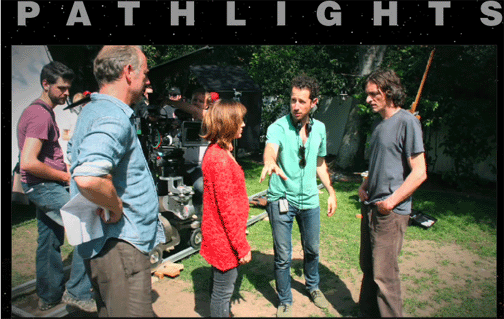
On location, left to right: Xander Berkeley, Sarah Utterback, director Zachary Sluser, lead actor John Hawkes.

Director Zachary Sluser has turned Tom Drury’s New Yorker short story into a short film now debuting on David Lynch Foundation Television. It is up for one week only, from December 2-9, 2009. After this showing, it will be presented at film festivals in 2010.

I highly recommend watching the short film, and the 3-part Behind The Scenes series on the making of this film. Some of the staff at DLF.TV were invited to film and interview the people involved in the making of this short feature—actors and crew. Very inspiring. Gives you a deeper insight and appreciation for these fine young filmmakers from MSAE, MUM, Fairfield, and their LA friends working on set. The value of TM is also mentioned. The bliss generated by everyone dedicating themselves to the project, for free, is special, and DLF.TV was able to capture it—a great example of what this young and vibrant new online TV channel is all about—celebrating consciousness, creativity and bliss. Catch the wave: http://dlf.tv/2009/pathlights/

Path Lights, introduced at the Woodstock Film Festival, has now been selected for the international competition at the 32nd Clermont-Ferrand Short Film Festival, Jan. 29-Feb.6, 2010 in south-central France. It’s the premiere short film festival (they screen short films exclusively) in the world and the second largest film festival in France after, Cannes.  Over 5100 short films were submitted and there are usually around 75 international (non-French) short films in competition. Very exciting. http://www.clermont-filmfest.com/index.php?m=226&c=3&id_film=100077897&o=88.

Following that acceptance was news that Path Lights has been invited to participate in the 39th International Rotterdam Film Festival, which will take place January 27–February 7, 2010. Rotterdam is probably the 4th major film festival after Cannes, Berlin, and Venice.    …. more to come ….

Some recent articles on Path Lights debuting on DLF.TV

THE NEW YORKER
Q&A: Tom Drury
http://www.newyorker.com/online/blogs/backissues/2009/12/q-a-tom-drury.html

IFC.com: The Independent Eye: Turn on your Path Lights.
By Alison Willmore on 12/02/2009
http://www.ifc.com/blogs/indie-eye/2009/12/path-lights.php

USATODAY POPCANDY
David Lynch Foundation spotlights a noteworthy short film
http://content.usatoday.com/communities/popcandy/post/2009/12/david-lynch-foundation-spotlights-a-noteworthy-short-film/1


PASTE MAGAZINE
By Emily Riemer
David Lynch Television Presents Short Film Path Lights
http://www.pastemagazine.com/articles/2009/12/david-lynch-television-presents-short-film-pathlig.html

The Millions: Curiosities
Oh, Tom Drury, how I love thee.
http://www.themillions.com/2009/12/oh-tom-drury-how-i-love-thee.html

UPDATE: Path Lights is now available on Vimeo: https://vimeo.com/117333877.