I came across this tweet by Tony Walsh @LongfellaPoet about this event: Delighted to share this. Please watch/tag/share. It’s my poem Take This Pen, beautifully illustrated by the wonderful @chrisriddell50. It’s an inspiration piece to launch #tellyourtruthpoem for @PoetryDayUK.
Enjoy this powerful poem and video that is sure to inspire young and old alike to creatively express their own truth in a poem. Read more on this international superstar poet, teacher, and performer Tony Walsh Poet.
Very relevant is this poem, WHO ARE YOU? in the 2013 film, Words and Pictures, inviting students to create and become who they are.
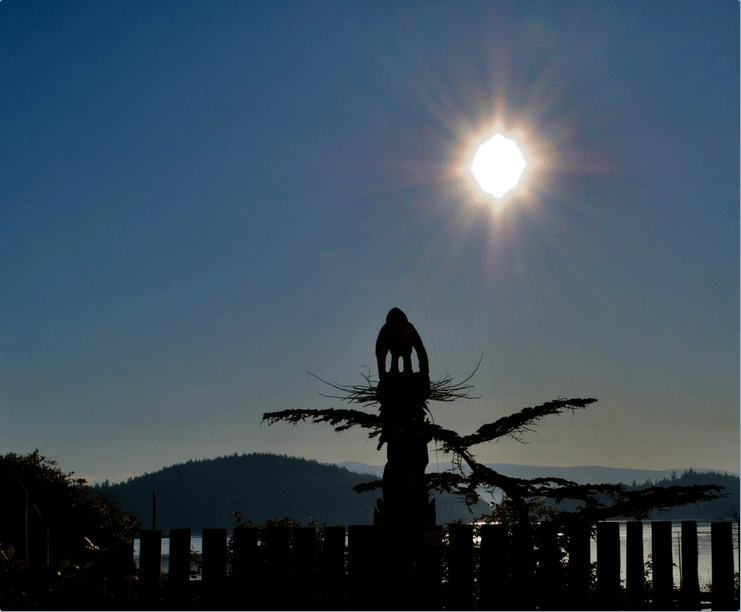
Here is another beautiful blog post by westcoastwoman. I had liked and posted an earlier one, Afterglow. She said this photo became the muse for the poem. It was a happy accident. In our discussion she “tried to photograph this totem at daybreak and twilight and finally in frustration a full on ‘throw away’ sun-in-the-lens shot. This is the one that stuck for me. Shadow and Light ….. loved it.” Yes, it is stunning, and the short, succinct poem it inspired delivers a powerful message!
Interestingly, on Monday morning, at the end of my meditation, I had this loving feeling in my heart, thinking of Sali. So I wrote this poem for her. It contains two haiku and a last line, which brought a quiet healing, knowing the bond of love is eternal; death cannot touch it. I remembered the jyotish reading Sali received from Pandit Shastriji with the nadi leaves, where he told us of some of our past lives together. She had later conveyed a message to me, that we would share again “The Peace that Passeth Understanding” I had written about after she had passed. See “Final entries leading up to and after Sali’s passing.”
An Undying Love
Still love you Sali An undying kind of Love That lasts Forever
Souls from the same Source Incarnating together Lifetime to lifetime
July 2, 2019 Update: I am reminded of this appropriate quote from the Zen poet Ryokan I had included in a post about his poetry. The last half of it is how I feel about the eternal nature of love I share(d) with Sali.
“In all ten directions of the universe, there is only one truth. When we see clearly, the great teachings are the same. What can ever be lost? What can be attained? If we attain something, it was there from the beginning of time. If we lose something, it is hiding somewhere near us.”
This is a beautiful blog post by westcoastwoman—the photo, quote, and six-sentence description. She intimately makes the universal personal. Click here to see the many responses to it, including mine. Having spent some time on the west coast of Canada I appreciate how she captured the magic in words. The experience cannot be pinned down. It’s transcendent—”in-between-time” and “neither here nor there.” The deep silence of nature’s transitions between night and day, twilight and predawn, are like a metaphor for our own inner experiences—the gaps between waking, dreaming and sleeping, and the silent unbounded backdrop to them, our own transcendental Self.
“Everyday a new picture is painted and framed, held up for half an hour, in such lights as the Great Artist chooses, and then withdrawn, and the curtain falls. And then the sun goes down, and long the afterglow gives light.”
Henry David Thoreau
Afterglow
Every night they come, the watchers of the sun-set, drawn down by the need to see the light extinguish behind the islands and the sea.
I want to share with them as they slowly rise and disperse that the setting of the sun is only a prelude to the experience they had been called to witness, but I stay silent.
It is this time between the setting sun and rising moon, this short extension of the day, this in-between-time when my heart and mind settle for just a moment.
I watch as the sky paints itself with each night’s original palette, wanting only to share with those who can look out from the same place and feel the colours as they appear, understand the need for silence.
In these moments when I am neither here nor there, anything is possible, magic is afoot and I am caught in the afterglow of another original creation as it slowly fades from sight.
The darkness takes the light, the starlings swoop once more in perfect unison over the water, I share with all who stand watching… being neither here nor there, a silent good night.
Written in response to GirlieontheEdge’s Six Sentence Story Word Prompt. Prompt word: Extension.
###
This reminds me of a poem I wrote down while waking from a dream in a foreign land. It was during the predawn, when “the moon bows / before the rising sun.” See: Indonesian Mystery Poem honoring Nyi Roro Kidul.
I walk down the street. There is a deep hole in the sidewalk. I fall in. I am lost … I am helpless. It isn’t my fault. It takes forever to find a way out.
Chapter 2
I walk down the same street. There is a deep hole in the sidewalk. I pretend I don’t see it. I fall in again. I can’t believe I am in the same place. But it isn’t my fault. It still takes a long time to get out.
Chapter 3
I walk down the same street. There is a deep hole in the sidewalk. I see it is there. I still fall in … it’s a habit. My eyes are open. I know where I am. It is my fault. I get out immediately.
Chapter 4
I walk down the same street. There is a deep hole in the sidewalk. I walk around it.
Chapter 5
I walk down another street.
* * * * *
This little metaphorical story has helped those dealing with bad habits, addictions, tunnel vision, ultimately the mistake of the intellect. It shows a way out of our ignorance and misery by acknowledging our mistakes and not repeating them. Becoming more conscious we can change for the better, taking responsibility for our destiny. Of course, only reading this poem won’t get the job done. We also need to change our consciousness. Change begins within, and learning to meditate can also help. It’s the 12th step of any Twelve-Step Program. The David Lynch Foundation offers scholarships to those in need to learn the Transcendental Meditation technique and improve their lives from within.
I recently discovered poets writing about telescopes, like Ted Kooser and Kenneth Rexroth, what they saw through them, and how they were transformed by the experience. Here is a poem called Telescope (Averno: Poems) by Pulitzer Prize winner (1993) Louise Glück. It was among the poems she read during a Lannan Literary Event (May 11, 2016).
There is a moment after you move your eye away when you forget where you are because you’ve been living, it seems, somewhere else, in the silence of the night sky.
You’ve been stopped being here in the world. You’re in a different place, a place where human life has no meaning.
You’re not a creature in a body. You exist as the stars exist, participating in their stillness, their immensity.
Then you’re in the world again. At night, on a cold hill, taking the telescope apart.
You realize afterward not that the image is false but the relation is false.
You see again how far away each thing is from every other thing.
Kenneth Rexroth also describes a loss of body awareness and identifies with the enormity of the star-filled summer night sky while looking through a telescope. Here’s an excerpt from The Heart of Herakles.
My body is asleep. Only My eyes and brain are awake. The stars stand around me Like gold eyes, I can no longer Tell where I begin and leave off.
Watch the very moment 2020 Literature Laureate Louise Glück received her Nobel Prize medal and diploma. Glück received the prize “for her unmistakable poetic voice that with austere beauty makes individual existence universal”. (This presentation took place over 2 months later still during the time of the coronavirus so she and her presenter were wearing masks.)
Watch the very moment 2020 Literature Laureate Louise Glück received her #NobelPrize medal and diploma.
Glück received the prize “for her unmistakable poetic voice that with austere beauty makes individual existence universal”. pic.twitter.com/IKOi0zm0bp
Poets have written about the night sky and how it’s transformed them. Pulitzer Prize winner (2005) and U.S. Poet Laureate (2004-2006) Ted Kooser read from his poetry before a standing-room only audience in Campbell Hall at UC Santa Barbara (August/2005). In his introduction to this poem, Telescope, Kooser describes how he wakes up early every morning to write. William Stafford used to do the same thing.
Telescope
This is the pipe that pierces the dam that holds back the universe,
that takes off some of the pressure, keeping the weight of the unknown
from breaking through and washing us all down the valley.
Because of this small tube, through which a cold light rushes
from the bottom of time, the depth of the stars stays always constant
and we are able to sleep, at least for now, beneath the straining wall of darkness.
As part of the Pulitzer Centennial Campfires Initiative, the South Dakota Humanities Council commissioned a series of essays about prize winners. Christine Stewart-Nuñez wrote about her poetry teacher: Ted Kooser: A poet of connection.
Kenneth Rexroth also wrote about the cosmos looking through a telescope and how it changed him in this poem, The Heart of Herakles.
My body is asleep. Only
My eyes and brain are awake.
The stars stand around me
Like gold eyes, I can no longer
Tell where I begin and leave off.
Louise Glück in her poem, Telescope, describes a similar loss of body awareness as she identifies with the enormity of the star-filled night sky.
You’ve been stopped being here in the world. You’re in a different place, a place where human life has no meaning.
You’re not a creature in a body. You exist as the stars exist, participating in their stillness, their immensity.
Poets Rumi and Octavio Paz also open our minds to a cosmic perspective. In The Essential Rumi, Coleman Barks translates his poem:
I am so small I can barely be seen. How can this great love be inside me?
Look at your eyes. They are small, but they see enormous things.
Paz’s poem, Brotherhood, translated with Eliot Weinberger, is an homage to the ancient astronomer, Claudius Ptolemy.
I am a man: little do I last and the night is enormous. But I look up: the stars write. Unknowing I understand: I too am written, and at this very moment someone spells me out.
In that blog post I conclude with my haiku, Forest Flowers, and mention my poem As Above So Below. Both describe relationships between the individual and the universal.
The teaching of writing has evolved over the decades. Teachers used to praise students for duplicating what they were instructed to write, or criticized and graded poorly for not meeting established norms. This practice of praise or blame created consequences that were detrimental to the writer. They doubted their own natural ability to express themselves in writing, wondering whether it was good or not.
W.S. Merwin, in his poem, Berryman,* about his college professor John Berryman, asks him “how can you ever be sure that what you write is really any good at all?” He gives him an unexpected honest answer.
I had hardly begun to read I asked how can you ever be sure that what you write is really any good at all and he said you can’t
you can’t you can never be sure you die without knowing whether anything you wrote was any good if you have to be sure don’t write
Nearly three decades after he mentored Merwin, Berryman would encapsulate his advice to young writers in this Paris Review interview, on the perils of praise and blame.
I would recommend the cultivation of extreme indifference to both praise and blame because praise will lead you to vanity, and blame will lead you to self-pity, and both are bad for writers.
It’s interesting to see this explanation—how praise (fame) or blame (criticism) might influence a young writer’s psychology, and therefore his or her creative output and development as a writer. Advising them to stay true to themselves, remain unswayed by public opinion, would allow them to maintain their own integrity as artists.
David Lynch is another artist who always follows his own muse and tells young filmmakers to do the same. Answering a student’s question about his creative process, he says we’re nothing without an idea. Using a fishing analogy, he explains that a desire for an idea is like a bait on a hook. He gives a detailed account of how he falls in love with ideas, turns them into a script, and transforms them into a film, or other works of art. To catch bigger fish, you have to dive deeper. David describes daydreaming and TM as ways to get there. He tells students to stay true to their vision, to meditate, and most importantly, to always have the final cut.
When writers and poets were asked to teach creative writing, some conveyed the enterprise as a process to be explored and unfolded, not as a specific product to be reproduced. What they said made sense. I practiced their suggestions and discovered my own process of becoming a writer and a poet.
I also shared their strategies with my students facilitating them as writers. The most important takeaway was this: If you took care of the writer, the writing would take care of itself.
I enjoyed asking younger students questions to find out what they were passionate about, to help them uncover their own voice. If they said something interesting, I had them write it down, then asked them to combine their thoughts into a rough draft. I had them listen to what they had written by reading it aloud to me, to use their skills as a reader. Once involved in the process they naturally wanted to clarify their writing, to include relevant details, to edit their work. They had become intrinsically motivated writers!
Here are a few favorite writers who inspired me along the way.
What some favorite poets, writers and teachers say about writing
My daughter Shara and her husband Toby live on Lopez Island, WA. On Feb 12, Toby took this photograph of their buddha statue covered in snow. About a foot tall, it’s located in their back yard near the clifftop seats overlooking the ocean. It’s quite the view! I visited them in June 2017. Toby said: “We had quite a bit of snow here, it was really lovely just for that week.” He recently added the photo to his impressive collection on social media. I was inspired to write him a winter haiku on this first day of spring!
a winter haiku
wrapped in white silence contemplating nothingness the buddha ascends
If you suddenly and unexpectedly feel joy,
don’t hesitate. Give in to it. There are plenty
of lives and whole towns destroyed or about
to be. We are not wise, and not very often
kind. And much can never be redeemed.
Still, life has some possibility left. Perhaps this
is its way of fighting back, that sometimes
something happens better than all the riches
or power in the world. It could be anything,
but very likely you notice it in the instant
when love begins. Anyway, that’s often the
case. Anyway, whatever it is, don’t be afraid
of its plenty. Joy is not made to be a crumb.