Mary Oliver went Swimming, One Day in August, to deepen and quiet her spirit, then wrote about it. The poem was published in RED BIRD (2008) and posted @maryoliverofficial Instagram with other wonderful poems. It is a perfect metaphor for transcendence and renewal. We may not be able to swim in the sea, but we can dive daily into our own consciousness with our TM practice to experience “the deepening and quieting of the spirit,” then come out refreshed to take on the day.
Swimming, One Day in August

It is time now, I said,
for the deepening and quieting of the spirit
among the flux of happenings.

Something had pestered me so much
I thought my heart would break.
I mean, the mechanical part.

I went down in the afternoon
to the sea
which held me, until I grew easy.

About tomorrow, who knows anything.
Except that it will be time, again,
for the deepening and quieting of the spirit.
Publisher Beacon Press on Red Bird
“Red bird came all winter / firing up the landscape / as nothing else could.” So begins Mary Oliver’s twelfth book of poetry, and the image of that fiery bird stays with the reader, appearing in unexpected forms and guises until, in a postscript, he explains himself: “For truly the body needs / a song, a spirit, a soul. And no less, to make this work, / the soul has need of a body, / and I am both of the earth and I am of the inexplicable / beauty of heaven / where I fly so easily, so welcome, yes, / and this is why I have been sent, to teach this to your heart.” — Taken from Mary Oliver’s publisher Beacon Press on Red Bird.
See this remembrance of Mary Oliver (1935-2019) and her astonishing poetry, with links to articles, interviews, and readings, as well as more of her favorite poems I’ve loved and posted over the years.
— Written and compiled (citing sources) by Ken Chawkin for The Uncarved Blog.
These days we are constantly bombarded with social media and advertising messages on our portable devices. Life has become a lot more complicated than in the past. This short poem by Wu-Men reminds us to take time to notice the simple pleasures that each season brings. And with a peaceful mind we can enjoy our best life.
I first discovered this text as one of a four-book compilation by Paul Reps and Nyogen Senzaki in Zen Flesh, Zen Bones: A Collection of Zen and Pre-Zen Writings, published by Tuttle in 1957. I had bought a paperback copy of the 1961 Doubleday Anchor Book from a Montreal used book store in 1967 and carried it around with me.
That summer, I had an awakening experience, and those contradictory koans I read somehow made sense. I had become a seeker and learned Transcendental Meditation (TM) on September 30, 1967, three weeks after Maharishi had visited Expo 67 to speak at the Youth Pavilion. This was during Canada’s Centennial Year and what was considered to be one of the most successful World’s Fairs of the 20th century.
When the school year started, I set up a SIMS club—a chapter of the Students International Meditation Society—then arranged for and publicized a TM Introductory Lecture on the Loyola College campus. Other new meditators had done the same at McGill University, and Sir George Williams University, which, with Loyola, would later become Concordia University.
Many hundreds of students learned TM that school year in Montreal, and some of us would go on to become TM teachers. The same situation occurred in cities across Canada and the United States. It was an exciting time, especially when the Beatles had learned TM and went to Rishikesh, India to study with Maharishi. “Dear Prudence” Farrow Bruns was on that course, along with Beach Boy Mike Love and Donovan. From June 10-14, 1968, I joined other meditators to study with Maharishi at Lake Louise.
I never imagined that posting a little poem by Zen master Wu-men would awaken memories of reading Zen Flesh, Zen Bones, and learning to meditate all those years ago. TM continues to help me live a better life.
Also enjoy reading the fine poetry of Ryōkan, another Zen master.
Stephen Mitchell later translated and read Tao Te Ching by Lao Tzu (The Book of The Way). I first enjoyed reading The Way of Life According to Laotzu translated by Witter Bynner. George Harrison was inspired to write “The Inner Light” based on Chapter 47 of this ancient text. It was first released March 15, 1968 by the Beatles as a B-side to “Lady Madonna”.
— Written and compiled (citing sources) by Ken Chawkin for The Uncarved Blog.
This simple yet profound little poem seems to indicate that Mary Oliver was in a very good place when she wrote and published it later in life.
Everything That Was Broken by Mary Oliver
Everything that was broken has forgotten its brokenness. I live now in a sky-house, through every window the sun. Also your presence. Our touching, our stories. Earthly and holy both. How can this be, but it is. Every day has something in it whose name is forever.
Felicity: Poems (Penguin Books, 2015, 2017)
Mary Oliver eventually overcame her damaged psyche. She found love, creatively expressed her deep appreciation of nature, and manifested her destiny as a great, beloved poet. Her poetry inspired, instructed. Brokenness transformed into wholeness. She lived a fulfilled life.
Devoted fans forget their brokenness when they read Mary Oliver’s transformational poetry. It heals. See a related love poem, Coming Home.
“Yes, I was the brilliance floating over the snow and I was the song in the summer leaves, but this was only the first trick I had hold of among my other mythologies, for I also knew obedience: bringing sticks to the nest, food to the young, kisses to my bride.
But don’t stop there, stay with me: listen.
If I was the song that entered your heart then I was the music of your heart, that you wanted and needed, and thus wilderness bloomed there, with all its followers: gardeners, lovers, people who weep for the death of rivers.
And this was my true task, to be the music of the body. Do you understand? for truly the body needs a song, a spirit, a soul. And no less, to make this work, the soul has need of a body, and I am both of the earth and I am of the inexplicable beauty of heaven where I fly so easily, so welcome, yes, and this is why I have been sent, to teach this to your heart.”
But before she read the poem, Lisa told the audience she was “taking a tiny bit of poetic license tonight, changing two letters, and I’m gonna call it, Red Bird Explains Herself.”
Even though Mary’s muse, Mother Nature, epitomized as the Red Bird, inspired and informed her, Mary’s poetry did that for us. She is our Red Bird, the song that entered our hearts with the beauty of heaven—a living testament to her life here on Earth.
Bill Reichblum, literary executor of the Mary Oliver Estate, spoke first 1:13, followed by Lindsay Whalen 7:00, Secretary Hillary Rodham Clinton 11:55, Maria Shriver 18:11, Coleman Barks 28:04, Lisa Starr 33:05, Eve Ensler 50:30, John Waters 58:10, and Mary Oliver 1:04:43, from a recording of her 2012 reading of Wild Geese at the 92nd Street Y.
Vancouver, BC visual artist and author Olga Campbell published DEAR ARLO – letters to my grandson, her third book. Like her previous one, A Whisper Across Time, it is filled with art, poetry, prose, and her family’s story of the Holocaust. This one includes old family recipes.
Olga sent me a pdf of the book for review purposes. I found it culturally rich and emotionally authentic and ordered a copy of the 218-page hardback book with colored images. She is offering a special introductory price until July 31st. You can purchase a copy on her website https://olgacampbell.com/dear-arlo.
From the Foreword: Olga Campbell is a second generation Holocaust survivor. Her mother’s entire family was killed during the war and although her mother survived, that trauma stayed with her and had a profound impact on Olga. The feelings generated by this as well as by the sudden and unexpected death of her husband, at the age of 49, shaped Campbell’s emotional life for years.
“DEAR ARLO – letters to my grandson” is her response to these circumstances through art, poetry, prose – even family recipes. This is an exploration into the legacy of trauma and how it shapes one’s identity.
Arlo in his car with Olga.
The book however does not only focus on trauma, it also celebrates the power of writing and art as a transformational and healing tool, and it looks at the wonder and magic of life. At the heart of the book are letters to Campbell’s grandson, Arlo. These letters serve to unify the book and transition from one section to the next. This book is a legacy, not only for the author’s grandson, but for all of us who are invited to share in this intimate journey.
One of the many poems in the book that made an impression on me is “Morning in Hyderabad” on pages 52-53. Olga wrote the poem during one of her three visits there from 2010 onwards. It is so vivid you can see and hear everything she describes as night slowly transitions to day.
MORNING IN HYDERABAD

the night is still
and then awakens
with a cocophany of muted sounds...
slowly at first,
then louder
as it explodes
into the light of day...
in the grey stillness
just before dawn
a dog barks in the distance...
far away a rooster crows
a new day
a fresh canvas to be painted on
all yesterdays forgotten
the wheels of a car rolling by
subdued motorcycle rumbles
soft sound of a horn
the quiet swishing of a sweeping broom
the dreamlike songbird...
gentle sounds
giving comfort to the fading night...
a clock is ticking
time moves
a door opens - where does it lead to?
a door closes - what is left behind?
invisible footsteps marching solemnly
birds join in
to create a harmonious tribute to the day
the songs grow in complexity
and volume
the symphony of sound gets louder
and more clear
anxious to cast off the shadow of darkness...
a voice calls out
no answer
more voices and
gentle interchange
from one heart to another
the ancient mystical call to prayers
pulls the string of hearts
the chanting of centuries
fills the dawn with inner joy
the clatter of pots and dishes
water dripping
people talking
children laughing
the smell and sizzle of breakfast
and burning wood fills the air
and so the day begins

— Olga Campbell, “DEAR ARLO – letters to my grandson”
There is a wonderful section titled SPIRITUALITY on pages 162-165 where Olga describes how she learned TM and later went to Rishikesh, India in late December 1969 with her husband Chris to study with Maharishi to become TM teachers. I remember meeting them both in June 1968 on a course with Maharishi at Lake Louise. The next time I met Olga was in March 1994 after Chris had died unexpectedly. This was a few months after I had arrived in Vancouver towards the end of 1993.
One of the letters to Arlo (page 65) sets up the section about Chris’s death and Olga’s grief, explaining what she was dealing with back then. “When I wrote these poems they were an expression of my feelings around Chris’ death and some of them are sad and heavy.” She wonders if “they might be too heavy and personal for a teenager to read.” She reminds him that “these were my feelings at the time they were written, and they were written to relieve the pressure of the pain I was feeling at that time.” She reassures him saying, “I am no longer feeling that intense pain, but the words are now frozen in time and you are reading them in the present. So, what you are reading is a fixed moment in time, but is not the narrative of my life.”
She tells him that “the same thing applies to the poetry about Second Generation Holocaust Trauma.” (That section begins with a letter to Arlo on page 106. On pages 114-115 she explains, HOW A WHISPER ACROSS TIME CAME TO BE WRITTEN and what followed once it was in print.) She concludes that she has “spent years dealing with these feelings and coming to peace with them,” but assures him that “I am doing really well most of the time.”
Olga wrote about that unfortunate time in LIFE STOPS, pages 67-68, followed with poems about it, then DEATH AND DYING, pages 72-74, where she describes Chris’s full life and series of events leading up to his death. It’s followed by many pages of images of artworks and poems.
One powerful poem that stands out is I AM NOT THINKING on page 78, which painfully recalls memories of their good times together. The title was the reverse of “I’m thinking of,” one of several writing prompts I had learned from a Natalie Goldberg workshop that I shared with Olga and a few friends in a course I led at her home. Olga kept resisting saying that she wasn’t a writer; she was a visual artist. But once she started doing the exercises, something opened up in her. She couldn’t stop writing and began incorporating relevant samples into her paintings and collages. Olga had discovered her inner poet.
Meditating and creating are the two activities that fulfill Olga’s raison d’être. In the PS at the bottom of that letter to Arlo she explains: “I do art and write because it makes me feel alive and feel connected to something greater than myself.”
In LEGACY (page 125) Olga writes that both Transcendental Meditation and studying art “have been invaluable in my healing and have given me a sense of purpose, joy, and peace. Meditation has given me a solid foundation from which to feel and act, and art has allowed me to express myself fully and has led to numerous art exhibits and to the writing of three books.”
Olga Campbell’s artwork is on display at the Zack Gallery Jan. 8-27, with an artist reception Jan. 9, 6-8 p.m. Campbell speaks as part of the JCC Jewish Book Festival on Jan. 23, 7 p.m., in the gallery.
Olga Campbell: “DEAR ARLO – Letters to My Grandson.” A Memoir January 8 – 27 Through visual art, poetry, prose, family recipe, and letters to her grandson Campbell responds to second generation Holocaust trauma and to the grief resulting from the premature death of her husband. The book however is not only about the exploration of the legacy of trauma, it also celebrates the power of art as a healing and transformational tool and looks at the awe and wonder and ebb and flow of life.
Artist Reception Jan 9, 6:00pm – 8:00pm Artist Talk In Conversation: January 23, 7:00pm – 8:30pm
Interviews and Reviews for DEAR ARLO – letters to my grandson
The Great Wave off Kanagawa has been described as possibly the most reproduced image in the history of all art, as well as being a contender for the most famous artwork in Japanese history. This woodblock print has influenced several Western artists and musicians, including Claude Debussy, Vincent van Gogh and Claude Monet.
Roger Start Keyes, art historian, Hokusai scholar, and co-founder of York Zen, wrote his poem “Hokusai Says,” featured on the York Zen Welcome Page, in Venice in 1990. It appeared suddenly as he was making notes for the “Young Hokusai” paper he was to give at a symposium on Hokusai the following day.
Hokusai says look carefully. He says pay attention, notice. He says keep looking, stay curious. He says there is no end to seeing. He says look forward to getting old. He says keep changing, you just get more who you really are. He says get stuck, accept it, repeat yourself as long as it’s interesting. He says keep doing what you love. He says keep praying. He says every one of us is a child, every one of us is ancient, every one of us has a body. He says every one of us is frightened. He says every one of us has to find a way to live with fear. He says everything is alive – shells, buildings, people, fish, mountains, trees. Wood is alive. Water is alive. Everything has its own life. Everything lives inside us. He says live with the world inside you. He says it doesn’t matter if you draw, or write books. It doesn’t matter if you saw wood, or catch fish. It doesn’t matter if you sit at home and stare at the ants on your veranda or the shadows of the trees and grasses in your garden. It matters that you care. It matters that you feel. It matters that you notice. It matters that life lives through you. Contentment is life living through you. Joy is life living through you. Satisfaction and strength is life living through you. Peace is life living through you. He says don’t be afraid. Don’t be afraid. Look, feel, let life take you by the hand. Let life live through you.
Click to listen to poet Roger Keyes recite his poem, Hokusai Says.
Hokusai’s instructions, received, written and recited by Roger Keyes, about paying attention, noticing things, and living life fully, remind me of Mary Oliver‘s lessons on attention, receptivity, listening, delighting in and writing, expressed in many of her poems, like Mindful and Praying.
This Famous Artwork Isn’t What You Think … | “The Great Wave off Kanagawa” by Hokusai explained. Why It’s Art dives into the fascinating story behind “The Great Wave off Kanagawa,” one of the most famous Japanese artworks in the world. This video reveals the surprising truth about Hokusai’s masterpiece and how it was created. We explore the deep symbolism within the image, from the powerful wave to the distant Mount Fuji, and uncover how this single woodblock print profoundly influenced Western artists like Vincent van Gogh and Claude Monet. Discover the incredible journey of a piece of Japanese popular art that ended up changing the course of art history across continents.
See this remembrance of Mary Oliver (1935-2019) and her astonishing poetry, with links to articles, interviews, and readings, as well as more of her favorite poems I’ve loved and posted over the years.
— Written and compiled (citing sources) by Ken Chawkin for The Uncarved Blog.
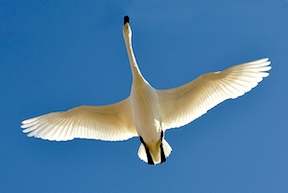
Mary Oliver’s poem, Swan, asks us if we see, hear, and feel what she does, drawing rich references to the beautiful aspects of a swan, culminating in two powerful questions.
Did you too see it, drifting, all night, on the black river? Did you see it in the morning, rising into the silvery air, an armful of white blossoms, a perfect commotion of silk and linen as it leaned into the bondage of its wings; a snowbank, a bank of lilies, biting the air with its black beak? Did you hear it, fluting and whistling a shrill dark music, like the rain pelting the trees, ...like a waterfall knifing down the black ledges? And did you see it, finally, just under the clouds — a white cross streaming across the sky, its feet like black leaves, its wings like the stretching light of the river? And did you feel it, in your heart, how it pertained to everything? And have you too finally figured out what beauty is for? And have you changed your life?
The questions that Mary Oliver asks her readers at the end of the Swan poem remind me of the one she asks at the end of The Summer Day (aka “The Grasshopper”).
See this remembrance of Mary Oliver (1935-2019) and her astonishing poetry, with links to articles, interviews, and readings, as well as several of her favorite poems I’ve loved and posted over the years.
— Written and compiled (citing sources) by Ken Chawkin for The Uncarved Blog.
“The Laughing Heart” by Charles Bukowski (August 16, 1920 – March 9, 1994) seems to be another of his “death poems,” as his wife Linda referred to them in a January 21, 2011 interview. It was probably written toward the end of his life (73) when he was diagnosed with leukemia and had started Transcendental Meditation (TM).
Linda Bukowski described what TM had done for her husband. “It allowed him to open up a space within himself to say these words about himself dying. These later poems, death poems, are so acute and so awake and aware and I think that had a lot to do with how meditation allowed him to be creative in his later months and write these poems, that I still cannot read.”
The poem, cited on bukowski.net, was written and first published in Prairie Schooner circa 1993, the year before he died. He had learned Transcendental Meditation prior to that and was enjoying practicing it regularly.
Even filmmaker David Lynch, toward the end of a Dec 31, 2006 New York Times article, was quoted as saying that Bukowski liked meditating. “I heard Charles Bukowski started meditation late in his life,” Mr. Lynch said, referring to the poet laureate of Skid Row, who died in 1994. “He was an angry, angry guy, but he apparently loved meditation.”
I later added that information to an earlier post about another death poem, “a song with no end,” in Charles Bukowski sang the life victorious. He carried that same upbeat message in this poem.
The Laughing HeartBy Charles Bukowski
your life is your life
don't let it be clubbed into dank submission.
be on the watch.
there are ways out.
there is light somewhere.
it may not be much light but
it beats the darkness.
be on the watch.
the gods will offer you chances.
know them.
take them.
you can't beat death but
you can beat death in life, sometimes.
and the more often you learn to do it,
the more light there will be.
your life is your life.
know it while you have it.
you are marvelous
the gods wait to delight
in you.
Footnote: Thanks to Rhonda Thompson Gilpatrick‘s comment on September 19, 2009 pointing out an error in the fifth line of this Bukowski poem that Best American Poetry had posted. The correction was made and works better now.
Love this poem, but you’ve got one of the lines wrong (every site I look at does, though). I have the original printing of this. The line “there is a light somewhere,” should be “there is light somewhere.”
This is an important distinction between a specific light somewhere and light that is universally available somewhere—most likely within first, then without as well.
During Transcendental Meditation, breathing slows down, momentarily suspends; metabolic rate lowers twice as much as in deep sleep; deeply-rooted stresses and strains are released, dissolved, and repaired, respectively; bodily functions normalize; reaction time improves, a host of factors improve indicating a reversal of the aging process. Longtime TM meditators have a biological age of 12-15 years younger than their chronological age—one way “you can beat death in life, sometimes. and the more often you learn to do it, the more light there will be.”
— Written and compiled (citing sources) by Ken Chawkin for The Uncarved Blog.
July 5, 2024: I came across a fascinating interview with Charles Bukowski’s wife posted by Read Me A Poem: Bukowski Born Into This INTERVIEWS LINDA LEE BUKOWSKI. Linda mentions when her husband Hank had learned Transcendental Meditation and had practiced it regularly twice a day during the last six months of his life. The whole interview is brilliant. The TM part starts at 6:54. I was happy to hear her speak about his appreciation for TM, but also surprised to hear her describe what she felt when she saw him meditating. It is quite profound and very moving. When he was diagnosed with leukemia, he had stopped writing. TM made a deep impact on his life. He was able to write again. And he wrote the most profound poetry of his life.
Do you remember hearing a cricket chirping at night? Did you enjoy listening to its song, or was it annoying? Two well-known poets wrote about their encounters with a cricket, but from different points of view—the poet and the cricket.
I first found this poem, Nothing Is Too Small Not to Be Wondered About, by Mary Oliver. Attentive to all creatures, including the smallest of them, she wonders what happened to the cricket after it stopped its singing.
I then came across another poem about a cricket, Postlude, by Rita Dove. But it’s written from the perspective of one with something to say, and the magic that can happen when we stop and listen.
The cricket doesn’t wonder
    if there’s a heaven
or, if there is, if there’s room for him.

It’s fall. Romance is over. Still, he sings.
If he can, he enters a house
    through the tiniest crack under the door.
Then the house grows colder.

He sings slower and slower.
    Then, nothing.

This must mean something, I don’t know what.
    But certainly it doesn’t mean
he hasn’t been an excellent cricket
    all his life.

Mary Oliver, “Nothing Is Too Small Not to Be Wondered About.” Felicity: Poems. New York: Penguin Press, 2016.
I found that one on Best Poems, and then as it appears with line breaks on page 27 of Felicity posted at the University of Arizona Poetry Center under Poems of Love and Compassion.
2nd cricket poem
PostludeRita DoveStay by the hearth, little cricket.
—Cendrillon
You prefer me invisible, no more than
a crisp salute far away from
your silks and firewood and woolens.
Out of sight, I'm merely an annoyance,
one slim, obstinate wrinkle in night's
deepening trance. When sleep fails,
you wish me shushed and back in my hole.
As usual, you're not listening: time stops
only if you stop long enough to hear it
passing. This is my business:
I've got ten weeks left to croon through.
What you hear is a lifetime of song.
Read about Mary Oliver (1935-2019) and her astonishing poetry in this memorial acknowledgment to her poetic legacy. It contains links to articles, interviews, and poetry readings, as well as many of her favorite poems I’ve loved and posted over the years.
— Written and compiled by Ken Chawkin for The Uncarved Blog.



 The Uncarved Blog