Archive for the ‘Maharishi University’ Category

Maharishi University of Management Business Faculty Win National Ethics Case Study Award

April 18, 2014
Maharishi University of Management Wins National Ethics Case Study Award

MUM Professor and Student Duo Win IMA Carl Menconi Ethics Award

Fairfield, IA (PRWEB) April 18, 2014

Tara Barker, from the Institute of Management Accountants (IMA), announced the Best Case Study for the 2014 Carl Menconi Ethics Competition went to a paper co-authored by Dr. Andrew Bargerstock and Ye Shi, faculty members in the Department of Business Administration at Maharishi University of Management (MUM) in Fairfield, Iowa. The article about the case study will be published in the July issue of Strategic Finance, a monthly journal from IMA that focuses on professional practices in management accounting and finance.

The case developed by Bargerstock and Shi spotlights the dilemma of a fictitious Melissa Parks, an XBRL specialist at a company that manufactures large-scale water purification systems that are sold to government and private institutions, primarily in third-world countries. One day on her way to work, Parks hears a radio report about a large multinational corporation receiving a $250 million fine from the Securities & Exchange Commission (SEC) for violations of the Foreign Corrupt Practices Act, a U.S. law that forbids financial payments to foreign officials for the purpose of procuring a business contract. This prompts Parks to recall a conversation she overheard recently at work, which at once makes her suspect that her company also might be engaged in practices that violate the Act. Parks must then decide what to do with her knowledge – perhaps at the risk of her own career advancement.

“The case really looks at the ethical decision an employee must make to ‘do the right thing’ when the easiest, and most convenient, path is to do and say nothing,” explained Bargerstock.

The overall goal of the Menconi Case Competition is to develop teaching cases around ethical issues affecting management accountants and finance professionals. The IMA Statement of Ethical Professional Practice acts as a valuable resource for guiding professional action. Through the Menconi recognized cases, published by the IMA, accounting educators get the opportunity to explore with students, the path to proper action in professional accounting activities.

According to Dr. Bargerstock, Director of MUM’s MBA Programs, “In this post-Enron era, both educators and accounting professionals understand the importance of a heightened level of discussion about when and what to do when they are faced with a moral dilemma. The Menconi case studies series provides a springboard for undergraduate and graduate-level thinking about ethical behaviors for our next generation of accountants. Instructor Shi and I feel fortunate to have contributed to this dialogue.”

This accomplishment continues a pattern of recognition from the IMA for the accounting faculty and Ph.D. students at MUM. In 2009, Dr. Bargerstock was named Excellence in Lean Accounting Professor at the Lean Accounting Summit. In 2011, Manjunath Rao was named Lean Accounting Student of the Year and shortly, thereafter, he received a research grant from the IMA for his PhD dissertation research completed in 2013. Bargerstock and Rao published two articles in the IMA’s quarterly academic journal, Management Accounting Quarterly in 2011 and 2013. In October, 2013, Ye Shi was named IMA’s Lean Accounting Student of the Year for her work in teaching and writing case studies while pursuing her Ph.D. at MUM.

Maharishi University of Management (MUM) in Fairfield, IA is a private university featuring Consciousness-Based℠ Education. The accredited traditional curriculum offers bachelor’s, master’s, and doctoral degrees in the arts, sciences, humanities, and business, but also integrates self-development programs. Innovative aspects include the Transcendental Meditation® program, one course at a time, and organic vegetarian meals. Visitors Weekends are held throughout the year. For more information, call the Admissions Office at 800-369-6480 or visit http://www.mum.edu.

For more information, visit the MUM website: http://www.mum.edu/press-releases#ethics.

Iowa Public Radio reports on how far we’ve come treating PTSD in Veterans, from lobotomies to TM

March 27, 2014

Iowa Public Radio news correspondent Rick Fredericksen reports on Veterans: Lobotomies to Meditation

Listen to today’s (March 27, 2014) Iowa Public Radio report on how Iowa Veterans have been historically treated for what is now known as PTSD — from lobotomies, to drugs and therapy, to finally a more benign approach, that of meditation, specifically Transcendental Meditation.

Iowa Public Radio correspondent Rick Fredericksen produced an impressive historical report on the subject. Early attempts to deal with this misunderstood medical problem were crude and frightening. Introducing TM as a viable option shows you how far we’ve come in dealing more humanely with Veterans suffering from PTSD!

It aired twice this morning with a third broadcast on All Things Considered this afternoon at 4:50pm CST. You can listen to the 7:30 minute report online http://bit.ly/QjMY00, where you can also see a 3-photo slideshow, and link to the Wall Street Journal investigation.

Dan Gannon, IDVA, meditates in IPR studio

Marine veteran Daniel Gannon meditates in the IPR studios.

Interviews with meditating Iowa veterans include Luke Jensen, Afghanistan veteran; Vietnam veteran Daniel Gannon, Iowa Dept of Veterans Affairs; and Jerry Yellin, WWII veteran, and national TM advocate for veterans.

Rick Fredericksen did a fantastic job! What a testament to TM, and boost for MUM, gearing up to welcome veterans as students!

This story is also reported on the TM Blog: PTSD Treatments: From Lobotomies to Meditation.

PTSD Treatments: From Lobotomies to Meditation

Related news items:

Matt Kelley of Radio Iowa interviews Jerry Yellin about an Iowa Veterans Summit solution to PTSD

Military Leaders to Promote Meditation at Iowa Summit to Help Reduce Veteran Suicide Epidemic

See video highlights of the Iowa Veterans Summit – PTSD and Transcendental Meditation

AFP report: War veterans say Transcendental Meditation could help with PTSD


Craig Pearson on KRUU FM show, Writers’ Voices, discusses his new book, The Supreme Awakening

February 26, 2014
Craig_Pearson

Craig Pearson, PhD

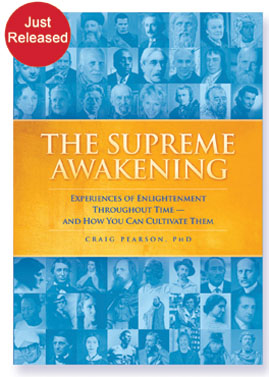
Enjoy this interview with author Craig Pearson, PhD and his latest book, The Supreme Awakening: Experiences of Enlightenment Throughout Time  – and How We Can Cultivate Them. If you click on the links you’ll read more about the concept and structure of the book. See the website for The Supreme Awakening book here, where you can read comments by David Lynch, Norman Rosenthal, and others, chapter headings, and the first chapter, Moments of Awakening. See a mailer for the book.

Here is an interview that took place last Friday on a popular KRUU FM radio show in Fairfield, Iowa called Writers’ Voices. Monica Hadley and her mother Caroline invited Dr. Pearson to discuss his book The Supreme Awakening. Craig is truly an inspiring speaker! Click here to listen: Writers’ Voices – 20140221 – Craig Pearson. Monica writes on her blog:

The_Supreme_Awak_52d4535363d15This week on Writers’ Voices, Monica and Caroline welcome MUM Executive Vice President Craig Pearson to discuss his recently released book, “The Supreme Awakening: Experiences of Enlightenment Throughout Time  – and How We Can Cultivate Them.” The product of research Dr. Pearson did for his doctoral dissertation, this book allows the reader to share the enlightened experiences of people throughout history. By gathering these many stories from across history, from saints and mystics, writers, world leaders, even athletes, Dr. Pearson provides a unique perspective on what is obviously a universal experience.

Many of the people profiled within are expected, people who are well-known for their spiritual experiences – Buddha, St. Teresa of Avila, Thoreau, Rumi. But there are many surprises here as well – Anwar Sadat, Einstein, Plato and many more.  I was most fascinated by these stories.  It made me realize that the accomplishments of many great persons may have been a direct result of their experiences with other states of consciousness.

Dr. Pearson is also the author of The Complete Book of Yogic Flying.

Craig Pearson was also interviewed on The Alan Colmes Show on FOX News following Writers’ Voices on Friday. Another interview aired on KHOE’s A Chat With The Dean by Dr. Cathy Gorini on the new book. You can also listen to a presentation Dr. Pearson gave in Dalby Hall on the book, which was recorded for broadcast by KHOE.

I posted an interview and series of articles you can link to by Dr. Pearson on my blog: Craig Pearson interview and articles on awakened consciousness, transcendence and enlightenment.

Here is a video of Dr. Pearson’s recent presentation on his book, The Supreme Awakening, in Dalby Hall on the MUM campus seen on the MaharishiUniversity channel.

Guest blogger and author William T. Hathaway reviews Craig Pearson’s book, The Supreme Awakening.

Other talks on this topic by Craig Pearson are available in this MIU Webinar at Dalby Hall published in Enjoy TM News and this interview on TM Talks.

Capetown’s Shafiq Morton interviews David Leffler on a solution to the violence in Kiev

February 20, 2014

The VoicThe Voice of the Capee of the Cape’s after five Drivetime Show has a national and international flavor focusing on issues making news where the biggest story of the day or week is analyzed. South African host Shafiq Morton interviewed American Dr. David Leffler this week, Wednesday, Feb. 19, 2014, on a unique solution to the growing violence in Kiev.

Dr-David-LefflerDavid R. Leffler, Ph.D. is the Executive Director of the Center for Advanced Military Science (CAMS) at the Institute of Science, Technology and Public Policy, in Fairfield, Iowa, USA. He spoke on IDT, Invincible Defense Technology, as a viable solution to the rising crisis. Dr. Leffler explained how increasing stress levels erupt into opposing factions, violence and war, and how group practice of Transcendental Meditation and its advanced procedures can defuse such collective stress and prevent war, softening the atmosphere for people and groups to more harmoniously discuss solutions to their problems without resorting to violence.

Listen to the 20-minute interview on 91.3 FM http://iono.fm/e/74837.

I was so impressed by Morton’s questions and responses to Leffler’s informative answers, I posted this comment:

When Marconi said we could communicate through the airwaves they thought he was crazy. He was just using a technology that was able to take advantage of the electromagnetic field that was already there. Invincible Defense Technology similarly uses an advanced procedure to allow our minds to collectively enliven the all-powerful, all-nourishing Unified Field, the source of all the force and matter fields, the home of all the laws of nature, for the good of society, and the world, depending on the size of the group. Thank you for exposing your listeners to this hopeful and intelligent out-of-the-box proven approach to creating world peace!

The editorial piece referred to in the interview was co-authored by Dr. Leffler and Dr. Mykola Didukh, National Director for TM in Ukraine. Titled, “Proven Strategy to Prevent Turmoil in Ukraine,” how Invincible Defense Technology could be implemented to solve the crisis, the Op-Ed was published earlier this month in a number of locations: NEPAL: Review Nepal; WORLD SERVICE: The Common Ills; UNITED STATES & CANADA: Times of Earth; INDONESIA: Sigma News; and UKRAINE: Evening Lugansk, which was also published in Russian and Ukrainian.

(more…)

KTVO reports on Maharishi University of Management’s Visitors Weekend

February 19, 2014

Maharishi University of Management holds Visitors Weekend
by KTVO Newsdesk
Posted: 02.09.2014 at 6:42 PM

FAIRFIELD, IOWA — Prospective students from various states and even countries made the trek to Fairfield on Friday for Maharishi University of Management’s Visitors Weekend.

It isn’t your typical Visitors Weekend at Maharishi University of Management.

The three-day event began Friday and ended Monday with various educational sessions by professors throughout the weekend.

“So they really have a chance to come here and not just get a two-hour campus tour and there’s our fancy buildings,” said Brad Mylett, Dean of Admissions. “But to really go deep into every facet of Consciousness-Based Education and what M.U.M. has to offer.”

Such sessions included a creativity, digital media, and the future presentation by Gurdy Leete.

“We’re seeing this huge, amazing change in the world of media where the formerly, separate silos of media–like print media, broadcast media, film media, music media–all those boundaries are disappearing,” said Leete. “Many of the old companies are dying and being reborn in new form.”

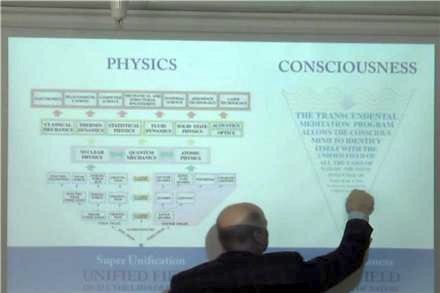
maharishi visitors weekendVisitors were also treated to a modern physics lecture by renowned physicist Dr. John Hagelin.

Beth Stone made the trip from Orlando, Florida and was particularly intrigued by Dr. Hagelin’s knowledge and experience with Transcendental Meditation.

“I practice T.M. myself and was looking for a program that is more complete,” said Stone. “That’s focused on learning and not just giving information out.”

Graduates of M.U.M. even come back to help coordinate the weekend and share their experiences to the prospective students.

“It prepares you not only for the real world, but for yourself,” said graduate Elisabeth Fowler. “And it helps you to understand who you are as an individual, and allows you to become prepared for any experience that comes your way.”

Visitors Weekends like this see much success with 60 percent of prospective students enrolling in the next academic year.

M.U.M. holds visitors weekends ten times a year, one in every month except January and August.

For more information visit http://www.mum.edu or call the Admissions Office at 800-369-6480.

Fairfield, Iowa, The Spiritual Sister City, published in Lawrence, Kansas Magazine

February 11, 2014

Susan KrausSunflower Publishing sent Susan Kraus to Fairfield, Iowa to write a travel piece for one of their magazines, Lawrence Magazine, the premier quarterly magazine for Lawrence, Kansas.

Lawrence Magazine Spring 2014Their Spring 2014 issue includes an article on Fairfield, Iowa filed under Journey by travel writer Susan Kraus. Titled, The Spiritual Sister City, the description reads: With a little meditation in the heartland, a rural town in southeast Iowa transforms into a cultural and educational center.

Susan timed her visit last summer to take in a First Fridays Art Walk. Besides exploring Fairfield, she also toured the Maharishi University of Management campus, and learned about Transcendental Meditation, Consciousness-Based Education, and Sustainable Living. She brought her husband, who, decades earlier, when he was a university student, had learned TM.

Susan is also a social worker and her husband works at a university in the video department. They had lunch with Ken West, also from Kansas, who had done some photography in an area Susan was familiar with. They shared a lot about the Kansas and Iowa landscapes, and used some of Ken’s photos for the piece.

Susan wrote an accurate assessment of what she found here in such a refreshing way. You can read her story by clicking on this PDF: Lawrence Magazine spring 2014 for MUM.

See a related article by Des Moines Register editorial columnist Rox Laird. His Sunday Opinion piece features the collaborative civic-minded town of Fairfield and Maharishi University’s Sustainable Living Center. Fairfield defines community action: Jefferson County town shows how to ‘manufacture dreams’ through civic collaboration. MUM obtained permission to make this wonderful article available as a reprint. You can see it beautifully laid out on their website link.mum.edu/GreenFF.

Second study to show Transcendental Meditation reduces PTSD in African Refugees—in just 10 days

February 10, 2014

Transcendental Meditation significantly reduces PTSD in African refugees within 10 days

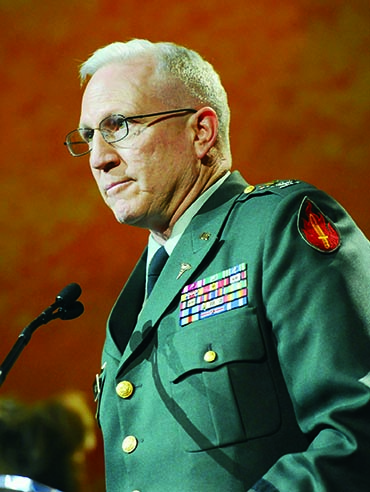
This is lead author Col. Brian Rees, MD, MPH, US Army Reserve Medical Corps

This is lead author Col. Brian Rees, MD, MPH, US Army Reserve Medical Corps

African civilians in war-torn countries have experienced the threat of violence or death, and many have witnessed the abuse, torture, rape and even murder of loved ones. Many Congolese living in Ugandan refugee camps are suffering from severe posttraumatic stress disorder (PTSD).

New research shows that Congolese war refugees who learned the Transcendental Meditation® technique showed a significant reduction in posttraumatic stress disorder in just 10 days, according to a study published today in the February 2014 issue of the Journal of Traumatic Stress (Volume 27, Issue 1, pages 1–119).

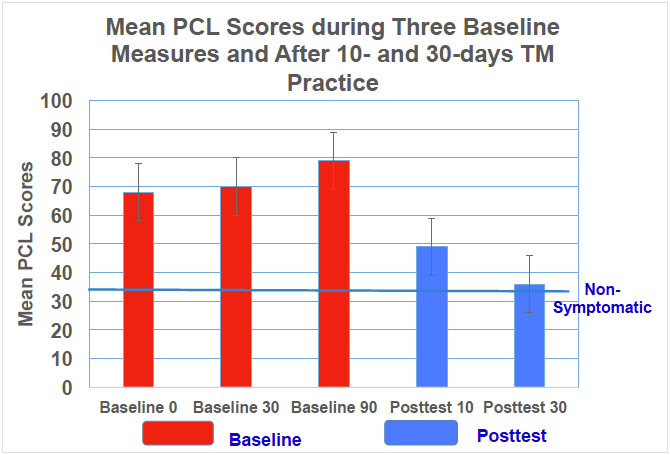
In the study, “Significant Reductions in Posttraumatic Stress Symptoms in Congolese Refugees within 10 days Transcendental Meditation Practice,” 11 subjects were tested after 10-days and 30-days TM practice. After just 10-days PTSD symptoms dropped almost 30 points.

“An earlier study found a similar result after 30 days where 90% of TM subjects dropped to a non-symptomatic level. But we were surprised to see such a significant reduction with this group after just 10 days,” said study author Brian Rees, MD, MPH.

The subjects were assessed using the Posttraumatic Stress Disorder Checklist for Civilians, (PCL-C), which rates the severity of PTSD on a scale from 17 to 85. A score below 35 means the symptoms of PTSD have abated.

Eleven Congolese refugees who had been tested three times over a 90-day period on the PCL-C, which rates the level of PTSD on a scale from 17 to 85, began with an average score of 77.9. They learned Transcendental Meditation within 8 days of the third test and after 10 days their average score dropped to 48, which was highly clinically significant. They were retested 30 days later measuring an average score of 35.3. With scores below 35 considered non-symptomatic, they were practically symptom free.

Eleven Congolese refugees who had been tested three times over a 90-day period on the PCL-C, which rates the level of PTSD on a scale from 17 to 85, began with an average score of 77.9. They learned Transcendental Meditation within 8 days of the third test and after 10 days their average score dropped to 48, which was highly clinically significant. They were retested 30 days later measuring an average score of 35.3. With scores below 35 considered non-symptomatic, they were practically symptom free.

The subjects in the study initially tested with an average score of 77.9. After just 10 days of practicing the Transcendental Meditation technique, their PTSD test scores dropped to an average of 48, which was highly significant clinically.

Thirty days later the subjects were tested again with their PTSD scores falling to an average of 35.3 — meaning that they were nearly without symptoms of PTSD.

“What makes this study interesting is when we tested them in the 90 days before they began the TM technique, their PTSD scores kept going up,” said coauthor Fred Travis, director of the Center for Brain, Consciousness, and Cognition at Maharishi University of Management. “During that period their scores were rising, from 68.5 at the beginning to 77.9 after 90 days. But once they started the Transcendental Meditation technique, their PTSD scores plummeted.”

According to the researchers, during this particular meditation technique one experiences a deep state of restful alertness. Repeated experience of this state for 20 minutes twice a day cultures the nervous system to maintain settled mental and physical functioning the rest of the day. This helps to minimize disturbing thoughts, sleep difficulties, and other adverse PTSD symptoms.

In this video, Dr. Travis explains the neurophysiology of trauma and how TM relieves it. He says, “Something very profound is happening. Because experience changes the brain, and trauma locks in a specific brain functioning (the over stimulated amygdala), you’re stuck in a specific way of thinking and feeling, (vigilance, fear and mistrust) and appreciating the world.” He further explains how the experience of transcending, with Transcendental Meditation, calms the amygdala, relieves PTS symptoms and frees the individual “to see more possibilities.”

Congolese refugee Esperance Ndozi and her 5 children

Congolese refugee Esperance Ndozi and her 5 children

Esperance Ndozi was one of the Congolese refugees traumatized by the civil war. The 35-year old mother of 5 was part of the group of refugees that learned TM. Before learning the effortless technique, Esperance couldn’t find relief from a flood of dark disturbing memories. She could hardly sleep. After a week of meditating 20-minutes twice a day she describes increasing relaxation and relief from PTSD symptoms. “Your mind, your body relaxes. You feel you are out of the outside world. You are just in your peaceful world. No negativity. It doesn’t come near me now.” Like other refugees in the study the calm and peace grew to last throughout the day. Watch the video.

A previous study of Congolese refugees, which involved 42 subjects found that the Transcendental Meditation group had an average Checklist score of below 35 after 30 days, a non-symptomatic level, while the average score of the control group actually worsened over the same period.

“This is now the fourth study to show an improvement in PTSD,” said Dr. Rees, a colonel in the US Army Reserve Medical Corps. “The Transcendental Meditation technique is increasingly being seen as a viable treatment by the US military.”*

###

Study co-author Dr Fred Travis is a professor of neurophysiology at Maharishi University of Management, an accredited university to the PhD level, where Transcendental Meditation is incorporated into its curriculum and practiced by faculty and students. This provides a way for students, including veterans, to reduce the effects of past stress and trauma, and make learning easier and more enjoyable. www.mum.edu

This study was funded in part by the David Lynch Foundation. www.davidlynchfoundation.org/africa

The Journal of Traumatic Stress is published on behalf of International Society for Traumatic Stress Studies.

Source: EurekAlert!

*Two earlier studies have shown the Transcendental Meditation (TM®) technique to effectively lower post-traumatic stress in veterans of Vietnam and Iraq/Afghanistan wars.

See first refugee study: New study shows Transcendental Meditation significantly reduces PTS in African refugees

New study out on Transcendental Meditation shows reduced teacher stress and burnout

February 3, 2014

Transcendental Meditation Reduces Teacher Stress and Burnout, New Research Shows

Effect of Transcendental Meditation on Employee Stress, Depression, and Burnout: A Randomized Controlled Study

This graph shows the average level of change in total burnout, as measured by the Maslach Burnout Inventory, in the Transcendental Meditation group compared to controls. The graph displays a marked reduction in burnout symptoms in the TM group, with the control group showing a small increase in burnout over the duration of the study.

This graph shows the average level of change in total burnout, as measured by the Maslach Burnout Inventory, in the Transcendental Meditation group compared to controls. The graph displays a marked reduction in burnout symptoms in the TM group, with the control group showing a small increase in burnout over the duration of the study.

A new study published in The Permanente Journal (Vol. 18, No.1) on health showed the introduction of the Transcendental Meditation® technique substantially decreased teacher stress and burnout.

Research indicates that stress and burnout are pervasive problems among employees, with teachers being especially vulnerable to feeling frequent stress from their jobs. Burnout, a syndrome of emotional exhaustion, depersonalization, and job dissatisfaction, has been found to contribute to lower teacher classroom performance and higher absenteeism and job turnover rates.

This current study sought to determine whether practice of the Transcendental Meditation (TM) program results in lower psychological distress and decreased burnout in teachers and support staff at the Bennington School in Vermont, a special in-residence school for students with behavioral problems.

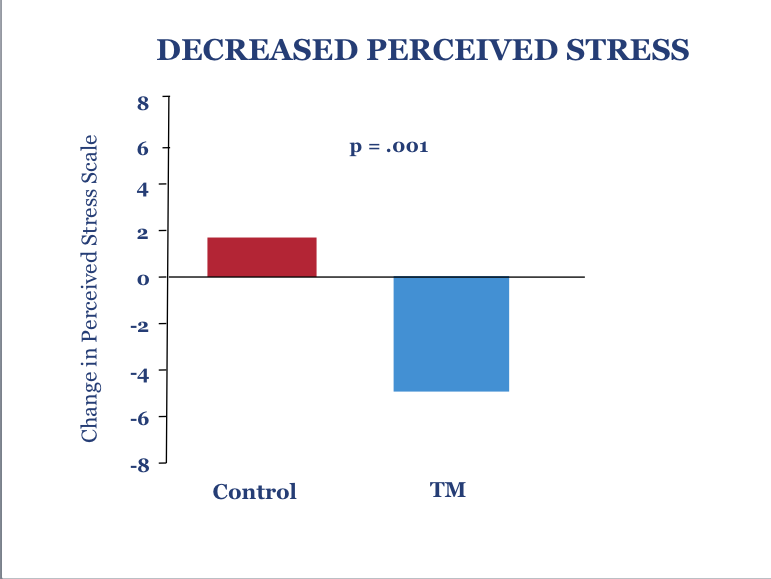
This graph shows the average level of change in perceived stress, as measured by the Perceived Stress Scale, in the Transcendental Meditation group compared to controls. The graph displays a marked reduction in perceived stress in the TM group, with the control group showing a small increase in stress over the duration of the study.

This graph shows the average level of change in perceived stress, as measured by the Perceived Stress Scale, in the Transcendental Meditation group compared to controls. The graph displays a marked reduction in perceived stress in the TM group, with the control group showing a small increase in stress over the duration of the study.

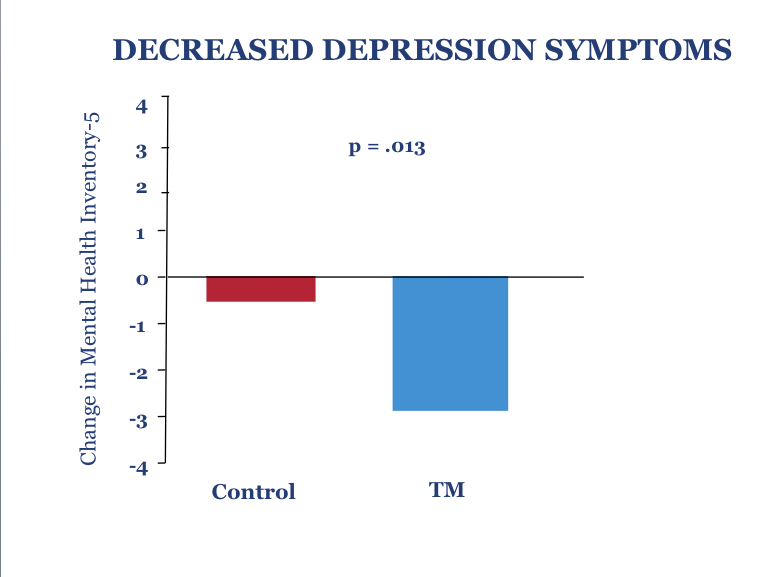
According to Dr. Charles Elder, MD, MPH, lead author of the study and a Senior Physician in the Department of Internal Medicine at Kaiser Permanente Northwest, “The results of this randomized controlled trial are very striking and demonstrate the utility of introducing a stress reduction program for teachers and other public and private employees. The four-month study found significant and clinically important decreases in perceived stress, emotional exhaustion associated with teacher burnout, and depressive symptoms in those practicing the TM program compared to a wait-list control group.”

“Burnout and other psychological distress factors have been linked to negative health behaviors, obesity, and hypertension, all of which are major contributors to cardiovascular disease,” emphasized Dr. Sanford Nidich, EdD, study principal investigator and Professor of Education at Maharishi University of Management. “Prior medical research has found that practice of the TM program is effective in reducing both risk factors for heart disease and cardiovascular events. Taken as a whole, this present study and prior research provide evidence for the value of the TM program for enhancing mental and physical health and well-being, explained Dr. Nidich.”

This graph shows the average level of change in decreased depression symptoms, as measured by the Mental Health Inventory-5, in the Transcendental Meditation group compared to controls. The graph displays a marked reduction in depression symptoms in the TM group, with the control group showing a small decrease in depression over the duration of the study.

This graph shows the average level of change in decreased depression symptoms, as measured by the Mental Health Inventory-5, in the Transcendental Meditation group compared to controls. The graph displays a marked reduction in depression symptoms in the TM group, with the control group showing a small decrease in depression over the duration of the study.

The study included 40 teachers and support staff measured at baseline and then randomly assigned to either immediate start of the TM program or delayed start (wait-list control group). Compliance with practice of the TM technique throughout the four-month intervention period was high; 100% of the participants assigned to the TM group meditated at least once a day. Of those, 56% meditated regularly at home twice a day.

This is the first study to investigate the effects of Transcendental Meditation on teacher burnout. Recent published studies have shown a positive impact of this program on student graduation rates, academic achievement, and psychological distress. Transcendental Meditation has seen widespread implementation in secondary schools across the country within the context of school-wide Quiet Time programs.

The study was funded by the Nine East Network and David Lynch Foundation.

About the Transcendental Meditation technique

The TM technique is a simple, natural, effortless procedure practiced 20 minutes twice each day while sitting comfortably with the eyes closed. Extensive peer-reviewed research studies have found that TM reduces psychological distress, including anxiety and depression, and promotes overall mental and physical health.

The TM technique is available in the USA through Maharishi Foundation USA, a federally recognized non-profit educational organization. Through partnerships with other non-profit organizations and foundations, full TM scholarships have been given to more than 250,000 at-risk children, school teachers, veterans suffering from PTSD, homeless people, and others. Visit http://www.tm.org for more information.

About Maharishi University of Management

Maharishi University of Management is an accredited university offering bachelor’s, master’s, and doctoral degrees in the arts, sciences, humanities, and business, where Transcendental Meditation is also practiced by both professors and students. Visit http://www.mum.edu for more information.

Source: EurekAlert!

@MaharishiU Accounting Prof Andrew Bargerstock prepares students for XBRL certification – Ledger

January 17, 2014

College students learn difficult accounting program
By ANDY HALLMAN | Jan 16, 2014

Maharishi University of Management accounting professor Andrew Bargerstock teaches a class in which students are certified in an accounting program called Extensible Business Reporting Language. M.U.M. is the first college in the world to offer certification in the program as part of its academic curriculum. / Photo by: ANDY HALLMAN

Maharishi University of Management accounting professor Andrew Bargerstock teaches a class in which students are certified in an accounting program called Extensible Business Reporting Language. M.U.M. is the first college in the world to offer certification in the program as part of its academic curriculum. / Photo by: ANDY HALLMAN

Accounting students at Maharishi University of Management are getting a leg up on the competition.

Those students have the opportunity to become certified in a worldwide accounting standard. According to M.U.M. accounting professor Andrew Bargerstock, the university is the first in the world to offer this certification as part of its curriculum.

The standard is called Extensible Business Reporting Language, often referred to simply as XBRL. It is a way of creating an accounting document that allows the information to be easily transferred to government agencies such as the Federal Deposit Insurance Corporation or the Securities and Exchange Commission.

The program requires a high level of computer coding knowledge. Bargerstock said learning how to use the program is no easy task because the students are bombarded with tons of technical computer jargon unfamiliar to most accountants.

“Accountants typically don’t have a lot of training in IT [information technology],” Bargerstock said. “They’ll know how to run ‘Quickbooks’ and ‘Excel,’ but they don’t know anything about the underlying coding. It’s a bit of a challenge. It takes a little bit longer for the water to seep into the sponge – a very dry sponge.”

Bargerstock and 11 of his students have been certified in XBRL, so he knows just how difficult the program is to learn.

“I failed the test the first time I took it, and had to go over it and over it again,” he said.

The certification training is done online and includes instructional audio files. The first time Bargerstock tuned in to one of the audio courses, he reacted by saying to himself, “This is way beyond what I was expecting. There was so much jargon it sounded like a foreign language.”

Learning XBRL is no picnic but once the students complete the necessary training they will stand out from their peers. Recruiting firms have told Bargerstock XBRL certification will put M.U.M.’s students at the top of the pile of résumés when it comes time to look for a job.

“In job interviews, people will say whatever they need to to get the job, and they’ll be a chameleon who changes from day to day,” he said. “This certification shows the students have taken the initiative to learn something.”

The federal government has required businesses and organizations to submit their accounting records in XBRL format since 2011. Bargerstock said the advantage of XBRL is the numbers only have to be entered in the original accounting document and not in every report created from that document. When it comes time to create the reports for the various government agencies, each agency extracts from the document whatever it needs to create its own report.

In the past, accountants would have to tediously fill out reports for each government agency. Now, those reports are created automatically by the computer thanks to the way the information is coded.

Bargerstock introduced his students to XBRL certification last fall. Although he helped the students with their certification, they trained for the certification on their own outside of class and did not receive academic credit. Another group of six students began taking a class with Bargerstock in November in which they were receiving academic credit while obtaining XBRL certification. Those students will finish their class in February.

Reprinted with permission from The Fairfield Ledger. The article was on the front page of Thursday’s Ledger, five columns across the middle of the page, with a photo.

Added point of clarification from Andy Bargerstock: “The certification training does not teach the technical side (tagging) of XBRL. XBRL certification training is the first step towards competency. If any of our certified students get hired, they will need 2-3 months of intensive training in the technical aspects of XBRL.”

Related: @LauraSimon reports on @MaharishiU Accounting students gaining certification in new worldwide financial reporting standard.

Health India’s Editorial Team says Transcendental Meditation (TM) is taking the world by storm

January 14, 2014

Health India

Transcendental Meditation — a meditation technique that is taking the world by storm

Editorial Team January 14, 2014 at 5:24 pm

Meditation, a simple yet deep-rooted technique that helps you think better, control your emotions with finesse and even makes you a better person. First practiced in India, meditation is a method carried down through the ages. It was first mentioned in the Vedas and is well-known in India as a doorway to nirvana. But now the Americans have woken up to its benefits.

According to study carried out by Fred Travis, director of the centre for brain, consciousness, and cognition at Maharishi University of Management in the US, physiological measures and first-person descriptions of transcendental experiences and higher states have only been investigated during practice of the Transcendental Meditation (TM) technique.

After analysing descriptions of transcendental consciousness from 52 people practicing TM, Travis found that they experienced ‘a state where thinking, feeling, and individual intention were missing, but self-awareness remained’. A systematic analysis of their experiences revealed three themes – absence of time, space and body sense.

‘This research focuses on the larger purpose of meditation practices – to develop higher states of consciousness,’ explained Travis. With regular meditation, experiences of transcendental consciousness begin to co-exist with sleeping, dreaming and even while one is awake.

This state is called cosmic consciousness in the Vedic tradition, said the paper published in the journal Annals of the New York Academy of Sciences. Whereas people practicing TM describe themselves in relation to concrete cognitive and behavioural processes, those experiencing cosmic consciousness describe themselves in terms of a continuum of inner self-awareness that underlies their thoughts, feelings and actions, added the paper.

‘The practical benefit of higher states is that you become more anchored to your inner self, and, therefore, less likely to be overwhelmed by the vicissitudes of daily life,’ said Travis. TM is an effortless technique for automatic self-transcending, different from the other categories of meditation – focused attention or open monitoring.

It allows the mind to settle inward beyond thought to experience the source of thought – pure awareness or transcendental consciousness. This is the most silent and peaceful level of consciousness – one’s innermost self, said the study.

Wondering what it is? Here is all you need to know about the TM technique

Transcendental Meditation?

Also called the TM technique, Transcendental Meditation is a simple practice one does for 20 minutes twice in a day. All you need to do is sit comfortably and close your eyes. This meditation technique is not a religion, philosophy or lifestyle, it is simply a way to reach self-development.

This technique allows your mind to settle and gives you a chance to experience pure awareness, also known as transcendental consciousness. It allows you to experience the most silent and peaceful level of consciousness – your innermost self. It also allows your brain to attain deep rest helping you be more efficient and betters your cognitive functions.

Where did this technique originate?

About 50 years ago, Maharishi Mahesh Yogi introduced Transcendental Meditation to the world. Maharishi Mahesh Yogi is considered the representative of Vedic tradition in our day and age. This form of meditation helped in restoring knowledge and helps people experience a higher state of consciousness. The most important aspect of this technique is that it is still practiced with the same technique and principles as it was when the Vedas were first written, giving it maximum effectiveness.

How do I learn?

The TM technique has local teachers who will guide you through the process. It consists of seven steps after which one can practice the TM technique on their own.

Benefits of the TM technique

The TM technique is known to calm your mind, directly affecting the stress that your brain experiences on a daily basis. According to the experts, practicing the TM technique regularly helps in developing total brain control, thereby making you more equipped to deal with every day stress. It indirectly reduces the production on hormones that are commonly produced when one is stressed and thereby stops the damage that is normally produced.

Apart from all this, a calm mind and body is the best way to protect your body from cardiovascular stress. The TM technique also has great benefits for students, it helps improve their memory, IQ and helps them fight stress.

With inputs from: IANS

Reference: Transcendental Meditation

Related: Transcendental experiences during meditation practice – paper published in @AcademyAnnals.

Health India also posts: Practice Transcendental Meditation to lower BP, heart and mortality risks.

See more news coverage: Transcendental Meditation and lifestyle changes both stimulate genes that reduce blood pressure and extend lifespan.