Archive for the ‘Articles’ Category

Indonesian Mystery Poem honoring Nyi Roro Kidul

April 12, 2011

Indonesian Mystery Poem
Honoring Nyi Roro Kidul
Queen of the Southern Seas

He hides within the rock
of three dimensions
and cannot be found
in this world

When night comes
she rises like a moon
to shine her light
upon the mountain

The sea dances
rising and falling
like a lover
in her arms

What pull does she have
on his life
as she looks for a partner
to dance with

The moon bows
before the rising sun
and he is left
breathless

© Ken Chawkin
June 2000
Jakarta, Indonesia

(more…)

Dr. Sherrill Sellman interviews Stephen Hopson on PRN’s What Women Must Know

April 11, 2011

What Women Must Know – 04/11/11

Today Dr. Sherrill Sellman interviewed Stephen Hopson about his life and book, Obstacle Illusions, on What Women Must Know with Dr. Sellman, on the Progressive Radio Network. Stephen is introduced at 5:46 minutes into the show. To listen to this “profoundly inspiring interview” click on the title or download the mp3. You can find out more about Obstacle Illusions at http://www.obstacleillusionsbook.com, and about Stephen Hopson at http://sjhopson.com. See additional articles and interviews for Stephen posted here on this blog.

Deaf Pilot Tells His Record-Setting Story on ANN

April 4, 2011

Deaf Pilot Tells His Record-Setting Story on AkronNewsNow.com

The 28-minute special with Ryan Haidet, aired Sunday morning (4-03-2011) on two of AkronNewsNow stations — 1590 WAKR and 97.5 WONE. They aired five minutes of that interview again this morning (Monday, April 4, 2011) on 1590 WAKR.  And it has been running in the news as a short story on all three of their stations — 97.5 WONE, 94.9 WQMX and 1590 WAKR.

You can listen to the whole interview, after a short commercial here: http://bit.ly/gMcjhW. Link to article with photo: http://bit.ly/dU3d9x.

Stephen Hopson will have another book-signing for Obstacle Illusions this Saturday, April 9, 2-4 pm, at Revelations Bookstore and Cafe in Fairfield, Iowa.

See related posts on Stephen Hopson here. You can read more about Hopson’s story on his website: www.sjhopson.com.

The Journey by Mary Oliver

April 3, 2011

THE JOURNEY

One day you finally knew
what you had to do, and began,
though the voices around you
kept shouting
their bad advice —
though the whole house
began to tremble
and you felt the old tug
at your ankles.
“Mend my life!”
each voice cried.
But you didn’t stop.
You knew what you had to do,
though the wind pried
with its stiff fingers
at the very foundations,
though their melancholy
was terrible.
It was already late
enough, and a wild night,
and the road full of fallen
branches and stones.
But little by little,
as you left their voices behind,
the stars began to burn
through the sheets of clouds,
and there was a new voice
which you slowly
recognized as your own,
that kept you company
as you strode deeper and deeper
into the world,
determined to do
the only thing you could do —
determined to save
the only life you could save.

Mary Oliver (Dream Work)

During a poetry reading at the 92nd Street Y for her new poetry book, A Thousand Mornings, Mary OIiver read The Journey (18:10), as well as some of her other well-known poems.

Read: Maria Shriver Interviews the Famously Private Poet Mary Oliver.

Others: Five A.M. in the Pinewoods (House of Light) Mindful (Why I Wake Early)

Wild Geese by Mary Oliver, photo by Ken West

See It Is I Who Must Begin by Václav Havel. It shares a similar sentiment.

See this remembrance of Mary Oliver with links to more of her poems.

Meditation improves maths and English

April 2, 2011

Meditation improves maths and English

Created: Monday, March 28, 2011

The Transcendental Meditation technique may be an effective approach to improve maths and English academic achievement in low-performing students, according to a new study published in the journal Education.

The study was conducted at a California public middle school with 189 students who were below proficiency level in English and maths. Change in academic achievement was evaluated using the California Standards Tests (CST).

Students who practised the Transcendental Meditation programme showed significant increases in maths and English scale scores and performance level scores over a one-year period. 41% of the meditating students showed a gain of at least one performance level in maths compared to 15% of the non-meditating controls.

Among the students with the lowest levels of academic performance, “below basic” and “far below basic,” the meditating students showed a significant improvement in overall academic achievement compared to the control group, which showed a slight gain.

“This initial research, showing the benefits of the Quiet Time/Transcendental Meditation programme on academic achievement, holds promise for public education,” said Sanford Nidich, EdD, lead author and professor of education at Maharishi University of Management. “The findings suggest that there is an easy-to-implement, value-added educational programme which can help low-performing minority students begin to close the achievement gap,” said Nidich.

Results highly relevant to South Africa

“This study has huge relevance to South Africa,” said Dr Taddy Blecher, director of Consciousness Based Education in South Africa. “The school featured in the study was situated in a poor and often violent neighbourhood, and the students participating in the study were from underprivileged socio-economic backgrounds, with low and sometimes very low levels of proficiency in basic educational skills. These are the same kind of challenges that confront educators in South Africa. At present, standard tests of basic skills (especially maths) at Grade 6 level place South African children near the bottom of the international table.

“Where we have implemented Transcendental Meditation in South African schools,” Blecher continued, “results have been excellent. When 9,000 school-children learned TM in a Gauteng township their pass rates increased by 25%, while the pass rates of 12,000 children in other schools in the area fell by 1%.  South African schools implementing TM have also experienced a marked improvement in student motivation and discipline, as well as teacher morale.”

Faculty of the California school, surveyed as part of the project, reported the Quiet Time/Transcendental Meditation programme to be a valuable addition to the school. They reported the students to be calmer, happier, and less hyperactive, with an increased ability to focus on school-work. In terms of the school environment, faculty reported less student fights, less abusive language, and an overall more relaxed and calm atmosphere since implementation of the programme.

health24 is South Africa’s largest health website.

Also see New research shows Transcendental Meditation improves standardized academic achievement

Real Life Solution: Combating PTSD with TM

March 25, 2011

March 25, 2011 posted by Veterans Today · Leave a Comment

By Dr. David Leffler

In early 2010 WWII veteran Jerry Yellin was introduced to a young man, Dory Klock, an eight-year Army veteran who had fought in Bosnia. Dory was having difficulty adjusting, keeping a job, and fighting drugs and alcohol. As a combat veteran, Jerry knew these inner struggles all too well. Dory’s wife and two daughters were suffering with him, and Dory’s mom Lin, Jerry’s friend, was beside herself. Then one day Lin called and asked Jerry if he could help her out. “Sure, Lin, anything,” he told her.

She began weeping; she couldn’t speak. Finally, she asked, “Can you help me put Dory’s medals and ribbons on his dress uniform? We want to bury him in it, Jerry. He committed suicide yesterday.” Lin brought Dory’s uniform to Jerry’s home and he put the medals and insignias in place. When Lin left, Jerry broke down. His thoughts ran wild with the suffering so many are experiencing from the life and death of our warriors who experience combat and have nothing to hold onto when they come home. Jerry was a P-51 Pilot who flew 19 missions over Japan and saw the horror of Iwo Jima – a battle involving 90,000 soldiers on a small island where 28,000 people died. He knew from his own experiences as a returning veteran who suffered from what is now called Post-Traumatic Stress Disorder (PTSD) that the problem is overwhelming our nation.

Jerry relates: “Can we expect our warriors to return from the horrors and experiences of war and integrate back into a normal routine without something deep and meaningful to hold onto? I could not. And neither can they. I also know that each and every PTSD victim needs a vehicle, a methodology that will help them help themselves. Antipsychotic and antidepressant drugs are used extensively but are extremely costly, especially for the long haul, and do not provide a cure. Many turn to alcohol and recreational drugs as a temporary escape from problems. Eighteen veterans from all our wars are said to be committing suicide daily. I know that care is dependent on complete willingness and cooperation from the patient. And that takes a long time. America does not have that time now. We are in crisis.”

This article offers a scientifically verified, time-tested solution to how we can help our military personnel, veterans and their families.

Read the rest of Real Life Solution: Combating PTSD with TM.

Also posted on OpEd News and the Purple Heart Service Foundation as Combating PTSD.

Positive News: Could the military use meditation to create peace?

March 24, 2011

Read this article published in the Spring 2011 Issue 67 of Positive News: Could the military use meditation to create peace? by David Hugues.

All his life, Einstein searched for proof of one underlying field of creation – a ‘unified field,’ more basic and many hundreds of thousands of times more powerful than the nuclear level. Today, scientists around the globe are beginning to believe that such a field indeed exists; and there’s growing evidence that a simple technique, Transcendental Meditation, may access this field and harness its power to create peace in the world. What’s more, some military authorities are quietly taking the idea seriously, and have begun applying it for themselves.

Download the PDF to read this interesting article.

Meditation on the rise locally, nationally

March 24, 2011

The Daily Iowan: Meditation on the rise locally, nationally

BY KENDALL MCCABE | MARCH 24, 2011 7:20 AM

Click here to view an exclusive photo slideshow.

Yosra Elkhalifa felt stressed. She sat in an individual study room at the Blank Honors Center, her midterm in Theory and Practice of Argument just an hour away. But instead of cramming, she began to meditate.

She did not twist into a yogic pose but sat comfortably in a straight-backed chair with her eyes closed and her hands folded in her lap.

The University of Iowa freshman said transcendental meditation has given her a more positive outlook on life, though she has been practicing for only six weeks.

“I felt like I almost had an advantage over other people because I wasn’t panicking over the test,” she said. “I’ve been able to focus better, which is crucial, because I’m taking 17 credit hours.”

Nationally, the number of Americans meditating is increasing.

Click here to view video. (click here for free QuickTime player download)

According to a 2007 U.S. Census Bureau Survey, nearly 10 percent of the population over 18 practices some form of meditation, up from about 8 percent in 2002.

Locally, both transcendental and Buddhist meditation techniques are growing in popularity, Iowa City instructors said.

Linda Rainforth, who taught Elkhalifa transcendental meditation, conducts free introductory lectures. She said there are well more than 100 Iowa City residents who meditate, with thousands in Iowa.

Her students, who range from 6-year-olds to seniors, often meet at the Iowa City Public Library for group meditation.

Before beginning, they decide how long to meditate, then sit comfortably in their chairs with their eyes closed; the only sound is the ticking of a nearby clock.

“Take a few minutes to come out,” Rainforth whispers when the time is up, prompting students to slowly open their eyes.

College students who want to learn the art of transcendental meditation can take courses, which require a tuition payment.

The David Lynch Foundation, a nonprofit group based in Fairfield, Iowa, aims to fund scholarship programs for schools and other groups and pay for transcendental-meditation training for those wanting to learn the technique. The organization boasts many celebrities on its advisory boards, such as hip-hop pioneer Russell Simmons and actor Stephen Collins.

“We find that people are excited about transcendental meditation as they hear about the [foundation],” Rainforth said. “Many people at the top of their field are coming out and talking about transcendental meditation.”

Rainforth, who has practiced the technique for 34 years, said more than 30 UI students, staff, and faculty practice transcendental meditation regularly. One-third of the participants are new to meditation, she said, but the other two-thirds are “long-term.”

Katie Nimmer-Tsilosani, a North Liberty resident, said she runs a demanding childcare business in her home.

“[Transcendental meditation] provides me deep relaxation as well as a boost of energy that is much appreciated in my busy and fun life,” she wrote in an e-mail.

Link to rest of the article: http://www.dailyiowan.com/2011/03/24/Metro/22323.html.

This article was later mentioned in Third Age.com: Meditation On the Rise in America.

New research shows Transcendental Meditation improves standardized academic achievement

March 21, 2011

New research shows TM improves standardized academic achievement
A study with at-risk urban middle school students

The Transcendental Meditation® technique may be an effective approach to improve math and English academic achievement in low-performing students, according to a new study published in the journal Education.

The study was conducted at a California public middle school with 189 students who were below proficiency level in English and math. Change in academic achievement was evaluated using the California Standards Tests (CST).

“The results of the study provide support to a recent trend in education focusing on student mind/body development for academic achievement,” said Dr. Ronald Zigler, study co-author and associate professor at Penn State, Abington. “We need more programs of this kind implemented into our nation’s public schools, with further evaluation efforts.”

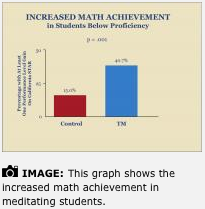
Students who practiced the Transcendental Meditation program showed significant increases in math and English scale scores and performance level scores over a one-year period. Forty-one percent of the meditating students showed a gain of at least one performance level in math compared to 15.0% of the non-meditating controls.

Among the students with the lowest levels of academic performance, “below basic” and “far below basic,” the meditating students showed a significant improvement in overall academic achievement compared to controls, which showed a slight gain.

“This initial research, showing the benefits of the Quiet Time/Transcendental Meditation program on academic achievement, holds promise for public education” said Sanford Nidich, EdD, lead author and professor of education at Maharishi University of Management. “The findings suggest that there is an easy-to-implement, value-added educational program which can help low-performing minority students begin to close the achievement gap,” said Dr. Nidich.

The middle school level is of particular concern to educators because of low academic performance nationally. Sixty-six percent of eighth-grade students are below proficiency level in math and 68% are below proficiency level in reading, based on 2009 National Assessment of Educational Progress data.

Faculty surveyed as part of the project reported the Quiet Time/Transcendental Meditation program to be a valuable addition to the school. They reported the students to be calmer, happier, and less hyperactive, with an increased ability to focus on schoolwork. In terms of the school environment, faculty reported less student fights, less abusive language, and an overall more relaxed and calm atmosphere since implementation of the program.

The study was supported by the David Lynch Foundation.

Study Facts

• This study evaluated change in academic achievement in public middle school students practicing the Transcendental Meditation program compared to non-meditating controls. A total of 189 students (125 meditating and 64 non-meditating students), who were below proficiency level at baseline in English and math, were evaluated for change in academic achievement, using the California Standards Tests (CST).

• Ninety-seven percent were racial and ethnic minority students.

• The Transcendental Meditation program was practiced in class twice a day as part of the school’s Quiet Time program for three months prior to posttesting.

• The Transcendental Meditation program was taught in the context of a school-wide Quiet Time program in which students voluntarily chose the Quiet Time program in which they wanted to participate.

• The Transcendental Meditation technique is a simple, natural, effortless technique that allows the mind to settle down and experience a silent yet awake state of awareness, a state of “restful alertness.” Practice of this stress reduction program does not involve any change in beliefs, values, religion, or lifestyle.

• Compared to eyes-closed rest, research has found that Transcendental Meditation practice is characterized by decreased activation or arousal of the autonomic nervous system, as reflected in decreased breath rate and lower sympathetic nervous system activity. The Transcendental Meditation program has been shown to increase electroencephalographic (EEG) brain integration and coherence, especially in the frontal area of the brain, responsible for higher-order processing.

• Other published research on high school and college students has shown reduced psychological distress, improved positive coping ability, decreased blood pressure, reduced cardiovascular reactivity to stressful stimuli, reduced absenteeism, and decreased school suspensions.

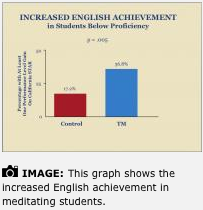
• Results of the current study indicated improvement for meditating students compared to controls on English scale scores (p = .002) and math scale scores (p < .001). A greater percentage of meditating students improved at least one performance level in math and English compared to controls (p values < .01).

• A matched-control subgroup of 50 students in each group yielded similar results.

Facts on Academic Achievement

• According to the National Assessment of Educational Progress (NAEP), 68% of eight grade students nationally are below proficiency level in reading and 66% are below proficiency in math, based on 2009 data.

• Nearly 1.3 million students did not graduate from high school in 2010.

• For further facts please see the National Assessment of Educational Progress: http://nces.ed.gov/nationsreportcard/subjectareas.asp
Also see Alliance for Excellence in Education website http://www.all4ed.org/files/UnitedStates.pdf

###

Posted today, March 21, 2011: New research shows Transcendental Meditation improves standardized academic achievement. Source: EurekAlert!

Also reported in South Africa by health24:Meditation improves maths and English

Also see: San Francisco Bay Area News: From time-out to quiet time: meditation comes to SF schools

This new article: The San Francisco Examiner—Meditation program mends troubled Visitacion Valley Middle School

TM Blog reports (with video): “Meditation mends troubled school in San Francisco” – SF Examiner, and Struggling students find TM improves academic achievement: New research.

MUM BLOG Reports: Transcendental Meditation: Improving academic performance.

See Related Research: Transcendental Meditation Effective Antidote to Record Stress Levels in School Students.

The New York Times: Look Who’s Meditating Now

March 19, 2011

Look Who’s Meditating Now

Evan Sung for The New York Times
POSTER BOY Russell Brand with David Lynch at the December Met fundraiser for Mr. Lynch’s foundation, which promotes Transcendental Meditation.

By IRINA ALEKSANDER
Published: March 18, 2011

RUSSELL BRAND, the lanky British comedian, has made a career of his outrageous antics. While a host at MTV UK, he went to work dressed up as Osama bin Laden. At the network’s annual music awards, he likened Britney Spears to a “female Christ.” And he was fired from the BBC after leaving raunchy messages on the voicemail of a 78-year-old actor, a comic bit that even his country’s then-prime minister felt compelled to denounce.

It is jarring then, to say the least, to hear Mr. Brand, 35, speaking passionately and sincerely about the emotional solace he has found in Transcendental Meditation, or TM. Yet there he was in December, onstage at the Metropolitan Museum of Art (as his new wife, the pop singer Katy Perry, waited backstage), describing how TM has helped him repair his psychic wounds.

“Transcendental Meditation has been incredibly valuable to me both in my recovery as a drug addict and in my personal life, my marriage, my professional life,” Mr. Brand said of the technique that prescribes two 15- to 20-minute sessions a day of silently repeating a one-to-three syllable mantra, so that practitioners can access a state of what is known as transcendental consciousness. “I literally had an idea drop into my brain the other day while I was meditating which I think is worth millions of dollars.”

Mr. Brand was the M.C. at a benefit for the David Lynch Foundation, an organization that offers TM at no cost to troubled students, veterans, homeless people, prisoners and others. Like many other guests in the room, Mr. Brand has been personally counseled by Mr. Lynch, the enigmatic film director, who has been a devout practitioner of TM, founded in 1958 by the spiritual leader Maharishi Mahesh Yogi, since its first wave of popularity in the late ’60s. That is when Mia Farrow, after her divorce from Frank Sinatra, joined the Beatles in the Maharishi’s ashram in Rishikesh, India; when George Lucas started meditating and was rumored to have based the Yoda character in “Star Wars” on the Maharishi (the resemblance is eerie); and when the talk show host Merv Griffin, after being introduced to the technique by his tennis buddy, the actor Clint Eastwood, invited the Maharishi to be on his show in 1975.

Since then, the celebrity endorsement, and therefore the enrollment numbers, had quieted down. That is, until the last three years when, according to the national Transcendental Meditation program, enrollment tripled.

At Trinity College in Hartford, the women’s squash league began meditating together after every practice last year. The Doe Fund, an organization that assists the homeless, has begun offering TM to its residents along with computer skills and job training. And Ray Dalio, the billionaire hedge-fund manager of Bridgewater, has long credited the success of his funds to his daily practice.

The Transcendental Meditation program attributes the spike to a series of recent studies that suggest TM can help reduce blood pressure and stress, and to the relatively recent affordability of TM. (The adult course, which had ballooned from $75 in the ’60s to $2,500 in 2007, dropped, because of the economy, to $1,500 in 2008.) No less important has been Mr. Lynch’s foundation, started in 2005, for which enlisted celebrities like Mr. Brand, interrogated often by news outlets about their diets and alternative lifestyle remedies, have been preaching about the technique.

“It’s like, imagine the ripples on top of an ocean,” Dr. Mehmet Oz, who meditates in an armchair in an enclave off his bedroom, said at Mr. Lynch’s benefit. “And I’m in a rowboat, reactively dealing with the waves and water coming into my boat. What I need to do is dive into the deeper solace, the calmness beneath the surface.”

The actress Susan Sarandon meditates once a day for 20 minutes in bed. “It helps me chill out and focus,” she said. (Ms. Sarandon said she doesn’t practice TM specifically, but was at the benefit to gather insight.)

The singer Moby, another guest, has meditated in the back of a taxicab. “Transcendental Meditation has given me a perspective on agitation,” he said. “That it’s a temporary state of mind and I don’t necessarily need to take it that seriously.” Moby said the technique helped him quit drinking more than a year ago. “I used to think that TM was for weird old hippies,” he added. “But then I heard that David Lynch was involved, and that made me curious.”

ON the afternoon before the benefit, Mr. Lynch, 65, arrived at the museum, holding hands with his wife, Emily Lynch, 32, and was escorted by a museum employee to a green room downstairs. Mr. Lynch, like a cartoon character, has maintained the same uniform for decades: a pressed white shirt under a boxy black suit and a hedge of gray hair. He scooped up a soggy egg-salad sandwich from a tray and explained what brought him to the practice.

“I was not into meditation one bit,” Mr. Lynch said, in his laconic Missoula, Mont., drawl that years of living in Los Angeles has failed to dilute. “I thought it was a fad. I thought you had to eat nuts and raisins, and I didn’t want any part of it.”

Mr. Lynch was persuaded by his sister, Martha, when he began having marital difficulties with the first of his four wives, Peggy, in the early ’70s. “I had a whole bunch of personal anger that I would take out on her,” he said. “I think I was a weak person. I wasn’t self-assured. I was not a happy camper inside. Two weeks after I started, my wife comes to me and says, ‘This anger, where did it go?’ I felt a freedom and happiness growing inside. It was like — poooft! — I felt a kind of smile from Mother Nature. The world looked better and better. It’s an ocean of unbounded love within us, so it’s real hard to get a conflict going.” (Still, a year later, the couple divorced.)

It’s easy to shrug off such utterances as hokey, New Age prattle — who can forget Jeff Goldblum’s flaky character in “Annie Hall” on the phone, complaining that he’d forgotten his mantra? — but less so when the person reciting it has dreamed up his most widely admired, vivid films on the days when he was dropping out of consciousness for at least 30 minutes a day.

“Artists like to say, ‘I like a little bit of suffering and anger,’ ” he said. “But if you had a splitting headache, diarrhea and vomiting, how much would you enjoy the work and how much work would you get done? Maybe suffering is a romantic idea to get girls, but it’s an enemy to creativity.”


A version of this article appeared in print on March 20, 2011, on page ST1 of the New York edition. It was also published Saturday, March 26, 2011, in the TheLedger.com: Transcendental Meditation: Celebrities, Recent Biological Studies Increase Interest in Discipline